
Home / Hayati Pro Max Plus Prefilled Pod Kit / Mad Blue Hayati Pro Max Plus 6000 Pod Kit
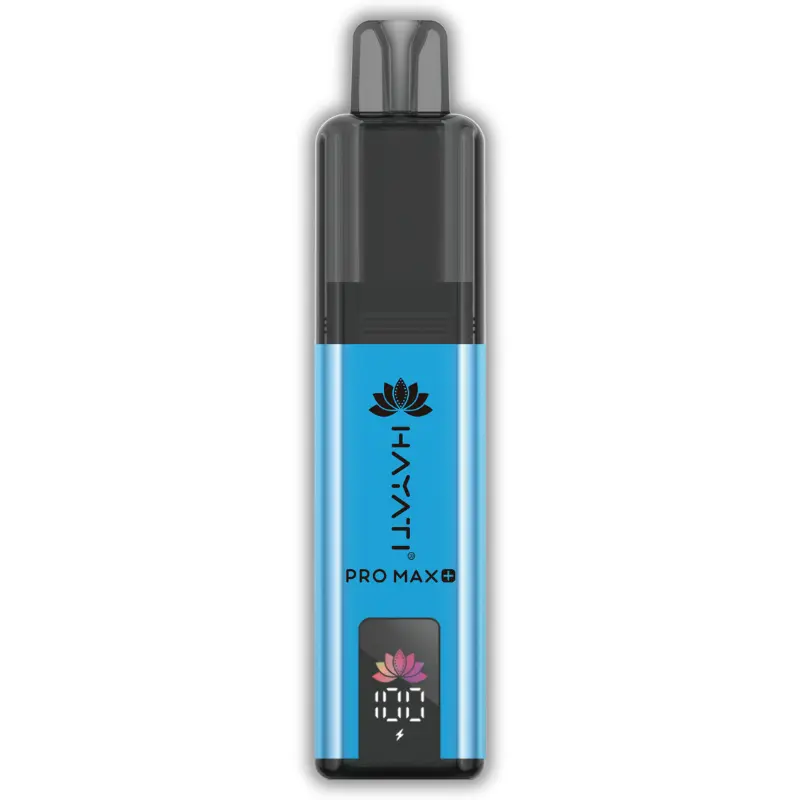
Hayati · Pro Max Plus
Mad Blue Hayati Pro Max Plus 6000 Pod Kit
£7.99
✔ In stock — ready to ship
Genuine Hayati
Free over £20
Same-day dispatch
Secure checkout
Mad Blue in kit form is £7.99, and what that buys is a rechargeable Hayati Pro Max Plus body with an 850mAh cell together with one prefilled pod holding 12ml of liquid at 20mg nicotine salt. Hayati put a figure of up to 6,000 puffs against the pod, which is a laboratory estimate generated by test apparatus drawing to a fixed schedule rather than anything that describes a person's week. The liquid inside is a blue confectionery fruit, sweet, and by the brand's own account pitched at the bold end of what this range sells. That is the whole of the transaction, and it takes one paragraph because there is nothing unusual in it.
The unusual part is the name, and specifically the first word of it. Mad is an intensity claim with no subject attached. It announces that something in this liquid has been pushed further than it would be in an ordinary blue, and it declines to say which thing. That is not a small gap. A blue raspberry accord has several properties that can independently be raised, and raising different ones produces liquids that a person would not confuse for a moment, so a buyer reading the label knows only that the pod is turned up in some direction and not what direction that is.
The Mad Blue Hayati Pro Max Plus Pods listing, which is the same liquid at £5.49 for people who already own the hardware, worked the naming problem out in full and made exactly that finding. It did not attempt the flavour, and said so. This page takes the handover. The question here is narrower and more useful: given the accord this liquid is built on, given what Hayati's own labelling habits reveal about how they talk about intensity, and given what each of the candidate dials would cost a manufacturer to turn up, which one is Mad most likely naming? The answer can be narrowed considerably further than the listing does on its own. It cannot be narrowed all the way, and the point at which the evidence gives out is marked plainly below rather than glossed over.
What the pod listing settled, and the question it left on the table
Three findings from that page are taken as read here, because redoing counting work somebody has already done properly is a waste of the reader's time.
The first is scale. Blue is not an occasional flavour word in this catalogue, it is the organising one. Of the 492 Hayati listings, 127 carry blue in some form, resolving to 42 distinct flavour names once the same liquid sold on different hardware is collapsed together. Ranked by title frequency, blue beats every genuine fruit in the range, which is a peculiar situation given that no plant anywhere produces it.
The second is the shape of the shelf. Of the 89 pods on the Pro Max Plus pod shelf, 18 are blue, and that page sorted them by how much a shopper could work out from the title alone: six fully legible, six where a second real term does the work, two partial, and four that hand over nothing but the colour. Mad Blue is one of the four. The kit shelf mirrors this exactly, which is worth one sentence of confirmation since it is the shelf you are actually on. Eighteen of the listings on the Hayati Pro Max Plus Prefilled Pod Kit shelf are blue, and they are the same eighteen names. Buying the kit rather than the pod changes the hardware question and changes nothing at all about the choosing problem.
The third finding is the one this page is built on. Mad is a magnitude with no vector. It tells you the size of something without telling you its direction, and in a sweet fruit liquid there are at least four properties that could be the thing being sized: sweetness, acid, coolant and flavour concentration. Those four produce four pods that share a category and very little else.
Where that page stopped, reasonably, was at the observation that the listing cannot resolve the ambiguity. It placed coolant and sweetness in an explicitly unknown column and recommended a named neighbour to anybody for whom either was a hard requirement. That is honest and it is also incomplete, because the listing is not the only evidence available. The accord has a structure. The house has a vocabulary with measurable habits. Flavour materials have costs. None of those three things is a statement from Hayati and all three narrow the field, which is the work below.
Four dials, and the one Hayati have no word for
Start with the evidence that is easiest to check, because it is sitting in the product titles and anyone can repeat the count in ten minutes.
A brand that sells 492 liquids develops a working vocabulary. Over enough listings that vocabulary reveals which properties the brand considers worth declaring on a label, and by omission, which ones it does not. So I went through every title in the catalogue looking for words that name a property rather than an ingredient, and sorted them by which of the four dials they refer to. The result is lopsided in a way that turns out to be informative.
Cold has a full vocabulary and it is used constantly. Counting titles that carry any cooling or mint term at all, the figure is 121 of 492 listings across 42 distinct flavour names. Split by family that is 96 listings using an ice-family word (Ice, Frozen, Cooler, and single appearances of Ice Cold and Frosted) and 26 using a mint-family one (Mint, Spearmint, Menthol), with exactly one title, Frosted Mint, sitting in both. Nearly a quarter of everything Hayati sell declares its cooling in the title. The Blue Razz Mojito Hayati Pro Max Plus 6000 Pod Kit does it without using a cold word at all, since mojito carries mint by implication, which is the closest the range comes to an undeclared chill and even that is not really undeclared.
A note on the counting, since the cooling vocabulary has been audited before. The Blue Frozen pod listing established that Ice, Frozen and Cooler are alternatives rather than graded steps, and that finding stands, including its observation that the ice words and the mint words do not appear together. My union count picks up two single-use words its list did not include, Cold and Frosted, and Frosted Mint is one title that pairs a frost word with a mint one. Whether Frosted reads as an ice-family word is a judgement call rather than a correction, and either way it moves the headline figure by one listing and disturbs nothing.
Acid has a vocabulary too, smaller but unambiguous. Sour appears in 21 listings covering seven distinct names: Blue Sour Raspberry, Red Sour Raspberry, Cherry Sour Raspberry, Sour Apple, Tropical Sour Juice and two dual pods. It is a level word. It names the axis and the direction in one syllable, and Hayati reach for it when they mean it. Blue Sour Raspberry Hayati Pro Max Plus Pod Kit is the proof that they will apply it to precisely this colour on precisely this hardware at precisely this price.
Sweetness has nouns but no level word. This is the interesting one. Across all 492 titles, the number that use a bare sweetness-level term, meaning sweet, sweeter, sugary, syrupy or anything of that kind, is zero. Not one. What Hayati have instead is a confectionery lexicon: 56 listings across 27 distinct names invoke a specific sweet thing rather than a level of sweetness. GB and Gummy Bear, B'Gum and Bubblegum, Cotton K, Rocky Candy Orange, Strawberry Jelly Beans, Ice Pop. Blueberry B'Gum Hayati Pro Max Plus 6000 Pod Kit and Strawberry GB Hayati Pro Max Plus 6000 Pod Kit are both in that group, and notice what those names do. They tell you what kind of sweetness by naming a confection. They do not tell you how much.
Concentration has nothing at all. No word in the catalogue names flavour loading, intensity, strength of flavouring or anything adjacent to it. There is no house term for a liquid being louder than its neighbours, because the range has never needed one.
Now the part that pulls those four counts together. I looked for bare magnitude words, meaning any term in a title that asserts a quantity without naming what is being quantified. In 492 listings there are two. Mad, which appears three times and is always this flavour. And Bomb, which appears on Fruit Bomb and its dual variants. The parallel is precise enough to be worth pausing on: both attach a magnitude word to a category word rather than to a specific thing. Fruit Bomb is a lot of fruit, unspecified. Mad Blue is a lot of blue, unspecified. Everything else in the catalogue that wants to signal intensity does it by naming the property, and the two names that do not are built the same way.
Here is what that lexicon map is worth as evidence. A brand coins a word where it lacks one. If Hayati had wanted this pod to be understood as colder, they had Ice, a word they have used on 90 listings, and they would have written Blue Ice, which nothing prevented. If they had wanted it understood as sharper, they had Sour, and they had already applied it to a blue on the same shelf at the same price. If they had wanted it understood as a particular confection, they had a lexicon of 27 such names ready to hand. In three of the four cases the existing word was available, established, cheap and clearer than Mad, and they did not use it.
The dials with no house word are sweetness level and concentration. Those are the two where a brand that wanted to say more has to invent something, and inventing something is what happened here. That is not proof, because a brand can also use an odd word for a property it already has a word for, out of nothing more than a wish for a different-looking label. But it is real evidence, it points in one direction, and it is the kind of evidence a product page can actually check.
How much each dial can move before the accord stops being itself
The lexicon argument is about Hayati. The next one is about the liquid, and it is independent of the first, which is why the two together are worth more than either alone.
A blue raspberry accord is a built thing with no natural original, and the reasons it is nonetheless stable and recognisable across manufacturers are set out on the Blue Fusion Hayati Pro Max Plus 6000 Pod Kit listing rather than here. The Blue Frozen kit page then takes the accord apart into its components and traces which sense receives each of them, and the Blue Razz Fruit Twist Hayati Pro Max Plus 6000 Pod Kit page sets out why sugar and acid behave as two independent controls. All of that is established and none of it is repeated below. What has not been asked anywhere is the question this product forces: not what the parts are, but how far each part can be pushed upwards before the thing stops being a blue raspberry and starts being something else. Elasticity, in other words, rather than anatomy.
Sweetness: the dial with the most room above it
Sweetness in this accord is not a component sitting alongside the others, it is the medium the others are suspended in. A blue raspberry is a confectionery reference before it is a fruit reference, which means that raising the sweetness does not push the profile away from its target. It pushes it further into it. Double the perceived sweetness of a blue raspberry and you have a more emphatic blue raspberry. Double the perceived sweetness of, say, a blackcurrant and you have damaged it, because a blackcurrant's identity depends partly on a tartness that sugar covers.
That is the structural point and it is decisive. Of the four dials, sweetness is the only one where turning it up moves the liquid towards the thing its name promises rather than away from it. There is real headroom, and the ceiling is set by something other than coherence.
Two things do set a ceiling. The first is palate weight. Past a certain loading the sweetness stops reading as flavour and starts reading as a physical coating, and the descriptor people reach for is thick rather than sweet. The second is the coil, which is covered further down because it deserves its own section on a 12ml pod. Neither of those ceilings is reached at the first draw. Both are reached over hours or days, which matters enormously for the commercial argument below.
Acid: cheap to add, and already close to its ceiling
Acid does the opposite job. It is the shortening agent in a sweet liquid, the thing that stops the sweetness from lying flat across the whole draw, and a blue accord normally carries a modest amount of it precisely to keep the confectionery from becoming a single uninterrupted note.
The trouble with raising it is that acid has a very short run before the effect inverts. A little more reads as brighter and more defined. A little more than that reads as sharp in a way people describe as tangy. Beyond that it produces salivation at the sides of the tongue and a tightening at the back of the throat, and it stops being a flavour property at all and becomes a physical one. The window between noticeably brighter and actively unpleasant is narrow, and where a person's line sits inside it varies more than almost anything else in vaping.
There is a second constraint specific to this format. This pod carries nicotine at 20mg, which is the maximum the United Kingdom permits in a liquid of this kind, and nicotine at that level already contributes a sensation at the back of the throat. A manufacturer building a high-acid liquid on a 20mg base is stacking two throat effects on top of each other and will hear about it. A high-acid blue is an entirely viable product and Hayati sell one, which is the point: when they build it, they call it Sour, so the person who wants it can find it and the person who does not can avoid it. Nobody puts a lot of acid into a liquid and then declines to mention it, because the complaints arrive immediately.
Coolant: the dial that does not amplify anything
Cooling is the dial most often confused with intensity, and on this accord it is the one that cannot be what Mad means, for a reason that is about mechanism rather than about preference.
A coolant is not a flavour. It is felt rather than tasted, and it sits over the entire draw rather than occupying one part of it. Raising it therefore does not make the blue louder. It makes the blue quieter and adds something else on top, because the cold both occupies attention and suppresses how sweet a thing registers while it is present. A heavily cooled blue is not an intensified blue raspberry. It is a cold liquid with a blue raspberry underneath, and the fruit is the part that has been reduced.
Anyone who has moved between a plain fruit pod and its iced counterpart knows this from experience: the iced one is more striking and less detailed. The fruit does not get bigger, it gets outlined. So if a manufacturer wanted to sell the idea that a flavour has been turned up, coolant would be a strange way to deliver it, because the customer who bought intensity would find a liquid in which the named thing is harder to make out than in the ordinary version.
And then the labelling evidence lands on the same square. Cooling is declared in the title 121 times out of 492. A brand that flags its cooling that reliably, on the same platform, on the same shelf, at the same price, has no reason to hide a heavy chill behind a word like Mad. Two separate lines of reasoning, one about how cold behaves in the mouth and one about how Hayati write labels, arrive at the same place.
Concentration: the only dial that raises everything at once
The fourth candidate is total flavour loading held at constant sweetness and acid. More material, same balance. This is the dial that most literally means turned up, and it deserves to be taken seriously rather than dismissed.
Raising concentration does genuinely produce loudness. It is also the dial with the most awkward consequences, and they are worth naming. Flavour materials are not uniformly pleasant at all levels, and the parts of an accord that are charming in small amounts are frequently the first to become objectionable in large ones. The soft, faintly perfumed element that makes a blue raspberry read as blue rather than as ordinary raspberry is exactly the sort of thing that turns soapy when it is pushed. A liquid built at very high loading tends to develop a hardness at the top that people describe as chemical, and it is a far more difficult formulation problem than adding sweetener, because the balance has to be re-solved rather than simply scaled.
It is also the expensive dial, which is the subject of the next section.
The shape of the four together
Lined up, the four dials are not equivalent options facing a manufacturer, and the asymmetry is stark. One of them moves the liquid towards its own name with a ceiling that is days away. One of them has a narrow window and produces complaints on the first draw. One of them reduces the thing it is supposed to be increasing and would in any case have been named in the title. And one of them works but is harder and dearer to execute. That is not four candidates. It is one obvious answer, one plausible companion, and two that have to argue their way back in.
What it would cost to turn each one up
Cost is the least glamorous input into this question and probably the most reliable, because it operates on every product in a range simultaneously and does not depend on anyone's intentions.
High-intensity sweeteners are the cheapest ingredient in the argument by a wide margin. They are used at fractions of a percent, they deliver a great deal of perceived sweetness per unit, and increasing the dose is a single-number change to a recipe that requires no reformulation of anything else. If a brand wants a liquid to read as bigger than its neighbours and wants that to be apparent within one second of the first draw, sweetener is the instrument, and it has been the instrument across the whole of this product category for as long as the category has existed.
Coolants are also cheap, and that is exactly why the labelling evidence matters so much. If cost were the only consideration, a brand might well reach for coolant to manufacture an impression of intensity. But Hayati's own naming habits show they treat cooling as a declared property rather than a hidden one, on 121 listings, so the cheapness of the ingredient does not translate into a reason to expect it here.
Acid is cheap too. The constraint on acid is not money, it is the narrowness of the window and the immediacy of the downside, which brings us to the sharpest point available on this whole question.
Consider when the buyer discovers the disadvantage of each dial, relative to when the money changes hands. An over-acidic liquid announces itself on the first draw, before anything else about the product has registered. So does an unwanted coolant. Both produce an immediate, unambiguous, findable complaint, and on a 12ml pod the person is stuck with a fill they do not want. Excessive sweetness behaves completely differently. On the first draw it is not a defect at all, it is the selling point: a very sweet liquid is emphatic, generous and exactly what somebody buying a pod called Mad Blue thought they were getting. The disadvantage of a heavily sweetened liquid arrives on the third day, as fatigue, as a coating that will not clear, as the sense that the pod has become tiring rather than that it was ever wrong.
Every incentive in the structure of the product points the same way. Sweetness is the dial whose upside is immediate and whose downside is deferred past the point of purchase. That is not an accusation of bad faith, it is just what the incentives are, and it is a large part of why sweet-forward liquids dominate the prefilled pod market generally rather than in this range specifically.
Concentration, finally, is the one that actually costs money. Flavour concentrate is the expensive part of a liquid, and doubling it at the same volume is a real hit to the unit cost of a pod selling at £7.99 with a device in the box. It is not impossible and it is not even unlikely as a partial contributor, but a brand looking for the loudest possible impression per penny does not start there.
The verdict, and exactly where the evidence stops
Three independent lines have now been run: what Hayati's vocabulary shows about which properties they declare, what the accord can absorb without breaking, and what each dial costs against when its downside surfaces. They agree. Graded by how much weight each deserves, the position comes out like this.
Reasonably confident. Mad names sweetness, primarily. It is the only dial that moves the liquid towards the thing its own name promises, the only one Hayati have no existing word for besides concentration, the cheapest to raise, and the one whose drawback lands after the sale rather than on the first draw. Expect a liquid at the very sweet end of a category that is already sweet, and expect the sweetness to be the first thing you notice and the last thing to leave.
Probable. Flavour concentration is up as well, though as a companion rather than as the main event. Sweetener alone at high loading tends to read as heavy rather than as loud, and a liquid sold on boldness that is merely thick would disappoint the person who bought it. The likeliest construction is a well-sweetened base with the flavouring pushed enough to carry over it. That is a formulation guess, clearly labelled as one.
Probable, in the negative. There is no declared-grade cooling in this pod. Hayati name cold in nearly a quarter of their titles, they had Ice available and did not use it, and a heavy chill would in any case work against the intensity the name is selling. The pod sibling put coolant in the unknown column and it can be moved out of it, but only as far as probable.
Here is where that stops being reliable, and it is a genuine limit rather than a formality. The labelling argument rules out a chill large enough that a brand would consider it a feature worth naming. It does not rule out a small coolant used as a lift, which is an ordinary technique in sweet liquids and is used precisely because it stops a heavily sweetened profile from sitting flat. A trace at that level is not what anyone means by an iced pod and is not something a brand would put in a title, so the naming evidence is simply silent about it. If your requirement is no cooling whatsoever rather than no obvious cooling, this page cannot give you that and neither can the listing.
Unlikely. Mad names acid. The window is narrow, the risk is immediate, the accord does not want much of it, and Hayati have a one-word label for exactly this that they apply to a blue on this shelf. If you want the sharp reading of blue, the product that says so is the one to buy, and it costs the same.
Still unknown, and not narrowable from here. Where this liquid sits against the other seventeen blues on the shelf in absolute terms. All the reasoning above concerns direction, not magnitude. Mad could denote a substantial step above the house blue or a marketing flourish over something quite ordinary, and nothing in the catalogue, the labelling or the pricing distinguishes those two possibilities. The price row is flat across the whole shelf, so it carries no signal either.
What arrives on the first pod, and four signatures that tell the dials apart
All of the above is inference, and inference that can be checked is worth more than inference that cannot. The first pod is the experiment that settles it, and it takes about four draws if you know what you are looking for. Each dial leaves a different signature, and they are distinguishable without any special skill.
If it is sweetness. The sweetness arrives instantly and broadly, spread across the whole tongue rather than located anywhere. It outlasts the draw by a noticeable margin, so there is still sweetness in your mouth thirty seconds after the exhale has gone. The characteristic tell is coating: the roof of the mouth feels covered rather than flavoured, water does not clear it quickly, and anything you eat or drink within the next few minutes tastes muted. The blue itself will be present but you will notice it second, after the sugar.
If it is concentration. The impact is at least as large but it is front-loaded and it stops. There is more detail in the fruit, the perfumed element of the blue is more obvious, and there may be a faint hardness at the top of it that was not there in a milder version. The critical difference is the tail: the mouth clears far more completely between draws, because there is no heavy sweetener deposit left behind. Loud but not sticky is the concentration signature. Loud and sticky is the sweetener signature.
If it is acid. You will know inside one draw and the sensation is positional rather than diffuse. Salivation at the sides of the tongue, a slight tightening at the back of the throat on the exhale, and the sharpness arriving before the sweetness rather than after it. Nobody who has vaped a genuinely sour liquid will mistake this for anything else.
If there is coolant. Cold builds through a draw rather than switching on, so take one deliberately long pull and one deliberately short one and compare. If the long pull is distinctly cooler than the short one, there is a coolant present in more than trace quantity. If both read the same, and the only cold sensation is the ordinary faint coolness of any vapour in the mouth, there is not. That single comparison is the most informative four seconds available on this pod, and it resolves the question the naming evidence could not.
Write the answers down. Three lines is enough: whether the mouth clears between draws, whether the long pull is colder than the short one, and whether the sharpness arrives before or after the sugar. Those three readings between them pin the liquid against every neighbour on the shelf, they cost nothing to take, and they are the only description of Mad Blue that will exist anywhere you can reach.
What it is not
Ruling things out is often more useful than ruling them in, and several of these are common enough mistakes to be worth stating flatly.
It is not a blueberry liquid. Blue and blueberry are two different categories that happen to share a syllable, a confusion the catalogue does nothing to help with given that both live on the same shelves. If what you want is the fruit, Blueberry Pomegranate Hayati Pro Max Plus Pod Kit and Blueberry Cherry Cranberry Hayati Pro Max Plus Pod Kit name it and this listing does not.
It is not a fresh-fruit profile. Nothing in the blue family tastes of something picked. The reference point is a sweet, and an amplified version of a sweet is a bigger sweet. A person looking for the juicy, slightly watery character of real fruit should be looking at White Peach Raspberry Hayati Pro Max Plus 6000 Pod Kit instead.
It is not a layered blend. There is one accord here, not a construction of three fruits taking turns. Hayati's own description treats it as a single cohesive thing rather than an itemised recipe, and the reasoning above gives no cause to doubt that. If you want a blend with internal movement, the three-berry listings and the Mixed Berries kit are built differently, with components that arrive at different points in the draw rather than fusing into one.
It is not a drink profile. No lemonade carbonation, no cocktail framing, no tea. Blue Razz Lemonade Hayati Pro Max Plus Pod Kit takes the blue accord into that territory, and the blackcurrant lemonade listing does the same for dark berry, while this one stays where it is.
And it is not a mild pod. Whatever Mad turns out to specify, nothing about the name, the brand's own framing or the reasoning here suggests a restrained liquid. Somebody who finds ordinary blue liquids too sweet already has no reason to expect relief from this one.
Twelve millilitres of a loud liquid, and why its decline hides itself
A 12ml fill served by a single coil that cannot be changed is a long run for any liquid, and the arc it follows is not flat. On a heavily sweetened pod it follows a particular shape, and the shape has a trap in it that is specific to this kind of liquid.
The mechanism is straightforward. Sweeteners do not evaporate off a coil the way aromatic materials do. They are deposited, they accumulate, and over a pod's life they build a layer that changes how heat reaches the liquid. The more sweetener a formulation carries, the faster that happens, which means a pod built on an amplified sweetness reaches the state a milder pod would reach later. If the reasoning above is right about which dial Mad names, this pod's residue behaviour is the direct consequence of the thing the name is advertising.
What that does to the taste over 12ml goes roughly as follows. Early on, everything is present and the fruit sits clearly on top of the sugar. Through the middle the aromatic part thins first, because it is the fragile half of the accord and a fouled coil reproduces it least well. Towards the end the sweetness is still there, largely undiminished, but the thing it was carrying has gone quiet, and a warm, faintly toasted edge appears behind it.
Here is the trap. On a fruit-forward liquid the decline is obvious, because the fruit is the loudest thing and its retreat is unmistakable. On a sweetness-forward liquid the decline is partly hidden, because the component that survives longest is also the component doing most of the talking. The pod goes on tasting emphatically of something for a long time after it has stopped tasting specifically of blue raspberry. People describe this as the flavour getting boring rather than as the coil getting tired, and they tend to blame the liquid.
The practical consequence is that you should judge this pod by the fruit rather than by the sweetness. When you can no longer name the blue in it and what remains is generic sugar with a warm edge, that is the coil, not the recipe, and continuing gains you nothing except a worse impression of a liquid you may still like. Hayati publish no coil specification and no parts breakdown for these pods, so there is no resistance figure to reason from and nothing to service.
There is a second effect over a much shorter timescale, and it is the paradox at the centre of any product sold on amplitude. A constant strong stimulus fades from attention faster than a moderate one. Twenty minutes of continuous use on a loud liquid and the loudness is substantially gone, not because anything has changed in the pod but because you have stopped registering it. A restrained flavour stays roughly as interesting at draw fifty as at draw five. An emphatic one is dramatic at draw five and unremarkable at draw fifty, and the way back is to stop for a while rather than to draw harder. Anyone who keeps a second device in rotation will notice the effect the moment they switch to something quieter and find it briefly tasteless, which is the same phenomenon running in the other direction.
The kit, kept to the part that matters
What arrives in the box is a Hayati Pro Max Plus body with an 850mAh rechargeable cell and one prefilled pod already filled with 12ml at 20mg. That is the entire contents. There is no coil to fit, no liquid to pour, no wattage to choose and no settings of any kind, and once the first pod is finished you continue with replacement pods rather than with anything else. The £2.50 gap between this and the bare Mad Blue pod is the price of the device, and it only exists once.
The single specification that genuinely bears on this liquid is the 12ml fill, for the reason the previous section sets out. A big fill and a fixed coil mean that the entire run of the pod happens on one piece of hardware whose condition changes as the sweetener accumulates, and a pod carrying an amplified sweetness works that coil harder than a restrained pod of the same size would. Twelve millilitres is also a long commitment to a profile that the label does not describe, which is the reason so much of this page is spent on working out what the profile probably is.
On which pods fit which bodies, do not take a cross-range fitment judgement from any retail page including this one, because Hayati publish very little about it. Everything else about how the device behaves over time, the charging rhythm, the condensate in the airflow path, how a pod seats and how the range recycles, is covered across the Hayati Pod Kits shelf, and going through it again here would displace the only material on this page that is actually about Mad Blue.
Specifications
The table is ordered by how much each row can help you choose, starting with the rows that differ between listings and ending with the ones that are identical across the entire shelf and therefore cannot discriminate at all.
| Flavour information published | Colour family and an intensity claim; no fruit, no coolant, no sweetness level |
| What the intensity word specifies | Nothing. Magnitude only, direction unstated |
| Purchase price | £7.99, device included |
| Same liquid without hardware | £5.49 as a bare pod |
| Cell in the supplied body | 850mAh, rechargeable |
| Liquid supplied | 12ml, prefilled, one pod |
| Nicotine | 20mg, as a salt |
| Manufacturer's puff figure | Up to 6,000, a laboratory estimate under fixed test conditions |
| Coil resistance and VG/PG ratio | Not published by Hayati for this pod |
| Brand and range | Hayati, Pro Max Plus |
Two rows need a note. The 20mg strength is the highest concentration permitted in a liquid of this type in the United Kingdom, which means it is not a choice Hayati made for this flavour and not a way of distinguishing this pod from any other on the shelf. Nicotine is addictive, and the figure here is the ceiling rather than a middle setting. Every blue listing on this platform carries the same number, so it is useless as a tiebreaker.
The unpublished row is the honest one. Coil resistance and liquid ratio are stated on plenty of vape products and are not stated on this one, and since a resistance figure would tell you something real about how the pod draws and how warm it runs, its absence is a genuine gap rather than a pedantic one. Nothing on this page infers either number, and any page that states one for a Pro Max Plus pod is inventing it.
The price row deserves a second look for a reason connected to everything above. At £7.99 this sits at the same price as every other flavour kit on the shelf, including the ones that name three fruits and the one that names its acid. The shop is charging nothing extra for an intensity claim and giving nothing back for the missing description, so price contributes no information to the question this page has been working on.
Where it sits among the neighbours
Sorted by what you would be trying to fix or find, rather than by resemblance, since resemblance is exactly the thing the name makes hard to judge.
If you want the intensity but want to know what direction it runs in. This is the central swap and it goes to Blue Sour Raspberry Hayati Pro Max Plus Pod Kit. Same colour, same hardware, same £7.99, and a name that puts the amplification on a stated axis. If the thing you liked about the idea of Mad Blue was the promise of something turned up, and you would rather it were the sharpness than the sugar, that listing is the one that commits. The reverse is also worth saying: if you tried Sour and found the acid tiring, the reasoning on this page suggests Mad Blue is likely to be pushed in the opposite direction, which is a rare case where an unspecified name is actually predictable.
If you want the sweetness made explicit rather than implied. The confectionery names tell you what kind of sweet. Blue Razz GB Hayati Pro Max Plus Pod Kit is the gummy reading of blue, rounded and chewy in character, and it is the nearest thing on the shelf to a described version of what this page predicts Mad Blue to be. Blueberry B'Gum Hayati Pro Max Plus 6000 Pod Kit takes the same idea towards bubblegum and away from berry. Strawberry GB Hayati Pro Max Plus 6000 Pod Kit runs the gummy treatment on red fruit, which is a useful comparison if you want to work out whether it is the sweet style or the blue accord you actually respond to.
If you want the blue with a second real thing in it. Every one of these keeps the accord and gives it something to push against. Blue Razz Cherry Hayati Pro Max Plus Pod Kit adds a darker, rounder fruit that sits underneath rather than on top. Blue Razz Blackcurrant Hayati Pro Max Plus Pod Kit brings a tartness that survives a sweetened base better than most fruits do. Blue Razz Pineapple Hayati Pro Max Plus Pod Kit adds a tropical acidity with a slightly resinous edge to it. Blue Razz Mojito Hayati Pro Max Plus 6000 Pod Kit puts citrus and mint against the berry, and is the one to avoid if the coolant question is the one that worries you, since a mojito carries mint by definition.
If the colour is the point but the vagueness is not. Blue Fusion Hayati Pro Max Plus 6000 Pod Kit and Blue Razz Fruit Twist Hayati Pro Max Plus 6000 Pod Kit are the other two opaque blues on the kit shelf, and buying them alongside this one is the mistake the pod listing warns against, since a disagreement between two undescribed liquids teaches you nothing transferable. Pair an unreadable name with a described one instead.
If you want a berry but not this berry. Blackberry Raspberry Hayati Pro Max Plus Pod Kit keeps the dark fruit weight and drops the confectionery framing. Dragon Berries Hayati Pro Max Plus 6000 Pod Kit moves the berry idea towards something lighter and less familiar. Grape Berry Hayati Pro Max Plus 6000 Pod Kit swaps the blue accord for the grape one, which is the other great confectionery colour and behaves in many of the same ways. Strawberry Raspberry Cherry Hayati Pro Max Plus Pod Kit keeps the sweetness and changes the colour entirely.
If you want the cold that this one probably does not have. Blackberry Ice Hayati Pro Max Plus 6000 Pod Kit states it in the title, which is precisely the labelling habit this page has leaned on as evidence. Buying a titled Ice product is the only way to be certain of a coolant, and the same logic in reverse is why Mad Blue probably has little.
If you want something carbonated in character rather than syrupy. Berry Lemonade Hayati Pro Max Plus 6000 Pod Kit changes the texture of the sweetness rather than its level, which is a different answer to the same complaint about heaviness.
If you would rather test the question on other hardware. Blue Razz Cherry Hayati Rubik Prefilled Pod Kit at £5.99 is a smaller and cheaper way into the blue family on a different device. On the Pro Ultra Plus platform, Blueberry Raspberry / Mr Blue Hayati Pro Ultra Plus 25000 Prefilled Pod Kit is a single pod divided into two internal reserves with a collar that selects which one feeds the coil, so it sets a fully described blue directly against an undescribed one and lets you switch between them mid-session. That is the comparison this page has been arguing for, delivered in one purchase, with the caveat that the two halves share a coil so the first draws after turning the collar carry some of the previous side. Blueberry Cotton K / Raspberry Cotton K Hayati Pro Ultra Plus 25000 Prefilled Pod Kit runs the confectionery reading of both blue and red at once, and the same pairing exists on the Mini Ultra at £3.99, which is the least expensive way to find out whether the candyfloss treatment suits you before spending more on it.
If none of it is landing. The Berry Vapes shelf runs to 225 products and the full Hayati range to 492, which is a great deal of room to move in if the blue accord itself has stopped being interesting.
Handling a pod you are also trying to measure
Ordinary handling advice applies to this pod as it does to every other one, so what follows is confined to the things that matter because of what this particular liquid probably is and because you are using the first pod as an experiment.
Let the kit stand upright for two or three minutes after the pod goes in, and keep the opening draws short and slow. There is a specific reason to be careful here rather than a general one: a partly dry first pull on a heavily sweetened liquid does not taste obviously burnt, it tastes flat and slightly papery underneath the sugar, and that is very easy to record as a property of the flavour when it is actually a property of the first thirty seconds. Since the whole point of your first few draws is to take a reading, a scorched start contaminates the measurement.
Take the long-pull and short-pull comparison early, while the coil is fresh, because it becomes harder to read once residue has begun to build. Do it before you have had a hot drink, and do not do it immediately after eating anything sweet.
Space the draws out while you are assessing. A sweet liquid with a long tail does not clear between rapid draws, and a second draw taken on top of the residue of the first gives a reading of the accumulation rather than of the liquid. Two or three minutes apart is enough, and it also lets the adaptation effect release so that draw four is as informative as draw one.
If you keep more than one blue in rotation, label them. Pods from this shelf are physically identical to each other, so an unwrapped pod in a drawer is unidentifiable, and a careful set of readings attached to the wrong pod is worse than no readings at all. A single letter in marker on the base solves it.
Store spare pods upright, in a drawer that children and pets cannot get into, away from warmth and out of direct light. Sweet fruit liquids darken and dull over weeks in a warm bright place, and on a flavour with no published description that matters more than usual, because you have no reference to tell you whether what arrived is what the pod is meant to taste like or what six weeks on a windowsill did to it.
Judge the end of the pod by the fruit rather than by the sweetness, for the reason set out earlier. When the blue has gone quiet and what is left is generic sugar with a warm edge behind it, the pod is finished regardless of how much liquid is visible. A used pod still contains a coil, a wick and a film of liquid that cannot be recovered, so it does not belong in ordinary household rubbish; most places selling these will accept them back, and the pod is sealed and not designed to be opened or refilled, so there is nothing to do with it beforehand.
Questions this listing raises
What does Mad actually mean on this label?
Hayati do not say. It is a magnitude word with no direction attached, which is the finding the Mad Blue pod listing established by counting. This page argues from three independent lines of evidence that the most likely referent is sweetness, probably with flavour concentration raised alongside it, and that cooling and acid are both unlikely. That is reasoning rather than a statement from the manufacturer.
Why do you think it is sweetness and not just a stronger flavour overall?
Both are plausible and the answer is probably some of each. Sweetness gets the greater weight because it is far cheaper to raise, because raising it moves a confectionery accord towards its own target rather than away from it, and because Hayati have no existing word for sweetness level while they do have words for cold and acid. Concentration would work too, but it costs real money per pod and is a harder formulation to balance.
Is there any cooling in it?
Probably not at any level you would notice as a feature. Hayati declare cooling in 121 of their 492 product titles, and this one declares none, which is meaningful evidence from a brand that labels the property reliably. What it cannot rule out is a small coolant used to stop a sweet liquid from sitting flat, which is common and is never named on a label. One long draw compared against one short draw settles it in four seconds.
How sweet is it compared with the other blues on this shelf?
Unpublished, and not derivable. Everything on this page concerns which direction the intensity runs in, not how far it runs. Mad could indicate a substantial step above the house blue or a label flourish over something fairly ordinary, and since every listing on the shelf is the same price, there is no second signal to check it against.
Does it taste of blueberry?
No, or at least not in the sense of the fruit. Blue as a vape category is a confectionery accord with no plant behind it, and the listings that mean the berry say blueberry. If the fruit is what you are after, the blueberry-named kits on the same shelf name it properly and this one does not.
What is the difference between this and the pod listing at £5.49?
The device. This kit includes the Pro Max Plus body with its 850mAh cell along with the first pod, and the pod listing is the same 12ml of liquid on its own for somebody who already owns a body. The £2.50 difference is hardware and it is paid once.
How long will one pod last?
That depends entirely on how you use it and nobody can tell you in advance. The figure Hayati publish is up to 6,000 puffs, which is a laboratory estimate produced by apparatus drawing at a fixed length and interval, and human use varies far too much for it to work as a schedule. Treat it as a number for comparing listings against each other.
Will it get sickly by the end of the pod?
Sweet liquids lose definition over a large fill rather than becoming more intense, so the more likely complaint is that it goes vague rather than that it goes sickly. What happens is that the aromatic part of the accord thins first while the sweetness persists, so the last portion of the pod tastes emphatically of sugar and only faintly of blue. That is the coil rather than the recipe.
Why does it seem less intense after twenty minutes of use?
Sustained exposure to a strong stimulus reduces how much of it registers, and the effect is larger the louder the liquid is. A pod sold on amplitude will therefore seem to flatten within a session more noticeably than a restrained one. Putting it down for half an hour restores it; drawing harder does not.
Is £7.99 reasonable for this kit?
It is the standard price for every flavour kit on the Pro Max Plus shelf, whether the name describes three fruits or one colour. Since the price does not vary, the shop is neither charging a premium for the intensity claim nor discounting for the missing description, and the price tells you nothing about the question this page has been examining.
Can I tell from the packaging what is in it?
No more than the listing tells you. The published record covers the name, the format, 12ml, 20mg, the puff figure and the price, and it stops there. No fruit is named, no coolant is stated, and no sweetness level is given, which is why the first pod has to do the work of the description.
Should I buy two blues at once to compare them?
Only if one of them names what is in it. Two opaque names bought together produce a preference you cannot generalise, because neither label tells you which property you responded to. Pairing this one with a fully described blue on the same shelf gives you a fixed reference point and makes the comparison interpretable.
The short version
Mad Blue as a kit is £7.99 for an 850mAh Pro Max Plus body and one prefilled 12ml pod at 20mg, rated by the manufacturer at up to 6,000 puffs under laboratory conditions. The liquid is a blue confectionery accord, sweet, and sold on a claim of intensity that names no direction.
The pod listing established that Mad is a magnitude with no vector, and left the flavour question open. Three independent lines close most of it. Hayati have level words for cold and for acid and use them on 121 and 21 listings respectively, and no level word for sweetness anywhere in 492 titles, so an invented intensity word most likely names the property they have no term for. The accord itself has real headroom in sweetness, very little in acid, and gets quieter rather than louder when coolant is added. And sweetness is the cheapest dial to raise and the only one whose drawback arrives days after the purchase rather than on the first draw.
The working verdict is a sweetness-led amplification, probably with the flavour loading pushed to carry over it, probably without any cooling worth the name, and probably not an acid play. Where that stops is a small coolant lift, which no naming convention would reveal and which one long draw against one short draw will tell you in seconds. If you want the intensity with its direction stated instead of inferred, the sour blue on the same shelf costs the same money and says so on the label. If you want the loud sweet version and are content to take the reasoning on trust until the first pod confirms it, this is the listing that offers it.
Strictly for adults aged 18 and over. Nicotine is an addictive substance.
You might also like


