
Home / Hayati Pro Max Plus Pods / Cola Ice Hayati Pro Max Plus Pods
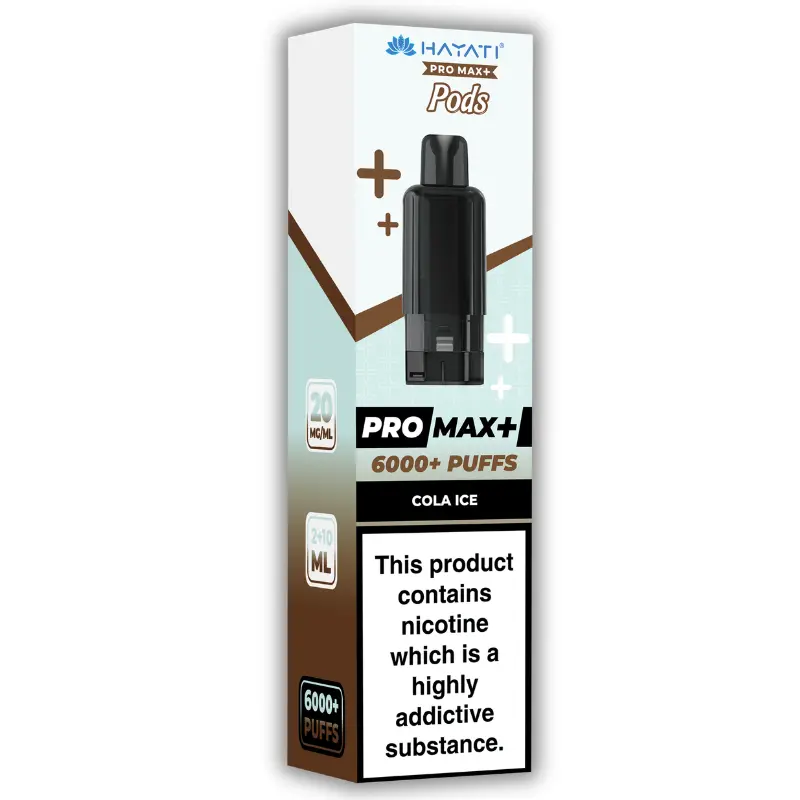
Hayati · Pro Max Plus
Cola Ice Hayati Pro Max Plus Pods
£5.49
✔ In stock — ready to ship
Genuine Hayati
Free over £20
Same-day dispatch
Secure checkout
Cola Ice on the Pro Max Plus is a replacement pod and nothing more. £5.49 buys 12ml of prefilled liquid at 20mg nicotine salt, filled before it left the factory, with the device taken as read because anybody on this listing already owns one. Hayati put a bench figure of up to 6,000 puffs against the pod, produced by apparatus drawing to a fixed pattern rather than by anyone actually vaping it. One flavour runs the whole 12ml, with no selector and nothing to switch to.
The word doing the most work in that title is not Cola. It is Ice, and what that word does to a cola is not what it does to the twelve fruits sitting either side of it on the same shelf.
This page has one argument and it runs the length of the flavour writing. Cooling a fruit and cooling a cola are opposite problems, because a fruit has no temperature of its own and a cola does. The cola accord is assembled out of warm materials. Cinnamon, nutmeg, vanilla and the oils pressed from citrus peel are the contents of a spice cupboard, not a fruit bowl, and warmth is not a decorative feature of that list, it is the thing the list adds up to. A coolant laid over a strawberry supplies something the strawberry does not have. A coolant laid over a cola argues with something the cola already is.
Whether that argument is a fault or the whole point of the product is the question worth £5.49 of your attention, and it has a real answer rather than a diplomatic one. The short version is at the end of the fourth section. Everything before it is the working, including the parts where the working depends on facts Hayati have not published and the page says so.
The mirror of the watermelon problem
Three different jobs a coolant can be doing
Most iced listings are doing the obvious thing. The base has a body, the body has weight or sweetness or a slightly cloying finish, and a cooling agent arrives late to cut it, terminate it and leave the mouth ready for the next draw. That is contrast, and contrast is a relationship between two unlike things. It is why an iced mango works, why an iced pineapple works, and why nearly every fruit on the shelf tolerates a coolant without complaint.
There is a second case, and the Watermelon Ice page in this shop sets it out at length. Watermelon carries no cooling compound at all, yet everybody describes it with temperature words, because it is mostly water, it is served chilled, and its aroma arrives and leaves at the speed of a cold drink. Ice on a watermelon therefore supplies a quality the base has already suggested. Nothing is contrasted, because you cannot contrast a thing with itself. That page calls the result redundancy and argues, convincingly, that redundancy is not automatically a defect: a buyer who wants the cold above everything gets a draw that points one way from start to finish, and coherence is a legitimate thing to buy.
Cola is the third case, and it is neither of those. The base does not lack a temperature and it does not imply the same temperature as the coolant. It implies the opposite one. A coolant on a cola is not supplying what is missing and not duplicating what is there. It is contradicting what is there, and contradiction behaves differently from both of the other two.
The distinction matters because the failure modes are not the same. A redundant coolant wastes itself: you paid for a component that had nothing to do. A contradicting coolant spends itself against the product, which is a bigger claim and needs more evidence before anybody should believe it. The rest of this section supplies the evidence. The section after it works out what actually happens. The one after that puts the case for the defence, which is stronger than it first looks.
Count it before believing it
An argument that begins "this is the only listing that does X" should be counted rather than repeated, so here is the count. The Hayati Pro Max Plus Pods shelf holds 89 listings. Sixteen of them name a cooling quality: eleven say Ice, one says Cooler, one says Frozen, and three are mint or menthol listings, where the cold is not applied to anything because the cold is the flavour.
Of the thirteen that are not mints, twelve are built on fruit. Lychee, banana, blackberry, red apple, pineapple, watermelon, strawberry, strawberry and raspberry together, kiwi, a dark mixed-fruit blend and two sugary frozen-fruit confections. Every one of those is a base with no temperature of its own, so every one of those is either the contrast case or the watermelon case.
Cola Ice is the thirteenth, and it is the only cooled listing on the shelf whose base is not a fruit and not a mint. That is the claim, narrowed until it is true, and it survives the counting. It is also worth noting what it does not say. There are other warm profiles on this shelf, a tiramisu among them and a green tea blend, and Hayati have cooled none of them. Three cola listings sit on this shelf and only one of them carries Ice: Cola Lime and Cherry Cola both leave the accord at its own temperature and add a flavour instead.
Widen the frame to the whole catalogue and cola turns out to be cooled about as often as it is not. Eighteen listings across every format carry cola in the name, and nine of those eighteen also carry a cooling word. Half. That is a genuinely unusual split for a flavour family, and it is the most informative number on this page, because it says the trade knows perfectly well that a cola can go either way and has not settled the question either. Nobody cools half the strawberries.
Why the warmth is structural rather than incidental
The full component-by-component breakdown of what a cola accord is made of lives on the Cola Ice Pro Ultra Plus kit page, which takes the accord apart into its citrus, spice, vanilla and acid groups and explains what each contributes to a draw. That inventory is taken as given here and not rebuilt. What this page does with it is different: it asks what the inventory implies about temperature, which is a question the breakdown raises and does not answer.
Read the list back as a shopping list and the answer is uncomfortable. Cassia cinnamon. Nutmeg. Coriander seed. Vanilla. Oil pressed from the peel of oranges and lemons and limes. Put those in front of somebody with no context and ask what is being made and nobody says a cold drink. They say mulled wine, or a spiced biscuit, or a pomander. Every material on the list belongs to the warm half of the flavour world, and four of the five are things you would reach for in November.
The warmth is not just an association, either, though association is a large part of it. Cinnamaldehyde, the compound that makes cassia taste of cassia, is an irritant as well as an aroma: it produces a physical catch at the back of the throat that has nothing to do with smell and does not go away if you hold your nose. That catch is warmth in the sensory rather than the poetic meaning. Nutmeg contributes a lower, drier version of the same thing. So a cola is not merely reminiscent of warmth in the way watermelon is reminiscent of cold. Part of its warmth is delivered directly to the tissue of your mouth, by the same broad system that reports temperature and irritation, and it does not depend on your memory cooperating.
That is the asymmetry the whole page turns on. Watermelon's coldness is entirely learned, so a coolant merely says again what the fruit was already suggesting. Cola's warmth is partly learned and partly delivered, so a coolant is not saying the opposite of a suggestion. It is saying the opposite of a signal. Those are different situations and they produce different outcomes in the mouth.
What actually happens when the two meet
They do not cancel, they compete for a reading
The kit page describes the interaction as a partial cancellation, with the ice and the spice occupying the same territory and reducing one another in proportion. That is the right shape and it is worth being more precise about the mechanism, because the precision changes what you should expect on the first draw.
Cooling agents and warming spices do not act on the same receptor. The cold-reporting machinery in your mouth and the irritant-reporting machinery are separate systems that happen to feed into the same interpretive place further up. So nothing is being neutralised chemically. Both signals fire at full strength, arrive together, and the reconciliation happens in your head rather than on your tongue. Mark that as inference on my part: no manufacturer publishes receptor data for a vape liquid and nobody has measured this pod. What can be said with confidence is that the two signals are not cancelling in the way an acid cancels a base.
Practically, competition is worse for the spice than cancellation would be. Cancellation is symmetrical: two things of equal size reduce each other equally. Competition is decided by loudness, and a synthetic coolant is enormously louder in the temperature channel than a trace of nutmeg. When two signals arrive in the same channel and one is ten times the size of the other, the small one does not get halved. It gets ignored. The warmth is not subtracted from the draw so much as overruled.
What survives of the spice is the part that was never temperature in the first place: the aromatic part, the smell of cinnamon rather than the heat of it, detected in the nose and untouched by anything happening to the cold receptors. That is why a heavily cooled cola still reads as spiced without reading as warm. You get the perfume of the spice cupboard with the fire taken out from under it, which is a recognisable thing and a thinner one.
Sweetness is load-bearing here, and cold leans on it
Now the second mechanism, which is the one buyers almost never see coming.
Temperature changes how sweet something tastes. A fizzy drink left to go warm on a table tastes markedly sweeter than the same drink poured over ice, and the difference is not evaporation or dilution, it is the taste machinery itself working better at higher temperatures. Cold genuinely suppresses perceived sweetness. That is established for actual cold liquid and anybody can test it in a kitchen this afternoon.
Here is the honest complication, and it is the most important hedge on this page. A vape coolant does not make anything cold. It triggers the nerve endings that report cold while the vapour stays at whatever temperature the coil made it. So the sweetness suppression that happens in a chilled drink may not transfer at all, because the physical condition that causes it, a genuinely lower temperature at the taste receptors, is absent. There are two possible readings and neither is settled by anything Hayati publish. Either the brain applies the same downgrade to sweetness whenever it receives a cold signal, whatever the actual temperature, in which case the suppression is real and the mechanism is attentional. Or the downgrade needs real cold, in which case a chemical coolant leaves sweetness exactly where it was and merely distracts you from it. Both readings produce a similar experience and I cannot tell you which is happening. Treat everything in the rest of this subsection as conditional on the first reading being at least partly right.
Conditional on that, the consequence for a cola specifically is larger than for anything else on the shelf. Sweetness in a cola is not a flavour, it is a structural member. The accord contains an aggressive acid, and the only thing standing between that acid and an undrinkable liquid is a great deal of sugar balanced against it. Take the sugar out of a cola and you do not get a less sweet cola, you get something sour and medicinal that nobody would recognise. The two are held in tension and the tension is the recipe.
Reduce the apparent sweetness by any mechanism at all and the acid does not reduce with it. It becomes proportionally louder without getting any louder in absolute terms. The kit page makes the same observation from the other direction, arguing that the acid is what stops the vanilla turning heavy over a long session. Both are true and they are the same balance viewed from either end. What that page does not say, because it has other work to do, is that the balance can be pushed too far the other way, and a coolant is exactly the thing that pushes it.
What survives is the top, and the top is not cola
Stack the two mechanisms and you can predict the shape of the draw before tasting it.
The spice is damped, because it was competing in the temperature channel with something much louder. The sweetness is damped, or at least attentionally displaced, for the reasons above. What is left untouched? The citrus peel oils, because they are pure aroma with no temperature claim of their own and nothing about a cold signal interferes with them. And the acid, because acidity is a taste with a strong physical component and a coolant does nothing to soften it.
Citrus plus acid, with the warm body knocked down and the sweetness dialled back. Write that out as a flavour brief and hand it to somebody and they will not make you a cola. They will make you a lemonade. That is the risk this pairing runs, stated as plainly as it can be: over-cool a cola and it drifts toward its own top note, and its top note belongs to a different drink.
Worth saying what the drift is not. It is not a fault in the liquid and it is not Hayati doing something careless. It is the predictable direction of travel when you put a strong coolant on this particular accord, and it is a matter of degree rather than a switch. A light coolant produces a cola that finishes cold. A heavy one produces a spiced citrus drink wearing a cola's name. Where this pod sits between those two is the thing the listing does not tell you, and the specifications section returns to that.
There is a neat irony available here. Cola Lime does the citrus push deliberately, adding lime on purpose to a cola base and building the resulting drink around it. If heavy cooling pulls Cola Ice toward citrus by accident, then the two listings can end up nearer each other than their names suggest, arriving at a similar place by opposite routes. Anybody who tries both and finds them closer than expected has not made a mistake. They have noticed the mechanism.
The draw itself, honestly
Enough theory. What arrives, in what order.
The opening instant is dry and aromatic, all peel rather than juice, with a faint bitterness at the edge of it. That is the citrus group and it is the fastest thing off the coil. Behind it, within the same second, comes the acid, which does not taste sour in the green-apple sense so much as tighten the sides of the tongue and start the mouth watering. Those two events are the front of the draw and they are strong, because they are the two components the coolant does not touch.
The middle is where the argument this page has been making becomes audible. There is spice and it is legible as spice. What it is not is hot. Compare it honestly against a cinnamon-forward anything and the difference is obvious: the aroma of the cassia is present, the warmth underneath the aroma is not. It reads slightly hollow, in the specific sense that a note you expect to have a floor under it does not have one. Most people will not name that as an absence. They will describe the pod as crisp, which is the polite word for it, and crisp is not wrong.
Vanilla arrives on the turn and rounds things off, and it is the one warm component that survives reasonably intact, because vanilla's warmth is almost entirely aromatic rather than physical. It gives the exhale a syrupy roundness the inhale does not have.
Then the cold, arriving a half-beat behind the vanilla and building rather than appearing. It is not a menthol blast and there is no long frozen tail of the sort a dedicated mint produces. It reads as moderate on my reckoning, though moderate is a judgement and not a figure, and the figure does not exist.
The finish is the most interesting two seconds of the draw and it is where the contradiction becomes something you can taste directly rather than reason about. A cold surface sensation sits on the tongue and palate. Underneath it, not covered completely, is the residue of the spice. Two temperatures, one on top of the other, neither winning outright. Some people find that fascinating and some find it unsettled. It is the signature of the pairing and no fruit listing on this shelf produces anything like it, because no fruit listing has anything warm to leave underneath.
What it is not
- Not a cherry cola. There is no red fruit in it anywhere. Cherry Cola on this same shelf is the version with dark cherry over the accord, and notably it carries no cooling at all.
- Not a citrus cola, though this page has argued it can drift that way. The deliberate version is Cola Lime, and the lemon-led take is Lemon Cola Ice Hayati Rubik Pods at £3.99, on different hardware.
- Not sour. The acid is holding the recipe together, not performing. Anybody who wants acid as the event should look at Blue Sour Raspberry or Cherry Sour Raspberry, which put the sharpness at the front deliberately.
- Not a menthol product. The cooling is a component of a flavour rather than the flavour itself, and anyone wanting the cold as the main event is better served by the dedicated mint listing than by this.
- Not a dessert or a cream soda. Cream soda strips the spice out and runs on vanilla alone. This keeps the spice, it just refuses to warm it.
- Not a fruit, which sounds obvious and is worth writing down, because a buyer scrolling 85 listings of berries and stone fruits can reasonably assume everything on the shelf behaves the same way and this one does not.
The case for the defence: the cold is standing in for the fizz
What carbonation actually is
Everything above treats the coolant as a cost. There is a serious argument that it is the single most useful thing in the pod, and it deserves a fair hearing rather than a paragraph of balance at the end.
Start with what a fizzy drink does to a mouth. It is two separate events happening together. One is chemical: dissolved carbon dioxide forms a weak acid in the liquid and that acid registers as a sharpness. The other is mechanical: bubbles come out of solution against the surfaces of your mouth, thousands of tiny bursts, and you feel them. Both of those are largely reported by the same nerve system that reports touch, heat, cold and irritation, rather than by the taste buds or the nose. Fizz, in other words, is mostly something you feel rather than something you taste. Anyone who has had sparkling water go up their nose knows this without needing the explanation.
A vape has no route to either half by the normal means. There is no liquid holding dissolved gas and no bubbles to burst, so the sensation cannot be reproduced, only substituted for. The kit page makes the case that acidity is the substitute, and it is right that acidity covers part of the job: acid produces the tightening and the salivary response that are a real component of what fizz feels like.
Where that argument stops, and what is left over
Acid covers the chemical half. It does not cover the mechanical half, and the mechanical half is not a detail. The prickle of bubbles against the tongue is the part people actually mean when they say a drink is fizzy. A flat cola still contains all of its acid. Nobody is fooled.
So what in this pod could possibly stand in for a physical prickle? Go through the components. The citrus oils are aroma and cannot touch you. The vanilla is aroma. The spice does deliver something physical, as argued above, but it delivers warmth, and warmth is the wrong direction for a cold can. The sweetness is a taste. The nicotine salt is formulated to be smooth and deliberately does not deliver much throat presence.
That leaves one component in the entire liquid that operates by producing a physical sensation on the surfaces of your mouth rather than a smell or a taste, and it is the coolant. On this reading the ice is not decoration and not an error. It is the only material in the pod working in the same sensory channel as the missing bubbles, and it is therefore the only candidate for the job.
That reframes the whole trade. The coolant is not competing with the spice for no reason. It is buying back the physical dimension of a carbonated drink, which is the dimension a vape is structurally incapable of producing, and it is paying for it in spice warmth. Put like that, the pairing stops looking like a clash and starts looking like a considered purchase.
Where the substitution falls short
The argument is strong and it is not complete. Two problems with it, both of them inferences from how the two sensations behave rather than from anything measured.
The first is texture in the sense of time signature. Carbonation is granular and intermittent. It is thousands of discrete tiny events, irregularly spaced, decaying over a few seconds, and the irregularity is a large part of why it reads as lively. A coolant is the opposite kind of signal: smooth, continuous, slow to build and slow to fade, a plateau rather than a stutter. Same channel, entirely different rhythm. The coolant can tell your mouth that something physical is happening. It cannot tell it that something physical is happening several hundred times a second in randomly scattered spots.
The second is location and timing. Bubbles act at the front, on the tongue and the roof of the mouth, and they act while the drink is in there. A vape coolant builds through the draw and peaks on the exhale, at the back of the throat and up into the nose. So even where the channel matches, the map does not. You are getting a physical event in roughly the right modality at the wrong place and the wrong moment.
Both of those are my reasoning rather than a published finding, and a reader who thinks the rhythm objection is overstated is entitled to. What is not arguable is that the two sensations are not identical, because if they were, every cola vape would be indistinguishable from the drink and none of them are.
The verdict
On the balance of what can actually be established, the second reading is better supported than the first. This is not a clash. A clash means two components fighting to nobody's benefit, and that is not what is happening here, because the coolant is doing real work that no other material in the liquid could do. It is supplying a physical presence in the only sensory channel where a carbonated drink lives, and a cola without any physical presence at all would read as syrup.
But the defence is a partial one and the cost is genuine, so the honest verdict is a trade rather than a vindication. What Cola Ice does is spend the warmth of the spice to buy back a fraction of the feel of the fizz. That is a coherent thing to do, and given that essentially nobody drinks a cola warm, it is arguably the right thing to do. The fraction it buys back is small, because the rhythm and the location are both wrong, and the warmth it spends is a large part of what separates a cola from every fruit in the catalogue. A buyer whose idea of cola is the cold can on a hot day is getting a good deal. A buyer whose idea of cola is the warm, syrupy, faintly medicinal version is paying for something they did not want with something they did.
The unsatisfying part of that verdict is that the listing cannot tell you which of those two buyers you will turn out to be in practice, because the number that would decide it, the strength of the coolant, is not published for this pod or for any pod in the range. The whole argument on this page comes down to a ratio between two forces and Hayati have stated neither. That is the one thing to hold onto out of seven thousand words: this is a pod where the balance decides everything and the balance is unpublished.
The pod, briefly
There is not much to say about the hardware side that the shelf page does not cover better, so this is short on purpose.
What arrives is one pod in a packet, already filled, holding 12ml. No device, no battery, no cable, no spare anything. It needs a Hayati Pro Max Plus body that you already own, and Hayati publish no cross-range fitment chart, so match the range name printed on your device to the range name in the title before ordering. If the device is the part you are missing, the Cola Ice Pro Max Plus 6000 Pod Kit at £7.99 is the same liquid with the hardware included, and the difference between the two prices is the body, bought once.
The one specification that genuinely matters for this particular liquid is that the coil is bonded into the pod and cannot be changed, cleaned or inspected. Across 12ml, one mesh element does the entire job and then retires with the pod. That is unremarkable for the format and it matters more here than on a fruit, for a reason the Cola Ice Pro Ultra Plus pods page spells out in the context of a larger pod: an accord that depends on acid for its identity has more riding on coil condition than one that depends on sweetness, because the sharp end of a profile narrows before the sweet end does. A tired berry pod is still a berry. A tired cola is a syrup.
Beyond that, the resistance of the coil is not published, the carrier ratio is not published, and nothing in this listing states a charging arrangement because a pod does not have one. Everything else worth knowing about the platform is on the Hayati Pro Max Plus Pods shelf page, and the wider refill range sits under Hayati Prefilled Pods & Refills.
Specifications, and the one line that is blank
The table below is ordered by relevance to this page rather than by convention, which means it opens with something Hayati do not tell you.
| Cooling level | Not published, for this pod or any other in the range | The figure that would settle whether the spice survives |
| Sugar and acid balance | Not published | Decides how the liquid reads if apparent sweetness drops |
| Profile as named | Cola Ice | Two components in one name: a warm accord and a cold agent |
| Liquid supplied | 12ml, filled before shipping | Whole volume on a single non-serviceable coil |
| Nicotine | 20mg, nicotine salt | Salt formulation is smooth by design, which leaves the coolant as the only physical event in the draw |
| Format | Replacement pod, no device included | A repeat purchase, not a first one |
| Body required | Hayati Pro Max Plus, owned separately | Sold as a refill for hardware you have |
| Bench figure | Up to 6,000 puffs, Hayati's own rating | A laboratory estimate from a machine, useful for ranking pods and useless as a forecast of your week |
| Price for one | £5.49 | Compare against the same flavour in other formats before assuming this is the cheap one |
| Coil resistance | Not published against this product | No basis for predicting draw temperature |
| Carrier ratio | Not published against this product | No basis for predicting how the coolant carries |
| Fill date or batch mark | Absent from the listing | Age of stock cannot be read before opening |
| Maker | Hayati | Concentrate composition not disclosed by them either |
Four of those thirteen rows say the information does not exist, and the first two are the ones this page needed most. That is not a complaint about Hayati specifically, who publish roughly what every other manufacturer in the format publishes. It is a statement about what a retail listing can and cannot support. A page that gave you a cooling figure would be making it up.
On the nicotine line, 20mg is the ceiling permitted in a consumer nicotine product in the United Kingdom, and it is the only strength offered across the Pro Max Plus pod range, so it is not a choice you are making when you buy this pod. Its relevance to the argument here is narrow and specific: salt-formulated nicotine at this strength is deliberately low on throat presence, which removes one more candidate for delivering a physical sensation and concentrates the entire job onto the coolant. On a freebase liquid at high strength there would be a second physical event in the draw and the coolant would matter proportionally less.
The bench figure deserves one sentence and no more. It ranks this pod against others measured the same way. It describes how much work one coil is expected to process. It has nothing to say about how many days you will own the thing, and on a flavour many people use as an occasional change rather than an all-day pod, the gap between the two is enormous.
How it compares
Within the cola family
Four cola listings are worth setting against this one and they differ along two axes: whether there is cooling, and whether there is fruit.
Cherry Cola is the same price on the same shelf and is the direct control experiment for this entire page. Dark cherry over the accord, no cooling word in the name. If the argument here is right, Cherry Cola should read as noticeably warmer and rounder than Cola Ice, with the cinnamon and nutmeg audible as heat rather than only as aroma, and with the sweetness sitting higher. Anyone genuinely interested in whether the coolant costs what I say it costs should buy both and find out, which is £10.98 for a considerably better answer than this page can give you.
Cola Lime is the citrus-forward one, pushing lime past the level the base recipe contains. It is the deliberate version of the drift described earlier, and the interesting thing about putting it next to Cola Ice is that it takes the profile toward the same top note without using cold to get there. Someone who likes the brightness of Cola Ice but finds the chill intrusive should probably be buying this instead, and it is on the same shelf at the same price.
Cola Ice Pro Max Plus 6000 Pod Kit is this exact liquid with a device in the box at £7.99. Relevant only if you need hardware.
Cola Ice Hayati Mini Ultra Pods at £3.49 is the same flavour name on smaller hardware, and it is the cheapest route into the profile in the catalogue. It is not a like-for-like trial, because a different platform means a different coil and a different airflow and Hayati publish no assurance that the concentrate is identical across formats, but if the question is broadly whether iced cola suits you at all, it costs two pounds less to find out.
Against the same flavour on the bigger platform
Cola Ice Hayati Pro Ultra Plus 25K Pods at £7.99 carries 22ml rather than 12ml and sits on the larger system. That page is worth reading for a reason unrelated to price: it takes the position that cola is a rotation flavour rather than an all-day one, and works through what it means to restock something you deliberately use slowly, including how a pod ages while closed in a drawer rather than in use. If you recognise yourself in that description, the ownership arithmetic there applies just as much to 12ml as to 22ml, and arguably more, because a smaller pod spends proportionally less time open.
The Pro Ultra Plus kit version holds the full flavour breakdown and the analysis of how the profile shifts as the coil wears. This page assumes you have either read it or already know what a cola vape tastes like.
Worth one line on a neighbouring format: the fruited cola in that range, Raspberry Cola, has a page arguing something genuinely useful about this whole flavour family, which is that a cola's reference standard is a commercial secret kept deliberately unchanged, and that the secrecy is exactly why buyers agree about cola liquids more than they agree about mangoes. The practical upshot for you is that other people's verdicts on a cola transfer to your palate far better than their verdicts on a fruit do. That applies squarely to this pod, and it is the reason it is worth reading reviews of a cola and largely not worth reading reviews of a peach.
Against the iced fruits on the same shelf
Twelve cooled fruits share this shelf and most of them are in the contrast case, where the ice has something to push against.
Smooth Strawberry Ice and Strawberry Raspberry Ice are the straightforward version: a sweet, slightly coating red fruit with a cold finish that wipes it away. Nothing in either is arguing with the coolant, which is why they read as easier and less eventful than this does.
Red Apple Ice is the closest structural neighbour among the fruits, because apple carries a genuine acid of its own, so the cold lands on something with a sharp edge already present. It is the best comparison on the shelf for anyone who wants to isolate what cold does to acid without spice muddying the reading.
Pineapple Ice and Lychee Ice sit at the perfumed end, where the fruit's aromatics are delicate and the chill is doing most of the structural work. Banana Ice is the odd one among them, since banana is heavy and creamy and genuinely needs the cut.
Blackberry Ice and Kiwi Cooler are useful as calibration rather than as alternatives. Draw on one of those and then on this, and the thing you are listening for is whether the cold feels like it belongs to the flavour or like it is sitting on top of it. On the fruits it belongs. On the cola it sits on top, and once you have heard that you cannot unhear it.
Ice Pop is the cold-forward confection on the shelf, sweet and frozen and pointing entirely one way. It is the clearest example of the watermelon case in the range: nothing in it disagrees with anything else in it. Whether that is a virtue depends on whether you want a flavour to have an argument going on inside it.
Against the uncooled sweets and the sour listings
Blackcurrant Juice is a useful reference in the other direction: sweet, dark, no cooling word, and it demonstrates what this shelf sounds like when nothing is competing for the temperature channel at all. Blueberry B'Gum marks the confectionery end of the sweetness scale, well above where Cola Ice sits.
Blue Sour Raspberry and Cherry Sour Raspberry put acid at the front as a deliberate event. Cola Ice has plenty of acid but hides it inside the structure, and anybody who found this pod sharper than expected is probably reacting to an acid that was always there and became audible when the sweetness dropped away behind the cold.
Black Mamba is the opposite kind of listing entirely, named for a mood rather than an ingredient, and it is mentioned here only to point out that Cola Ice has the rarer virtue of a name that tells you exactly what is in the packet. Both components are declared. The only thing missing is the ratio between them.
Cherry Ice on the Pro Ultra Plus is worth a mention as the textbook contrast case in the wider Ice Vapes range: a fruit with no temperature of its own, cooled, with no complications. The rest of the cola family across every format is gathered on the Cola Vapes shelf, and everything Hayati make sits under the full range.
Getting the best from it
The draw decides the balance more than anything else you control
You cannot change the coolant level in this pod and you cannot change the spice level, but you can change the ratio you perceive, and the lever is the length and speed of the draw.
A short, slow pull favours the front of the profile: peel oils, acid, brightness. A longer pull lets the coil run hotter for longer, drives off more of the heavier material, and brings the vanilla and the spice up relative to the top note while also building more coolant, since coolant accumulates through the draw. The two effects do not cancel. On this liquid specifically, a longer draw makes the whole thing more extreme at both ends, warmer in the middle and colder at the finish, while a short draw produces the citrus-and-acid reading the warning above describes. If the pod arrives reading thin, lengthen the draw before concluding the liquid is wrong.
Chain-drawing hurts this profile in an unusual way
Drawing repeatedly with no gap heats the coil beyond its comfortable range and starves the wick, and on most liquids the result is a general dulling. On this one the loss is targeted. The volatile citrus top goes first, and the citrus top is the component holding up the entire front of the draw. Meanwhile the coolant, which is a robust material, carries on at full strength. Four draws into a chain you can end up with something that is mostly cold and mostly vanilla with a hole where the brightness was. Leave twenty or thirty seconds between draws and the front reassembles.
A first-pod method for finding out where the balance actually sits
Since the coolant strength is unpublished, the only way to know what you have is to measure it against yourself, and it takes about five minutes on the first day.
Take one draw on the new pod with a rested palate, first thing, before anything else. Note which arrives most loudly: the brightness, the spice or the cold. Then draw on whatever your usual all-day pod is, twice, and come back to the cola. The second reading will differ from the first, and the direction of the difference is the useful information. If the cola now reads colder than it did on a rested palate, the coolant in your pod is on the strong side and the spice is going to struggle for the rest of the pod. If it reads warmer and more syrupy, the balance in your pod is moderate and the argument on this page applies only in a mild form.
Repeat that on the last day of the pod and compare. Whatever has shifted between the two readings is the coil ageing rather than the liquid changing, and knowing which is which is the difference between replacing a pod that is finished and replacing one you have merely got used to.
Storage, and why this flavour cares more than most
Keep an unopened pod upright, away from sunlight, and out of a hot car in summer or a cold porch in winter. That advice is on every page in this shop and the reason it belongs on this one specifically is the citrus. Peel oils are the most fragile material in the pod, they are the first thing heat and light degrade, and they are the component holding up the front of a cola draw. A pod stored badly does not lose a bit of everything. It loses its opening, which on this profile is most of what distinguishes the liquid from spiced vanilla syrup.
The corollary is that stock age matters here more than on a berry. Nothing on the packet or in the listing records a fill date, so this is not something you can check, only something worth knowing. If you keep spares, use the oldest one first rather than the one nearest the front of the drawer.
When it is finished
A spent pod announces itself on this flavour by going flat in the literal sense. The sharpness that made it read as a fizzy drink narrows, the mouth-watering response drops off, and what is left is sweet and spiced and slightly inert. That is a more specific signal than the general dulling you get from a tired fruit pod, and it tends to arrive before the flavour has gone in any broader sense, which is why people persist with cola pods a little past the point of enjoyment.
A finished pod is still a piece of electrical waste, because there is a coil bonded inside it and a residue of liquid around the wick, so it belongs in a retailer take-back point or a household recycling facility that accepts small electricals rather than in a kitchen bin. Keep both used and unused pods out of reach of children and pets. If you are restocking several things at once, the wider pod catalogue sits at Hayati Pods.
Questions people actually ask about this pod
How cold is it?
Moderate on my reading, arriving late and building rather than hitting at the front. Hayati publish no cooling figure for this pod or for anything else in the range, so nobody can give you a number, and any page that does is inventing one. The practical test is in the first-pod method above.
Does the ice ruin the cola?
No, but it changes it in a specific direction. The spice loses its warmth and keeps its aroma, the sweetness reads lower, and the citrus and acid at the front become proportionally more prominent. Whether that is an improvement depends on whether your mental picture of cola is a cold can or a warm syrup.
Is it fizzy?
Nothing in a vape can carbonate, because carbonation needs dissolved gas in a liquid. What a cola liquid does instead is approximate the sensation using acidity, which covers the sharp, mouth-watering part, and in this pod arguably using the coolant as well, which covers part of the physical prickle. It reads as lively rather than flat. It does not read as a can.
How does it compare with the uncooled colas on the same shelf?
Cherry Cola and Cola Lime both leave the accord at its own temperature. Against those, this one is brighter and crisper at the front and less round in the middle. If you want to isolate exactly what the coolant is doing, Cherry Cola is the closest control because it adds a fruit rather than a temperature.
Is this the same liquid as the kit version?
The Cola Ice Pro Max Plus 6000 Pod Kit is the same flavour on the same platform with a device included, and that listing is the one to buy if you do not already have the hardware. This page is the refill on its own.
How sweet is it?
Above the middle of the shelf and well short of the confectionery end. It is sweeter than the sour listings and considerably less sweet than the gummy and bubblegum ones. The sweetness sits low and broad across the palate rather than sharp at the front, which is a vanilla and syrup character rather than a fruit one.
What does the 6,000 figure mean?
It is Hayati's own rating, produced on laboratory apparatus drawing to a fixed pattern. It is a way of ranking pods measured the same way and it describes the workload one coil is expected to handle. It forecasts nobody's fortnight.
Can I try the flavour more cheaply first?
Cola Ice Hayati Mini Ultra Pods at £3.49 is the cheapest listing carrying this flavour name. It is a different platform with a different coil, and Hayati do not state that the concentrate is identical across formats, so treat it as an indication rather than a trial of this exact pod.
Why does my pod taste colder near the end?
Coolants are robust and the aromatic materials around them are not, so as the coil accumulates residue the bright and sharp components narrow while the cooling holds its level. The cold has not increased. Everything above it has dropped, which shifts the balance and makes the chill the loudest remaining thing.
Is there a menthol taste?
Not in the sense of a mint flavour. The cooling registers as temperature rather than as a flavour of its own, and there is no herbal or spearmint character to it. Anyone wanting cold as the actual flavour should buy a dedicated mint listing rather than this.
Does it gunk a coil faster than a fruit?
Hayati publish no sweetener content, so this cannot be answered from the listing. What can be said is that the consequence of a tired coil is more severe on this profile than on a berry, because the acid that gives a cola its identity is among the first things to narrow, and a cola without its acid stops reading as cola.
Should I run it as my only pod?
Plenty of people do, and plenty treat it as the thing they turn to when their usual flavour has worn out its welcome. The Pro Ultra Plus pods page makes a detailed case for the second pattern and for what it does to the arithmetic of restocking, and the reasoning holds at 12ml as well as at 22ml.
In summary
Cola Ice on the Pro Max Plus is a £5.49 refill holding 12ml of 20mg nicotine salt, carrying a spiced cola accord with a cooling agent laid over it, for a device you already own. Hayati's bench rating for the pod is up to 6,000 puffs, which is a laboratory measurement and not a promise about your week.
What makes it worth a page of its own is that it is the only cooled listing on an 85-strong shelf whose base is not a fruit and not a mint, and that difference is not trivia. Cooling a fruit adds a quality the fruit does not have. Cooling a cola contradicts a quality the cola already has, because the accord is built from cinnamon, nutmeg, vanilla and citrus peel, and every one of those materials belongs to the warm half of the flavour world. The spice loses its heat and keeps its smell. The sweetness, which is the structural member holding the acid in check, reads lower. What survives untouched is the bright top and the sharpness underneath it.
Against that, the cold is doing a job nothing else in the liquid could do. Carbonation is mostly a physical sensation rather than a taste, no vapour can produce bubbles, and the coolant is the only material in the pod operating in that same physical channel. So the honest verdict is not that the pairing clashes. It is that the pairing is a trade, paying spice warmth for a fraction of the feel of a fizzy drink, and it is a trade most people who reach for a cola will be happy with, because almost nobody drinks one warm.
The frustrating part is that the ratio deciding all of this, the strength of the coolant against the depth of the spice, is the one number Hayati do not publish. If the cold in your pod runs strong, the argument on this page bites hard. If it runs light, it barely applies. Buy one and find out, or buy Cherry Cola alongside it and find out properly.
Strictly for adults aged 18 and over. Nicotine is an addictive substance.
You might also like


