
Home / Hayati Pro Max Nic Salts / Cherry Cola Hayati Pro Max Nic Salt
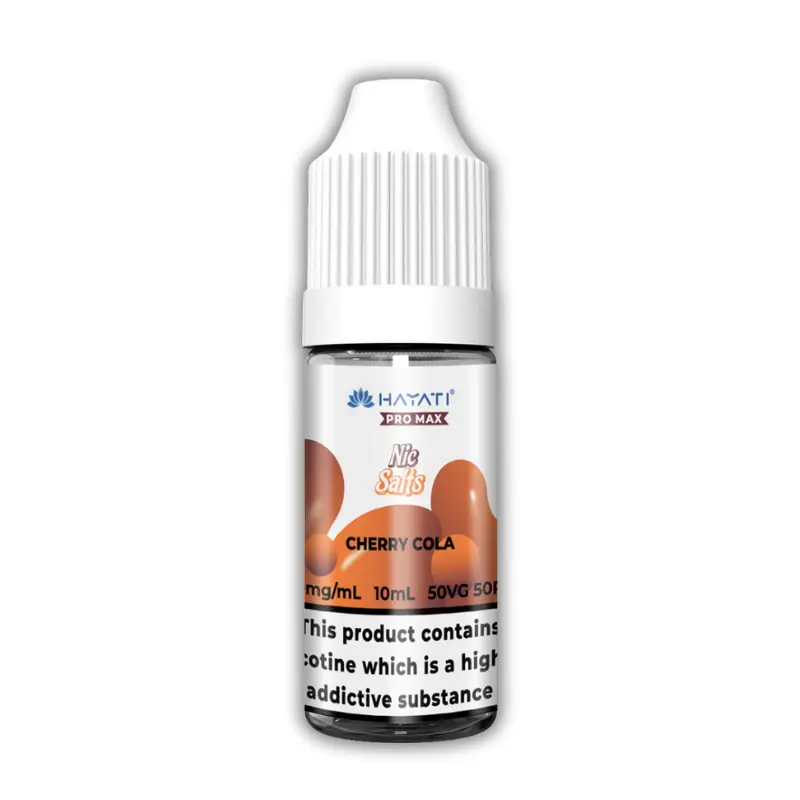
Hayati · Pro Max
Cherry Cola Hayati Pro Max Nic Salt
£2.49
✔ In stock — ready to ship
Genuine Hayati
Free over £20
Same-day dispatch
Secure checkout
Cherry Cola in this format is ten millilitres of finished liquid in a bottle at £2.49, mixed at an even fifty-fifty carrier split, carrying nicotine salt at 10mg per millilitre. There is no device in the box, nothing to charge and nothing sealed shut. It is one of sixty-five bottles on the Hayati Pro Max Nic Salts shelf, sixty-four of which cost exactly this, and every one of which is 10mg on the same base. On price, volume, strength and ratio it is indistinguishable from its neighbours, which is true of almost every bottle here and is not what this page is about.
What distinguishes this listing is a single clause at the end of its flavour paragraph. Hayati finish the description by telling you where the liquid sits relative to two other bottles by name, placing it between the chilled one and the sharper one for anyone choosing between the cola flavours. That is not a tasting note. It is a purchasing instruction with a named scale attached, and it is the most directive sentence anywhere on this shelf.
It also does not work. The two endpoints are not graded on the same property. One of them is a temperature claim and the other is an acid claim, and cold and sour are not two ends of one line. There is no position between them, so there is nothing for a third bottle to occupy, and a buyer who follows the instruction literally will get something other than what the sentence promises. That is the subject of this page: not what cherry cola tastes like, which has been covered at length elsewhere in this shop and is covered below only by citation, but whether the shop's own most useful-looking piece of guidance can be used.
The flavour question is genuinely closed. Thirteen pages on this site already deal with the cola stem across every format Hayati sell it in, and the analysis of this exact liquid belongs to the Cola Vapes pages that got there first. Nothing below adds a fourteenth account of the taste. What follows is an argument about a sentence.
The sentence, and how unusual it actually is
The claim handed to me for this page was that this is the only listing in the catalogue that hands a buyer a named three-point scale with the product in the middle. I counted it against the catalogue as it stands, because a rarity claim in a brief has been wrong in this shop several times before and correcting one has never made a page worse.
It is not the only one. There are exactly two.
Searching all 492 descriptions for a sentence that uses a between-style construction and names two other Hayati products inside it returns three hits, and one of those is a divided pod naming its own two halves, which is a description of what is in the packet rather than a pointer at anything else. That leaves two genuine cases. This bottle is one. The other is Black Mint's quieter neighbour on the mint side of the same shelf, the Fresh Mint bottle, which tells you that if one named mint is too soft for you and another named mint is too icy, this is the one in the middle. Two listings in 492, both on this shelf, both £2.49, both 10ml.
So the handed claim narrows from one to two, and the narrowing improves it, because the second case is the control. If both of them were broken you would be looking at a house habit and there would be nothing to say about this listing in particular. They are not both broken. One of them is a properly constructed scale that a buyer can act on, and the other is this one. Having a working example from the same copy desk, on the same shelf, at the same price, in the same sentence shape, is what turns an observation about one clause into an argument about it.
It is worth saying what this count is not, because a related one has already been done on this site and the two are easy to confuse. The Red Berry Ice bottle page counted the if X is too Y construction across the whole catalogue and found that six listings in 492 use it while naming a specific Hayati product as the thing that is too something. That census is cited here and not recounted. Mine is a different cut and it catches a different set: of Red Berry Ice's six, five name a single product as one end of a comparison and only the mint bottle names two. Cherry Cola is not in that set at all, because it never uses the words too or if in that way. It arrives at the same structure through a different sentence shape, which is exactly why a search for the first construction missed it.
Nor is a pointer itself rare here. The Fizzy Cherry bottle page counted the referral habit across the whole range and established that twenty-two of these sixty-five bottles name a different Hayati flavour inside their own description, which is roughly three times the rate of any other shelf and a thing that never happens at all on two of them. That finding is taken as read. The point is the gap between the two figures. Twenty-two bottles point at something. Two place themselves between two named things. Pointing is ordinary on this shelf. Ranking is not, and a rank is a much stronger promise than a pointer, because a pointer only says here is the nearest thing while a rank says here is the order and here is your place in it.
What the working version looks like
Take the mint sentence apart first, because it is short and because seeing a good one makes the bad one obvious.
Three products are named. One property is in play, which is how much cold the liquid delivers. The soft end is a spearmint described as rounder and lightly sweetened with a chill that builds gently. The hard end is a Menthol bottle described as being about the sensation of cold rather than a herbal taste at all, bracing, frosty and uncluttered. The middle bottle then says, in its own copy, that it emphasises the herbal side over pure cold. Every one of the three descriptions is talking about the same variable, and each one puts itself at a different point on it.
That is a scale. It has one dimension, three measured points and named endpoints, and a reader who knows they find one endpoint excessive and the other insufficient can act on it immediately without tasting anything. The purchase is decidable from the copy.
One qualification, because it matters and because getting it wrong would contradict a finding already established on this site. The Blue Frozen pods page counted Hayati's cooling vocabulary across all 492 titles and found that the words are not a graded scale: Ice, Frozen and Cooler are alternatives rather than tiers, Frozen and Cooler each attach to exactly one flavour, Chill and Freeze do not appear at all, and an ice-family word never shares a title with a mint-family word. That page's conclusion is the one I am relying on, and it drew a distinction that does the work here. The vocabulary is graded where the words name substances and ungraded where they name sensations, because a substance has a referent and a sensation does not.
Apply that to the mint sentence and it holds up. Spearmint and menthol are substances. The mint ranking is not grading three title words against each other, it is grading three named ingredients, and it does it in the body copy rather than in the names. Nobody reading it is being asked to infer that one title word outranks another. That is why the mint scale survives the census and why it is a legitimate control rather than a second example of the same error.
So the general test a scale has to pass is narrow and it is not demanding. All the points on it must be measured on one property, and that property must be one the reader can have a preference about in advance. Two points is enough to set a direction. Three gives you a middle. What you cannot do is measure the two ends on different properties and then claim a middle, because a middle is an arithmetic idea and arithmetic needs one number line.
Taking the two endpoints apart
Now the cola sentence. The two named endpoints are Cola Ice, described as the chilled one, and Cola Lime, described as the sharper one. Both are on this shelf. Both are £2.49. Both are 10ml at 10mg on the same even base. The only published difference between the three bottles is what has been done to the cola.
Read each of their own flavour paragraphs and count the vocabulary in it, which is the only evidence available because nobody publishes a recipe.
The Cola Ice paragraph runs on temperature. It uses six cold words in the course of describing itself: chilled, ice, cold, crisp, cooling and the image of a poured glass over cubes. It uses zero acid words. Not tart, not sharp, not tangy, not zesty, not sour, not citrus. There is no acid claim anywhere in it, and the paragraph closes by saying the liquid is cola and cooling working together with nothing else pulling attention away. That is a bottle described entirely on one property.
The Cola Lime paragraph runs on acid. It uses five acid words about itself: the lime cuts through the base, it is zesty, it is tart, it is citrus, and the finish is sharp. It describes the lime as brightening the profile and as keeping the base from reading heavy or syrupy over a long session. The only cold word anywhere in that paragraph is the name Cola Ice, which appears in the last sentence and is the name of a different bottle. Cola Lime makes no temperature claim about itself at all.
Set those two side by side and the problem is already visible. Hayati are not describing two positions on a line. They are describing two different operations performed on the same base. One lowers the perceived temperature. The other raises the acid. Neither paragraph says anything about the property the other one is built on.
The cola-ice kit page on this site has already established that the two operations work by different mechanisms, damping the warm middle of the accord in one case and crowding it out in the other, and that a buyer who wants the warm middle intact is served by neither. That finding is cited and not rebuilt. What that page did not go on to ask, because it was answering a different question, is what follows for the sentence on the bottle. This is the step: if the two modifications act on independent properties, then a product cannot be positioned between them, because between requires the two to be comparable and they are not.
Then the detail that settles it, and it is inside this listing's own paragraph rather than in either of the others. Count the vocabulary Hayati use for Cherry Cola itself, in the sentences before the final clause. The cola is called the backbone, and it is rich, sweet and carries a gently spiced depth. The cherry is folded through that base, contributing a fruity, slightly tart sweetness, and it rounds off the cola's edges. What is left on the finish is sweetness, fruit and a lingering note of the drink.
There is no temperature word in any of that. Not one. The only two cold words in the entire paragraph are chilled and Ice, and both of them appear in the final clause, and both of them belong to a different bottle. The same is half true of the acid vocabulary: sharper also appears only in the final clause and also describes a different bottle, leaving slightly tart as the one acid word the paragraph applies to this liquid, and it is attached to a sweetness rather than standing on its own.
So the closing clause imports two properties that the rest of the paragraph never claims, and then positions the product on a line drawn between them. The paragraph argues against its own last sentence. You can see the fault without leaving the listing.
The fourth bottle, which is the proof
An objection is available at this point and it is a fair one. Perhaps cold and sharp really do sit on one perceptual line for most people. Plenty of vapers use the word refreshing for both, and if the two properties always moved together the sentence would be loose rather than wrong.
They do not always move together, and this shelf contains the proof at £2.49.
Bru Ice is a 10ml bottle on the same sixty-five-listing shelf, named for an orange soda, and its own description does both things at once. It is a chilled liquid: the copy calls it a can taken from the cooler and gives it an icy finish, using six cold words in the process. It is also an acidic one: the copy calls it slightly citrusy and tangy. Cooled and sharpened, in the same bottle, described in the same paragraph by the same copy desk.
That bottle is not filed under Cola Vapes, which is worth knowing if you go looking for it, because Hayati file it with the cooled products instead. What ties it to this group is its own last sentence, which offers it as a rotation partner to Cola Ice for anyone who wants a couple of drink-style flavours running together. Hayati put it next to the colas themselves.
Now the logic. If cold and sharp were the two ends of a single line, a product could not be at both ends simultaneously. Bru Ice is. It therefore has no coordinate on the one-line scale, which means the one-line scale does not describe the space these liquids actually occupy. Two independent properties describe it, and two properties give you four cells rather than three points.
Here is the map, built only from what each listing says about itself.
| Cooled, acid not claimed | Cola Ice. Six cold words, zero acid words. The base with a coolant on it and nothing else. |
| Not cooled, acid claimed | Cola Lime. Five acid words, no temperature claim of its own. The base with citrus raised. |
| Cooled and acid claimed | Bru Ice. A different soda, chilled and tangy at once. The cell the one-line scale says cannot exist. |
| Neither cooled nor sharpened | Cherry Cola. No temperature word of its own. One acid word, subordinated inside a sweetness, and qualified below. |
Four bottles, four cells, one shelf, one price. That is the honest shape of the choice, and it is not a line with a middle on it. Cherry Cola's position is not between the other two. It is off the axis they define, in the only cell neither of them occupies, and being in a cell of your own is a different kind of fact from being in the middle of a row.
One limitation on the map, stated rather than buried. Every cell in it is built from the bottled shelf's own copy, and the same flavour names are written differently on other platforms. The Cola Ice sold as a sealed refill, for instance, has a bright tang in its description that the bottle's description does not mention at all. So this is a map of four listings rather than a map of four recipes, and it should be read as a description of the guidance Hayati publish rather than as a claim about what is in the concentrate. That caveat applies to every page on this site that reasons from copy, including this one, and it does not weaken the argument, because the argument was always about the guidance.
The two ways a buyer gets this wrong
The reason to spend a page on a clause is that people act on it. Here is what acting on it does.
Read the sentence as written and the natural inference is that this bottle is a cooled cola with the cooling turned down. Less cold than the chilled one, and less sharp than the sharp one, so presumably a little of each. Somebody who finds Cola Ice a shade too cold for a long day, and who wants the same drink with the chill eased off, will read that clause as an answer to their question.
They will get a bottle with no cooling in it at all. Nothing in this listing names a coolant, no cold word is applied to the liquid, and the shop's convention across the whole range is that a cooled product announces it in the name. On the available evidence this is uncooled, and uncooled is not a smaller amount of cooled.
The Blue Frozen census is what makes that a hard edge rather than a soft one. Because the cooling vocabulary is not graded, there is no vocabulary in which a bit less cold could be expressed even if such a product existed, and no product in the cola family occupies that position anyway. The step from the cooled cola to any uncooled one is the whole distance in a single move. A buyer looking for eighty per cent of the chill has nothing to buy, and the sentence that seemed to offer it has instead sent them to the far end.
The mirror failure is quieter and is more likely to be blamed on the palate. Somebody who likes Cola Lime but finds the citrus finish too insistent will read the clause as offering the same idea with the acid dialled back. What they get is a liquid whose only acid word is folded into a sweetness and whose stated job is to round the base off. That is not a reduced version of a cutting citrus. It is the base made fuller instead of brighter, which is a change in the opposite direction, and somebody expecting a gentler sharpness will register the result as sweeter and heavier than the bottle they were trying to move away from.
Both failures come from the same fault, which is that the clause invites you to read your position on a line you cannot be on. The honest version of the same guidance is one sentence longer and it costs nothing: the three colas differ in what has been added, one has a coolant, one has citrus, this one has fruit and sweetness, and choosing between them is choosing which addition you want rather than how much of one thing you want. That sentence would fit in the space the current one occupies.
Narrowing my own claim: the tartness is there
The version of this argument I was handed said Cherry Cola adds no acid. That overstates it, and the page is better for saying so plainly.
The listing does use an acid word about this liquid. The cherry is described as adding a fruity, slightly tart sweetness. That is a real claim and it should not be argued away to tidy up a diagram.
What survives counting is a directional distinction rather than a presence-or-absence one, and it is visible in what each listing says the acid is doing. Cola Lime's citrus is described as cutting through the base, as brightening the whole profile and as keeping the cola from feeling heavy over a long session. Every one of those verbs describes an agent working against the sweetness. Cherry Cola's tartness is described as rounding off the edges and as making the finish sweet and fruity. Those verbs describe something working with the sweetness rather than against it, and the fourth listing in the family, the Cherry Cola sold as a complete kit, uses the same direction, calling the result fuller and more rounded rather than sharp.
So the fourth cell of the map is not no acid. It is acid present and subordinated, which is a weaker claim and a true one. It does not affect the argument about the scale, because the scale fails on the independence of the two axes rather than on the magnitude of anything, and a small amount of acid in the fourth cell is still a different variable from the temperature of the first.
There is a related finding I am citing rather than redoing. The page for this liquid's sealed refill lined up all three of Hayati's Cherry Cola descriptions against one another and found that the tartness word appears on the kit and on this bottle but is absent from the refill, which instead says the cherry makes the cola fuller rather than sharper. That is the one place where the three descriptions genuinely contradict rather than merely omit. It is also, note, the only one of the three where the acid vocabulary disappears completely, which is consistent with the reading above: where the word survives it is always attached to a rounding rather than to a cut.
What the map says about sweetness
One conclusion falls out of the four cells without any tasting, and it is worth stating because it is the practical answer to the question most buyers are actually asking.
Of the four, this is the one with nothing working against the sugar. Cola Ice has a coolant, and a coolant lifts the impression of the sweetness off the palate. Cola Lime has a citrus described as stopping the base from reading syrupy. Bru Ice has both. Cherry Cola has a fruit whose stated job is to round the base out, which adds body rather than removing it.
So this reads as the sweetest of the four, and the conclusion is reached by elimination rather than by assertion. Nobody has published a sugar figure for any bottle in this range, no such figure exists in any listing, and nothing here is a measurement. The refill page for this same liquid reached the same conclusion independently on its own three-bottle shelf, by the same structural route, and flagged it as an inference from what each modifier is rather than a fact about a recipe. That flag applies here too and it is not a formality: a page that presents a deduction from marketing copy in the same voice it uses for the price has told the reader something false about how much to trust it.
If sweetness accumulating over a long day is the thing you mind, the map tells you where to go and it is not a subtle answer. You want a cell with something in it that works against the sugar, and there are three of those.
Three listings, one liquid, and only one of them carries the instruction
Hayati sell this flavour three times. This bottle at £2.49, a sealed refill at £5.49, and a complete kit at £7.99. Of the three, only the refill has a page on this site, and that page owns the comparison of the three descriptions outright. What it established is taken as given below and none of it is rebuilt: all three agree that cola is the floor and cherry sits over it, fizz is mentioned on the kit listing alone, spice on this bottle alone, tartness on the kit and this bottle but not the refill, and the word caramel functions as the cola marker in this catalogue rather than as a general sweetness adjective. It also worked out that cherry is doing a job in this blend that it does nowhere else on its shelf, and it set out what a buyer should do depending on which half of the blend they find themselves reaching for. Read it there.
What that page did not have occasion to ask is which of the three listings carries the ranking clause, and the answer is the interesting part.
Only this one does. The refill's description names no other cola at all; it suggests pairing the pod with a fruit pod and leaves it there. The kit's description does name both Cola Ice and Cola Lime, but it does something completely different with them: it says the liquid sits comfortably alongside the two of them for anyone who likes to rotate.
Read those two sentences next to each other. Same liquid. Same two neighbours named. One listing says the three are points on a scale and you should pick your position. The other says the three are companions and you should run them together. Those are not two phrasings of one idea. They are opposite pieces of advice, because a scale implies the three are substitutes for one another and a rotation implies they are not.
And the rotation reading is the one the map supports. Products differing on independent properties are exactly the products worth running together, because each one supplies something the others do not, while products differing in amount of one property are substitutes and there is little reason to own two. Hayati's own copy reaches the right answer on the kit listing and the wrong one on the bottle, which suggests the bottle's clause is a copywriting decision rather than a considered ranking.
The rotation reading is also the majority one across this family. Cola Lime's bottle offers itself as a partner to Cola Ice for anyone who likes to switch between the two. Bru Ice offers itself as a rotation partner to Cola Ice. The sealed Cola Lime refill puts it most directly of all, describing itself as the one to take if you prefer citrus over cooling, which is a choice between two different things stated as such, and is the clearest evidence in the whole set that the copy desk knows perfectly well the two properties are separate. Four listings in the drink family describe these relationships as pairings. One describes them as a ranking. The odd one out is the one on the cheapest listing.
That last point has a practical edge. The £2.49 bottle is the cheapest way into this liquid and therefore the most likely first encounter with it, which means the one listing carrying the broken instruction is the one most likely to be read by somebody who has no basis for checking it.
What buying it in a bottle is actually for
The format section on a bottle page is usually the least interesting part, because every bottle on this shelf is the same object. Ten millilitres, an even carrier split, 10mg of nicotine salt, a cap and nothing else. There is no coil, no cell, no rating and nothing to recycle beyond the bottle itself. The even split is thin enough to wick into a tight mouth-to-lung coil and carries flavour at low power, which is why the whole Hayati E-Liquids nic salt line is built on it, and it is the wrong liquid for a high-power sub-ohm tank. Say that once and move on. Check what your own device is built for before buying, since a bottle that suits a refillable pod does not suit every kind of hardware.
What is worth adding is specific to the argument above, because the bottle format is the only one that lets a buyer test the map for themselves.
The four bottles in the drink family cost £2.49 each. Buying all four costs under a tenner and gives you forty millilitres of liquid, which is several weeks of mouth-to-lung use, and every one of them goes into the same pod with the same coil at the same strength on the same base. Six variables are frozen by the manufacturer before you start. What varies is the liquid and nothing else.
No sealed format allows that. A prefilled pod fixes the liquid to a coil you did not choose, at a different strength, in a volume you have to finish; comparing two of them means comparing two coils as well as two liquids. The bottled shelf hands you a genuinely controlled comparison for the price of a sandwich, and if you want to know whether the four-cell map above matches your own palate, that is how you would find out. It is the one thing this format does that the other two Cherry Cola listings cannot.
Two practical notes if you run that comparison. Take the readings in the morning, because an overnight break resets your sense of smell and an afternoon judgement made after an hour of something sweet is a judgement about your palate. And give the wick a proper flush between bottles rather than topping straight over, because a cooled liquid leaves a coolant residue that will sit under the next fill and make an uncooled bottle read colder than it is, which is precisely the variable you would be trying to measure.
Specifications, ordered by what decides the purchase
The rows below run in the order that matters for this listing rather than in the order a spec sheet usually takes, and the last four rows record what the listing claims about itself, because on this page those claims are the subject.
| Cooling | None named in the title or in the description. Treat as uncooled. |
| Acid | One word, slightly tart, attached to a sweetness and described as rounding rather than cutting. |
| Sweetness | Not published. Reasoned above as the highest of the four drink bottles by elimination, not measured. |
| Ranking clause | Present. Names two other bottles and places this one between them. One of only two such clauses in 492 listings. |
| Flavour construction | Two components. Cola as the base, cherry over it. Ratio not published. |
| Volume | 10ml, in a bottle you open and pour |
| Nicotine | 10mg per millilitre, as nicotine salt. Every bottle on this shelf is 10mg and no other strength is offered here. |
| Carrier base | An even fifty-fifty split, the same as all sixty-five bottles |
| Price | £2.49, which is 24.9p per millilitre |
| Intended hardware | Refillable pod kits and low-power mouth-to-lung devices. Not a sub-ohm liquid. |
| SKU | HPM-NS-CHERRY-COLA |
| Filed under | Pro Max Nic Salts, Cherry Vapes, Cola Vapes, Hayati E-Liquids, New Products |
| Not published | No coolant type, no sweetener content, no flavour concentrate breakdown, no ratio between the two named components |
Two of those rows carry more weight than the rest. The nicotine figure is a property of the format rather than of this flavour, a point the Pink Lemonade bottle page settled by counting: every one of the sixty-five bottled salts in this catalogue is 10mg, every one of the forty shortfills is 0mg, and 365 of the 372 sealed prefilled listings are 20mg. Nobody decided Cherry Cola should be lighter in a bottle. Bottles are 10mg. That count is cited and not repeated, and nothing on this page builds an argument on the strength difference between the three Cherry Cola listings, because there is no argument there to build.
The last row matters more than it looks. Everything this page argues is reasoned from published copy, and the copy is thin. There is no coolant field, no sweetener figure and no ratio anywhere in the listing set, which means the four-cell map is a map of what Hayati say rather than of what they mixed. That limitation is the honest frame for the whole page and it is also the reason the clause at the end of the description mattered enough to examine: when a manufacturer publishes almost nothing, the one directive sentence they do publish carries a great deal of weight with buyers, and it ought to be sound.
Where to go instead, cell by cell
The map turns into shopping advice more cleanly than the original clause did, because each cell answers a different question.
If you want the base with a coolant on it and nothing else added, that is Cola Ice and there is no substitute for it in this format. If you want the base with the citrus raised, that is Cola Lime, and its own refill listing describes the choice between the two as citrus against cooling, which is the clearest statement of the two-variable structure anywhere in the catalogue. If you want both at once you are outside the cola family and into Bru Ice, which is a different soda and tastes like one.
If you want a drink-shaped liquid with the sweetness left intact and no cutting agent in it, this bottle is the one, and that is a real and specific thing to want. It is the answer for anybody whose complaint about the other three is that something keeps getting in the way of the drink.
The cherry side of the question runs somewhere different. Nine other bottles on this shelf carry a cherry, and the sealed refill page for this liquid established a finding about them that is worth knowing before you browse: across the shelf, cherry is normally cast as the depth of a blend and here it is cast as the lift, so the word on the label is a weaker guide to the sensation than it looks. Cite that rather than rediscover it. What the bottled shelf offers in practice is Cherry Ice, which is the fruit with a coolant and nothing else, and Fizzy Cherry, which is the fruit with an acid texture and no second fruit. Those two are a neat illustration of the same two-variable structure in a different family: one cools, one sharpens, and they are not two settings of one dial. Their own descriptions name each other, which is one of only two reciprocated pairs on this shelf, a finding the Fizzy Cherry page owns.
For cherry inside a larger blend, Cherry Berry puts mixed berries around it, Blue Razz Cherry sets a candied blue raspberry over the top, and Blueberry Cherry Cranberry and Strawberry Cherry Cranberry both bury it in a stack of three with cranberry supplying the sharpening at the end. None of those is a cola and none of them will answer a question about the drink. If you want the fruit in a large bottle for a higher-power device, the Fizzy Cherry shortfill is the same idea at 120ml on the same even base, sold without nicotine.
The lemonades are the family most often confused with this one, and the distinction is structural rather than a matter of taste. Blackcurrant Lemonade, Berry Lemonade and Blue Razz Lemonade all put the fruit on the floor and use the drink as the lift, which is the reverse of the cola arrangement where the drink is the base and the fruit goes over it. In every one of those three the lemonade is described as stopping the fruit from building up, which puts all three of them firmly in the acid column. If the appeal of this bottle is the soft-drink shape rather than the cherry, the lemonades are the nearest family and none of them is in the same cell.
Two more bottles are worth naming for contrast rather than as substitutes. Blackcurrant Juice is the shelf's clearest example of the same cell in the fruit world, a dark sweet liquid with no coolant and only a light sharpness at the edges, so it is the closest thing here to a control if you want to know what an uncooled and unsharpened bottle feels like over a long day. Juicy Peach is the other uncooled sweet bottle worth putting next to it.
And for rotation, which the kit listing recommends and which the map supports, the useful partners are the bottles that share nothing with this one. Blackberry Ice and Banana Ice are cooled and fruit-led. Blue Razz Mojito and Lemon Lime are the citrus corner and will strip a sweet residue from the palate faster than anything else on the shelf. Blackberry Raspberry and Blueberry Raspberry are uncooled two-berry pairings that sit well against a drink flavour without competing with it. Mr Blue and Black Mamba are both named for a mood rather than an ingredient, so neither can be placed on any map from its title, which is a separate problem this shop has written about elsewhere.
Living with an uncooled sweet bottle
General handling advice for a 10ml bottle is on dozens of pages here and repeating it helps nobody. What follows is the part that is different because this particular liquid has no coolant and no cutting agent in it.
Prime properly and wait longer than feels necessary. A fresh coil dropped straight into a sweetened liquid and pulled on immediately runs hot and dry, and heat is unkind to the fruit end of this blend before it touches the base. The first draws on an under-wetted wick will read as thick and syrupy, which is the wrong first impression of a drink flavour and one that corrects itself after a few minutes standing.
Expect the accumulation and plan for it. This is the cell with nothing working against the sugar, which is the whole finding of the map, and the consequence over a twelve-hour day is that the sweetness settles broadly across the palate and stays there between draws rather than arriving and clearing the way a sharp fruit does. That is not a fault in the liquid. It is what the cell means. The practical response is to keep something in the acid or the cold column on hand and alternate, which is what three of the four drink listings recommend in their own words.
Watch the coil rather than the calendar. A sweetened liquid leaves more residue on a coil than a thin citrus does, and the failure on this profile has a recognisable shape: the fruit at the front narrows first, the spiced depth flattens after it, and what is left is a broad sweetness with no front and no finish. The signal to change the coil is the disappearance of the opening rather than a general dullness, and it usually arrives before the bottle is empty.
Mind what the pod held before this. Coolants are chemically persistent and will sit in a wick through a rinse, so filling an uncooled bottle into a pod that last held a cooled one puts a chill under a liquid that does not have one. On most flavours that is a curiosity. Here it undoes the single property that distinguishes the bottle from its neighbours, and somebody testing the four-cell map in a shared pod would get a false reading on exactly the variable they were measuring.
Store it in a drawer rather than on a windowsill. Warmth accelerates the ageing of a sweetened liquid and this one is sweetened at both ends, with the cherry over a caramel-weighted base. A bottle left in a warm car will darken and lose its front sooner than one kept cool and dark, and the loss lands on the fruit before it lands on the cola. Keep the cap on tight between fills, keep it out of reach of children and pets, and put the empty bottle in with ordinary plastic recycling, since a bottle with no coil and no cell in it is not electrical waste.
Questions this listing raises
Is this bottle colder than Cola Lime and warmer than Cola Ice, as the description suggests?
No. Nothing in this listing describes the liquid as cooled at all, and Hayati's convention across the range is that a cooled product names the cooling in its title. Cola Lime is not described as cooled either, so the two of them are in the same position on temperature and the ranking clause cannot be read that way.
So is the sentence in the description simply wrong?
The sentence names three real products and its underlying intuition is sound, which is that this bottle is the least extreme of the three. What it gets wrong is the structure. It treats a temperature claim and an acid claim as two ends of one line, and they are independent, which is why a fourth bottle on the same shelf manages to be both at once.
Which of the three colas is the sweetest?
This one, on the reasoning above, and the reasoning is elimination rather than measurement. It is the only one of the three with no coolant and no cutting citrus in it, so there is nothing offsetting the sugar. No sweetness figure is published for any bottle in this range, so treat that as an inference from what each modifier does rather than as a number.
Is there any tartness in it at all?
Yes, and the page originally claimed otherwise before checking. The listing describes the cherry as adding a slightly tart sweetness. The distinction that survives is what the acid is for: in Cola Lime the citrus is described as cutting through the base, and here the tartness is described as rounding the edges off, which is the opposite job.
How many listings in the range give a named three-point ranking like this?
Two out of 492. This bottle and the Fresh Mint bottle on the same shelf. The mint one works, because its two endpoints are both graded on how much cold the liquid delivers, which is a single property. Naming a rival is far more common: twenty-two of the sixty-five bottles here do it, a count established on the Fizzy Cherry page.
Is it the same liquid as the Cherry Cola pods and the kit?
Hayati publish no formulation for any of the three, so nobody outside the factory can confirm it. What is published is three separately written descriptions that agree on the architecture and disagree on three details, a comparison worked through in full on the page for the sealed refill. The strength difference between the bottle and the two sealed listings is a filing convention rather than a recipe signal.
Why does the kit listing tell me to rotate these three and this one tells me to choose between them?
Because two people wrote two descriptions of the same liquid. The rotation advice is the one that matches the structure, since products differing on independent properties complement each other while products differing in the amount of one property substitute for each other. Three of the four listings in this drink family describe the relationships as pairings and only this one describes them as a ranking.
What is Bru Ice doing in a discussion about colas?
It is on the same shelf at the same price, it is a soda rather than a fruit, and its own description offers it as a rotation partner to Cola Ice. Its role here is as a test case: it is described as both chilled and tangy, which is a combination the one-line scale has no room for, and that is what shows the two properties are separate.
What is the practical difference between this and Cola Ice for all-day use?
The coolant. A chill lifts a sweetness off the palate between draws, so the cooled bottle does not accumulate in the same way over twelve hours, while this one is in the cell with nothing working against the sugar. Whether that is a drawback depends on whether you are running it alone or in a rotation.
Will it work in my sub-ohm tank?
It is not intended for one. The even carrier split is thin by the standards of a high-power coil, and 10mg of salt is a good deal more nicotine per draw than that hardware is designed around. This belongs in a refillable mouth-to-lung pod or a compact low-power kit.
Is there a plain cola in the bottled range with nothing added?
Not on this shelf. The three colas here are the cooled one, the citrus one and this one, and each has had something done to the base. The broader position across all formats has been counted on the cola pages elsewhere in this shop and the answer does not improve.
How long does a 10ml bottle last?
That depends entirely on your device, your coil and how often you draw on it, and no honest figure exists. Ten millilitres in a mouth-to-lung pod is commonly somewhere between a few days and a fortnight. What is worth watching on this particular liquid is the coil rather than the level, because a sweetened blend narrows at the front end before the bottle runs out.
The short version
Ten millilitres of cherry cola at 10mg on an even base, £2.49, one of sixty-five bottles that are identical on every published specification. The flavour has been written about elsewhere on this site in more detail than a further account could add to, and this page has not attempted one.
What is specific to this listing is its last clause. It is one of only two places in 492 descriptions where Hayati rank their own products on a named scale and put the product you are looking at in the middle of it, and unlike the other one it cannot be used, because its two endpoints are measured on different properties. Cooling and acid are independent variables, which the shop's own copy demonstrates twice over: once on the sealed Cola Lime listing, which frames the choice as citrus against cooling rather than as a position between them, and once on a fourth bottle that manages to be both at the same time and therefore has no place on the line at all.
The map that replaces the line has four cells and this bottle occupies the one with no coolant and no cutting agent, which makes it the sweetest and fullest of the group by elimination and not the moderate middle the clause implies. A buyer who reads the sentence as offering a cola with the chill turned down will get one with no chill in it, and a buyer who reads it as offering a gentler citrus will get one moving in the other direction. Both of those are ordinary misreadings of a sentence that invites them.
Buy it if what you want is the drink shape with the sweetness left alone and a fruit added over the top, which is a specific thing to want and the only cell of the four that supplies it. Buy something else if you want the sweetness held in check, and use the two axes rather than the one line to decide which.
Strictly for adults aged 18 and over. Nicotine is an addictive substance.
You might also like


