
Home / Hayati Pro Max Plus Pods / Galaxy Aura Hayati Pro Max Plus Pods
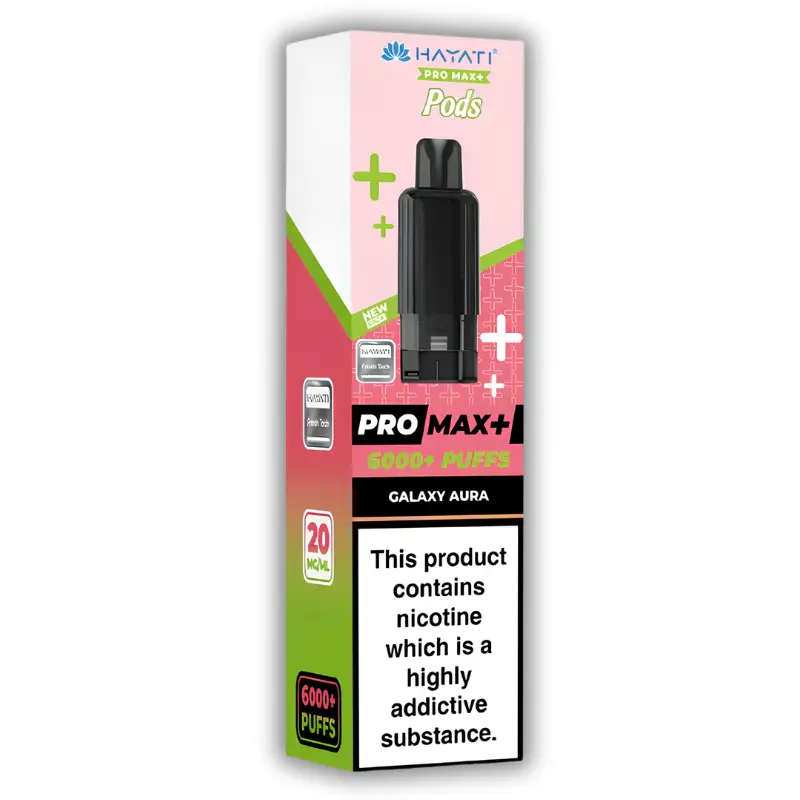
Hayati · Pro Max Plus
Galaxy Aura Hayati Pro Max Plus Pods
£5.49
✔ In stock — ready to ship
Genuine Hayati
Free over £20
Same-day dispatch
Secure checkout
This listing is a refill and nothing besides. £5.49 buys one Galaxy Aura pod for the Hayati Pro Max Plus, arriving with 12ml of liquid at 20mg already inside it, and there is no hardware of any kind in the packaging. Without a Pro Max Plus body already sitting on the desk the pod does nothing at all, which tells you who is reading this: somebody who has had the flavour once, liked it enough to go again, and is now topping up rather than deciding.
Reordering is where a price finally gets examined. A first purchase is partly curiosity, and curiosity absorbs an enormous amount of financial doubt. The second one is colder. The novelty has been spent, the liquid holds no surprises, and the only live question is whether £5.49 is a sensible number for what arrives. Most shoppers settle that question without noticing they have asked it, by glancing sideways at what the same thing costs somewhere else.
Galaxy Aura will not let you do that, and the obstruction is built into its name.
Look at a neighbour on the same shelf. Mango Banana Hayati Pro Max Plus Pods is also £5.49, and mango with banana is not a Hayati invention. It is a combination that many manufacturers make, in pods, in bottles, in disposables, under their own labels and at their own prices. Anybody who wants to know whether £5.49 is steep for a 12ml mango banana pod can go and find out in about four minutes, and whatever comes back is an answer. Galaxy Aura has no counterpart to look up. Nobody else sells a Galaxy Aura, because those two words belong to Hayati, and nobody can sell its equivalent either, because the recipe behind them has never been published. No second quotation for this product exists anywhere in the market.
The consequence needs stating carefully, because it is easy to hear as an accusation and it is not one. This pod costs exactly what every named pod beside it costs. The number is not the issue. What the coined name changes is who controls the frame the number gets judged inside, and on a product with an invented title and an undisclosed recipe that frame belongs to the brand in its entirety. What follows works through what that means for a repeat buyer, which figures still hold up as benchmarks, and how to work out whether the money is going on a recipe or on a name.
Why an invented name has nothing to stand next to
Nobody prices anything in isolation. A price only means something against another price, and there are three ordinary routes a shopper uses to find one. All three are closed here, and it is worth walking them individually because they fail for different reasons.
The first route is the same product elsewhere. Type a product name into a search box and the market answers with a spread of prices from competing sellers, and your own retailer's number lands somewhere inside that spread. This works because most product names are shared property. Galaxy Aura is not. It is a coined phrase attached to one manufacturer's liquid, and the only place it appears is on Hayati listings, which makes every search a single-source search. The price you find is the only price there is.
The second route is the same recipe elsewhere, and it is the one people underestimate. A descriptive flavour name is not really a name at all. It is a portable instruction. Walk into any shop or open any site with the words "blackcurrant and mango" in your head and you can ask for the category, and what comes back is a set of genuinely comparable goods made by different firms. That is why Blackcurrant Mango Hayati Pro Max Plus Pods is price-checkable and this pod is not. The ingredients in Galaxy Aura have never been listed, so there is no instruction to carry anywhere, and even a shopper prepared to hunt for a near-match has nothing to hunt with.
The third route is the product's own history. When a listing shows a previous price alongside the current one, a buyer learns something real: that the seller once thought a different number was viable. This listing shows no previous price, and neither does any other product in the range, so there is no discount record to read. Nobody can say whether £5.49 is where this pod started, whether it has moved, or whether it has ever been softened.
With those three closed, one comparison survives, and it is the one Hayati themselves supply. You can hold Galaxy Aura against other Hayati pods. That is not nothing, and the next section argues it is worth more than it first appears, but notice its shape: the manufacturer supplies the product, the price, the categories it is filed under, the shelf it sits on and the entire set of alternatives you are allowed to weigh it against. Every reference point in the comparison comes from the same source as the thing being compared.
None of this is peculiar to vaping, and it is certainly not misconduct. Coined names exist across consumer goods precisely because a distinctive name resists substitution, which is a textbook commercial objective rather than a scandal, and a manufacturer with a recipe it does not wish copied has an obvious reason to keep the ingredient list off the box. Motive is not the subject here. What a buyer can and cannot know is the subject, and on that narrow question the situation is unambiguous: with a named pod you can form an outside view of the price, and with this one you cannot.
The flat shelf, which is better evidence than it looks
Here is the fact that does most of the reassuring, and it is worth more than any amount of argument in either direction. There are 89 products on the Hayati Pro Max Plus Pods shelf. Every single one of them is £5.49. Not most of them, not the popular ones, all 89.
Think about what that rules out. If a manufacturer wanted to turn the opacity of a coined name into money, the mechanism would be straightforward: charge a little more for the products nobody can check, and rely on the absence of an external comparison to keep the premium invisible. There is no premium. Galaxy Aura is priced the same as Midnight Dream Hayati Pro Max Plus Pods, which is also an invented name, and the same as Blackberry Raspberry Hayati Pro Max Plus Pods, which lists its contents in the title and could be price-checked against half the market by teatime. The unmarked pods and the marked pods sell for identical money.
That is decent protection, and a fair page says so plainly rather than burying it. The structural problem this page describes is real, and the most likely practical outcome of it is nothing at all, because a uniform shelf price leaves no room for the problem to express itself.
Now the limit on that reassurance, which matters just as much. A price that is identical everywhere cannot discriminate. Ask whether Galaxy Aura is fairly priced against its siblings and the answer is always yes, automatically, for every product on the shelf, which means the comparison carries no information about any individual pod. It tells you the coined names are not being taxed. It cannot tell you whether the shelf as a whole is keenly priced or leisurely priced, because answering that requires stepping outside Hayati, and Galaxy Aura is the one product on the shelf you cannot step outside with.
A second limit. Flat pricing is a policy rather than a promise, and policies are revised. Nothing here suggests Hayati intend to revise this one, and the uniformity across 89 listings looks like a settled approach rather than a temporary alignment. It is simply worth knowing where any future divergence would appear first. Coined names are the cheapest place to move a price, for the same reason they are the hardest to benchmark, so a buyer who wants to keep an eye on this should watch what the unmarked pods do relative to the marked ones rather than watching Galaxy Aura on its own.
What the £5.49 buys in information
Set the money aside briefly and audit what the listing actually hands over, because the audit is short and the shortness is the point.
On the record: the name Galaxy Aura, the brand, a pod holding 12ml, a concentration of 20mg, an upper figure of 6,000 puffs which Hayati obtained on test equipment, the requirement for a Pro Max Plus body that is not included, the £5.49, a reference code, and seven shelves in the catalogue. That is the complete published account of this product.
Off the record: which fruits are in it, in what proportion, at what acidity, whether it carries any cooling agent and at what strength, how sweet it is on any scale, the carrier ratio, the resistance of the coil, and whether the liquid in the pod arriving this month is the same formulation as the one that arrived at launch. None of those fields is filled in, and several of them are blank across the entire range rather than blank on this listing alone.
There is one more piece of flavour metadata, and it is instructive in a way Hayati almost certainly did not intend. The pod is filed under Berry Vapes, Exotic Vapes and Sweet Vapes, and so is the Galaxy Aura Hayati Pro Max Plus 6000 Pod Kit, which holds this identical liquid in this identical pod. Three flavour shelves, the same three on both listings, and not one of them narrows the contents down to a fruit.
That agreement is recent, and how it was reached is the instructive part. In the source data this catalogue was built from, the two listings did not match: the pod carried the Berry tag and the kit did not, the kit carried the Sweet tag and the pod did not. One liquid, two packages, two different flavour classifications from the same company. Nothing about the liquid differed, so this site now gives same-liquid siblings the same flavour shelves and both listings read alike. The tidying does not add any knowledge. It proves the categories were applied by hand, one listing at a time, with nothing checking that the two entries for a single product agreed, and hand-maintained tags are not a basis for pricing anything, which closes off the last route by which a buyer might have reasoned from the catalogue to what is in the pod.
So the honest summary of the exchange is this. Two pods on this shelf cost the same and one of them tells you what it contains. The gap is not in the price. The gap is in what the price comes with, and nobody who buys this pod should be under the impression that the information exists somewhere they have not looked.
Benchmarks that survive a coined name
Being unable to price-compare a product is not the same as being unable to benchmark anything about it. Several figures on this listing are immune to the naming problem, because a name can obscure a recipe and cannot obscure a volume. These are the ones worth computing.
Price per millilitre. The pod holds 12ml and costs £5.49, which works out at 45.75p per millilitre. That figure is checkable against any prefilled pod from any manufacturer whose capacity is published, which is most of them, and it does not care what the flavour is called. It also has an internal use. Hayati's own formats sit at different points: the Mini Ultra pod is listed at 4ml, and at £3.49 for something like Blue Razz GB Hayati Mini Ultra Pods that comes to roughly 87p per millilitre. At the other end, the Pro Ultra Plus pod is listed at 22ml, so Blue Razz GB Hayati Pro Ultra Plus Pods at £7.99 works out near 36p per millilitre. The Pro Max Plus pod sits between them, which is exactly where a mid-sized format ought to sit.
Two cautions on that number before anybody treats it as decisive. Millilitres are only comparable if you finish them, and a larger pod bought and abandoned is dearer per millilitre used than a smaller one finished. Formats also differ in how much liquid a given session consumes, so a per-millilitre figure compares what is in the packaging rather than what a day costs. Used with those caveats it is still the single most portable benchmark available here, and it is the one most buyers never bother to calculate.
The hardware gap. The kit version of this flavour is £7.99 and the bare pod is £5.49, so a Pro Max Plus body costs £2.50 when it arrives alongside its first pod. That gap is identical across the range, which makes it verifiable: you can confirm in a minute that Hayati are not quietly loading a larger hardware margin onto the flavours nobody can price-check. A coined name cannot hide arithmetic that is visible on two listings at once.
The alternative you are giving up. This is the benchmark that converts an unanswerable question into an answerable one, and it costs nothing to run. The nearest substitute for Galaxy Aura sits on the same shelf at the same money. So the real price of this pod is not £5.49. It is £5.49 plus the certainty you could have had for £5.49, because Blueberry Raspberry Hayati Pro Max Plus Pods would have told you what was in it for the same coin. Asking "is this pod dear?" gets you nowhere. Asking "is the mystery worth the certainty I am handing back?" is a question you can actually answer, and on a reorder, where you already know what the liquid does, the answer is frequently a straightforward yes. Somebody who has tasted it and wants it again is not buying mystery any more. They are buying a liquid they like, and the opacity has already done whatever damage it was going to do.
The imported anchor. One deliberate technique is worth the trouble for anyone who cares about this. Order a coined pod and a plainly named one together, and use the named one as a price probe. You can check Cherry Berry Hayati Pro Max Plus Pods or Strawberry Raspberry Blueberry Hayati Pro Max Plus Pods against the wider market yourself, in a few minutes, because those combinations are made by many firms. Whatever verdict you reach about that pod's value transfers straight to Galaxy Aura, because the shelf is flat and the two cost the same. It does not tell you the recipe is good. It tells you whether the shelf you are buying from is competitively priced, and Galaxy Aura is priced on that shelf.
Choose the anchor carefully, because names vary in how checkable they are and the difference is larger than it looks. A fully literal title like Blueberry Pomegranate Hayati Pro Max Plus Pods is a strong probe: type it anywhere and comparable products come back. A partly coined title is weaker. Strawberry GB Hayati Pro Max Plus Pods names a fruit and then attaches an abbreviation that is not a fruit, so half of it searches well and half of it does not. Blue Razz Fruit Twist Hayati Pro Max Plus Pods pairs a widely used first term with a second that commits to nothing in particular. And a fully coined title such as Blue Fusion Hayati Pro Max Plus Pods has the same problem as this pod. Pick the probe from the literal end of that spectrum or the probe inherits the fault it is meant to correct.
Recipe or name: working out which one you are paying for
Three tests settle this reasonably well, and none of them requires trusting anybody.
Start with the premium test, which has already been run above. If the invented name were being charged for, it would show up as a higher price on the products carrying invented names. It does not. Across 89 listings the coined and the descriptive sell for the same figure, so on the available evidence the name is not on the bill. That is the strongest single conclusion this page reaches, and it points in the reassuring direction.
Then the guarantee test, which points the other way and is more interesting. A name is worth paying for when it secures something. Usually that something is consistency: the label is a commitment, and if the contents drift away from it the label becomes wrong. Here is the awkward part. A descriptive title constrains the product, because a pod sold as blackberry and raspberry has to taste of blackberry and raspberry or the packaging is inaccurate. A coined title constrains nothing whatsoever. Galaxy Aura is not a specification, so there is no version of the liquid that would contradict it, and a reformulation would need no relabelling of any kind. Whatever your money secures, it is not a description that the product has to live up to.
Last, the exclusivity test. One thing you definitely buy with a coined name is that this liquid comes from one place, and exclusivity cuts in both directions. It means nobody else is selling the same thing more cheaply, which is a comfort of sorts. It also means there is no fallback if the listing disappears, and no way to specify the product to a different supplier, because the only words for it are Hayati's words. That is genuine pricing power sitting unused. The reason it stays unused is the flat shelf, not any limit on the brand's ability to move the number.
Put the three together and a fair verdict emerges. You are paying the going rate for a 12ml prefilled pod on this platform, the same rate as everything around it, and the coined name comes attached to that purchase without adding to the bill. What it costs you is not money. It is the ability to form an outside opinion about the money, which for a reorder of something you already enjoy may be a cost you are entirely content to carry, and for a first purchase is a reason to buy one rather than several.
The pod on its own, in brief
Hardware gets three short paragraphs here because nothing about it is specific to this flavour and the Hayati Prefilled Pods & Refills shelf covers the platform properly.
What arrives is one pod, filled at the factory with 12ml of liquid at 20mg, and nothing else. There is nothing to assemble, nothing to fill and nothing to charge, because there is no battery in the package. A Pro Max Plus body has to be supplied by you, and anyone who does not own one should be looking at the kit version of this flavour at £7.99 instead, which bundles the body with an identical pod.
The specification that bears on this particular liquid is the 12ml itself, and it bears on it for a commercial reason rather than a technical one. The volume is fixed and it is sealed in at the factory, so there is no smaller quantity available and no way to commit to part of a pod. Every purchase on this listing is the full 12ml at the full £5.49. On a blend whose contents are published, that hardly matters, since you know what you are committing to. On one whose contents are not, it means the smallest possible trial and the standard purchase are the same size, and there is no sampling step between them. Hayati publish no carrier ratio and no coil resistance against this listing, so neither figure appears on this page, and any number quoted for either elsewhere has been carried over from a different product.
The figures, and whether each one checks out anywhere else
The table below does two jobs. It records what the listing states, and it says whether that statement can be verified against anything outside Hayati's own catalogue, which is the question this whole page turns on.
| Item | What this listing states | Checkable outside Hayati? |
|---|---|---|
| Flavour name | Galaxy Aura | No. The phrase is Hayati's alone |
| Ingredients or fruits | None given | No, and this row closes most of the others |
| Retail price | £5.49 | No competing quotation exists |
| Liquid in the pod | 12ml, filled at the factory | Yes. Volume is volume |
| Cost per millilitre | 45.75p | Yes, against any pod with a published capacity |
| Nicotine concentration | 20mg | Yes, it is a stated and widely used figure |
| Cooling agent | Not named on the listing | Only weakly, as an absence rather than a measurement |
| Sweetness or acidity value | Not published for anything in the range | No |
| Carrier ratio | Field left blank | No |
| Coil resistance | Field left blank | No |
| Manufacturer puff figure | Up to 6,000, from test equipment | Only against products measured the same way |
| Earlier price on this listing | None shown | No, and none is shown anywhere in the range |
| Hardware supplied | None | Not applicable |
| Catalogue shelves | Seven, Berry Vapes, Exotic Vapes and Sweet Vapes among them | No, these are Hayati's own categories |
| Brand | Hayati | Not applicable |
| Reference code | hpm-plus-pods-galaxy-aura | Not applicable |
Three rows deserve a note. The 20mg entry is a concentration and nothing more. Nicotine is addictive, the figure describes what is in the liquid, and it is not put forward here as advice to anybody about what to choose.
The puff figure belongs to Hayati and was produced under controlled laboratory conditions as a ceiling. It is not a forecast, real figures move a long way with how a person draws, and a bench maximum is by construction the favourable case. As a benchmark it is nearly useless across brands, because you would be comparing test protocols rather than products, and it is only worth anything between items measured on the same equipment.
The blank rows are the honest ones. A carrier ratio governs vapour density and how the liquid travels through a wick, and a resistance figure governs how tight the draw feels and how warm the vapour runs. Neither appears in this product's data, so neither is stated, and a figure for either found on another page has come from a sibling listing or from somebody's assumption.
Where £5.49 goes further, and where it does not
The choice is not between Galaxy Aura and something cheaper, because on this shelf nothing is cheaper. It is between spending the same money on a pod you can research and a pod you cannot, and the right answer depends entirely on what you want the research for.
If you want a price you can verify. Buy a title that reads as a recipe. Blackberry Raspberry is two berries and no editorial. Blackcurrant Mango puts a dark lead against a warm base and names both halves. Strawberry Kiwi and Guava Kiwi Passion Fruit are combinations plenty of manufacturers make, which is exactly what makes them price-checkable. Every one of those is £5.49, so choosing one costs you nothing except the coined name you were curious about.
If you want the dark, sweet register with the contents printed on it. Blue Razz Blackcurrant states its darker component openly. Blueberry Pomegranate takes a similar direction with a sharper second fruit. Blackberry Ice adds a coolant and, more usefully for this discussion, announces it in the title, which is the convention across the range and one reason the absence of any such marker on Galaxy Aura is worth noticing.
If the coined register is what appeals. It is a legitimate taste and several listings serve it. Midnight Dream, Blue Fusion and Dragon Berries all sell an impression rather than a parts list. One warning that follows directly from everything above: a rotation assembled entirely from coined names contains no priced reference point at all, so the buyer loses the ability to sanity-check any of it. Keeping one plainly named pod in the mix costs the same money and preserves the anchor.
If you want the partly coined middle ground. Strawberry GB and Blue Razz GB name something real and then append a shorthand, which gets you halfway to a searchable description. Berry Lemonade names a category rather than a specific fruit, which is vaguer than a two-fruit title and far more definite than an invented one.
If the sharper end is what you are after. Blue Sour Raspberry puts the acid in the title, and Strawberry Raspberry Ice stacks a coolant on two red fruits. Both tell you in advance what Galaxy Aura leaves you to discover, and both do it for the same £5.49.
If the format is the question rather than the flavour. Changing format moves the per-millilitre figure more than changing flavour moves anything. The Mini Ultra pod is the smaller 4ml format at £3.49, which is a lower outlay and a higher cost per millilitre. Blue Razz GB Hayati Pro Ultra Plus Pods runs to 22ml at £7.99 and inverts that trade. Neither is on the same device as this pod, so the comparison is about what a format costs rather than about what you can drop into your existing body.
If you need the device as well as the liquid. The Galaxy Aura Hayati Pro Max Plus 6000 Pod Kit at £7.99 is the same pod with a body attached, and its page works through the naming question from a different direction to this one. For everything else on the platform, the Pro Max Plus pod shelf holds all 89 flavours at one price, and the New Products listing is where any additions turn up before they are filed anywhere else.
A summary for anyone still weighing it. Galaxy Aura makes sense as a repeat purchase for somebody who has tasted it, wants it again, and is comfortable that the only valuation available is their own. It makes less sense as a considered first purchase for somebody who wants to know they are paying a fair market rate, because the market rate for this product cannot be established by anybody, including the person writing this page.
Getting value out of a pod you cannot price-check
Since the price cannot be optimised, the only lever left is not wasting what you have bought. These are anchored to this pod rather than to pods in general.
Treat the early volume as the valuable part when you are doing the accounting. A sweetened composite leaves more residue behind on a heating element than a light, sharp liquid does, and the effect is not that the flavour stops but that it broadens and loses its edges. If the last couple of millilitres arrive muddy, your effective cost is not 45.75p per millilitre across the whole pod, it is a higher figure across the portion that performed. That is a genuine cost worth counting, and it argues for running a pod steadily rather than letting it linger.
Heat and light are the other route to paying full price for less. Warmth works on the lighter aromatic compounds first, which are the ones carrying whatever definition the blend has, so a pod kept in a drawer at room temperature keeps more of what you paid for than one left on a windowsill or in a car. Store it where children and pets in the household cannot reach it.
Avoid leaving a part-used pod standing for weeks while something else is in the device. A coil already wetted with liquid and then left idle picks up a stale quality that has nothing to do with how the blend was built, and it is easy to blame the recipe for what is really a storage outcome. Finish one before opening the next where you reasonably can.
Knowing when a pod is finished matters here for the same accounting reason. Thinning vapour and a faint scorched edge are the usual signals, and on a heavy sweetened liquid the first change is often that the profile flattens into one broad note rather than obviously weakening. There is still flavour coming through at that stage, which is why people carry on, but it is no longer the flavour the pod was sold to produce, and stretching it is not saving money in any meaningful sense.
One last habit, and it belongs to this page rather than to any other. Write down the date and the price every time you order this pod. With no competing seller, no published recipe and no discount history, your own purchase record is the only price series that exists for this product anywhere. If the number ever moves, the flat shelf described above is what you would want to check it against, and you will only be able to do that if you kept the earlier figure.
Questions a repeat buyer asks about the money
Why can I not find this pod anywhere else to compare the price?
Because the name is Hayati's own invention rather than a description, so no other manufacturer makes a product called Galaxy Aura. The recipe has not been published either, which means there is no comparable blend to search for under a different name. Those two facts together leave the product with no external price to be measured against.
Is £5.49 expensive for a 12ml pod?
That question cannot be answered from this listing alone, which is the honest position. What can be said is that it works out at 45.75p per millilitre, that the figure sits between Hayati's smaller and larger pod formats, and that every one of the 89 pods on this shelf carries the same price. Checking a plainly named pod from the same shelf against the wider market is the closest thing to an answer available.
Does Hayati charge more for the flavours with invented names?
No. Every product on the Pro Max Plus pod shelf is £5.49, coined names and descriptive names alike. That uniformity is the strongest evidence a buyer has that the opacity of the name is not being turned into margin.
What is the price per millilitre, and is it a useful number?
It is 45.75p, from £5.49 across 12ml. It is useful because volume is one of the few things an invented name cannot obscure, so it compares cleanly against any pod with a published capacity. Treat it as a ceiling on value rather than a measure of it, since millilitres left unused are still paid for.
How much cheaper is the pod than the kit?
£2.50. The kit is £7.99 and includes a Pro Max Plus body with an identical filled pod, and this listing is £5.49 for the pod alone. That £2.50 sits at the same level right across the range, which makes it one of the few figures here you can verify by looking at two listings side by side.
Has this pod ever been reduced?
No previous price is shown on the listing, and no product in the range shows one. There is therefore no discount history to read, and no way to tell whether £5.49 is where the price started or where it has settled.
What do I know about the flavour for my money?
The name, and nothing that can be turned into an ingredient. Hayati publish no fruits, no proportions, no sweetness figure and no cooling marker for this pod, so the description you hold is whatever you formed on the last one. A pod that lists its contents costs the same and hands you considerably more.
Did the pod and the kit once carry different flavour tags?
They did. In the source data the pod sat on Berry Vapes and the kit did not, while the kit sat on Sweet Vapes and the pod did not, for one liquid in two packages. That was filing done by hand, listing by listing, with nothing checking that the two entries agreed. This site now pools flavour shelves across the pod and the kit of a single liquid, so both read Berry, Exotic and Sweet today. The tags are consistent now, and they still describe how the catalogue was filed rather than what is in the pod.
Which named pod makes the best price anchor?
One whose title is a plain recipe that many firms make, so that a search returns genuinely comparable products. Two-fruit titles work well for this. Titles containing an abbreviation or a vague second word are weaker probes, because half the name searches and half of it does not.
Does the 6,000 puff figure help me judge value?
Barely. It is Hayati's own laboratory ceiling, produced on test equipment under controlled conditions, and comparing it against another brand's figure mostly compares the two test methods. It has some use between products measured the same way and very little use as a cost-per-puff calculation.
Is there a device in the box?
No. This listing is the filled pod on its own, and a Pro Max Plus body has to already be in your possession for it to be of any use. The kit version of the same flavour is the route for anybody who needs the hardware too.
If I go off it, can I get the same thing from another brand?
There is no way to specify it to anybody, because the only words for this liquid are the ones Hayati coined and the recipe behind them is unpublished. That is the practical cost of an invented name, and it is the one place where the naming decision has real commercial consequences for a buyer rather than merely inconvenient ones.
The short version
Galaxy Aura as a bare pod is £5.49 for 12ml of liquid at 20mg, with no device included and a Pro Max Plus body required to use it. Hayati quote an upper figure of 6,000 puffs, obtained on laboratory equipment rather than in ordinary use, and publish no ingredients, no carrier ratio and no coil resistance against this listing.
The distinctive thing about buying it a second time is that the price has no external reference point of any kind. Nobody else sells this name, nobody can sell its recipe because the recipe is not public, and the listing carries no earlier price, so all three of the ordinary ways of judging whether a number is reasonable are shut. Everything you are permitted to compare it against comes from the same company that set the price. That is a structural fact rather than an allegation, and the fairest reading of the evidence is reassuring: all 89 pods on this shelf cost £5.49, the coined names carry no premium over the descriptive ones, and the shared price is decent protection against precisely the risk the structure creates.
What remains worth doing is benchmarking the things a name cannot cover. Work out the cost per millilitre and hold it against the other formats. Note that the body costs £2.50 on top of a pod. Price-check a plainly named sibling against the wider market and let the flat shelf carry the verdict across. Then decide what the unknown is worth to you, which on a reorder of something you already enjoy is a much smaller question than it sounds.
Strictly for adults aged 18 and over. Nicotine is an addictive substance.
You might also like


