
Home / Hayati Pro Max Plus Pods / Guava Kiwi Passion Fruit Hayati Pro Max Plus Pods
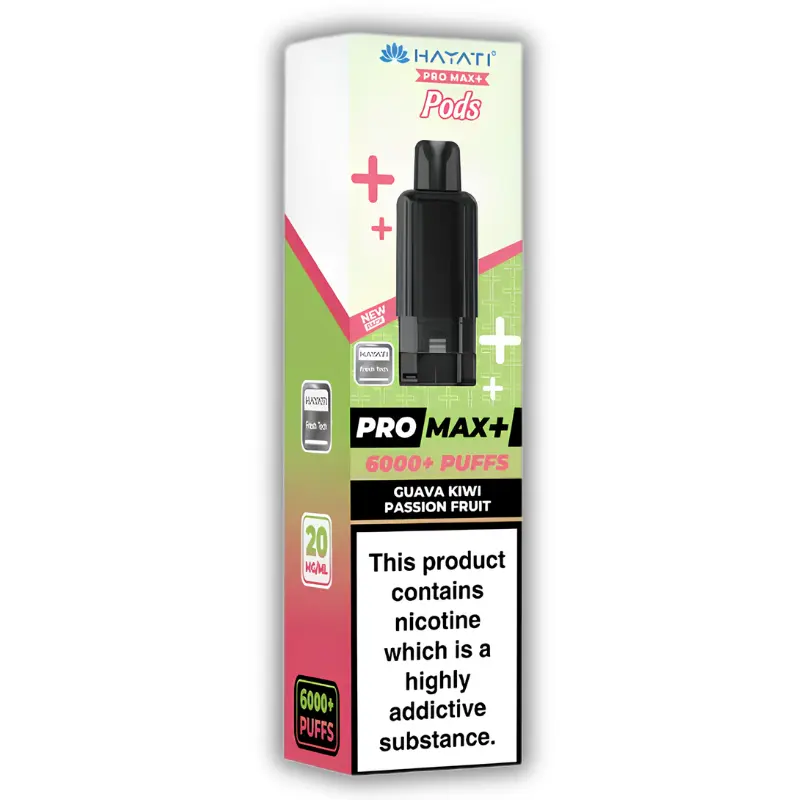
Hayati · Pro Max Plus
Guava Kiwi Passion Fruit Hayati Pro Max Plus Pods
£5.49
✔ In stock — ready to ship
Genuine Hayati
Free over £20
Same-day dispatch
Secure checkout
Sold here on its own, without a device: one factory-filled Guava Kiwi Passion Fruit pod for a Pro Max Plus body you already have. The price is £5.49. Inside is 12ml of liquid at 20mg nicotine in salt form, with the coil built into the pod and no way in to either. Hayati's stock reference is hpm-plus-pods-guava-kiwi-passion-fruit, and their own figure for a full pod is up to 6,000 puffs, which comes off test equipment drawing on a timer rather than from anybody's actual use of it. None of that is remarkable. Every pod on this shelf carries roughly the same set of numbers, and if the specification were the story there would be no reason to write more than a paragraph.
What is worth writing about is a property of this liquid that has nothing to do with the hardware and everything to do with the fact that you are buying it for the second time. Three fruits are named on the front of the listing. They arrived pre-mixed, in proportions decided by a flavourist you will never meet, and the pod is the smallest unit anyone sells. There is no version of this recipe with more kiwi in it. There is no version with the guava turned down. You cannot buy two thirds of it and leave the rest on the shelf.
That sounds like a statement of the obvious, and in a sense it is. The consequence is not obvious at all, and it only becomes visible on a reorder. Somewhere in the first pod you formed an opinion, and on a three-part blend that opinion almost always has parts. One of the fruits is the reason you are back. One of them you are neutral about. Quite often there is a third you would drop if dropping were on offer. On a single-fruit pod an opinion like that converts straight into a purchase, because what you liked and what is for sale are the same object. Here they are not, and the gap between them is the subject of this page.
A preference with nothing to spend itself on
Consider what a liking normally does for a buyer. You try something, you decide you want more of a particular quality in it, and the next order moves you towards that quality. That loop is the entire mechanism by which anyone ends up with a rotation they are happy with. It works because the thing you liked and the thing on sale line up: if you liked a mango pod because of the mango, buying mango again gets you mango again.
A composite breaks the loop in a specific place. The loop still runs up to the point of knowing. What it cannot do is convert. You finish a pod of this and conclude, let us say, that the green sourness in the first half of the draw is the part you actually came for and the scented sweetness sitting behind it is something you put up with. That is a real, useful, hard-won conclusion about your own palate. Now try to act on it. The only listing that contains exactly that green sourness in exactly that setting is this one, and it comes with the scented sweetness attached, because they are the same liquid. You are not buying a kiwi component and a guava component that happen to ship together. You are buying a single liquid that cannot be separated back into the things you have opinions about.
Run the same thought on a simple product and the difference is stark. Somebody who reorders Blackcurrant Juice has a preference that maps one to one onto a purchase. They like blackcurrant, the pod is blackcurrant, and if they want more blackcurrant next month they buy the same thing and get more of it. Their knowledge and their basket are the same shape. Triple Mango is an even purer case, since it takes one fruit and works it three ways rather than introducing a second idea at all. Preference in, product out, no loss in translation.
Now do the arithmetic that nobody prints on a listing. If the part of this pod you are loyal to is the kiwi, and the kiwi is responsible for perhaps a quarter of what reaches you on a draw, then three quarters of every £5.49 is buying material you did not specifically want in order to obtain the quarter you did. That is not a complaint about value. It is a description of how a bundled good works, and it is the same arithmetic whether the bundle is a blend of fruit or anything else sold as one unit. The uncomfortable bit is that on a simple product the ratio is one to one and nobody has to think about it, whereas here it can be four to one and the listing says nothing.
Two things follow, and they pull in opposite directions. The first is that partial knowledge has no partial purchase available to it, so a buyer who has half an opinion is stuck buying the whole recipe or buying something else entirely. The second is that the same sealed ratio is the reason the pod tastes the way it does at all, which is the argument for staying, and it gets a section of its own further down. Both are true. The point of this page is that the tension between them is what a reorder of a composite blend actually is, and that it is worth a minute of thought rather than a reflex click.
Where the range hides the problem
Hayati's naming makes this harder to see than it needs to be, because a three-fruit title looks like a specification and behaves like a brand. Read it as a specification and you will expect to be able to dial its terms. Read it as a brand and you understand immediately that the whole phrase is the product and none of its words are adjustable. The second reading is the accurate one. Guava Kiwi Passion Fruit is a single name for a single liquid, and the fact that the name happens to list three real fruits is a courtesy rather than a menu.
The listings named for a mood put this beyond argument. Sunset Aura and Galaxy Aura name no fruit whatsoever, and Midnight Dream and Blue Fusion do the same. On those, a buyer cannot form a component-level preference in the first place, because there are no published components to have preferences about. They are bundles whose contents are not itemised. This pod is a bundle whose contents are itemised, which is genuinely more useful, but itemisation is not the same as availability. Knowing that guava is in there does not make guava purchasable on its own terms, any more than reading a list of ingredients on a jar lets you buy one of them.
The honest framing for a repeat buyer is therefore narrow. Three names on the front tell you what to attribute your reaction to. They do not tell you what to do about it, and working that out means reading the rest of the shelf, which is a different activity from reordering and one the reorder button exists to save you.
Three parts, and what the pod would be without each one
The chemistry of why these particular fruits interact the way they do is worked out at length on the Guava Kiwi Passion Fruit Pro Max Plus 6000 Pod Kit page, including why the passion fruit is the component that decides the outcome, why the guava is not an independent second opinion alongside it, and what the kiwi is doing structurally. Anyone who wants that analysis should read it there. It is not repeated here, because it is the same liquid and there is no second version of the truth about it.
What this section does instead is a subtraction exercise, which is the form the question takes when you are deciding what to order next. For each of the three, the useful thing to know is not what it contributes in the abstract but what the liquid would become if it were not there, because that imagined liquid is the one you are shopping for when you go looking for alternatives.
Take out the kiwi
Kiwi owns the opening. Acid lands on the tongue faster than aroma travels, so the first thing you get is tartness with a leafy edge to it, and that is most of what distinguishes this pod from the general run of warm-climate fruit blends on the shelf. It is also short. By the middle of the draw it has handed over.
Remove it and you are left with something noticeably rounder and considerably sweeter in the reading, even though no sugar has been added, because the thing that was cutting the sweetness has gone. The remaining profile would be scented, floral, pink and pleasant, and it would read much closer to the confectionery end of the shelf than this pod does. If you have ever had a fruit liquid that seemed nice for ten minutes and cloying by the end of an evening, that is roughly the failure mode you would be walking into.
People who find, on reflection, that the kiwi is the point have the best-served preference of the three, because Hayati treat kiwi as a category. The Kiwi Vapes shelf holds twelve listings across formats, which is short enough to read in one sitting, and two of them are direct approximations of the part you want.
Take out the guava
Guava supplies the body, such as it is, and it is the most individually identifiable of the three. It arrives just behind the kiwi and stays longest, and its character is narrow and scented rather than broad and juicy: more like the smell of a flowering shrub than like biting into something. Whether you find it lovely or slightly soapy is largely a matter of how you get on with floral sweetness in general, and it is the single most common reason somebody decides this blend is not for them.
Remove it and the pod becomes thin, sharp and quite short. The kiwi would have nothing to cut against, which is a problem, because acid without sweetness stops reading as freshness and starts reading as sourness with no purpose. You would have something closer in construction to a citrus-led liquid than to a tropical one. That is a legitimate thing to want, and it exists on the shelf, but it is not this recipe with a fruit removed. It is a different design.
Take out the passion fruit
This is the hardest subtraction to imagine, because the passion fruit is the component least likely to be separately nameable in the first place. Its work shows up late, as a lift on the exhale that makes the guava read as juicy rather than as scented. Most people who run this pod could not point at it and say that is the passion fruit, and yet it is doing a disproportionate share of the work.
Remove it and very little seems to go missing on any single draw. What goes missing is across the pod: the blend would flatten, the guava would move towards perfume rather than fruit, and the whole thing would feel more like two things placed next to each other than one thing. Nobody would be able to say why. This is the awkward case for a repeat buyer, because it is the component you are least able to have an opinion about and the one whose absence you would most notice.
What the exercise is actually for
Doing this deliberately, rather than reordering on autopilot, converts a vague reaction into a shopping instruction. "I liked it" buys nothing new. "I liked it and the part I would keep if I could only keep one is the tart green opening" is an instruction that points at specific listings. The rest of this page is written on the assumption you have done that, because if you have not, the comparison section below is just a list of names.
Two things this pod is not, which matter for the same reason. It is not cooled: no temperature word appears anywhere in the title, and Hayati put one there when a liquid contains something cold, so the freshness you meet on the inhale is acidity rather than chill. And it is not a sour-coded product in the way a listing that says so in its name is. Tropical Sour Juice targets acidity on purpose and declares it. Here the tartness is a property of a fruit that happens to be in the recipe, which is a smaller and less adjustable thing.
The pod itself, briefly
There is not much to say about the hardware that has not been said across the ninety-odd listings sharing this device, and the Hayati Pro Max Plus Pods shelf will take you to the pages that say it. What arrives is one sealed pod and nothing else. No body, no cable, no spare anything. If you do not already own a Pro Max Plus, this listing on its own will not get you vaping.
The specification that matters most for the argument on this page is the dullest one on the sheet: 12ml, filled at the factory, with no port to open. That number is the size of the commitment. A pod is not a taster. Whatever you concluded about the ratio of these three fruits, you are signing up to another twelve millilitres of exactly that ratio, and there is no smaller quantity of it available anywhere. On a liquid you are certain about, that is convenience. On one you are two thirds certain about, it is the reason this decision deserves more thought than the price suggests.
The coil sits inside the pod and cannot be reached, serviced or replaced, which is the trade you accept for a pod that works out of the wrapper with no priming ritual beyond letting it stand. When the liquid is gone the whole assembly is finished and a new pod takes its place. Hayati name no charging connector in this product's data and no connector is named here, so treat any page that specifies one for this system as having got it from a writer rather than a manufacturer. The same applies to coil resistance and carrier ratio, neither of which appears against this listing.
What is fixed, what is chosen, and what is simply absent
The table below is arranged around the question this page asks rather than around the usual specification order, because on a reorder the useful division is not hardware against liquid. It is the things you get to decide against the things that were decided for you.
| Item | Status |
|---|---|
| The three fruits present | Fixed. Guava, kiwi and passion fruit, in one liquid |
| The ratio between them | Fixed at the factory, never published |
| Quantity per purchase | Fixed. 12ml, no smaller unit sold |
| Nicotine as supplied | Fixed. 20mg, salt form, single option on this listing |
| Cooling | Fixed at none. No cold marker in the name |
| Coil | Fixed inside the pod, not serviceable |
| Price of one pod | £5.49 |
| Whether to buy it again | Yours. The only variable this page can help with |
| What to alternate it with | Yours, and the nearest thing to an adjustment available |
| Puff figure | Manufacturer's laboratory estimate, up to 6,000 for a full pod |
| Flavour concentrations | Absent from the data for every pod in the range |
| Carrier ratio | Absent |
| Coil resistance | Absent |
| Fill date or batch marking on the listing | Absent |
| Device included | No |
| Catalogue reference | hpm-plus-pods-guava-kiwi-passion-fruit |
| Maker | Hayati |
Read down the first column and the shape of the purchase is plain. Almost everything material about this product was settled before it reached a shelf, and the two rows in the middle are the whole of your influence over it. That is not a criticism of Hayati. It is what a prefilled pod is, and the same table would look much the same for any of the ninety listings on this platform. It is worth laying out because the marketing language around prefilled pods talks constantly about choice, and the choice on offer is between whole products, not within one.
The strength row deserves its own note, since it is the one axis where the range does sometimes split a flavour into variants. Hayati publish a separate range-level listing at Hayati Pro Max Plus Prefilled Pods 10mg, and nothing in this product's data says whether this particular blend is among the flavours offered there. Do not assume it is. Nicotine is addictive and the figure on this listing is 20mg with no alternative attached to it, which is a fact to read rather than a recommendation to act on.
The absent rows are ordinary rather than suspicious. No prefilled pod in this catalogue publishes a concentration, a resistance or a carrier ratio, and a page that starts quoting percentages for a recipe nobody has published has crossed from description into invention. The fill-date row is the one that occasionally matters in practice, and the answer is that there is no date on the listing and none printed on the packet, so a pod's age is not something a buyer can verify.
Routes out, and what each one costs you
This is the practical section. If you have decided which part of the blend you are there for, here is what the rest of the catalogue can and cannot do about it. The honest summary up front: every route involves giving something up, because none of these listings is this recipe minus a fruit. They are other recipes that happen to contain something similar.
If the kiwi is the part you want
This is the best-served case, and there are two serious options plus a couple of oddities.
Strawberry Kiwi is the closest thing to a decomposition that exists on this shelf. Two fruits instead of three, the kiwi keeps its acid and its green edge, and the partner is soft and red rather than scented. What you give up is the entire aromatic upper register: no perfume, no floral top, no tropical lift on the exhale. What you gain is legibility, because two fruits in different territories are far easier to hold apart than three. People who liked this pod for its tartness and were ambivalent about the floral part usually find that a straight upgrade. People who liked the tartness because of what it was cutting through find it oddly flat, since there is much less to cut through.
Kiwi Cooler promotes kiwi from a structural role to the headline, and hands it a declared coolant to sit on. That is a genuine answer to "more kiwi, please" and it comes with a condition attached: you are also buying cold, whether or not you wanted cold. If the appeal of the current pod was partly that it stays warm and fruity all the way through, this is not a neutral substitution.
Two further kiwi listings exist and both come with a hardware caveat, which is the sort of thing that turns into a drawer of pods that will not seat in the body you own. Strawberry Kiwi Hayati Rubik Pods at £3.99 is the same fruit pairing listed against a different Hayati system. Kiwi Banana and Strawberry Banana on the Pro Ultra Plus at £7.99 is the only place in the range where kiwi meets a genuinely dense partner, which is the one experiment this pod does not run, and it is listed against the Pro Ultra Plus rather than the Pro Max Plus. Hayati publish no cross-fitment chart, so match the platform in the title to the body in your hand and do not reason from the brand name.
If the guava is the part you want
Thinner ground, because guava is rarely a headline fruit anywhere. Strawberry Guava is the one listing that gives it room, pairing it with a partner that does not compete for the top of the profile. That makes it the nearest thing available to hearing the guava on its own.
What you give up is everything the kiwi was doing. No green note, no real acidity, and a consequent shift towards sweetness that some people find becomes wearing over twelve millilitres. It is a useful reminder that the guava you enjoyed here was being held in check by something, and that removing the thing holding it in check does not give you more of what you liked so much as more of what you liked without its counterweight. That is the single most common disappointment in this whole exercise and it is worth expecting.
For a sideways move rather than a direct one, Lychee Ice is a different fruit doing a comparable job: floral, scented, light in body, high in the profile, with a coolant underneath it. If what you actually like is perfumed exotic fruit rather than guava specifically, that is a better lead than anything with guava in the title. The Exotic Vapes shelf collects the category across formats and is the sensible place to browse from.
If the passion fruit is the part you want
Nothing in the Pro Max Plus pod range names passion fruit on the front of a listing, so this preference has no direct route at all. The closest relation Hayati sell is Blackcurrant Mango, for reasons set out on the kit page rather than here, and it is a very different liquid with something related happening underneath it.
If it is the effect rather than the fruit you are after, that late lift that makes everything read fresher, then acidity is the blunter and more reliable substitute. Tropical Sour Juice, linked earlier, is built around it and says so. Lemon Lime takes the same idea to a citrus pairing with none of the tropical material, which is a cruder instrument and an honest one.
If you liked the structure but want different fruit in it
Worth separating out, because a fair number of people who enjoy a three-part blend are enjoying the structure rather than any individual component. If that is you, the shelf has several listings built the same way and you can move fruit families without losing the shape. Blueberry Raspberry Cherry and Blueberry Cherry Cranberry are the two nearest structural analogues, both three-part, both with a sharp element doing roughly the job the kiwi does here, and both in the dark berry family rather than the tropical one. They have precisely the same unbundling problem, which is the point: you would be swapping one sealed ratio for another.
Dragon Berries and Caribb Crush sit in adjacent territory with less published detail, the second especially, whose name is a description of a mood rather than a contents list. Both will keep appearing next to this pod in a filtered view, and neither can be calibrated against your experience of this one in any rigorous way.
If you want fewer moving parts full stop
A perfectly reasonable conclusion, and the cleanest response to the whole argument on this page. Buy something with one idea in it and the gap between what you know and what you can buy closes completely. Triple Mango, mentioned earlier, is the extreme version. Blackcurrant Juice is the straightforward one. Mango Banana and Blue Razz Cherry are two-fruit listings, which is the sensible intermediate step: enough contrast to stay interesting, few enough components that a preference still maps onto a purchase with only a little loss.
Three components is where the arithmetic starts working against a buyer. Two is usually manageable, because liking one and tolerating the other still means half of every purchase is the part you came for rather than a quarter of it.
The one adjustment that is actually available
You cannot change the recipe, but you can change how often you meet it. Ordering this alongside something structurally opposite, and alternating between them, does not alter a single millilitre of what is in the pod. It alters the proportion of your week that contains guava. That is a weaker lever than a dial on the device would be, and it is the only one on offer. Double Menthol is about as far from this profile as the shelf goes and is the usual choice for that job, and Hubba Bubba is the confectionery-end counterpoint if you would rather the contrast came from sweetness than from cold.
For browsing rather than deciding, Hayati Prefilled Pods & Refills puts every pod in the catalogue side by side across systems, and the full Hayati catalogue is the place to filter from the top. Do check the platform named in a title against the device you own before ordering from either, since both mix systems together.
The case for not going anywhere
Everything above assumes decomposition is worth attempting. It is only fair to put the other side, because the other side is strong and it is the reason most people reorder the thing they had.
The first argument is the one that undoes the whole subtraction exercise. A blend is not an assembly of separable parts with a shared container. What you taste on the exhale of this pod is not guava plus kiwi plus passion fruit arriving in sequence: it is the result of the three being together, and a version with one removed is not this liquid minus a fruit. It is a different liquid. Strawberry Guava is not the guava part of this pod. It is guava in a different recipe, with a different partner, made to a different balance, and whatever you liked about the guava here may simply not survive the move. The subtraction exercise is a way of forming a shopping instruction. It is not a prediction of what the substitute will taste like, and treating it as one is how people end up disappointed by a listing that was perfectly good.
The second argument is about what the sealed ratio buys you. A recipe that cannot be adjusted also cannot be got wrong, and there is a real comfort in that. Somebody who could turn the passion fruit up would eventually turn it up too far, because the temptation with a component that does something nice is always to want more of it, and more of it is frequently the wrong answer. The proportions in this pod were set by somebody whose job it is to know where the limits are, and they set them once, for everybody. That is the trade-off of a mass-produced blend stated plainly: no control, in exchange for not needing any.
The third is about effort. Working out which listing approximates the part you want, ordering it, running twelve millilitres of it and forming an opinion is a project of some weeks and several pounds, and at the end of it you may well conclude that the original three-part version was better than any of its neighbours. That is a genuinely common outcome and it is not a failure. It is information, and once you have it you can reorder this pod without the nagging sense that something better was one click away.
So the defensible positions are two, and they are not the same position. One is "I like this and I have not looked", which is fine and describes most repeat purchases of anything. The other is "I like this, I know which part of it I am there for, I have looked at what else the shelf offers, and this is still the best available container for that part". The second is worth more than the first, and it costs about ten minutes.
Handling a pod whose recipe you cannot change
General pod advice applies here as it does everywhere, so what follows is restricted to the points that behave differently because of what is in this particular liquid.
Let a new pod stand upright for two or three minutes before the first draw. The reason is specific rather than ritual. A wick pulled on dry gives you a scorched note, and on a heavy sweet liquid that note has somewhere to hide. This recipe has almost no weight in it, so there is nothing to hide behind, and a scorched first impression sits on top of the fruit for the rest of the pod. Since you cannot rebalance the liquid afterwards, a bad start is not recoverable.
Judge it early in a session, not late. Acidity stops registering on a palate long before aromatic material does. An hour into continuous use you have effectively lost the kiwi while the guava is still arriving at full strength, which means the pod you are tasting at that point is a lopsided version of the one you bought. Anyone using late-session impressions to decide whether to switch listings is deciding on bad evidence.
Leave a gap between draws. Consecutive pulls run a coil hot, and heat is hardest on the lightest and most volatile material in a liquid. Here the light volatile material is not decoration, it is most of the recipe, so a hot coil costs this pod proportionally more than it would cost a dense fruit blend. Ten or fifteen seconds is enough.
Store spares somewhere cool, dark and dull. A drawer or a cupboard. Not a car dashboard, not a coat pocket against a radiator, not a windowsill in summer. Sustained warmth drives off the lightest components of a liquid first, and in this pod that means the lift and a good part of the scent go before anything else does. A badly stored pod does not spoil, it goes quiet, and it goes quiet in the exact direction this recipe can least afford. Keep pods and device where children and animals cannot reach them.
Do not pull harder when it starts to tire. The instinct to draw longer on a fading pod moves more liquid across a coil that is already labouring and speeds up residue on the mesh. On this blend that accelerates you towards the least attractive version of the recipe, the one where the tart green opening has gone and the scented sweetness is all that is left.
Know when it is finished. Thinning vapour plus a flat, slightly burnt edge that a rest does not fix means the liquid is gone. There is no fill port and no replaceable coil, so nothing can be done at that point. A spent pod still holds a coil and a residue of e-liquid, which puts it in a take-back bin at a vape retailer or a council recycling point rather than in the household waste.
Questions a second-time buyer actually asks
Can I get this flavour with more kiwi in it?
No. The recipe is mixed and sealed before the pod leaves the factory, and Hayati publish no variant of this blend at any other balance. The nearest approximations are listings where kiwi is the lead fruit rather than a structural element, which is a different liquid rather than an adjusted version of this one.
Does this listing include a device?
It does not. £5.49 buys the pod alone, and it assumes you already own a Pro Max Plus body. The complete kit is a separate listing at a higher price, and buying it again would mean paying for a second device you do not need.
Is there any cooling in it?
None. Hayati signal a coolant in the product title when one is present, and this title is three fruit names with no temperature word among them. The freshness on the inhale comes from the kiwi's acidity, which is a different sensation once you know to look for it.
I only really like one of the three fruits. Should I keep buying it?
That depends on how much of the draw your preferred fruit accounts for and how you feel about the rest. If the other two are actively unpleasant to you, no, because there is no way to reduce them and you will be paying for them every time. If you are merely neutral about them, this is usually still the best available way to get the part you want, since nowhere else on the shelf puts it in this particular setting.
Is Strawberry Guava just the guava half of this pod?
No, and treating it that way is the commonest mistake here. It is a separate recipe in which guava meets a different partner and is balanced differently, so the guava in it may not behave as the guava in this blend does. It is the closest listing to that preference, not an extract from this one.
How much liquid am I committing to?
Twelve millilitres, which is the only quantity sold. There is no sample size and no smaller pod, so every purchase of this flavour is a full pod of the same fixed recipe. That is worth weighing if you are still undecided about the balance.
Can I mix two pods to get a blend I prefer?
Not on this hardware. The pods are sealed with no fill port and the coil is enclosed, so there is nothing to open and nothing to combine. The only version of mixing available is alternating between two pods across a day or a week, which changes how often you meet a flavour rather than what is in it.
Is a lower nicotine strength offered for this flavour?
Not on this listing, which supplies 20mg in salt form with no alternative attached. A separate range-level listing exists at 10mg, and this product's data does not say whether this blend appears among its flavours, so do not assume it does. Nicotine is addictive and the figure is there to be read as a fact.
Which fruit is most obvious in the draw?
Guava is the most identifiable and the most persistent, kiwi is the most distinct because it occupies ground the other two do not touch, and passion fruit is the hardest to name separately because most of what it does is lift the other two rather than announce itself. The name lists them roughly in order of prominence.
Will a pod listed against another Hayati system fit my device?
Hayati publish no fitment chart and no cross-compatibility note anywhere in the product data, so nothing here can answer that either way. The only reliable signal is which system a pod is listed under. Match that to the body you own, and do not infer a fitting from a shared brand name on the box.
The short version
£5.49 buys one sealed pod holding 12ml of a three-fruit tropical liquid at 20mg nicotine salt, for a Pro Max Plus body you supply yourself, with a manufacturer's laboratory figure of up to 6,000 puffs on a full pod. Kiwi opens it with tartness and a green edge, guava carries the scented middle and lasts longest, and passion fruit works behind both, lifting them rather than appearing in its own right. There is no cooling in it and no dense fruit underneath it.
The thing that separates this from a simple reorder is that the recipe is a bundle you cannot edit. By the time you are buying a second pod you generally know which of the three fruits you are there for, and that knowledge, which would be directly actionable on a single-fruit listing, buys you nothing here. You cannot take the guava out, cannot turn the passion fruit up, and cannot purchase any quantity smaller than the whole twelve millilitres of a ratio somebody else set. The routes off this listing all lead to other recipes rather than to parts of this one, and each costs you something: the kiwi listings drop the aromatic top, the guava listing drops the acid, and nothing at all leads to the passion fruit.
Against that, the interaction between the three is a real part of what you liked, so a decomposed version is not this pod with a fruit removed. It is a different drink. Stay if the whole is what you enjoy and you have looked at the neighbours honestly. Move if one component is the whole of your interest and another listing puts it somewhere you would rather have it. Either way, the useful thing is knowing which of those two you are doing.
Strictly for adults aged 18 and over. Nicotine is an addictive substance.
You might also like


