
Home / Hayati Pro Max Plus Pods / Dragon Berries Hayati Pro Max Plus Pods
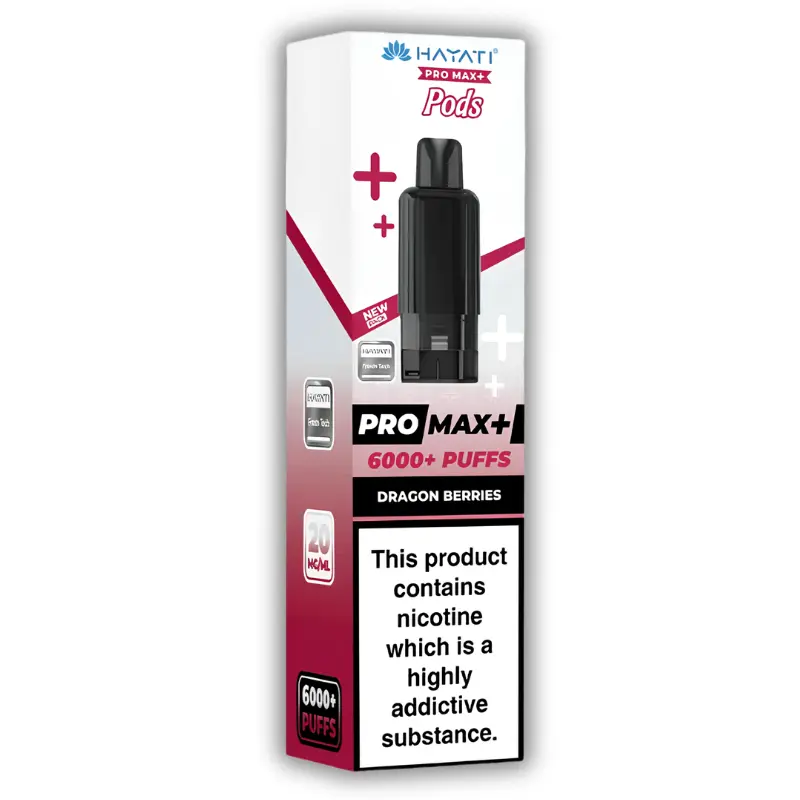
Hayati · Pro Max Plus
Dragon Berries Hayati Pro Max Plus Pods
£5.49
✔ In stock — ready to ship
Genuine Hayati
Free over £20
Same-day dispatch
Secure checkout
£5.49 buys twelve millilitres of liquid and nothing else. No body, no case, nothing to plug in: this is the Dragon Berries refill for a Hayati Pro Max Plus that is already in your pocket, filled at 20mg, sold on the assumption that you have been here before. First purchases go to the kit. Second and fifth and eleventh purchases come to a listing like this one. So the page you are reading is not about discovering a flavour. It is about repeating one, and repetition asks a question that discovery never has to answer.
The question is short. You liked a pod. You are buying the pod again. Which part of it are you actually buying?
On most listings that is a silly thing to ask, because the title answers it before you finish reading. Somebody restocking Blackberry Raspberry is restocking blackberry and raspberry in some ratio, and if one of the two is the reason they came back they can say which. Somebody restocking Strawberry Kiwi has two levers with labels attached to them. Dragon Berries is not assembled that way, and the difference is structural rather than cosmetic. One half of the name points at a fruit that, on the available evidence, contributes very little to what ends up in your mouth. The other half is a category noun standing where a recipe would go. Between them they make it genuinely awkward to say what the money is for, and that awkwardness is built into the product rather than into your attention.
What the kit page settled, and the bill it left unpaid
Three findings already sit on Dragon Berries Hayati Pro Max Plus 6000 Pod Kit, the same liquid with a body in the box at £7.99. Rebuilding them here would waste space this page needs.
Finding one concerns the word. Hayati write "Dragonfruit" out in full elsewhere in their catalogue when they are confident about it, which places "Dragon" on this listing in the house shorthand group rather than the atmospheric group. It is a real fruit with syllables removed, not a mood word in the way Midnight Dream is a mood word. Finding two concerns the copy. Hayati's own description of this blend never states dragon fruit as an ingredient. It reads the name and reports what the name appears to indicate, which is a different act from declaring contents, and a quieter one. Finding three concerns the fruit. Dragon fruit has no character compound, so a dragon fruit flavour anywhere in any product is an accord built to produce an impression rather than an extract of a plant, and what people enjoy when they eat one is largely colour, texture, chill and water, none of which vapour carries across.
Stack them up and they add to a modifier rather than a lead. The kit page reached that conclusion, hedged it properly as an inference, and stopped there. What it never did was follow the conclusion as far as the till.
Follow it, and the arithmetic of a reorder changes shape. If the dragon fruit element is pale, then whatever you enjoyed on your first pod was produced overwhelmingly by the berry base, with a small adjustment somewhere near the top of the profile doing the rest. Your £5.49 is therefore mostly a payment for that base. And the base is the half of this product with no species named, no proportion given, no tartness signal anywhere on the record, and nothing a buyer could ever hold the maker to. You are rebuying the unnamed component under the impression that you are rebuying the named one.
Which is the subject of everything below: working out the real object of a preference. That is a harder problem than describing a flavour, and on a second purchase it is a considerably more useful one.
Preferences attach themselves to words, and the words are printed on the box
Start with what actually happened the first time. You did not taste a berry base and then taste a dragon fruit accord and then combine your two opinions. You took a draw. One percept arrived, indivisible, and you found it agreeable enough to come back. Nothing in that experience was itemised, because perception does not deliver itemised results, and no amount of concentrating harder on a mouthful of vapour produces a parts list.
Then, at some point afterwards, you had to explain the preference, either to somebody else or to yourself while deciding whether to order more. Explanation is a language task, and language tasks run on the vocabulary available. The vocabulary available was the product title. Two words: one of them unusual, one of them generic.
Given that pair, the credit goes to the unusual word almost every time, and for a reason that is perfectly rational until you examine it. A reason has to feel like a reason. "I liked it because it was a sweet berry pod" does not feel like an explanation, because it describes a large fraction of this shelf and therefore explains nothing about why you chose one member of it. "I liked the dragon fruit in it" feels like an explanation, because it identifies something particular. The distinctive element gets the credit not because it earned it but because it is the only element specific enough to be named.
Notice how little of that has to do with the liquid. Had the same twelve millilitres shipped as Mixed Summer Fruits, the same buyer would report liking a decent berry pod and go looking for other berry pods. Had it shipped as Dragon Fruit Berry Blast, the same buyer would report a stronger exotic character than they got. The percept is identical in all three cases. Only the handle changes, and the handle is what survives into a reorder three weeks later, because a handle can be remembered and a percept cannot.
Two costly errors fall out of this, and they point in opposite directions, which is why the page cannot resolve them with a shrug.
The first error is chasing the wrong attribute sideways. A buyer who believes the exotic note was the point goes hunting for other exotic listings, lands on something built around a loud tropical fruit, and finds it completely unlike what they wanted. That is not the new pod's fault. They bought a description of their own reasoning rather than a description of their preference. If berries were doing the work, a tropical pod without berries removes the actual cause and keeps the imaginary one.
The second error is the mirror image. A buyer who concludes "fine, it is just a berry pod" and picks any named berry listing may find the substitute subtly wrong and be unable to say why, because the small adjustment they never credited was in fact doing something. Failing to name a component is not evidence the component was idle. Those are two different claims and the gap between them is exactly where this purchase decision lives.
So the page owes you a verdict rather than a pair of hedges. It arrives further down, after the evidence, and it is not the verdict most pages about an exotic modifier would reach.
The half you are rebuying has no label on it
Here is the asymmetry that decides most of this, and it is checkable rather than theoretical. Hayati publish a short flavour description against every listing on this shelf. Read what those descriptions commit to for the named berry pods, and then read what they commit to here.
Strawberry Raspberry Cherry gets three species, in order, with a stated job for each: one supplies sweetness, one supplies the sharp lift, one supplies depth. The copy also says there is enough tartness to carry the blend across a full pod. That is four separate assertions a buyer could test and find false.
Blackberry Raspberry gets two species, a direction for each, and an explicit claim that the blend is tart rather than syrupy and reads as fruit rather than as confectionery. Blueberry Pomegranate goes further still and names a texture: the pomegranate is described as tannic as well as tart, which is an unusual thing to put in writing and a very easy thing to be caught out on. Cherry Berry names its lead fruit and states that the supporting berries supply the tang that stops the cherry running away with the pod.
Now Dragon Berries. The description gives the berry mix two properties, sweetness and depth, and says the lighter exotic edge keeps it from reading as an ordinary berry flavour. That is it. No species. No proportion. No tartness, no sharpness, no acid of any kind mentioned in any direction. No claim about whether it reads as fresh fruit or as boiled sweets, which is the distinction that decides more abandoned pods than any other single attribute.
Two of those blanks matter more than the rest. The first is the missing acid signal, and it matters because tartness is the axis along which berry blends in this range differ most, and the axis Hayati describe most readily when it exists. Every named berry listing on this shelf says something about it. This one says nothing, which is not proof the blend is flat, because absence of a claim is not a claim of absence. It does mean the axis you would most want fixed before reordering is the one the record leaves open.
The second is the missing species list, and its consequence is specific to a repeat purchase rather than a first one. When a named pod disappoints, you know what to change. Too much dark fruit means move to the red end. Too sweet means find something with declared tartness. An unnamed base gives you no such handle: if the fourth pod feels wrong you have nothing to adjust, because you never knew what was in the third. A liquid you cannot describe is a liquid you cannot substitute, and substitution is the entire content of a restocking decision.
There is a fair counter to all of this and it deserves stating before the comparison begins. A composite berry accord that genuinely does not resolve into one nameable fruit is a real thing rather than a marketing dodge, and a maker who declines to print a species list for a blend like that is being more accurate than one who picks a fruit at random and prints it. The kit page gave both readings of the naming decision and refused to choose. This page does not need to choose either, because the practical consequence is the same under both: whatever is in there, no berry stood up and identified itself, and you are buying a description that stops at "sweet" and "deep".
A naming family nobody points out, and why it is the right test bed
There is a small group of listings on this shelf built to exactly the same grammar as Dragon Berries: one named thing, then the unnamed category noun. Once you see it, the comparison that answers this page's question is sitting right there, at the same price, on the same hardware.
Grape Berry is the same construction. A named modifier, grape, and then "berry" doing the same duty it does here. Cherry Berry is the same again, with the modifier promoted to the lead position. Berry Lemonade is the same shape with the modifier drawn from a drinks register instead of a fruit one. And Dragon Berries closes the set. Four products, one recipe pattern, four different answers to the question of how loud a modifier should be.
Line them up by how much of the pod the modifier can plausibly occupy and you get a ladder.
Grape sits at the top. Grape in this format is a heavy, sweet, purple-fruit material with a good deal of body, and Hayati's own copy for that listing describes the grape as the base with the berries layering depth on top of it. The modifier has taken over. Someone reordering Grape Berry knows perfectly well that grape is the reason, because grape is not the sort of thing that hides.
Cherry sits next. Loud, dark, immediately recognisable, and the copy gives it the lead while explicitly assigning the berries a corrective job. Again the buyer can attribute correctly, because cherry announces itself on the first draw.
Lemonade is a different kind of loud: not a fruit but a structural change, a citrus register laid over berries that alters the shape of the whole draw rather than adding a note to it. Nobody misattributes lemonade.
Dragon fruit sits at the bottom of the ladder, and by a distance. It is, by the kit page's account, the quietest edible thing anyone would seriously build a flavour around: mild, watery, very low in acid, with no molecule that identifies it. The accord assembled to represent it is pale and floral by construction. So across four listings with identical grammar, three have modifiers that unambiguously earn their billing and one has a modifier whose entire case rests on being noticeable at all.
That ladder is the useful thing this family gives you, because it converts a vague worry into a concrete question. Not "is dragon fruit nice", which nobody can answer for you, but "does this modifier do enough to distinguish the pod from the base it is sitting on". On the other three the answer is obviously yes. Here it has to be argued.
Against the pods that name what yours does not
Everything below sits at £5.49, on the same platform, as a pod on its own. Price is not the variable. What varies is how much of the purchase is specified in advance, and that is the axis a repeat buyer should be choosing on.
If your honest read is that you liked a sweet berry pod. Then the sensible move is a berry pod with a printed structure, and there are three good ones. Strawberry Raspberry Cherry is the fullest statement of the red-fruit accord on this shelf, three species with declared roles and a stated tart edge, which is a more complete specification than Dragon Berries offers by some margin. Blackberry Raspberry narrows to two and runs darker and sharper, with the tartness put in writing. Cherry Berry keeps the unnamed berry mix you may have grown fond of and simply gives it something audible to work against. That last one is the closest structural swap available: same base treatment, modifier turned up.
If what you liked was the lightness rather than the exotic idea. This is the case worth taking seriously, because a pale floral component sitting over berries mostly registers as the pod being less heavy than it should be. Two listings deliver exactly that with a named partner. Strawberry Watermelon pairs a berry lead with a watery, low-intensity fruit, which is close to the job a dragon fruit accord is built to perform, except that the source of the lightness is on the label. Strawberry Kiwi is even more direct: kiwi is one of the fruits people habitually reach for when trying to describe dragon fruit, it carries the green edge and the faint sharpness, and here it is printed in the title where you can check it. If you enjoyed a berry pod that felt thinner and greener than most, these are the same effect with a receipt.
If you want the sweetness pulled back. Nothing in this blend's record suggests acid, and a repeat buyer who has noticed the pod getting harder to read by the eighth millilitre is describing a sugar problem rather than a flavour problem. Blue Sour Raspberry attacks it with declared sourness. Blueberry Pomegranate attacks it with tannin and tartness, which is a subtler correction and keeps the blend closer to fruit than to sweets. Blackcurrant Lemonade uses citrus to do it, and Blackberry Ice uses a coolant instead, reaching a similar clearing effect by an unrelated route. Dragon Berries carries none of those four devices, which is worth knowing before you order a third one.
If you concluded the exotic note was the point and you want more of it. This is where the attribution error costs real money, so read the warning before you spend. Dragon fruit will not get louder by buying a pod with more of it in, because the ceiling is set by the fruit rather than the dose. What you can buy is a tropical character you are able to name. Guava Kiwi Passion Fruit is built on acidity and perfume with three fruits all loud enough to follow individually, which is the opposite construction to this one. Tropical Sour Juice puts a sour edge on tropical fruit so the profile bites before it sweetens. Mango Banana goes the other way into weight and creaminess. Any of the three gives you an exotic note you could identify blindfolded, which Dragon Berries very probably does not. Browse the rest on the Exotic Vapes shelf if none of those three fits.
If you are comparing one blurred name against another. Dragon Berries is only half a member of the vague-title group, since it does name a fruit even in clipped form. Full members behave differently and should not be treated as equivalent options. Sunset Aura and Galaxy Aura name a mood and no ingredient at all. Blue Fusion hides two fruits behind a colour. Mr Blue asks to be treated as a single cohesive blue flavour rather than a blend you pick apart, which is at least honest about the unpicking problem. Vim Ice is cryptic in the title and specific about the style, dark fruit with a chill. Against that company this listing is comparatively forthcoming, and that is a genuine point in its favour.
If the blue accord is your usual territory. Crossing over is a bigger jump than the shared word "berry" suggests. Blue Razz GB and Blue Razz Blackcurrant both start from a confected sweet-sharp base with a tang running under it, and a soft uncooled red berry blend with no declared acid will read as flat for the first half hour until expectation catches up. That is an adjustment rather than a fault, but it is easier to make deliberately than by surprise.
The wider Berry Vapes shelf runs to a couple of hundred listings if none of the above is right, and the whole Hayati Pro Max Plus Pods range holds eighty-nine pods for this device.
The case for the modifier, put as well as it can be put
Everything above leans one way, so the other side gets a proper hearing rather than a token paragraph. The argument against the modifier is weaker than it first looks.
Begin with the logical point, which is the strongest thing the defence has. "I cannot describe the difference" and "there is no difference" are separate statements, and the first does not imply the second. People are poor at naming components inside blends generally: handed a well-made three-fruit liquid, most experienced vapers report that it is complex without reliably listing the three fruits, which says something about naming rather than about the liquid. Requiring a modifier to be nameable before it counts as real would disqualify much of what makes any blend worth having.
Second, sub-threshold components genuinely do work. A material present below the level at which anyone could identify it can still shift where the sweetness peaks, how long the finish runs, and whether the blend reads heavy or light. That is ordinary in flavour construction rather than exotic, and it shows up as a change in character rather than as an ingredient you can point at. If the dragon fruit accord here is contributing at all, this is the form the contribution takes.
Third, the failure to name it is partly the fruit's own doing, as the kit page established at length. A component with no character compound cannot be named by anybody, including the person who formulated it, without the label in front of them. Judging the component by whether you can name it therefore measures the fruit's vocabulary problem rather than its contribution.
Fourth, and most practically: Hayati chose to put the word in the title. A range this size has no shortage of alternative names available, and titling a product after a component that contributes nothing at all invites exactly the complaint this page is describing. The simplest explanation for the word being there is that something in the recipe is meant to correspond to it.
So what evidence would separate "real but unnameable" from "not doing anything"? One thing only, and it is available to you rather than to me. A modifier that is present but sub-threshold still changes the blend's behaviour over time, because the light floral and watery materials that make up a dragon fruit accord are the most volatile part of the recipe. They leave a warm pod faster than the sweetener and faster than the heavier berry notes. Which means a pod near the end of its life should read as measurably more ordinary than the same pod on day one, and more ordinary specifically in the direction of plain sweet berries. If your second pod started out subtly different from the berry pods you know and converged on them as it emptied, the modifier is real and you have watched it evaporate. If it read the same at twelve millilitres as it did at two, the word on the box is doing more work than the material behind it.
The verdict. On the balance of what is published, I think the modifier here is real and I think it is close to worthless as a reason to buy. Those are compatible positions and the distinction is the whole point. Something is almost certainly in there, it is almost certainly shifting the blend a little lighter and a little more floral than a plain berry accord, and that shift is small enough that it cannot be the thing you are paying for, because you could not pick it out of a line-up and because the same lightening effect is available from Strawberry Watermelon or Strawberry Kiwi with the cause printed on the label. A modifier earns its place when it changes what the pod is for. This one changes how the pod feels by a margin you would struggle to defend in an argument, which makes it a pleasant detail rather than a purchase reason. Reorder this because the berry base suits you. Reorder it for the dragon fruit and you are paying £5.49 for a word.
The pod on its own, in short
Eighty-nine listings share this hardware and the device has been explained at length elsewhere, so this section stays small on purpose. What arrives is one pod, prefilled, holding twelve millilitres at 20mg, with no body and nothing else in the packet. It goes onto a Pro Max Plus you already own, and the device behaves exactly as it did with the last pod on it.
The specification worth dwelling on for this particular liquid is the twelve millilitres, and the reason is specific to the question this page has been asking. On a pod whose contents are itemised, that figure is a diary entry telling you roughly when to reorder. On a pod whose distinguishing component is unverified, the same figure is the size of the commitment you are making to a reading of two words. Nothing can be decanted, diluted or blended with anything else once it is sealed in there, and a modifier that is inaudible to you at the second millilitre will not become audible at the tenth. Order one and settle the question, rather than ordering three and settling it twice over.
Hayati quote a ceiling of 6,000 puffs for the pod. Treat that as a laboratory number obtained on test apparatus under controlled conditions rather than a forecast for a person, since draw length and how often the device is picked up both move the real total, and they move it in one direction only. Everything else about the platform, how the pod seats, what changes as the body ages, and how the rest of the catalogue relates to it, is covered on the Hayati Pro Max Plus Pods shelf and across the broader Hayati Prefilled Pods & Refills listing.
The listing read as an attribution document
The table below is arranged by who gets the credit for what, because that is the question this page exists to answer. Rows recording what Hayati decline to state are included deliberately. On a product where half the recipe is withheld, the withholding is part of the specification and a buyer deciding on a fourth pod should see it laid out rather than inferred.
| Line on the listing | What it says, and who it credits |
|---|---|
| Component named in the title | Dragon, clipped, one word |
| Component left as a category | Berries, with no species given |
| Component the maker's copy describes first | The berry mix |
| Properties claimed for the berry mix | Two, sweetness and depth |
| Tartness or acidity signalled anywhere | None, in the title, the copy or the filing |
| Coolant signalled in the title | None |
| Dragon fruit confirmed as an ingredient | No. The copy interprets the name rather than listing contents |
| Liquid supplied | 12ml, already in the pod on arrival |
| Nicotine concentration | 20mg |
| Device in the packet | None. A Pro Max Plus body is required and is not supplied |
| Puff ceiling quoted by Hayati | 6,000, from test equipment |
| Carrier ratio | Absent from this product's data |
| Coil resistance | Absent from this product's data |
| Shelves it appears on | Six, of which Berry Vapes and Exotic Vapes carry any information |
| Stock reference | hpm-plus-pods-dragon-berries |
| Made by | Hayati |
| This listing | £5.49 |
| Same liquid with a body included | £7.99 |
Three rows need a note. The 20mg states a concentration and nothing more; nicotine is addictive, the figure reports what the liquid holds, and no strength is recommended to anyone here. The two absent technical rows are the ones most often filled in from a neighbouring page, after which a guess circulates as though somebody had measured it. One governs vapour density and how quickly liquid moves through the wick, the other governs how tightly the device pulls, and this product publishes neither, so neither is given a value.
The row that matters most for a reorder is the fifth, the empty tartness line. Every named berry listing compared above puts something on the record about tartness. This one puts nothing, and a buyer choosing between restocking here and moving to a named pod is, in practice, choosing between an unstated acid level and a stated one. That is a real difference in what £5.49 buys, even though both boxes contain the same volume of liquid at the same strength.
Making the next pod answer the question
General handling advice for a pod of this type is the same everywhere and is not worth repeating. What follows is aimed at one thing only: coming off your next twelve millilitres knowing what you actually like, so the pod after that is chosen rather than defaulted into.
Write the prediction down before the pod arrives. This sounds fussy and it is the single most useful thing on the list. Memory of a flavour reconstructs itself around whatever you believe about it, so an opinion formed after tasting will quietly agree with whatever you expected. Commit to a sentence in advance: either "I expect this to taste noticeably different from a plain berry pod" or "I expect it would pass as one". A prediction you cannot revise afterwards is worth ten impressions you can.
Judge it on draws four through ten, not on the first. The opening draws of a fresh pod are where the light top of the profile is loudest, and also where you are most primed by having just read the wrapper. Both push the same way, towards hearing the exotic note. Let it settle, then form a view.
Track the drift rather than the taste. This is the test set out above, and it costs nothing to run. Note how the pod reads early and note it again as the liquid runs low. Convergence towards a plain sweet berry profile is the signature of a volatile modifier leaving the blend, and it is the best evidence available to you that there was one. No change at all across twelve millilitres is informative in the other direction.
Keep the pod cool, because the thing in question is the first casualty. The materials carrying any exotic character are the lightest in the recipe, so a pod that has spent an afternoon on a warm windowsill will answer your question wrongly and you will not know it has. Room temperature, upright, away from direct sun, never left in a parked car, and in a drawer that children and pets have no access to.
Do not chain-pull it hunting for the note. Drawing hard and repeatedly works against itself twice over. A heavily sweetened liquid outruns a wick when it is pulled at speed, laying a scorched edge over the delicate part you are straining to hear, and continuous use flattens your own sensitivity within a quarter of an hour. Long slow draws with gaps between them are how a faint note gets found, if it is there.
Know when the answer is no longer available. A coil accumulating residue strips the lightest materials first, which on this blend means the distinguishing note goes before anything else does. Once vapour thins and a faint toasted edge appears behind the fruit, the pod has stopped being a valid test as well as a pleasant one. Drawing on it further tells you about the coil rather than the liquid, and the remaining puffs are not worth having.
Questions that come up on the second order and after
Is this the same liquid as the kit, or a reformulation for the refill?
Nothing in the listings suggests any difference. Both carry twelve millilitres at 20mg under the same flavour name, and the only published distinction between the two entries is that one includes a device and one does not. The £2.50 gap between £5.49 and £7.99 is the body, which you already own.
If the dragon fruit barely registers, why does the pod taste different from an ordinary berry pod?
Two possibilities, and they are not equally likely. A small amount of a pale floral material genuinely can shift a blend lighter without becoming identifiable, which is the most probable explanation. The other is that the base itself is simply built differently from whichever berry pod you are comparing it against, since no two berry accords on this shelf are the same. Both are real; only the first credits the name.
Which berries are actually in it?
Hayati do not say, anywhere. No species appears in the title, the flavour copy or the shelf filing, and the range is perfectly willing to print three fruit names in a row when it has three to print. That leaves the base unspecified, which is the main practical argument for a named listing if knowing matters to you.
I liked this and want something similar but described properly. Where do I go?
Cherry Berry is the closest structural match, since it keeps the unnamed berry mix and swaps the quiet modifier for an audible one. If the lightness was what appealed, Strawberry Kiwi or Strawberry Watermelon reproduce that effect with the source named. If it was the depth, Blackberry Raspberry runs darker and puts its tartness in writing.
Should I expect any cooling?
Nothing in the title indicates it, and this range flags coolant in the product name without exception, which is why the ice listings say so in their second word. An unmarked title is therefore sound grounds for expecting none. Cooling strength is not published for anything in the range, marked or otherwise, so this is a reading of a convention rather than a measured figure.
Is it sweet, and does it get harder to taste as the pod empties?
Expect it towards the upper half of this shelf for sugar. Berry accords carry a heavy sweetener load as standard, the maker's own wording emphasises sweetness and depth, and no acid is claimed anywhere that might pull it back. A sweet blend with nothing sharp or cold in it does tend to stop registering after a stretch of continuous use, which is your perception adapting rather than the pod failing, and a break restores it.
How many should I order at once?
One, if you are still unsure what you like about it. The whole difficulty on this listing is that the component in the title cannot be verified before purchase, and stacking up twelve millilitres at a time multiplies a bet you have not settled yet. Once you have run the drift test described above and know whether the modifier is doing anything for you, order to suit.
What is the VG to PG ratio?
Unpublished for this product, so no figure appears on this page. Coil resistance is in the same position. Any number quoted for either of them elsewhere did not come from Hayati's specification for Dragon Berries, because those fields are empty, and copying one from a neighbouring listing would only make a guess look corroborated.
Does the 6,000 puff figure tell me when to reorder?
Not usefully. It is an upper bound Hayati obtained on test equipment under controlled conditions, and it describes the apparatus more than it describes anybody's week. The twelve millilitre figure is the more honest planning number, and even that varies with how long your draws are.
Would a blind taste test settle whether the dragon fruit is there?
Not on its own. You would be asking yourself to name a fruit that has no distinctive molecule to name it by, and failing that proves very little. A comparison is more informative than an identification: two pods sampled within a minute of each other, the only question being whether they differ.
Is this pod worth more than a named berry pod at the same price?
Not on specification, since the named listings tell you more for the same money. It is worth it if you have tried the base and prefer it, which is a perfectly good reason and the only one this page endorses. Buying it because the title mentions an unusual fruit is the purchase most likely to disappoint.
Where that leaves the reorder
£5.49 puts one filled pod in your hand: twelve millilitres, 20mg, no device, for a Pro Max Plus you already have, with Hayati quoting 6,000 puffs as a laboratory ceiling. The liquid is the same as the £7.99 kit, which is where the flavour and the naming are analysed in full.
What this page adds is the reorder arithmetic. Dragon fruit contributes less to a blend than almost any other fruit anybody names a product after, and the kit page set out why in detail. Follow that through and the thing you formed an attachment to is the berry base, which is the half of this product Hayati decline to describe beyond calling it sweet and deep. Every named berry listing on the same shelf, at the same price, commits to more than that, most importantly on tartness, which is the axis those blends actually differ along.
The modifier is probably real. It is probably making the pod a little lighter and a little more floral than a plain berry accord would be, and that is a genuine effect rather than a marketing story. It is also an effect you can buy with a name attached to it, from two or three listings a click away, which is what stops it being worth paying for as a feature. Restock this because you have tried the base and it suits you. Do not restock it for the fruit in the title, and do not go looking for that fruit elsewhere in the range, because it was never the reason.
The full Hayati catalogue is there if the answer turns out to be that you want something else entirely.
Strictly for adults aged 18 and over. Nicotine is an addictive substance.
You might also like


