
Home / Hayati Pro Max Plus Pods / Midnight Dream Hayati Pro Max Plus Pods
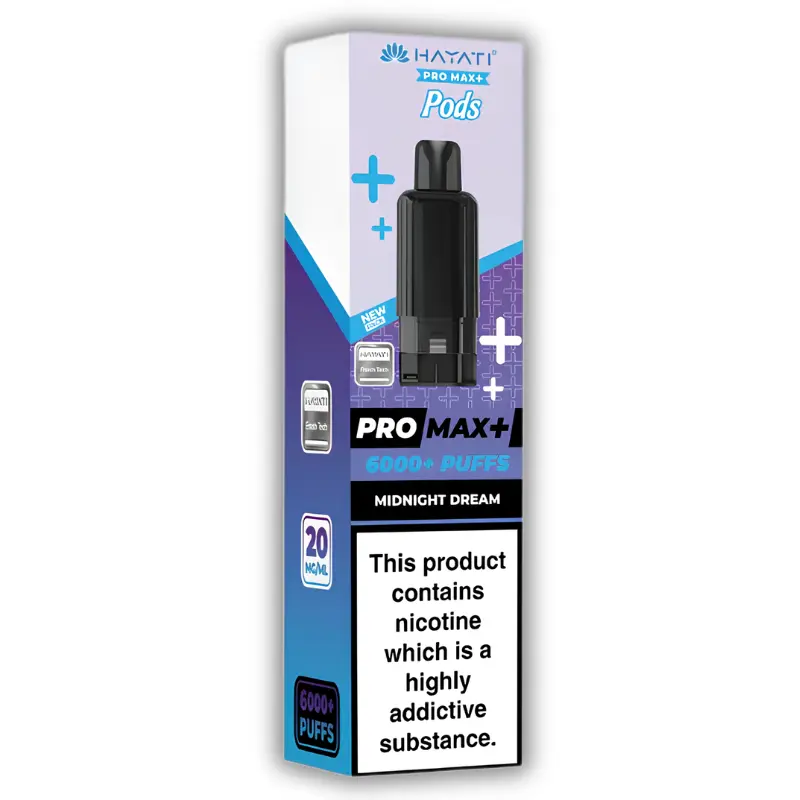
Hayati · Pro Max Plus
Midnight Dream Hayati Pro Max Plus Pods
£5.49
✔ In stock — ready to ship
Genuine Hayati
Free over £20
Same-day dispatch
Secure checkout
£5.49 is the smallest quantity of Midnight Dream that exists. Not the smallest convenient quantity, or the smallest quantity anybody would recommend starting with. The smallest one, full stop. Hayati put this liquid into two listings, this replacement pod and the Midnight Dream Hayati Pro Max Plus 6000 Pod Kit at £7.99, and both of them contain the identical 12ml. There is no bottle, no 2ml version, no tester, no half pod, no trial anything. The unit has one size, and that size was settled by how the hardware is manufactured rather than by how much of an unfamiliar flavour a sensible adult would want to buy first.
Now set that beside the question the buyer is actually holding, which is a very small question. Is this for me. Three or four draws would answer it for most people. A single millilitre would answer it with room to spare. The smallest thing on sale is twelve times that, and 12ml on one device is not an afternoon's curiosity, it is the better part of a week of daily use and frequently longer.
The unit and the question are therefore badly mismatched in size, and on this particular listing that mismatch is the whole of the risk. Where a title names its fruit the mismatch barely registers, because the question was already closed before the basket page loaded and the 12ml is simply a supply decision. Here the title names an hour and a state of sleep, the flavour cannot be predicted from the published record, and the only instrument that resolves it is the pod itself. So a buyer is asked to commit to twelve units of liquid in order to obtain roughly one unit of information, and to do it in one indivisible payment, up front, with the wrapper as the point of no return.
The kit listing is where the name itself gets taken apart, and that work is not repeated below. What follows is the other half of the problem: what it means when a shop's minimum order is structurally larger than a shopper's minimum question, what can be done to make an indivisible 12ml behave as though it were smaller, what the gamble is honestly worth once the arithmetic is done on published prices, and which of the pods sitting beside this one at the same £5.49 will answer a question instead of posing one.
Twelve millilitres of liquid, one millilitre of information
Start with the shape of the curve, because it explains everything that follows. Information about an unfamiliar liquid does not accumulate evenly across a pod. It arrives almost entirely at the front. The first few draws tell you the register, the sweetness weight and whether the thing is pleasant at all. By the end of the first millilitre a person has formed something close to their final view, and everything from the second millilitre onwards is confirmation, habituation or boredom rather than discovery.
Volume, meanwhile, accumulates perfectly evenly. Every millilitre costs the same 46 pence or thereabouts, and every millilitre after the first buys almost no new knowledge. What a buyer of Midnight Dream is actually purchasing, then, is one millilitre of information wrapped in eleven millilitres of consequence, sold as a single item at one price with no option to take the useful part on its own.
That is not a complaint about Hayati specifically and it is worth being precise about whose fault it is, which is nobody's. A prefilled pod is one manufactured object. The liquid and the mechanism that turns it into vapour are assembled together and sealed together, so the smallest thing the factory can produce is one complete pod, and one complete Pro Max Plus pod holds 12ml. The granularity of the purchase is inherited from the granularity of the part. No retailer can break a pod in half and sell you the first quarter, and if a shop offered to do so you should decline.
The consequence of the seal is the part people underestimate. An unopened pod is an ordinary retail object. An opened one is a decision that has already been made. There is no arrangement published against this listing for sampling, for testers, or for what happens to a pod that has been opened and not enjoyed, and this page is not going to describe one that has not been published; the site's own terms are the place to look for anything of that kind. The practical posture to take is that the £5.49 leaves your possession when the wrapper does, and that the question after that point is not whether the purchase was wise but what the remaining liquid is now worth to you.
One further piece of arithmetic makes the scale concrete. Hayati put a ceiling of 6,000 puffs against this pod. That figure comes off bench equipment running at a fixed draw length and a fixed interval, so it describes a machine's day rather than a person's, and the real total sits somewhere below it by an amount nobody can quote for you. Even treating it loosely, though, it says something useful about units: the decision needs perhaps thirty draws and the pod is specified in thousands. The two numbers are three orders of magnitude apart. That is the gap this page is about.
Why "just read the description first" does not work here
The standard advice for buying an unfamiliar consumable is to read the description, and it is good advice in almost every case. It is worth understanding why it works, because understanding that is what shows you the precise point where it stops working on this listing.
A description works because it is a free sample. That is its entire function. It costs nothing, it carries no commitment, and it transfers enough expectation that most people can decide without spending. Crucially, it does this by pointing at things the reader has already tasted. The word blackcurrant is not a description in itself, it is a pointer to a memory of blackcurrant that the reader supplies from their own experience. A two-word title like Blackcurrant Mango is two such pointers plus an ordering, and between them they do most of the work that a physical sample would do, for nothing.
Midnight Dream contains no pointer. Neither word indicates a substance that anybody has put in their mouth. That is not a comprehension problem on the reader's side, and it is important to say so, because people do genuinely reread these listings assuming they have missed a line. Rereading it will not help. Reading it more carefully will not help. There is nothing in the text to extract, and the free proxy therefore returns a null result.
Once the free proxy returns nothing, the next available instrument is consumption, and consumption on this platform starts at 12ml and £5.49. That is the whole of the problem in one sentence. The two rungs on the ladder are free-and-empty and £5.49-for-a-week, and the range between them is unoccupied. For a declared flavour there is no need for a middle rung, because the top of the ladder is where you already are. For this one the missing rung is exactly where a buyer would want to stand.
Hayati's own paragraph against the listing does gesture in a direction, pointing at something darker and sweeter with a mellow character, and it deserves to be weighed rather than dismissed. The kit page weighs it properly. The short version relevant here is that a gesture at a direction narrows the field without naming anything inside it, and narrowing a field does not shrink a purchase unit by a single millilitre. A buyer who reads that paragraph and then buys is buying precisely as much liquid, at precisely the same price, with a slightly smaller set of possible outcomes.
There is a second-order loss too, and it is easy to miss. Buying a declared pod teaches you something beyond the pod: it teaches you how this range writes. If the listing says sharp and the liquid is sweet, you learn to discount the next listing's adjectives accordingly, and that lesson carries across the catalogue. An undescribed liquid cannot teach that lesson, because there is no claim to check the experience against. So the purchase returns a verdict on one flavour and nothing transferable, which makes it a worse use of £5.49 than the price alone suggests.
The catalogue does sell smaller units, just not of this
It would be easy to read all of the above as a complaint about the shop, and that reading is wrong in a way worth correcting, because the correction is actually useful to somebody choosing what to order.
Smaller purchase units do exist here. The cheapest single pod on this product's own related list is the Blue Razz Cherry Hayati Mini Ultra Pods at £3.49, which is a third off the price of anything on the Pro Max Plus shelf. What that listing does not do is sample Midnight Dream, because it is a different flavour on different hardware, and its liquid volume is not something this page will quote since it is not in the facts for this product. What it demonstrates is the general principle: your minimum spend is set jointly by the flavour you want and the device family you own, and the device family is often the larger of the two influences.
The range also contains one genuine structural answer to the granularity problem, which is the dual-flavour pod. Straw' Guava / Dragon Berries Hayati Pro Ultra Plus Pods at £7.99 put two liquids inside one purchase. That costs more money and involves more total volume, so it is not cheaper in any sense. What it changes is the concentration of the bet: a buyer who dislikes one of the two has the other, and the exposure to any single flavour decision is roughly halved. Nobody markets these as a sampling mechanism and Hayati do not describe them that way, but structurally that is one of the things they do.
And plenty of Hayati flavours appear in several formats at several prices, which gives a curious shopper a cheap way in before committing to a 12ml pod of the same thing. Midnight Dream is not one of them. It appears twice, as the kit and as this pod, carrying the same liquid at the same volume both times. So the flavour with the least published information also happens to be among the ones with the fewest routes in. Those two facts are unrelated in origin, a naming decision and a range-planning decision made by different people for different reasons, but they land on the same product and they compound. A buyer facing an unpredictable liquid with several cheap ways to test it has an inconvenience. A buyer facing an unpredictable liquid with one 12ml door has a genuine decision to make before paying.
Five things that make 12ml behave like a smaller purchase
The unit cannot be shrunk. What can be changed is how much of it is actually at stake, and there are five levers worth knowing, all of them using things that already exist on this catalogue.
Lower the money without touching the volume. If a working Pro Max Plus body is already in the house, this listing rather than the kit is the correct line to order, and the saving is the cost of a second body you do not need. That does not reduce the liquid at risk by a drop. It reduces the cash at risk by about a third, which on a purchase made specifically to find something out is the difference between an experiment and an expense. Buying the kit again when a body is already in the drawer means paying for hardware twice in order to ask one question.
Take the sample out of the purchase rather than trying to buy one. The sample exists. It is the first millilitre, and you are going to own it either way. What usually goes wrong is that nobody treats it as a sample, so no verdict gets formed at the point where the information is complete, and the decision drifts until it is made by habit at the eighth millilitre instead. Fix the checkpoint before the wrapper comes off: two unhurried sittings, then a verdict, then act on it. A view arrived at deliberately in the first day is worth more than a view arrived at accidentally in the second week, and it is worth more precisely because there are still eleven millilitres left to do something about.
Use the fact that the pod is not attached to the device. A Pro Max Plus pod is a portable object and a Pro Max Plus body will run any pod on the platform, which means a single pod can produce opinions from more than one person for one price. If somebody else in the household or the office owns one of these bodies, the pod goes across for an evening and comes back. That is not a scheme anybody is offering, it is just a property of a two-part device, and it converts an indivisible purchase into something that can be evaluated by two people at no extra cost. Whether you want to share a mouthpiece is a personal matter and not something this page has a view on.
Buy a question that can actually be closed. This is the counter-intuitive lever and probably the most valuable one. If the unit will not shrink, change what the unit is buying. For the identical £5.49 you can settle a genuinely useful question with a labelled product: whether the dark berry register suits you on this device at this strength, say, or whether the sweet confection profile does. A declared pod answers its question completely and leaves you with a result you can reuse. Answer one of those first and Midnight Dream stops being a bet on the whole dark half of the shelf and becomes a much narrower bet on one composite, which is a far better purchase than the same product would have been a fortnight earlier.
Order one, and treat the instinct to order two as a symptom. The minimum order is already bigger than the question. Multiplying it means doubling a commitment whose odds have not been observed yet, since the observation is inside the first pod and has not happened at the moment the basket is filled. The reasoning that produces a second pod on the first order is usually a delivery-convenience reasoning rather than a flavour one, and convenience is a poor argument for owning 24ml of something nobody has described to you.
What the bet is honestly worth
The kit page establishes that the dark half of this shelf contains two quite different things and that nothing in this listing chooses between them. Take that as given. The question here is narrower and purely numerical: given an unresolvable outcome and an indivisible £5.49 unit, what is the honest expected value, and when does it go negative.
Begin with the loss, because almost everybody gets the loss wrong. The instinctive figure is £5.49, on the reasoning that this is what was spent. It is not the real figure. If the pod misses and it is the only pod in the house, one of two things happens. Either you keep using something you do not enjoy for the better part of a week, which is a real cost even though it does not appear on a card statement, or you order a replacement straight away, which most people do. That second route costs £5.49 written off plus £5.49 spent again, so the realistic downside of a miss is somewhere around £11 and a few days of waiting, not £5.49. That is arithmetic on the published shelf price and nothing more, and it is the number worth holding in your head rather than the sticker one.
Now the upside, which is smaller than it looks and is the part that rarely gets said. The alternative to this purchase was never nothing. It was a labelled pod at the same £5.49 which you would, in all likelihood, have enjoyed, because the shelf is full of competent liquids that print their contents on the front. So the gain from a hit is not the pleasure of a good pod. It is the pleasure of a good pod minus the pleasure of the good pod you would otherwise have bought, and that difference is novelty rather than enjoyment. Landing on something you like and would not have found by reading labels is a real reward. It is just a much smaller reward than the phrase "it turned out lovely" implies, because the counterfactual was also lovely.
Put the two together and the shape is clear. A modest, bounded upside made mostly of novelty, against a downside of roughly two pods and several days. That is not a terrible bet. It is a bet that pays when novelty is itself the thing you are shopping for, and it stops paying the moment what you actually want is a good pod, because good pods are available with labels attached for the same money and no waiting.
None of these are measured probabilities, and it would be dishonest to present them as such. No rating, no distribution of outcomes and no tasting data exist for this listing. What is available is arithmetic on prices that are published and an assessment of your own tolerance, and a page that dressed that up as a percentage would be inventing the percentage.
There are five situations in which the answer is simply not to take it, and they are worth stating flatly. When this would be the only pod you own, because a miss then has nowhere to go and the fallback is a week of grudging use. When there is a specific occasion attached, a journey or a long day, because an unknown is the wrong thing to depend on. When you have a precise target in mind, since a precise target is the one thing an unlabelled pod cannot be aimed at. When £11 and a few days is not a sum you can write off without irritation. And when you already know that one of the two possible directions is something you dislike, because on this listing there is no way to avoid landing on it except by not playing.
The pod on its own
There is not much hardware to discuss, and about ninety listings share what there is, so this is deliberately brief. The packet contains one item: a Pro Max Plus replacement pod, supplied already holding 12ml of liquid at 20mg, sealed, with nothing to add and nothing to assemble. No device is included, which is the entire difference between this listing and the kit. It fits a Hayati Pro Max Plus body.
The specification that matters for the argument on this page is the 12ml figure, and it matters in an unusual way. On most listings a volume is a supply number, telling you how often you will be reordering. Here it is a unit number. It is the size of the smallest commitment available, and every difficulty described above follows from it rather than from anything about the flavour. If the same liquid were sold in a 2ml pod at a pound, this page would be four paragraphs long and would say buy one and find out. It is not, so it is not.
The 20mg figure is a concentration and is offered here as a plain statement of what the liquid contains. Nicotine is addictive. No other strength is listed against this flavour, so there is no choice to make on that axis. Hayati's 6,000-puff ceiling for the pod is a bench measurement taken on test equipment under fixed conditions, useful for comparing products measured the same way and not useful as a forecast of anybody's week.
Everything else about the platform, how a pod seats, what shifts as a device ages, what the body will and will not accept, is covered properly on the Hayati Pro Max Plus Pods shelf and on the kit listing, and restating it here would spend words that the purchase question needs.
The listing, read as a unit of purchase rather than a spec sheet
The table below is arranged around the question this page asks, so it leads with what you can buy and in what quantity, and puts the liquid details underneath. Several rows are empty on purpose. On a listing like this one an absent row carries as much weight as a filled one, and printing the absences stops a reader assuming the information is sitting somewhere they have not thought to look.
| Field | Entry |
|---|---|
| Smallest purchasable quantity of this flavour | One pod, 12ml |
| Price of that unit | £5.49 |
| Any smaller size of the same liquid | None in the range |
| Only other listing carrying it | The 6000 pod kit at £7.99, same 12ml |
| Tester or sample option | Not offered |
| Arrangement for an opened pod | Not published against this listing |
| Device included | No, pod only |
| Supplied condition | Prefilled and sealed |
| Nicotine concentration | 20mg |
| Alternative concentrations | None listed for this flavour |
| Maker's puff ceiling | 6,000, measured on bench equipment |
| Fruit or ingredient named anywhere | None |
| Flavour shelves | Berry Vapes, Exotic Vapes |
| Shelves in total | Six, four of them about format or recency |
| Reference code | hpm-plus-pods-midnight-dream |
| Maker | Hayati |
Three of those rows decide the page and the rest are context. The first one fixes the size of the commitment. The third one removes the escape route that most catalogues provide, because a range that sells the same liquid in two sizes lets a shopper buy the small one and find out. And the sixth is blank, which means the commitment is one-way in practice whatever the terms elsewhere on the site may say.
Two of the entries deserve a warning about what they are not. The 6,000 figure belongs to the manufacturer and describes equipment, so anyone treating it as a duration is converting a laboratory ceiling into a personal forecast, and the conversion rate varies enormously between people. The 20mg figure describes the liquid and is not a recommendation to anybody. Carrier ratio and coil resistance do not appear in this product's data at all, so they do not appear on this page, and a figure for either found elsewhere has been carried across from a different listing or assumed outright.
Where the same £5.49 buys a question you can close
Here is where the page earns its keep, because the alternatives are the whole point. Everything named below sits on the same shelf, runs on the same body and costs the same £5.49, and every one of them tells you what is inside before you pay. If the granularity problem described above bothers you, the correct response is not to find a smaller Midnight Dream, because there is not one. It is to spend the identical money on something whose 12ml you are not gambling with.
Take the declared dark fruit first, since that is the direction the name points. Blackberry Raspberry is the plain two-berry construction with nothing held back, the most direct substitute for whatever Midnight Dream turns out to be if it turns out to be real fruit. Blueberry Raspberry swaps in the rounder of the two dark berries. Blueberry Raspberry Cherry adds a third and gets closer to the weight a composite carries. Blueberry Pomegranate puts an unusual fruit in a familiar frame, which is roughly what the two shelf tags on this listing jointly suggest without committing to. Cherry Berry and Grape Berry take the same idea in two other directions, and Blackberry Ice is the one to look at if a cold finish is wanted, since it says so in the title rather than leaving you to find out.
The confection side of the dark half is equally well labelled and deserves to be considered on its merits rather than as a fallback. Blue Razz GB is the reference version of that profile. Mr Blue works the same register with different sweetness handling. Blue Razz Cherry and Blue Razz Fruit Twist build a fruit frame around it, Blue Razz Lemonade puts it inside a carbonated structure, and Blue Sour Raspberry is the sharp one in a corner of the shelf that mostly is not. Blue Razz Blackcurrant is worth singling out, because it resolves the central uncertainty of this page by simply containing both things and saying so on the front, which makes it the closest thing to a labelled version of the gamble.
If what appeals is a berry profile with an architecture on top, Berry Lemonade does that on the fruit side. If the dark half is not the requirement at all, Strawberry Kiwi is about as predictable as this range gets, two named fruits and no surprises, and Caribb Crush moves the whole thing somewhere warmer.
Suppose instead that novelty genuinely is the point, and that you have read the arithmetic above and are happy with it. Then the honest advice is different, and it is that Midnight Dream is one of several unlabelled listings rather than a special case. Galaxy Aura withholds its recipe in the same way. Blue Fusion commits to a colour and then declines to say anything further. Dragon Berries is the interesting middle case, an unusual fruit named openly inside a berry frame, which delivers most of the novelty with none of the guessing and is probably the better first purchase for anybody whose appetite is for something unfamiliar rather than for something unknown. Those two words are not synonyms and the difference between them is worth £5.49.
Two structural alternatives close this out. If the objection is to the unit size rather than to this flavour, the Blue Razz Cherry Mini Ultra pod at £3.49 shows what a smaller unit looks like on other hardware, and the Straw' Guava / Dragon Berries Pro Ultra Plus pod at £7.99 shows what spreading one purchase across two liquids looks like. Neither is a route into Midnight Dream, and saying otherwise would be pretending. For browsing by what is actually declared, Berry Vapes holds 225 listings and Exotic Vapes holds 55, the two shelves this product is filed on, and the full Hayati catalogue runs to several hundred if none of the above fits.
Handling a pod you bought in order to find something out
General pod handling applies here as it does anywhere. The advice below is specific to a pod bought as a test rather than as a restock, which is a different job and calls for a different routine.
Open it at the beginning of a day rather than the end of one. A test needs two unhurried sittings reasonably close together, and a pod opened late at night gets one tired sitting followed by a gap, which is the worst possible sampling pattern for forming a view. First impressions of an unfamiliar liquid are unreliable enough without adding fatigue to them.
Set the checkpoint by the calendar rather than by feel. This is the single most useful habit for a purchase of this shape. Decide before opening that the verdict gets made at, say, the end of the second day, and then make it on that day whatever the state of your enthusiasm. The reason is not fussiness. It is that a decision left to arrive on its own will arrive at whatever point the pod becomes background, and by then the interesting question has been replaced by inertia. The checkpoint is what turns eleven remaining millilitres into something you can still act on.
If the verdict comes back negative, the pod is not rubbish, it is an unwanted asset. Park it properly rather than leaving it loose in a bag. Room temperature, out of direct sun, nowhere warm, and kept where children and pets in the household have no access. Tastes shift over weeks and a liquid that read as too heavy in June can read as exactly right in November, so a stored pod is a small option you still own rather than money that has gone.
If a second pod was ordered despite the advice above, leave it sealed until the first has reached its checkpoint. A sealed pod can sit for a long time. An opened one cannot be unopened, and opening the second before the verdict on the first converts a recoverable mistake into an unrecoverable one for no benefit whatsoever.
And if the verdict is positive, notice that the granularity has quietly flipped from a problem into an advantage. 12ml was an awkward unit while the flavour was unknown, because it forced a large commitment to a small question. The same 12ml is a good unit once the question is closed, because it means fewer reorders, fewer gaps and one less thing to think about. Nothing about the pod changed. What changed is that the information arrived, and the size that was wrong for finding out is the size that is right for carrying on.
Questions about buying an unlabelled pod at this size
Is Midnight Dream sold in any smaller quantity?
No. Two listings carry it, this pod at £5.49 and the 6000 pod kit at £7.99, and both hold the identical 12ml. There is no bottle, no smaller pod and no partial option, so 12ml is the minimum commitment available for this flavour.
Is there a tester or sample I can try first?
Nothing of that kind is offered against this listing and no sampling arrangement is published. The absence is worth noting rather than working around, because it means the only route to finding out what the liquid tastes like is buying a full pod of it.
Can I return it if I open it and dislike it?
No arrangement covering an opened pod is published on this listing, so this page will not describe one; the site's own terms are where to check. The sensible working assumption is that a sealed pod is a retail item and an opened one is a decision already taken.
How long does 12ml actually last?
That varies enormously between people and no honest figure can be given. Hayati's ceiling of 6,000 puffs is a bench measurement from test equipment rather than a duration. For most people running one device it is a matter of days rather than hours, which is why the unit is larger than the question being asked of it.
Should I order this pod or the kit?
The pod, if a working Pro Max Plus body is already in the house, since the kit's extra cost buys hardware you would then own twice. The kit makes sense only if you have no body, or you specifically want a spare one, or you want two devices so that two flavours can be kept going at once.
Can two people split one pod to halve the cost of finding out?
A pod is a separate object from the body and a Pro Max Plus body will run any pod on the platform, so a pod can move between two owners of that device and produce two opinions for one price. Whether sharing a mouthpiece is something you want to do is a personal matter this page takes no position on.
What does the listing actually tell me about the flavour?
It points at a darker and sweeter direction with a mellow character, and names no fruit and no ingredient anywhere. The kit listing is where that wording gets weighed in detail. For the purposes of this page the relevant point is that a direction narrows the possibilities without reducing the quantity you have to buy.
Is there a cheaper way to test an unfamiliar flavour in this catalogue?
Cheaper single purchases exist, such as the Mini Ultra pod at £3.49, but that is different hardware carrying a different liquid, so it is not a way into this one. Within the Pro Max Plus shelf every pod costs the same £5.49, which means the cheapest way to reduce uncertainty is to choose a listing that declares its contents rather than to look for a smaller unit.
What is the realistic worst case if I dislike it?
Around £11 and a few days, on published prices: the £5.49 written off plus a replacement pod ordered immediately, which is what most people do rather than persevering. Framing the downside as £5.49 understates it, and framing the purchase against that larger figure is the more useful way to decide.
Is a lower nicotine strength available in this flavour?
Not listed. One concentration appears against Midnight Dream, which is 20mg, and no alternative exists in the product data for it. Nicotine is addictive, and the figure is a statement of what is in the liquid rather than a suggestion for any particular person.
When should I simply not buy this one?
When it would be the only pod you own, when it is meant for a specific occasion, when you have an exact flavour in mind, or when writing off two pods' worth of money would annoy you. In all four cases a labelled pod at the same price does the job with none of the exposure.
The position, in plain terms
This listing is one prefilled Pro Max Plus pod, 12ml of liquid at 20mg, no device included, at £5.49, with a manufacturer's bench ceiling of 6,000 puffs. No fruit is named for it anywhere in the published record, and the kit listing is where that absence gets examined properly.
What this page adds is the structural half of the problem, which is that the smallest thing available to buy is several times larger than the question a buyer is trying to answer. Is this for me takes a millilitre to settle. The shop's minimum unit is twelve, it is sealed, it is indivisible, and no sampling or opened-pod arrangement is published to soften it. On a declared flavour that gap costs nothing, because the question was already answered by the title. On an undescribed one it is the entire risk of the purchase, and it is a gap that applies to a great many listings on these shelves rather than to this one alone.
The levers that exist are worth using: take the pod rather than the kit if a body is already yours, fix the verdict point before the wrapper comes off, remember the pod can travel to another body, order one and not two, and understand that the honest downside is nearer £11 than £5.49. Weighed properly, this is a reasonable bet for somebody shopping for novelty and a poor one for somebody shopping for a good pod, because the shelf beside it is full of good pods that print their contents on the front for the same money.
Strictly for adults aged 18 and over. Nicotine is an addictive substance.
You might also like


