
Home / Hayati Pods / Hayati Pro Max Plus Prefilled Pods 5mg
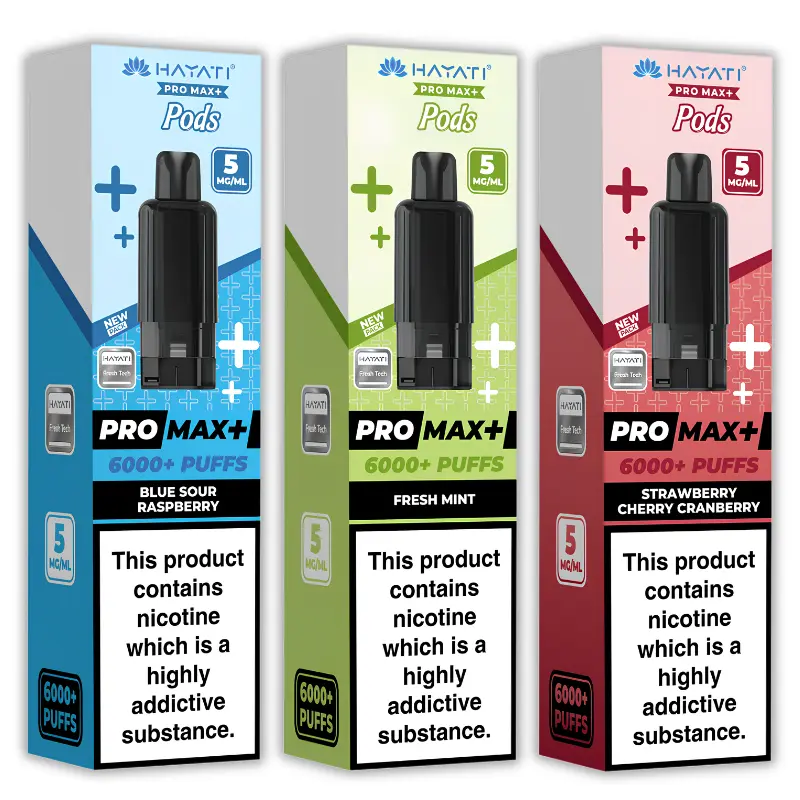
Hayati · Pro Max Plus
Hayati Pro Max Plus Prefilled Pods 5mg
£5.49
✔ In stock — ready to ship
Genuine Hayati
Free over £20
Same-day dispatch
Secure checkout
£5.49 buys one prefilled pod for the Hayati Pro Max Plus, holding 12ml of Banana Ice, filled at 5mg. The packet contains the pod and nothing else, so a Pro Max Plus body already sitting in a drawer is the condition for getting any use out of it. Hayati publish a laboratory figure for the pod of up to 6,000 puffs, which is a bench estimate produced under test conditions rather than a forecast of anyone's week.
The interesting thing about this listing is not the banana. It is the number in the title. Walk the Hayati Pro Max Plus Pods shelf and the nicotine column barely moves: nearly ninety products, and almost every one of them 20mg. Four listings break that pattern, and all four hold the same Banana Ice recipe. This one at 5mg, the 10mg pod, the zero-nicotine pod, and the 20mg Banana Ice pod that most people meet first. One liquid, four nicotine figures, identical price, identical volume.
That isolates a variable which is normally welded shut. Everywhere else in the range, changing the nicotine means changing the flavour too, since no other recipe is offered twice. And the assumption almost everyone carries into the comparison is the one this page argues with: that the nicotine figure governs the throat and leaves the taste alone.
It does not leave the taste alone. Nicotine is an ingredient with sensory properties of its own. It has a taste, it has a feel, and it interacts with the other things in the bottle in ways that are well understood and rarely written down on a product page. Take three quarters of it out of a recipe and you have not made a quieter version of that recipe. You have made a different one. What follows is an account of which parts move, in which direction, and why banana in particular is the liquid where the difference is most audible.
Nicotine is not a flavourless carrier
Start with the chemistry, because the sensory consequences fall straight out of it. Nicotine is an alkaloid, which is a family of plant compounds that includes caffeine and quinine, and the family has a characteristic in common: on the tongue, alkaloids read bitter. Nicotine is no exception. In isolation it is bitter, peppery, faintly woody, with an acrid quality that grows steeply rather than smoothly as the concentration climbs.
At the figures used in prefilled pods that is not a background detail. Twenty milligrams per millilitre is a substantial dose of a bitter, pungent substance in a liquid whose flavouring components are typically present at a few per cent. It is one of the loudest single things in the mixture, and it is in every draw.
The part that happens in the throat is a separate channel
The tongue is only half of it. The sensation people describe as throat hit is neither taste nor smell. It is trigeminal, the nerve system that reports physical and chemical irritation in the mouth, nose and throat, and it runs on completely different wiring from the taste buds. The prickle of a carbonated drink is trigeminal. So is the heat of chilli, the sting of raw onion, and the cold of menthol, which is why menthol feels cold without lowering the temperature of anything.
Nicotine is a trigeminal irritant, and a fairly strong one. A large part of what a 20mg liquid feels like in the throat is coming from the nicotine rather than from the flavouring or the base. That matters for a flavour discussion because people routinely attribute the sensation to the wrong ingredient. A blend that feels sharp gets described as a sharp flavour, when a share of the sharpness is the nicotine reporting itself through a nerve that does not know the difference between a fruit acid and an alkaloid.
Bitterness and sweetness fight each other
The second mechanism produces the biggest surprise on a first draw, and it is a straightforward perceptual effect called mixture suppression. Put a bitter compound and a sweet compound in the same mouthful and each suppresses the other. The sweet reads less sweet than it would alone, the bitter less bitter. Neither has changed in quantity; the perception has.
Now remove three quarters of the bitter term and leave the sweet term where it was. Nothing Hayati publish suggests the sweetener is adjusted between the four listings, so the sugar-analogue load is identical in the 5mg pod and the 20mg pod. What changes is how much of it gets through, and the answer is noticeably more. The 5mg version tastes sweeter than the 20mg version, not because it contains more sweetener, but because there is less opposing it.
Attention is finite, and irritation takes the front of the queue
Third mechanism, and the one that gives the angle its upside. A strong irritant does not merely occupy the throat. It raises the threshold at which faint aromatic detail registers, partly through genuine sensory masking and partly because attention is limited and a loud signal takes most of it. Cut the shouting and the quiet parts of a blend become audible. Top notes that were technically present in the 20mg liquid, and which a careful drinker of it could find if they went looking, now arrive unprompted at the front of the draw. Nothing has been added. The floor of the mix has been raised into view.
Four things move at once, not one
Put the mechanisms together and the honest summary runs like this. The bitter, peppery contribution of the nicotine drops away. The sweetness rises without a single change to the sweetener. The throat sensation falls sharply. Whatever aromatic detail the recipe contains gets a clearer run at your nose. And any coolant in the blend now has the trigeminal channel much more to itself, so the cold reads as a larger share of the whole even though the coolant dose is untouched.
None of that is captured by the phrase "the same flavour, weaker", which is how the difference is almost always described. It is not the same flavour. It is a recipe whose balance was set with a large bitter, pungent ingredient in it, being served with most of that ingredient absent. Whether the result is better or worse is a matter of taste. That it is different is a matter of composition.
Two things Hayati do not tell us, and both change the size of the effect
This page would be dishonest if it did not flag the gaps. Hayati's listing for this pod gives a flavour, a volume, a nicotine figure and a puff rating. It does not state whether the nicotine is in salt or freebase form, and it does not state the VG/PG ratio of the base.
Both matter here. A nicotine salt is nicotine paired with an acid, which lowers the pH of the liquid and softens the trigeminal response at any given figure; a freebase formulation at the same figure is more assertive in the throat. If this pod is a salt, the throat difference between 5mg and 20mg is real but smaller than the arithmetic suggests, and the flavour differences described above are proportionally more of the story. The base ratio matters separately: PG carries flavour more efficiently and is more irritating, VG produces more vapour and mutes detail. Neither figure is published, so neither is stated here as fact. Treat the direction of the effects in this page as reliable and the magnitudes as unquantified.
What all of that does to Banana Ice specifically
Time to stop talking in general terms. The abstract case applies to every liquid ever made; the useful question is what it does to this one, and banana turns out to be close to a best case for demonstrating it.
What is on the record and what is not
Hayati's own description of the liquid is short. It is a banana blend with cooling, the banana is smooth and mellow rather than sharp, the cooling gives the finish a fresh edge without stripping the creaminess out, and there is nothing sour or bitter anywhere in it. That is the entirety of the flavour information attached to the listing.
What is absent is longer: no coolant figure and no coolant type, no indication of which banana character is being aimed at, no sweetener declaration, and no statement that the recipe is identical across the four strengths beyond the obvious implication that it is. The name does its job here, so the silence is a caveat rather than the whole subject, but it is worth knowing where the published facts stop.
Why banana is the liquid with the least holding it up
Here is the structural point, and it is the reason this pod is a better demonstration of the nicotine effect than almost anything else on the shelf. Consider what gives a draw its shape, the thing that stops it reading as an undifferentiated sweet cloud. There are broadly four candidates: acid from the fruit, a coolant, astringency or tannin from something like pomegranate or cranberry, and the nicotine.
Most of this range is built on the first. Blue raspberry, lemonade, blackcurrant, cherry, sour anything: those liquids have a sharp component of their own that cuts across the sweetener on every draw. Banana does not. Ripe banana is one of the least acidic fruits in common flavouring use, and the flavour is carried overwhelmingly in volatile esters rather than in acid. Whatever edge a 20mg Banana Ice pod has, almost none of it is coming from the fruit. It is coming from the coolant and from the nicotine, and now one of those two has been cut to a quarter.
The consequence is symmetrical and both halves are true. Banana is exactly the sort of aroma-led, ester-driven flavour that benefits most from the masking coming off, and the parts of it that 20mg partly flattens are the parts that make it taste like fruit rather than like sweetness. It is also the blend with the least structure remaining once the nicotine term shrinks, so it is the one most at risk of tipping into something thick and cloying. You do not get one without the other.
The order of arrival, and how it differs from the 20mg pod
On a slow draw the cold registers first, as it does at any strength, because chill receptors are fast. The difference starts immediately afterwards. On the 20mg pod, what follows the cold is a combined arrival of fruit and pepper that most people read as a single event. On this one the pepper is largely gone, and what fills the space is the ester lift, that slightly high, sweet, faintly solvent-adjacent brightness that is the top of any banana flavouring. At 20mg it sits under the throat sensation and reads as part of the general intensity. At 5mg it is out in front and unmistakable.
Mid-draw the banana body arrives as it always did, soft and rounded, with the light creaminess Hayati mention sitting behind rather than beside it. That part is the most stable of all, because body is carried by the heavier, less volatile components and those were never the ones being masked.
The finish is where the second big change lands. A 20mg draw of this liquid ends dry and slightly astringent, and the dryness is not the coolant: it is the nicotine. Take it out and the finish gets longer, wetter and sweeter, and the sweetness sits on the tongue afterwards instead of being swept off. Whether that reads as generous or as sickly depends entirely on how much sweetness you like left behind. It is the single most divisive difference between the two versions and the one worth deciding about before buying.
Sweetness, stated plainly and without flattery
This pod is sweeter than the 20mg pod of the same liquid. Not marginally. Anyone moving between them in the same afternoon will notice it inside two draws, and the direction is never the other way.
Whether that is a recommendation depends on where you already sit. Somebody who finds the 20mg version of this flavour well judged, and who likes that the sweetness is held in check, is being offered a version with the check removed. Somebody who finds most of this shelf too aggressive, and who has always felt that the banana was fighting through something to reach them, is being offered the version where it does not have to. Both of those people exist and the product page that pretends only the second one does is not telling the truth.
For a rough placing against neighbours: banana already sat at the heavy, thick end of the sweetness range rather than the bright end, and this figure moves it further that way. If your instinct is that Blueberry B'Gum and confectionery-style blends are as sweet as you want to go, this pod is in that territory while the 20mg Banana Ice pod sits just short of it. If you want a liquid that resets your mouth between draws, the acid-led listings do that and this one does not: Blackcurrant Lemonade and Blue Razz Lemonade are where to look.
The ice gets bigger without the coolant changing
Hayati name this one Ice, and across the range Ice, Frozen and Cooler are the only signals anyone gets about how much cooling is in a liquid, since no listing publishes a figure. Ice is generally the most moderate of the three markers. That is a naming convention rather than a specification and it should be held loosely on any page.
On a strength-varied listing it should be held more loosely still, and this is a point that only arises here. Those three markers are effectively calibrated against 20mg products, because virtually everything carrying them is 20mg. Cooling and nicotine both report through the same trigeminal channel. Shrink one of them and the other occupies a larger share of what that channel is telling you, so the perceived cold goes up while the coolant dose stays exactly where it was. The practical upshot is that the word Ice on this pod does not mean quite what it means on a 20mg listing such as Cherry Ice Mini Ultra pods, not because Hayati have changed the coolant but because you are measuring it with less noise in the way.
That also explains a reaction people have to small-figure pods and then misattribute, which is that the liquid seems colder than expected. On a heavily chilled blend such as Blue Frozen the shift would be far more pronounced, since the coolant is already doing most of the structural work. On a moderate Ice blend it is real but manageable.
What this pod is not
It is not a reformulation. Hayati are not claiming a different recipe at this figure, and nothing in the listing suggests the flavouring has been retuned for it. The differences described on this page follow from removing a sensory ingredient, not from adding anything.
It is not a zero-nicotine pod either, which matters if you have arrived here from the 0mg listing. There is nicotine in this liquid, and at 5mg the bitter and trigeminal contributions are quieter but not absent.
It is not sour, not tart and not sharp in the fruit sense, and nothing about the nicotine figure changes that: there was no fruit acid in it at 20mg and there is none here. If a jolt of sourness is what you want from a pod, Blue Sour Raspberry is the listing to look at and this is the wrong one. Nor is it a dessert blend. The creaminess is a texture the banana sits in rather than a custard or a bakery layer, and it does not become one here.
Which recipes would gain from this and which would come apart
What follows is a thought experiment with one caveat, stated again at the end: every product named below is sold at 20mg only, so you cannot actually run the comparison on them. The reasoning is still worth having, because it tells you what kind of flavour a small nicotine figure flatters, and that is useful when deciding whether this Banana Ice pod is the shape of liquid you want.
Blends that gain
Aroma-led, low-acid, softly structured liquids gain the most, because the thing being unmasked is exactly what they are made of and they were not relying on the nicotine for anything except a bit of edge. Banana is the type specimen. Gum and candy-floss accords belong in the same family: Blueberry B'Gum is a dark berry sitting on a sugary gum base with very little acid in it, and Blueberry Cotton K and Raspberry Cotton K put an airy confectionery sweetness over fruit in much the same way. Both would read markedly more aromatic and markedly sweeter at a small nicotine figure.
Cola blends are the most interesting case on the shelf. A cola accord is built from spice and citrus oils, cinnamon, vanilla and a bitter-aromatic complex, much of it subtle enough to be partly buried at 20mg. Cherry Cola and Cola Ice are the two listings where taking the pepper out would most likely reveal detail people did not know was there, because the spice notes and the nicotine were competing for the same attention and the spice was losing.
Blends that keep their shape but change character
Acid-led liquids do not fall apart, because their structure never depended on the nicotine in the first place. What happens to them instead is a shift in balance: the acid still cuts, but it now cuts through more perceived sweetness, so the whole thing reads further towards confectionery and away from fruit. Blue Razz Lemonade, Blue Razz Pineapple and Blue Razz Cherry are all in that bracket. So is Blue Razz Fruit Twist, where the sweet side is already generous.
Liquids with astringency in them hold up better than plain sweet ones, because tannin does some of the same structural work the nicotine was doing and it is untouched by the strength. Blueberry Pomegranate has a genuinely tannic edge from the pomegranate, and Blueberry Cherry Cranberry gets a comparable dryness from the cranberry. Those two would move least of anything named here.
Blends where the structure was mostly borrowed
The liquids that lose the most are the ones with a big sweetener load, little acid and no astringency, where the nicotine was quietly the only thing stopping the sweetness running away. Banana Ice is in this category, which is why this page has been careful to state the downside as well as the upside. Heavily cooled sweet blends are in a related position: on Blue Frozen the cold is already the dominant structural element, and taking the nicotine down mostly makes a cold liquid colder relative to everything else in it.
And then there are the ones where nobody can say. Black Mamba is named for a mood and its composition is not published, so any prediction about how it would behave at a smaller nicotine figure would be invention. Blue Fusion is only slightly better documented. Where the ingredients are not on the record, the honest answer is that the reasoning above cannot be applied, and saying so is more useful than guessing.
The caveat, as promised. Every product in this section is sold at 20mg and nothing else. A choice of nicotine figure exists on exactly one recipe in the Hayati prefilled pod catalogue, and you are reading its page. Everything above is a framework for thinking, not a set of purchases you can make.
The pod and the device it needs
Inside the packet: one pod, prefilled and closed at the factory, holding 12ml of Banana Ice at 5mg. No battery, no case, no spare. The body it attaches to is the Hayati Pro Max Plus, bought separately and presumably already owned by anyone reading this, and the whole of the Hayati Prefilled Pods & Refills shelf works on the same principle: the device is the durable part and the pod is the consumable.
The specification that actually matters for this particular liquid is the pairing of 12ml with a single coil that cannot be changed. Every millilitre in the pod passes over the same wick and the same wire, and the last millilitre goes over a coil that has been working for the whole of the pod's life. On an acid-led blend that mostly costs you a little sharpness towards the end. On an aroma-led blend at a small nicotine figure it costs you more, because the ester lift described earlier is the most fragile thing in the mix and it is also the part this version of the recipe is leaning on hardest. The upside of the 5mg pod and the thing that fades first are the same thing.
Hayati's published puff figure for the pod is up to 6,000, an estimate generated on test equipment rather than a description of what any individual will observe. Draw length, draw frequency and the state of the device all move the real number, and the laboratory conditions that produce the figure do not resemble ordinary use. Treat it as a rough size indicator for comparing one pod against another and nothing more. For the rest of what the platform does, and for the eighty-odd other liquids that run on it, the Pro Max Plus pod shelf is the place to look.
The numbers on the listing
| Product code | hpm-plus-pods-5mg |
| Supplied as | One prefilled replacement pod, no device |
| Nicotine figure | 5mg |
| Flavour as listed | Banana Ice |
| Liquid in the pod | 12ml, filled at the factory |
| Manufacturer puff figure | Up to 6,000, a laboratory estimate |
| Device needed | Hayati Pro Max Plus, purchased separately |
| Brand | Hayati |
| Price | £5.49 |
| Not published | VG/PG ratio, coolant level, salt or freebase form |
One row deserves comment that it rarely gets, which is the price. This pod is £5.49. So is the 10mg pod, so is the zero-nicotine pod, and so is the 20mg Banana Ice pod. The nicotine figure carries no price at all, which is worth noticing because it removes a variable from the decision entirely. You are not paying for a sensory difference, and you are not saving money by avoiding one. The four listings are priced as the same product because, commercially, that is what they are.
It follows that the comparison described throughout this page costs one extra pod rather than a premium, and the result is not an opinion you have to take from a page like this one. It is something you can establish for yourself in an evening with two pods and a clear palate.
The 12ml row sets the scale of the commitment. Twelve millilitres in a single sealed unit is a substantial quantity of one liquid, and there is no way to abandon it partway that recovers anything. That is the ordinary trade across the Hayati Pods shelf, but it is worth restating on a page asking you to run a sensory experiment, because the experiment is not a small one.
Two of the shelf placements on this listing are worth flagging as filing rather than description. The pod appears under Blueberry Vapes and Cherry Vapes in Hayati's catalogue. The liquid is Banana Ice. Those shelves tell you something about how the range is tagged and nothing whatsoever about what is in the pod, and anyone arriving from either of them expecting berry or stone fruit should know that before ordering.
How it compares, and who should pick what
Against the other three strengths of the same liquid
This is the comparison that matters, because it is the only one where the liquid is held constant. The zero-nicotine Banana Ice pod is the arithmetic limit of everything described above: no bitter term at all, maximum sweetness, maximum aromatic clarity, and the coolant left as sole occupant of the trigeminal channel. By the reasoning of this page it is very nearly a different product.
The 10mg pod is the useful middle observation rather than a compromise. Half the nicotine of the 20mg version means the bitter and trigeminal contributions are roughly halved, enough for the sweetness shift to be perceptible while the recipe still reads recognisably as the version most people know. It is the listing that tests whether the effect described here is real, with the smallest change to what you are used to.
The 20mg Banana Ice pod is the reference version and it is worth saying clearly that it is not the inferior one. It is the version the recipe was balanced around. The pepper and the dryness are doing real work in it, holding a sweet low-acid liquid in shape, and plenty of people prefer that shape. The argument of this page is that the 5mg pod is a different object, not a better one.
Against the flavours you would rotate with
A sweet, low-acid, cold liquid is a poor candidate for being the only thing you run, and that is more true at 5mg than at 20mg, because the sweetness is more insistent and there is less contrast within the draw itself. Something with real acid in it makes a better partner than something with more sweetness. Blackcurrant Lemonade is the straightforward choice, and Blue Sour Raspberry the emphatic one. Cherry Berry sits between them with a rounder fruit profile that still has some tartness behind it.
Ordering matters with this liquid more than it does with most. Banana leaves a sweet film that reacts badly with citrus, so going straight from this pod to a lemonade blend produces a few faintly soapy draws before things settle. The reverse order is fine. If you run two pods alongside each other, put the banana second in any given stretch rather than first.
Blends to avoid stacking next to it are the ones in the same sweetness register, since the whole point of a rotation is contrast. Blueberry B'Gum and Blue Razz GB are both generous with sweetness in their own right, and following one heavy sweet liquid with another tends to flatten both.
Against the other Hayati formats
If the 12ml commitment is the obstacle, the smaller formats are worth knowing about even though none of them offers a choice of strength. Blueberry Raspberry Mini Ultra pods and the Blueberry Straw' Menthol version of the same format hold 4ml at £3.49, which is a third of the liquid for roughly two thirds of the price: worse value per millilitre, better for finding out whether you like something. Rubik pods sit at £3.99 on a different device again.
Going the other way, the Pro Ultra Plus pods hold 22ml at £7.99 and are the better unit economics once you have settled on a flavour and a device. Blueberry Raspberry and Blueberry Raspberry Cherry is a dual-flavour pod on that platform, and the 25000 kit version at £11.99 includes the device for anyone who does not own one. None of those is available at a small nicotine figure, which is the recurring limitation: the format that offers the strength choice is this one, and the flavour that comes with it is banana. The wider catalogue sits in the full Hayati range.
Handling a pod that depends on its top notes
Ordinary care applies, but the priorities are not the same as they would be on an acid-led pod, and this is where the strength actually changes the advice rather than just the description.
Heat is the first thing to take seriously. The ester that carries banana is volatile, which is precisely why it is fragile, and warmth accelerates its loss both in storage and in use. A pod left on a car dashboard or a sunny sill for an afternoon will have less of the aromatic lift than the one in the packet next to it, and on the 20mg version you might not notice, because the pepper and the cold would cover the gap. On this version you will, because that lift is the main thing the smaller nicotine figure bought you. Keep the spare in a cupboard at room temperature and out of direct light.
Give a pod that has just arrived a few minutes upright before the first draw. Liquid shaken about in transit takes a moment to settle into the wick, and the first draw on an unsettled pod is thin in a way that has nothing to do with the recipe. Fit it, leave it alone, then start. That is a small thing on most pods and slightly less small on an aroma-led one, where a thin first impression tends to be the impression you keep.
Judge it fresh against fresh. The commonest way people get this comparison wrong is to draw on a new 5mg pod and compare it with the memory of a 20mg pod that was two thirds used at the time. A worn coil has already lost some fine aromatic detail, so that comparison measures coil age at least as much as it measures nicotine. Put a new pod of each in play within a day of one another, and take the first assessment in the pod's first hour.
Watch for the sweet film. Low-acid sweet liquids leave a coating that dulls the next few draws of anything, including of themselves, and a glass of water between stretches does more here than it would on a sour blend. It also makes the ester easier to detect, since a dry mouth reports aromatics poorly.
This liquid signals the end of a pod in a specific order. The aroma goes first, so the banana thins towards a general sweetness while the cold is still fully present. Then the sweetness itself starts to read slightly toasted. Vapour volume holds on longer than either, which is why judging by cloud alone keeps a pod in service past the point where it is giving you what you bought. On a 5mg pod that first signal matters more, because you were relying on the aroma harder.
Store it away from anything with a strong smell of its own, since a packet kept with coffee or a scented product can pick up a trace of it, which matters more on a delicate blend than on a blackcurrant. Keep it away from children and animals as a matter of course, and leave the pod in its packet until the device is ready for it.
Questions people actually ask about a 5mg pod
Is the liquid in this pod the same recipe as the 20mg Banana Ice pod?
As far as anything Hayati publish indicates, yes: same flavour name, same 12ml fill, same price, with the nicotine figure as the stated difference. They do not publish the formulation, so that is an inference from the listings rather than a confirmed fact. What this page argues is that an identical recipe with a different nicotine figure does not produce an identical sensory result.
Will it just taste like a weaker version of the same thing?
No, and that is the main point of this page. Nicotine has a bitter, peppery taste of its own and it produces much of the throat sensation, so removing most of it changes the balance of the whole mixture rather than turning the volume down evenly. Expect more perceived sweetness, a clearer fruit aroma, less dryness in the finish and a cooling that reads as a larger share of the draw.
Why would it taste sweeter if the sweetener has not changed?
Because bitterness and sweetness suppress each other when they are in the same mouthful. The sweetener load is doing the same thing it always did; there is simply less bitterness standing in front of it, so more of it reaches you. It is a perceptual effect rather than a change to the liquid.
Does nicotine really have a flavour of its own?
It does. Nicotine is an alkaloid, and the family it belongs to, which also includes caffeine and quinine, is characteristically bitter. On its own nicotine reads bitter, peppery and faintly woody, and at pod strengths it is one of the more prominent single ingredients present rather than a trace.
Is this a nicotine salt or a freebase liquid?
Hayati do not state it on this listing, so this page does not either. The distinction matters, because a salt formulation is less assertive in the throat at any given figure than a freebase one, which would change how large the difference between this pod and a 20mg pod feels. The flavour effects described here point in the same direction regardless, but their size depends on an answer that is not published.
Does it fit a Pro Max Plus I already own?
Yes. It is a replacement pod for that device and nothing else is in the packet. The pod will not serve as a substitute on the Mini Ultra, the Rubik or the Pro Ultra Plus, which all take their own.
How much liquid is in it, and what is the puff figure based on?
Twelve millilitres, prefilled and sealed at the factory. Hayati's figure of up to 6,000 puffs is a laboratory estimate generated under test conditions, and the conditions in a test rig do not match how anyone actually draws on a device. Use it for comparing one pod against another rather than as a prediction.
Will the ice feel stronger than it does on the 20mg pod?
Probably, and not because Hayati have altered the coolant. Cooling and nicotine both report through the same nerve pathway, so with less nicotine competing for it the cold takes up a larger share of what that channel is telling you. The dose is unchanged; the proportion is not.
What other strengths does this Banana Ice pod come in?
Four figures exist across the prefilled pod listings for this recipe: zero, 5mg, 10mg and 20mg, all at 12ml and all at £5.49. The 10mg pod and the zero-nicotine pod are the two other places the same liquid can be found with a different nicotine figure on it.
Is it cheaper because there is less nicotine in it?
No. All four strength listings are £5.49 for 12ml. The nicotine figure has no effect on the price, which is worth knowing because it means the choice between them is entirely about what you want the liquid to taste and feel like.
What if the sweetness turns out to be too much?
Then the liquid is telling you that the bitter term was doing something you valued, which is a useful thing to learn about your own palate. An acid-led blend such as Blue Razz Cherry holds its shape without depending on that, and the 20mg version of this same banana recipe keeps the counterweight in place.
Why is a banana pod filed under blueberry and cherry?
Catalogue tagging rather than anything in the pod. The listing carries those shelf placements in Hayati's data while the liquid itself is Banana Ice, so the Blueberry Vapes and Cherry Vapes shelves are not a guide to what is inside this one.
The short version
One prefilled pod at £5.49, 12ml of Banana Ice, 5mg, no device in the packet, with a manufacturer's laboratory figure of up to 6,000 puffs attached to it. Mechanically it is the same consumable as every other pod on the Pro Max Plus shelf.
What makes it worth a page is that it is one of four listings where a single recipe is offered at different nicotine figures, and that nicotine is not a neutral ingredient. It is bitter and peppery in its own right and it produces much of the throat sensation, so a version of a recipe with a quarter of it in place is a different sensory object rather than a quieter copy. The differences run in a predictable direction: sweeter, because there is less bitterness opposing the sweetener; more aromatic at the front of the draw; longer and wetter in the finish, because the drying edge is gone; and colder in proportion, because the coolant has more of the throat to itself.
Banana is a good showcase for that and also the flavour most exposed by it, since it has no fruit acid to fall back on. Whether the result is an improvement is a genuine matter of taste, and anyone who liked the 20mg version precisely because the sweetness was held in check may well prefer it. The idea worth discarding is that the only thing changing here is a number.
Strictly for adults aged 18 and over. Nicotine is an addictive substance.
You might also like


