
Home / Hayati Pro Max Plus Pods / Blackcurrant Lemonade Hayati Pro Max Plus Pods
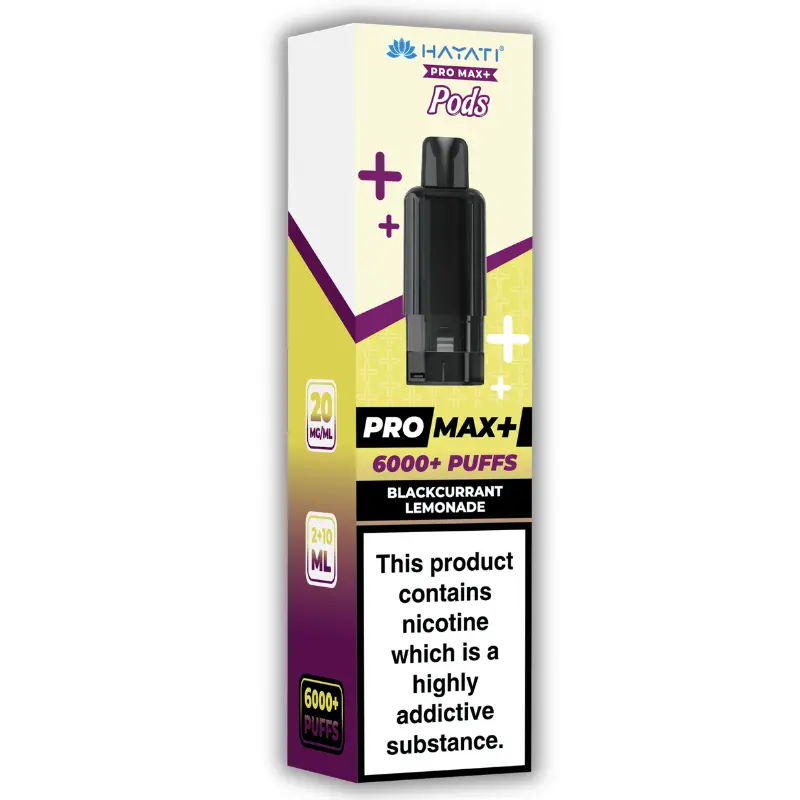
Hayati · Pro Max Plus
Blackcurrant Lemonade Hayati Pro Max Plus Pods
£5.49
✔ In stock — ready to ship
Genuine Hayati
Free over £20
Same-day dispatch
Secure checkout
One pod, factory-sealed, 12ml of Blackcurrant Lemonade inside it at 20mg nicotine in salt form, £5.49. What turns up is that object and nothing around it: no body, no lead, no spare, which makes the listing useful only to somebody who already owns the device. Hayati's published figure for it is up to 6,000 puffs, generated on their laboratory equipment by a machine drawing to a pattern nobody outside the company has seen, so it ranks listings against each other and forecasts nothing about your fortnight. Anyone without the hardware should take the Blackcurrant Lemonade pod kit at £7.99 instead, which carries the same liquid with a device attached, and the gap between the two prices is the entire difference between the two listings.
That is the transaction, and it takes one paragraph. The rest of this page is about the second word in the name, because that word is doing something stranger than it looks.
Lemonade is not a flavour. It is a drink, and more specifically it is a drink that does not exist until somebody adds water to something. That is not a quibble about definitions. It is the central fact about the whole family of British drinks the word belongs to, and it has a consequence for a sealed pod that nobody selling one ever mentions: the operation the word names cannot be performed here. There is no water in a pod, no tap, no jug and no ratio. The 12ml arrives at one concentration, fixed before the pod was sealed, and nothing you own will lengthen it.
So the word is not an instruction and it is not a description of a process. It has to be doing some other job. Working out which job turns out to be the most useful thing on the label, because the answer is a claim about where this blend sits relative to the others, and unlike a recipe, a position can be checked.
A drink that only exists once you add the water
What the dilution family has in common
Squash, cordial and lemonade are not three names for one thing, but they share a structure, and the structure is the point. Each names a finished drink that arrives in the glass by combining a flavoured base with water. The base is not the drink. Anybody who has taken a mouthful of neat squash out of curiosity knows exactly how much it is not the drink: the thing in the bottle is cloying, thick, faintly medicinal, and unpleasant in a way the diluted version never is. What converts one into the other is water, and the proportion of water is the recipe.
Which means the ratio is where the drinker's own taste enters the process. Two people making from the same bottle produce two measurably different drinks, and both are correct, because the bottle never specified a strength that the drinker was bound by. Pour an inch and top it to the brim and you have one drink. Pour three inches into the same glass and you have a different one, out of the same bottle, on the same afternoon. This is so ordinary in British kitchens that it is invisible, and households have standing disagreements about it that survive for decades.
Lemonade complicates this slightly, and the complication is worth being honest about rather than skating over, because the word covers two different products in this country. There is the bottled fizzy kind, bought ready to drink, and there is the made kind, whether that means lemon juice with sugar and water or a lemon cordial lengthened at the sink. The second is obviously a dilution performed by the drinker. The first looks like an exception until you notice that it is a dilution too, simply one performed at a filling plant instead of a worktop: a flavoured syrup taken to drinking strength with water and carbonation at a proportion the manufacturer fixed. Either way the drink is mostly water and the water is constitutive. There is no such thing as undiluted lemonade. What you would have instead is a syrup that nobody would drink.
The difference between the two readings matters for one specific reason, and it is the reason this page exists. In the made version the ratio belongs to the drinker. In the bottled version it belongs to the manufacturer, and the drinker gets a fixed concentration with no lever on it at all. A pod is unambiguously the second case. Whatever else Blackcurrant Lemonade is, it is a drink that has already been made up for you.
Nothing here can be lengthened
Set the format beside the drink and the mismatch is total. A 12ml prefilled pod is sealed at the factory. No filling arrangement is published against this listing and the description makes no provision for one, so the sensible working assumption is that the volume you receive is the volume you use. There is no port for water, obviously, but also no legitimate way to introduce anything else, no second reservoir, no dosing step and no point in the process at which a proportion gets decided by you. The blend arrives at drinking strength, in the same sense that a bottle of fizzy lemonade arrives at drinking strength, and for the same reason: somebody else already did the part that would otherwise have been yours.
Follow that through and one reading of the label dies immediately. The word cannot mean what it means on a shelf of drinks, where lemonade names a preparation with a variable in it. Nothing in this pod is variable. Say it plainly: the name refers to a category of drink defined by a step the product is physically incapable of hosting.
That is not a criticism. It is very nearly the opposite, because the alternative reading that survives is more informative than a recipe would have been.
The two things the word can still be claiming
Strip out the process and two candidate meanings are left standing.
The first is a straightforward flavour cue. Lemonade names a particular citrus accord, the sweetened, rounded, slightly cloudy one you meet in a glass of soft drink, rather than the sharp aromatic character of a lemon itself. That much is real, and it explains the taste. It does not explain the choice of word, because a formulator wanting sweetened citrus could have written Lemon and Sugar, or simply Lemon, and Hayati use the plain fruit word plenty of times elsewhere. Something made Lemonade the better label.
The second is a position claim, and this is the reading that holds up. The word is a coordinate rather than an instruction, and it fixes the blend on two axes at once. On the first, the blackcurrant is held below the ceiling it would reach if it filled the pod alone. On the second, a separate citrus sharpness has been added, of a kind the fruit does not generate by itself and a cordial does not have. A drink word chosen from the dilution family communicates both of those in four syllables, which is why it beats the alternatives, and it does so without committing anybody to a number.
One precision is needed here or the claim becomes something it cannot support. Lower intensity does not mean less flavouring. Nobody publishes a flavouring percentage for any listing in this range, so any statement about how much concentrate went in would be invention. The axis is internal: it concerns where the blackcurrant sits in relation to everything else in the blend, and how heavy the impression is in the mouth, not the absolute quantity of anything. A pod can present a fruit as lightened while carrying as much flavouring as its neighbour does. The word claims a proportion, and proportion is exactly what a dilution word is built to express.
Why a coordinate is worth more than a recipe
Here is the payoff, and it is practical rather than philosophical. A recipe word would tell you nothing you could act on, because you cannot follow it. A coordinate tells you where to expect the product to land, and the range supplies enough neighbours to check the prediction against.
If the reading above is right, this pod should be the lighter and sharper of Hayati's blackcurrants, and the difference should show up as position rather than as a different fruit. That is falsifiable on a shelf you can actually shop. If it turns out to taste like a heavier, sweeter blackcurrant than the range's other treatments, the word was decorative after all and this page was wrong. The rest of the argument sets up the test properly and says what a failed result would mean.
Testing the reading against Hayati's own nineteen
Nineteen listings, six names, one job
An argument about what a word claims can be checked against every other place the same company uses it, so here is that count rather than an assertion.
Nineteen listings in this catalogue carry Lemonade in the title. The Lemonade Vapes shelf holds exactly nineteen and the two sets are identical, so nothing is hiding off the shelf in this instance. Those nineteen resolve to six distinct flavour-name strings, which are Blackcurrant Lemonade, Berry Lemonade, Pink Lemonade, Blue Razz Lemonade, Straw' Lemonade and one dual pairing that puts two of those on a single Mini Ultra kit. Five blends, in other words, plus one listing that sells two of them together.
Now the interesting part. Read Hayati's own flavour text for all nineteen and sort it by what the lemonade word is credited with doing. Every one of the nineteen reaches for sharpness vocabulary: sharp, tangy, zesty, tart, crisp, or some combination. Fifteen of the nineteen also reach for weight vocabulary, describing the lemonade as lifting, lightening, brightening or keeping the fruit from sitting heavy. And not one of the nineteen introduces a fruit that the title had not already named. The lemonade word never brings a third ingredient into the description. It only ever adjusts the two properties this page has been calling axes.
Fifteen out of nineteen and nineteen out of nineteen is not proof of anything about the liquid. It is marketing copy, quite possibly written from the title rather than from a tasting, which is a caveat that applies to every inference drawn from this catalogue's prose. What it is good evidence of is what the word is understood to claim by the people printing it. They use it as a two-axis modifier, consistently, across five blends and four hardware platforms, and never as the name of a preparation.
Nobody in this catalogue sells a concentrate
A second count, and this one surprised me enough to run it twice.
Not one of the 492 listings is named for a concentrate. There is no Squash, no Cordial, no Syrup and no Concentrate anywhere in the range as a flavour name. Every drink word Hayati actually use names something finished and pourable: Lemonade on six names, Cola on seven, Mojito on four, Juice on two, plus a single Punch, a single Green Tea, a Coffee, a Crush and a Fizzy Cherry. The vocabulary is entirely ready-to-drink vocabulary. Nothing in the catalogue is named for the bottle that a drink gets made from.
That is a real pattern and it deserves a careful reading rather than a triumphant one. The likeliest explanation is simply that concentrate names are unappetising and nobody would buy a pod called Blackcurrant Syrup, which has nothing to do with the physics of the format. But the effect is the same either way. The naming has quietly conformed to what the format can deliver. Every drink word in the range points at a glass rather than at a bottle, and a pod, having no dilution step available, can only ever be a glass.
The other drink words are worth a glance while the point is fresh. Cherry Cola names a drink that is never diluted by the drinker under any circumstances, so it carries no lost lever at all and the word is purely a flavour cue. Cola Ice stacks a temperature word on top of a drink word, which is a different construction again. Cola is the clean case, and lemonade is the awkward one, precisely because lemonade is the only drink word here that a British household routinely makes for itself.
Where the dilution imagery leaks back in
Four of the nineteen lemonade listings reach for dilution imagery in their own prose despite selling a product with no dilution in it. They describe a tall glass of squash topped up with fizzy lemonade, or a cordial lengthened with something sparkling, which is an image of a preparation with a ratio in it, offered for an object that has neither. One of those four is the kit version of this very flavour.
This listing's own text does something smaller and more revealing. It says the berry and the citrus meet halfway. Halfway is a proportion, and a proportion is the one thing a buyer of this pod has no say in whatsoever. It was set at the fill, it is identical in every pod off that line, and no two people who buy it will be drinking it at different strengths the way two people making squash from the same bottle would be. The copy reaches instinctively for the language of a mixed drink because that is how the flavour is meant to be imagined, and in doing so it describes a freedom the format removed.
Worth saying clearly that the deeper question of what blackcurrant even refers to for a British buyer is not this page's argument. It belongs to the Pro Ultra Plus 25K version of this flavour, which establishes at length that the sweetened drink and not the fresh berry is the standard nearly everyone in this country measures against, and shows why the familiar objection that these liquids taste manufactured is reporting a success as a failure. Read that page for what the fruit word points at. Read this one for what the drink word does to it. The companion piece is the full map of every blackcurrant modifier Hayati sell, counted and sorted into classes on the Blackcurrant Juice pod page, which is where to look for how many there are and how they relate. Re-running either argument here would be padding.
What the position claim predicts
The prediction, stated so it can fail
Take the two axes seriously and three specific expectations follow, all of which can be wrong.
The blackcurrant should read as held back rather than as absent. Under a position claim the fruit is still the subject, sitting at a lower point on its own scale, with headroom deliberately left above it. If it reads as a faint purple suggestion under a lemon pod, the word overshot. If it reads as full-throated jammy blackcurrant with a squeeze of something sour over the top, the word did nothing.
The citrus should be identifiably separate and not merely an increase in tartness. Blackcurrant has acidity of its own, inherited from the skin, and a pod could raise the fruit's own sourness without adding a second thing. A lemonade claim is stronger than that. It says a different acid is present, from a different source, with a different shape, arriving at a different moment.
And the blend should end lighter than it starts. The one property a dilution word most reliably names is body: a lengthened drink moves through the mouth quickly and does not coat. If this liquid lingers and thickens as the session goes on, it has failed the axis that the word most specifically claims, whatever the taste is doing.
The draw, reconstructed rather than measured
Flagged as reasoning from the construction, since Hayati publish no flavour breakdown for this or any listing and nobody outside the factory holds one.
Expect the opening to be dark fruit arriving as weight rather than as brightness, which is how a low, dense note announces itself. Expect the citrus across the middle, changing the shape of the draw as much as the taste of it. Expect the finish to run brighter than the opening, because citrus outlasts dark fruit on an exhale and the last thing present will be the sharper thing. None of that is unusual for a lemonade construction and none of it is where this page's argument lives.
The argument lives in the relative positions, so the useful question is not what the sequence is but how far along each axis the blend sits, and that only becomes answerable when you have something to measure it against. Fortunately the range provides the measuring sticks.
Two comparisons that settle it
For the intensity axis, put it next to Blackcurrant Juice. This is close to a controlled experiment and the range rarely offers one. Same fruit, same 12ml, same 20mg, same device, same £5.49, one word different, and that word is the other drink modifier in the dilution family's vicinity. Juice claims the fruit undiluted and unpartnered. Lemonade claims it positioned lower with something else in the space. Run them on alternate days, or alternate hours, with the same draw length, and the question to hold in mind is whether the blackcurrant in this pod reads as the same fruit placed lower or as a different fruit altogether. If it is the same fruit placed lower, the coordinate reading is confirmed and the word earned its place. If the two taste unrelated, then the modifier is not adjusting a shared base and Hayati are simply using one fruit name for two different liquids, which would be worth knowing before you buy either again.
For the sharpness axis, put it next to a lemon rather than a lemonade. The catalogue keeps the two words genuinely distinct, and the count shows it: the Lemon Vapes shelf runs to 54 listings, of which 16 are lemonades and 38 use lemon as an ingredient alongside other fruit. Lemon Lime is the cleanest reference at this end, two citrus fruits with very little sweet body beneath them. Lemon Pineapple and Pineapple Lemon Burst both use lemon as a fruit against a tropical partner, and Cherry Peach Lemon puts it third in a stack of three. Against any of those, a lemonade accord should read rounder, sweeter and less aromatic, because the drink has its sugar and acid balanced against one another before it reaches you while a fruit does not. If the citrus here reads as bright zest and rind, the label has borrowed the drink word for something that is really a lemon blend.
Three lemonade listings in the range do not appear on the Lemon Vapes shelf at all, which is a small inconsistency in how the shelves are built rather than a statement about the liquids, and it is a reminder that a flavour shelf is a starting point rather than an inventory.
What a failed test would actually mean
Worth saying, since a page that only describes confirming results is not testing anything.
If the blend reads as heavier than the plain blackcurrant rather than lighter, the position claim is simply false for this product, and the honest conclusion would be that Lemonade here is a flavour cue with no positional content, doing the same work as any other second word. That would not make it a poor liquid. It would make the label less informative than this page has argued, and it would mean a buyer choosing between the blackcurrants gets less guidance from the names than the naming pattern suggests.
Nobody can run that test for you from a listing page, which is the limit on all of this. Hayati publish no comparative data, this page has not tasted the two pods side by side, and anyone writing a retail listing who claims to have measured the difference is guessing in a confident voice.
The lever a squash drinker has and a pod owner does not
The ratio was never a detail
Return to the kitchen for a moment, because the thing that has been removed is easy to underrate.
Someone who makes their squash weak is not drinking a diminished version of someone else's drink. They are drinking their drink, and the strength is a settled preference, held for years, applied without thinking to whatever bottle is in the cupboard. Strong-squash and weak-squash people exist in roughly the numbers you would expect and neither has ever persuaded the other. The bottle offers a guide proportion on the label and almost nobody follows it, which tells you how much of the drink's identity the buyer considers theirs to set.
That lever is not present here in any form. The concentration was decided at the fill and the pod is a single fixed point on the axis. A buyer who finds this blend a shade too sweet cannot lengthen it, and a buyer who finds it a shade too faint cannot make it up. The adjustment that the word on the label alludes to is the exact adjustment the format has taken away, which is a quietly amusing result and also a practical one, because it changes what buying carefully means.
What is actually adjustable, and what those adjustments do
Three levers remain, and it is worth being precise about them, because two of them are often mistaken for a dilution control and neither is.
Draw length. A shorter pull delivers less of everything: less fruit, less citrus, less nicotine, less vapour. That is a change in dose, not a change in proportion. Dilution does the opposite thing, holding the volume of drink constant while altering the ratio inside it, so that you get a full glass of something milder rather than a smaller glass of the same intensity. A short draw cannot make this liquid a lighter version of itself. It can only make it a smaller instance of itself, and the balance between the blackcurrant and the citrus stays exactly where the factory put it. Anybody trying to tone down a blend by sipping at it is scaling, not diluting, and the two feel quite different after twenty minutes.
Alternation. Running two pods across a day and moving between them changes the average of what you taste across the session without changing either liquid. This is the nearest thing to a ratio you can construct, and it works at the timescale of an afternoon rather than of a mouthful. It also costs a second purchase, which is the honest catch.
The catalogue itself. The real concentration control in a prefilled range is exercised at the point of purchase and nowhere else. Choosing between the modifiers is the only way to choose a position, which is why the words matter more here than they would in a format you fill yourself. A bottle of liquid, being something you pour, leaves the owner some say over what goes into the tank. A sealed pod leaves none, and every decision you get to make has already been made by the time it arrives.
The one concentration Hayati do let you pick
There is a genuine exception, and it sits on the nicotine axis rather than the flavour one, which makes it a neat illustration of the whole argument.
The Pro Max Plus pods shelf runs to 89 listings. Eighty-six of them are 20mg. The remaining three are a 10mg listing, a 5mg listing and a zero-nicotine listing, and all three carry the same flavour, Banana Ice, which also exists as its own named listing at the standard 20mg. So the range does acknowledge that concentration is something a buyer might want a say in. It offers that say on exactly one substance, at four settings, attached to exactly one flavour, and the choice is made in the basket rather than in the hand.
The flavour axis gets nothing comparable. There is no lighter version of this blend, no stronger one, and no listing anywhere in the catalogue that offers the same recipe at two flavour concentrations. Both the 20mg generic pod listing and the 10mg version exist to vary the nicotine and nothing else. Nicotine is an addictive substance, and which strength suits a given person is not a question a shop page should be answering, so the point being made here is structural rather than a recommendation: the sheet has a concentration row, and it is not for the flavour.
Buying at 12ml when you cannot adjust
One consequence for the order rather than for the draw. A bottle of squash that turns out sweeter than you like can be poured longer for the rest of the bottle. A pod that turns out sweeter than you like is 12ml of exactly that, and the only remedies are to finish it, to shelve it, or to alternate it with something drier until it is gone.
Which makes small formats worth more on a dilution-family flavour than they are on a fruit you already know. The Mini Ultra version at £3.49 is the cheapest route to a verdict inside the prefilled formats, although it runs on its own device rather than this one, and the same blend also exists as a bottled nic salt on a different Hayati line at a lower strength, which is the one format in the range where the owner has any say over what goes into the tank. Neither is an exact preview, since hardware changes how a liquid presents itself, but either answers the only question that cannot be answered by reasoning about a word.
The packet, and the one part of it that bears on a ratio
Kept short, because roughly ninety listings share this hardware and it has been taken apart from every useful angle across the prefilled pods and refills shelf. Only what touches this liquid is restated here.
The contents are one prefilled pod, sealed, holding 12ml, with a coil fixed inside it that will not come out and cannot be rinsed, rewicked or exchanged. That closure is what gives this page its subject. An object with no way in has no filling step, and an object with no filling step cannot host a dilution step either, so the sealing is not merely a convenience decision about manufacturing. It is the reason the word on the label had to stop meaning a preparation.
The consequence that matters over a fortnight is that the two halves of the blend do not age at the same speed. A citrus top is fragile where a dark fruit base is not, which means the balance the label describes is a property of a new pod rather than a property of the product. It starts moving as soon as residue begins to gather, and it only moves one way.
Check the range name printed on your device against the range name in this title, and settle nothing beyond that. Beyond it, the silence is total: no resistance figure, no wick material, no airflow number and no dimensions are published against this listing. If another page quotes you one of those with confidence, it has taken it from somewhere other than this product's data.
The sheet, with the rows that matter first
Ordered by how much each line bears on the argument above rather than by the sequence a specification usually runs in.
| What the second word claims | A position, not a preparation: the fruit held below its own ceiling, with a separate citrus sharpness added |
| Flavour concentration | One setting, fixed at the fill. No dilution step exists in the format |
| Adjustable by the owner | Draw length and which pod is in the device. Nothing internal to the liquid |
| Nicotine concentration | 20mg salt. The only axis this range varies, and it varies on three other listings rather than on this one |
| Cooling | None specified anywhere in the listing, and none described |
| Liquid volume | 12ml, prefilled and sealed |
| Price | £5.49 |
| Manufacturer figure | Up to 6,000 puffs, produced on Hayati's own laboratory equipment |
| Supplied | The pod by itself. Device bought separately |
| Coil | One, fixed, carrying the whole volume |
| Flavour name as listed | Blackcurrant Lemonade |
| Listing reference | Hayati, blackcurrant-lemonade-hayati-pro-max-plus-pods |
Three of those lines carry more than they look like carrying. The others are listed so that nothing has to be dug out of a description.
The pair of concentration rows is the whole of this page compressed into four table cells. A specification sheet for a drink-named product does turn out to have a concentration line on it, and the line is about the nicotine. The substance whose quantity carries legal weight gets a number, a unit and three alternative settings elsewhere on the shelf. The substance the product is named after gets one setting, no number at all, and no alternative anywhere in 492 listings.
Treat the cooling row as disqualifying rather than as a footnote if a cold finish is the requirement. No coolant is named and nothing in the flavour text behaves like one, so whatever freshness registers is acid at work, and acid and chill are not interchangeable sensations however often people report them in the same words. The mistake usually runs one way: a sharp liquid gets described as refreshing, and the next order is something with Ice in the title, which turns out to be a different experience entirely.
The manufacturer figure is there to be attributed rather than leaned on. Up to 6,000 puffs is what Hayati's own bench produced under laboratory conditions, with the draw pattern behind it unpublished. What a figure like that describes is the amount of work one sealed coil was built to take, and it says nothing about how long a person will have the pod. Comparing it with the ratings on the 22ml and Mini Ultra formats is worse than useless, since those numbers came off different hardware and no one ever calibrated the three against each other.
Where it sits among the neighbours
Four lemonades on one shelf, and what varies between them
The Pro Max Plus pods shelf carries exactly four lemonades, and they make an unusually clean set because the modifier is constant and the thing being modified is not.
This one names a specific fruit. Berry Lemonade names a family instead, which leaves the dark half free to be almost anything and lowers the bar it can fail to clear. Blue Razz Lemonade applies the drink word to a confectionery accord with no original anywhere in nature, so the lemonade is lightening and sharpening a sweet rather than a fruit. Pink Lemonade is the limiting case, where the only word accompanying the drink is a colour.
Under the coordinate reading all four are making the same structural claim and differing in what the claim is applied to, which is a more useful way to hold them in mind than treating them as four unrelated flavours that happen to share a suffix. If you like what the lemonade word does to a dark fruit here, the same operation applied to a candied blue accord is a predictable experience rather than a gamble.
Outside this device the construction continues. Straw' Lemonade in the Mini Ultra format and the same flavour as a Pro Ultra Plus pod put a fruit with almost no sharpness of its own underneath the citrus, which throws the second axis into relief: with strawberry the lemonade has to supply all the sharpness there is, whereas here it is adding to sharpness the blackcurrant already brought.
The same fruit under other words
Sixteen listings sit on the Blackcurrant Vapes shelf and the modifier is what separates them. Three of them matter for anyone choosing on the axes this page has described.
Blackcurrant Juice is the control case set out above, and one structural observation from its page is worth carrying across: sharpness suppresses the perception of sugar without any sugar having been removed, which means an unsharpened version of a blend will read as the sweeter of the two at identical sweetener levels. Neither page needs to taste anything for that to hold, and it supports the second axis here.
Blackcurrant Mango and Blue Razz Blackcurrant belong to a different class of modifier entirely, since adding a second fruit does not move a blend along an axis, it gives away part of the draw. That difference is the most valuable thing the map page establishes, and it is easy to lose sight of when sixteen listings present as a row of purple rectangles. Wanting the blackcurrant lightened and wanting it accompanied are separate wishes, served by separate words.
The same liquid at other sizes, and a claim worth narrowing
Blackcurrant Lemonade exists seven times across four Hayati platforms, which the map page correctly identifies as the widest spread of any blackcurrant in the catalogue. Worth narrowing that before anyone reads too much into it. Counted across the whole range rather than within the blackcurrants, 21 flavour names reach four or more platforms and several reach seven, so four is comfortably mid-table catalogue-wide. Within its own fruit this blend travels furthest. Across the shop it travels averagely, and the honest reading of distribution is that it sells steadily rather than that it is exceptional.
Of the seven, three are relevant to somebody holding this page. The kit at £7.99 is the identical liquid with a body. The Pro Ultra Plus pod puts it in 22ml on other hardware. The Mini Ultra pod is the small commitment. Each runs on its own device, so none is a substitute for this one; they are routes to the same flavour rather than alternatives within a drawer.
Sideways, if the position is wrong for you
Two directions are worth naming. If the lemonade turns out to be doing too little and you want the sweetness in a different register entirely, Grape GB shows what a confectionery modifier does to a dark fruit, which is to make the sugar the subject and the fruit a direction. If the sharpness is the part you came for and the drink framing is not, Blue Sour Raspberry uses an explicit sour word, which is an axis word rather than a drink word and claims something more pointed than a lemonade does.
For wider browsing, the full Hayati catalogue runs to 492 listings and the modifier vocabulary described here works on any of them.
Living with a fixed ratio
General pod handling applies here as it does anywhere. What follows is the part that genuinely differs for a blend whose whole identity is a proportion you cannot alter.
Fix your reference in the first day or two. The two axes are only measurable while the coil is new. Decide early whether the blackcurrant is held below its ceiling and whether the citrus reads as a separate arrival, because later you will be assessing the liquid and the mesh at once with no way to separate them. Most people who conclude a flavour disappointed them are describing its final third.
Expect the ratio to drift in one direction. This is the point that matters most on a lemonade and it runs against intuition. A fading pod usually feels like less of everything, but here the fragile component is the light one, so as the citrus thins what remains is the heavier half. The blend does not weaken so much as move along the axis, toward the position the word was claiming it did not occupy. A pod in its last third is a plainer, sweeter blackcurrant, and the sensation is closer to concentration than to decline. Noticing that shift is a better guide to where you are in the pod than counting days.
Pulling harder will not bring the lemonade back. Force recovers nothing from a narrow draw, and it costs you the fragile half first by running the coil warmer and taking liquid out of the wick quicker than it returns. Chasing the citrus is therefore the single most reliable way to lose it, which is an unhappy incentive on a flavour whose whole claim rests on the bright component.
A pod that has been sitting deserves three or four draws before a verdict. Liquid left standing in a part-used pod comes back thick on the opening pulls, and on this blend that presents as the citrus having gone missing rather than as staleness in general. It has not gone missing. Draw unhurriedly for a minute and the balance re-establishes itself, and a pod condemned on its first pull out of a drawer has been judged on the least representative moment it offers.
Storage acts on the same axis as wear. Warmth and daylight take the delicate end of a liquid before anything else, so a pod that has spent a fortnight somewhere sunny arrives with the sharp half already reduced and the sweet half intact. That is the identical direction of travel a worn coil produces, which means bad storage and heavy use are not two problems but one, arriving by different routes. A drawer or a cupboard prevents it. Spares and the pod in use both belong where children and pets cannot get at them.
Settle the endgame before you are in it. The last portion of 12ml is long enough for the question to be real, and the choice is between finishing a plainer blackcurrant than the one you bought and retiring the pod on the day the citrus stops arriving. Either answer is respectable. Drifting between them for a fortnight collects the disadvantages of both and the benefit of neither.
The spent pod is not household waste. What is left in it is mesh plus the remains of a nicotine liquid, which is why vape retailers and council collection points take these and a kitchen bin should not. Nothing inside is salvageable, so there is no reason to open one.
Questions this listing raises
Does Lemonade mean this is a watered-down blackcurrant?
No, because there is no water in it and no dilution step in the format. The word is doing something else: claiming a position rather than describing a process. It says the fruit sits below the ceiling it would reach on its own and that a separate citrus sharpness has been added, which is a claim about proportion inside the blend rather than about anything having been thinned.
Can I make it milder or stronger once I have it?
Not in the sense a squash drinker means. The concentration was fixed when the pod was filled and there is no way to alter the balance between the fruit and the citrus. A shorter draw gives you less of the whole thing rather than a milder version of it, which is a change of dose and not of ratio, and the only other lever is alternating with a different pod across the day.
How does it differ from Blackcurrant Juice on the same device?
Same fruit, same volume, same strength, same price, and one word of difference. Juice claims the fruit undiluted and with nothing beside it, Lemonade claims it positioned lower with citrus in the space. Running the two in the same week is close to a controlled comparison and it is the quickest way to find out whether the modifiers describe real differences or merely different marketing.
Is it fizzy?
Vapour cannot carry carbonation, so nothing here can literally sparkle. Carbonation is another property that a finished drink gets from the water it was made with, which is the same category of thing the format cannot deliver. What a lemonade liquid supplies instead is a quick acidity that the palate tends to file under liveliness.
Is there any cooling in it?
No coolant is specified against this listing and nothing in the flavour description behaves like one, so the finish runs warm. Any freshness in it is acid doing the work. Anyone who wants a cold dark fruit should choose a listing that says so in its name rather than expecting the sharpness here to produce the same sensation.
Does it taste of actual lemons?
It should not, if the word has been used accurately. A lemonade accord is sweetened, rounded citrus with the sugar and acid already balanced against one another, whereas a lemon is zest and rind with a bitter edge. The catalogue keeps the two words separate and uses lemon as an ingredient on 38 listings, so the distinction is one Hayati observe rather than one invented here.
What arrives for £5.49?
One sealed prefilled pod holding 12ml at 20mg nicotine salt, and nothing besides. There is no device, no lead and no spare in the pack, so the listing only makes sense for somebody who already owns a Pro Max Plus. The kit at £7.99 is the same liquid with hardware included and is the right order otherwise.
Is this the same liquid as the kit version?
As far as the listing data shows, yes. The kit carries the identical flavour with a rechargeable device in the box, and this listing is that pod on its own. Anyone who already has the device is paying twice for hardware by ordering the kit.
What is the cheapest way to find out whether I like it?
The Mini Ultra pod at £3.49 is the smallest prefilled commitment to this flavour, though it needs its own device rather than this one. The same blend also exists as a bottled nic salt on another Hayati line at a lower strength, which suits a refillable setup. Neither is an exact preview, because hardware changes how a liquid presents, but either settles the question of whether the profile suits you.
Can the pod be topped up or refilled?
Nothing in the listing provides for it and no filling method is published, so the pod should be treated as a single committed unit. That answer carries more weight on this product than on most, since a way in is the one thing that would hand back any of the control the word Lemonade implies. The coil is equally fixed, so even a pod somebody managed to top up would be pulling through mesh that had already processed 12ml.
Will it fit the Hayati device I already own?
Hayati name a Pro Max Plus and publish nothing further: no measurements, no fitting description, no table of what works with what. The only check available is that the range written on your device is the range written in this title, and no further reasoning should be built on top of it. Blackcurrant appears elsewhere in this catalogue on hardware that has nothing to do with this pod, and similar-looking rectangles are not evidence of anything.
Why does one shelf need four different lemonades?
Because the lemonade word is a modifier rather than a flavour, so it can be applied to anything. The four on this shelf apply it to a named fruit, a fruit family, a confectionery accord and a colour respectively. The operation is constant and the thing being operated on is the variable, which is a more useful way to read them than as four separate flavours that happen to share a word.
The argument in one place
The purchase, restated: £5.49, a single factory-sealed pod, 12ml of liquid, 20mg of nicotine in salt form, a Pro Max Plus of your own required, no coolant of any description, and up to 6,000 puffs as measured on Hayati's laboratory equipment. Weight at the front of the draw, citrus through the middle, a close brighter than the opening was.
The argument is that the second word on the label names something the format cannot do. A lemonade is a drink defined by dilution, the concentrate is not the drink, and the ratio is where the drinker's own taste normally enters. A pod has no water, no ratio and no dilution step, so the word cannot be describing a preparation. What it can describe, and what the evidence supports, is a position on two axes: the blackcurrant held below the ceiling it would reach alone, and a separate citrus sharpness added that neither the fruit nor a cordial supplies. That is checkable, which a recipe would not have been. Hayati's own text across all 19 lemonade listings uses sharpness language in every case and lightening language in 15, and never once brings in a third fruit, which is the two-axis claim in their own words.
The consequence a buyer can use is a prediction and a test. This should be the lighter and sharper of the blackcurrants, and the range supplies the controls to check it against: the same fruit under an undiluted modifier on the same device at the same price, and a set of lemon listings where the citrus is an ingredient rather than a drink. If it fails those, the word was decorative and this page was wrong.
The other consequence is a loss. Anyone who habitually makes their squash weak or strong is used to owning that decision, and here it belongs to whoever set the fill. Draw length changes the dose and not the proportion, alternating between pods works only across hours, and the only real concentration choice in the range is the nicotine one, offered on three listings out of 89 and on a single flavour. Choose carefully at the basket, because that is the last point at which anything about this liquid is yours to set.
Strictly for adults aged 18 and over. Nicotine is an addictive substance.
You might also like


