
Home / Hayati Pro Max Plus Pods / Mad Blue Hayati Pro Max Plus Pods
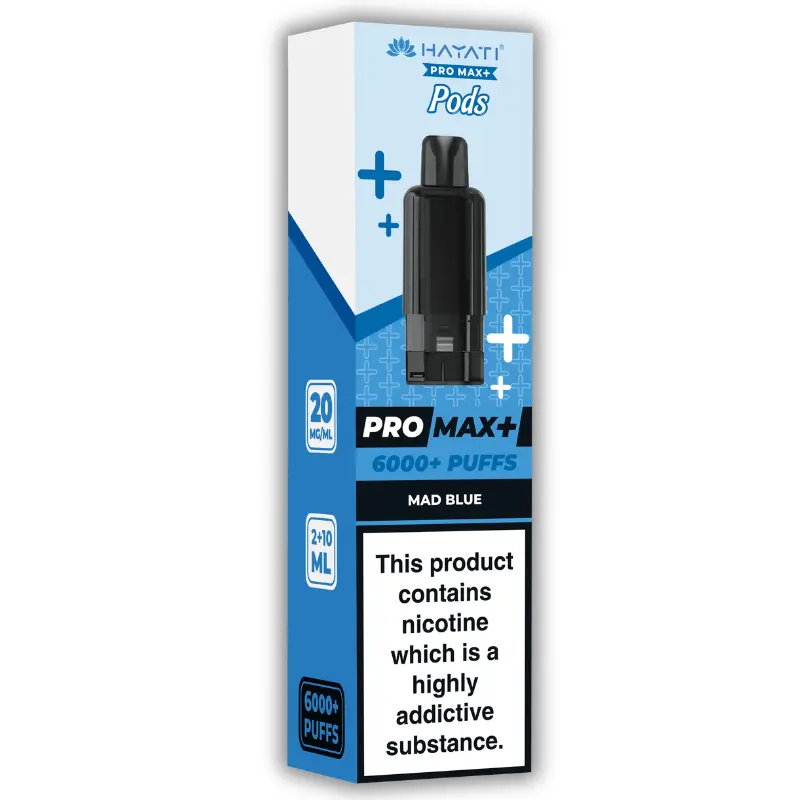
Hayati · Pro Max Plus
Mad Blue Hayati Pro Max Plus Pods
£5.49
✔ In stock — ready to ship
Genuine Hayati
Free over £20
Same-day dispatch
Secure checkout
Mad Blue as a bare pod is £5.49. That buys one sealed Pro Max Plus pod holding 12ml of liquid at 20mg, and no hardware whatsoever, so the listing is only useful to somebody who already has a Pro Max Plus body on the desk. First purchases happen at the Mad Blue Hayati Pro Max Plus 6000 Pod Kit, which is £7.99 with a device included. This page is written for the other transaction, the one where the hardware question is closed and the only thing still open is which pod goes in the basket.
That question has a peculiar shape on this particular listing, and it is not a flavour question. Before writing a word of this page I went through the product titles in the Hayati catalogue and counted every one carrying the word blue, in any form. There are 127 of them out of 492 listings. On the Hayati Pro Max Plus Pods shelf, which is the only shelf that matters when you are restocking a Pro Max Plus, 18 of the 89 listings are blue, and every single one of them costs the same £5.49 as this one.
Eighteen candidates, one price, and a colour that names no fruit. The interesting thing about Mad Blue is therefore not that blue is an invented flavour category, because that argument has already been made properly one shelf over and does not need making twice. The interesting thing is quantity. Hayati have taken a word that describes no plant and built a sub-range on it large enough that a buyer standing in front of it has almost nothing to steer by. That is a navigation problem rather than a tasting problem, and navigation problems have solutions, which is what most of the length below is spent on.
One caveat before the counting, and it governs everything after it. What I counted were names. Counting names tells you about naming behaviour with a good deal of confidence and tells you about liquid with none at all. Nothing below should be read as a claim about what is inside this pod. Where I move from the count to a guess about contents, I have said so in the sentence where it happens.
Counting the blue
Here is the arithmetic, stated plainly enough that anybody can repeat it. Across the full 492 Hayati listings, 83 titles use blue as a standalone word: Blue Razz, Blue Fusion, Mr Blue, Mad Blue and so on. A further 44 use it only inside blueberry, where it is part of a fruit's ordinary English name and is not doing colour work at all. Together that is 127 listings, a shade over a quarter of everything Hayati sell here.
Strip the platform suffixes off those titles and the 127 listings resolve into 42 distinct flavour names, because most flavours are sold several times over on different hardware. Mr Blue alone accounts for 13 listings, appearing as Pro Max Plus pods and kits, Pro Ultra Plus pods and kits, Mini Ultra pods and kits, Rubik pods and kits, two bottle formats and one side of a dual pod. Mad Blue is more modest at three: this pod, the kit, and a 10ml nic salt bottle at £2.49.
Those numbers are large in the abstract. They become properly striking when you set the word against the rest of the vocabulary. I ranked every word appearing in the catalogue's titles after removing the platform terms, and the order at the top runs: ice 90, blue 83, raspberry 74, cherry 62, strawberry 60, razz 48, blueberry 46, lemon 38, peach 32. Only one word beats blue, and ice is a temperature rather than a flavour. Which means that blue, a colour corresponding to no fruit grown anywhere, is the most frequent flavour word in the entire Hayati catalogue, ahead of raspberry by nine listings and ahead of strawberry by twenty-three.
Now compare blue with the other colours, since that is the fairest test of whether this is a house habit or a blue-specific one. Counting standalone colour words the same way: blue 83, red 12, orange 7, pink 4, black 4, white 3, green 2, purple none. Orange should be discounted further because orange is also a citrus fruit, and in three of its seven appearances it is plainly the fruit. Green appears twice, both times inside Peach Green Tea, where it describes the tea. Pink is Pink Lemonade and a single Mr Pink. Black standing alone is Black Mamba and Black Mint.
So the honest reading is not that Hayati name things after colours. It is that Hayati name things after one colour. Every other colour in the catalogue is used a handful of times or fewer. Blue is used eighty-three times and has acquired its own grammar, with a shorthand (Razz), a persona (Mr Blue), an intensifier (Mad Blue), a temperature variant (Blue Frozen) and a term meaning several unspecified blues at once (Blue Fusion). No other colour in the range has any of that.
The sub-range is also visible in the shop's own furniture, which is a useful independent check on my counting. There is a Blueberry Vapes shelf carrying 90 products, sitting alongside the broader Berry Vapes shelf of 225. A retailer does not build a shelf for a colour unless the colour has enough stock behind it to make one. The blueberry shelf is narrower than my count of 127, which makes sense: it is gathering a fruit rather than a colour, so the Blue Razz and Mr Blue listings that name no berry are not automatically on it. The two numbers disagreeing is not an error in either. It is the first sign of the thing this page is about, which is that blue and blueberry are two different categories wearing overlapping words.
Which of the eighteen can be told apart from the name alone
The catalogue-wide figures set the scale. What decides an actual purchase is the eighteen sitting on the shelf you are buying from, so I sorted those eighteen by how much a person could work out from the title without opening anything.
Six of them name real fruit and a second real thing, and are fully legible: Blueberry Raspberry, Blueberry Raspberry Cherry, Blueberry Cherry Cranberry, Blueberry Pomegranate, Strawberry Raspberry Blueberry and Blueberry B’Gum. Every component of those names points at something you could buy in a shop and put in your mouth, with B’Gum as the one elision, and an elision that takes about two seconds to unpick.
Six more pair the blue raspberry convention with a second term that names something specific: Blue Razz Mojito, Blue Razz Pineapple, Blue Razz Lemonade, Blue Razz Cherry, Blue Razz Blackcurrant and Blue Sour Raspberry. These are one step less legible than the first six, because the blue half is a trade convention rather than a plant, but the second half does genuine work. Mojito means citrus and mint. Pineapple means pineapple. Sour names an axis and tells you which end of it the liquid sits at.
Two are partial. Blue Razz GB carries an abbreviation that is not expanded anywhere on its own listing. It can be resolved, but only sideways, by noticing that the catalogue also sells a Blue Razz Gummy Bear bottle and a Strawberry GB, at which point GB obviously means gummy bear. That is a real piece of information hidden behind a two-letter puzzle, and it is worth saying that I am inferring it from the pattern across listings rather than reading it off this one. Blue Frozen is the other partial: frozen is a genuine, checkable, first-draw-obvious claim about coolant level, and it says nothing at all about fruit.
Four give you nothing beyond the colour. Blue Razz Fruit Twist, where fruit twist is a phrase that could cover any combination of anything. Blue Fusion, where fusion asserts only that more than one thing went in. Mr Blue, which is a persona. And Mad Blue, which is this one.
Six, six, two, four. That is the actual shape of the shelf, and it means a third of the blue block is either partly or wholly unreadable from its title. If you already know which fruit you want, twelve of the eighteen will serve you and the shopping takes a minute. If what you know is that you want a blue, all eighteen are live, and the four at the bottom of that list are indistinguishable from each other on the page.
What the distinguishing word is actually claiming
Each of those eighteen names is built the same way: the colour, plus a distinguishing word. The colour is constant, so every scrap of discriminating power in the name has to come from the other part. It is worth being precise about what each of those other parts is actually asserting, because they are not doing remotely the same kind of job and they are laid out on the shelf as though they were.
Razz points at a fruit convention. It is the strongest of the modifiers, because blue raspberry is a specific, widely made, widely recognised accord rather than a vague direction, and the word appears on 48 listings here. Anyone who has had a blue raspberry anything can predict a Blue Razz liquid within reasonably tight bounds. Razz is doing more work than the colour it sits next to.
Sour names an axis and a direction on it. Acid level is one of the few things about a sweet fruit liquid that varies enough to matter and is immediately obvious on the first draw. A name containing sour has told you something you can verify in four seconds.
Frozen also names an axis, coolant, and also gives a direction, high. It leaves the fruit unspecified, which is a real gap, but it closes the one variable that most often ruins a pod for somebody who did not want it.
GB names a confectionery reference, and does it in code. Once decoded it is as informative as Razz.
Fusion names a structural property, blending, without saying what is blended. It rules out single-note simplicity and rules in nothing.
Mr names nothing. It is a piece of personality attached to a colour, and it is the flattest name in the group.
Mad, which is the word this listing turns on, is the one worth dwelling on, because it looks more informative than it is. Mad reads as an intensifier, and an intensifier feels like information. It seems to promise that something is turned up. The trouble is that it does not say which thing, and in a sweet fruit liquid there are at least four independent dials that could be the one being advertised.
- Sweetness. A mad blue could mean more sugar, and a syrupy pod is a very different experience from a restrained one.
- Acid. It could mean sharper, which pushes it towards the territory Blue Sour Raspberry occupies openly.
- Coolant. It could mean colder, which is what Blue Frozen says in plain English.
- Concentration. It could mean more flavouring at the same sugar and acid levels, which reads as loudness rather than as sweetness or sharpness.
Those four produce four genuinely different pods, and nothing in the name or the listing indicates which is meant. Mad is a magnitude with no vector attached. Compare that with sour, which is also one word and also short, and which gives you both the axis and the direction. The two words cost the same amount of space on a label, and one of them is four times more useful than the other.
I want to be careful here, because this is exactly the point at which a page can slide from analysing a name into pretending it has analysed a liquid. Everything in the last few paragraphs is a reading of words. It is entirely possible that Mad Blue is a sharply defined, tightly made liquid that anybody would recognise instantly. The name does not tell you that it is, and the name does not tell you that it is not. What the name tells you is that Hayati chose not to specify, and the count above suggests they made that choice repeatedly, across a sub-range, rather than once.
What this listing puts on the record, and what it leaves off
The cleanest way through an underspecified product is two flat lists. Here is everything Hayati commit to on this listing.
- The name, Mad Blue.
- The format: a prefilled replacement pod for the Pro Max Plus, with no device supplied.
- Fill volume: 12ml.
- Nicotine strength: 20mg.
- A manufacturer's figure of up to 6,000 puffs, which is a laboratory estimate produced under controlled conditions and not a forecast of your week.
- The price, £5.49.
- That the flavour sits in the blue family, which is a statement about a category rather than about a recipe.
And here is what is not published anywhere I can find.
- Which fruits, if any, the blend is built from.
- Whether there is any coolant in it, and if so how much.
- Where the sweetness sits relative to the other seventeen blues on the same shelf.
- What mad refers to, out of the four possibilities above.
- The VG/PG ratio of this pod's liquid.
- Coil resistance, and any parts breakdown for the pod.
- Whether this liquid is the same recipe as the Mad Blue nic salt bottle, which is a different strength and a different format.
Sorted by how much weight I would put on each, the claims come out like this. Reasonably confident: the liquid is sweet, and it is recognisably a member of the blue family, because that is what the category is and Hayati have placed it there in their own description. Probable: it leans candied rather than fresh-fruit, which is how essentially every blue liquid in the trade behaves, and the intensifier in the name suggests it is not a restrained example. Unknown: which of the four dials mad refers to, whether there is coolant, and where it falls on sweetness against its shelfmates.
Notice that the unknown column contains the two things most likely to decide whether you enjoy the pod. Coolant presence is close to binary in its effect: somebody who does not want menthol will not be talked round by the fruit underneath it. Sweetness is the axis on which sweet fruit liquids most often become tiring by the third day. Both are unpublished. If either of those is a hard requirement for you rather than a preference, a named listing serves you better, and Blue Frozen answers the coolant question outright while Blue Sour Raspberry answers the acid one.
A filter is only half of a navigation system
Here is where the count turns into something practical. Any system for choosing between many similar things needs two separate capabilities. It needs to narrow, and then it needs to order. Blue is very good at the first and supplies nothing at all for the second.
As a filter it is genuinely efficient. Eighty-nine listings become eighteen with no reading, no clicking and no product knowledge, just by scanning for a word. A buyer who knows they want a blue has eliminated seventy-one candidates in about a second, which is a better hit rate than most shop filters manage. That is real value and it should be credited.
Then the sorting has to happen, and this is where the shelf runs out of instruments. There are normally three things a buyer sorts a shortlist by.
The first is the name, and for a third of the eighteen the name has already been spent on the filter. Mad Blue, Mr Blue, Blue Fusion and Blue Razz Fruit Twist have each used their entire title to say the one thing all eighteen have in common. There is no residue left over to sort by.
The second is price, and on this shelf price has been deliberately removed as a signal. Every one of the eighty-nine listings is £5.49, the six-fruit blends and the one-word colours alike. Uniform pricing is a perfectly sensible retail decision and it makes the basket easy to predict, but it does mean that the tiebreaker most shoppers reach for second is simply unavailable. The Blueberry Cherry Cranberry Hayati Rubik Pods listing at £3.99 shows that Hayati do price differently across hardware, so the flatness here is a property of this shelf rather than of the brand.
The third is other people's words, and a coined name degrades that channel too, though the argument for why belongs to a different page and is not rehearsed here.
Three sort keys, all three weakened at once, and the weakening comes from the same source in each case: the name carries a category instead of a description. That is the cost of scaling a colour, and it lands entirely on the buyer, because Hayati's side of the transaction works perfectly well either way.
The honest case for a house colour
Having spent a thousand words on the problem, it is only fair to put the other side properly, because a house colour identity is a legitimate commercial strategy and quite a lot of what it does is useful to the person buying.
Start with the strongest point in its favour. Colour shorthand works because buyers genuinely do hold a taste under a colour word. Somebody who says they like blue is not being vague; they are pointing at a specific, stable, well-established confectionery accord that they can recognise instantly and would notice the absence of. The Blue Fusion Hayati Pro Max Plus Pods page sets out why that accord is real and remarkably consistent between manufacturers despite having no natural original to be measured against, and that argument stands. A name built on it is not an empty name. It is a name pointing at something the buyer already owns a mental copy of.
Second, and this one specifically favours the listing you are reading rather than blue names in general: a repeat buyer needs a name to re-identify a product, not to describe it. You have had this pod. You know what it tastes like. Your requirement of the label is that it lets you find the same thing again, quickly, without ambiguity. Judged on that job, Mad Blue is an excellent name. It is two words, it is unique in the catalogue, it types into a search box without error, and nothing else in 492 listings is close enough to be confused with it. Try the same test on Blueberry Raspberry Cherry and Blueberry Cherry Cranberry, which are highly descriptive and genuinely easy to mix up with each other. Descriptiveness and memorability are not the same property, and the informative names are worse at the second one.
Third, the colour block has a real function for somebody who does not want to choose carefully. A large body of near-neighbours at one price is close to interchangeable by design, and a buyer who just wants a blue and does not much mind which can pick any of the eighteen and land inside their preference. For that shopper the flatness is a convenience, not a defect. Not everybody is optimising.
Fourth, from the brand's side the logic is obvious and not sinister. A recognisable colour identity means a new liquid arrives with an audience already attached. It reduces the risk of every launch. Since the whole line is priced identically, the brand is not extracting a premium for the name, which is a meaningful difference from how coined naming usually works.
Where the strategy stops scaling
The case above is sound at small numbers, and the count is what puts it under strain. A colour used four or five times is a badge. It marks a small family, everybody understands it immediately, and the individual members are still distinguished by their other words. That is how red behaves in this catalogue, across its twelve listings, and nobody could get lost in it.
A colour used eighty-three times is not a badge, it is a category, and categories need internal structure to be usable. Sub-ranges in every other trade develop one as they grow, whether numbers, tiers, a sweetness index or a family suffix. This one has developed a partial grammar instead: Razz for the raspberry reading, Frozen for cold, GB for confectionery, and then four names that sit outside the grammar entirely and are told apart only by the fact that they are different words.
The failure is therefore quite specific and worth stating precisely, because the vague version of this complaint is unfair. The problem is not that Hayati use colour names. It is not that they use a lot of them. It is that the sub-range grew past the point where a single shared word could carry the sorting, and the naming did not grow with it. Twelve of eighteen kept their second word doing real work. Four did not, and those four are now competing with each other for the same buyer, at the same price, with nothing to separate them on the page.
That is a judgement about a naming system, not about a liquid, and I want to keep those apart. It is entirely possible that Mad Blue is the best pod on the shelf. Nothing in the count bears on that either way. What the count establishes is that the listing cannot tell you, and that eighteen listings at one price with one shared word is a situation a buyer has to bring their own method to.
Working through a block of near-identical names
So here is the method, which is the practical payoff of all the counting.
Start by deciding what your blue is for. The eighteen split cleanly by purpose once you ask that question, and the split is more useful than any ranking. If you want blue as fruit, meaning you want to taste something that grew, the blueberry-named listings are where to go and the rest of the block is a distraction; Blueberry Pomegranate is the clearest example because both halves are plants. If you want blue as confectionery, the Razz family is the whole of your shortlist. If you want blue as cold, Blue Frozen says so on the label and nothing else on the shelf does. If you want blue as loudness, which is the register Mad Blue is advertising, then this listing and Blue Sour Raspberry are the two that claim it, and only one of them says which direction the loudness runs in.
Do not put two unreadable names in the same order. This is the single most useful rule for a block like this one. If you buy Mad Blue and Blue Fusion together and dislike one of them, you have learned almost nothing transferable, because neither name tells you what the disliked property was. Buy one opaque name at a time and pair it with something fully described. Blueberry Raspberry is the natural pairing, being the plainest two-fruit blue on the shelf, and it gives you a fixed point to measure the unnamed one against.
Use the cheaper format to scout, if you own the hardware for it. Mad Blue exists as a 10ml nic salt bottle at £2.49 as well as as this pod. That bottle is a 10mg liquid for refillable pod kits rather than anything that fits a Pro Max Plus, so it is not a substitute purchase. What it is, if you happen to keep a refillable device around, is a considerably smaller way to find out what Hayati mean by mad before committing to 12ml of it. The obvious caution is that I am inferring the two liquids share a profile from the fact that they share a name, and Hayati do not state that anywhere. Treat it as a strong hint rather than a guarantee.
Write down what arrives, on the first pod, in three lines. Not a tasting note, which will be wrong by next month, but three readings you can check against later. Where the acid lands, at the front of the draw or on the exhale. Whether the sweetness coats the mouth or prickles and runs dry. Whether there is any cooling at all, on a scale of none, a trace, or obvious. Those three answers between them resolve most of what the name left open, they take one draw each to establish, and they are the only description of this liquid that will exist anywhere you can reach.
Then decide whether the colour is your category at all. A meaningful number of people work through several blues, find each one broadly fine and none of them memorable, and conclude the fault is in the individual pods. Sometimes the honest answer is that the accord itself is not for you, and eighteen attempts at it will not change that. The exits are all on the same shelf and cost the same: Blackberry Ice for a dark berry with a cold edge, Strawberry Raspberry Cherry for red fruit instead, Berry Lemonade for something carbonated in character, or Mixed Berries if the appeal was the berry weight rather than the colour.
The pod on its own
The hardware side of this purchase is short, because there is nothing unusual in it. What arrives is one sealed pod, prefilled, in packaging with no accessories of any kind. It seats into a Pro Max Plus body you already own, and the flavour changes when the pod changes, which is the entire interaction model. There is no coil to buy, no bottle to open, nothing to screw together.
The one specification that actually matters for a liquid like this one is the 12ml fill, and it matters for a reason peculiar to an underspecified name. Twelve millilitres is a large indivisible commitment to a profile you cannot preview. On a listing that names its fruit, the size is a supply decision and nothing more. Here it is the size of the bet, because the pod cannot be opened, cannot be decanted, cannot be split with anybody and cannot be partially returned to the shelf. Hayati rate the pod at up to 6,000 puffs, a laboratory figure arrived at under fixed test conditions, and the practical translation is that a pod you turn out not to like is several days of not liking it or £5.49 written off.
On fitment, keep the rule simple and do not take a cross-range fitment judgement from any retail page, this one included, because Hayati publish very little about which bodies accept which pods. Everything else about how this device behaves in daily use, including charging rhythm, condensate and how a pod ages, is covered across the Hayati Pro Max Plus Pods shelf and does not need repeating here. The liquid is the only part of this transaction that is specific to Mad Blue.
The listing in figures
The table below is the published record, ordered from the things that vary across the blue block down to the things that do not vary at all, which is the order that is actually useful when you are choosing between eighteen listings rather than reading one.
| Name | Mad Blue, the only listing in the catalogue using that pair of words |
| Flavour information published | Colour family only; no fruit named, no coolant stated |
| Cost of this listing | £5.49, identical to all 88 other pods on the shelf |
| Same flavour, other formats | Kit at £7.99; 10ml nic salt bottle at £2.49 |
| Liquid supplied | 12ml, sealed, prefilled |
| Nicotine content | 20mg |
| Manufacturer puff figure | Up to 6,000, a laboratory estimate |
| Hardware included | None |
| Brand | Hayati |
Two rows deserve a note. The 20mg strength is the UK legal maximum for nicotine in an e-liquid of this kind, and it is the figure on every one of the eighteen blue listings, so it cannot help you choose between them. It is worth saying that nicotine is addictive and that the strength here is the highest permitted rather than a mid-range setting. If a lower figure is what you are after, the shelf does carry Hayati Pro Max Plus Prefilled Pods Zero Nicotine (0mg), though those are a strength-led listing rather than a Mad Blue.
The price row is the one worth staring at. Uniform pricing across eighty-nine listings means the shop is telling you, quite explicitly, that it considers a three-fruit named blend and a one-word colour to be worth the same money. That is a coherent position, since the liquid volume and the hardware are identical. It just means the price is silent on the question you are asking, and you should not read the flatness as a judgement in either direction.
Which blue to buy instead, and on what grounds
Concrete alternatives, sorted by the reason you would switch rather than by similarity, because similarity is exactly what is hard to judge here.
If the problem is that you want to know what is in it. Move to a named blue and accept that you are trading intensity marketing for legibility. Blueberry Raspberry is the reference point for the whole colour, two fruits, both real, nothing hidden. Blueberry Raspberry Cherry adds a third and makes the middle of the blend fuller. Strawberry Raspberry Blueberry takes the same idea but leads with red fruit rather than blue, which changes the character more than the ingredient list suggests.
If the problem is that you wanted the loudness and got something flat. The Razz family is where the sharper readings live, and each member varies it in a stated direction. Blue Razz Mojito puts citrus and mint against the berry. Blue Razz Pineapple adds a tropical acid. Blue Razz Lemonade lightens and carbonates the impression. Blue Razz GB goes the other way into rounded confectionery sweetness, and is the choice if loud meant sweeter rather than sharper. Blue Sour Raspberry is the one that puts the intensity where you can see it, in the acid.
If the problem is that you wanted a sweet shop rather than a fruit bowl. Blueberry B’Gum takes the blueberry side towards chew and bubblegum, which is a different kind of sweetness from the syrup a plain blue usually carries.
If the problem is that you want depth rather than brightness. Blueberry Cherry Cranberry brings a tart, drier finish thanks to the cranberry, and Blueberry Pomegranate is the most grown-up reading of blue on the shelf, since pomegranate carries an astringency that sugar does not cover.
If you are willing to change hardware to get more out of the same colour. The Pro Ultra Plus platform carries the blue family too, at larger volumes and different prices. Blueberry Raspberry Hayati Pro Ultra Plus Pods is the direct equivalent of the shelf reference point. Two dual listings are more interesting for a buyer with this particular problem, because a dual pod is one pod with two internal reserves and a collar that selects between them, so you can switch sides mid-session rather than committing to one profile for 12ml. Blueberry Raspberry/Mr Blue Hayati Pro Ultra Plus 25K Pods pairs a fully described blue with an undescribed one, which is exactly the compare-and-contrast this page has been recommending, delivered in a single purchase. Blueberry Raspberry / Blueberry Raspberry Cherry Hayati Pro Ultra Plus 25000 Prefilled Pod Kit does a narrower version, holding two blends that differ by one fruit, which is about as controlled a comparison as the catalogue offers. Blueberry Cotton K / Raspberry Cotton K Hayati Pro Ultra Plus Pods is another coded name, K standing in for a confectionery reference the way GB does, and it is worth knowing before you order that you will be decoding again. Grape GB / Blue Razz GB Hayati Pro Ultra Plus 25000 Prefilled Pod Kit sets the blue gummy reading directly against the grape one, which is the cleanest way to work out whether it is the colour or the confectionery you actually like.
If the colour is not the point any more. Nothing on the blue list will fix a general tiredness with candied berry. Blackberry Ice keeps dark fruit but adds cold. Berry Lemonade changes the texture rather than the fruit. The full Berry Vapes shelf runs to 225 products and the Blueberry Vapes shelf to 90, which between them will take you well outside the eighteen without leaving berries behind.
Living with a pod you cannot identify by sight
There is one handling problem genuinely specific to buying inside a colour block, and it is worth more attention than the usual advice. Blue pods from this shelf are physically identical to one another. Same body, same volume, same seal. Once a pod is out of its wrapper, Mad Blue and Blue Fusion and Mr Blue are the same object, and nothing on the pod itself will tell you which liquid is inside. If you keep two or three blues in rotation, as many people on this shelf do, you will eventually have an unlabelled pod in a drawer and no way to identify it short of fitting it and finding out.
So mark them. A single letter in marker pen on the base, or simply keeping each pod in its own wrapper until the moment it goes in, solves it entirely and costs nothing. This sounds trivial and it is the most useful practical sentence on the page for anybody buying more than one blue at a time, because the alternative is that your careful three-line note about where the acid lands gets attached to the wrong pod.
The rest of the handling is ordinary. Let a newly fitted pod stand for a minute or two before the first draw so the wick is properly wetted, and take the first few draws gently rather than hard, since a dry first pull on a sweet liquid is the one that tastes scorched and sets a bad first impression on a flavour you were trying to assess. Draw length is the only variable you control on this device, and a longer, slower pull tends to bring out sweetness while a short one reads sharper, which is worth knowing when the whole question is which dial mad refers to.
Sweet liquids leave residue on a coil faster than dry ones, and since a candied blue is at the sweeter end of what this range sells, expect the flavour to flatten towards the end of the 12ml rather than stopping cleanly. Hayati publish no coil specification for these pods and no parts breakdown, so there is nothing to service and no resistance figure to reason from. When a pod starts tasting muted and slightly burnt at the back of the throat, that is the end of it, and pushing on gains nothing but a worse impression of a liquid you may want to judge fairly.
Store a part-used pod upright, in a drawer rather than a windowsill, and away from heat. Sweet fruit liquids darken and dull over weeks in warm light, and on a flavour you cannot look up, a pod that has quietly aged in a bag is a genuine risk, because you will read the change as a formulation change rather than as storage. Somewhere children and pets cannot reach is the right drawer. A spent pod still holds a wick, a coil and a film of unusable liquid, so it should not go in with household waste; battery and vape take-back arrangements exist at most places that sell these, and the pod is not designed to be opened or refilled, so there is nothing to recover from it before it goes.
Questions a restocker asks
How many blue flavours does Hayati actually sell?
Counting product titles across the whole catalogue, 127 of 492 listings carry the word blue in some form, resolving to 42 distinct flavour names once you strip out the same flavour sold on different hardware. On the Pro Max Plus Pods shelf specifically, 18 of the 89 listings are blue.
What does mad mean on this label?
Hayati do not say. It reads as an intensifier, but it does not specify which property is intensified, and there are at least four candidates: sweetness, acid, coolant and flavour concentration. Those produce four noticeably different pods, so the word narrows the field less than it appears to.
Is there menthol or ice in it?
Unpublished, and this is the most common way to be caught out by an unnamed blue. Hayati flag cooling in the name when it is a feature, as they do with Blue Frozen, so the absence of any such word is weak evidence against a heavy chill. It is not proof, and if you need a definite answer, buy a listing that states it.
How does it differ from Mr Blue and Blue Fusion?
From the published record, not at all in any way you could act on. All three are one-price listings on the same shelf whose names give a colour and nothing else. The only difference available to a buyer in advance is the implied intensity in the word mad, and Hayati publish nothing that would let you check it.
What does the GB in Blue Razz GB stand for?
Gummy bear, almost certainly. The listing itself does not expand it, but the catalogue also sells a Blue Razz Gummy Bear bottle and a Strawberry GB, which makes the abbreviation obvious once you have seen both. That is an inference from the pattern across listings rather than something Hayati state on the product.
Is £5.49 a fair price for this pod?
It is exactly what every other pod on this shelf costs, including the ones that name three fruits. Whether that is fair depends on what you think a specified recipe is worth, and since the price does not move, the shop is not charging you extra for the colour or giving you a discount for the missing description.
Can I try the flavour without buying a 12ml pod?
Not on this hardware. Mad Blue also exists as a 10ml nic salt bottle at £2.49, which is a different strength and needs a refillable pod kit rather than a Pro Max Plus, so it is only an option if you already own one. Note also that Hayati do not confirm the bottle and the pod share a recipe; sharing a name is suggestive, not conclusive.
Does the kit version taste different from this pod?
Nothing in the published information suggests so. The Mad Blue Hayati Pro Max Plus 6000 Pod Kit at £7.99 is the same 12ml pod with a body added, so the £2.50 difference buys hardware rather than liquid. Once you own a device, this listing is the repeat purchase.
I bought three blues at once and cannot tell which pod is which. Now what?
Fit one and taste it, which is the only way to identify an unwrapped pod, since they are physically identical. Then mark the other two before they go back in the drawer. Keeping each pod in its original wrapper until use avoids the whole problem.
Which blue should I buy if I want to compare two properly?
Pair one unreadable name with one fully described one, never two unreadable names together. Mad Blue alongside Blueberry Raspberry gives you a fixed reference to measure the unknown against, and a disagreement between them is interpretable. Two coined names in the same order teaches you almost nothing.
Does the 6,000 figure mean anything for how long a pod lasts me?
Very little. It is a manufacturer's laboratory estimate generated by a machine under fixed conditions, and human draws vary in length, frequency and depth far too much for it to predict a week. Treat it as a comparative number between listings rather than a schedule.
Are all the blues on this shelf basically the same liquid?
Nothing published says either way, and it would be a serious claim to make without evidence. What can be said is narrower and still worth knowing: the names of four of them do not distinguish them from each other, which is a fact about the labels rather than about the contents.
The short version
Mad Blue at £5.49 is a 12ml prefilled pod at 20mg for a Pro Max Plus you already own, and by the published record it is a sweet blue-family liquid whose fruits, sweetness level and coolant are all unstated. It sits inside the largest colour block in the Hayati catalogue: 18 of the 89 listings on this shelf, 127 across all 492 products, with blue the most frequent flavour word in the whole range despite naming nothing that grows.
That scale is the reason this listing is harder to buy than it looks. Twelve of the eighteen blues on this shelf can be told apart from their names. Four cannot, and this is one of the four, because mad announces that something has been turned up without saying which thing. A colour is an efficient filter and a poor sort key, and with every listing at one price there is no second key to fall back on. If you want the colour and are relaxed about the specifics, buy it and note down three readings on the first draw so the second pod has something to be checked against. If the specifics are what decide it for you, a named neighbour on the same shelf costs the same money and tells you what you are getting.
Strictly for adults aged 18 and over. Nicotine is an addictive substance.
You might also like


