
Home / Hayati Pro Max Nic Salts / Mr Blue Hayati Pro Max Nic Salt
Hayati · Pro Max
Mr Blue Hayati Pro Max Nic Salt
£2.49
✔ In stock — ready to ship
Genuine Hayati
Free over £20
Same-day dispatch
Secure checkout
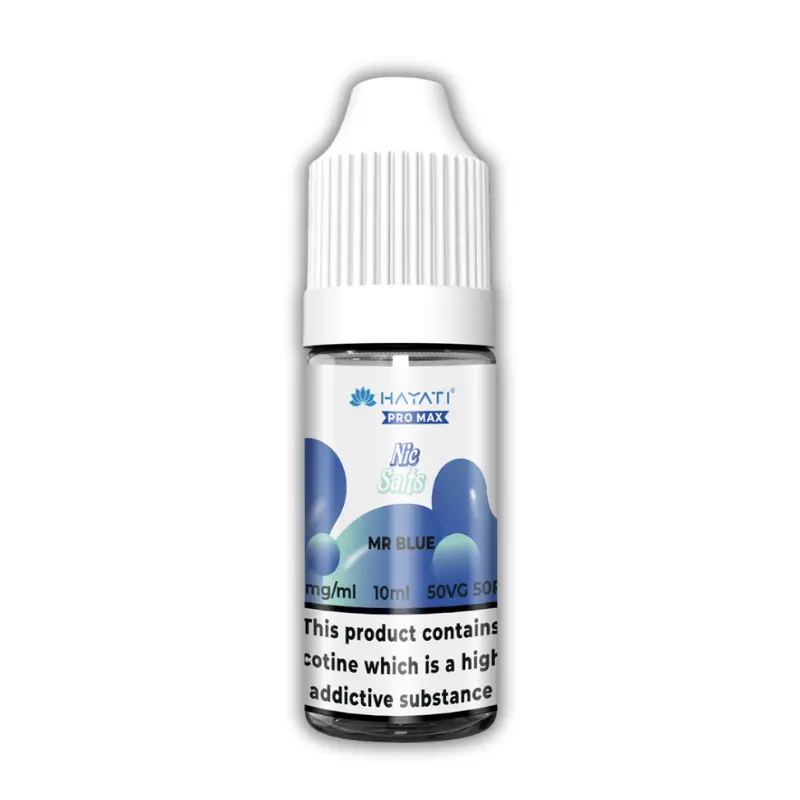
Two pounds forty-nine buys ten millilitres of Mr Blue at 10mg, mixed evenly between vegetable glycerine and propylene glycol, in a bottle with no device, no pod, no element and no cell anywhere in the transaction. As an object that is the whole of it, and the object is not what this page is about.
What is worth attention here is the shelf. The Hayati Pro Max Nic Salts shelf holds 65 listings, and every one of them is recorded at ten millilitres, at 10mg, in the same even base. Sixty-four of the 65 carry the same £2.49. That degree of agreement across a range this size is unusual, and it has a consequence nobody has drawn out: on a shelf where every published figure is held still, the liquid is the only thing left that can differ, and the device doing the work is one object you already own rather than sixty-five separate factory-sealed ones. Mr Blue is the bottle this page is filed against, and it also happens to be the point the shelf's blue navigation is built around, which makes the construction and the anchor two halves of one argument.
Both halves were handed to me as claims, and both needed counting before they could be used. One did not survive intact and the narrowed version is better. The other survived exactly, to the listing. The working for each is below, because a rarity claim in this catalogue has a poor record of standing up, and printing the count is the only way a reader can check what they are being told.
A note on what this page is not. Four other pages on this site have worked Mr Blue over, and between them they own the naming analysis, the two possible readings of the colour, the cost of the ambiguity at 22ml and the question a returning buyer asks about batch consistency. None of that is re-argued here, and where it bears on something below it is cited rather than rebuilt. This page is about the shelf and about what the anchor's emptiness does to a person trying to navigate it.
Counting the shelf before leaning on it
The version of the claim I was given was that this is the only controlled set in the catalogue. It is not, and the catalogue says so in a few minutes, which is where a claim of that shape should always go first.
Take every shelf Hayati operate with five or more listings on it, and ask of each whether the price, the nicotine strength and the volume are single-valued across every member. Seven shelves pass that test outright. The two Mini Ultra shelves pass, at £3.49 for thirty 4ml pods and £3.99 for twenty 4ml kits, all at 20mg. Both Rubik shelves pass, nineteen pods at £3.99 and twenty kits at £5.99, all 12ml at 20mg. The nicotine pouch shelf passes with eleven listings at £4.49. And the two 120ml shortfill shelves pass, twenty listings each at £6.99 and 0mg.
The Pro Max Nic Salts shelf does not pass. Sixty-four listings at £2.49 and one at £2.79 is one price exception, and one exception is enough to disqualify it from the strict version of the claim. So the sentence as handed to me is wrong, and the correction is worth having rather than working around.
Here is what survives the count, and it is a sharper thing than the original.
First, size. Sixty-five listings is more than twice the largest of the seven strictly uniform shelves, which is the thirty-listing Mini Ultra pod shelf. Uniformity across a dozen products is an accident of a small range. Uniformity across sixty-five is a decision, and it is being maintained deliberately.
Second, and this is the part that matters, the purchase contains no hardware. Of the seven strictly uniform shelves, five sell sealed prefilled pods. On those shelves the published figures agree, but the thing doing the tasting is manufactured into each unit, and Hayati publish nothing at all about the element inside any of them. Two pods on the same shelf at the same nominal specification can still differ in wick, in element condition and in airway, and a buyer has no way to know. Uniform numbers on a pod shelf are uniform numbers about the liquid, not about the instrument.
The other two strictly uniform shelves are the 120ml shortfills, which are hardware-free in the same way this one is. They are 0mg, twenty listings each, and a different transaction in every practical sense: a large bottle bought for a higher-glycerine application rather than a small one bought for a pod. Mr Blue is on one of them, as the Mr Blue Hayati Pro Max 70/30 E-Liquid at £6.99, so the same name reaches both kinds of uniform set.
Put those together and the honest version of the claim reads: this is the largest uniform set in the catalogue by a wide margin, and it is the only nicotine-bearing one where the buyer's own device and element serve every listing in turn. That is what was meant by controlled, and it is true once it is said carefully. Sixty-five liquids, one instrument, no variable in the purchase except the liquid itself.
The Summer Dream Hayati Pro Max Nic Salt page already recorded the uniformity as a fact, in service of a different argument about why a bottled reading and a sealed pod are at different strengths. It states the figures and moves on. What it does not do, and what is done above, is ask whether the arrangement is unique and find out that it very nearly is. Everything that page says about what a person does with ten millilitres of an unfamiliar liquid stands, and is deliberately not repeated below. This page is about the shelf as a piece of construction rather than about a procedure to run on one bottle.
The one price that is not £2.49, and what the extra thirty pence buys
The exception is worth a paragraph of its own, because it is the kind of thing a buyer can walk into.
The £2.79 listing is Hayati Pro Max Nic Salts E-Liquid, a listing whose title names the range and nothing else. Its structured flavour field records Banana Ice. That flavour is also on the shelf under its own name, as Banana Ice Hayati Pro Max Nic Salts, at £2.49. The two listings agree on volume, on strength and on base, and they differ by thirty pence.
So the shelf's only price variation, across sixty-five listings, is a thirty-pence premium on a duplicate of something already stocked. It is also the shelf's only duplicated flavour: the other sixty-four flavour fields are all distinct. Whether that is a filing artefact or an intentional generic entry, Hayati do not say, and a buyer arriving on the generic listing has no way to tell from the page that the same liquid is cheaper two rows away. Worth knowing before clicking.
The field that varies in kind rather than in value
If the numbers are held still, the natural next question is what is left to vary. The answer is the flavour name, and one piece of metadata that is present on some listings and absent on others.
Hayati's data carries a structured profile field, the slot where a flavour gets resolved into components. On this shelf it is filled on fifteen listings and empty on fifty. Filled, it reads like a recipe summary: Blackberry and Raspberry, Blackcurrant and Lemonade, Strawberry and Gummy Bear, Blue Raspberry and Menthol. Empty, it reads like nothing at all, and the buyer is left with the title and the marketing paragraph.
The interesting part is what predicts which. Sort the sixty-five by how the web address ends and the shelf splits forty-five singular, eighteen plural and two generic listings whose addresses end in a range name instead. Every one of the fifteen filled profile fields belongs to a plural address. Not one of the forty-five singular addresses carries a profile. The correlation is total.
Three plural addresses have no profile either, and two of those three are the listings where the title and the address disagree about the plural: Blue Razz Cherry Hayati Pro Max Nic Salt and the Lemon Lime bottle both read singular on the title and plural in the address. The third is Banana Ice, which is the duplicated flavour discussed above. Every anomaly in the correlation is a listing that is anomalous in some other way too.
What follows from that is worth stating plainly. The profile field is not a property of the liquid. It is a property of when the listing was created. A bottle with a filled profile is not better documented because Hayati knew more about it; it is better documented because it was entered during a period when that field was being populated, and the address ending is the fossil of that period. Two bottles of identical status can therefore present very differently to a reader, and neither difference says anything about the recipe.
The Summer Dream page noticed one consequence of this from the other direction, observing that Black Mamba is the only coined flavour on the shelf for which Hayati filled the profile in. That observation is correct and the count above explains it: Black Mamba Hayati Pro Max Nic Salts has a plural address, so it falls inside the populated vintage, while the other coined names on the shelf do not. The exception is not about Black Mamba being unusually well described. It is about when somebody typed it in.
Mr Blue has a singular address. Its profile field is empty. The one structured slot in Hayati's own data that exists to say what a liquid is made of has nothing in it for this bottle, and the reason is chronological rather than descriptive. That is the second time on this page that an apparent fact about Mr Blue turns out to be a fact about the catalogue's machinery, and it will not be the last.
One practical note on those address endings, since they trip people up. Forty-five singular against eighteen plural is not a rule anybody can guess at, and a link typed from memory has a good chance of landing nowhere. Every link on this page is copied character for character from the catalogue rather than reconstructed, and anyone building their own list should do the same.
Thirteen blue bottles, and how many of them tell you anything
Thirteen of the sixty-five have the word blue in the title, Mr Blue included. That is one bottle in five on a shelf that also carries cola, menthol, tobacco, apple, mango and three separate cherry constructions, so blue is doing a great deal of work here relative to any other colour or fruit family.
Nine of the thirteen name a fruit outright. Blue Razz Cherry Hayati Pro Max Nic Salt, Blue Razz Gummy Bear Hayati Pro Max Nic Salt, Blue Razz Lemonade Hayati Pro Max Nic Salt and Blue Razz Mojito Hayati Pro Max Nic Salts all carry the razz contraction, which is raspberry. Blue Sour Raspberry Hayati Pro Max Nic Salt spells the fruit out and adds an acid direction. Blueberry Cherry Cranberry Hayati Pro Max Nic Salt, Blueberry Raspberry Lemon Hayati Pro Max Nic Salt, the plain Blueberry Raspberry and the three-berry Strawberry Raspberry Blueberry all lead on blueberry. Nine titles, and in every case you can hold the liquid up against something you have eaten.
Four do not. The Mr Blue Rubik kit page worked out what the second word is doing in each of the catalogue's bare blue names, counted how many listings each carries across the whole range, and set out why a courtesy title is a different kind of word from a temperature or a magnitude. That analysis is settled and is not repeated. What is new here is where those four names land on this particular shelf, and the answer is that all four of them land on it: Blue Frozen Hayati Pro Max Nic Salts, Blue Fusion Hayati Pro Max Nic Salt, Mad Blue and Mr Blue are all here, at the same volume and the same strength, and sixty-four of the shelf at the same price. Every bare blue Hayati sell is available in the one format where they can be held against each other without the hardware changing underneath.
Of those four, one resolves itself. Blue Frozen's profile field reads blue raspberry and menthol, so the fruit and the coolant are both on the record, and its own paragraph is explicit that the cold is the dominant element rather than a background note. The other three carry no profile at all. Blue Fusion's paragraph names the blue raspberry and blueberry family as a pair without choosing between them. Mad Blue's paragraph does the same and attaches an intensity word. Mr Blue's paragraph says that blue usually points at those two and that the name places the liquid in that territory.
Usually. Places. Territory. Three hedges in one sentence, on the listing that the other two hedge against.
What names Mr Blue, and the shape that makes
Here is the second claim, and this one survives the counting exactly as it was handed over.
Search all 492 product descriptions for any mention of Mr Blue, then discard the twelve listings that carry the name themselves, since a listing naming its own flavour is not a reference to anything. What remains is three listings. Mr Pink Hayati Pro Max Nic Salt describes itself as the counterpart in the same range, in a different colour. Mad Blue positions itself for anyone who finds Mr Blue insufficiently loud. Blue Fusion names Mr Blue and Mad Blue together as two other routes into the same colour family. Three listings, and all three are on this shelf.
Now run a second count that was not asked for and turns out to close the loop. How many of the sixty-five bottles explain their flavour by reasoning from their own name rather than by naming a component? Four. Mr Pink, whose paragraph says outright that the name gives a colour instead of a fruit list and that the shade is the best available guide. Mad Blue, whose paragraph takes the two words as two clues and reads them. Blue Fusion, whose paragraph starts from what the name suggests. And Mr Blue, whose paragraph explains what blue conventionally signals and then places itself inside that convention.
The same four listings. The only bottles on the shelf that navigate by reference to each other are the only bottles on the shelf that decline to say what is in them. It is a closed loop of four, three of them pointing at the fourth, and the fourth pointing at a trade convention rather than at a fruit.
That is the structural fact this page exists to record, and it is not a criticism of anybody's copywriting. It is close to inevitable. A writer handed a name with no ingredient in it has two options: invent an ingredient, which would be dishonest, or locate the product relative to something else, which is what all four of them did. Having chosen the second, the nearest available landmark is another bottle with the same problem, because those are the ones the comparison feels natural against. The loop is a consequence of the naming decision, not of the writing.
Where the handed claim had to be narrowed
The version I was given went further than the above. It said that of every flavour the catalogue uses as a reference point, Mr Blue is the only one whose name names no ingredient. That is not quite true, and the count takes about ten minutes.
Pull every flavour name in the catalogue and ask which of them are invoked inside the description of a listing that is not that flavour. Most of the results are ordinary ingredient words doing ordinary work: bubblegum, menthol, blueberry, tobacco, cola, spearmint. Strip those out and look only at names that point at nothing you could eat or drink. There are four. Mr Blue is cited three times. Mad Blue is cited once, by Blue Fusion, which is inside the loop described above. Black Mamba is cited once, by the Red Berry Ice bottle, which offers itself as the lighter and redder option. Ice Cold is cited once, by a mint pouch listing, and Ice Cold names a temperature rather than a thing.
So Mr Blue is not the only one. The narrowed claim, which is true and is the one this page uses, is that Mr Blue is the only flavour in 492 listings cited by more than one other listing while naming nothing you can taste. Three citations against one apiece for the other three, and one of those three is inside Mr Blue's own cluster.
There is a supporting observation that makes the narrowed version land harder than the original would have. Of the four non-naming reference points, three are resolved somewhere in the record. Black Mamba's profile field spells out a dark berry mix with a cool finish. Ice Cold's own paragraph states plainly that there is no fruit in it and that the chill is the whole product. Mad Blue's paragraph, while hedged, at least commits to a direction by attaching an intensity word to the colour. Mr Blue's record resolves nowhere. Empty profile field, hedged paragraph, and three other listings using it as a fixed point.
That is the finding. The shelf's most-cited landmark is its least-specified listing.
What the empty name costs in navigation, which is where it actually bites
All of the above would be a curiosity if it stayed in the copy. It does not, because Hayati's own filing reacts to it.
The catalogue operates thirty flavour-navigation shelves, the ones named after a fruit or a family rather than after a product line: berry, blueberry, raspberry, cherry, lemon, mango, mint, ice and the rest. They exist so somebody can start from a taste and arrive at a product. Every bottle is filed onto however many of them apply.
Mr Blue is filed onto exactly one, and it is Mr Blue Vapes, a shelf named after Mr Blue. It is on no berry shelf, no blueberry shelf and no raspberry shelf. Mad Blue is on two of them. Blue Fusion is on four. Blue Razz Mojito is on five. A buyer who starts from a fruit and works inwards will meet every other blue on this shelf and will never meet this one, because there is no fruit on the listing to file it under.
The self-named shelf partly compensates, and it only exists because thirteen listings across every Hayati product line carry this name, which is enough volume to justify a shelf of its own. Only two of the thirty flavour shelves are named for a flavour that names nothing edible, and they are Mr Blue Vapes and the Summer Dream shelf, both holding thirteen listings. So the compensation is real but it is available to almost nothing else.
Mr Pink shows what happens without it. Mr Pink exists once in the entire catalogue, as this shelf's £2.49 bottle and nowhere else. It is on no flavour shelf at all, one of only three bottles on the shelf in that position, and there is no pink equivalent of the Mr Blue shelf because one listing does not earn one. The pink counterpart is therefore genuinely harder to find than the blue one, and a reader who wants it should follow the link above rather than hope to stumble on it.
Two numbers that are both thirteen sit near each other here and they are different sets, so it is worth separating them. Thirteen of the sixty-five bottles on this shelf have blue in the title. Thirteen listings across the whole catalogue carry the name Mr Blue. The coincidence is arithmetic and nothing more.
The liquid, briefly, because it is not this page's material
Five pages on this site now discuss this flavour, and between them the analysis is finished. The Pro Ultra Plus pods page established that a bare blue in this trade indexes two possible things, counted how thoroughly Hayati's own copy avoids choosing between them, and recorded that two of the seven listings in the whole catalogue that manage to describe themselves with no sensory adjective at all are Mr Blue. The Pro Max Plus pods page lined up two separate descriptions of the same liquid and reported where they disagreed. The Rubik kit page ran the vocabulary of all thirteen descriptions against catalogue base rates. Going over any of that again would produce a worse version of it.
What this listing puts on the record, in its own right, is short. It is a blue-fruit liquid. It is described as bright and sweet with a sharp edge, and as candied rather than fresh, which is a real distinction and the only genuinely descriptive thing on the page: a confectionery register rather than an orchard one. There is no cooling declared, and the paragraph says so directly by describing the liquid as being without ice or additional layers. That silence is stronger evidence here than silence usually is, because the range puts a cold word in the title whenever a coolant is present, a convention established by counting rather than by tasting, and this title has no such word.
Where that leaves a buyer is roughly here. Reasonably confident: sweet, uncooled, candied in character, single-register rather than a medley you take apart. Probable: the blue is the manufactured blue raspberry convention rather than a blueberry-led blend, on the strength of how the word is used everywhere else in the catalogue. Unknown, and this is the axis that decides the purchase: whether it is distinguishable from the other blue bottles on this shelf at the same price. That last one is filed in the unknown column by every page that has looked at it, and nothing in the data moves it.
What the shelf does contribute to that question, and this is the only place the construction argument touches the liquid, is that it removes the excuse. On sealed pods the reason two blues cannot be compared is partly that each brings its own unpublished element. Here that reason is gone. If two of these bottles are hard to tell apart, the liquids are similar, and there is nowhere else to put the blame.
The figures, and what the sheet is not telling you
| Flavour as recorded | Mr Blue |
| Structured profile field | Empty, as on 50 of the 65 bottles |
| Price | £2.49, matching 64 of the 65 |
| Bottle | 10ml |
| Nicotine | 10mg per millilitre |
| Preparation | Nicotine salt |
| Base | 50:50 vegetable glycerine to propylene glycol |
| Cooling declared | None |
| Hardware included | None |
| Product code | HPM-NS-MR-BLUE |
| Filed on | Pro Max Nic Salts, Hayati E-Liquids, Mr Blue Vapes, New Products |
| Cited by | Three other listings, all on this shelf |
Read that table against the argument above and a strange property emerges. Eight of the twelve rows are shelf defaults. The price is the shelf price. The volume, the strength, the preparation and the base are what all sixty-five carry. The absent cooling is shared with roughly three-quarters of the shelf. The empty profile is shared with fifty of them. Take away everything that is true of the shelf as a whole and two rows are left with any information in them: the flavour name, which names a colour, and the citation count, which is a fact about other listings rather than about this one.
That is not a complaint about the specification. It is the specification working exactly as the shelf intends. A controlled set is a set where the specification stops being the differentiator, and this bottle is the clearest illustration of that on the shelf, because it has nothing else in the paperwork either.
One row deserves a word on its own. Ten milligrams per millilitre is the figure every bottle on this shelf carries, so there is no selection to make within the format. Nicotine is an addictive substance and this page offers no view on what strength anybody should use. The 50:50 base is thin, which is why a bottled salt of this kind is intended for a refillable pod or a low-power mouth-to-lung device rather than a wide low-resistance tank. Match the liquid to the device you actually own, and do not take a compatibility decision from a retail page, this one included.
What to reach for instead, and why
The comparisons that matter here are not the usual flavour neighbours, because the shelf's construction changes what a comparison costs. Everything below is the same volume, the same strength, the same base and, with the one exception already discussed, the same price, so choosing between them is a choice about the liquid and nothing else.
If you want a blue with a fruit attached to it. The four razz constructions are the obvious route. Blue Razz Cherry puts a deeper red fruit underneath the candied berry and is the one to take if Mr Blue's single register is the objection. Blue Razz Lemonade runs a citrus tang across the same base, which is a different solution to the same problem, and Berry Lemonade Hayati Pro Max Nic Salt is the version of that idea without the blue. Blue Razz Gummy Bear pushes the confectionery register harder rather than away, and is the nearest thing on this shelf to more of what Mr Blue already is. Blue Razz Mojito is the only one of the four with a declared cooling element in its profile, and it is a background thread rather than a front note.
If the sweetness is the problem. Blue Sour Raspberry keeps the blue and puts an acid edge across it, which is the most direct correction available without leaving the colour. Blueberry Cherry Cranberry uses cranberry for the same job across three fruits, and Blueberry Raspberry Lemon uses citrus at the end of the exhale. Outside the blues, Blackcurrant Juice Hayati Pro Max Nic Salts is the shelf's plainest single dark fruit and Blackberry Raspberry Hayati Pro Max Nic Salts pairs two with no sweetener construction over the top.
If you want cold. Blue Frozen is the blue with the menthol, and its own paragraph is unusually direct that the chill leads rather than accompanies. Blackberry Ice Hayati Pro Max Nic Salts takes a darker fruit under the same treatment, and Strawberry Raspberry Ice Hayati Pro Max Nic Salt moves the whole thing to the red end. For cooling without any fruit at all, Lemon Mint Hayati Pro Max Nic Salt keeps a citrus lift over a mint base.
If you are working through the coined names deliberately. Blue Fusion and Mad Blue are the two that sit closest, and the loop described earlier means their copy will keep pointing you back here. Black Mamba is the coined name on this shelf that Hayati did resolve in the data, so it is the one where the gap between a name and a description is smallest. Summer Dream is the far end of the same spectrum, where neither the title nor any description commits to anything, and its page works through what a buyer does about that.
If you want to leave the blue entirely. Strawberry GB Hayati Pro Max Nic Salts is the red-fruit confectionery equivalent, Double Apple Hayati Pro Max Nic Salts and Blackcurrant Lemonade Hayati Pro Max Nic Salts both carry filled profile fields if you would rather buy something the data describes, and the full Hayati E-Liquids range covers the shortfill side for anyone mixing their own. The complete Hayati catalogue is there if none of the above fits.
If you want this liquid in another format. The Mr Blue Vapes shelf collects all thirteen listings carrying the name, from a 4ml pod up to a 22ml sealed unit, and the pages for those listings deal with the trade-offs between them. This bottle is the smallest nicotine-bearing unit of the flavour on sale.
Living with a candied blue in your own hardware
General bottle handling is the same here as anywhere on the shelf, so what follows is only the part that changes because of what is in this particular bottle.
A candied blue carries a noticeable sweetener load, and sweetener is what accumulates on an element. The effect on this liquid specifically is directional rather than general: the sharp edge the description mentions is the lighter and more volatile part of the blend, and it is the first thing a tiring element stops delivering. A fouled coil does not make Mr Blue taste worse in an even way. It makes it taste flatter and sweeter, which is the same direction the liquid already leans, so the change is harder to notice here than it would be on something with citrus or acid in front. The practical consequence is that the signal to change an element is not a drop in flavour but a loss of the edge, and if you are running this as a daily liquid it is worth knowing that the decline is gradual and one-directional rather than sudden.
The first draws on a fresh element are not representative. Cotton that has not fully wetted delivers a thin and slightly odd version of anything, and on a thin even base the wait is short but it is not nothing. Fill, leave it a couple of minutes, and take the first few pulls gently.
The shelf's uniformity makes one thing cheap that is usually expensive, and it is worth using. Swapping from one of these bottles to another costs you a rinse and a fresh element rather than a new device, a new pod format or a different strength. If you are trying to work out whether Mr Blue is distinguishable from Blue Fusion or Mad Blue, that is the one comparison the catalogue actually makes easy, and it is easy because of the construction described at the top of this page rather than by anybody's design intention.
Carryover matters more on an undescribed liquid than on a named one. A chamber that has been running something cold or sharp leaves a trace for several draws, and since two of the open questions about this liquid are exactly whether there is cold in it and how sharp the edge is, a dirty chamber will answer both wrongly. Run a few draws to clear it, or keep a pod for it.
Keep the cap on and keep the bottle out of warmth and direct light. Any flavoured liquid drifts, and the light aromatic end goes first, which on this liquid is the part carrying the edge rather than the sugar. A bottle left somewhere warm for a fortnight will read duller before it reads spoiled. Ten millilitres used over a few weeks stays consistent against itself; the same bottle picked up again six months later is not the same liquid and should not be treated as one.
An empty 10ml bottle and its cap are plastic packaging and go into household recycling according to whatever your local authority takes. Liquid you have decided against should not go down a sink, so keep it capped and use your local arrangements for household chemicals. Nothing in this purchase contains an element or a cell, so none of the electrical disposal rules that apply to a spent pod apply to it. Store it upright, and keep it out of reach of children and pets.
Questions this listing raises
What does Mr Blue actually taste of?
Hayati do not name a fruit anywhere on this listing, and the structured field that exists for that purpose is empty. What the listing does commit to is a sweet blue-fruit liquid with a sharp edge, candied rather than fresh, and with no cooling. Beyond that, the trade convention behind the word blue points at blue raspberry and blueberry, and that is an inference from how the catalogue uses the word rather than something Hayati have confirmed here.
Is there any ice, mint or menthol in this bottle?
None is declared, and the listing goes slightly further by describing the liquid as being without ice or extra layers. The range also puts a cold word in the title whenever a coolant is present, so the absence of one here is corroborating rather than merely silent. If cooling is what you are after, Blue Frozen is the blue version and roughly a quarter of this shelf declares cooling of some kind.
Why is one bottle on this shelf £2.79 when everything else is £2.49?
Because the £2.79 listing is the generic range entry rather than a named flavour, and its flavour field records Banana Ice, which is already on the shelf under its own name at £2.49. The two agree on volume, strength and base. That single exception is the only price variation across all sixty-five listings.
Are all the bottles on this shelf really the same specification?
On volume, strength and base, yes, and that was checked against the catalogue rather than assumed: all sixty-five are recorded at 10ml, 10mg and a 50:50 base. On price, sixty-four of the sixty-five match. Seven other Hayati shelves are uniform on all three of price, strength and volume with no exception at all, so this is not the only controlled set in the catalogue, but it is by a distance the largest and it is the only nicotine-bearing one where you supply the hardware.
Why does it matter that the hardware is not included?
Because it is what makes the sixty-five comparable to each other. On a sealed pod shelf every unit brings its own element, and Hayati publish nothing about any of them, so two pods at identical stated specification can still differ in ways the buyer cannot see. Here one device and one element serve every bottle in turn, so the liquid is genuinely the only thing that changes between one purchase and the next.
Which other listings mention Mr Blue, and why does that matter?
Three: Mr Pink, Mad Blue and Blue Fusion, all of them bottles on this shelf. It matters because those same three, plus Mr Blue itself, are also the only four listings on the shelf that explain their flavour by reasoning from their name instead of naming a component. The shelf's only cross-referencing runs between the only four bottles that decline to say what is in them.
Is Mr Blue the only flavour in the catalogue used as a reference point without naming an ingredient?
No, and the version of that claim this page was handed had to be narrowed. Mad Blue, Black Mamba and Ice Cold are each cited once by another listing and none of them names something you can eat either. What is true is that Mr Blue is the only one cited by more than one other listing, with three against one apiece, and the only one of the four whose record resolves nowhere: the other three are each pinned down by a profile field or by their own copy.
Why is this bottle hard to find when browsing by flavour?
Because Hayati file products onto thirty flavour-navigation shelves and this one is on a single one of them, the shelf named after Mr Blue itself. It is on no berry, blueberry or raspberry shelf, because there is no fruit in the title to file it under. Mad Blue is on two of those shelves and Blue Fusion on four, so the fruit route reaches every other blue on this shelf and not this one.
Some of these bottles have a flavour breakdown in the data and some do not. What decides it?
When the listing was entered, not what is in it. Fifteen of the sixty-five carry a filled profile field and every one of those fifteen has a plural web address, while none of the forty-five singular addresses carries one. The field is a fossil of a data vintage. Mr Blue has a singular address and an empty field, and that says nothing whatever about the recipe.
Is this the same liquid as the other Mr Blue products?
The name is shared and the descriptions run along similar lines, but this is a 10mg bottled salt in a 50:50 base and the sealed Mr Blue pods are prefilled units at 20mg with no published ratio. Hayati say nothing about whether the underlying concentrate is identical, so the honest answer is that the flavour identity almost certainly carries across and the character of a draw does not. The Mr Blue Vapes shelf lists all thirteen formats.
Can I use this in a sub-ohm tank?
It is the wrong tool for it. A thin even base tends to flood a wide low-resistance coil rather than feeding it steadily, and a salt preparation is built around the small throughput of a restricted low-power draw. The 120ml shortfill bottles exist for higher-glycerine applications and are supplied at 0mg.
Is Mr Pink the same liquid in a different colour?
Its listing describes itself as the counterpart in the same range with a pink and red fruit character instead of a blue one, and it uses the same reasoning-from-the-name approach that Mr Blue does. It exists exactly once in the whole catalogue, as a £2.49 bottle on this shelf, so unlike Mr Blue there is no pod or kit version of it and no shelf of its own.
The position, plainly
Ten millilitres of Mr Blue at £2.49, 10mg in salt form, evenly split between glycerine and glycol, uncooled, with no hardware in the purchase. On its own numbers it is indistinguishable from sixty-four other bottles, which is the point rather than a criticism.
The shelf it sits on is the largest set in this catalogue where every published figure is held constant and the buyer supplies the instrument. That is not quite the unique arrangement it was presented to me as, since seven other shelves are strictly uniform and this one carries a single thirty-pence exception, but it is the only nicotine-bearing one with no hardware in the box, and it is more than twice the size of its nearest rival. Sixty-five liquids, one device, one element, nothing else moving.
Mr Blue is the point that arrangement is navigated from. Three other listings in 492 cite it, all three on this shelf, and those three plus Mr Blue are precisely the four bottles here that explain themselves by their names rather than by their contents. Of the four flavour names in the catalogue cited by another listing while naming nothing edible, Mr Blue is the only one cited more than once and the only one left unresolved everywhere: empty profile field, hedged paragraph, filed onto no fruit shelf, reachable only through a shelf named after itself.
Which makes the buying decision straightforward to state even though the liquid is not. If you already know you like the candied blue register and want the plainest version of it without cooling or a second fruit, this is that, at the shelf price, in the format where swapping to a neighbour costs almost nothing. If you want to know what is in it before you spend, nothing on this listing or anywhere in Hayati's data will tell you, and the nine blue bottles on this shelf that do name a fruit are the better purchase for that reason alone.
Strictly for adults aged 18 and over. Nicotine is an addictive substance.
You might also like


