
Home / Hayati Pro Max Nic Salts / Mr Pink Hayati Pro Max Nic Salt
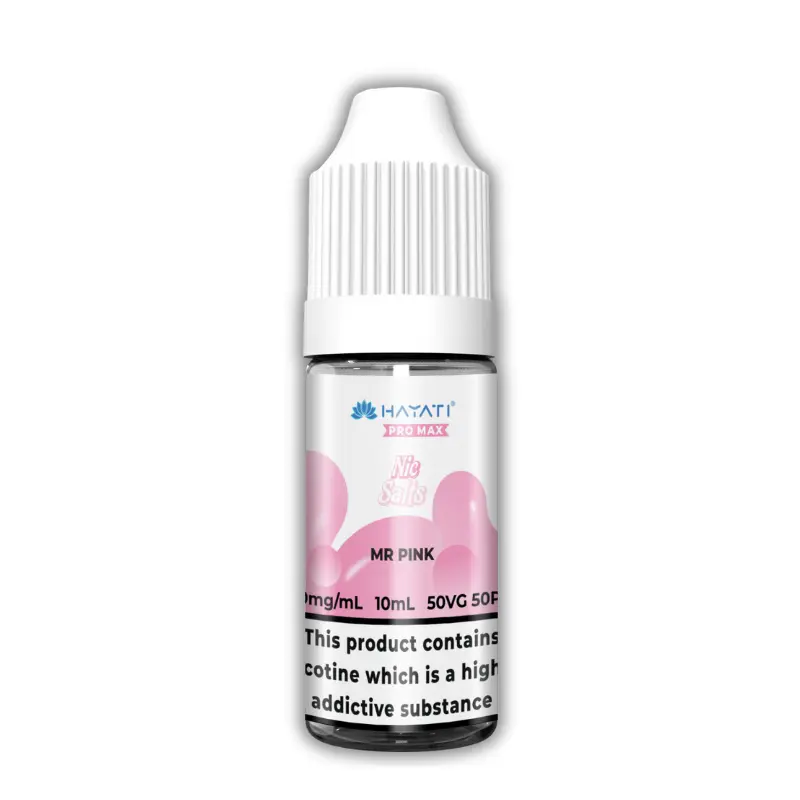
Hayati · Pro Max
Mr Pink Hayati Pro Max Nic Salt
£2.49
✔ In stock — ready to ship
Genuine Hayati
Free over £20
Same-day dispatch
Secure checkout
Mr Pink is a 10ml bottle of 10mg nicotine salt, mixed at fifty percent vegetable glycerine to fifty percent propylene glycol, sold at £2.49 with no device, no pod, no coil and no cell in the purchase. That price is the floor of this entire catalogue. Sixty-four of the 492 listings sit at £2.49 and every one of them is a bottle on the Hayati Pro Max Nic Salts shelf. Nothing Hayati sell costs less than this listing does.
That is the whole of the hardware story, and it is the last easy paragraph on this page. The difficult part is the liquid, and the difficulty is not that Hayati say little about it. They say 134 words, which is about average for this catalogue. The difficulty is that every method this site normally uses to get past a thin product description happens to be unavailable on this particular listing, and all four of them are unavailable at the same time.
Those methods are not secrets. They have been worked out one at a time across the pages of this site, each one by a writer who needed it for a specific product and then left it behind for the next. You line a flavour's listings up against each other and read the disagreements. You look at which shelf the catalogue filed it on, because filing is a judgement somebody made with the product in front of them. You read the twin, meaning the same recipe sold under a second name in a second format. And you follow whatever the description itself points at when it runs out of things to say.
On Mr Pink the first method has a sample of one. The second has nothing to weigh. The third has no twin to read. The fourth points at a flavour whose own description problem has already been documented at length on this site, which makes the pointer a redirect rather than an answer. Four for four.
What follows walks each method in turn, names the page that established it, shows exactly how it fails here, and then counts whether any of this is actually unusual. It is not, individually. Thirty-eight listings are sold exactly once. Twenty-two carry no flavour shelf. Thirty-nine end their flavour paragraph by naming a different product. Those are ordinary numbers. What is not ordinary is the overlap, and the last of those sections gives the intersection. After that comes the only honest output of the exercise: a short list of what Hayati's 134 words genuinely license you to expect, marked by confidence, with the page stopping there rather than manufacturing a tasting note to fill the gap.
The four methods, and why naming them first matters
A page that simply says "Hayati do not tell us much" has told the reader nothing they could not see for themselves in ten seconds on the listing. The useful version says which specific tools were reached for, what each one would have produced, and what its absence costs. That way a reader who disagrees with the conclusion can see which step they would attack.
It also keeps this page honest about its own limits. Three of the four methods below are not mine. They were built elsewhere in this corpus for other products, they are cited rather than rebuilt, and the arithmetic behind them belongs to the pages that did it. What is mine is the observation that they arrive here together, the count that establishes how unusual that is, and the decision about where to stop.
One thing this page will not do is treat the gap as an invitation. A flavour name that withholds its ingredients is a commercial choice with predictable effects, and the temptation on a listing like this one is to fill the silence with confident prose about strawberry and raspberry. That would be inventing a product. The catalogue supports a colour family, a sweetness direction and two absences, and the last third of this page sets out exactly those and refuses the rest.
Method one: read a flavour's listings against each other
The single most productive technique in this corpus was worked out on the Blackcurrant Lemonade kit page, and the idea is simple enough to state in a sentence. Most flavours here are sold several times over, on different platforms and in different formats, and Hayati commission fresh copy for each listing rather than reusing one paragraph. That means several writers, at several different moments, without consulting each other, have each described the same liquid. Where they agree, the agreement is worth something, because independent convergence is hard to fake. Where they split, the split tells you something about how the copy was produced.
The Blackcurrant Lemonade page ran it on seven listings and found that the platform a listing sits on predicts which words its description uses, which is a finding about the copy desk rather than about the berry. The Summer Dream nic salt page ran it on eleven and came away with four properties closed and one open. The Mr Blue Rubik kit page ran it on thirteen and produced a full vocabulary census, counting each candidate word inside the set and then again across the other 479 listings, because a word that is common everywhere proves nothing however often it turns up in front of you. The Pink Lemonade kit page ran it on three and argued, reasonably, that three descriptions agreeing is easier to trust than seven that split.
Three, seven, eleven, thirteen. Mr Pink has one.
What a sample of one actually removes
It is worth being precise about the loss, because "only one description" sounds like a quantity problem and it is really a structural one. Four separate operations become impossible, not merely harder.
You cannot separate a property from a copywriting variant. When a single listing calls a liquid bright, there is no way to know whether brightness is a feature of the recipe that every writer would have noticed, or the word that one person happened to reach for on one afternoon. With eleven listings you can see whether the word survives being written eleven times. With one you are reading a single person's vocabulary and calling it evidence.
You cannot detect house vocabulary from inside the set. The Mr Blue Rubik census had to control for this and found that sweet appears in eleven of its thirteen, which looks like a finding until you notice that the overwhelming majority of the rest of the catalogue uses it too. Mr Pink's description uses sweet three times in 134 words, which is a striking density until you remember that the control is unavailable here and the word is house vocabulary throughout this range. The repetition inside one paragraph is not thirty-three listings converging. It is one paragraph with a limited stock of adjectives.
You cannot treat an omission as a policy. This is the loss that bites hardest. The Pink Lemonade kit page established that across three separate descriptions of that liquid, the number of botanical nouns used for the pink component is zero, and it argued correctly that one omission is an oversight while three is a decision. Mr Pink names no fruit either. But with one description there is no way to distinguish a deliberate refusal from a writer who had nothing to work from, and those two situations mean completely different things. A refusal implies somebody knew and chose not to say. A blank implies nobody at the writing end knew either.
You cannot spot the outlier. The most useful single observation the Pink Lemonade kit made was that one of its three listings used the word rosier, which appears exactly once in all 492 descriptions. A word that appears once in a set of three, and nowhere else in the range, is a flag worth following. Finding an outlier requires a set to be an outlier within.
How common is a sample of one
Common enough that nobody should treat it as remarkable on its own. Normalising the title stems, stripping the format words and the inconsistent apostrophes, 38 of the 492 listings carry a flavour name that appears exactly once in the catalogue. Narrow it to this shelf and thirteen of the 65 nic salts are in that position, including Black Mint, Kiwi Grape Raspberry and Fresh Menthol Mojito.
Look at those three and the point about conjunction starts to make itself. Black Mint has one listing and the title contains a named aromatic, so the sample size hardly matters. Kiwi Grape Raspberry has one listing and names three fruits in order. Fresh Menthol Mojito has one listing and declares a cooling agent, a drink reference and a freshness direction before you have read past the title. Each of them is sold exactly once and none of them needs a second description, because the first thing a buyer reads already contains the information a diff would have been looking for.
A sample of one costs you nothing when the title does the work. It costs you everything when the title is a colour with an honorific in front of it.
Method two: weigh the shelf the catalogue filed it on
The second method is quieter and it is often better than reading the copy, because a shelf assignment is a judgement rather than a sentence. Somebody at Hayati decided that a given liquid belongs with the cherries, or with the berries, or with the sweet ones, and that decision was presumably made by a person who could taste it. Copy can describe the name. A filing decision has to describe the thing.
This catalogue carries 52 category pages and they divide cleanly into two kinds. Twenty-two are range shelves, organised by hardware: the pod kits, the refill pods, the platforms, the e-liquids. Thirty are flavour shelves, organised by what the liquid tastes of. The flavour shelves run from the very broad down to the very specific, with Berry Vapes at 225 listings, Cherry Vapes at 72 and Sweet Vapes at 61, and they get narrow at the bottom end, where Fresh Mint Vapes holds eleven.
Two of those thirty flavour shelves are named after a coined flavour rather than an ingredient. Mr Blue Vapes holds thirteen listings. Summer Dream Vapes holds thirteen. Both are names that tell a buyer nothing about contents, and in both cases Hayati responded by building the name its own shelf, which is itself a kind of statement: the flavour is a destination, go here.
Mr Pink sits on three shelves and all three are range shelves. Hayati Pro Max Nic Salts, the wider Hayati E-Liquids shelf of 105 bottles, and New Products, which holds all 492 and therefore filters nothing. Not one flavour shelf. There is no Pink Vapes shelf in this catalogue and no Red Vapes shelf either, so the colour has nowhere obvious to go, and the thirty flavour shelves that do exist include none that Mr Pink was thought to belong on.
The tag, which exists, and what I was told about it
I was handed this property as "there is no tag to weigh" and that is not quite right, so here is the correction. The tag exists. Mr Pink carries two of them, one reading nicotine salt e-liquid, which 156 listings share and which says only what format it is, and one reading mr pink, which has exactly one member.
Set that against the comparison. The mr-blue tag has thirteen members and a matching thirteen-listing shelf. The summer-dream tag has thirteen and a matching shelf. A tag with one member is not a category, it is a label, and it groups the product with itself. So the narrowed claim is the true one: Mr Pink has a tag, the tag is a set of one, and a set of one carries no information a reader did not already have from the product title. The practical consequence is identical to having no tag, which is presumably why the claim reached me in the stronger form, but the stronger form is wrong and worth correcting because somebody checking the data would find the tag and reasonably conclude the page had not looked.
What a flavour shelf would have told a buyer
More than it sounds, and this is the part worth dwelling on. Shelf membership is comparative by construction. If Mr Pink sat on Cherry Vapes, you would know Hayati thought it belonged with 71 other listings whose titles mostly name cherry outright, and that comparison alone would collapse most of the uncertainty on this page. If it sat on Sweet Vapes and nothing else, you would know the sweetness was the salient property and the fruit was not. If it sat on Berry Vapes you would know at least the family.
None of those is available. And the absence cuts in a direction that is easy to misread, so here is the caution. A missing shelf is not evidence that the liquid does not belong on one. Filing in this catalogue is uneven, and 22 of the 492 listings carry no flavour shelf at all, a group that includes all three tobacco listings, the four Quokka entries, several generic range listings that name no flavour at all and the Coffee pouches. Some of those are plainly filing gaps rather than statements. Reading the absence as a positive claim about the liquid would be exactly the sort of inference this brief exists to prevent.
What the absence does establish is narrower and still useful. Whatever Hayati know about this liquid, they have not encoded any of it in the catalogue's own structure, and the structure is the only part of a retail listing that cannot be written by somebody who has not tasted the product.
Method three: read the twin
Most flavours in this catalogue exist more than once for a commercial reason rather than a descriptive one, and the pattern is consistent. A liquid that sells gets tooled onto more formats. It starts as a bottle or a small pod, and if it moves, it acquires a kit, a larger pod, a refill, sometimes a shortfill at a bigger volume.
For a writer that produces two useful things. The first is a second description of the same recipe, which is method one. The second is different and often better: a different SKU of the same liquid is a different transaction, with a different price and a different amount of the stuff, and comparing them tells you what the range thinks the liquid is worth.
Mr Blue is the clean illustration and the Rubik kit page has already worked out what its distribution means, so the finding is cited here rather than rebuilt. Eleven solo listings across seven distinct formats, plus two more where it shares a divided pod. A Rubik kit, a Pro Max Plus pod and kit, Pro Ultra Plus, Mini Ultra, a 10ml nicotine salt at this same £2.49, a 120ml 50/50 shortfill and a 120ml 70/30. Seven sets of packaging and seven separate decisions to commit stock, which is expensive and is not done out of affection.
Mr Pink has one. No kit. No prefilled pod on any platform. No 120ml version in either mix. Nothing larger and nothing smaller, because 10ml at £2.49 is already the smallest and cheapest unit this catalogue sells.
The cheap way in, with nothing to go in to
Here is where the asymmetry gets genuinely odd, and it inverts an argument this site has made repeatedly.
Four separate pages on this site recommend buying a 10ml bottle before committing to a sealed pod of an unfamiliar flavour, and the Summer Dream nic salt page is written entirely from inside that recommendation, working out what the test costs, what it settles, how fast, and where a bottle reading fails to transfer to a pod. The logic is sound and the arithmetic is theirs. A £2.49 bottle de-risking a £7.99 or £11.99 sealed purchase is a sensible ratio, and for Summer Dream the bottle and the pods are both real objects a buyer can put in a basket.
Mr Pink is the cheapest route into Mr Pink. It is also the only route, the middle of the route and the end of it. The bottle that would normally be a test is here the entire product line, which means the whole apparatus the Summer Dream page builds does not apply. There is no transfer problem because there is nothing to transfer a reading to. There is no strength mismatch to correct for, because 10mg is the only strength on this shelf and there is no 20mg sealed version sitting at the other end of the comparison. There is no question of whether your own hardware distorts the reading relative to the factory's, because no factory version of this liquid exists.
That sounds like a simplification and in one narrow sense it is. The purchase has exactly one degree of freedom. One flavour, one volume, one strength, one price, no option list on the listing and no variant to choose. Buy it or do not.
The cost sits on the other side of the same fact. A twin is not only a cheaper entry point, it is corroboration. When the Blue Razz Cherry bottle and the Blue Razz Cherry pod describe the same liquid, each one is a check on the other. Mr Pink has no check. Every word anybody knows about this liquid outside of tasting it comes from a single paragraph written once, and there is no second document anywhere in the range that could contradict it.
And no way up, which matters if you like it
The forward path is missing too, and it is worth saying plainly because it changes who this listing suits. If you buy this bottle and it turns out to be exactly what you wanted, the ordinary next step is unavailable. There is no Mr Pink kit to move to, no sealed pod for the days you would rather not carry a bottle, and no 120ml to buy when you have settled on it. The only way to have more Mr Pink is to buy more of this one bottle.
For a refillable-device owner that is a non-issue, and refillable-device owners are who this format is built for. For anybody hoping a flavour they like will follow them onto other hardware, it is a real limitation, and the honest reading of a single listing at the bottom of the price ladder is that the range has not committed to it. Nothing in Hayati's published material says why, and this page is not going to guess at a commercial decision.
Method four: follow the pointer the description gives you
When a description runs out of things to say about a liquid, the standard move in this catalogue is to point at a different one. It is a sensible move and it is very common: 84 of the 492 flavour paragraphs name another product from the range somewhere inside them, and 39 of those do it in their closing sentence, which is the position that carries the most weight because it is what the buyer reads last.
Mr Pink's flavour paragraph does it in the closing sentence. After describing a colour family and a sweetness direction, the last thing it says is that a reader who got on with Mr Blue will find this one the pink version of the same idea.
Read that as a piece of writing and it is doing a lot of work in one line. It is the only sentence in the 134 words that names a specific thing rather than a category. It converts an unanswerable question, what does this taste of, into an answerable one, have you tried the other one. And it gives a buyer who has tried Mr Blue a genuine reason to click, which is what it is for.
Where the pointer goes
Follow it and the problem becomes visible immediately, because Mr Blue is the most thoroughly documented naming problem on this site. The Rubik kit page counted the honorifics across all 492 titles and found fourteen listings resolving to exactly two flavour names, thirteen Mr Blue and one Mr Pink, and then ran a vocabulary census across the thirteen Mr Blue descriptions which established how far that copy drifts away from the liquid and towards the name. The Pro Ultra Plus pods page took the same flavour and measured what the colour actually indexes. Both findings are theirs and neither is repeated here.
One number of my own, kept short because the census above covers the ground. Nine of the thirteen Mr Blue listings name blue raspberry or blueberry somewhere in their copy. So the common characterisation, that the thirteen decline to describe the flavour, is overstated and I am narrowing it. They decline to confirm an ingredient, most of them say so in as many words, and then the majority volunteer a guess anyway, inferred from the colour rather than from any recipe. That is a meaningfully different situation from silence, and it is worse for a reader following a pointer, because inference dressed in the same typeface as fact is harder to discount than a blank.
What the pointer can and cannot carry across
Suppose you take the pointer at face value and accept that Mr Pink stands to pink as Mr Blue stands to blue. What have you been given?
Exactly the part that is shared, which is the grammar. Both names are an honorific attached to a colour. Both refuse a head noun, so there is no fruit for the colour to modify. Both were built by the same copy desk in the same range at the same price on the same shelf.
What is not shared is the only part that would have helped. The Rubik kit page reached this conclusion from the opposite direction, when it went looking for why one of the two names travelled onto seven formats and the other did not, and concluded that the colour rather than the honorific was doing the commercial work. Blue is an established trade convention with a reference confection behind it and a very large existing audience. Pink is not a convention in the same way. A buyer reading blue has a specific sweet-counter profile to call up. A buyer reading pink has strawberry, raspberry, watermelon, bubblegum, cherry, lemonade and several others, with nothing in the word to narrow between them.
So the analogy transfers the grammar and withholds the semantics. Mr Pink is to pink what Mr Blue is to blue, and blue means something while pink means a range of things. The pointer is structurally sound and informationally empty, which is an unusual combination and is the reason it reads as more helpful than it is.
One thing the pointer does not do, which nobody has noted
It runs one way. Search all 492 descriptions for a mention of Mr Pink and exactly one turns up, which is Mr Pink's own. Thirteen Mr Blue listings were written, across seven formats and over what must have been a considerable stretch of time, and not one of them mentions the pink counterpart. Several of them cross-reference other products quite happily, including each other.
Do not over-read that. It is consistent with several stories and the data cannot choose between them. The plainest is a commercial one: a copywriter given a single low-volume bottle reaches for the range's best-known name to lend it context, while a copywriter given the range's best-known name has no reason to send traffic to a single low-volume bottle. That would make the pointer an ordinary piece of merchandising rather than a statement about flavour, which is worth knowing before you weight it.
The alternative reading is less flattering and equally unprovable, which is that the relationship was asserted once and nobody at the writing end ever confirmed it. On the evidence available I would not choose between them, and a buyer should treat the Mr Blue sentence as an invitation rather than a specification either way.
The conjunction, counted
Everything above rests on four properties arriving together, and a claim built on a conjunction needs its parts counted separately or it is worthless. Any four sufficiently specific properties will eventually intersect at one listing. So the test is whether each property is common on its own, because if they are, the intersection is genuinely informative rather than an artefact of picking narrow enough criteria.
Taking them one at a time across all 492 listings:
- Sold exactly once. 38 listings, once the title stems are normalised for format words and apostrophes. Roughly one listing in thirteen.
- No flavour shelf. 22 listings, about one in twenty-two.
- The flavour paragraph closes by naming a different product. 39 listings, about one in thirteen. Widen it to naming another product anywhere in the paragraph and it is 84, one in six.
- The title names nothing edible. 94 listings, nearly one in five, which makes it the least remarkable of the four by a distance.
Not one of those is rare. Three of them are things you would expect to bump into every few pages of browsing. Now the intersections, and this is where it turns.
Sold once and no flavour shelf together: four listings. Sold once and closing with a pointer: six listings. No flavour shelf and closing with a pointer: one listing. All three together: one listing. It is this one.
The other three in the sold-once-and-unshelved group are worth naming, because each of them has an escape route Mr Pink does not. The shelf's own generic Pro Max Nic Salts E-Liquid listing sits in that group, and it is a range entry rather than a flavour, so nothing is missing from it. The Tobacco nic salt is there, and its title names the profile outright, so an unfiled listing costs a buyer nothing. The Fruit Bomb Mini Ultra pod is there, and although the name is abstract, the same words appear inside several longer dual-pod titles elsewhere in the range, which gives a reader something to pull on. In each case one missing tool is covered by another that still works.
Mr Pink is the only listing in 492 where the diff has a sample of one, the catalogue's own filing says nothing, there is no second SKU to cross-check against, and the description's most specific sentence is a redirect to a different flavour. That is the finding, and it is worth stating what kind of finding it is.
What the conjunction does and does not license
It does not make the liquid unusual. Nothing above is a claim about what is in the bottle. A listing can be badly documented and taste like anything at all, and there is no reason to think the recipe is less ordinary than its neighbours. If anything, the commercial logic points the other way: a £2.49 bottle at the bottom of a large range is unlikely to be where a manufacturer puts its most difficult blend.
It does not make the listing a poor purchase. £2.49 is the floor price of 492 listings and the downside of being wrong is £2.49 and ten millilitres. Judged as a risk rather than as a document, this is about as small a bet as this catalogue offers.
What it does license is a calibration. Every other page on this site can tell you something about a liquid before you taste it. This one can tell you very little, and a reader who has got used to the rest of the corpus should adjust down rather than assume the usual level of confidence is hiding somewhere in the text. It also means that if you buy this bottle, your own first fill is not one data point among many. It is the second document in existence about this liquid, and the first written by somebody who has actually had it in a coil.
What the 134 words actually license
Here is the residue, which is the honest output of everything above. Hayati's paragraph is short and it does commit to some things. Those commitments are worth taking seriously precisely because there are so few of them, and each is graded below by how far it can be pushed.
Reasonably confident
It is sweet. The word appears three times in 134, attached to the fruit, attached to the blend and attached to the sort of buyer it is aimed at. Sweetness is house vocabulary across this range and the density inside one paragraph proves nothing by itself, as noted above. What makes it usable is that no counterweight appears anywhere. There is no tart, no sour, no sharp, no tang, no zest, no acid word of any kind in the 134 words. On a shelf where Blue Sour Raspberry builds its entire description around a sweet-sour contrast and Blueberry Cherry Cranberry names the cranberry specifically for its bite, an acid word is clearly available to these writers when the liquid has one. Its complete absence here is a weak signal pointing in a consistent direction.
There is no cooling in it. This is the strongest inference available and it does not rest on my reading. The Blue Frozen pods page counted the cooling vocabulary across the whole catalogue and established the convention: Ice appears in ninety titles, Frozen in three, Cooler in two, and no listing combines an ice-family word with a mint-family word. Hayati flag a coolant in the title when there is one. This title carries none, and neither does the description, which does not use a cooling word anywhere in its 134. Read the liquid as uncooled. If cold is what you want, Red Apple Ice and Banana Ice declare it in the title in the ordinary way.
It is not a confectionery build. Same logic, different vocabulary. No confection word appears anywhere in the 134: no candy, no candied, no gummy, no jelly, no bubblegum, no sherbet, no sweet-counter reference of any kind. This range is entirely willing to name a confection when one is intended, and does so on H’Bubba and Blue Razz Gummy Bear, both of which put the sweet in the title and then spend most of their copy on it. The absence here is meaningful in the same weak way the missing acid word is.
Probable
Red and pink fruit, and bright rather than dark. Hayati state both of these directly, so they are not inferences at all in one sense. The reason they sit under probable rather than above it is that a colour family is not an ingredient, and the Pink Lemonade kit page has already established what a bare colour word can carry in this catalogue and counted every colour word in all 492 titles to do it. That work is not repeated here. The relevant consequence is that the dark half of the berry register is ruled out: nothing here should read like Blackcurrant Juice or the deep end of Blackberry Raspberry, both of which lead with depth and dark-fruit richness. Whatever this is, Hayati have said it is not that.
It is a blend rather than one fruit. The description refers to a mix and to fruit in the plural, and it addresses itself to buyers who like sweet fruit mixes. That is consistent enough to act on. It does not tell you how many components or whether they separate on the palate, which is the axis that actually decides whether a medley stays interesting, and nothing in the record touches it.
Unknown, and staying that way
Which fruits. Strawberry, raspberry, cherry, watermelon and several others are all inside the licensed colour family and nothing distinguishes between them. The Pink Lemonade kit page found, while counting the phrase red fruit across all 492 descriptions, that Mr Pink is one of a small handful of listings using that phrase where the title names no red or pink fruit at all. That is the record. It is a category term standing where a species would go.
Whether the blend resolves. Unknown and consequential. A medley you can take apart holds attention for weeks. A medley that reads as one undifferentiated sweet fruit is restful for a few days and monotonous afterwards. On a 10ml bottle the cost of guessing wrong is small, which is the one genuine mercy of this format.
How sweet. Direction only. The 134 words place it on the sweet side and give no magnitude, and there is no second description to triangulate against. Anyone needing a defined position on that scale should buy something that states one.
That is the complete list. It ends here rather than continuing into a tasting note, because a tasting note for this liquid would be a fabrication, and the corpus has recorded before that a page which states a naming convention and then writes as though the fruit were confirmed has told the reader something false. If you want the opening, the middle and the exhale described draw by draw, buy a listing that names its contents. Several are recommended below and every one of them costs the same £2.49.
Ten millilitres, and the numbers that go with them
The format section is short because the format is not what is interesting here and because the same bottle has been described at length elsewhere on this shelf.
What arrives is a 10ml bottle of liquid at 10mg, and nothing else. No device, no coil, no pod, no charging of any kind. The 50/50 split between vegetable glycerine and propylene glycol is the standard mix for this kind of liquid and it is thin, which is what a small mouth-to-lung coil needs in order to keep its wick fed. Thicker liquids are built for a different sort of hardware entirely and will not travel through a narrow wick at the rate a pod draws it. Anything refillable and low-powered is the right home for this bottle. A sub-ohm tank is not.
The strength deserves a sentence of its own because of what it does and does not tell you. Every one of the 65 listings on this shelf is 10mg and there is no other figure available anywhere on it, so the number carries no information about this particular liquid and is not a choice the buyer is making. Nicotine is addictive at any strength. What 10mg does affect is the nicotine salt preparation, which is standard for this format and is why the liquid can carry that much without the draw becoming difficult in a small coil.
Two practical notes that follow from the volume rather than from the flavour. Ten millilitres is several fills in most pods rather than one, so a bottle is not a single-session commitment, and the portion you have to put through a coil before forming a view is a fraction of what you paid for. And because the bottle can be recapped, a wrong answer here leaves you holding a mostly full bottle in a drawer rather than an opened sealed unit you cannot recover anything from.
The figures, with the empty rows left visible
The table below is the whole of the published specification. Several rows that would appear on a kit listing are absent here rather than unknown, because this product has no hardware to have them, and those are marked as not applicable rather than left blank.
| Listing | Mr Pink Hayati Pro Max Nic Salt |
| Price | £2.49, which is the lowest price in the catalogue |
| Volume | 10ml bottle |
| Nicotine | 10mg, the only strength offered on this shelf |
| Preparation | Nicotine salt |
| Base ratio | 50 percent vegetable glycerine, 50 percent propylene glycol |
| Stated flavour | Mr Pink. No fruit is named in the title or the description |
| Cooling declared | None |
| Brand and code | Hayati, HPM-NS-MR-PINK |
| Suited to | Refillable pod systems and other low-powered mouth-to-lung hardware |
| Not suited to | Sub-ohm tanks |
| Hardware included | Not applicable. This listing is liquid only |
| Other formats of this flavour | None. One listing in 492 |
| Flavour shelves | None. Filed only on range shelves |
Two of those rows are the argument of this page compressed into a table, and they are the last two. On almost any other listing in this catalogue those rows would carry something. The row that would normally read "also available as" is the one a buyer checking a flavour before committing would look at first, and here it is empty by fact rather than by omission.
One row deserves a note because it is easy to skim. The price row is not a discount and there is no previous price behind it. £2.49 is what this listing costs and it is also the floor of the whole catalogue, shared with 63 other bottles on the same shelf. There is no cheaper way to buy any Hayati liquid than this, which makes the price a poor signal about anything: it tells you which shelf you are on and nothing about which bottle.
Choosing against the rest of the shelf
The nic salt shelf holds 65 bottles at essentially one price, which makes this the easiest comparison section on the site to write and the most useful to a buyer, because the only cost of choosing differently is which bottle goes in the basket. Everything below is grouped by what somebody looking at Mr Pink might actually have wanted, and in most cases there is a listing that states outright what this one only gestures at.
If the licensed profile is what you want, but named
Sweet, bright, red and pink fruit, no cooling and no confectionery. Three listings hit that description and say so on the label.
Strawberry Watermelon is the closest match and the most direct. Its own copy makes a point of the fact that no candy and no ice are named in the blend, which leaves the fruit doing everything, and the two components are chosen to complement rather than compete: one ripe and rounded, one lighter and juicier. If you read Hayati's paragraph about Mr Pink and formed a mental picture, this is probably close to the picture, with the difference that here it is written down.
Cherry Berry is the same territory built as a stack rather than a blend. Cherry sits on top with a small tang, a softer berry medley fills in underneath, and the description is explicit that the two layer rather than mask each other. It is the listing to pick if you want the red-fruit family and would also like to be able to tell the components apart, which is precisely the property Mr Pink's record cannot speak to.
Pink Lemonade is the other pink name on this shelf and it is instructive to compare the two listings side by side. Same colour word, same company, same price, and its description manages a structure: a base, a modifier, a direction of travel. The Pink Lemonade kit page has set out at length why the noun behind the colour is what makes that possible, and that reasoning is not repeated here. For a buyer the practical difference is simply that one of the two pinks tells you what it does to your palate and the other does not.
If the unresolvable blend is the appeal rather than the problem
Some people genuinely prefer a flavour they do not have to analyse, and this range caters to them deliberately.
Rainbow is the most honest version of the idea on this shelf. Its copy states plainly that the name points at a spread of fruits rather than any one, that no single note is meant to dominate, and that each puff is about the blend rather than about picking things out. That is the same proposition as Mr Pink with one large advantage: Rainbow says out loud that the blur is intentional, so a buyer knows the vagueness is the product rather than a gap in the documentation.
Blue Fusion does it in the other colour, naming a family and declining to itemise, and Black Mamba does it with a name that indicates nothing at all before revealing a dark berry mix with a late cooling turn. Those three plus this one are the shelf's abstract names, and of the four, Mr Pink is the only one with no second listing anywhere to cross-check.
If you wanted an edge on it
Nothing in the 134 words suggests this liquid has one, so if sharpness is part of what you are after, buy it explicitly.
Blue Sour Raspberry builds the whole blend around a sweet-sour contrast and its copy says the contrast is the point. Blueberry Cherry Cranberry takes a softer route, using the cranberry to supply a tart bite underneath two sweeter fruits so the medley does not turn syrupy. Kiwi Grape Raspberry alternates the three in sequence, sharp then round then tart, and is the listing to pick if you want the components to take turns rather than merge.
If you wanted it darker
Pink specifically rules the dark register out, so this is the group to move to if the bright end was never what you were after. Blackcurrant Juice is the plainest, a full dark fruit with only light sharpness at the edges and no cooling at all. Blackberry Raspberry keeps a bright berry on top of a deeper one and stays legible because there are only two components. Blackberry Ice is the single-fruit version with cold added.
If you wanted cold
There is none here and the title convention means there is unlikely to be any hidden in the blend. Blue Frozen is the heaviest cooling on this shelf and its own copy warns that it is not for anyone wanting a gentle hint. Red Apple Ice keeps the cold clearly present while leaving the fruit in focus. Black Mint and Fresh Menthol Mojito leave fruit behind entirely, the first for a mint with a deeper note running alongside it and the second for a lime, mint and menthol construction that pushes the chill hardest on the exhale.
If you wanted the sweetness to come from a sweet rather than a fruit
The confection listings are a different proposition and they declare it. H’Bubba is bubblegum held centre stage from inhale to exhale with nothing sharp pulling focus. Blue Razz Gummy Bear puts a candied berry over a chewy-sweet roundness so the result reads as a bag of sweets rather than as fruit. Either is the right move if what attracted you to Mr Pink was the promise of sweetness rather than the promise of fruit.
If you wanted a drink rather than a bowl of fruit
A drink structure gives a blend a shape that a fruit medley does not, which is worth something on an all-day liquid. Berry Lemonade is the general-purpose one, a berry medley with a citrus lift over it. Blackcurrant Lemonade is the dark and more bracing reading of the same idea, and Blue Razz Lemonade is the candied one. Away from lemonade, Cherry Cola folds a slightly tart red fruit into a sweet cola base, and Cola Lime uses a zesty citrus squeeze to keep the same base from sitting heavily.
Two more worth a glance
Double Apple is the listing to consider if what you wanted was fruit that tastes like fruit rather than like a sweet, and it achieves that with two readings of one fruit rather than a medley. Blue Razz Mojito sits in the other direction, adding a citrus squeeze and a thread of mint underneath a sweet berry. The full range, including everything on other formats, is on the complete Hayati listing if none of the groupings above matches what you came for.
Running a liquid nobody has written a second paragraph about
General advice about bottles and coils is on the shelf pages and does not need repeating. What follows is the handling that changes because of what this particular listing is.
Take notes on the first fill, because there is no reference to check against. On most flavours here you can read three or four descriptions, form an expectation and then compare. Here you cannot, and the practical consequence is that your own first impression is doing more work than usual. Write down what arrives first, whether the blend separates into components you could name, and where the sweetness sits relative to a bottle you already know. Twenty seconds of that on day one is worth more than a week of vague recollection, because if you come back to this listing in three months there will still be nothing to look it up against.
Judge it against a named bottle, not against the description. The most reliable way to place an unnamed blend is to run it next to something with a defined profile. Keep a bottle whose character you already know in the rotation for the first few days and compare directly. Strawberry Watermelon or Cherry Berry make particularly good anchors here, because if this liquid does turn out to be in that neighbourhood you will know quickly, and if it does not you will know that too.
Prime a fresh coil properly and give it a few minutes. Put a few drops directly onto the exposed wicking material before filling, then leave the filled pod standing for two or three minutes before the first draw, and keep the first several pulls short and gentle. The specific reason to bother on this liquid rather than in general: a slightly scorched wick produces a flat, papery dullness, and on a flavour you have never tasted and cannot look up, you have no way to tell that dullness apart from the liquid simply being mild. On a named fruit you would notice the fruit missing. Here you would just conclude the flavour was unremarkable and you might be wrong.
Expect the sweetness to show up on the coil. A sweet fruit blend leaves more residue on a coil than a plain citrus or a mint does, and the flavour flattens before the wick fails. The useful signal on this liquid is when the fruit stops reading as fruit and starts reading as generic sugar. That is the point to change the coil, and it will arrive sooner than the coil's lifespan on something drier.
Keep the cap tight and the bottle out of the light. Warmth and light both work on a liquid over time, and a sweet fruit blend is not the most stable thing in a drawer. A cupboard is fine, a sunny windowsill is not, and a car in summer is the worst place available. Store spares somewhere children and pets cannot get at them.
Write the full listing name down if you want to find it again. This is a real problem on this specific product rather than generic advice. Mr Pink exists once, carries no flavour shelf, appears in no category a browser would land on by accident, and shares its first word with thirteen listings of a different colour. Searching for it by the flavour alone will return the other name before it returns this one. The complete title, or the £2.49 price on the nic salt shelf, will get you back.
Dispose of the empty bottle sensibly. An empty 10ml bottle and its cap are plastic and go in with household plastics where the local service accepts them. Anything left in the bottom should not go down a drain. There is no cell and no electronics in this purchase, so none of the electrical recycling that applies to the device listings applies here.
Questions this listing raises
What flavour is Mr Pink?
Hayati do not say beyond a colour family. Their description commits to a sweet fruit blend in the red and pink range, bright rather than dark, and names no fruit at all. There is no second listing of this flavour anywhere in the catalogue to compare that against, which is unusual and is the main subject of this page.
Is there any ice or menthol in it?
No cooling is declared. Hayati's convention across the whole catalogue is to put a cold word in the title when a coolant is present, a convention established by counting every cooling term in all 492 titles on the Blue Frozen pods page. This title carries none and neither does the description. Read it as uncooled.
How is this different from Mr Blue?
The names share a structure, an honorific in front of a colour with no fruit attached. What they do not share is the colour's usefulness. Blue is an established trade convention with a specific profile behind it, while pink covers strawberry, raspberry, watermelon, cherry and several others with nothing to choose between them. Mr Blue also exists on seven formats, so a buyer can cross-check thirteen descriptions of it. Mr Pink exists once.
Is Mr Pink available as a pod or a kit?
No. This bottle is the only listing carrying the name in the entire 492-product catalogue. There is no prefilled pod, no complete kit, no larger shortfill and no version on any other platform. If you settle on this flavour, more of this bottle is the only way to have more of it.
Why does it cost so little?
It does not cost less than its neighbours. £2.49 is the standard price for a 10ml bottle on this shelf and 64 listings share it, which also makes it the lowest price anywhere in the catalogue. The price is a property of the format rather than a judgement about this liquid.
What can I use it in?
Refillable pod systems and other low-powered mouth-to-lung hardware. The 50/50 base is thin enough to wick quickly through a small coil, which is what that kind of device needs. It is not built for a sub-ohm tank, where a thicker mix is the right choice.
Can I get it in a different strength?
Not on this listing and not on this shelf. All 65 nic salts here are 10mg and no other figure is offered, so there is no dropdown and nothing to select. Nicotine is addictive at any strength.
Is it sweeter than the other bottles on this shelf?
Unknown, and worth saying so plainly. Hayati place it on the sweet side and give no magnitude, and with a single description there is nothing to triangulate against. What can be said is that no sour, tart or sharp word appears anywhere in the copy, on a shelf where those words are used freely when a liquid has an edge.
Should I buy this or something with a named fruit?
If you want to know what you are getting, buy the named one. Strawberry Watermelon and Cherry Berry sit in the same colour family, cost the same and describe themselves properly. Mr Pink is worth £2.49 if the unknown is part of the appeal, or if you have liked other abstract blends in this range and are happy to find out by tasting.
Does the mention of Mr Blue mean they taste alike?
It means Hayati position them as counterparts in the same range. Treat it as a pointer rather than a specification. The two names share their grammar and not their colour, and the colour is the part that would have carried flavour information. It is also worth knowing that the reference runs one way: none of the thirteen Mr Blue listings mentions Mr Pink.
How much does 10ml actually give me?
That depends entirely on your pod's capacity and how much you vape, so no honest figure exists. What matters more is that ten millilitres is several fills rather than one in most small pods, so a first impression costs a fraction of the bottle and the rest can be recapped if the answer comes back no.
The position, in plain terms
Mr Pink is a 10ml, 10mg, 50/50 nicotine salt at £2.49, sweet, in the red and pink fruit family, with no cooling and no confectionery reference anywhere in its description. That sentence contains everything the catalogue supports, and this page has spent several thousand words explaining why it cannot support more.
The reason is worth carrying away, because it applies beyond this listing. Four ways of learning about a liquid from a catalogue rather than from a coil all happen to fail here at once. There is only one description, so there is nothing to read it against. There is no flavour shelf, so the filing tells you nothing. There is no second SKU, so there is no corroboration and no way up if you like it. And the one specific thing the description says is a redirect to a different flavour, whose own naming problem is the best documented on this site. None of those four situations is rare on its own. Thirty-eight listings are sold once, twenty-two carry no flavour shelf, thirty-nine close their flavour paragraph with a pointer. The intersection of all three is this listing and nothing else in 492.
What that means for a purchase is less dramatic than the analysis suggests. £2.49 is the floor price of the catalogue and the bottle can be recapped, so being wrong is cheap in a way that almost nothing else here is. Buy it if an unnamed sweet fruit blend appeals and you are content to find out by trying. Buy Strawberry Watermelon, Cherry Berry or Pink Lemonade instead if you would rather read what you are getting before you pay for it. Those three cost exactly the same and they tell you.
Strictly for adults aged 18 and over. Nicotine is an addictive substance.
You might also like


