
Home / Hayati Pro Max Nic Salts / Summer Dream Hayati Pro Max Nic Salt
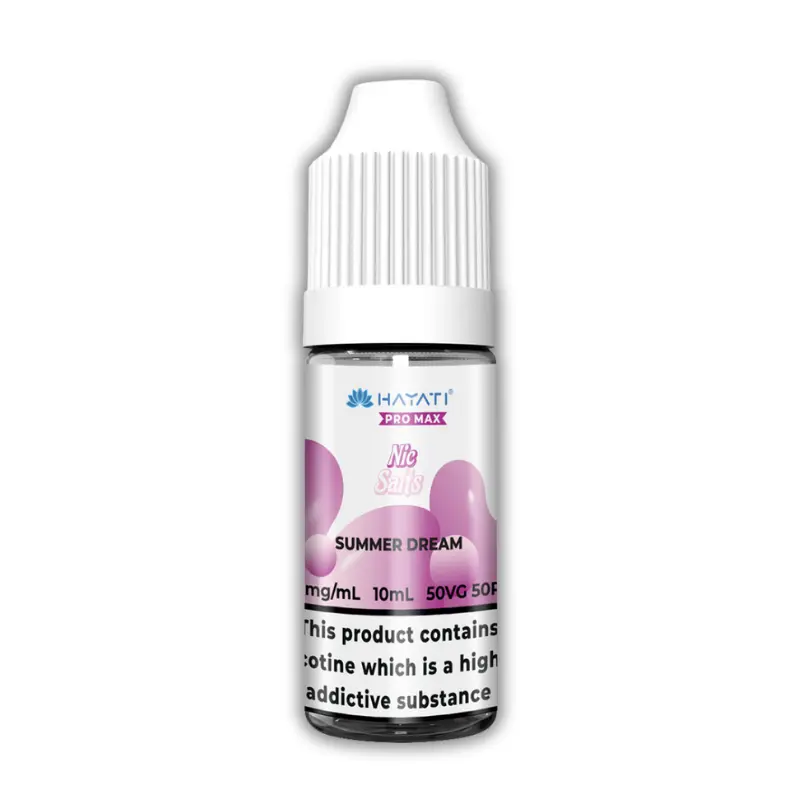
Hayati · Pro Max
Summer Dream Hayati Pro Max Nic Salt
£2.49
✔ In stock — ready to ship
Genuine Hayati
Free over £20
Same-day dispatch
Secure checkout
£2.49 buys ten millilitres of Summer Dream at 10mg, mixed at fifty percent vegetable glycerine to fifty percent propylene glycol, with no device, no pod, no coil and no cell anywhere in the purchase. It is the cheapest of the thirteen listings Hayati print this name on, and the only one of the thirteen that is nicotine-bearing liquid and nothing else. The two other bottles carrying the name hold 120ml and are supplied at 0mg, which puts them in a different transaction. Everything else with Summer Dream on the front is a sealed pod.
Four pages on this site have already told you to buy this bottle. The Pro Ultra Plus pod listing works through what it costs to meet an undescribed flavour at 22ml, concludes that almost nobody should, and sets out a ranked order of cheaper ways in with this bottle at the top of it. The Rubik kit calls it the cheapest instance of the name in the catalogue by a wide margin and notes that it is available before anybody commits to a pod. The dual pod and the dual kit both point at it as the sensible thing to do first. That is a standing recommendation repeated across four listings, and it has never once been written from the point of view of the thing being recommended.
So this page is not another warning about commitment. That argument is finished and it was made properly. This page is the other half of it: the working instructions for the test those pages prescribe. What a buyer actually does with ten millilitres of an unnamed flavour to find out whether they want twenty-two millilitres of it. What the test settles and how fast. And, at length, because they are real and nobody has set them out, the two things standing between a reading taken here and a purchase decision made about a sealed pod. The first is that the strength is a different number on each side. The second is that the equipment is yours rather than the factory's, and it is the larger of the two by some distance.
The short version, before the reasoning: a couple of pounds buys you most of the answer, which makes the advice sound. It buys you most of the answer only if you already own something refillable, and if you do not, the cheapest honest test is a different product, named at the end.
Checking the instruction before following it
A recommendation repeated four times is still a recommendation, and this catalogue has a habit of producing claims that do not survive being counted. So the first job is to confirm that this bottle is what the sibling pages say it is.
On price it holds without qualification. Of the thirteen titles carrying Summer Dream, collected together on the Summer Dream Vapes shelf, this is the lowest ticket at £2.49. The next cheapest is a 4ml Mini Ultra pod at £3.49, then the Mini Ultra kit and the Rubik refill at £3.99 each, and the ladder climbs from there to £11.99 for a Pro Ultra Plus outfit. Nothing with this name on it costs less.
On cost per millilitre it holds against every sealed format and loses to the two 120ml bottles, which is not a real loss because those are 0mg. At £2.49 for 10ml this works out at 24.9p per millilitre. The Pro Ultra Plus pods page prices all thirteen listings this way in a single table and there is no point rebuilding it here; the relevant line is that the cheapest prefilled millilitre of Summer Dream is 33.3p and the dearest is 99.8p, so a nicotine-bearing millilitre of this liquid has never been cheaper than it is on this listing.
What the counting does change is the word "cheapest". This bottle is the cheapest Summer Dream. It is not cheap relative to what it is being used for, because the thing being tested costs £7.99 and the test costs £2.49, which is a third of the purchase it is meant to de-risk. That ratio only looks good next to the alternative of not testing at all. It is worth holding on to, because it sets a limit on how much effort the test deserves: a protocol that takes a fortnight and three coils to run has already cost more than the pod it was protecting you from.
One more thing the siblings are right about and it is worth stating plainly rather than assuming. This bottle exists. For most flavours in this catalogue it would not, and the last section of this page counts exactly how unusual that is. Summer Dream is one of a small group where the cheap route in is a genuine option rather than a thing a page can only wish for.
The test has one open question and four audits
Most advice about trying an unfamiliar liquid assumes you are starting from nothing. Here you are not, and that changes the shape of the exercise considerably.
The Rubik kit page ran a technique first established on the Blackcurrant Lemonade family, which is to line up every listing of one flavour and compare the descriptions against each other. Summer Dream has eleven solo listings, so eleven copywriters at eleven different moments each wrote a paragraph about the same liquid, and the places where they agree carry weight no single listing can. That work is done. It found four properties asserted or implied with enough consistency to be treated as closed, and one left wide open.
Closed: no fruit is named anywhere, on any of the eleven. No cooling is declared on any of them, and since the range puts a cold word in the title whenever a coolant is present, a convention established by counting the whole catalogue on the Blue Frozen pods page, that silence is evidence rather than an absence of it. Every prefilled listing calls the liquid sweet. Nothing anywhere attaches a sour, tart or acidic word to it, and four listings describe it as a blend in which nothing is meant to lead.
Open: which fruits, in what proportions, and whether the result reads as berry, tropical, orchard or a deliberate blur. One shelf tag on one 120ml bottle points at strawberry, weighed carefully on the Rubik page and correctly left in the "possible" column rather than promoted.
Read that list the way a person holding a bottle should read it, and the test has a much narrower job than it first appears. There is one thing to find out. There are four things to check.
The one thing
Fruit identity, and underneath it the question that actually decides whether you would want 22ml: does the blend resolve into components you could list, or does it stay one undifferentiated fruit impression. Those are not the same question and the second is the more useful. A medley you can take apart stays interesting for weeks. A medley that never separates is restful for a few days and monotonous after that, and on a sealed pod the difference between those two outcomes is roughly the difference between a good purchase and twenty millilitres you finish out of stubbornness.
The four things
Here is the part nobody has said, and it is the reason the test is worth more than the open question alone. All four closed properties are closed on copy. Not on measurement, not on a published specification, not on anybody tasting anything. They are closed because eleven marketing paragraphs agree, and marketing paragraphs in this catalogue have been caught describing the name rather than the liquid more than once. Checking them costs nothing extra, because you have to run the liquid anyway, and a failure on any one of them tells you something far more valuable than a confirmation would.
- Is it uncooled? Eleven silences and a naming convention say yes. If your first fill has any cold in it, the convention has a hole in it and every other uncooled inference anybody has drawn from this catalogue is weaker than it looked.
- Is there really no acid? Eleven descriptions with no tart word is a strong run. A citrus lift at the back of the exhale would be the single most consequential correction available, because the absence of sharpness is the main thing separating this liquid from most of the shelf it sits on.
- Is it sweet, and how sweet? Direction is settled and degree is not. This is the axis you can actually place, because the shelf gives you anchors at both ends.
- Does nothing lead? Four listings say so and it is a structural claim rather than an ingredient one, which makes it the easiest of the four to falsify. If one fruit is plainly in front, the copy has been describing a category rather than a recipe.
Run the test that way and a negative result on any audit is a finding about how this catalogue writes, not just about one bottle. That is a return the sibling pages could not offer, because you cannot audit a description without tasting the liquid, and tasting the liquid at 22ml costs £7.99.
What ten millilitres actually gives a test that a pod cannot
The obvious answer is that it is cheaper, and the obvious answer is the least interesting one. The bottle gives the test two structural properties that no sealed unit of this flavour has at any price.
You can stop
A chamber of two millilitres or thereabouts takes a fraction of the bottle, and the rest of the bottle is still liquid when the fraction has told you what you needed. The Triple Mango bottle page does this arithmetic for its own flavour and the general shape of it carries: ten millilitres is several fills rather than one, and the number depends on what you own. What matters here is not the count but the consequence. The money at risk in this test is not £2.49. It is the portion you actually put through a coil before forming a view, and the remainder is either liquid you now want, if the answer came back yes, or liquid sitting in a capped bottle in a drawer, if it came back no.
Set that against the object the test is about. The Pro Ultra Plus pods page establishes that a sealed pod cannot be split, decanted, diluted, part-used or handed on with the flavour intact, because the liquid, the wick and the element are one manufactured thing. That is the defining property of the format and it is why a wrong answer at 22ml is unrecoverable. The bottle simply does not have it. A wrong answer here leaves you holding a capped bottle, which is a considerably better position than holding an opened pod, and it is the entire reason the corpus keeps pointing at this listing.
You can do it twice
This is the property that matters most and it is the one nobody mentions. A single reading of an unfamiliar blend is not a result. It is one observation taken by a person who had no expectation, on a palate in whatever state the day left it, possibly after coffee, possibly at the end of an evening. Read a liquid once and you have an impression. Read it three times across separate days and you have either an impression that replicates, which is worth acting on, or three readings that disagree, which is worth knowing before you spend £7.99.
A sealed pod cannot give you that, and not because of the price. It is because the instrument changes underneath the measurement. All 22ml passes through one element that cannot be swapped, so a reading taken on day one and a reading taken on day eight are taken through mesh in two different conditions, and you have no way to tell a difference in the liquid from a difference in the hardware. The Rubik page makes the point for a 12ml pod and it is worse at twenty-two: a fouling element takes the lighter and more volatile part of a blend first, so a medley read late reads simpler and heavier than the same medley read early. On an unnamed blend that is precisely the error that would make you reject a liquid you would have liked.
A bottle breaks that. The element in a refillable device is a small separate consumable, so it can be at a known and repeatable point in its life for each reading, and the liquid is untouched by the state of it. Three readings at a comparable point in three coils' lives, or three readings early in one coil's life, are comparable to each other in a way that three readings spread across a 22ml pod can never be. Replication is the thing you are actually buying for £2.49, and it is worth more than the millilitres.
How quickly
Faster than the format suggests. The identity question and all four audits are answerable inside the first fill, because they are categorical rather than quantitative: is there cold in it, is there acid in it, does one fruit stand in front, does it separate. None of those needs a week. The only thing a longer run adds is the boredom question, which is the one axis that genuinely takes time and which no amount of careful first-day tasting will answer. If you want to know whether you would still like it on day ten, there is no shortcut, and the bottle is at least the cheapest place to spend the ten days.
The Midnight Dream pods page argues for fixing a verdict point before the wrapper comes off, on the grounds that a decision left to arrive on its own arrives by habit instead. That discipline is right and it applies here with one change of emphasis. On a sealed pod the checkpoint exists to stop you drifting into a purchase you never decided on. On a bottle it exists to stop you taking one reading and calling it a result.
The first limit: the strength is a different number on each side
This bottle is 10mg per millilitre. Every prefilled Summer Dream listing, all eight of them, is specified at 20mg. That is a plain difference between the two formats and it is recorded here as a fact about the products.
Two catalogue facts make it structural rather than incidental, and they are worth having because they remove any sense that this is something a buyer arranged badly. The bottled shelf offers no choice at all: all 65 listings on the Hayati Pro Max Nic Salts shelf are recorded at the same 10mg, in the same 10ml, in the same even base, and 64 of the 65 are the same £2.49. And no Summer Dream listing anywhere exists at any concentration between the two, so there is no configuration of purchases that would let anybody run this test at the strength the pod carries. The two numbers are a property of the formats, not a decision either side of the transaction made.
The consequence is real and it is not a matter of dosing. Nicotine contributes a sensation at the back of the throat independent of the flavouring, and it contributes to how heavy or thin a mouthful of vapour feels. Change the concentration and you change both of those, so the physical character of a draw taken from this bottle is not the physical character of a draw taken from a 22ml pod of the same name. A verdict formed here on how the thing feels does not transfer. This page has nothing to say about which concentration anybody should be using, does not recommend one, and is not describing a ladder. Nicotine is an addictive substance and the figures above are statements of content.
What does transfer
The flavour's identity and its shape. Which fruit or fruits are in it, whether they resolve into components, where the sweetness sits relative to liquids you already know, whether there is any cold, whether there is any acid, and whether one element stands in front of the others. Those are properties of the flavouring rather than of the nicotine, and they are exactly the five things the test is for. Every question on the list in the section above survives the strength difference intact.
What does not
How the draw feels. Its weight, its throat character, how satisfying a given length of pull is, and therefore how often you reach for the device and how quickly you would get through 22ml. Anybody forming a view on those from this bottle and then buying a pod on the strength of it is reading the wrong instrument, and the mistake is easy to make because feel and flavour arrive in the same mouthful and are not separated by the person receiving them.
One more difference sits alongside the strength and is smaller but worth naming. This bottle's carrier base is published at an even fifty-fifty split. No carrier ratio is published for any prefilled Hayati pod, so the ratio in a Summer Dream pod could match this bottle or could not, and nobody outside the factory can say. Carrier ratio affects vapour density and mouthfeel rather than flavour identity, so it lands on the same side of the line as the strength does: it is another reason the feel will not transfer and not a reason the flavour will not. The range-level bottled listing sets out what an even base does at a coil in more detail than is needed here.
The second limit: the equipment is yours, and this is the bigger problem
The strength difference is annoying and quantified. This one is neither, and it is the reason the test needs a protocol rather than an instruction.
A bottle arrives with no heating element, no power source and no airway. Those three things come from a device you chose, and the general consequences of that were worked out at length on the range-level bottled listing, which sets out what the format hands back to the buyer and what it charges for the privilege. The Triple Mango and Tobacco bottle pages each take the next step for their own liquid, describing which of those properties matters most to a particular profile and in which direction each one pushes. None of that is being rebuilt here, because none of it is the problem this page has.
The problem here is narrower and, I think, worse. You are not trying to make this liquid taste its best. You are trying to use a reading taken through your equipment to predict a liquid delivered through somebody else's, and the two sets of equipment are not merely different. They are both unpublished.
Why this is worse than the strength difference
Compare the two confounds as measurement problems and the asymmetry is immediate.
The strength difference has two numbers on it. 10mg on this side, 20mg on the other, both printed, both certain. You cannot remove the difference but you can name it, hold it in mind, and discount for it when you read your own result.
The hardware difference has no numbers on either side. Hayati publish no element resistance, no running power and no airflow figure for any prefilled pod in the range, which every pod page on this site records as a gap. And they publish none for their own refillable Quokka pods either, which are sold as pods you fill yourself with no flavour and no strength attached. So the comparison is between an unspecified element in a sealed pod and an unspecified element in whatever you own. The difference between them is not a known quantity you can adjust for. It is not a quantity at all. Nobody can tell you its size or even its direction, and a page that offered you a correction factor would be inventing one.
That is why this confound outranks the strength one despite sounding softer. A named difference is a discount. An unnameable one is a source of error you cannot bound, and the practical form it takes is simple: a disappointing result from this bottle may be the device rather than the liquid, and from inside the experience there is nothing to tell you which.
The allowance: run a control
You cannot remove the confound. You can find out whether your instrument is working, and that is a different and much more achievable thing.
Take a liquid whose identity you already know well, from the same shelf, and run it through the same device at the same point in the same element's life, adjacent in time to the Summer Dream reading. Not to compare the two flavours. To check that the equipment reports faithfully. If your known reference arrives as you remember it, the instrument is in working order and the Summer Dream reading is worth something. If your known reference arrives thin, muddy or wrong, the device is the suspect and nothing you read about the unknown liquid that day means anything at all.
The choice of control matters and the best one is boring on purpose. It wants a single declared fruit, no coolant and no acid, because a control with several things going on cannot fail visibly. Juicy Peach is the cleanest on this shelf: one ripe stone fruit, nothing cold, nothing sharp, and a profile most people can recall accurately. Double Apple works for the same reason if peach is not in your rotation.
Two of the four audits can be given their own control at no extra effort, and doing so converts a vague check into a specific one.
- The cooling channel. If you want to know that your setup would show you a coolant if one were present, run something that declares one. Banana Ice puts the cold at the end of the breath rather than underneath it, and Black Mint makes no attempt at subtlety. If either reads cold on your device, then Summer Dream reading warm is a fact about Summer Dream.
- The acid channel. Blue Sour Raspberry is the obvious sour reference on this shelf, and Blue Razz Lemonade carries a carbonated structure with a cut at the end. If your equipment delivers either of those as sharp, an absence of sharpness in the unknown is evidence rather than an artefact.
The sweetness audit needs anchors rather than a control, because it is a placement question. Blue Razz Gummy Bear and Grape GB sit at the confectionery end of the shelf, and Blackcurrant Juice is a single fruit carrying its own weight without much sugar on top. Place Summer Dream between whichever two of those you have to hand and you have a number you can use, instead of the word "sweet" that eight listings have already given you for nothing.
This is not the same move the Midnight Dream kit page makes when it sets up two declared pods as poles and asks which one an unknown liquid sits nearer. That is a placement exercise and it runs on the same platform as the thing being placed. This is an instrument check, it runs on your platform rather than the manufacturer's, and its purpose is to find out whether your readings can be trusted at all before any placement is attempted.
The asymmetry in what a result is worth
One consequence of all this deserves stating on its own, because it changes how the two possible outcomes should be treated and it is not obvious.
A positive result is fairly robust. If Summer Dream arrives through your hardware as a blend you enjoy, then the liquid is capable of arriving that way, and the sealed pod is a differently configured delivery of a recipe you have established you like. The device cannot have manufactured an enjoyable flavour out of nothing.
A negative result is much weaker, and this is where uncontrolled testing does damage. Thin, flat, muddy or simpler than expected are all things a tired element produces regardless of what is in the bottle, and on a blend built so that nothing leads they are also, plausibly, what the liquid is. The two readings are indistinguishable from the inside. Which means a single uncontrolled negative is not a reason to rule the pod out, and a controlled negative, taken with a known reference behaving correctly on the same device on the same day, very nearly is.
Put in one line: this test can tell you yes with reasonable confidence and can only tell you no if you have checked the instrument first. Anybody who takes one disappointing fill from a coil of unknown age as a verdict has not run the test. They have run something that resembles it.
A third limit, stated briefly because it is not this page's to settle
Whether the liquid in this bottle is the same recipe as the liquid in a Summer Dream pod is not published. The name is shared, the eleven descriptions run along the same lines, and the Rubik page looked for anything that would settle it and found nothing. A liquid formulated for a 50/50 base at 10mg and a liquid formulated for a sealed pod at 20mg are not obviously the same mixture, and Hayati say nothing either way.
That is a limit on the whole enterprise rather than one you can design around, and it is the honest reason this page says the test answers most of the question rather than all of it. It is also not a reason to skip the test, because the alternative is buying 22ml of a liquid about which you know nothing at all rather than 22ml of a liquid about which you know a great deal and hold one unresolved doubt.
The figures, sorted by who decides each one
A bottle's specification is shorter than a pod's and the interesting thing about it is where the missing rows went. On a sealed pod, element resistance and airflow are unstated properties of an object you cannot open. Here they are absent from the listing because they are not in the box, and the table says whose they are instead of leaving a blank.
| Row | Entry | Decided by |
|---|---|---|
| Price | £2.49 | The shelf. 64 of the 65 bottles are the same figure |
| Liquid | 10ml | The format |
| Cost per millilitre | 24.9p | Arithmetic. Lowest of any nicotine-bearing Summer Dream |
| Nicotine | 10mg per millilitre, salt form | The shelf. The only concentration offered across all 65 |
| Same flavour in a sealed pod | 20mg on all eight prefilled listings | The other format. Stated for comparison, not as advice |
| Carrier base | 50 percent glycerine, 50 percent glycol | Published here. Not published for any prefilled pod |
| What arrives | Liquid. No device, no pod, no element, no cell | The listing |
| Fruit named anywhere | None, on this listing or the other twelve | Hayati, eleven times over |
| Cooling named | None, and the range declares it when present | A naming convention, counted catalogue-wide |
| Flavour shelf tags on this listing | None | Merchandising |
| Element resistance | Not applicable to a bottle | You |
| Power and airway | Not applicable to a bottle | You |
| How much liquid sits at the element | Whatever your chamber holds | You |
| Whether this recipe matches the pod recipe | Not published | Nobody outside the factory |
| SKU | HPM-NS-SUMMER-DREAM | Hayati |
| Brand | Hayati | Hayati |
Three rows carry the page. The nicotine pair is the first confound, printed on both sides so you can at least see it. The two rows with your name against them are the second confound, and the reason they are worded that way rather than left empty is that a blank invites a reader to assume the information exists somewhere they have not looked. It does not. There is no figure to find, because the object those rows describe is in your drawer rather than in this listing.
The last of the three is the recipe row, which is the only one of the sixteen that would change the value of the test if it were filled in. Everything else on the sheet can be worked around or discounted. That one cannot.
Two small notes on rows that look like gaps and are not. The bottled shelf offers one concentration and no variants, so there is nothing to select and no comparison to draw within it. And an even carrier base is thin, which means it moves through cotton quickly and suits restricted low-power devices rather than wide-open low-resistance tanks; the range-level listing covers what that implies for hardware and there is no need to repeat it at length.
What the test costs, and the person it does not work for
Here is the arithmetic, and then the caveat that undoes it for a large number of readers.
For somebody who already owns a working refillable device with a serviceable element in it, the test costs £2.49 plus the fraction of an element's life it consumes. That is the whole bill. Against it sits a £7.99 sealed pod, or £11.99 if a Pro Ultra Plus body is not already in the house, and the possibility of twenty-two millilitres that cannot be split, decanted or passed on. Spending a third of the purchase price to close most of the question on the purchase is a straightforwardly good trade, both confounds included, and the corpus is right to keep recommending it. I would take it every time.
For somebody who owns no refillable hardware, the same sentence is close to useless, and this is where the four sibling pages all stop slightly too early. Their ranked orders say "the bottle if you own something refillable" and then move on. It is worth finishing the sentence.
Hayati's own refillable line is the Quokka, sold as three kits and as replacement pods you fill yourself, and the cheapest of the kits is £8.99. Even at that entry price the hardware costs more than three times the bottle it would be bought to hold, and more than the sealed 22ml pod the test was supposed to protect you from. Buying a device in order to run a £2.49 experiment on a £7.99 purchase is not a saving in any arrangement of the numbers, and nobody should do it. A refillable device is a reasonable thing to own for its own reasons, and it is not a reasonable thing to buy for this.
So name the alternative
For a reader with nothing refillable in the house, the cheapest honest test of Summer Dream is the Summer Dream Hayati Mini Ultra Pods at £3.49, which is 4ml of the same name, sealed, at 20mg. If there is no Mini Ultra body either, the matching Mini Ultra Pod Kit at £3.99 puts a device in the box for fifty pence more, which makes it the cheapest complete route to this flavour that exists.
And it is not merely a fallback. On the specific job this page is about, which is predicting what a sealed 22ml pod will be like, the small sealed pod is the better instrument and the bottle is the cheaper one. Count the confounds. The bottle carries three: a different concentration, an unspecifiable hardware difference, and the unresolved recipe question. The 4ml pod carries one and a half: the recipe question applies to it exactly as it does to the bottle, and the hardware differs between Mini Ultra and Pro Ultra Plus, but the difference is between two factory-set configurations rather than between a factory and your drawer, and the concentration is identical at 20mg. Nothing about the strength or the feel of a draw needs discounting, because there is nothing to discount.
What the pod loses is everything the bottle gained. It cannot be stopped partway with the remainder intact, it gives you one reading rather than three, and at 87.3p per millilitre it is the most expensive Summer Dream in the catalogue by volume. So the honest ranking is not a single order. It is two:
- If you own something refillable: this bottle, at £2.49, for the repeats and the ability to stop. Run a control alongside it, discount the feel of the draw entirely, and treat a negative as provisional unless the control behaved.
- If you do not: the 4ml Mini Ultra pod at £3.49, for the matching strength and the absence of the hardware question. One shot, no repeats, and a pound more, in exchange for a reading that needs less interpretation.
Both are better than meeting this flavour at 22ml, which is the point all four sibling pages were making and which this page does not dispute.
How far the advice generalises, which is less far than it sounds
The corpus prescribes a cheap test as though a cheap test were always available. It is not, and the counting is worth doing because it puts this bottle in perspective.
Hayati sell 146 distinct flavour names in sealed prefilled formats. Of those, 48 also exist as a 10ml bottle on the nic salt shelf. Forty-one exist in a 4ml Mini Ultra format. Fifteen exist as both, which is the group with a genuine choice of instrument, and Summer Dream is one of the fifteen. Seventy-two, very nearly half, have neither, and for those flavours there is no cheap route in at all: the smallest thing on sale is the thing you were trying to avoid buying.
Midnight Dream is the worked example of the seventy-two and the reason its own pod page reads the way it does. Two listings, both 12ml, no bottle, no small pod, nothing. The advice this page is giving could not be given there at any price, and the pod listing had to spend its length on making an indivisible twelve millilitres behave like a smaller purchase instead.
That is the real difference between the two coined names, and it is worth more to a buyer than any amount of analysis of what Summer and Midnight might connote. One of them can be checked for £2.49. The other cannot be checked at all. The 65 bottles on this shelf, and the wider Hayati E-Liquids range they sit inside, are the only part of the catalogue where a flavour question can be asked cheaply, and they cover fewer than a third of the flavours Hayati put in a sealed pod.
The rest of the shelf, sorted by what each bottle would be for
Everything below is £2.49, 10ml, 10mg and the same even base, so the only variable between them is the liquid. They divide neatly by the job you would be buying them to do.
If you want a control or an anchor
Covered above, and the shortlist is Juicy Peach for a single declared fruit, Double Apple for the same role in a different family, Banana Ice or Black Mint to prove your setup reports cooling, Blue Sour Raspberry to prove it reports acid, and Blue Razz Gummy Bear or Grape GB for the top of the sweetness scale. One of the peach or apple bottles is the single most useful thing to have in a drawer if you intend to do any of this more than once.
If the unnamed blend is the problem rather than the flavour
Plenty of bottles on this shelf occupy the same warm, sweet, uncooled region and print their contents. Strawberry Watermelon is the two-fruit version of the idea, and its own listing is unusual in selling itself on restraint rather than intensity. Strawberry Raspberry Blueberry is three named berries, which is about as close as the shelf comes to a declared medley. Blueberry Cherry Cranberry takes the same three-fruit structure somewhere darker and puts an astringent berry at the back of it.
If you want the medley idea with a dominant note
Blackberry Raspberry is two berries from the same genus with one plainly in front, which is the opposite construction to a blend where nothing leads. Berry Lemonade puts a soft-drink frame around a berry base, so the structure does the work the fruit would otherwise have to. Blue Razz Cherry builds a deeper red fruit underneath a tangier one, which is a composite with an architecture rather than a blur.
If the absence of cold or the absence of sharpness is the objection
Eleven listings say Summer Dream has neither. If that reads as a drawback rather than a feature, the shelf answers it directly. Blackberry Ice puts a tannic dark berry under a chill, Blue Frozen pushes the cold considerably harder, and Blue Razz Mojito takes a cooled route through a drink construction instead. On the sharp side, Blueberry Raspberry Lemon keeps berries in front and uses citrus as a cut at the end.
If it is the coined name you find interesting
Summer Dream is not the only bottle on this shelf whose title names nothing you can taste. Counting them gives ten, and the interesting thing is how few of them stay unresolved once you read the description. Blue Fusion gives a colour in the title and then names the blue raspberry and blueberry family in the first paragraph. Mad Blue works the same colour with an intensifier attached. Black Mamba is the most useful comparison of the group, because its copy resolves the name completely to a dark berry mix with a cooling turn late in the exhale, and because it is the one coined flavour in the whole range for which Hayati filled in the structured profile field. Summer Dream is the outlier: the title names nothing and the description declines as well, eleven times.
If none of it fits
Fizzy Cherry and Cola Ice leave the fruit-blend category entirely, and the full Hayati catalogue is there for anyone who has concluded that an undescribed liquid is not worth the arrangements described above.
Running the bottle when the point of it is a reading
General bottle handling applies as it does to any of the 65. What follows is only the part that changes because this liquid is being used as a measurement rather than as a supply.
The first draws on a fresh element are not the reading. Cotton that has not fully saturated delivers a muted and slightly odd version of whatever is in it, and on a thin even base the wait is short but it is not zero. Fill, leave it a minute or two, take the first few pulls gently, and start paying attention somewhere around the fifth or sixth. Treating draw one as the verdict is the commonest way to conclude that a liquid is weaker than it is, and on a blend built so that nothing leads it is the commonest way to conclude that there is nothing there.
Take the readings at a comparable point in an element's life. This is the whole reason the bottle beats the pod as an instrument, and it only pays if you actually use it. Three readings taken at wildly different states of the same element are three readings of three different things. If an element is visibly past its best between reading two and reading three, change it and start the sequence again rather than mixing the two.
Write the result down as an answer, not as a description. Cold, yes or no. Acid, yes or no. Does one fruit lead, yes or no. Sweetness, a position between two named bottles. Descriptions drift, get coloured by whatever you read most recently, and are not comparable a week apart. A short list of answers is, and the whole value of doing this three times depends on being able to compare the three.
Keep the cap on and keep it cool. Warmth and light age any flavoured liquid, and the light aromatic end goes first, which on a medley is precisely the material you are trying to detect. A bottle that has spent a fortnight on a windowsill will give you a misleading reading well before it gives you a spoiled one. Keep it at room temperature, out of direct sun, and out of reach of children and pets.
An open bottle drifts, and here that matters more than usual. Ten millilitres used over a few weeks stays consistent enough to compare against itself. The same bottle half finished and picked up again six months later is not the same liquid you read in the spring, so a re-test at that distance is a new experiment rather than a fourth data point. If the plan is three readings, take them reasonably close together.
Switching a pod over. A chamber that has been running something cold or sharp keeps a trace of it for a few draws, which on this liquid is actively misleading, because two of the four audits are looking for exactly cold and exactly sharp. Either dedicate a pod to the test or run a few draws to clear it before the reading starts.
Disposal. An empty 10ml bottle and its cap are plastic packaging and go with your household recycling according to whatever your local authority accepts. Liquid you have decided against should not go down a sink; keep it capped and dispose of it with your local arrangements for household chemicals. Nothing in this purchase contains an element or a cell, so none of the electrical waste rules that apply to a spent pod apply here, which is one of the quieter advantages of the format.
Questions about using a bottle to answer a question about a pod
What does Summer Dream taste of?
No listing anywhere says, and there are thirteen of them. Across the eleven that carry the name on its own, Hayati describe a sweet, warm-weather blend in which nothing is meant to lead, name no fruit, mention no cooling and attach no tart word to it. One shelf tag on one 120ml bottle points at strawberry, which is the only fruit anywhere in 492 listings attached to this name and nowhere near enough to write a description from. This page will not invent the rest, and the point of the bottle is that you can find out for £2.49.
Is this bottle the same strength as the Summer Dream pods?
No. This is 10mg per millilitre and all eight prefilled Summer Dream listings are specified at 20mg. That is a plain difference between the two formats, stated as a fact about the products. The bottled shelf offers one concentration across all 65 of its listings, so there is nothing to select between here. Nicotine is an addictive substance and this page offers no guidance on strength.
So what does a reading from this bottle actually tell me about the pod?
It tells you the flavour's identity and shape: which fruits, whether the blend resolves into parts, roughly how sweet it is against liquids you know, and whether there is any cold or any acid in it. Those are properties of the flavouring. It does not tell you how a draw from the pod will feel, because the concentration differs, the carrier ratio is unpublished on the pod side, and your equipment is not the equipment in a sealed pod.
How much of the bottle do I need to use?
Less than you would think. All five questions the test is for are categorical and answerable inside one chamber-fill, so the identity question is settled long before the bottle is. The only thing that genuinely takes time is whether you would still enjoy it after a week, and nothing shortens that. What the remaining liquid is for is repeats, which is the part most people skip and the part that makes the result worth acting on.
What if it tastes thin or muddy?
Do not take that as a verdict until you have run something you know well through the same device on the same day. A tired element produces thin and muddy regardless of what is in the bottle, and on a blend with no dominant note it is indistinguishable from the liquid simply being like that. A positive result here is fairly robust because equipment cannot invent a flavour you enjoy. A negative one is only worth acting on if your control behaved properly.
Is there any ice, mint or menthol in it?
None is declared on any listing carrying this name, and the range puts a cooling word in the title whenever a coolant is present, a convention established by counting the whole catalogue rather than by tasting. Expect an uncooled blend, and treat checking that as one of the things the bottle is for. Seventeen of the 65 bottles on this shelf do declare cooling if that is what you want instead.
Is the liquid in this bottle the same recipe as the liquid in the pods?
Not established. The name is shared and the descriptions run along the same lines, but this is a 50/50 base at 10mg and the pods are sealed units at 20mg with no published ratio, and Hayati say nothing about whether the underlying concentrate is identical. It is the one limit on this test that cannot be designed around, and it is the reason the honest claim is that the bottle answers most of the question rather than all of it.
I do not own a refillable device. Should I buy one to try this?
No. Hayati's own refillable line starts at £8.99 for the cheapest Quokka kit, which is more than three times this bottle and more than the 22ml pod the test was meant to protect you from. A refillable device is worth owning for its own reasons and is not worth buying for one experiment. The 4ml Summer Dream Mini Ultra pod at £3.49, or the matching kit at £3.99 with a device included, is the cheaper route for anyone starting from nothing.
Which is the better test, the bottle or the small pod?
They are better at different things. The bottle is cheaper, can be stopped partway with the rest intact, and lets you take three readings instead of one. The 4ml pod matches the concentration of the format you are buying and removes the hardware question entirely, so its reading needs less interpretation, but it is one shot and it is the dearest Summer Dream in the catalogue by volume at 87.3p per millilitre. If you own something refillable, take the bottle. If you do not, take the pod.
Why does this page spend so long on my equipment?
Because a bottle has no element, no power and no airway in it, so all three come from you, and the pod this test is predicting has all three set in a factory and published nowhere. The strength difference between the two is annoying but it has numbers on both sides. The equipment difference has numbers on neither, which makes it impossible to correct for and therefore the larger source of error in anything you conclude.
Can I use this bottle in a sub-ohm tank?
It is the wrong tool for it. A thin even base tends to flood a wide low-resistance coil rather than feeding it steadily, and a salt formulation is built around the small throughput of a restricted low-power draw. The two 120ml Summer Dream bottles exist for higher-glycerine applications and are supplied at 0mg.
Do many Hayati flavours have a bottle like this one?
Fewer than half. Of the 146 distinct flavour names Hayati sell in sealed prefilled formats, 48 also appear as a 10ml bottle and 41 appear in a 4ml Mini Ultra format, with only 15 offering both. Seventy-two have neither, so for those flavours the smallest unit on sale is the pod itself. Summer Dream is one of the 15, which is why it can be tested at all.
The position, in plain terms
Ten millilitres of Summer Dream at £2.49, 10mg in salt form, evenly split between glycerine and glycol, with no hardware in the purchase. It is the cheapest of thirteen listings carrying this name and the cheapest nicotine-bearing millilitre of it anywhere at 24.9p, and four other pages on this site have already nominated it as the thing to buy before committing to a sealed pod. Those pages are right, and this one exists to say what following their advice actually involves.
The test has a short job list, because the eleven-listing comparison has already closed four of the five things worth knowing. One question is genuinely open, which is what fruit is in it and whether the blend separates into parts. Four are closed on copy rather than on measurement, which makes them worth auditing while you are here, and a failure on any of them would be a more valuable finding than a confirmation.
Two limits sit between a reading taken here and a purchase made there. The concentration is 10mg on this listing and 20mg on every sealed Summer Dream pod, which means the flavour's identity and shape transfer and the feel of a draw does not. And the element, the energy behind it and the airway are yours rather than the factory's, which is the bigger problem, because unlike the strength it cannot be quantified on either side and therefore cannot be discounted. The practical answer to it is a control run: a declared single fruit you already know, through the same device on the same day, to establish that the instrument is telling the truth before you believe anything it says about a liquid you do not know. Without that, a disappointing result is as likely to be your coil as the blend.
Both limits accepted, this is a good trade. A third of the pod's price closes most of the question, and the remainder of the bottle is still liquid whichever way the answer falls. It only works for somebody who already has a refillable device, though, and buying one for the purpose costs more than the pod you were being careful about. For anybody in that position the cheapest honest test is the 4ml Summer Dream Mini Ultra pod at £3.49, or the kit at £3.99 with a body included, which gives up the repeats and the ability to stop in exchange for matching the strength and removing the equipment question altogether.
Strictly for adults aged 18 and over. Nicotine is an addictive substance.
You might also like


