
Home / Hayati Pro Max Plus Pods / Mr Blue Hayati Pro Max Plus Pods
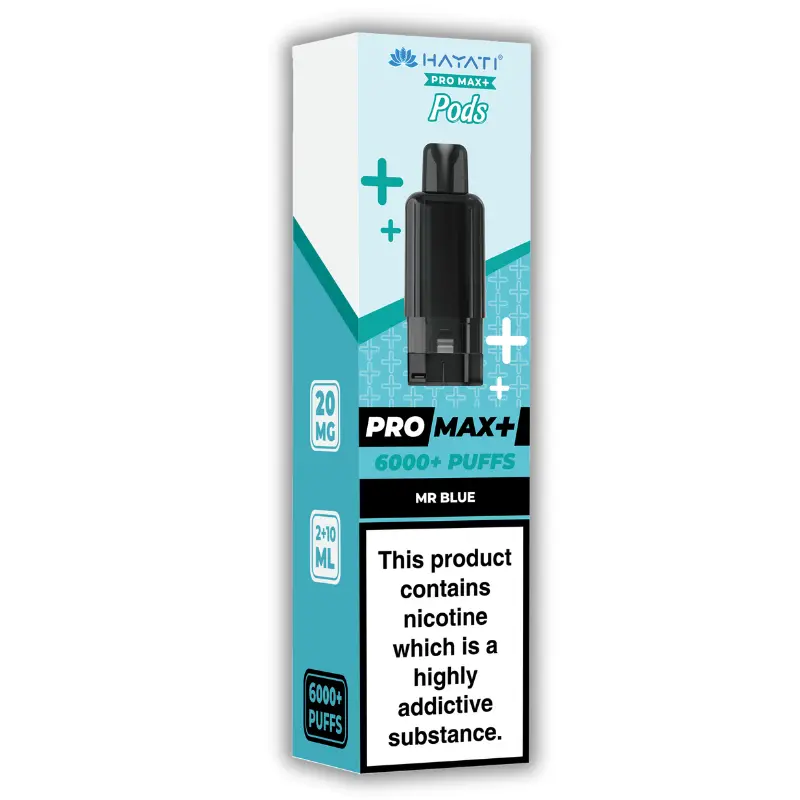
Hayati · Pro Max Plus
Mr Blue Hayati Pro Max Plus Pods
£5.49
✔ In stock — ready to ship
Genuine Hayati
Free over £20
Same-day dispatch
Secure checkout
£5.49 buys one sealed replacement pod for the Hayati Pro Max Plus, carrying 12ml of prefilled liquid at 20mg nicotine salt, in the flavour Hayati call Mr Blue. There is no device in the packet. Hayati put a figure of around 6,000 puffs against a full pod, rated by the manufacturer at up to that number on standardised test apparatus under a fixed draw pattern, which makes it a workload figure for one sealed coil rather than a forecast of anybody's fortnight. If the device is the thing you are missing, the Mr Blue Hayati Pro Max Plus Pod Kit at £7.99 is the identical 12ml with a body attached.
Almost nobody arrives at a bare refill listing without a device in the house, and almost nobody owns the device and still wonders what the liquid is. They found out by drinking it. That is the ordinary route to this page, and it matters here more than it would on most listings, because everything written about this flavour so far has been addressed to the other person.
Two pages on this site have worked Mr Blue over at length and both of them are about the moment before the first pod. One takes the name apart as a naming device and asks what a courtesy title can and cannot promise. The other asks which of two possible blues the colour is pointing at, and concludes that the question is unsettled and that a 22ml pod is the wrong place to find out. Both are useful and neither is repeated below. Both also stop at the same door, because the reader they are written for stops existing the moment the first pod is finished.
What follows is about the purchase after that one. The restocker has a different problem, and it is not a smaller version of the chooser's problem. It is close to the reverse of it. A chooser is asking what this liquid is and was always going to find out by tasting, so vague copy costs them a week and nothing else. A restocker already knows what it is and is asking something copy has to answer or nobody can: is the pod that arrives this month the same as the one that arrived last month, and if it is not, how would I know. That question needs a published baseline, and it needs it in writing, because a memory of a flavour is not evidence against a later pod. This page is an audit of what baseline actually exists for Mr Blue, what it will settle, what it will not, and what to do about the gap.
What the record already settles, and one line of it that needs correcting
The naming question is closed and this page does not reopen it. The Mr Blue Rubik kit page established, by searching all 492 product titles, that a form of address is used twice in the whole catalogue and resolves to two flavour names, this one and Mr Pink, that both are attached to colours naming no fruit, that Mr Pink never travelled past a single bottle, and therefore that the honorific is a decoration on a convention which was already selling rather than the thing selling it. That page also lined up all thirteen descriptions of this flavour against catalogue base rates, found no cooling declared on any of them, found every mention of acid qualified, and tagged each claim with a confidence level. The Mr Blue Pro Ultra Plus pods page took the colour itself apart, separating the invented blue of the sweet counter from the grown berry, and measured the distance between them in Hayati's own copy. It also reached the conclusion that an empty name is a perfect label once you have tasted the thing, because a name that predicts nothing still identifies reliably.
All of that is settled. Take it as read.
The count behind it holds up. Searching the 492 titles for this flavour name returns thirteen listings, eleven of them carrying Mr Blue on its own and two carrying it behind an oblique alongside Blueberry Raspberry on the Pro Ultra Plus. I checked it because the house rule here is to count a number before repeating it, and it is the same thirteen both earlier pages arrived at from different directions.
One line does need correcting, or at least confining. The Pro Ultra Plus pods page is built on a measurement: count the distinct sensory adjectives in each of the thirteen flavour paragraphs and the figure for the 22ml listings is nought. That measurement is right and I reproduced it. What it does not cover is this listing. The zero belongs to the two solo 22ml listings, the bare pod and its kit, and this one is not among them, because the copy on this page's own listing calls the liquid sweet, candied and berry-like, says it is sugary without being harsh, and attaches a gentle tang to it. Collapse the variants and that is four distinct sensory words, which is exactly the figure the earlier page recorded for this listing and roughly the catalogue's normal ration. So a buyer arriving here from that page should not carry the nought with them. It describes the largest pod Hayati make and not this one.
That correction is the hinge of everything below, because four words is not nothing and it is also not a baseline, and the difference between those two statements is the whole of the restocker's problem.
Four words, and one sentence that is doing a different job
Run the same count across the 89 pods on the Hayati Pro Max Plus Pods shelf and the picture is unremarkable. Using a wide net that takes in sweetness, acid, weight, temperature, texture and confectionery terms, the shelf runs from one word at the bottom to ten at the top and clusters in the middle. This listing sits below the shelf's midpoint and well above its floor. It is not a terse listing. It is an ordinary one, and being ordinary is not the finding.
The finding is in a different sentence. Alongside the four adjectives, the listing makes one claim that is not an adjective at all. It says the tang keeps the sweetness in check, and it attaches a duration to that: over a full pod. Those five words are the only place in the whole published record of this flavour where anything is said about how the liquid behaves across the life of the unit you are buying, and they are the only claim on the listing that a later purchase could be held against.
Three counts establish how unusual the placement is, and one of them cuts against me, so all three are here.
The exact phrase
Searching every flavour paragraph in the catalogue, the words "over a full pod" appear in three listings out of 492. This is one. The other two are a Blueberry Raspberry Lemon nic salt, where the citrus is credited with stopping the berries from building into a heavy sweetness, and a Caribb Crush pod, where sharpness is credited with keeping the blend fresh. Widen the search to any mention of a full pod and the figure rises to seven. Either way it is scarce vocabulary, and both of the other two attach it to the same structural idea: something in the blend is preventing something else from taking over as the pod goes on.
The construction, and the agent it names
This is the part worth the page. The phrase "keeps the sweetness in check" appears in eight listings out of 492, and it always makes the same shape of promise: the liquid is sweet, and something in it stops the sweetness from running away. What differs is whether Hayati say what that something is.
- A peach and green tea kit credits the tea's faint bitterness.
- A bubblegum nic salt credits the cooling.
- A banana nic salt credits the chill laid over the top.
- A raspberry Cotton K pod credits the raspberry leading the inhale.
- A Vimbull shortfill credits the cooling.
- A lemon cola pod credits the lemon.
- Blueberry Cherry Cranberry Hayati Pro Max Plus Pods, on this shelf at this price in this format, credits the cranberry's sharp dry finish.
Seven of the eight name the agent. One does not, and it is this listing, where the job is given to "the tang" with no fruit, no acid source and no component behind it. The promise is identical in every case. The checkability is not, and the difference is not cosmetic. A buyer holding the cranberry pod who finds a later one turning sugary can go looking for the cranberry, because they have been told which component is meant to be doing the work and they know what a failing cranberry note tastes like. A buyer holding this pod who finds a later one turning sugary has been told that a tang was supposed to prevent it and nothing whatever about where the tang comes from. They cannot tell a weaker acid from a stronger sugar, and they cannot tell either from a coil that has aged faster than the last one.
That is the specific cost of vagueness to a repeat buyer, and it is a different cost from the one the earlier pages describe. It is not that you cannot predict the liquid. You can, because you have had it. It is that you cannot adjudicate it.
Where the durability statement sits across the thirteen, and the count that narrows the claim
Of the thirteen listings carrying this flavour name, four say something about how the liquid holds up over time. Three of those four are bottles: the 10ml nicotine salt says the thinner blend keeps the flavour consistent from one fill to the next, the 70/30 says the sweetness stays even from puff to puff, and the 50/50 shortfill says the profile tastes the same on the last fill as on the first. The fourth is this pod.
Five of the thirteen are bare refills, which is to say the listings a restocker actually lands on: the Pro Ultra Plus pod, the Mini Ultra pod, the Rubik pod, the Blueberry Raspberry/Mr Blue Hayati Pro Ultra Plus 25K Pods pairing, and this one. Four of those five say nothing at all about duration. This is the only refill listing in the set that does.
Now the narrowing, because the first version of this claim was stronger than the evidence and I would rather say so than quietly soften it. I had it in mind that a listing which both addresses a returning buyer and publishes something that buyer could check would be close to unique. It is not. Across all 492 listings, 88 carry some statement about how a liquid holds up, which is roughly one in six and not rare at all, and 45 address somebody who already knows the flavour or already owns the hardware. Twelve listings do both. Four of those twelve are bare refill pods, and this is one of the four rather than the only one. The honest version is therefore narrower: doing both jobs at once is uncommon rather than singular, and within this flavour's own set of thirteen it happens twice, on the 10ml bottle and here, with only one of the two being a sealed pod.
And one hypothesis died on the way, which is worth reporting because it would have made a better story than the truth. It looked as though Hayati might be writing differently for the two kinds of buyer, describing the arc of a single draw on kit listings and the arc of a whole pod on refill listings. They are not. Across 188 bare pod listings and 178 kit listings, draw-scale language appears on 30 per cent of pods and 28 per cent of kits, and pod-scale language on 11 per cent of each. There is no split. Whatever put a duration clause on this particular listing was one writer's sentence rather than a policy about who reads which page, and the restocker here is served by accident rather than by design. That does not make the sentence less useful. It does mean nobody should expect to find one on the next refill listing they open.
What the clause will settle, and what it will not
Take the published baseline at its full strength, which is more than it first looks. Hayati assert, on this listing, that the liquid is sweet, that the sweetness is candied rather than fresh, that it is sugary without being harsh, that a gentle tang runs underneath it, and that the tang holds the sweetness down for the length of a pod. That is five propositions, and four of them are one-off impressions of the sort you cannot argue with. The fifth is a relationship between two things over time, and relationships over time are testable in a way that adjectives are not.
So here is what a second pod can actually settle against the record.
It can settle whether the relationship holds. If a later pod reads as sugar with nothing underneath it from the first day, and stays that way after an hour's rest and a full charge, the listing's central claim has failed on that pod. That is a real finding and it is the only one the copy supports. Nothing else on the listing can fail, because nothing else on the listing commits to anything a pod could contradict.
It cannot settle a level. Nothing tells you how sweet, and the Rubik kit page established why: this catalogue has no sweetness-level vocabulary anywhere, so no listing in the range can be placed on a sweetness scale from its own copy, and eleven of the thirteen calling this flavour sweet is uninformative when 94 per cent of everything else does too. A pod that is noticeably sweeter than you remember is not contradicting the listing. It is not engaging with it.
It cannot settle a cause. Because the checking agent is unnamed, a failure of the relationship has at least three explanations and the copy distinguishes none of them. The acid component may be weaker in this batch. The sugar may be heavier. Or the pod is fine and your coil is a fortnight older than you think it is, which is the likeliest explanation of the three and the one people reach for last.
It cannot settle cooling, but cooling is settled anyway. Nothing in this liquid is described as cold, and that is not an absence of information. The Rubik kit page found no cooling word on any of the thirteen descriptions, and the Blue Frozen work established by counting that this range puts cooling in the title whenever it is there. Treat Mr Blue as uncooled with confidence. If a pod ever arrives with a chill on it, that is a genuine anomaly rather than a batch variation.
The practical upshot is that the published record gives a restocker one usable test and three dead ends. That is better than nothing, which is what the 22ml listings give, and it is a long way short of what a named blend gives, and the rest of this page is about closing that distance yourself.
The liquid across twelve millilitres
No kit page for this flavour on this platform has been written yet, so the flavour reading is this page's to do, with one restriction: the colour argument belongs to the Pro Ultra Plus pods page and is not rebuilt here. That page's conclusion, which I am citing rather than re-deriving, is that a bare blue resolves to a line with two ends, an invented confectionery blue with edge and little body at one end and a grown berry with body and little edge at the other, and that Hayati's own copy places Mr Blue somewhere inside that line without ever saying where.
What this listing adds to that is a shape rather than a position, and the shape is the part a returning buyer can use. Two things are asserted to be present, sugar and a tang, and one is asserted to be governing the other. Read that as an architecture and several consequences follow, all of them marked below for how far the evidence carries them.
The sweetness is described as candied, which is a specific word rather than a general one. Candied sweetness is the sweetness of a boiled sugar sweet rather than of ripe fruit: it arrives early, it sits on the front of the tongue, and it does not taper. Fruit sweetness behaves differently, building later and fading. The listing's choice of word is therefore a real piece of information about placement, and it is the strongest single hint available that the sugar here is doing a confectionery job. That is consistent with what the earlier page found across the whole set, where the recurring adjectives are candied, sugary and bold rather than ripe, juicy or fresh. Reasonably confident.
The tang is described as gentle and as running underneath. Underneath is the second useful word. An acid that runs underneath is a structural acid rather than a leading one, which is the opposite arrangement from Blue Sour Raspberry Hayati Pro Max Plus Pods on this shelf, where the copy has the liquid opening on a pucker and finishing sweet. Front-loaded acid and underlying acid feel different on the same sugar level: the first announces itself and then leaves, the second is only noticeable by its absence. Probable, and it follows from the wording rather than from anything Hayati state about a recipe.
Put the two together and the likely arc across a single draw is a sweet arrival, a middle where the sugar holds without building, and an exhale that fades rather than lingering. That is an inference from an architecture, not a tasting note, and it should be read as such. Nobody writing a product page has drunk this liquid and any page that describes it draw by draw as though from experience has made it up.
The arc across twelve millilitres is a separate matter and it is the one the listing actually commits to. Here the reasoning is firmer, because it does not depend on what is in the blend, only on what happens to any sweetened liquid passing through one sealed coil from full to empty. Sugared liquids leave residue. Residue takes the light, volatile part of a blend before it takes the heavy part, which means a sweet liquid with a delicate acid loses the acid first and keeps the sugar. On a blend where the acid is the smaller of the two components and is explicitly described as gentle, that is precisely the wrong part to lose.
So the predictable course of a pod of this liquid is that the listing's own claim becomes progressively less true as the pod empties, not because anything is wrong with it but because the component doing the checking is the component that goes first. A pod at the two-thirds mark should read rounder, heavier and more purely sugary than the same pod on day one. A buyer who has had three or four of these knows that curve without being told. A buyer on their second pod may mistake it for a bad batch, and that misreading is the single most likely false alarm this flavour will produce.
Which gives the restocker a rule with a real edge on it: compare pods at matched ages or do not compare them. A fresh pod judged against a two-thirds-empty one is a measurement of coil condition wearing a flavour's clothes, and on a liquid whose entire published claim is about the balance between a sugar and an acid, that is the one confound guaranteed to move the reading in the direction you are worried about.
What the liquid is not is worth stating flatly, because a returning buyer's memory drifts and the negatives are firmer than the positives. There is no cold in it, on the evidence of thirteen descriptions and a range convention of declaring cooling in the title. There is no sourness: the word appears on none of the thirteen, and this catalogue uses sour when it means it, which is why Blue Razz Lemonade Hayati Pro Max Plus Pods can be described as roughly half sweet and half sour on the same shelf while this one cannot. There is no named fruit, no second flavour, no collar to turn, nothing to charge and nothing to fill. And there is no creamy, bakery or dessert element anywhere in the record, which distinguishes it from the gum and spun-sugar readings of blue that sit nearby.
The same liquid, described twice, by two people who disagreed slightly
Mr Blue is sold in this exact format twice: as this pod and as the kit, both 12ml at 20mg on the same platform. Hayati wrote fresh copy for each, which makes the pair the cleanest possible comparison in the whole set, because the hardware is identical and only the buyer differs. Lining a flavour's own listings up against each other is a technique this site established elsewhere and it pays here, in a small way.
Both descriptions agree on the family, on candied sweetness, and on the presence of a tang. Where they part is what the tang is for. The kit listing gives it the job of stopping the liquid tasting flat, which is a claim about interest: without the acid the blend would be boring. This listing gives it the job of keeping the sweetness in check, which is a claim about excess: without the acid the blend would be cloying. Those are not contradictory but they are not the same sentence either, and a buyer choosing between a liquid that might be dull and a liquid that might be sickly is being told two different things about the same 12ml.
The kit listing also puts its arc across a draw, calling it one cohesive blue sweetness from inhale through to exhale. This one puts its arc across a pod. Given that the wider count found no systematic difference between how Hayati write pod pages and kit pages, the right reading is the one the Blackcurrant Lemonade work set out: a disagreement between two listings of one liquid is evidence about how the copy was produced, not evidence about two recipes. Two writers, two months apart, reached for the same tang and assigned it whichever job the sentence they were building needed. Nobody should conclude that the pod and the kit contain different liquids, and nobody should treat either job description as a specification.
What survives the disagreement is the thing both writers independently put in: there is an acid in this, it is smaller than the sugar, and it is load-bearing. Two people describing the same liquid without consulting each other both felt the need to explain why the sweetness does not win. That is about as close to corroboration as an unlabelled liquid gets.
The packet, kept short
There is one item inside and it is already filled. No device, no charger, nothing to assemble, nothing to add. The £2.50 between this listing and the kit is the body, paid once and spread across every refill after it, which is why buying the kit twice is the one clearly wrong move available on this flavour.
Only one specification here changes how the liquid behaves, and it is the 12ml, acting through the coil rather than through the flavour. Hayati publish no serviceable coil and no filling arrangement for this pod, so the working assumption has to be a single sealed object in which the whole 12ml passes through one piece of mesh from new to spent. The manufacturer's figure of up to 6,000 puffs is best read as an expectation about that mesh's working life, arrived at on a test rig rather than by counting, and its only honest use is ranking products measured the same way against each other. Nothing about it converts into days.
On fitment, once and then not again: check the range name printed on your device against the range name in this title before ordering, because a retail listing is not a hardware specification. The rest of the platform, bodies and bare pods together, is on the Hayati Prefilled Pods & Refills shelf, and the whole of Hayati's pod catalogue sits one level out at Hayati Pods.
The figures, ordered by how much a returning buyer needs them
| What the listing publishes that a later pod could contradict | One claim: the tang holds the sweetness down for the length of a pod |
| Component named as doing that job | None. Seven of the eight listings using this construction name one |
| Sensory adjectives in Hayati's own flavour text | Four, which is the shelf's normal ration and not the nought recorded for the 22ml listings |
| Cooling | None declared, here or on any of the thirteen listings |
| Fruit components published | None, on any listing of this flavour |
| Liquid in one sealed unit | 12ml, through a single coil from new to spent |
| Price, and what that is per millilitre | £5.49, which works out at 45.8p |
| Nicotine | 20mg nicotine salt, the only strength in this flavour on this platform |
| Device in the packet | None. The kit is £7.99 |
| Manufacturer puff figure | Around 6,000 for a full pod, a laboratory estimate |
| Coil resistance and carrier ratio | Neither is published for this pod |
| Listings carrying this flavour name | 13 of 492, eleven of them solo |
| Of those, bare refills | 5, of which this is the only one publishing a durability claim |
The top two rows are the page. Everything under them is context, with three exceptions worth a sentence each.
The 20mg is the legal ceiling in this country for a liquid containing nicotine rather than a decision anybody made about this flavour, and since every prefilled Hayati pod carries it the number separates this listing from nothing at all. Nicotine is addictive. What it does mean in practice is that no lighter version of Mr Blue exists in this hardware. If a lower strength is what you are after, the strength-led listings on this platform are filed as Hayati Pro Max Plus Prefilled Pods 10mg and Hayati Pro Max Plus Prefilled Pods Zero Nicotine (0mg), both £5.49, and both carry a flavour in their data as a family default rather than being flavourless, so read the listing before assuming the strength is the only variable.
The 45.8p per millilitre is the useful number on a restocking page and it is not the cheapest route to this liquid in the catalogue. The Rubik refill is 33.3p and the 22ml Pro Ultra Plus pod is 36.3p, both cheaper per millilitre, and neither goes into a Pro Max Plus. Among the things that do fit your device, this is the floor, and the kit at 66.6p is the same liquid with hardware you already own bundled in front of it.
The two blank rows are not omissions. No coil resistance and no carrier ratio are published for any prefilled Hayati pod, which is normal for the format and means nobody can tell you in advance how a replacement will draw against the pod currently in your device. Figures for both circulate and they are inferences rather than manufacturer statements, so a difference in draw between two pods of this flavour is not something the specification can help you interpret.
What to keep beside it, and what to move to
A comparison section on a chooser's page ranks alternatives. On a restocker's page it does two other jobs, and they are more useful. The first is calibration: which pod to keep in the drawer as a fixed reference, so that next time something feels off you have a measuring stick and not just a memory. The second is succession: what to reach for when you have had enough of this, which on a sweet uncooled liquid tends to arrive suddenly rather than gradually. Everything named below is 12ml at 20mg and £5.49 unless it says otherwise, because every pod on this shelf is the same size and the same price, which is exactly what makes them usable as references.
Two pods that make good measuring sticks
Blue Razz GB Hayati Pro Max Plus Pods is the shelf's plainest statement of a blue pushed hard towards confectionery, described as tangy blue raspberry with a rounded sugared finish and explicitly less sharp than the sour blues. That makes it the right reference for the sugar axis. If a later Mr Blue pod feels as though the sweetness has run away, half an hour alternating with this one will tell you whether it has genuinely moved or whether your tolerance has. Keep the reference pod at a similar point in its life if you can.
Blueberry Raspberry Hayati Pro Max Plus Pods is the reference for the other axis. Its copy has the blueberry soft and dusky and the raspberry supplying a bright tangy bite, with each fruit named and each job assigned. Everything the Mr Blue listing declines to specify, this listing specifies, at the same price on the same shelf, which makes it the single most useful pod to own alongside this one. It is also the flavour Hayati's own dual-pod copy treats as the defined half whenever they put the two side by side. If you want the acid in a blue to be identifiable rather than merely present, this is where the shelf puts it.
The neighbours that answer a specific complaint
If the tang has stopped doing its job for you and you want the checking agent named and stronger, Blueberry Cherry Cranberry Hayati Pro Max Plus Pods is the direct answer, since it makes the identical structural promise and hands it to a cranberry, which is a genuinely dry fruit rather than a sweet one. If you want the acid at the front instead of underneath, Blue Sour Raspberry opens on it. If the objection is that the blend has no shape, the shelf offers two pods built from a blue plus a named second component: Blue Razz Cherry Hayati Pro Max Plus Pods folds a darker fruit underneath, and Blue Razz Pineapple Hayati Pro Max Plus Pods puts a natural acidity next to the manufactured one.
If what has worn out is the sugar level rather than the flavour, Blueberry Pomegranate Hayati Pro Max Plus Pods is the least sugary use of a blue berry on the shelf, with a tannic tartness doing what a tang cannot. In the other direction, if you have concluded that what you actually like is the confectionery register rather than the blue, Blueberry B’Gum Hayati Pro Max Plus Pods names the sweet the liquid is imitating instead of implying it through a colour.
The other bare blues, which are the closest relatives and the likeliest confusions
Three other pods on this shelf name a blue with no fruit attached, and a restocker should know what they are, if only to avoid ordering one by mistake in a hurry. Mad Blue Hayati Pro Max Plus Pods is the turned-up version, described as sweet, sharp and punchy rather than subtle, with a magnitude word in the title and no vector attached to it. Blue Fusion Hayati Pro Max Plus Pods declares in its second word that the parts are meant to read as one thing, and its copy names both the tangy side and the deeper jammy side, which is more disclosure than this listing offers. Blue Frozen Hayati Pro Max Plus Pods is the same corner with a heavy chill declared in the title, and it is the pod to reach for if the thing you have started wanting is cold rather than different.
Those three plus this one are the whole of the bare-blue group in the range, a point the Rubik kit page established by counting and which holds on this shelf as well. What separates them is exactly how much of the blue each one is willing to specify, and this listing specifies the least of the four.
Leaving the blue corner without leaving the register
A month of sweet blue tends to end in one of two ways: you want something still sweet but differently coloured, or you want the sugar down. For the first, Mixed Berries Hayati Pro Max Plus Pods is the broadest fallback on the shelf and its own copy sells it as the thing to reach for when nothing sharp, cold or creamy appeals. Blueberry Raspberry Cherry Hayati Pro Max Plus Pods keeps the blue base and adds depth underneath it. Grape Berry Hayati Pro Max Plus Pods moves the base fruit from blue to purple while keeping the sweetness and the tang arrangement roughly intact, which makes it the smallest available step away.
For a sharper break, Strawberry Kiwi Hayati Pro Max Plus Pods puts a green zesty brightness at the end of every draw, which is a different structure rather than a different fruit. And Black Mamba Hayati Pro Max Plus Pods is worth naming for one reason only: it is the other pod on this shelf whose name withholds its contents, so if the thing you enjoy is buying an unlabelled liquid and finding out, that is where the shelf sends you next. Its listing is honest that the name points at a mood and not at an ingredient.
The same flavour on hardware you may also own
All thirteen listings carrying this name sit on the Mr Blue Vapes shelf, which is the fastest way to see the seven formats and what each costs on one screen. Two of them are worth a restocker's attention specifically. The Blueberry Raspberry/Mr Blue Hayati Pro Ultra Plus 25K Pods pairing at £7.99 puts this liquid in a 22ml divided pod alongside a fully specified berry mixture, with the two reserves kept apart and a rotating mouthpiece selecting which one reaches the coil, exactly as that listing states. It needs a Pro Ultra Plus body, so it is not a substitute for this pod, but it is the only place in the range where Mr Blue sits a turn away from something named, and that makes it the best single purchase for anybody who wants a reference and the flavour in one item.
On the smaller platforms, Blueberry Raspberry Hayati Rubik Pods at £3.99 is 12ml for a Rubik and works out at 33.3p per millilitre, and Blueberry Raspberry Menthol Hayati Mini Ultra Pods at £3.49 is the 4ml cooled version of the same berry pairing for a Mini Ultra. Neither fits the device this pod is for, and both are listed here because a household with two bodies in it can run a reference on the cheaper one. The wider category everything above sits in is Berry Vapes.
Running the second pod against the first
General pod advice is not reprinted here. These are the points at which the ordinary handling changes because of something specific to restocking this particular liquid: a sweet uncooled blend, a small governing acid, an unnamed agent, and a buyer who has a memory rather than a record.
Write the baseline down once, on a pod you are confident about. This is the whole recommendation of the page and it takes four minutes. On a fresh pod of a batch you are happy with, take three unhurried draws and note three things: how far into the draw the sweetness arrives, whether you can feel anything working against it, and whether the exhale fades or lingers. That is your record. It does not need to be eloquent and nobody else needs to read it. It exists because the listing gives you one testable claim and no way to calibrate it, and because a flavour memory three months old is not evidence about anything.
Date the pod, not just the note. Two pods of this liquid can differ because of the liquid or because of how long each sat in a drawer before it was opened, and on a sweetened blend the light aromatic material is what goes with time. A pod bought in March and opened in September is not a fair test of anything. Writing the month on the packet costs nothing and rules out the most common false positive.
Judge at matched depth. The point made above is worth restating as a rule because it is the one people break: compare a new pod with your note from a new pod, not with how the last one tasted the week before it ran out. A sweet liquid with a gentle acid always reads heavier at the two-thirds mark, so comparing across depths guarantees a false alarm in the sugary direction.
Rule the battery out before you blame the pod. Output on these devices is regulated, so a cell running low tends to produce a thin, slightly flat draw that is easy to attribute to the liquid. On a flavour you know well the difference is obvious. On the specific question this page is about, whether the tang is still holding, a low cell and a weak acid produce very similar impressions. Charge first, then judge.
Draw slowly and do not chain when you are assessing. Heat pushes sugar forward and shortens whatever acid is present, which on this architecture flattens the very relationship you are trying to read. A run of ten quick draws will make any pod of this liquid read as syrup, including a perfectly good one. Save the rapid vaping for after you have formed the view.
Know the signal that the pod is finished rather than faulty. On this liquid the end announces itself as sugar with nothing underneath, then as a dry, slightly harsh edge that does not clear after an hour's rest. That is a spent coil and not a bad batch. The temptation to push on is real because the pod cost money, and pushing on reliably spoils the memory of a flavour you would otherwise have reordered, which on a liquid you cannot describe is a memory worth protecting.
Storage, and why it bites harder here than on a cold pod. Somewhere shaded and at room temperature, away from sunny windowsills and car dashboards, and stored out of reach of children and pets as with anything holding nicotine. Heat works on a sweetened fruit liquid from the light end downwards, so the first thing a warm month takes is the aromatic part of the tang. On a blend whose acid is already described as gentle, that is the part there was least of to begin with, and losing it does not make the pod taste weaker, it makes it taste sweeter, which is the opposite of what people expect heat to do.
Know when to stop rebuying. A restocker's last question is one no chooser ever asks. The honest signal on this flavour is not that you have gone off it, because a mild sweet blue is difficult to actively dislike, which is probably why it is on so many product lines. The signal is that you have stopped noticing it. When two consecutive pods pass without a single moment of registering what is in your hand, the liquid has become furniture, and a pod you do not notice is the same money as a pod you enjoy. That is the point to spend one order on something from the succession list above and see whether coming back to this one is a pleasure or a shrug.
Disposal. What goes in the bin is not an empty plastic shell: there is mesh inside it and a film of liquid that never wicked, which puts a spent pod under the electrical waste arrangements rather than the household stream. A retailer with a take-back bin or a council site that accepts small electricals is the right destination, and a restocker generates more of these objects than anybody else, which is a reason to have worked out where the nearest one is.
Questions a returning buyer asks
Is this the same liquid as the kit version?
Nothing published says otherwise: both are 12ml at 20mg on the same platform, and the only difference in the listings is that the kit includes a device. The two descriptions do assign the tang slightly different jobs, one preventing flatness and the other restraining sweetness, but that is two writers describing one liquid rather than evidence of two recipes. Treat them as the same thing, priced differently because one has hardware in the box.
My latest pod tastes sweeter than the last one. Has the recipe changed?
Probably not, and there are three likelier explanations before you get to that one. The pod may be further through its coil than you think, since this blend loses its light acid before it loses its sugar. The cell may be low, which flattens a draw in a way that reads as one-dimensional. Or the pod may have sat warm for a while before you opened it. Rule those out at matched pod depth on a full charge, and if the difference survives all three, then you have something worth reporting.
What exactly does the listing promise that a bad pod could break?
One thing. It says a tang holds the sweetness down across a full pod. Everything else on the listing is an adjective, and adjectives cannot fail. If a pod reads as pure sugar from the first day on a fresh coil and a full charge, that claim has not been met. It is the only published sentence about this flavour that a later purchase can be measured against.
Why can I not tell what is causing the tang?
Because Hayati do not say. That construction appears on eight listings in the catalogue and seven of them name the component doing the work, whether that is a cranberry, a lemon, a raspberry, a green tea note or a cooling agent. This is the one that does not. It is a real gap rather than an oversight you can reason around, and it means a change in the balance cannot be traced to a cause from the copy alone.
Does anything in this pod cool?
No cooling is declared anywhere. The title carries no cold word and none of the thirteen descriptions of this flavour mentions ice, menthol, mint or frozen, and this range signals cooling in the title whenever it is present. Treat it as uncooled. If cold is what you have started wanting, Blue Frozen is the same corner of the shelf with the chill stated on the front.
How sweet is it against the other pods on this shelf?
Unknown, and nobody can tell you from the copy. Hayati have no sweetness-level vocabulary at all, so no listing in the range can be placed on a scale from its own description, and eleven of the thirteen calling this flavour sweet means very little when almost everything else in the catalogue is called sweet too. The only way to place it is to run it against a pod whose sugar level you already know, which is what the reference pods above are for.
Is the pod or the kit the right repeat purchase?
The pod, whenever a working body is already in the house. £7.99 buys the same 12ml with hardware in front of it, and buying hardware twice for one flavour is money spent on nothing. The kit earns its place in exactly two situations: you have nothing to put the pod in, or you want a second body so two liquids can be on the go at once, which on this flavour is a genuinely useful arrangement because it lets you run a reference alongside it.
Is this the cheapest way to buy Mr Blue?
No, and it would be wrong to say so. Per millilitre the Rubik refill at £3.99 works out cheaper, and so does the 22ml Pro Ultra Plus pod. Neither of them fits a Pro Max Plus, which means neither is available to you without buying a second piece of hardware. Among the things that do fit, 45.8p per millilitre is the floor for this liquid, and the flat pricing on this shelf means no flavour here costs more than another.
It is filed under blueberry. Does that confirm blueberry is in it?
No. The shelf tagging in this catalogue applies a blueberry filter to anything with blue in the title, which is a rule operating on a word rather than a merchandiser disclosing a recipe, and the point has been counted elsewhere on this site. Read it as a browsing convenience and give it no weight. The berry tag one level up is doing the same thing.
How many pods should I keep in reserve?
Enough to avoid running out and not enough to store for months, because a sweetened liquid does change in a warm drawer and the part it loses first is the part this flavour has least of. One spare behind the one in use is the arrangement that costs nothing and solves the problem. Buying six at once solves a problem you do not have and creates one you did not.
What is the manufacturer's puff figure worth?
It is around 6,000 for a full pod, rated by the manufacturer on test apparatus under fixed conditions, which makes it a laboratory estimate rather than a description of anyone's week. Its one honest use is comparing products measured the same way against each other. Nothing converts it into days, because nobody draws to a metronome.
Should I keep buying this?
If you still notice it, yes, and the arithmetic is not close: it is the cheapest route to this liquid in hardware you already own and the shelf charges the same for everything on it. If two pods have gone by without you registering what you were vaping, that is the signal to spend one order elsewhere and find out whether you miss it. A pod you have stopped noticing costs exactly the same as a pod you enjoy.
The position, plainly
£5.49 buys one prefilled 12ml pod at 20mg for a Pro Max Plus you already own, in a flavour whose name has been analysed twice on this site and does not need analysing again. The colour question is open, the honorific is a decoration on a convention, and neither of those facts reaches a buyer who has already settled the matter by drinking the liquid.
What does reach that buyer is narrower and has not been set out before. This listing publishes four sensory words and one structural claim, which puts it well clear of the 22ml listings where the sensory count is genuinely nought, and it is the only one of the flavour's five bare refill listings that says anything at all about how the liquid holds up over the life of a pod. That claim is the single thing a later purchase can be checked against. It is also weaker than it looks, because the component doing the checking is unnamed, which makes it one of eight listings in 492 to use that construction and the only one of the eight that declines to say what is doing the work.
The practical consequence is small and worth acting on. The copy gives you one test and no calibration, so write your own baseline on a pod you trust, date the packets, compare at matched depth and on a full charge, and treat a sugary drift late in a pod as the coil rather than the batch. Do that once and the vague name costs you nothing further. Skip it and every future pod is judged against a memory, which is the one instrument this flavour makes it hardest to keep honest.
Strictly for adults aged 18 and over. Nicotine is an addictive substance.
You might also like


