
Home / Hayati Pro Max Plus Pods / Grape Berry Hayati Pro Max Plus Pods
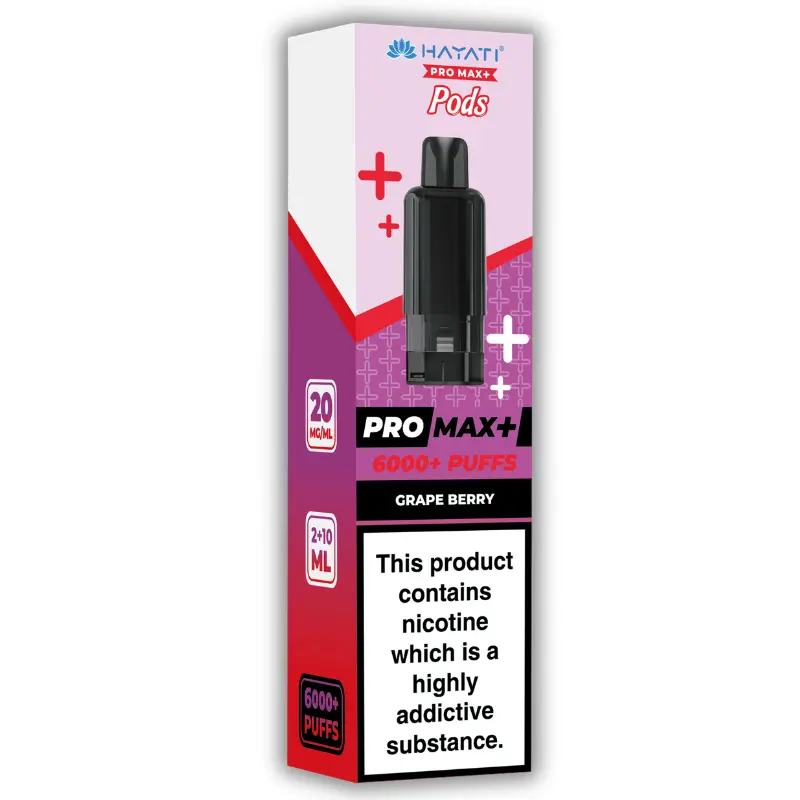
Hayati · Pro Max Plus
Grape Berry Hayati Pro Max Plus Pods
£5.49
✔ In stock — ready to ship
Genuine Hayati
Free over £20
Same-day dispatch
Secure checkout
Two words, one price, twelve millilitres. £5.49 puts a filled Grape Berry pod in your hand for a Hayati Pro Max Plus you already own, with no body in the packet and nothing to assemble. The liquid is at 20mg. The device is your side of the arrangement. All of that is ordinary, and the shelf this listing sits on holds eighty-nine entries that describe themselves in exactly the same shape.
What is not ordinary is the way the title is built. Read it as a specification and it splits straight down the middle. "Grape" is an assertion about a liquid. It names one plant, one flavour material, one thing a blend either tastes of or does not. Somebody could open this pod, take a draw and say, correctly, that the grape is not there. "Berry" is not that sort of word. Berry is a class, and a roomy one: strawberry, raspberry, blackberry, blueberry, cranberry, blackcurrant, cherry in the loose usage the trade actually employs. Any dark red or purple accord answers to it, and it is very hard to construct one that would not. Nobody has ever opened a pod labelled berry and found it to be not-berry, because there is nothing inside the word for a liquid to contradict.
Half this name is checkable, then, and half of it is not. That is the subject of the page. An unfalsifiable word cannot disappoint you, which sounds like a kindness, and it cannot inform you either, which is the invoice attached to the kindness. What follows works out three things: how widespread the convention is across this range, what the unfalsifiable half costs a buyer in practice, and whether it is a defect at all or a reasonable answer to a blend that genuinely has no parts list.
The short version, before the working. The specific word is carrying the whole load here, and unusually for this naming pattern, that turns out to be the right arrangement rather than a dodge. Grape is one of the loudest materials anybody builds a pod around. It does not need a named partner to be identifiable, and the thing sitting underneath it is doing a job that species names would describe badly. That verdict is argued rather than announced, and the point where it stops being about naming and starts being about the liquid is marked explicitly further down.
What the Dragon Berries page settled, and the half it left alone
This argument has a prior instalment and rebuilding it here would waste the space. The Dragon Berries pods page took the other half of the same title structure and worked it through in detail: what happens when the named modifier in a two-part flavour name contributes very little to the liquid. Its finding was that dragon fruit has no character compound to build from, that Hayati's own copy for that blend interprets the name rather than declaring an ingredient, and that a buyer who credits the exotic word for what they enjoyed has almost certainly misattributed a preference that belongs to the base.
That page also did something useful for this one. It identified the naming family: listings built as one named thing plus the unnamed category noun. It counted four of them and placed them on a ladder by how much of the pod the named half could plausibly occupy. Grape Berry sat at the top of that ladder, on the reasoning that grape is heavy, sweet and thoroughly unhideable, and that Hayati's own description gives the grape the base and hands the berries a supporting role. Dragon fruit sat at the bottom by a distance.
None of that is re-derived here and the conclusion is taken as read. What the Dragon Berries page did not examine, because its product gave it no reason to, is the other half of the construction. It treated "Berries" as a blank where a recipe should be. That is true as far as it goes, but a blank and an unfalsifiable claim are different objects with different consequences. A blank tells you nothing. An unfalsifiable claim tells you nothing while looking exactly like something, which is a more interesting failure and a more common one.
So the question this page takes up is the inverse of that one. Not "is the named modifier real", which for grape is not seriously in doubt, but "what is a buyer entitled to expect from the half of the name that no liquid could ever fail". And, since a page should be more use than a complaint, what the checkable half is being asked to do against an unspecified dark fruit background.
Counting the convention before arguing about it
Rarity claims are cheap, so here is the count rather than the adjective. Working through the eighty-nine listings on the Hayati Pro Max Plus Pods shelf and taking a category noun to mean a class word standing in a slot where a species could stand, nine listings use the convention. That is roughly one in ten.
They are not all the same shape, and the difference matters. Five pair a named thing with a bare class: Grape Berry, Cherry Berry, Dragon Berries, Berry Lemonade and Blue Razz Fruit Twist. The Dragon Berries page counted four, which is correct if you restrict the family to the word "berry". Widen it to any class noun and Blue Razz Fruit Twist joins, since "Fruit" is doing precisely the same duty there that "Berry" does here. Five, then, not four, and the correction is worth having because the fifth member behaves differently from the other four in a way that becomes useful later.
The remaining four name nothing at all and hand the entire recipe to a class: Mixed Berries, Fruit Twist, Triple Melon and Tropical Sour Juice. Those are a harder case than this listing, because there is no checkable half to fall back on. Whatever you conclude about Grape Berry, it at least has one word you could hold somebody to.
Across the full catalogue of 492 listings the convention appears thirty-eight times, which is thirty-seven vape listings plus a nicotine pouch, and those resolve to fifteen distinct flavour names duplicated across kits, pods, bottles and platforms. Guava Kiwi Passion Fruit is excluded from that count even though the word "fruit" is in it, because passion fruit is a species rather than a class, and counting it would inflate the figure with a listing that names all three of its components.
One in ten is not an epidemic and it is not a curiosity either. It is a settled house habit, applied often enough that a buyer will meet it several times while browsing a single shelf, and consistently enough that it clearly is not an oversight. Somebody decided that a class noun was an acceptable thing to print where a fruit name would normally go, and did it again and again. The question is what that decision transfers onto the person paying.
What the convention costs, itemised
Five costs, and they are not all equally serious. Taking the weakest first is fairer than leading with the strongest.
One: recourse becomes asymmetric. If you buy this pod and the grape is absent, you have a complaint with content. Something was named and is missing. If you buy it and the dark fruit underneath is not what you hoped, you have no complaint at all, because nothing was claimed. The two halves of the same title carry different weights of obligation, and the buyer discovers the difference only after paying. This is the smallest of the five costs because most people never complain about a £5.49 pod anyway, but it is the cleanest illustration of what unfalsifiable means in a commercial setting: it is a word that transfers risk without appearing to.
Two: substitution loses its handle. A named blend gives you adjustment. If Blackberry Raspberry runs too dark, you know to move towards the red end. If Strawberry Cherry Cranberry runs too dry for you, the cranberry is the thing to drop. An unnamed base offers no such lever. Should the dark half of this pod strike you as too jammy, there is no request you can make of the catalogue, because you cannot state what you are trying to move away from. You are reduced to trying another listing and hoping.
Three: cross-listing comparison stops working. This is the cost I had not expected to find and the one with real teeth. Five listings on this shelf print the word berry as a stand-in for unnamed content. Nothing on the record says whether they share a berry accord, whether they use five different ones, or whether the word is applied at slightly different strengths to slightly different mixes. The copy for each describes its own berries in its own terms, and no two sets of terms are the same. You therefore cannot reason from one to another. Having enjoyed the berries in Cherry Berry tells you, formally speaking, nothing about the berries here. That is a genuine loss, because reasoning across listings is most of what a shopper actually does on a shelf of eighty-nine near-identical boxes.
Four: the filing does not reliably repair the title, although it sometimes can. Hayati's own data layer carries flavour tags and fruit shelves, and on some listings those resolve a class noun that the title left open. Mixed Berries is filed under blueberry and raspberry. Triple Melon is filed under watermelon. Blue Razz Fruit Twist is filed under orange, which is a fruit nobody would have guessed from the title and which makes that listing considerably more informative behind the scenes than on the front. Three of the nine resolve. Six do not, and Grape Berry is one of the six. Its tags read berry, grape, grape berry, which repeats the class rather than resolving it, and its fruit shelves are Berry Vapes and Grape Vapes, neither of which narrows anything. The class noun on this listing is unresolved at every layer that exists: title, flavour copy, tags and shelf filing. Four checks, four blanks.
That filing is coarse in the other direction too, which is worth knowing before anyone treats a shelf as evidence. Grape Vapes holds nineteen listings, and four of them are not grape: two are the Straw' Grapefruit / Straw' Dragonfruit entries, where the fruit is grapefruit and the resemblance is orthographic rather than botanical, and two are the pod and the kit of a dark fizzy blend, filed there for reasons the data does not explain. A taxonomy that cannot keep grapefruit out of the grape shelf is not going to tell you which berries are in a berry blend.
Five: the price is identical to the listings that do specify. Every pod named in the previous three paragraphs costs £5.49. Strawberry Raspberry Cherry names three fruits and gives each of them a stated job. Blueberry Cherry Cranberry names three and commits to a dry finish. Blueberry Pomegranate names two and volunteers a tannic character, which is an unusually specific thing to put in writing and an easy thing to be caught out on. For the same money, those listings sell you more information. Information is not the product, but it is part of what you are choosing between when twelve millilitres at 20mg is the constant across the entire shelf.
Set out like that, the case against the convention looks fairly strong. It is weaker than it looks.
The case that "berry" is the truthful word
There is a real argument on the other side, and it is not the argument a marketing department would make. It is this: a mixed dark fruit accord frequently does not decompose into named fruits, and printing three of them anyway would be less accurate rather than more.
Start with what the range does when it genuinely has species to declare, because that is the strongest evidence available. Look at the three-fruit listings and notice that Hayati never simply list. They assign roles. On Strawberry Raspberry Cherry, one fruit supplies sweetness, one supplies the sparkle and one supplies the depth. On Strawberry Raspberry Blueberry, one is bright, one is sharp and one softens the finish. On Blueberry Cherry Cranberry, one gives softness, one gives depth and one supplies a dry edge that keeps the sugar in check. A named fruit in this range comes with a stated function every time.
That convention has an implication people miss. If you print three fruit names, you are not only claiming three materials are present. You are claiming the blend has three distinguishable parts, each doing something a taster could in principle follow. Print the names on a liquid that has no such structure and you have made a false claim about architecture while appearing to make a true claim about contents. The reader then goes hunting for a raspberry that the formulator never intended to be findable, fails to find it, and concludes the pod is badly made when the fault was in the label.
Second point for the defence: the class noun is a description of a role, not an evasion of one. When the unnamed half of a blend exists to sit under a lead and give it body, its species identity is close to irrelevant to the buying decision. What matters is whether the background is dark or bright, sweet or tart, thick or thin. Those are level questions, not identity questions, and a category noun plus an adjective answers them perfectly well. The copy on this listing does exactly that: the berries are described as adding depth, split between jammy and dark on one side and bright with a little tartness on the other. That is more use to a buyer than three species with no roles attached would be.
Third: naming can actively mislead when the named thing is not a lead. Blue Razz Fruit Twist is the proof. Its data resolves the twist to orange. Put orange in the title and every buyer arrives expecting a citrus pod, which, on the evidence of the copy, it is not. The class noun "fruit" is, in that specific case, the more honest word, because it signals a supporting blend without setting an expectation the liquid cannot meet. What looked like the range being vague is the range declining to overstate.
Fourth, and specific to this product: grape and dark berries occupy the same register. They are all purple, all sweet, all heavy at the same end of the profile. A named berry partner could not have supplied contrast here, because there is no contrast available between grape and blackberry in the way there is between blackcurrant and mango on Blackcurrant Mango, or between blue raspberry and pineapple on Blue Razz Pineapple. The berries in this pod are structural. They thicken and they add a small amount of acid. Naming them would imply a duet where the recipe intends a floor.
Where the defence runs out
Two limits, stated so the argument is not swallowed whole.
The defence holds only where the named half leads. It collapses entirely on Mixed Berries and on Fruit Twist, where the class noun is not describing a background but the whole liquid. "No possible product could fail this description" is a tolerable property for a supporting element and an intolerable one for the main event. Those listings are asking you to buy a word that excludes almost nothing, and the argument made above does not rescue them.
The defence also has nothing to say about acid. Tartness is not a species question and it never was. It is a level, it varies enormously between blends in this range, and Hayati describe it freely whenever it exists. A blend that declines to name its fruits could still state its acid level in one clause. Most do. The ones that do not have left open the axis along which berry blends actually differ, and no amount of "the accord does not decompose" explains the omission, because the acid level is not a component and does not need decomposing.
On that second limit, this listing passes. Its copy claims tang, and it claims the tang holds up across a long session, which is a statement about persistence and not just presence. That is a falsifiable assertion about the half of the name that was not falsifiable, and it is the single most useful sentence Hayati publish about this pod. It is also, notably, something the Dragon Berries copy never says about its berries.
Where the naming evidence stops
Everything above is drawn from documents: the two words in the title, Hayati's flavour copy for this listing and for the kit, the tag data, the shelf filing, and the same four layers on the eight sibling listings that use the convention. Those are checkable by anyone with the catalogue in front of them, and if any of the counts above are wrong they are wrong in a way you can demonstrate.
From here the page moves onto different ground. What follows is about the liquid, and it is reasoning rather than record. Grape as a flavour material behaves in known ways, the copy states which element leads, and those two things together support inferences about how the pod is likely to read. They do not support certainty, and each claim below is tagged for how far it goes: stated where Hayati put it in writing, inferred where I am reasoning from the material and the copy, and unknown where nothing on the record settles it. Nothing here comes from having a pod open, and a page that pretended otherwise would be the exact fault this brief exists to prevent.
What grape is being asked to do
Stated: grape leads. Both of Hayati's descriptions say so and they say it independently. The pod copy gives grape the base and describes the berries as layering depth over it. The kit copy for the same liquid goes further and supplies the reason the berries are there at all, which is that grape on its own can read as one-dimensional, so it has been given company. Two separate blocks of text, written at different times about the same recipe, agree on the hierarchy. That is about as close to corroboration as a retail listing gets, and it settles the only structural question that matters: this is a grape pod with a dark floor under it, not a berry pod with grape in it.
Inferred: grape is a good choice of lead precisely because it cannot hide. Grape in vapour is a heavy material. It arrives thick, sits in the middle of the palate rather than at the front or the back, and carries a very high perceived sweetness for the amount of sugar actually in the mix. It is also tonally unusual: nothing else in the fruit repertoire produces that particular concentrated purple impression, which is why a grape liquid is recognisable to almost anyone within a single draw, and why grape is the one fruit in this range that a category noun could never have stood in for. There is no world in which a manufacturer writes "Purple Berry" and expects you to work out that grape was meant.
Inferred: the order of arrival is likely to be grape, then depth, then a tail of tartness. Grape's weight means it fills the draw early. The berry material underneath, being darker and less volatile, tends to register slightly behind the lead rather than alongside it. The stated tang most plausibly shows up towards the end of the exhale, because that is where an acid note in a heavy sweet blend usually becomes audible: the sugar has already peaked and the sharpness is what is left standing. If you find the tartness arriving first instead, the blend is built differently from the way the copy describes it, and that would be worth knowing.
Stated, partly: the berries are not uniform. Hayati split them, describing part of the mix as jammy and dark and part as brighter with a little tartness. That is an unusually specific thing to say about an unnamed component, and it is doing real work. A uniformly dark berry base under a grape lead would produce something close to jam: two heavy purple elements stacked with nothing to lift them. The stated brighter fraction is what stops that happening, at least on paper. Whether it succeeds is unknown, and it is the main thing a first pod should be used to find out.
Inferred: sweetness sits in the upper half of this shelf. Grape accords carry a heavy sweetener load as a matter of construction, and a jammy berry base is not a corrective. The claimed tang is the only counterweight named anywhere, and no coolant appears in the title, which this range treats as its flag for cooling. The practical consequence is a blend with one brake and no chill. That is manageable over a full pod if the acid is genuinely there and genuinely persists, and heavy going if it is not.
Unknown: the sweetness is not quantified anywhere, on this listing or on any other in the range, so nobody can tell you where it lands relative to a specific neighbour. What can be said is the direction. A grape-led blend with a jammy floor is not going to read as restrained, and anybody whose complaint about berry pods is that they taste like confectionery should treat this listing with caution rather than hope.
What it is not
Ruling things out is often more useful than adjectives, and here most of the exclusions are solid.
Not cooled. Nothing in the title flags ice, frost or menthol, and this range is consistent about putting that word in the name when it applies, which is why Blackberry Ice announces itself in its second word. Reading an unmarked title as uncooled is therefore a reading of a convention rather than a measured fact, and the convention is well supported across the shelf. Cooling strength is not published for anything in this range in any case, marked or otherwise.
Not a confectionery blend. Neither description reaches for sweets, gum or candy vocabulary, and this range does say so when it means it. Blueberry B'Gum puts the gum in the name. Blue Razz GB is openly a sugared, gummy-style reading of its fruit. Grape Berry is written as fruit, and the absence of confectionery language in two separate copy blocks is reasonable evidence that fruit is what was intended. Whether a heavily sweetened grape accord reads as fruit in the mouth is a separate question and a fair one.
Not sour. Tang and sour are different claims and the copy makes only the first. A tang is a lift inside a sweet profile. Sourness is a distinct sensation with its own bite, and the range labels it when present, as on Blue Sour Raspberry. Nobody should buy this expecting a pucker.
Not a blue blend. This matters more than it sounds, because twelve of the eighty-nine listings on this shelf put the word blue in the title and a good many buyers arrive here from that direction. Blue raspberry is a confected, sharp, artificial-by-design flavour with a tang built into its structure. Grape is a dark, rounded, low-sharpness material. Crossing from Blue Razz Blackcurrant or Blue Razz Cherry to this will read as flat for the first stretch, not because the pod is flat but because your calibration is set for a different kind of sharpness. That is an adjustment, and it is easier made deliberately.
Not a single-fruit pod. Grape on its own exists in the range and the range explicitly positions it against this one. Hayati's copy for the solo grape listing says in as many words that the Grape Berry and Sakura Grape entries pair grape with something else, while the solo one lets grape stand alone. The catalogue therefore agrees with the reading offered on this page: Grape Berry is the version of grape with company, and the company is the part nobody named.
The failure mode, since every honest page should name one
Inferred, and this is the risk worth carrying into the purchase: if the unnamed dark fruit runs sweeter or jammier than the copy implies, the two halves merge and the pod stops being a grape pod. Grape and dark berry sit close enough on the palate that a heavy hand on the base does not produce a layered blend, it produces an undifferentiated purple sweetness in which nothing is identifiable. That outcome would be consistent with everything Hayati publish, because nothing they publish constrains the proportion. The stated tang is the safeguard against it and the tang is also the claim you cannot verify before paying.
Which gives a first pod a clear job. Not "is this nice", which nobody else can answer, but "can I still tell it is grape at the eighth millilitre". If yes, the recipe works as described and the unnamed half is a floor. If no, the unnamed half has swallowed the named one, and the more specific alternatives further down are where to go next.
The pod on its own, briefly
Eighty-nine listings share this hardware, the device has been taken apart at length across the range, and there is nothing new to add here, so this section stays short on purpose. One prefilled pod arrives, holding twelve millilitres at 20mg, with no body, no cable and no spare parts in the packet. It goes onto a Pro Max Plus you already have and the device behaves exactly as it did with whatever was on it last. Check the range name printed on your device against the range name in this title before ordering, since Hayati build several pod families and a retail page is not the place to settle a fitment question.
The specification that actually bears on this liquid is the seal. The pod is filled at the factory and closed, which means the ratio between the named half and the unnamed half is fixed before it reaches you and cannot be adjusted afterwards. On a listing where both components are named, that is unremarkable. Here it means the one variable this page has been picking apart is set by somebody else and delivered as a single twelve-millilitre unit. There is no dilution, no blending, no halfway position. You buy the proportion sight unseen or you buy something else.
Hayati put a ceiling of 6,000 puffs on the pod. That figure comes from test apparatus drawing at a fixed length on a fixed interval, so treat it as a property of the equipment rather than a forecast of your week, and expect the real number to fall below it rather than above. Everything else about the platform, including how pods seat, what changes as a body ages and how the wider catalogue relates to it, sits on the Hayati Prefilled Pods & Refills shelf and on the pod shelf linked earlier.
The listing read layer by layer
The table below is arranged by where on the record each fact appears rather than by type, because the argument of this page is about which layers commit to what. Rows recording an absence are included deliberately. On a product where one half of the name is unresolved everywhere, the pattern of blanks is part of the specification and a buyer should see it laid out rather than have to assemble it.
| Layer of the record | What it commits to |
|---|---|
| Title, first word | Grape. A named fruit, testable against the liquid |
| Title, second word | Berry. A class, testable against nothing |
| Flavour copy, lead element | Grape, given the base and the bulk of the sweetness |
| Flavour copy, supporting element | Berries, adding depth, split between jammy and bright |
| Flavour copy, acid | Tang claimed, and claimed to persist across a long session |
| Flavour copy, species | None. No berry is named at any point |
| Tag data | berry, grape, grape berry. The class is repeated, not resolved |
| Fruit shelves | Berry Vapes and Grape Vapes. Neither narrows the base |
| Coolant | Not signalled in the title, which is how this range flags it |
| Liquid supplied | 12ml, already in the pod on arrival |
| Nicotine concentration | 20mg |
| Hardware supplied | None. A Pro Max Plus body is required and is not included |
| Puff ceiling quoted | 6,000, obtained on test equipment |
| Carrier ratio | Not published for this listing |
| Coil resistance | Not published for this listing |
| Stock reference | grape-berry-hayati-pro-max-plus-pods |
| Maker | Hayati |
| This listing | £5.49 |
| Same liquid with a device | £7.99 |
Four rows want a note. The 20mg figure reports a concentration and nothing else; nicotine is addictive, the number describes what the liquid holds, and no strength is recommended to anybody on this page. The two unpublished technical rows are the ones most often filled in by reading a neighbouring listing, after which a guess starts circulating as though somebody had measured it, so neither is given a value here. And the twelve-millilitre row is the one that turns the whole naming argument into a practical matter, because it is the size of the commitment you make to a proportion you were not told.
The row that repays the most attention on a shelf browse is the fifth. Hayati's copy claims tang and claims it lasts. That is the only statement on the entire record that constrains the unnamed half in a way a taster could check, and it is the reason this listing comes out better than the other four in its naming family rather than worse.
Against the pods that name what this one does not
Everything below is £5.49 on the same hardware unless stated. Price is not the variable. What varies is how much of the purchase is specified before you pay, and after the argument above, that should be a conscious choice rather than an accident.
If grape is the reason you are here. Then this listing is the right shape and the unnamed half is not a problem, because you are not buying it. The solo grape pod in the range gives you the fruit with nothing under it, and Hayati's own copy for that entry frames Grape Berry and Sakura Grape as the paired alternatives, so the range agrees about what the choice is. Grape is thinly represented here: three of the eighty-nine listings on this shelf have it in the title, and the whole Grape Vapes shelf runs to nineteen entries across every format Hayati make, four of which are not grape at all. If grape is your thing, you have very few options and this is one of them.
If what you want is a dark fruit that is named and singular. Blackcurrant Juice is the closest thing on the shelf to a controlled comparison. It occupies the same purple register, it is deep and tart with a musky edge, and it is one fruit with nothing hidden behind it. Vape it alongside this pod and you learn something real: whatever Grape Berry does that Blackcurrant Juice does not is the contribution of the grape plus the unnamed base together. That is a cleaner experiment than any amount of introspection over a single pod.
If the berry half is the axis you actually care about. Then buy a listing that names it, because five of them do it properly for the same money. Strawberry Raspberry Cherry is the fullest red-fruit statement on the shelf, three species with declared jobs and a stated tart edge. Blackberry Raspberry narrows to two, runs darker, and puts its tartness in writing. Strawberry Raspberry Blueberry gives each of its three a separate function and lands in the middle. Strawberry Cherry Cranberry uses the cranberry as a dry brake on the sugar. Blueberry Pomegranate is the odd one out and the most specific of the lot, because tannin is a texture claim rather than a flavour claim and almost nothing else in the range attempts one.
If you want the sweetness held back. This blend has one brake and it is unverifiable until the pod is open. Three listings attack the same problem with declared devices. Blue Sour Raspberry uses stated sourness, which is a blunt instrument and effective. Blueberry Pomegranate uses tartness plus tannin, which is subtler and keeps the result closer to fruit. Blackberry Ice uses a coolant and arrives at a comparable clearing effect by an unrelated route. None of those three is a better pod than this one; they are pods whose sugar management is on the record.
If you are coming off the blue accords. That is the direction a lot of this shelf's traffic comes from, and the crossing is bigger than the shared word "berry" suggests. Blue Razz Lemonade and Blue Razz Cherry both keep a sharp confected top note running through the whole draw, and Blue Razz GB pushes the same base further towards sugar. Grape has none of that brightness. It is heavier, rounder and considerably slower to announce itself, so give it more than three draws before deciding.
If you are comparing one uninformative title against another. This listing is only half a member of the opaque-name group, because it does name a fruit. Full members behave differently and should not be treated as equivalent. Midnight Dream names a mood and no ingredient whatsoever, and Hayati's own copy concedes that the name sets an atmosphere rather than a recipe. Blue Fusion hides two fruits behind a colour. Mad Blue hides an unspecified intensity behind an adjective, and the copy says openly that the name does not list its fruits. Vim Ice is cryptic in the title and unusually specific about the style underneath it, which is the combination this page would recommend if a maker insists on a cryptic name. At least eleven listings on this shelf name no ingredient at all. Against that company, a title with one checkable fruit in it is doing comparatively well.
If you are weighing formats rather than flavours. The same recipe with a body in the box is the Grape Berry Hayati Pro Max Plus 6000 Pod Kit at £7.99, which is the listing to take if you do not own the device yet. Other platforms hold different volumes and different puff ratings and are not interchangeable with this one: Blue Razz GB Hayati Pro Ultra Plus Pods is a 22ml pod at £7.99, Blue Razz GB Hayati Rubik Pods is £3.99 for the compact Rubik, and Blue Sour Raspberry Hayati Mini Ultra Pods is £3.49 for a 4ml pod. Grape Berry is not offered on any of them, which is another consequence of grape being thin on the ground in this catalogue.
If none of the above is right, the Berry Vapes shelf runs to two hundred and twenty-five listings and the full Hayati range to four hundred and ninety-two.
Getting a clean read on the first pod
General pod-handling advice is identical across this range and repeating it here would serve nobody. What follows is aimed at one thing: finishing twelve millilitres with an answer to the question the title left open.
Give grape more draws than you would give a sharp flavour. Heavy, low-acid materials build on the palate rather than announcing themselves. A blue raspberry pod tells you what it is on draw one; a grape-led pod is still arriving on draw four. Judging this on two puffs straight after unwrapping will systematically underrate it, and the mistake compounds if you have just come off something confected.
Run the comparison, do not run the introspection. Trying to work out by concentration whether you can detect unnamed berries under a grape lead is a task nobody performs reliably. Comparison is far easier than identification. Draw on this, wait a minute, draw on a named dark pod, and ask only whether they differ and in which direction. Blackcurrant Juice is the most informative partner for this because it shares the register without sharing the construction.
Track the pod from full to empty and note when grape stops leading. This is the test the naming argument actually points at. If the grape is audible at twelve millilitres and gone by four, the unnamed base has taken over as the volatile top of the recipe thinned out, and you have learned that the floor is heavier than the copy implies. If grape leads the whole way down, the proportion is right and the class noun in the title was describing something genuinely subordinate. Either result is worth having and neither requires you to name a single berry.
Keep it at room temperature and out of the sun. Heat drives off the lighter fractions first, and on a blend whose stated tang is the only thing standing between it and heaviness, the lighter fractions are exactly what you want preserved. A pod left in a warm car will answer your question wrongly and give no sign that it has. Upright, cool, in a drawer that children and pets cannot get into.
Do not chain-pull a sweet grape blend. Two separate things go wrong. A heavily sweetened liquid pulled fast outruns the wick and lays a scorched edge over the fruit, and continuous use flattens your own sensitivity to sugar within about a quarter of an hour, at which point the pod seems to have lost its flavour when it is your palate that has stopped reporting. Longer draws with gaps between them keep both problems away.
Know when the pod has stopped being evidence. Residue builds on a coil fastest with sweetened liquids, and a grape accord is among the sweeter constructions in the range. As it accumulates, the lightest materials go first, which on this recipe means the stated tang and the brighter fraction of the berries. Once vapour thins and a faint toasted note appears behind the fruit, the pod has stopped telling you anything about the recipe and is only telling you about the coil. Further draws are not worth taking.
Dispose of the spent pod properly. A finished pod still holds a coil, so it does not belong in the kitchen bin. Shops that sell these normally accept them back, and household waste recycling centres handle small electrical items.
Questions this listing raises
Which berries are in it?
Hayati do not say, anywhere. No species appears in the title, the flavour description, the tag data or the shelf filing, and this range is perfectly capable of printing three fruit names in a row when it has three to print. What is on the record is that the mix is split between a dark jammy part and a brighter, slightly tart part, and that it sits under the grape rather than beside it.
Is "berry" a meaningless word on a vape label, then?
Not meaningless, but much weaker than it looks. It excludes a great deal: no citrus lead, no tropical lead, no cream, no tobacco, no cola. What it cannot do is distinguish this pod from any other dark fruit blend, and Berry Vapes holds two hundred and twenty-five listings, which is the size of the field the word narrows you to.
Does the grape actually lead, or is that marketing?
Two separate Hayati descriptions of the same recipe say grape leads, written for the pod and for the kit, and the kit copy additionally explains why the berries were added, which is to stop grape reading as one-dimensional. Independent agreement across two copy blocks is reasonable evidence. It is still copy rather than measurement, and the proportion is not published.
How does it differ from grape on its own?
By having a floor under it. The solo grape listing in this range is grape with nothing else, and Hayati's own description of it names Grape Berry as one of the paired options in contrast. Expect this one to read fuller and rounder, with a little more tartness in the tail, and expect the difference to be one of body rather than of a second identifiable fruit.
Is there any chill in this one?
Nothing in the title flags one, and this range is consistent about naming ice, frost or menthol when it applies. Treating an unmarked title as uncooled is a reading of that convention rather than a measured fact. No cooling strength is published for anything in the range, marked or otherwise, so a figure is not available for any listing.
How sweet is it?
Towards the upper half of this shelf, on the reasoning that grape accords carry a heavy sweetener load and a jammy berry base does not pull that back. The claimed tang is the only counterweight named anywhere and no coolant is flagged. Nobody publishes a sugar figure for any listing in this range, so this is a direction rather than a measurement.
I want a berry pod and this looked like one. Should I buy it?
Probably not, and that is the practical conclusion of this page. Everything the listing commits to about the berries is that they are dark, sweet and a little tart, which describes a very large part of the shelf. If the berry half is what you are choosing on, a listing that names its fruits and assigns them jobs gives you more to go on for the same £5.49.
Is the liquid the same as the kit version?
Nothing published suggests any difference. Both entries carry twelve millilitres at 20mg under the same flavour name and the same descriptions of the same profile. The kit listing includes a device and costs £7.99; this one does not and costs £5.49.
Why does the range use words like berry and fruit instead of naming things?
Two readings, and both are probably true of different listings. The generous one is that a mixed accord genuinely may not resolve into named fruits with separate jobs, and printing three species would claim a structure the liquid does not have. The less generous one is that a class noun is also what you write when there is nothing specific to write. Nine of the eighty-nine listings on this shelf do it, so it is a settled habit rather than a one-off.
What is the VG to PG ratio, and the coil resistance?
Neither is published for this product, so neither appears on this page. Any figure quoted for them elsewhere did not come from Hayati's specification for Grape Berry, because those fields are empty, and copying one across from a neighbouring listing only makes a guess look as though it had been confirmed.
Is the 6,000 puff figure a useful planning number?
Not really. It is an upper bound obtained on test apparatus drawing at a fixed length and interval, so it describes the equipment more accurately than it describes anyone's week. The twelve-millilitre figure is the more honest number to plan around, and even that moves with how long your draws are.
How many should I order?
One is enough to answer the open question. The proportion between the named half and the unnamed half is fixed at the factory and cannot be adjusted, so a second identical pod tells you nothing the first did not, and stacking them multiplies a bet you have not settled. Once you know whether grape still leads at the bottom of the pod, order to suit.
Where that leaves it
£5.49 puts one prefilled pod in your hand: twelve millilitres at 20mg, no device, for a Pro Max Plus you already own, with Hayati quoting 6,000 puffs as a laboratory ceiling. The same liquid with a body in the box is £7.99.
The argument of this page was that half the name cannot be wrong. One in ten listings on this shelf uses a class noun where a fruit name would go, and on four of the five that pair a class with a named thing, including this one, the class resolves to nothing at any layer of the record. That transfers real costs: no recourse on the unnamed half, no handle for substitution, no way to reason from one berry listing to another, and the same price as listings that specify properly.
The defence of the convention is stronger than it first appears and it applies here. A dark mixed accord sitting under a lead is doing a structural job, and printing three arbitrary species would claim an architecture the liquid does not have, which would be less truthful rather than more. This range names fruits only when it can also name what each one does, and that is a discipline worth respecting rather than a gap. Where the defence fails is on listings that hand the whole recipe to a class, and on any listing that hides its acid level behind the same vagueness. Grape Berry does neither. It has a loud, checkable lead that nothing could stand in for, and its copy commits to tang and to tang lasting, which is the one assertion about the unnamed half that a taster can hold somebody to.
So the verdict is usable and narrow. Buy this if you want grape with more body than grape alone provides, which is exactly what the range says it is for, and accept that the dark fruit underneath is a floor you are not choosing. Do not buy it as a berry pod, because on that axis it tells you almost nothing that two hundred and twenty-four other listings do not also tell you. Watch one thing on the first pod: whether grape is still leading when the liquid runs low. If it is, the unnamed half was doing the modest job the copy describes and the naming was honest. If it is not, the floor has come up through the ceiling, and a listing that names its fruits is the better place to spend the next £5.49.
Strictly for adults aged 18 and over. Nicotine is an addictive substance.
You might also like


