
Home / Hayati Pro Ultra Plus Pods / Strawberry Watermelon Hayati Pro Ultra Plus Pods
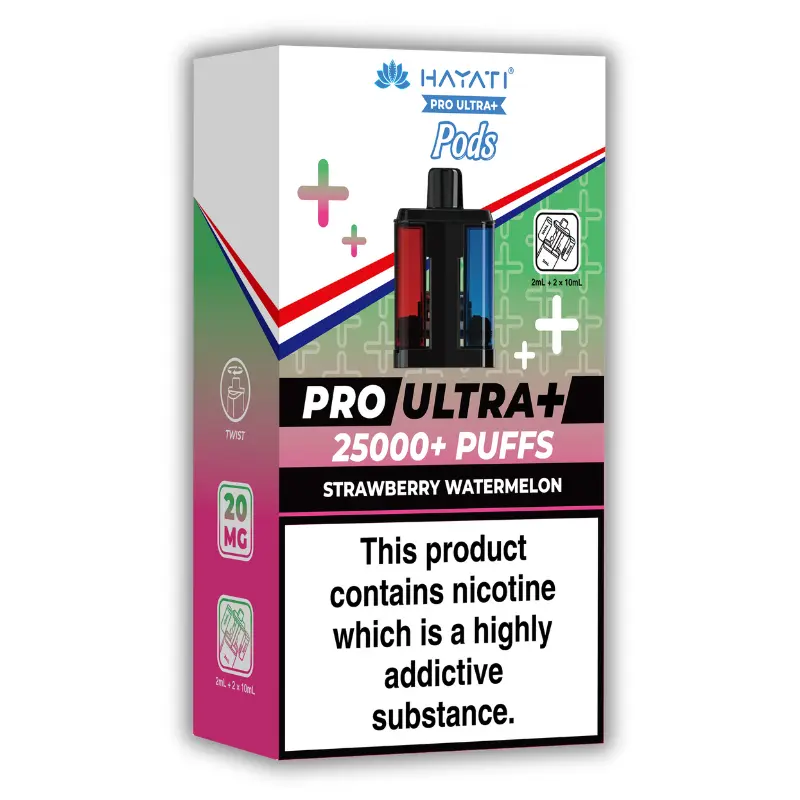
Hayati · Pro Ultra Plus
Strawberry Watermelon Hayati Pro Ultra Plus Pods
£7.99
✔ In stock — ready to ship
Genuine Hayati
Free over £20
Same-day dispatch
Secure checkout
Seven pounds ninety-nine buys one sealed pod holding 22ml of prefilled liquid at 20mg nicotine salt, all of it a single blend, drawn through one mesh coil that is built into the pod and thrown away with it. There is no oblique stroke in the title and no rotating collar under the mouthpiece, so nothing here selects between two reserves and nothing can be switched partway. Hayati rate the pod on their own test apparatus at up to 25,000 puffs, a laboratory figure rather than a forecast of anybody's month. No device is supplied, which makes this a refill for a Pro Ultra Plus body already in the house, and anyone without one wants the Strawberry Watermelon 25000 Prefilled Pod Kit at £11.99, which is the identical liquid with hardware attached.
That is the commercial position and it fits in a paragraph. The name takes longer, and not because it hides anything. It hides nothing at all. Two fruits are declared, both of them ordinary, and the listing adds that there is no ice and no sour element anywhere in the blend. Everything is on the table.
What is worth a second look is the specific pair. Sort the rest of this shelf by how its flavours are constructed and a pattern turns up immediately: nearly every one of them is built on an opposition. Something tart set against something sugared. Something chilled against something warm. A confectionery treatment against a plain fruit. A loud berry against a quiet one. The whole grammar of the range is contrast, and contrast is how a blend becomes legible, because two things are only distinguishable when they differ.
Strawberry and watermelon do not differ very much. Both are low in acid. Both are watery rather than dense. Both are carried almost entirely by light aromatic material rather than by anything the tongue can grip. Neither brings a structural marker that survives being diluted by the other. Put them in one pod and the honest question is not which one wins. It is whether there are two things in there at all.
The answer this page arrives at is that there probably are not, and that this is simultaneously the main risk of the purchase and the main argument for it. Those are not two separate findings. They are one property with two names, and which name you give it depends entirely on what you wanted 22ml of.
What a pairing is normally for, counted rather than asserted
The contrast census on this shelf
An assertion of the form "almost everything here works by contrast" is the kind of thing a product page says and nobody verifies, so it is worth doing the count before leaning on it. The Pro Ultra Plus pods shelf holds 52 listings. Twenty-five of them carry an oblique stroke, which on this format means one pod divided into two reserves with a collar that chooses which side feeds the coil. The remaining twenty-seven are single blends like this one.
Read the twenty-five dual listings by what separates the two halves and the axes are few and repeated. Cold against warm is the commonest: Blue Razz Pineapple / Strawberry Ice runs an uncooled tropical berry opposite a chilled one. Tart against sweet is next, worked openly in Sour Apple / Juicy Peach. Treated against untreated turns up in Blackcurrant Cotton K / Blue Raspberry, where a spun-sugar register sits beside a comparatively bare fruit. A fourth pattern holds one component fixed and moves the other, which is what Straw’ Grapefruit / Straw’ Dragonfruit and Kiwi Banana / Straw’ Banana both do, and it is the cleanest experimental design on the shelf because it isolates one variable. Even the pairings that look like two versions of one idea, Grape GB / Blue Razz GB among them, differ sharply on acid.
Now the twenty-seven single blends, which is the group this pod belongs to. Thirteen of them name more than one fruit, or one fruit plus something else. Eleven of those thirteen have an obvious divider running through them, which leaves two to argue about, and one of the two is this pod. Mango Peach Pineapple puts an acid tropical against two soft ones. Blueberry Raspberry Lemon and Orange Lemon & Lime are carried by citrus. Straw’ Lemonade and Blackcurrant Lemonade both bolt a drink construction onto a fruit, which is an acid decision dressed as a format. Raspberry Cola sets a berry against a spiced fizz. Strawberry Raspberry Ice adds an acid berry and a coolant to the same strawberry that is in this pod. Lemon Lime is two citrus fruits. Blue Razz Cherry pairs a sharp confectionery blue with a dark stone fruit.
The count that survives, stated narrowly so it can be checked: of the twenty-seven single-blend listings on this shelf, Strawberry Watermelon is the only one that names two specific fruits and nothing else, with no citrus, no coolant, no drink format, no confectionery treatment and no member carrying an acid line.
Be honest about the near miss, because there is one. Cherry Berry has no citrus, no ice and no sweet-counter word either, and a careless version of this count would have to include it. Two things exclude it. Berry is a category rather than a named fruit, so the listing is one fruit and a gesture rather than a pair. And cherry brings a register neither of these two has: a dark kernel depth underneath the sugar that gives a blend somewhere to sit. Whatever else Cherry Berry is, it is not two quiet things agreeing with each other.
Widening it to the whole catalogue, where the claim gets weaker and stays interesting
The shelf count is real but it is only 52 listings. Across all 492 products Hayati sell there are a handful of other two-fruit names with no modifier hung off them, and a page that pretended otherwise would be overselling. Mango Banana, Strawberry Guava, Peach Mango, Grape Berry, Sakura Grape, Blueberry Pomegranate and Strawberry Lychee are all built the same grammatical way: fruit plus fruit, no adjective, no treatment.
Look at what each of those pairs actually contains, though, and the pattern reappears from a different direction. Banana brings a heavy, almost creamy body that nothing else in a fruit blend resembles. Guava brings a musky edge that is unmistakable at low concentration. Lychee brings a floral perfume so distinctive it is difficult to bury. Pomegranate brings genuine tartness. Grape brings an ester so recognisable that the entire confectionery grape category is built on it. Mango brings density. In each of those pairings one member is a marker: a component you could identify blind, from a small quantity, without being told what to look for.
Neither strawberry nor watermelon is a marker. That is the narrowed claim and it is the one the rest of this page rests on. Not that Hayati never pair two fruits without a modifier, which they do, but that this is the pairing where both members are the quiet sort and neither is carrying anything the other can be measured against.
Two fruits with very nearly the same shape
Where a flavour's identity is allowed to live
The relevant mechanism has already been set out at length on Watermelon Ice and on the Watermelon Fruit Twist pod page, and rebuilding it here would be a waste of everyone's time. The short version, taken as settled rather than re-argued: a flavour can hold your attention through the tongue, which handles sweetness, acidity, bitterness and the physical business of cooling and drying, or through aroma, registered at the back of the nose, which is where the part that lets you name a fruit actually lives. Loud flavours occupy both columns. Quiet ones occupy only the second.
What that framing has been used for so far is to explain why watermelon gets covered up. The Fruit Twist page works through the crowding mechanism in detail and establishes something else worth knowing before buying anything with melon in the name: across the twenty-seven listings that carry watermelon somewhere in the title, covering eight distinct flavour concepts, Hayati never once sell the fruit unaccompanied, while peach, apple, mango and cherry are all allowed to stand alone. That count is theirs and it is not being redone here. The whole Watermelon Vapes shelf runs to twenty-nine listings, short enough to read end to end if you want to check it.
The novel part for this page is what happens when you apply the same framework to the other half of the name, because strawberry has been sitting in the loud column by association for years without earning its place there.
Strawberry is filed with berries it does not resemble
This pod sits on Strawberry Vapes, eighty-two listings, and inside the much larger berry grouping alongside raspberry, blackcurrant, cranberry and the various blue razz constructions. Every one of those neighbours has an acid line. Raspberry has a bright one. Blackcurrant has a deep one. Cranberry is defined by it. Blue razz is a confectionery abstraction whose entire personality is sharpness. Strawberry sits among them and has almost none.
Ripe strawberry is a sweet fruit with very low perceptible acidity, a soft texture that leaves nothing behind, and an aroma that the trade reaches for the word jammy to describe. Worth checking that word before treating it as informative: it appears in the descriptions of twenty-seven of the 492 listings, which makes it house vocabulary rather than a distinguishing observation. What strawberry genuinely contributes is a rounded sweetness plus a light aromatic signature, and if you subtract the aroma what remains is sugar with no name on it.
That is structurally the same situation watermelon is in. The two fruits differ in degree, not in kind. Strawberry has somewhat more aromatic material and somewhat more body; watermelon has less of both and more water. But both compete in the same single column, both are defenceless against anything with an acid line, and both lose their identity the moment their aroma is interfered with.
Hayati's own copywriters keep reaching for the same two words
Set the two halves side by side as the source text describes them and the division of labour is stated identically every time this flavour is sold. Strawberry is the sweetness and the body. Watermelon is the lighter, juicier one. Never the reverse, on any listing, in any format.
That is a real finding and it is also a small one, because it tells you what the copy desk believes rather than what is in the bottle. What makes it more than a curiosity is that the two assigned jobs are not on the same axis. Sweetness and body are properties of a flavour. Lightness and juiciness are the absence of properties. One fruit is being described by what it adds and the other by what it fails to add, which is as close as marketing copy ever comes to admitting that one component is a diluent.
Where the two overlap, which is almost everywhere
Line up the properties and count the shared ones. Low acid: both. Watery rather than syrupy in texture: both. Carried by aroma rather than by anything structural: both. Sweet in the plain sugar register rather than the sweet-counter register: both. Aromatically delicate enough to be the first thing lost to a warm coil: both.
Now count the properties on which they differ. Strawberry is slightly heavier and slightly rounder. Watermelon is slightly thinner and slightly greener. That is the entire list, and both differences are matters of degree in the same direction rather than genuine oppositions.
The consequence is worth stating precisely, because it is not the obvious one. Two things in the same column do not stack into something stronger. They blur. A pod holding two loud fruits produces a busy, fatiguing draw where both are audible and neither has room. A pod holding two quiet fruits in the same register produces one composite impression in which the components are not separately retrievable, and it is the second failure this liquid is exposed to.
The thing that holds it together is the thing that cannot separate it
So what is actually binding this blend? On the published record the answer is sweetness, since that is the only property both fruits have in full measure, and it is the property every one of this flavour's listings leads with.
Sweetness is a terrible glue for a two-fruit blend, and the reason is definitional. Sweetness is a level, not an identity. You cannot tell two fruits apart by how sweet each one is, in the way you can tell them apart by aroma or by acidity or by texture. Increase the sweetness and both components move together; decrease it and both recede together. A blend held together by the one axis on which its two members are indistinguishable has no mechanism for keeping them distinguishable.
The predictable outcome, and it should be said plainly rather than buried in a comparison section, is a liquid that reads as generically pink and pleasant. Sweet. Fruity. Watery. Unobjectionable. Handed to an adult vaper blind, it very plausibly produces the answer "sweet red fruit" with no further detail offered, and neither strawberry nor watermelon separately identified. That is not a pessimistic reading invented to look even-handed. It is the most likely single result given two fruits of this type bound by their only shared property, it happens across this category rather than at one brand, and anyone buying 22ml of this ought to have it in front of them before they pay.
The case on the other side, which is stronger than it first looks
Nothing to lose because there was no structure to begin with
Everything above treats legibility as the goal, and for a great many purchases that is wrong.
The Juicy Peach kit page already established the general position and there is no point restating its reasoning as though it were new: palate fatigue tracks intensity and sweetener load far more closely than it tracks repetition, so a quiet profile is the better candidate for a large pod rather than the worse one, and people finish 22ml of something gentle more comfortably than 22ml of something emphatic. That is settled corpus material. What that page could not do, because it was writing about a single fruit, is take the next step.
Here is the step. The usual objection to a blend on a large format is that a blend has structure and structure is exactly what a tiring coil takes away. The moment a three-fruit liquid stops separating into three fruits and collapses into one undifferentiated sweetness, you notice, and what you notice feels like a fault. A mono-flavour escapes that because it has almost no structure to lose; it can only get quieter, and quieter happens slowly enough that most people adapt without registering it.
Strawberry Watermelon is sold as a blend and may well behave, in this specific respect, like a mono-flavour. If the two fruits never separate in the first place, there is no separation to lose. There is no week in which the pod stops sounding like two things, because it never sounded like two things. It gets the wear economics of a single-note liquid while carrying a two-fruit name, and that is a genuinely unusual position to occupy on a 22ml format.
The same property that makes it hard to identify makes it hard to get bored of. A flavour with a peak asks you to notice the peak on every draw. Noticing is work, the work accumulates across a fortnight, and it is the accumulation rather than the repetition that ends a pod early. This liquid has no peaks to notice, so the accumulating cost is close to zero.
Why the volume is where the argument gets paid
The per-millilitre arithmetic across the three Hayati prefilled sizes is worked out properly on the Straw’ Lemonade pod page, including the awkward business of how the published puff ratings behave when you divide them by volume, and that analysis is not being repeated here. Take it as read that this is the cheapest of the three formats by liquid and the largest commitment by volume.
The currency that matters at 22ml is not pence per millilitre. It is completion. A pod you abandon at two thirds has cost you more per millilitre actually used than a smaller pod you finished, and there is no mechanism for recovering liquid from a sealed pod you have gone off. Whatever is left in it when you lose interest goes in the bin with the coil.
That reframes the entire purchase. The question is not whether this is the most interesting liquid on the shelf, because it obviously is not. The question is whether you will still be drawing on it in week three without effort. On that criterion a blend with no peaks is a reasonable bet and a loud, sugared, high-contrast one is a worse bet than its shelf appeal suggests, which is roughly the opposite of how these pods get chosen.
Two honest caveats on that. This is reasoning about completion rates rather than a measured figure, and nobody publishes completion rates. And it only applies if the liquid clears the low bar of being pleasant at all; a quiet pod you actively dislike is abandoned faster than a loud one, because there is nothing in it to argue you round.
The palate-break claim, which appears on this listing alone
One sentence in the source text for this pod does not appear on any of the other four listings of the same flavour: the suggestion that it works as a palate break between colder or sharper flavours. That is a claim about the pod's role in a rotation rather than about its taste, and it is the only role claim in the set.
Taken at face value it is consistent with everything above. A liquid with no acid, no coolant and no dominant note is the obvious thing to put between two that have all three, and the corpus has established repeatedly that two chilled pods stop being distinguishable from each other within a week.
The catch is arithmetic rather than sensory. A palate break is a supporting role, and 22ml is an enormous quantity of supporting role to buy in one piece. If that is genuinely why you want it, the same liquid exists in a 12ml Pro Max Plus pod at £5.49 and in a 10ml bottle of nic salt at £2.49, and either is a more proportionate way to occupy a secondary slot. Buying this size for a palate break makes sense only if it is going to end up as the main pod, which is a different purchase from the one the sentence describes.
Five listings of one liquid, lined up against each other
This flavour is sold five times over in the plain two-fruit form: this 22ml pod, the Pro Ultra Plus kit at £11.99, a Pro Max Plus kit at £7.99, a 12ml Pro Max Plus pod at £5.49, and a 10ml Pro Max nicotine salt at £2.49. Hayati wrote fresh copy for each. Reading the five against one another turns out to be the most informative thing available about this liquid, because a property all five assert is close to a fact, while a property only one asserts is either the most interesting thing on this page or a copywriter's variant.
What all five agree on
Three things, without exception. Strawberry supplies the sweetness and the weight. Watermelon supplies lightness and a watery quality. And there is no ice and no sour element, which four of the five state outright rather than leaving to inference.
That third point deserves its own line because absence is easy to skim past. The range names cooling explicitly whenever it is present, across ninety titles, and it is named nowhere here. The reasonable working position is that this is an entirely uncooled liquid with a warm finish, and that there is no acid seam anywhere in it either. Both of those constrain what the pod can possibly be doing, and both point the same way as everything else on this page.
What all five reach for that is not a flavour claim at all
Here is the pattern that only shows up when the five are read together. Every one of them, in its final sentence or two, abandons flavour vocabulary and switches to duration vocabulary. Working from morning to evening. Comfortable through the day. Easy across long stretches. A relaxed everyday choice. Something to draw on without much thought.
Check the words before trusting them, as this corpus has learnt to do. Easy-going turns up in twenty-seven of the 492 descriptions, uncomplicated in fifteen, relaxed in fourteen. Those are house vocabulary and prove nothing on their own. What is not house vocabulary is the ratio: all five listings of this one flavour end on endurance, and not one of them ends on intensity, distinctiveness or an image of the fruit. Five separate pieces of copy, written for five different price points, independently concluded that the interesting thing to say about this liquid is how long you can keep going with it.
That is evidence about the copy desk rather than about the bottle, and it should be reported as such. It is still the single strongest external support for the argument in the section above, precisely because nobody was trying to make it.
Where the five disagree, and what the disagreements are worth
Three of the five say the melon acts on the strawberry, keeping it from feeling heavy. One says the effect runs both ways, with the strawberry giving the melon body in return. One declines to give a direction at all and says only that one is richer and one is fresher. Not one of the five describes the strawberry acting on the melon by itself. The asymmetry is consistent: the melon is repeatedly cast as the thing that fixes a problem the strawberry would otherwise have, which is another way of saying it is being described as a corrective rather than as a flavour.
One listing, the £5.49 Pro Max Plus pod, is the only one anywhere in the five that makes a claim about running order. It says the liquid tastes fresh first and sugary second, and offers the image of cut fruit rather than anything confected. No other listing gives an order. That single sentence is the only checkable prediction published about this flavour, which makes it disproportionately useful and is why it turns up again in the test below.
The same listing supplies the other outlier, and it is a small gift. It calls the watermelon cool. On a blend that Hayati elsewhere state has no ice in it, a copywriter reached for a temperature word unprompted. The Watermelon Ice page argues at length that this fruit arrives with a temperature already attached to it before any coolant is involved, and here is that argument turning up as an accident inside Hayati's own product copy, on a liquid that contains no coolant at all. Independent corroboration from a source that had no idea it was corroborating anything.
Finding out, on the first pod, whether either fruit is actually there
Nothing published settles this, and a retail page that told you confidently how prominent each fruit is would be inventing the answer. What can be done is to settle it quickly once the pod is in your hand, and quickly matters because the money at risk is not £7.99, it is £7.99 minus whatever you have already used by the time you form a view.
Two families of test are already documented elsewhere and are not rebuilt here. The Watermelon Fruit Twist page owns the blind-naming method, where you hand the device to another adult vaper and ask for one word, and the describe-it-without-using-the-word exercise. The Watermelon Ice page owns the nasal-exhale method, which is the right instrument for hearing a fruit underneath a coolant. Both are worth running and neither is the test this pod specifically needs, because the question here is not whether one named component survives a competitor. It is whether the pod contains one thing or two.
Ask for a number before you ask for a name
The first test takes a single draw and most people skip straight past it. Do not try to identify anything. Count. How many separate things arrive between the start of the inhale and fifteen seconds after the exhale? One or two. That is the entire question.
Two is the good answer and it is the less likely one. If two arrive, they will be sequential rather than simultaneous, because two components in the same aromatic register cannot be heard side by side. One is the answer this page expects, and it is not a fault report. It means you have bought a composite that happens to be made from two fruits, which is a perfectly reasonable thing to own.
Subtract each fruit in turn
Ask what would be missing if the strawberry were removed. If the honest answer is that it would be less sweet, then the strawberry is functioning as a sweetener rather than as a fruit. Now ask the same of the melon. If the answer is that it would be heavier or thicker, the melon is functioning as a diluent rather than as a fruit.
Two functional answers and no flavour answers means the pod is one thing wearing a two-fruit name. One functional answer and one flavour answer means a real component sitting on a carrier, which is the commonest outcome for pairings of this type. Two flavour answers means you have a genuine two-part blend and you should discount most of the scepticism in the middle of this page.
Name the temperature of the finish
There is no coolant in this liquid. That makes temperature a clean diagnostic rather than a confounded one, which is a luxury you do not get on any of the iced listings.
If the exhale reads cool or fresh to you, the watermelon is arriving, because with no acid and no menthol in the pod there is nothing else that could produce that impression. If the finish reads warm and sweet with nothing on the end of it, the melon is not getting through and you are drawing on a strawberry with some water in it. This is the single most reliable indicator available on this particular blend and it works because of the absence, not in spite of it.
Check the one published prediction
Hayati's copy for the 12ml version claims the liquid tastes fresh first and sugary second. Take three slow draws with a gap between them and attend to order rather than to quality. Fresh before sweet confirms the published sequence and means the components are layered, which is the best structural outcome available here. Sweet before fresh means the strawberry has the front and the melon is a tail. Both at once means they have merged, which is the composite result and the one this page thinks most likely.
Read it twice, under two different conditions
Draw on it once immediately after something with an acid line, a lemonade or a sour pod or anything from the razz family, and then again after fifteen minutes of nothing at all on a rested palate. A liquid with no peaks reads as very close to nothing in the first condition and as its full self in the second, and the size of that gap is itself a result. A large gap tells you this pod cannot share a session with anything sharp and must own the day or own nothing. A small gap means it is louder than expected and the rotation advice below does not apply to you.
Decide at day three, not day twenty
Write down one word for what it is, before the coil has aged and before you have adapted to it. Adaptation is the real enemy on a quiet liquid: three weeks in, you will have stopped hearing whatever was there and will misreport your own first impression with complete sincerity. A verdict formed early is worth several formed late.
What each verdict should change is straightforward. Two fruits identified means this is doing something uncommon and the kit is the thing to point anybody else at. One composite that you enjoy means buy it again and stop reading the fruit names as a specification. One composite that bores you means the problem is the construction rather than the brand, and the comparison section below names the pods that fix it in each of the two available directions.
The pod, briefly, and the one number that bears on all this
What arrives is one factory-filled pod, sealed, with nothing to prime, nothing to fill and nothing to assemble. One mesh coil handles the whole 22ml; it cannot be removed, rewicked or replaced, and it is retired with the liquid. Anyone arriving here from a dual listing will find the mouthpiece is simply a mouthpiece, and twisting it is not a fault when nothing happens. The prefilled pods and refills shelf gathers every Hayati product that works this way if you want to see how 22ml sits against the shorter formats before committing.
The specification that bears on this page is the volume, and it bears on it in an unexpected direction. On a structured liquid, 22ml through one piece of wick is a long ask and the wear is audible: the blend narrows, a component drops out, and you can date the change. On this liquid the wear will be close to inaudible, because a composite with no peaks has no peak to lose. That is the same property being praised three sections above, and here it costs you something. You will have no reliable signal that the pod is late, and the change from "quiet and pleasant" to "faint and pleasant" is not a change most palates register from the inside.
What Hayati do not publish about this pod is worth listing plainly: no coil resistance, no airflow figure, no wattage, no wick material, no dimensions, and no indication of how much of each fruit is in the blend. Other retail pages will quote some of those confidently. They are not reading them from this product's specification, because it does not contain them, and a hardware figure should not be taken from a shop page, this one included. On fitting, all the listing states is that it takes a Pro Ultra Plus, so check the range name on the body you own against the range name in the title before ordering.
The sheet, ordered by what this page argues
| Number of separately identifiable components | Unpublished, and the subject of most of this page |
|---|---|
| What binds the two halves | Sweetness, on the published record. The one axis both fruits share |
| Acid line | None stated anywhere in the five listings of this flavour |
| Cooling | None. Not listed here and not implied by the title |
| Selector | No oblique in the name, no collar on the pod, nothing to turn |
| Liquid | 22ml, filled and sealed before dispatch |
| Nicotine | 20mg nicotine salt. No second strength on this listing |
| Coil | One, built in, not serviceable, discarded with the pod |
| Manufacturer figure | Up to 25,000 puffs, produced by Hayati on laboratory apparatus |
| In the pack | The pod by itself. No device, no accessories, no spares |
| Requires | A Hayati Pro Ultra Plus you already own |
| Price | £7.99 |
| Same liquid with hardware | £11.99 as the 25000 Prefilled Pod Kit |
| Same liquid, smaller | 12ml Pro Max Plus pod at £5.49, 10ml nic salt bottle at £2.49 |
| Brand | Hayati |
| Product code | strawberry-watermelon-hayati-pro-ultra-plus-pods |
The first row is not standard and would be pointless on most of this shelf. A listing called Cherry Ice has no gap between its name and its contents, so nobody needs a row explaining what the label leaves open. Here the gap is the entire subject, and putting it at the top rather than burying it in prose is the honest arrangement.
The cooling row is doing more work than a row of dashes usually does. On a quiet liquid a coolant is one of the few things that can hold attention when the aroma cannot, so its absence removes the safety net. Without it this pod has sweetness and aroma and nothing else, and the aroma is the fragile half. That is the gap Watermelon Ice fills from the opposite direction, by giving the melon a companion that works in a channel of its own rather than competing for the same one.
The nicotine row distinguishes nothing. Every pod in this format is listed at 20mg with no alternative offered, which makes it a constant across the shelf rather than a property of this flavour. Nicotine is addictive, and 20mg is the UK ceiling for this kind of product rather than a position on any scale.
What sits near it, and who should buy which
The same two fruits, treated differently
If the verdict on your first pod is that the blend is pleasant but unidentifiable, the fix is not a different pair of fruits. It is the same pair with something loud enough to give them an outline, and Hayati sell exactly that in three variations.
Watermelon B’Gum / Strawberry B’Gum is the most direct comparison available anywhere in the range, because it is these two fruits, separated onto either side of a collar, with a confectionery treatment applied to each. That sounds like burial and is closer to amplification: a sweet-counter register gives a quiet fruit the loud carrier it does not have on its own, and splitting them means neither has to share a draw with the other. Anybody who liked the idea of this pod and could not find the fruit should look there first.
Strawberry Watermelon Bubblegum in the Mini Ultra format at £3.49 keeps both fruits in one blend and adds the gum on top of them, and at 4ml it is much the cheapest way to find out whether a confectionery treatment is what was missing. Fruit Bomb / Straw’ Watermelon B’Gum takes the same treated pairing and puts it opposite an intense mixed fruit, which is the maximum-contrast version of this idea and the furthest thing on the shelf from what you are reading about. Blueberry H’Bubba / Watermelon H’Bubba does something similar in a softer sweet-counter register.
One fruit given a real opponent
The other direction is to keep one of the two and pair it with something that genuinely pushes back. For the strawberry, the shelf is generous. Strawberry Raspberry Ice adds an acid berry and a coolant, which is two oppositions at once and is the most straightforward way to hear what strawberry sounds like when something is arguing with it. Strawberry Ice / Strawberry Raspberry Ice holds the strawberry constant across a collar and changes only what is added, which makes it an unusually clean instrument for the same question. Straw’ Lemonade swaps the coolant for a citrus and a drink construction, and reads brighter than its sugar level suggests. Straw’ Cranberry Cherry / Cherry Ice puts the strawberry inside a tart three-fruit build and sets it against a chilled stone fruit.
For the melon on its own terms, Watermelon Ice is the experiment run from the other end: no partner fruit at all, and a coolant instead. Its page argues that the chill is partly redundant on a fruit that already implies coldness, which is a different problem from the one here and worth understanding before choosing between the two. Reading the pair together is the fastest way to work out whether what you want beside a quiet melon is a flavour or a sensation.
Pairings that keep their parts legible
If mixtures are what you like but you want to be able to hear the components, the shelf has a design pattern for it. Hold one fruit constant and move the other. Straw’ Grapefruit / Straw’ Dragonfruit keeps strawberry on both sides and changes its partner, so the difference you taste is attributable. Kiwi Banana / Straw’ Banana does the same with banana as the fixed term, and banana is the useful counter-example to everything on this page: it is a quiet fruit by aroma and a very loud one by body, which is exactly the marker strawberry and watermelon both lack. Straw’ Guava / Dragon Berries pairs the same strawberry with a musky fruit that cannot be missed.
If the verdict is that it is simply too quiet
Some people will run the tests, get a clear composite result, and decide they want something with edges. That is a legitimate conclusion and the shelf is mostly built for it. Blue Razz Cherry is a single blend with an acid front and a dark finish, and it is roughly the structural opposite of this pod at the same £7.99. Raspberry Cola brings a spiced fizz that no fruit blend can imitate. Blueberry Raspberry Lemon stacks three components with a citrus on top so that something is always arriving. Grape GB / Blue Razz GB goes to the sugared end and keeps the volume high on both sides. Mr Blue is the opaque option, named for nothing in particular, and its own page deals with what a name like that can and cannot tell you before purchase.
What to run alongside it
Rotation advice for most pods is about avoiding sameness. For this one it is about avoiding erasure, which is a different problem. A quiet composite placed next to anything sharp does not contrast with it; it disappears after it, for the rest of the session, and you will conclude the pod is faulty when it is only second in the queue.
Two workable arrangements. Either give this pod whole days and put the sharp things on other days, which is the arrangement its published palate-break claim quietly contradicts, or accept that it is the one you reach for first thing and last thing and let something else own the middle. Fresh Mint / Blue Razz Mint is the cleanest partner if you want maximum distance and a second body to run it on, since mint occupies a channel this liquid does not touch at all. Sour Apple / Juicy Peach gives you a tart option and a soft one behind the same collar, which means the sharp thing is available without being compulsory. Lemon Lime / Lemon Blueberry is the citrus version of the same idea.
For a cheap experiment rather than a commitment, Blueberry Straw’ Menthol at £3.49 puts a menthol against a strawberry in a 4ml pod, which answers the question of whether cold beside this fruit is what you actually wanted for a fraction of what a full-size mistake costs. The wider Pro Ultra Plus kits and pods shelf runs to 104 listings across both halves of the format if the conclusion you reached was about hardware rather than flavour. Every bare pod on this shelf is £7.99, so moving between flavours costs nothing at the till and staying with one is a habit rather than a saving.
Running a liquid that does not announce itself
The general pod advice applies here as it does everywhere and is not the useful part. What follows is specific to a blend whose entire identity sits in the fragile column.
Form your opinion cold and form it early. A warm device flattens light aromatic material and does nothing at all to sweetness, so a mid-session draw on a hot body is the least representative reading available and it biases in exactly one direction: towards the composite. Every judgement in the test section is worth making on a device that has been resting.
Do not chase it with harder draws. The instinct when a flavour is faint is to pull longer and harder, and on this liquid that makes things worse twice over. A hot draw suppresses aroma in the moment, and it lays residue down faster, which brings forward the point at which the aroma stops being rendered at all. Easing off recovers more of both fruits than pulling ever will.
Leave gaps. Chain-drawing raises coil temperature and leaves a film on the palate that flattens the quiet end of any profile. On a loud pod that costs you some detail. Here the quiet end is the whole product.
Store spares cool and dark. Heat drives off light aromatic compounds first and leaves sugar untouched, which on most liquids is a small loss. On this one it is a targeted subtraction: a pod that has spent a summer fortnight in a car comes out sweeter, blanker and less identifiable than the one you bought, without ever having leaked or looked wrong. A drawer indoors is all that is being asked, in a cupboard children and animals cannot open.
Give a rested pod a few draws before judging it. Any part-used pod left standing sits with liquid against a wick that has not moved, and the first pulls come through heavy and slightly stewed. On a sweet fruit composite that reads as syrup, which is the least attractive version of this liquid and not a fair sample of it. Three or four draws and the lighter material returns.
Accept that the end will not announce itself. A citrus pod signals its finish by losing zest and an iced pod by losing chill. This one has no signal of either kind, because a composite with no peaks cannot lose a peak. What you get instead is a slow narrowing towards plain sweetness that is indistinguishable, from the inside, from your own adaptation to it. The one usable check is the temperature test from earlier: if the finish stopped reading cool or fresh some time ago, the melon has gone and what is left is a sweet liquid with a two-fruit name on the wrapper.
Recycle the spent pod. A finished pod still contains a coil and a residue of liquid, so it belongs at a take-back point rather than in household waste, and that applies just as much to one retired early because it stopped being interesting.
Questions this pairing actually raises
Is this one flavour or two, and does anything on the pod turn?
One blend filling all 22ml, and nothing turns. The dual listings on this shelf put two names either side of an oblique stroke and fit a collar under the mouthpiece to select between two reserves. This title has no oblique and this pod has no collar, so the liquid is the same from the first draw to the last.
Will I be able to tell the strawberry from the watermelon?
Possibly not, and that is the honest answer rather than a hedge. Both fruits are low in acid, watery and carried by light aroma, so they compete in the same register and tend to merge into one impression rather than layering. The test earlier on this page settles it in a session: count how many things arrive before you try to name them.
Is there any ice, menthol or cooling in it?
None is listed, and four of the five listings of this flavour say outright that there is no ice. Hayati name cooling explicitly across ninety titles whenever it is present, so its absence here is meaningful rather than an oversight. Treat it as a warm-finishing liquid.
How sweet is it?
Sweet-leaning, with no acid anywhere to cut it, but sweet in the plain fruit register rather than the sweet-counter one. Every listing of this flavour describes the strawberry as supplying the sweetness and the watermelon as thinning it, which puts it well below the bubblegum and cotton-sugar builds and above the citrus listings.
Why would a quiet flavour be a better choice at 22ml than an interesting one?
Because what ends a large pod early is usually not boredom with repetition but the accumulated cost of a liquid that demands attention on every draw. A blend with no peaks makes no such demand, so people tend to finish it. The reasoning is set out in full on the Juicy Peach kit page and this pod is an unusual case of it, since it is sold as a blend but may behave like a single note.
How does it compare with the Watermelon Ice pod?
They solve opposite problems and are the most instructive pair on the shelf. Watermelon Ice gives the melon a companion that works on the tongue rather than in the aroma, so the two do not compete, though that page argues the cold is partly redundant on a fruit that already suggests it. This pod gives the melon a companion in exactly the same aromatic channel, which is the arrangement most likely to blur.
Is the strawberry the same one that turns up in the iced listings?
Nothing published confirms that, and Hayati do not identify their flavourings. What the copy consistently says is the same across listings: ripe, rounded, jammy, supplying sweetness and body. Whether the material is identical between products is not something a retail page can tell you.
Does the device come with it?
No. This is the pod alone and it needs a Pro Ultra Plus body already in the house. The kit listing bundles the identical liquid with the hardware at £11.99, which is the version to order if there is nothing to fit this to.
Is the 25,000 figure realistic?
It is a laboratory rating produced by apparatus drawing to a fixed pattern rather than by anybody using the pod normally. Read it as a way of ranking size classes against each other rather than as a forecast. On a liquid like this it also overstates the useful part, because a machine keeps counting long after the aromatic half has stopped arriving.
Can I refill it or change the coil?
Neither. The pod arrives filled and sealed with the mesh built into it, so the liquid and the coil are bought together and retired together. There is no service interval on this format, only a replacement.
How will I know when it is finished?
Less easily than on most pods, which is the practical catch here. There is no bright note to go missing and no chill to fade, so the decline is a slow narrowing towards plain sweetness that is hard to separate from your own adaptation. Checking whether the finish still reads cool or fresh is the most reliable indicator, since that impression can only be coming from the melon.
Is there a lower nicotine strength?
Not on this listing. It ships at 20mg nicotine salt with no alternative offered, which is the same across every pod in this format. Nicotine is an addictive substance at any strength it is sold in.
Where this leaves the purchase
£7.99 for one sealed 22ml pod at 20mg, a single uncooled blend with no acid, no collar and nothing to select, carrying Hayati's laboratory figure of up to 25,000 puffs, for a Pro Ultra Plus you already own.
The pairing is unusual on this shelf for a reason that reads as a weakness and works as a specification. Nearly everything else here is built on an opposition, and two fruits that oppose each other are two fruits you can tell apart. Strawberry and watermelon do not oppose each other on any axis. They are both low in acid, both watery, both carried by aroma, both sweet in the same way, and the sweetness that binds them is the one property incapable of distinguishing them. The likely result is a composite that reads as pleasant, fruity and hard to name, with neither fruit separately retrievable.
Say that plainly and it sounds like a complaint. It is also the reason this may be one of the better things to buy 22ml of. Loud flavours are what people abandon half-finished, a blend with no peaks has nothing to tire of and nothing to lose as the coil ages, and five separate pieces of Hayati's own copy for this flavour all end on how long you can keep going with it rather than on what it tastes like. Nobody was making an argument. They just kept reaching for the same register.
So: buy it if you want a large pod you will actually finish, if your objection to this range is that everything in it is shouting, or if you need something with no edges to sit between the pods that have them. Do not buy it expecting to taste two fruits, and do not buy 22ml of it on the strength of the fruit names alone. Run the count test on the first draw, name the temperature of the finish, and write down one word by day three. If two things arrive, you have landed on something uncommon. If one arrives and you like it, that is a perfectly good outcome and the only thing worth changing is how you read the first two words of a title.
Strictly for adults aged 18 and over. Nicotine is an addictive substance.
You might also like


