
Home / Hayati Pro Max Plus Pods / Cola Lime Hayati Pro Max Plus Pods
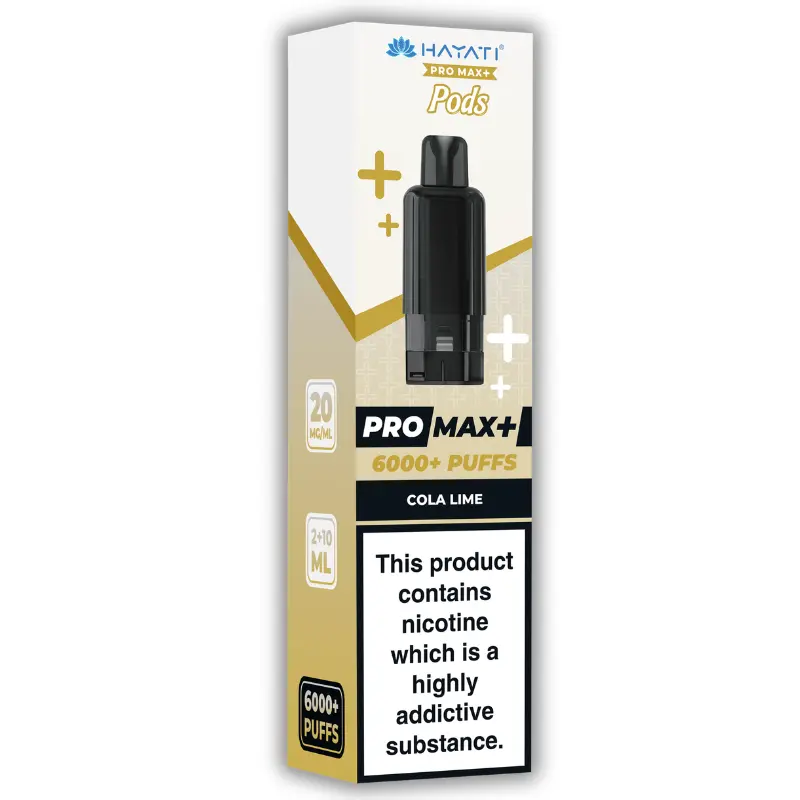
Hayati · Pro Max Plus
Cola Lime Hayati Pro Max Plus Pods
£5.49
✔ In stock — ready to ship
Genuine Hayati
Free over £20
Same-day dispatch
Secure checkout
Cola Lime is sold here as a bare pod for the Hayati Pro Max Plus, £5.49, holding 12ml of liquid sealed in at the factory at a nicotine strength of 20mg in salt form. No device comes with it and the price does not imply one. Anyone who does not already own the body wants the Cola Lime Hayati Pro Max Plus 6000 Pod Kit, £7.99, which carries the same liquid with hardware attached. The 6,000-puff figure printed against this listing is Hayati's own, taken on bench equipment drawing at a fixed length and interval, which makes it a fair way of ranking one pod against another and close to worthless as a forecast of your own month.
That is the listing. What makes it worth a page rather than a line is the second word, and specifically the fact that it does not do what the second word usually does on a cola.
Eighteen cola products sit in this catalogue. Most of the flavoured ones work by importing something: a cherry, a raspberry, a berry that grows on a bush and has nothing whatever to do with a soft drink. Lime is not in that category, or at least it is arguably not, because on the general public account of how a cola accord is built the citrus is already there. Orange and lemon oils sit across the top of the thing. A cola is a citrus construction with spice under it, not a caramel one with a squirt of fruit on the side, and if you accept that account then naming a pod Cola Lime is not adding a flavour at all. It is turning up a dial that was set before you arrived.
Whether that is really what is happening here is the question this page works through, because there is a decent counter-argument. Lime is not lemon and it is not orange. It carries a different set of aromatic compounds, more resinous and more bitter than either, so it may well read as a genuine newcomer rather than as more of something already present. Both readings predict different things about what the draw is like, and they are distinguishable. What follows sets out the public account of the accord and whose account it is, counts what the eighteen cola listings actually do to the base recipe, states the two readings as predictions, tests them, and reaches a verdict. Then the draw itself, the hardware in short order, and where this sits against its neighbours.
A second word that imports nothing
What the accord is generally said to contain, and whose account that is
The public understanding of a cola profile is that it is built from four groups: bright peel oils across the top, a set of warm baking spices under them, vanilla rounding it all off, and a hard acid running underneath the whole length of the thing. Two other pages in this range have already done the work on that. Our Cola Ice Pro Ultra Plus kit page takes the accord apart component by component and says what each group contributes and in what order. The Raspberry Cola Pro Ultra Plus pods page sets out why a profile whose original recipe was never published turns out to be the one buyers agree about most. Neither argument is repeated here. Read either if you want the anatomy or the epistemics, because this page needs only one fact out of that whole body of work, and it is the first one.
The fact is that the top of a cola is citrus. Not a citrus accent, not a citrus hint over something else, but one of the two halves the accord is made of. Strip the peel oils out of a cola and what remains is spiced vanilla syrup, which is not a recognisable version of the drink. The brightness at the front and the warmth in the middle hold each other up, and neither is decoration.
Now the caveat, and it matters more on this page than on any other cola listing in the range. All of that is public understanding, not a recipe. The formula behind the original drink has never been published and was never meant to be, so every account of what is in it is a reconstruction from the outside. Hayati publish nothing at all about how their own cola concentrate is built. What they state for this product is the flavour name, the volume, the nicotine strength and form, and a puff rating. There is no ingredient list here, no flavourist's breakdown, and nothing that would let anyone confirm that the citrus in this pod is orange and lemon oil rather than something else that lands in the same place. Every structural claim below is reasoning from the general account plus what a lime is known to smell of, and it is offered as reasoning rather than as a specification.
Worth flagging, too, that the published accounts do not entirely agree with one another on this exact point. Some versions of the classic breakdown list lime among the citrus oils alongside orange and lemon. Others name only orange and lemon and leave lime out. Our own two cola pages reflect that split: the kit page lists lime inside the citrus group, and the Raspberry Cola page names orange and lemon without it. That disagreement is not an error in either page. It is a genuine disagreement in the source material, and it is not a detail, because it is precisely the thing that decides whether this pod amplifies or adds. If lime is already in the base, Cola Lime is a volume control. If it is not, Cola Lime is a new ingredient placed in a crowded slot. The honest position is that nobody outside the company that owns the original formula can settle it, so the argument below is run both ways.
Counting what the cola listings actually do
Before accepting any of that, it is worth checking what the range does in practice rather than what an argument would like it to do. The Cola Vapes shelf is eighteen listings, short enough to read end to end, and they sort into four groups.
Six are the plain accord with cooling laid over it, sold across four different hardware families. One more is a dual Mini Ultra pod that keeps a cooled cola on one side and an orange, lemon and lime blend on the other, without mixing them. Five import a fruit: three cherry listings and two raspberry ones. One is a nicotine pouch, a different format entirely. That leaves five, and those five are the interesting group, because all five modify the base by raising a citrus rather than by adding a fruit. Three of them are the Cola Lime listings, this pod among them. Two are Lemon Cola Ice, on the smaller Rubik hardware.
So the catalogue attempts citrus amplification twice, with two different citrus, and the split is even less balanced than that sounds. The lemon version comes with cooling attached, which changes two things at once and makes it a poor instrument for isolating what raising a citrus does. Cola Lime does not. It changes one variable against the plain accord, and it is the only listing in the range that does so.
One more count, because it turned out to be the most useful thing this page found. Twenty-four listings in the whole catalogue have lime in the title. Twenty-one of them bracket it with lemon: Lemon Lime, Orange Lemon Lime, Lemon and Lime, in various pod formats and bottle formats. Exactly three do not, and those three are the three Cola Lime products. Lime does not appear on its own anywhere in this range. It appears as the junior partner in a citrus pair, or it appears in a cola.
That is a real pattern rather than a coincidence, and it cuts both ways. Read one way it says Hayati treat lime as something that belongs next to lemon, an adjustment to a citrus rather than a flavour that can carry a pod by itself, which supports the amplification reading. Read the other way it says lime is never sold alone because it is too sharp and too bitter to be pleasant alone, which is an argument that it is a strong distinct ingredient rather than a shade of one. The count establishes the pattern. It does not settle the interpretation, and a page that pretended otherwise would be overselling an arithmetic exercise.
The two readings, stated as predictions
Arguments about flavour go nowhere unless each side commits to something you could notice. So here are both, phrased as things the draw either does or does not do.
The amplification reading says the lime lands in a slot that is already occupied. On that account the blend should read as one flavour rather than two: a cola that is sharper, brighter and quicker off the mark than the plain version, with the citrus arriving at the same moment it always arrives and simply arriving louder. There should be no seam. You should not be able to point at a moment in the draw where the cola stops and the lime starts, because there is no lime event, only a bigger version of the cola's own opening. The failure mode on this reading is not a clash. Two things cannot clash if they are the same thing. The failure mode is imbalance: the citrus half of a two-part structure gets heavier while the other half stays where it was, and the spice, which was built to be in proportion to a certain amount of brightness, ends up demoted down the running order by the very component it was meant to be balanced against.
The addition reading says lime is a distinct material with its own aromatic signature, so it should behave like any other imported ingredient. On that account there should be a seam, or at least a second voice. You should be able to notice lime as lime, separable from the cola's own top, arriving at a slightly different moment or persisting after the rest of the citrus has gone. The failure mode on this reading is the ordinary one for a two-flavour blend: the imported note either sits awkwardly against the base or covers it.
Those are not the same prediction and you can tell them apart on the first pod. The test is whether there is a moment you can point at. If the draw opens bright and stays one thing, it is a dial. If something arrives, it is an ingredient.
What the naming suggests, and why it is weak evidence
Hayati's own naming grammar is worth a paragraph because it appears to take a side, and then on inspection it does not take it cleanly.
The fruited colas put the imported thing first. Cherry Cola. Raspberry Cola. The fruit leads the name because the fruit leads the draw, and both of those pages say so in their own ways. Cola Ice puts the modifier second, and the modifier there is a treatment rather than an ingredient: ice is something done to a liquid, not something in it. Cola Lime follows the Cola Ice pattern, not the Cherry Cola pattern. On a strict reading of that grammar, the name is telling you that lime is a treatment applied to a cola rather than a fruit added to one, which is the amplification reading exactly.
Then Lemon Cola Ice puts the citrus first, like a fruit, and the neat theory falls over. If raising a citrus were consistently treated as a treatment, that product would be called Cola Lemon Ice. It is not. So the naming evidence is split, and the honest conclusion is that Hayati's titles are not a reliable guide to the structure of the liquid inside them. They are titles. The Cola Lime name points in the direction this page argues for, and it is the weakest piece of evidence on the page.
Lime against the lemon and orange already in there
What the three oils share, and where lime goes its own way
All three of these citrus oils are dominated by the same principal compound, which is why a bowl of mixed peel smells broadly of one thing before it smells of three. That shared backbone is the reason citrus reads as a family at all, and it is the strongest single piece of support for the amplification reading, because it means a lime dropped onto an orange-and-lemon top is not landing in unfamiliar territory. It is landing on relatives.
The differences sit in the minor components, and they are not trivial. Orange is the roundest and sweetest of the three and contributes the least bitterness. Lemon carries the aldehydes that produce the sharp, clean, unmistakably lemon character most people can name blind. Lime is the odd one out. Its distinguishing compounds run more towards pine and resin than towards sweetness, and it carries a bitterness the other two do not have, which is why a lime is unpleasant to eat in a way an orange is not. It also reads slightly green, in the sense of leaf and stem rather than fruit flesh.
Two qualifications before that gets used for anything. The first is that lime is not one material. A cold-pressed lime and a distilled one differ substantially, the distilled version being noticeably more resinous and more bitter, and vape flavourings are not obliged to resemble either. The second is that nothing above comes from Hayati. It is the general account of what citrus oils are made of, applied to a pod whose concentrate is not documented. Treat it as the reasoning it is.
The case that this is amplification
Four things support it and they are worth having in one place.
The position is already occupied. Whatever else lime brings, it brings brightness at the front of the draw, and brightness at the front of the draw is where a cola's citrus already lives. A new ingredient normally announces itself by arriving somewhere nothing else is. This one has nowhere unoccupied to arrive.
The bar practice points the same way, and it is older than vaping by a long stretch. People put a wedge of citrus into a cola. They do not put a strawberry in one. The reason is not tradition, it is that the wedge works on something the drink already has, sharpening an edge that is present but muted under the syrup, whereas a berry would sit beside the drink rather than inside it. That practice is the closest thing to a real-world control experiment for what this pod is doing, and its existence is evidence that raising a citrus over a cola is felt as an adjustment rather than as a combination.
The shared backbone matters. A dial and a new ingredient are distinguishable mainly by whether the ear hears one voice or two, and materials that share their principal aromatic component tend to be heard as one.
And the acid stacks rather than competes. A cola's structure depends on a sharp acid underneath everything, and lime's own acidity runs in the same direction rather than across it. That is different from what happens when you drop a sweet low-acid fruit into the same accord, where the sharpness gets buried and spiced syrup is what is left.
The case that this is addition
Three things push the other way and none of them is weak.
The resin and pine character has no counterpart in the base. Orange and lemon do not contribute it. If a cola's top is built from those two, then the pine note is genuinely new material and not a louder version of anything, and new material is what an addition is. This is the strongest objection on the page and it does not go away.
Bitterness is a second channel entirely. Sweetness, sourness and bitterness are separately perceived, and the bitter edge lime carries is not simply more of the faint bitterness peel oils already contribute. It is more of it and also a different kind, sitting further back on the tongue and lasting longer. A dial that changes the quality of what it turns up is not really behaving like a dial.
And the disagreement about the recipe cuts here. If lime is not in the classic accord, and the published accounts genuinely divide on it, then the amplification argument is resting on an assumption it cannot verify. Assuming the conclusion is not an argument.
Which the evidence supports
Amplification, but with a change of accent, and the distinction matters because it predicts a specific experience rather than a compromise between two.
The decisive point is the seam, and the seam is about position rather than about chemistry. A flavour is heard as separate when it occupies a moment of its own. Lime does not get one here. It arrives at the front of the draw, which is where the cola's peel oils already are, and it leaves at the front too, because volatile citrus does not persist into an exhale that belongs to vanilla. There is no point in the draw where it is the only thing happening, and something that never has the stage to itself does not register as a second voice, whatever its chemistry says. That is why the correct structural description is one flavour turned up rather than two flavours combined.
The addition case survives in a narrower form, and it is right about what it is right about. The character of the brightness does change. This is not simply a plain cola with the top end raised, because what has been raised is not the base's own orange and lemon but a different citrus standing where they stand. The opening is bitterer and more resinous than a louder plain cola would be, and that is a real difference, not a rounding error. So: amplification of the position, addition within it. One voice, singing a different note than before.
Which brings the consequence the amplification reading predicted, and it is the thing to actually decide on. The risk here was never that lime would clash with cola, and it does not. The risk is imbalance, and imbalance is what you get. A cola accord is two halves in proportion, bright over warm. Raise one half and the other does not fall silent, but it falls down the running order. The spice in this pod is not damaged, covered or fought. It is simply later and quieter than it is in the plain version, because the thing that used to introduce it now takes up more room.
There is a neat contrast with the cooled version worth drawing, and it is a contrast rather than a repetition, because the mechanisms are not the same. Our Cola Ice pages establish that warm spice and a cooling agent work on the same sensory channel and therefore partially cancel, so a cooled cola reads less spiced because the coolant is actively damping the warmth. That is not what happens here. Nothing damps anything. The spice in Cola Lime is undamped and intact, and it is still harder to notice, because its introduction has been drowned rather than cancelled. Two routes to a quieter middle: one subtracts, one crowds. If the warm middle is the part of a cola you buy colas for, both routes take it away from you, and Cola Ice Hayati Pro Max Plus Pods, the same £5.49 on the same hardware, is the nearest thing to a controlled comparison you can run at home.
The draw, in the order things happen
Front
The opening is sharp and it is immediate. There is no build. Citrus is the most volatile part of anything in this pod and it comes off the coil first, and with the lime on top of whatever peel oils the base contributes, the first instant is the brightest opening of any cola in this range by a clear margin.
The character of it is dry rather than juicy. That is the thing most likely to surprise someone expecting lime cordial. Cordial is sweet and thick. This is closer to the smell released by cutting into the skin of a lime, aromatic and a little bitter at the outer edge, with a green, faintly resinous quality sitting behind the obvious sharpness. Sweetness is present in the opening but it is behind the brightness rather than in front of it.
Underneath, arriving almost with the citrus rather than after it, is the acid. On a plain cola that acid is the structural element holding the accord together. Here it has company, because lime brings acidity of its own, and the two read as one firm sour spine rather than as two separate sharpnesses. This is the sharpest cola on the shelf and it is not close.
Middle
The middle is where the argument above becomes something you can taste. Warmth comes up under the citrus in the usual way, and the spice is all present, but it arrives as general background heat rather than as an event. In a plain cola the dry, bitter opening acts as a set-up: it is brief, it clears, and the warmth that follows is legible precisely because something cooler and drier preceded it. Lengthen and brighten that opening and the set-up stops working. The warmth has to introduce itself.
The result is a mid-palate that is warm but not characterful. Anyone who values the spice specifically will find it thinner here than in the plain version, and the honest thing to say is that they will be right and the difference is not subtle. Anyone who finds a cola's spice slightly medicinal will find this the most drinkable cola in the range for the same reason.
There is a genuine handover to notice, and it is faster than on the fruited colas. The transition from bright to warm happens early in the middle of the inhale rather than at the midpoint, because there is more brightness to get through and it burns off sooner rather than later. Sharp citrus is loud and brief. It does not linger the way a jammy fruit lingers.
Exhale
Vanilla is the exhale and it is the least altered part of the pod. This is where a cola stops being a spice blend and starts being a drink, and the lime has nothing to say about it because volatile citrus is already gone by then. What you get is the round, syrupy sweetness the accord always produces, arriving abruptly after a dry inhale.
What the lime does change is the contrast across that junction. A plain cola's exhale is sweeter than its inhale by one step. This one is sweeter than its inhale by two, because the inhale has been made drier and sharper while the exhale has stayed where it was. The blend therefore feels more dynamic than the plain version even though the finish is essentially identical, and some people read that as the pod being sweeter overall when in fact it is the same sweetness with a sharper thing in front of it.
The aftertaste, three or four seconds later, is the tell. Sourness outlasts the sweetness. What sits on the palate is an acid tightness with a trace of warm spice under it, and very little of the syrup. That is a drink finish rather than a fruit finish, and it is the strongest evidence that this is still a cola and not a citrus pod wearing a cola's name.
Sweetness, sharpness, cooling and throat, plainly
Sweetness sits just above the midpoint of the pod shelf and below every listing named after a confectionery. It is less sweet than the fruited colas, because those add fruit sugar on top of vanilla and this adds acid instead. Set it against something like Dragon Berries Hayati Pro Max Plus Pods, where the sweetness is fruit-led and sits forward on the tongue, and this one reads drier and further back.
Sharpness is where it takes the shelf. Between the accord's own acid and the lime's, there is more bite here than in any other cola listing and more than in most of the fruit pods. It is not a sour product in the sense that word is used for a deliberate pucker. Anyone who wants that should be looking at Blue Sour Raspberry Hayati Pro Max Plus Pods, which is built for it. The sharpness here is structural, and its job is keeping a syrupy exhale from accumulating across a long pod.
On cooling, be careful, because the temptation on a page about brightness is to assume brightness implies chill. It does not. No cooling agent is listed for this pod and the name flags none. The cooling-vocabulary census on the Blue Frozen Hayati Pro Max Plus Pods page counted how the range uses Ice, Frozen, Cooler, Mint and Menthol across the whole catalogue and established that a cooled product says so in its title, without exception and without a grading system behind the different words. That finding is cited here rather than recounted. Applied to this listing it says the absence of a cooling word from the name is a strong signal, and a naming convention is still an inference rather than a published statement. Treat this as an uncooled blend, and if a cold finish is what you want, buy something that names one.
Throat character is moderate and firmer than a plain fruit pod at the same strength. Two things contribute: the warm spice, which produces a mild catch at the back independently of nicotine, and the acid, which tightens the sides of the tongue. The 20mg salt formulation is smooth in itself, and the firmness people notice on this profile is coming from the flavour rather than from the nicotine.
Six things the name might mean and does not
- Not a lime cordial or a limeade. The base here is a soft-drink accord with spice and vanilla in it, not a sweet citrus squash, and the lime is dry rather than sugared.
- Not a mojito. There is no mint, no sugar-and-leaf character and no rum reference. Blue Razz Mojito Hayati Pro Max Plus Pods runs a berry into a mint-and-lime construction, which is a different thing built on a different base.
- Not a cooled cola. Nothing in this pod produces a cold sensation. The brightness is aromatic and acidic, and people do mistake the two.
- Not a cherry or raspberry cola. No red fruit anywhere in it. Cherry Cola Hayati Pro Max Plus Pods is the fruited version on this hardware.
- Not a lemon cola. Lemon and lime are not interchangeable, and the difference between the two versions is the whole subject of this page.
- Not fizzy, because nothing in a pod can carbonate. What stands in for the sparkle is acidity, an argument our Cola Ice kit page sets out in full.
The pod, briefly
There is not much to say about this hardware that eighty-odd sibling pages have not already said better, so this section is deliberately short and the space saved has gone into the argument above. What arrives is one sealed pod, filled before it left the factory, ready to seat in a Pro Max Plus you already own. Nothing needs pouring, soaking or measuring, and there is no fill port because there is nothing to fill.
One number in the specification matters more than the rest for this particular liquid, and it is the 12ml. A single coil handles all of it, bonded in, impossible to rinse or replace, retiring when the liquid does. That volume is generous for a sealed unit, and on a profile whose identity rests on its sharp end, a long single-coil job is a different proposition from the same volume carrying a berry. The section on handling below explains why, and it is the practical reason to read this listing differently from the fruit pods sitting next to it on the Hayati Pro Max Plus Pods shelf.
The draw is restricted and narrow, a measured mouth-to-lung pull rather than an airy one, and the 20mg salt concentration is formulated on that assumption. For everything else about the platform, the shelf page covers the device properly, and the broader Hayati Prefilled Pods & Refills listing groups the whole range by how liquid gets replaced rather than by flavour, which is the more useful sort if hardware is the thing you are choosing between. On fitment, do the obvious check: match the range name printed on your device to the range name in the title, because Hayati publish no compatibility chart against this product.
What the specification says, sorted by what it decides
The table below is grouped by the kind of decision each line affects rather than in the conventional order, because on this product the lines that change the taste and the lines that change the bill are not the same lines, and the ones Hayati leave out are worth seeing as a block.
| Decides the taste: flavour | Cola Lime, one blend throughout |
| Decides the taste: cooling | None listed and none named in the title |
| Decides the taste: nicotine form | Salt |
| Decides the taste: strength | 20mg |
| Decides the taste: coil | One, sealed into the pod, handling the full volume |
| Decides the bill: price | £5.49 |
| Decides the bill: volume | 12ml, prefilled |
| Decides the bill: what is in the packet | The pod alone, no device |
| Decides the bill: version with hardware | Cola Lime Pro Max Plus 6000 Pod Kit, £7.99 |
| Manufacturer figure | Up to 6,000 puffs, measured on laboratory equipment |
| Identifiers | Hayati, product code hpm-plus-6k-pods-cola-lime |
| Not published: coil resistance | No figure issued for this pod |
| Not published: airflow, wick, dimensions | Nothing stated |
| Not published: flavour composition | No ingredient breakdown of the cola accord or the lime |
Three of those repay a second look on this product specifically.
The 20mg salt pairing is fixed, with no other strength offered on this pod. That concentration is the maximum permitted in the United Kingdom, and salt rather than freebase is the standard formulation at that level given how it behaves on a narrow airway. It earns its place here for a flavour-specific reason as well as a general one: this blend already contributes firmness at the back of the throat from two directions, warm spice and a doubled acid, and a freebase formulation stacked on top of both would be uncomfortable on a restricted draw. Nicotine is addictive, and what strength suits an individual is their own business rather than something a retail listing should have a view about.
The last row in the table is the one most relevant to everything above it. Hayati document the flavour name and nothing about what is in the flavour, which means the whole structural argument on this page rests on a public reconstruction of a recipe that was never published plus the general chemistry of citrus oils. That is a legitimate basis for reasoning and it is not a specification. Anyone who wants certainty about what is in the bottle will not get it from this listing, from this page, or from any retail page including ours.
The puff figure is the row most often misread. It is a workload measurement produced by a machine drawing to a fixed pattern until the pod stops producing, so it ranks pods within one format and forecasts nobody's fortnight. Read as workload, it describes what a single non-serviceable coil is built to process, which on an acid-led profile is a more interesting number than it looks.
Choosing between this and what sits around it
The two colas that change one variable each
The most useful comparison in the range is also the tidiest, because two listings on identical hardware at an identical £5.49 each change exactly one thing about the same base. Cola Ice takes the accord and cools it. This pod takes the accord and brightens it. Nothing else differs: same volume, same strength, same coil, same price. Anyone genuinely interested in what a modifier does to a cola can run that comparison properly, which is unusual in a catalogue where most comparisons change three things at once.
The directions are opposite in an interesting way. The cooled version damps the warm middle by working against it on the same sensory channel. This one demotes the warm middle by crowding its introduction. Both end up with less legible spice and they get there by different routes, and the finishes could hardly be less alike: one ends cold and the other ends sharp. If the warm syrupy middle is the part of a cola you actually want, neither modification is for you and the plain uncooled accord is not sold on this hardware.
The fruited direction is Cherry Cola Hayati Pro Max Plus Pods, also £5.49, which imports a dark stone fruit rather than raising a component. Cherry carries acidity of its own, so it interferes less with the accord's structure than a softer fruit would, and the result is rounder and sweeter than this pod by a wide margin. The comparison worth making is that Cherry Cola adds a voice and Cola Lime raises one, and if that distinction reads as hair-splitting on paper it does not on the palate: one of them has a moment where the fruit is what you are tasting, and the other never does.
The other citrus amplification, on other hardware
Lemon Cola Ice Hayati Rubik Pods at £3.99 is the range's other attempt at this idea and the only direct point of comparison for it. Lemon rather than lime, so the amplification argument is stronger there: lemon is in every published version of the accord, with no disagreement to work around, which makes that product a clearer case of a dial and this one the more arguable case. The complication is that it also has cooling, so it moves two things at once, and it sits on Rubik hardware with a much smaller pod. Treat it as a comparison rather than as an alternative unless you own that device, and note that the cheaper sticker price is not a cheap trial if the hardware is not already in the house.
The same caution applies to Cola Ice Hayati Mini Ultra Pods at £3.49, which is the least expensive way into a cola profile in this catalogue and needs its own body to work. There is also a Cola Lime bottle in the nic salt range for anyone running a refillable kit, which is a different format with different behaviour and not a smaller version of this pod.
If the citrus is what you are shopping for
Fourteen listings on this shelf carry a citrus word in the name and they divide into two groups that do not overlap much. Lemon Lime Hayati Pro Max Plus Pods is the closest thing to a control for the citrus half of this pod: the same two-citrus idea with no cola underneath it, which tells you what lemon and lime taste like in this format without a spice accord in the way. If you like this pod and suspect it is the brightness rather than the drink you are enjoying, that is the one to try next, and it is the single most useful comparison on the shelf for working out which half you are buying.
Lemon Pineapple Hayati Pro Max Plus Pods runs citrus against a tropical fruit, sweeter and juicier than anything here, and it shows how differently a citrus behaves when what sits under it is fruit sugar rather than vanilla and spice. The lemonades are a third treatment again: Berry Lemonade and Blackcurrant Lemonade both build a soft drink around citrus and a berry, which makes them structural cousins of this pod without any spice in the construction. A lemonade is bright and simple. A cola is bright over warm. That difference is the whole reason a cola can be demoted in the middle and a lemonade cannot.
If you want to leave drinks behind
Soft-drink profiles are a small minority of this shelf and the fruit listings are where most people go next. The sharp end is the useful direction, since sharpness is what brings anyone to this pod in the first place. Blackcurrant Juice Hayati Pro Max Plus Pods carries real tartness under a dark fruit. Blue Razz Fruit Twist Hayati Pro Max Plus Pods is the confectionery reading of sharp, sugared rather than acidic, and the page for it sets out why blue razz tastes the same wherever you meet it.
For sweeter and rounder, Mango Peach Pineapple puts three tropical fruits on one draw and Banana Ice Hayati Pro Max Plus Pods is about as far from a dry acidic opening as this shelf goes. Caribb Crush and Fruit Twist are the mixed-fruit options, and Black Mamba Hayati Pro Max Plus Pods is one of the listings whose name tells you nothing about the contents, which its own page deals with honestly rather than inventing a tasting note. If cold is what you actually want, Blackberry Ice Hayati Pro Max Plus Pods puts a dark berry under a chill without any spice to argue with it.
Prices across this shelf are flat, so moving between flavours costs nothing at the till and loyalty to one earns nothing either. Recent arrivals sit under New Products, the wider Hayati Pods listing shows how the pod systems sit relative to each other, and the full Hayati range is there for anyone who would rather scan than be walked through comparisons.
Getting a fair reading out of an acid-led pod
Ordinary pod handling applies here as it does everywhere and is not worth a section. What follows is specific to a liquid whose defining feature is a sharp, volatile top end sitting over a long single-coil job.
The first few draws are not the pod. A fresh pod runs slightly wet until the wick settles, and on this profile the excess presents as syrup with the sharpness buried underneath it. That is the exact opposite of what this blend is for, so anyone judging it at three draws is judging a version of it that will not exist in an hour. Give it twenty or thirty and then decide.
Citrus is the first thing to die on a tired coil, and on this pod that is a change of identity rather than a loss of detail. As residue builds on mesh, the bright volatile end of any profile narrows before anything else does, and the heavy sweet end survives longest. On a berry pod that shows up as a loss of zest and the pod is still recognisably itself. Here the bright end is the reason you bought it. Strip it and what is left is spiced vanilla syrup, which is the thing a cola is made from rather than a cola. Watch for the opening going quiet while the exhale stays exactly where it was.
Do not chase it by drawing harder. Pulling hard on a narrow airway raises coil temperature and moves liquid through the wick faster than the wick replaces it, and heat drives off volatile citrus before it touches anything else. The specific consequence on this liquid is that a hurried session removes the front of the draw, which leaves you starting at the spice and wondering where the lime went. Ten or fifteen seconds between draws keeps the opening intact.
Run it first in a rotation, not second. Spice and vanilla linger on the mouthpiece and the palate well after fruit esters have gone, and this pod's opening is the most delicate thing on the shelf to read. Coming to it after something heavily sugared flattens the citrus and wastes the best part of it. Going the other way costs nothing.
Keep it out of the light and off the warm surfaces. Citrus terpenes are the most heat-sensitive material in this pod, so a windowsill, a dashboard or a shelf above a radiator will take the top off it faster than the coil alone would. A drawer at room temperature is fine. Anything containing nicotine belongs where a child or an animal cannot get at it, and a closed box within arm's reach of the floor is not a barrier.
Know what spent looks like on this one. It is not a burnt taste and it is not a drop in vapour. It is flatness in the specific sense of the sour spine going soft while the sweetness stays put, so the pod that used to open sharp now opens round. Anyone who has drunk a cola left standing overnight will recognise the character instantly. At that point the coil has given what it has, and a fresh pod is the answer rather than persistence.
When it is done, it is waste with liquid and electronics in it. A finished pod does not belong in a household bin. Take it to a shop that accepts electricals back or to a local recycling point, which is where the whole of this format ends up regardless of flavour.
Questions this listing raises
Is the lime a separate flavour or part of the cola?
Structurally it behaves as part of it. Lime arrives at the front of the draw, which is where a cola's own citrus already sits, and it is gone by the exhale, so it never occupies a moment of its own. What changes is the character of the brightness rather than the number of things you are tasting. You should hear one voice, pitched higher and drier than usual, rather than two.
Is it sweeter or drier than plain cola?
Drier at the front and the same at the back. The exhale is essentially unchanged, because vanilla is not affected by anything the lime does, but the inhale is sharper and less sugary, so the contrast across the draw is wider. Some people read that widened contrast as extra sweetness on the finish when the finish has not actually moved.
Can you still taste the spice?
Yes, but later and quieter than in the plain version. Nothing covers or cancels it. What it loses is its introduction, because in a cola the brief dry opening is what makes the warm middle noticeable by contrast, and a longer brighter opening blunts that effect. If the warm spiced middle is the part you value most, this is not the cola for you.
Is there any cooling in it?
None is listed and the title names none. The cooling-vocabulary count on the Blue Frozen pods page established that cooled products in this range say so in the name, so the absence is a strong signal, though it is a reading of a naming convention rather than a published statement. Sharpness is not cold, and people do confuse the two on citrus profiles.
How does it differ from Cola Ice on the same hardware?
Same price, same volume, same strength, one variable changed each. Cola Ice cools the accord and this brightens it. Both make the spice harder to notice, by different mechanisms, and the two finishes are opposites: one ends cold, one ends sharp. It is the cleanest comparison available in this range if you want to know what a modifier does to a cola base.
Is it sour?
It is the sharpest cola in the catalogue and it is not a sour product. The acidity is structural, doing the job of keeping a syrupy exhale from accumulating over 12ml, rather than being there to make you wince. A deliberate pucker is a different category and the listings that offer it say so in the name.
Is lime actually in a cola recipe?
Published accounts of the classic accord disagree on exactly that. Some list lime among the citrus oils with orange and lemon, and others name only the two. The original formula has never been published, and Hayati publish nothing about their own concentrate either, so the question cannot be settled from outside. This page argues that it makes less difference than it looks, because the lime lands in the position the accord's citrus already occupies whether or not it was in the original list.
Why does lime never appear on its own in this range?
It does not, and the count is worth knowing: twenty-four listings across the whole catalogue have lime in the title, twenty-one of them pair it with lemon, and the only three exceptions are the three Cola Lime products. Lime is always either the junior half of a citrus pair or inside a cola. That is a consistent pattern across the range rather than a coincidence, though what it tells you about Hayati's view of lime is open to more than one reading.
Does a device come with it?
No. This is the pod on its own, sealed and prefilled, at £5.49. The same liquid with a body in the box is a separate listing at £7.99, and that is the one to order first if you do not already own a Pro Max Plus.
Is it fizzy?
Nothing in a pod can carbonate, because fizz requires gas dissolved in a liquid and vapour has none. The impression is built out of acidity instead, which tightens the sides of the tongue and prompts a watering response. This blend has more acid than any other cola here, so it reads brisker than the rest of them while still being a substitute for the real sensation rather than the thing itself.
What does the 6,000 figure mean?
It is Hayati's own rating, produced by machine at a fixed draw length and interval until the pod stops producing. It compares products within a format and predicts nobody's fortnight. Read it as workload: one sealed coil, the full 12ml, no intervention available at any point.
Can the pod be refilled when it is empty?
No provision for refilling is published and the coil is not a replaceable part, so treat it as one committed unit rather than a container you own. When the liquid is finished the coil has finished with it, and a fresh pod is the answer.
The short version
Cola Lime as a bare pod is £5.49 for 12ml of prefilled liquid at 20mg nicotine salt, one blend throughout, no cooling listed, no device in the packet, with a manufacturer's laboratory figure of up to 6,000 puffs that describes workload rather than calendar.
What makes it different from the other flavoured colas is that its second word does not import anything. Cherry and raspberry versions bring in a fruit from outside the recipe. This one raises a citrus, and citrus is one of the two halves the accord is built from on the general public account of it, which is a reconstruction of a formula nobody has published rather than a recipe anyone can check. Hayati publish nothing about their own concentrate, so every structural claim here is reasoning rather than specification.
The verdict the page reaches is amplification with a change of accent. Lime never gets a moment of its own, arriving where the accord's citrus already arrives and leaving before the exhale, so it reads as one flavour turned up rather than two combined. What it turns up to is not simply a louder orange and lemon, because lime brings a resinous, bitter edge those two do not have. And the predicted cost is the one you get: not a clash, which is impossible between a thing and more of itself, but imbalance, with the warm middle pushed down the running order by a brighter, longer opening in front of it.
Buy it if the sharp dry front of a cola is the part you came for and you want more of it than the plain version gives. Look elsewhere if the warm spiced middle is what you value, because this demotes it, and look elsewhere again if it is cold you are after, since sharp and cold are not the same sensation and this pod offers only one of them.
Strictly for adults aged 18 and over. Nicotine is an addictive substance.
You might also like


