
Home / Hayati Pro Max Plus Pods / Sunset Aura Hayati Pro Max Plus Pods
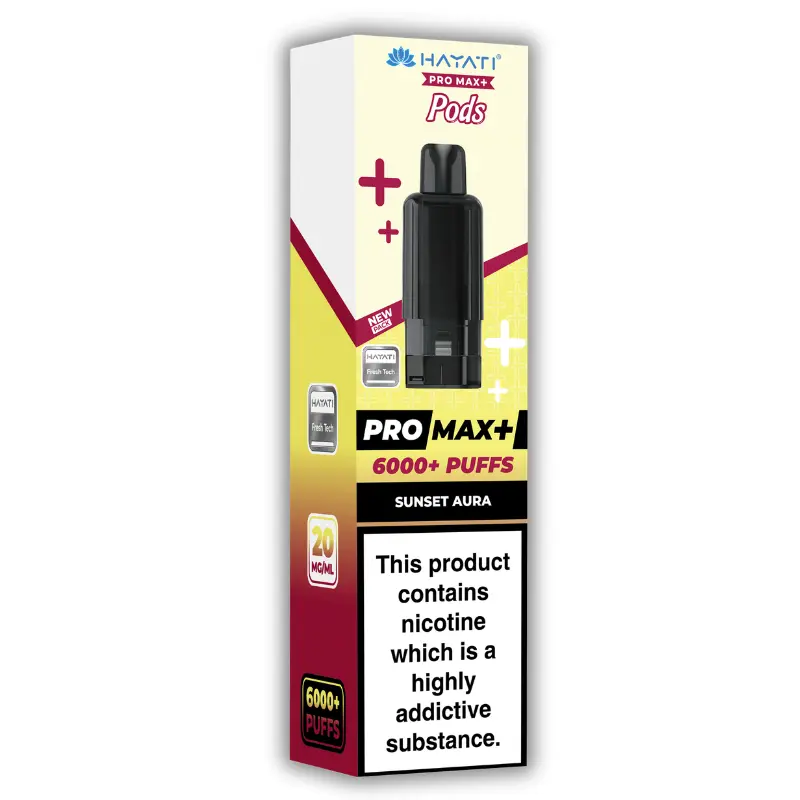
Hayati · Pro Max Plus
Sunset Aura Hayati Pro Max Plus Pods
£5.49
✔ In stock — ready to ship
Genuine Hayati
Free over £20
Same-day dispatch
Secure checkout
This listing is the pod and nothing else. £5.49 buys a replacement pod for the Hayati Pro Max Plus, supplied already holding 12ml of liquid at 20mg, with no body in the box and no way to use it unless a Pro Max Plus is already sitting on your desk. That makes the audience for this page narrow and specific. Almost nobody buys a bare pod first. The first purchase is Sunset Aura Hayati Pro Max Plus 6000 Pod Kit at £7.99, which includes the device; this one is what you order afterwards, once the hardware is a settled question and only the liquid is in play.
So you have had this before. That assumption changes the job. A page for somebody who has never met a flavour is a description; a page for somebody reordering it is something else, because the reader already holds a description, privately, and the only question worth asking is whether it is any good.
On most of this shelf that question barely arises. Reorder Mango Banana Hayati Pro Max Plus Pods and the two words on the packet do the checking for you. If your recollection has quietly wandered towards something with a citrus edge, the label says mango and banana, your memory gets corrected before you have spent anything, and the correction happens so fast you never notice it happening. Sunset Aura offers no such service. Hayati publish a name, a volume, a strength and a puff rating, and no flavour breakdown of any kind. Your memory of the last pod is not one description among several. It is the only description of this liquid that exists anywhere you can reach.
That is an uncomfortable position to reorder from, because human flavour memory is not a recording. It is reconstructed each time it is consulted, it drifts towards whatever is typical of its category, it gets rewritten by everything eaten and drunk since, and it sharpens the one attribute you happened to be paying attention to while losing almost everything else. The practical consequence is that a proportion of people who reorder an unnamed blend will open the new pod, take a draw, and conclude it has been changed. Sometimes they will be right. Often the liquid will be identical and the thing that moved will be them. This page is about telling those two cases apart, and about what to write down the first time so that the second time has something to check against.
What the kit page settled, and what it deliberately left alone
None of the groundwork is repeated here, because it has already been done properly one link away and doing it twice would waste the space this page needs.
The kit listing for this same flavour works through why a manufacturer names a blend after a quality of light instead of a fruit, what that decision implies about the liquid behind it, and how far the naming convention across this category can reasonably be pushed before it stops being evidence. It sets out flat lists of what Hayati state and what they leave off. It tags every expectation with a confidence level, reasonably confident down to unknown, and it puts the juicy-versus-confected axis in the unknown column where it belongs. It also gives a method for characterising an unfamiliar blend during the first hour of owning one. All of that is upstream of this page and it is where a first-time buyer should start.
What it does not cover, because it had no reason to, is the second purchase. The first-hour method assumes you are holding the pod and the liquid at the same moment, so perception and judgement happen together and memory is not involved. Reordering breaks that arrangement. Weeks go by, the pod is long finished, and the judgement has to be made from a stored record rather than from the liquid. Everything below deals with that gap: how the stored record decays, in which specific directions, and what can be done about it before rather than after.
The label you do not have
Start with what a printed flavour name actually does, because it is easy to assume its only job is telling a first-time buyer what to expect. That is the smaller half of the work.
A descriptive name is a permanent external check on your memory, consulted every time you handle the packaging. Own Guava Kiwi Passion Fruit Hayati Pro Max Plus Pods for a month and you will read those three words several hundred times without registering that you are reading them. Each reading is a small correction. If your memory has drifted towards the passion fruit and quietly dropped the kiwi, the label keeps putting the kiwi back. Whatever your palate does over that month, your verbal record of the product cannot drift far, because it is being rewritten from the box.
Three words on a packet are the smallest useful database anybody has built, and they run constant, invisible error correction. Remove them and the correction goes too. That is the structural difference between reordering this pod and reordering almost any of its neighbours.
A second layer matters more at the point of reorder. With a named blend, other people's descriptions also work as a check: somebody says a peach blend is on the sweet side and you can hold that against your own impression and adjust. Here there is nothing to hold it against. Nobody has published a breakdown, no two independent accounts can be triangulated, and any confident tasting note you meet for this liquid was invented by somebody in your position who felt the gap needed filling. A guess written down looks identical to a fact written down. The record is internal, unreviewed and uncorrected, and it has been sitting there since the last pod ran out.
None of this argues against buying the pod. It argues for knowing what kind of purchase it is. Reordering Triple Mango Hayati Pro Max Plus Pods is a specification purchase: the target is defined outside your head, and a pod that misses it gives you grounds anybody can evaluate. Reordering this one is a memory purchase, defined only by your recollection, with no third party who can adjudicate a mismatch. That is not a defect. It is a property of buying something whose maker chose not to describe it.
Four directions the record drifts between orders
Memory research has been reasonably settled for a long time on the broad point that recall is reconstructive rather than photographic. What follows applies that to flavour, and the honest position is that the general mechanisms are well established while the specific application to vapour is inference. Where the evidence is thinner, it says so.
One attribute gets sharper, the rest flatten out
Established as a general property of memory. Probable for flavour.
Recall does not shrink evenly. It concentrates. Whatever detail was most salient at encoding survives at close to full strength and often exaggerates, while the surrounding material levels off into something generic. If the thing you noticed about your first Sunset Aura pod was that it was sweeter than you expected, then weeks later your memory of it is essentially the word sweet with a fruit-shaped haze behind it, and the sweetness in that memory is probably pitched higher than the sweetness in the pod was.
That produces a common reorder experience: the new pod reads as less of whatever you remembered and more of everything else, and gets written off as a weaker batch. What has happened is that a compressed memory with one attribute cranked up is being set against a full liquid with all of its attributes present, so the liquid loses on the cranked-up attribute and wins on the rest. On a named pod the effect is self-limiting, because the label keeps reminding you there were meant to be three fruits and you only kept one. Here nothing reminds you, so the compression runs as far as it likes.
The memory slides towards the average of its category
Established in general memory research. Inference as applied here, though a strong one.
Where a memory has gaps, reconstruction fills them from the general case rather than leaving them blank, and the general case is whatever is typical of the category the memory sits in. A vague recollection of a warm sweet fruit blend is filed alongside every other warm sweet fruit thing you have met, and each recall rebuilds it partly out of that pool. Over a few weeks it becomes more generic than the liquid was, and the distinctive edges go first, because a distinctive edge is exactly the part the category average cannot supply.
The prediction that follows is counter-intuitive and worth holding onto, because it runs opposite to the previous one. If the drift has been towards the generic, the new pod will seem more distinctive than you remembered, not less. People usually read that as the liquid having been reformulated or the batch being unusually good. It is more likely to be the ordinary result of comparing a real thing against an averaged one. Abstract names make this worse in a way that is easy to state: the name itself supplies nothing to anchor the memory away from the average, whereas a name like Strawberry Kiwi Hayati Pro Max Plus Pods keeps dragging recall back towards two particular fruits every time it is read.
Everything you have vaped since has edited it
Established. Interference between similar memories is one of the most reliably demonstrated effects in the field.
Memories of similar things interfere with each other, and the interference runs both ways. A flavour experienced after the one you are trying to recall does not simply sit alongside it. It contaminates the earlier memory, and the more alike the two are, the worse the contamination.
This is where a rotation does real damage, and the damage is specific to the pods you happen to run. Spend the weeks between orders on something adjacent, say Juicy Peach Hayati Pro Max Plus Pods or Strawberry Guava Hayati Pro Max Plus Pods, and your memory of Sunset Aura will have absorbed some of their character, because the brain has no reason to keep two similar warm-fruit records cleanly separated and considerable incentive to merge them. Spend the same weeks on Blackberry Ice Hayati Pro Max Plus Pods or Blue Sour Raspberry Hayati Pro Max Plus Pods and the interference is much lower, because dark fruit and sour blue fruit file separately from warm fruit with very little overlap to confuse.
There is a practical rule buried in that. If you intend to reorder an unnamed blend and want your memory of it to survive the wait intact, the rotation partner that protects it is the one that is least like it, not the one that is most like it. A cooled or sour pod in the interval is a firewall. Another soft warm fruit pod in the interval is a solvent.
Non-vaping input counts too. Weeks of a particular squash, a fruit tea or a syrup in coffee all lean on the same memory. That effect is harder to pin down than the pod-to-pod case, so treat it as probable rather than established.
Your own words replaced the taste
Well demonstrated for faces. Mixed and contested for tastes and smells. Treat this one as the least certain of the four.
Describing a perceptual experience in words can degrade the perceptual memory of it, because a sentence is easier to store and retrieve than a sensory trace, so recall starts returning the sentence instead of the sensation. That is solidly established for visual material, faces above all. For flavour and aroma the picture is less tidy, with some findings pointing the same way and others not replicating, so nobody should lean on it hard.
It is in the list anyway because abstract names make the conditions for it unusually strong, which is specific to this pod rather than general. A printed name hands you your description and keeps it close to the label. No printed name means improvising one from scratch, and improvising it often, because every time somebody asks what you are vaping you have to invent an answer. Say "it is a sort of peachy, mango-ish thing" enough times and that clause is what gets stored. It is your own guess, and by the third repetition it carries all the confidence of a specification.
Then the pod arrives and does not match the clause, and the clause is what feels violated. Worth noticing before blaming the liquid, and worth noticing that the more articulate your description of an unnamed blend was, the more likely it is to have overwritten the thing it described.
Telling a changed pod from a changed palate
All four mechanisms above push in the direction of a mismatch on reorder. That does not mean every mismatch is imaginary. Batch variation is a real thing in liquid manufacturing, and Hayati publish no tolerances, no batch codes on the listing and no production dates, so there is no documentary route to settling it. What is available instead is a differential diagnosis, and it is reliable enough to be worth running before you write a pod off.
Take the two lists separately. Things that can genuinely differ between one pod of this and the next: the production batch and whatever fill variation the manufacturer's unpublished tolerances allow; how long the pod sat in storage and at what temperature, which takes the lighter aromatic compounds first; the individual coil and wick, which are not identical units even within a batch; and how far the wick had saturated by the time you formed a view.
Things that can differ in you: what you vaped in the previous hour, which is the largest short-term effect by some distance; what you ate, especially anything sweet, sour or fatty; how hydrated you are; any degree of congestion, since most of what reads as flavour arrives through the nose; the time of day; and the four memory effects above, which act over weeks rather than hours.
Five checks discriminate between the two lists reasonably well.
Wait a day before judging. Not three draws, not an evening. A pod judged in the first ten minutes after finishing something else is being judged against the residue of that something else. Almost every reorder complaint is generated on day one and a good proportion of them evaporate by day three without anything having changed.
Check the direction of the surprise against the predictions. If the new pod seems weaker in exactly the one attribute you remembered most vividly, that is the signature of levelling and sharpening and it is probably you. If it seems flatter or duller across the board with no particular attribute standing out, that is less easily explained by memory and slightly more consistent with a genuinely different pod. If it seems more distinctive than you recalled, that is the signature of drift towards the average and it is also probably you.
Introduce a fixed reference. Keep one named pod in the rotation permanently, the same one every time, and draw from it in the same session. It does not need to be similar to Sunset Aura; it needs to be unchanging. Lychee Ice Hayati Pro Max Plus Pods or Banana Ice Hayati Pro Max Plus Pods both work for this because both have a strong single marker that is easy to judge as present or absent. If the reference also reads differently today, the variable is you, and the Sunset Aura reading can be discarded. This is the closest thing available to a calibration check and it costs nothing beyond owning a second pod.
Rule out the device before blaming the liquid. A pod seated slightly off, a contact with residue on it, or a body repeatedly run flat will each change the character of the vapour without anything in the fill having moved. Reseat, wipe the contacts dry, and try a fully charged body first.
Judge the middle of the pod, never the ends. The opening draws read hot and imprecise while the wick finishes saturating, and the closing stretch loses sweetness before anything else. Setting the first day of a new pod against your memory of the middle of an old one is a rigged comparison, and it is the one almost everybody makes.
Run all five and most disputes resolve. What you will not get is proof. No amount of careful self-observation can establish that a batch differed, because you have no access to the specification it was made to. The best available outcome is a judgement that is not obviously contaminated, which is a lower standard than certainty and a much higher one than most reorder complaints are made to.
The note that makes the second pod readable
Everything above argues for writing something down, and the useful version of that is smaller and more specific than people assume. This is not the first-hour characterisation exercise from the kit page, which is about working out what the liquid is doing while you have it in front of you. This is a different document with a different reader: you, weeks later, with the pod gone and a decision to make. It needs to be short enough that you actually write it and structured enough to resist the four drifts.
Five fields, recorded around the middle of the pod rather than at the start.
Sweetness, as a position between two named pods you own. Not a score out of ten, which decays into a meaningless number, and not an adjective, which decays into the category average. A comparison: sweeter than this one, less sweet than that one. Relative positions survive because they can be re-tested later against pods that still exist. An absolute rating cannot be re-tested against anything.
Where the sweetness peaks in the draw. Front, middle or after the exhale. This is one of the most stable things about a liquid and one of the least likely to be preserved by unaided memory, which is exactly the combination that makes it worth writing down. It also happens to be the thing that separates a blend built as fruit from one built as confection, which is the axis Hayati leave entirely unpublished.
Whether anything tightens the sides of the tongue. Yes or no, and roughly how much. Acid presence is binary enough to record honestly and it changes how a pod behaves across 12ml more than any single fruit identification does.
What is still there after twenty seconds. The finish gives up the base of a composite, because the loud components fade first. Two or three words is plenty.
The date, and what you were vaping the week before. This field looks like bureaucracy and is the one that earns its place most often. It lets you discount a reading later, when you notice that the previous week was spent on something sharp and the pod was always going to read soft by comparison.
Skip the fruit identification. It is the field everybody wants and the least reliable one, because naming a fruit in an unnamed blend is a guess that hardens into a memory the moment it is written, and then becomes the thing the next pod gets measured against. Structure is more use and less likely to mislead you.
Keep it with the reorder rather than in a notebook: a line in the order note, a note on the saved item, anything that surfaces at the moment you are about to spend £5.49. A record you have to remember to consult gets consulted after the parcel arrives, which is too late to be worth anything.
The pod on its own, briefly
The hardware here is shared with roughly ninety other listings, so it gets a short section and a pointer to the shelf.
What arrives is one prefilled pod, already holding its 12ml at 20mg, and nothing else. No body, no accessories, no assembly. The device is bought once and kept; this listing replaces only the consumable part, which is the entire economic logic of the format and the reason £5.49 sits below the £7.99 kit. Hayati put a manufacturer rating on it of up to 6,000 puffs, which is a laboratory estimate produced on test equipment under controlled conditions and not a description of what any particular person will see.
The one specification that matters for a liquid with no published description is the 12ml, and it matters differently here than it does on a named pod. On a named pod the volume is a reorder-frequency question. On an unnamed one it is the size of the bet, because there is no decanting, no dilution and no blending: whatever is in there is what you are committed to for the full quantity. That is the argument for ordering one pod rather than three at a time, and it is the only hardware number on this listing whose significance changes depending on what is inside.
For charging behaviour, pod seating, how the device ages and how the wider range fits together, the Hayati Pro Max Plus Pods shelf and the broader Hayati Prefilled Pods & Refills listing cover the platform, and there is nothing to be gained from restating it here.
The listing in figures, read as a reorder
The table records what Hayati state and, as importantly, what they do not, since the blank rows are the reason this page exists at all.
| Field | What the listing gives |
|---|---|
| What a reorder buys | One prefilled pod, no device |
| Cost of one reorder | £5.49 |
| Liquid supplied | 12ml, already in the pod |
| Nicotine concentration | 20mg |
| Device required | Hayati Pro Max Plus, bought separately |
| Manufacturer puff figure | Rated by the manufacturer at up to 6,000, a laboratory estimate |
| Flavour breakdown published | None at all |
| Sweetness or acidity figures | None published for any listing in the range |
| Cooling marker in the name | Absent |
| VG/PG ratio | Not published against this product |
| Coil resistance | Not published against this product |
| Batch code or fill date on the listing | Not published |
| Filed on | Hayati Pro Max Plus Pods, Hayati Pods, Hayati Prefilled Pods & Refills, Exotic Vapes, New Products |
| Product reference | sunset-aura-hayati-pro-max-plus-pods |
| Maker | Hayati |
Four of those rows deserve a note from the reorder point of view rather than the first-purchase one.
The 20mg figure is a plain statement of concentration. Nicotine is addictive, the number describes what is in the liquid, and it is not offered here as a suggestion for anybody. It is worth knowing that a separate listing, Hayati Pro Max Plus Prefilled Pods 5mg, exists at a different concentration on the same platform, with no flavour carried in its title. That is stated as a fact about the catalogue and nothing more.
The two unpublished ratio and resistance rows are the ones that get filled in from sibling pages and then propagate as though somebody had measured them. They are genuinely absent from this product's data, so no figure appears here, and a number quoted for either of them elsewhere should be treated as unsourced until somebody says where it came from.
The missing batch code is the row a repeat buyer actually feels. Without it, there is no way to know whether two pods bought three months apart came from the same production run, so the most common reorder question has no documentary answer and has to be settled by the diagnostic above. That is a real limitation of the listing rather than something to talk around.
Which reorder to make instead, and when
The decision on a repeat purchase is not whether the flavour is good. You already know your answer to that. The decision is whether to reorder the same thing or use the £5.49 to move, and the honest answers differ by situation.
If the memory is still vivid and specific. Reorder it. A memory that has kept its structure, where you can still say where the sweetness peaks and what the finish does, has not drifted far. Vividness is not proof of accuracy, but a memory holding detail is in better condition than one collapsed to a single adjective.
If all you have left is "it was nice". That is the collapsed case, and reordering into it is how people end up disappointed by a liquid they liked. Either accept you are buying something close to new, or buy a named pod and get your bearings back. Cherry Peach Lemon Hayati Pro Max Plus Pods keeps stone fruit in the picture, adds an acid edge and states what it is doing, which makes it a useful reset precisely because nothing about it needs interpreting.
If you want the same warm territory with the guesswork removed. The named neighbours are the obvious move. Triple Mango Hayati Pro Max Plus Pods is one fruit built in layers, about as predictable as this shelf gets. Strawberry Guava Hayati Pro Max Plus Pods sits in the sweet tropical corner with a soft red fruit underneath. Guava Kiwi Passion Fruit Hayati Pro Max Plus Pods pushes sharper and greener. Caribb Crush Hayati Pro Max Plus Pods stops short of a parts list but at least names a region. Each gives you a label doing error correction for a month, which is what this pod cannot offer.
If you are collecting the unnamed ones on purpose. Galaxy Aura Hayati Pro Max Plus Pods is the other half of the Aura pair. Midnight Dream Hayati Pro Max Plus Pods is built the same way linguistically without belonging to a family. Black Mamba Hayati Pro Max Plus Pods and Dragon Berries Hayati Pro Max Plus Pods both hide their recipes behind an image. The note-taking matters more the more of these you run, because unnamed blends interfere with one another far more readily than named ones do.
If you need a firewall pod for the gap between orders. Something structurally unlike this will preserve your memory of it better than something similar. Blackberry Ice Hayati Pro Max Plus Pods, Blue Sour Raspberry Hayati Pro Max Plus Pods and Tropical Sour Juice Hayati Pro Max Plus Pods all file separately from a soft warm blend, as do Blueberry Pomegranate Hayati Pro Max Plus Pods and Blueberry Cherry Cranberry Hayati Pro Max Plus Pods in the dark-fruit register.
If you want to leave fruit behind for a while. The confectionery listings are unambiguous about what they are, so they slot in without confusing anything: Hubba Bubba Hayati Pro Max Plus Pods and Blueberry B’Gum Hayati Pro Max Plus Pods.
If the format is the thing you want to change. Cherry Ice/Peach Mango Hayati Pro Ultra Plus 25K Pods at £7.99 is a larger pod on a different platform carrying two flavours at once, one of them warm-fruit. It needs the matching device and is not a like-for-like swap. The full Hayati range and the Exotic Vapes shelf cover the rest.
One case deserves stating separately, because people get stuck in it. If you have reordered this three times and each time thought it was not quite what you remembered, the likely explanation is not three consecutive bad batches. It is that your memory of the first pod has become the standard and no later pod can meet it, because the standard is an artefact rather than a liquid. Either reset, by writing a fresh record on the next pod and ignoring the old one, or accept that the first pod is not coming back and buy something named. Chasing it is expensive and does not work.
Handling a pod you have ordered before
The general advice applies to this as to everything on the shelf. What follows is only the part that is specific to a repeat purchase of an unlabelled blend.
Give a new pod a few minutes upright before the first draw, then give your opinion of it a full day. The first point is about the wick. The second is about you, and on a reorder it is the more important of the two, because the comparison is against a stored record rather than against the packet.
Order the session deliberately. A soft, rounded blend goes first, before anything sharp or cooled has been through. Put it after Tropical Sour Juice Hayati Pro Max Plus Pods or a menthol pod and it reads as vague when it is only being crowded out, and on a reorder that misreading gets filed as evidence the liquid has weakened. Running order is the largest controllable variable in the comparison.
Store a spare flat, out of sunlight, away from anywhere that gets hot. Heat takes the lighter aromatic compounds first, and on a blend that may rest on delicate top notes the loss lands harder than it would on something built on heavy base notes. A pod that spent a fortnight in a car will not be the pod you remember, and there the memory is the accurate party. Keep spares somewhere children and pets have no access to.
Do not buy ahead in quantity on an unnamed blend. Two pods is a sensible maximum, and the reasoning is not about the liquid degrading. You are buying against a record you cannot verify, so the cost of being wrong scales with the order. Six of something named is a bet on the manufacturer. Six of this is a bet on your own memory, which is the weaker of the two.
Chain-drawing punishes it more than most. Repeated draws without a gap outrun the wick, and a partly dry wick puts a scorched edge over everything. On a pod you have had before, that edge is easy to mistake for a change in the fill. The scorch clears after a rest; a genuine change does not.
Know when it is finished rather than changed. The vapour thins first, the sweetness goes next, a faint toasted note arrives last, and a pod at the toasted stage is done. The reorder trap here is specific: the end of the previous pod is often the most recent thing you remember of the flavour, so you may be setting a fresh pod against a memory of a spent one. Judge the middle against the middle.
Questions a repeat buyer actually asks
My new pod tastes different from the last one. Has the recipe changed?
There is no way to establish that from the listing, because Hayati publish no batch codes, no fill dates and no flavour specification to compare against. Run the five checks in the diagnostic section before concluding anything, particularly the fixed-reference one, since a second unchanging pod tasting different on the same day tells you the variable is your palate rather than the fill.
Why does this matter more on Sunset Aura than on other pods?
Because the name carries no information. On a named blend the label corrects your memory continuously and for free, every time you pick the packet up. Here there is no label to check against, no published description, and no reliable third-party account, so your recollection is the only record of the product in existence and nothing is holding it in place.
What should I write down, and when?
Five things, recorded around the middle of the pod rather than on the first day: where the sweetness sits relative to two named pods you own, where in the draw it peaks, whether there is any acid, what remains after twenty seconds, and the date plus what you were vaping the week before. Keep it attached to the reorder rather than in a notebook, so it appears at the moment you are deciding.
Should I try to write down what fruit it is?
No. It is the most tempting field and the least useful one. A guessed fruit hardens into a fixed memory as soon as it is written, and then every future pod gets measured against the guess rather than against the liquid. Structure, sweetness position and finish are all more stable and more informative.
Does it help to keep a named pod in the rotation?
Yes, and it is the single most useful habit for anyone who runs unnamed blends. A fixed reference that never changes gives you a way to tell whether an odd reading is coming from the pod or from you. It does not need to taste anything like Sunset Aura; it needs to be consistent and to have one clear marker you can judge as present or absent.
What is in the box for £5.49?
One prefilled pod holding 12ml of liquid at 20mg, and nothing else. There is no device, no charger and nothing to assemble, so it is only usable if you already own a Hayati Pro Max Plus. The version that includes the body is the 6000 pod kit at £7.99.
Is the puff rating useful for planning reorders?
Only loosely. The figure is rated by the manufacturer at up to 6,000 puffs and comes from laboratory testing under controlled conditions, so it functions as a ceiling rather than a forecast. The 12ml volume is the more useful planning number, because your own consumption rate against it becomes predictable after a pod or two.
Is the VG/PG ratio published anywhere?
Not against this product. The field is blank in the specification, so no figure is given here. If you find a ratio quoted for Sunset Aura somewhere else, it has not come from Hayati's own data for this listing, and the same applies to any coil resistance you see attributed to it.
How does this compare with Galaxy Aura?
They share a naming style and a family label rather than a known flavour, and neither has a published breakdown. The kit page for Galaxy Aura works through what the shared word does and does not imply. For the purposes of this page the relevant point is narrower: two unnamed blends in the same rotation interfere with each other's memory traces much more readily than two named ones, so if you run both, write both down.
I liked it the first time and have gone off it. What happened?
Possibly nothing in the pod. Sustained use of one flavour flattens your response to it, which is ordinary and reversible, and a break of a few weeks on something structurally different usually restores it. The alternative explanation, that the fill varied, cannot be ruled out or confirmed, so the cheaper experiment is to rotate away and come back before deciding.
The short version
This is the replacement pod for a flavour that has no published description: £5.49, 12ml of 20mg liquid in a pod that fits a Pro Max Plus you already own, with Hayati rating it at up to 6,000 puffs as a laboratory figure. Everything about the liquid itself is covered on the kit page, which sets out what can honestly be inferred from the name and marks clearly where the inference stops.
What this page adds is the part that only applies the second time. Reordering an unnamed blend means reordering a memory rather than a specification, and memory of a flavour is reconstructed rather than replayed: it sharpens one attribute, it drifts towards the ordinary, it is edited by everything since, and it can be quietly replaced by your own description of it. That is well established in general and applied to vapour here as reasoning rather than measurement. The practical response is small and cheap. Write five structural observations down in the middle of the first pod, keep one unchanging reference pod in the rotation, spend the gap between orders on something structurally unlike this, and give a new pod a day before passing judgement on it. Do that and a mismatch becomes diagnosable instead of merely annoying. Skip it and you will spend £5.49 at a time arguing with a record nobody kept.
Strictly for adults aged 18 and over. Nicotine is an addictive substance.
You might also like


