
Home / Hayati Pro Max Plus Pods / Caribb Crush Hayati Pro Max Plus Pods
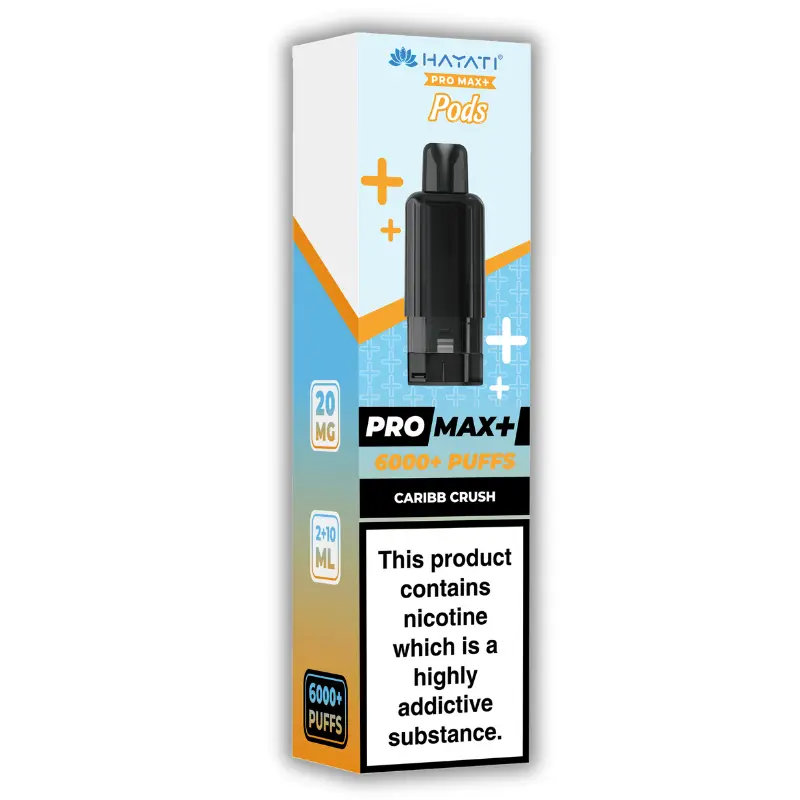
Hayati · Pro Max Plus
Caribb Crush Hayati Pro Max Plus Pods
£5.49
✔ In stock — ready to ship
Genuine Hayati
Free over £20
Same-day dispatch
Secure checkout
Caribb Crush Hayati Pro Max Plus Pods is one prefilled 12ml pod of Caribb Crush at £5.49, carrying 20mg nicotine salt, with no device in the packet. That description would fit eighty-eight other listings on the same shelf, and on almost all of them the interesting question is whether you would like the liquid. Here it is not, because of who reaches this page. A bare refill is bought by somebody who already owns the body and has already tasted the flavour. The question they came with is not what Caribb Crush is. It is whether they can keep getting it.
That turns out to be a real question with a checkable answer, and the answer is unusual enough to be worth the length of this page. Caribb Crush exists twice in Hayati's 492-listing catalogue: this refill at £5.49, and the Caribb Crush Hayati Pro Max Plus Pod Kit at £7.99, which is the same pod with a body beside it. There is no 10ml bottle of it. There is no Mini Ultra version, no Rubik version and no Pro Ultra Plus version. There is no second nicotine strength. One recipe, one volume, one strength, one device family, two listings, and both of those listings are the same physical pod under two prices.
Stacked on top of that is a second fact that makes the first one bite. Hayati never say what is in it. Both listings concede in so many words that the name does not identify the fruits, and having checked every description in the catalogue for that concession, Caribb Crush is the only flavour in the range where every listing it has makes it. So the reader who has settled the taste question privately, by tasting the pod, is holding the only usable description of this liquid that exists anywhere. That is not a rhetorical flourish. It has consequences for how you buy, how much you keep in the drawer, what you write down, and what you would do if the listing vanished, and the rest of this page works through them.
There is also a flavour section, and a long one, because the liquid deserves to be described rather than gestured at. It comes later than it usually would, and it is built from what the two listings actually assert rather than from the name.
What this page is not going to re-argue
Several pages on this site already take apart the problem of a flavour name that tells you nothing, and they do it well enough that repeating them would waste your time and mine. The Sunset Aura Hayati Pro Max Plus Pods page established the working method for a listing named after a feeling: put what the brand states in one column, what it withholds in another, and refuse to fill the second from the first. The Galaxy Aura Hayati Pro Max Plus Pods page took the next step and asked what a coined name costs you in information when there is no comparable product anywhere to price it against. The Midnight Dream Hayati Pro Max Plus Pods page works out what it means to commit twelve millilitres of liquid to a purchase whose only purpose is to find out what you bought. And on the question of whether a name can be treated as a recipe at all, the Blue Razz Mojito pods page settled it by showing that a drink name can promise a component the format cannot physically contain.
All four of those pages are written for a chooser. Every one of them is about the moment before the first draw, when the gap between the label and the liquid is the whole problem and the only honest advice is about how to close it.
You are past that moment. The gap closed the first time you used the pod, and it closed permanently, because taste is not a thing you forget between orders. Whatever Caribb Crush is, you know, and nothing written on a retail page can add to what your own mouth told you. From here the label's silence stops being an epistemic problem and becomes a logistical one, which is a different subject with a different set of answers. That is the subject of this page.
Two things follow immediately. The first is that most of the usual comparison writing is useless to you. Being told that a flavour is sweeter than its neighbour matters when you are picking; it matters much less when you have picked, and what you want to know is what happens to your supply. The second is that the silence you shrugged off at the point of purchase turns into a liability the moment you need a replacement, because a description you cannot read is also a description you cannot match against.
Two listings in four hundred and ninety-two, and a figure I had to correct
This page was commissioned with a claim attached: that Caribb Crush is one of thirty-six flavours on the Pro Max Plus pods shelf that appear nowhere else in the catalogue. House practice here is to count a claim like that before building anything on it, so I counted it, and it is thirty-four. The correction is small and the argument survives it intact, but the number on the page should be the number in the data.
Here is how the count works, so that you can repeat it. The Hayati Pro Max Plus Pods shelf holds eighty-nine listings. Four of those are strength variants filed under the range default rather than under their own flavour, which leaves eighty-five distinct flavours. For each of the eighty-five I asked whether that flavour appears on any listing outside the Pro Max Plus family, counting bottles, Mini Ultra, Rubik, Pro Ultra Plus and the pouches. Thirty-four do not.
Two different tests agree on thirty-four. Matching on the flavour field alone gives thirty-five, and the extra one is Blueberry Raspberry Cherry, which looks exclusive until you notice it reappears as half of a divided Pro Ultra Plus listing where the flavour field records only the other half. Matching on titles as well as fields catches it and brings the figure back to thirty-four. Asking the question the other way round, by testing each flavour for the existence of a bottle, a Mini Ultra pod, a Rubik pod, a Pro Ultra Plus pod or a pouch, produces thirty-four again. When two unrelated methods land on the same number I am content to publish it.
The breakdown behind that figure is more useful than the figure itself, because it tells you what a normal Hayati flavour looks like. Of the eighty-five flavours on this shelf, forty-five can also be bought as liquid in a bottle. Twenty-three appear somewhere on the Pro Ultra Plus. Twenty are sold as Rubik pods, seventeen as Mini Ultra pods, and exactly one exists as a nicotine pouch. A typical flavour in this range therefore has a second route, often a third, and that is the background against which Caribb Crush stands out.
All thirty-four of the single-route flavours have exactly two listings, a refill and a kit, which is the same shape Caribb Crush has. So the two-listing pattern by itself is not rare, and anyone telling you it is has not counted. What is rare is the combination of that pattern with the second fact.
I searched all 492 descriptions for the wording Hayati use when they decline to identify a blend: phrases of the form that the name does not specify, does not list or does not name the fruits. Ten listings do it. Those ten cover five flavours. Triple Melon concedes on one of its two listings and not the other. Mad Blue concedes on one of three. Summer Dream concedes on two of eleven, Mr Blue on four of eleven. Caribb Crush concedes on two of two, and it is the only flavour in the catalogue that does.
Put the two findings together and you get the shape of the problem. For Mr Blue, a buyer who finds one description unhelpful has seven others to read, several of which do name components, and five alternative formats to buy the liquid in. For Caribb Crush there are two documents in existence, they say substantially the same thing, and what they say includes an explicit refusal to identify the contents. There is no third document. There is no bottle whose feed text might be more forthcoming, no Rubik listing written by a different hand on a different day, no Pro Ultra Plus entry where the same recipe sits beside a named partner and gets characterised by contrast.
None of that is a criticism of the liquid, which may be very good. It is a statement about the paper trail, and the paper trail is what you are relying on the day you want another one.
The flavour, working only from what is on the record
Because no kit page for this flavour exists yet, the flavour analysis belongs here, and I am going to do it properly rather than hiding behind the missing label. There is more on the record than the name suggests, and the way to get at it is to compare the two listings against each other, ask which of their words are doing real work, and be explicit about where the description runs out.
What both listings agree on
Strip the two descriptions down to their assertions and a consistent core appears. Both call it tropical. Both describe several fruits combined rather than one leading the blend, and both use the same physical metaphor of fruit crushed together. Both say it is sweet. Both say it is juicy. Both attach a tang to it, positioned as an edge against the sweetness rather than as the main event. Both call it bright. Both state that the name withholds the fruits. Both deny that any single fruit is the headline.
Five properties, then, are asserted twice and contradicted nowhere: tropical, blended without a dominant component, sweet, tangy, and bright. On the evidence available that is the closest thing to fact you are going to get about this liquid, and it is not nothing. It rules out a single-fruit profile. It rules out a dessert or a drink construction. It rules out a dry or savoury reading of the word tropical, which does exist in vaping and would not be called sweet and juicy.
The words that are doing no work at all
An assertion repeated twice is only evidence if the words are chosen rather than stock. So I counted how often each of them appears across the whole catalogue, and the result is bracing. The word juicy appears on 162 listings out of 492. Bright appears on 150. Tangy appears on 145. Ripe, which the kit description also uses, appears on 94. Tropical itself appears on 69. Sharpness appears on 47.
Those are house words. A copywriter reaching for juicy on a fruit listing is not telling you anything they would not have told you about a third of the range, and a property that a third of the range shares cannot distinguish one pod from another. So the five agreed assertions shrink under examination. They are real, in the sense that nobody would write sweet about a menthol, but they carry almost no discriminating power.
Now run the same count on the words that are not stock. Crushed appears on exactly two listings in 492, and those two are this pod and its kit. Mysterious appears on two, one of which is this pod. Holiday appears on four, two of which are the Caribb Crush pair. Lush appears on nine. Beach appears once in the entire catalogue, on the Caribb Crush kit, in a line about a fruit cocktail at a bar. Full-bodied appears on seven.
Look at what that list contains. Every distinctive word in the Caribb Crush copy describes a scene rather than a taste. Crushed is a texture metaphor for the blending, not a flavour. Mysterious is an admission dressed as an adjective. Holiday, beach and cocktail are setting. The only distinctive taste-adjacent words are lush and full-bodied, both of which are about weight and sweetness rather than about which fruit. So the copy contains not one low-frequency word that names or narrows a flavour component. That is a stronger statement than saying the name is vague, and it is the finding I would most want a returning buyer to have.
Where the two listings disagree, and which way the disagreement runs
Two descriptions of one liquid, written separately, are a small natural experiment, and the differences between them are informative even when they are not intentional.
The kit copy names a place. It says the flavour takes its cue from the Caribbean, which is the only gesture at an origin anywhere in the record, and it extends the image with the bar and the cocktail. The refill copy drops the place entirely and substitutes an admission of mystery. The kit adds ripe and exotic and full-bodied; the refill adds a claim about the tang holding up across a full pod, which the kit does not make.
The substantive difference, though, is about fruit. The kit copy tells the reader it suits somebody who enjoys mango or pineapple and wants something with more layers. The refill copy deletes the two fruits and generalises to tropical flavours. Two named reference points on the more expensive listing; none on the cheaper one.
That is worth pausing on, because it runs the wrong way. The kit listing is read by somebody who has never tasted the liquid and is being asked for £7.99 on the strength of the description. The refill listing is read by somebody who has tasted it and is being asked for £5.49. It is the first of those two readers who needs the fruit names, and it is the second who gets less. The most plausible explanation is unremarkable, that two descriptions were written at different times with different word budgets, but the effect on the record is real: the document a repeat buyer is sent to is the thinner of the two.
One qualification, because precision matters more than a clean line. It is not strictly true that the refill description names no fruit. Mango and pineapple do appear on it, in the clause saying the blend has more layers than a single one of either. But they appear as a negative baseline, a statement of what Caribb Crush is not, rather than as a declaration of contents. And that construction is a house formula, not a disclosure: thirty-eight listings in the catalogue use some version of more layers than a single named fruit. So the two fruits on this page are boilerplate machinery, and reading them as ingredients would be a mistake. What they do tell you, weakly, is the family the writer had in mind.
What is absent, stated as absence
No cooling word appears anywhere in this listing. Not ice, not frozen, not cooler, not menthol, not mint, not chill, not freeze. That matters because coolant is the single largest swing factor in how a fruit blend actually drinks, and its absence from the title and the copy is the clearest negative signal on the page. The Blue Frozen Hayati Pro Max Plus Pods page did the full census of Hayati's cooling vocabulary and established that the terms are not graded into levels, so I will cite that rather than recount it. The relevant point here is simply that Hayati label cooling when it is present, across ninety-odd titles, and they have not labelled it here.
Also absent: any VG to PG ratio, any statement of the nicotine preparation, any ingredient list, any indication of how many fruits are in the blend. Two? Five? The copy says fruits, plural, and stops. The weight of the blend is described as lush and full-bodied, which suggests the sweetener load is not shy, but suggests is the right verb and I am not going to upgrade it.
The shape the description implies, marked as inference
Everything from here to the end of this subsection is reasoning from the copy, not reporting of it, and I want that boundary visible rather than blurred.
A blend built so that no fruit leads, carrying a high sweetener load and a tang described as an edge rather than as a sourness, has a fairly predictable architecture on a low-power pod. The sweetness arrives first and arrives wide, because sucralose-family sweeteners do not have a shape of their own and simply raise the whole signal. Underneath it sit the fruit esters, and in a blend with no designated lead they tend to smear into a single impression rather than resolving into components, which is precisely what the copy means by a combined character. The acid arrives late in the draw and on the exhale, which is where a tang put in to cut sweetness usually lands. If the blend is genuinely layered, the layering will show up as a difference between the front of the draw and the finish rather than as separable fruits within one draw.
That is a shape, not a tasting note, and I have not tasted this pod. What it gives you is something to check against, which is the useful form of inference. If your own experience of Caribb Crush is that one fruit clearly dominates, or that it is tart from the first moment rather than at the finish, then the copy is a poor guide to the liquid and you should weight your own reading accordingly. That is worth knowing, because if the copy is unreliable on structure it is also unreliable on the mango and pineapple hint.
Writing down what you already know, which is the part that matters
Here is where the flavour question and the supply question meet, and it is the practical recommendation this page exists to make.
You possess something no document in the catalogue contains: an accurate description of this liquid. If the listing is delisted, discontinued or quietly reformulated, that description is the only thing you will have to search with, and memory of a taste degrades into adjectives within a few months. So write it down now, while you have a pod in front of you, and write it in a form that a future search can actually use.
That means resisting the temptation to write it beautifully. A note that says lovely, sweet, holiday-ish is worth nothing in six months, because those words return most of the shelf. What is worth something is a note built from discriminating terms, and the way to find those is to use the catalogue's own vocabulary against itself. Words like juicy and bright return a third of the range and should not appear in your note at all. Words that appear on a handful of listings will actually narrow a search.
Concretely, I would record five things. First, the fruits you can actually identify, named individually, with a confidence mark against each: certain, probable, guess. Second, whether the blend resolves into components or stays merged, because that single property separates Caribb Crush from most of the named tropicals on the shelf. Third, where the acid sits in the draw and what kind it is, since a citrus bite, an apple-like tartness and a passionfruit sourness are three different things that all get written as tangy. Fourth, the sweetness level against a pod you know well, expressed as more or less than that pod rather than on an invented scale. Fifth, the absence of coolant confirmed, which is quick to note and closes off a whole branch of the shelf if you ever go searching.
Five lines. It takes two minutes, it costs nothing, and it is the only durable record that will exist of what you bought. Nobody writes this advice on a page for a flavour with seven listings across five formats, because for those flavours the brand has done it for you in seven different ways. Here it has not, and there is no prospect that it will.
The pod on its own
The hardware section on this page is short, deliberately, because ninety products share this device and everything worth saying about it has been said on the pages that own it. What is in the packet is one prefilled Caribb Crush pod holding 12ml of 20mg liquid, and nothing else. No body, no cable, no spare.
Pod fitment across the Hayati ranges is not a thing to settle from a retail page, so match the range name printed on your device against the range name in this title before ordering.
The one specification that changes how you should think about this particular liquid is the volume, and it is the volume rather than anything electrical. Twelve millilitres in a prefilled pod is a large single commitment of one flavour, and it is larger still when the flavour is one you cannot swap out mid-pod, since a single-flavour pod has no selector on it. The consequence for Caribb Crush specifically is that a pod lasts long enough for the coil to change character underneath the liquid, so the version of the flavour you meet in the last quarter is not quite the version you met in the first. On a blend whose distinguishing feature is a tang holding up against a heavy sweetness, that drift has somewhere obvious to go, and the next section on handling deals with it.
For anything else about the platform, the pods on the Pro Max Plus pods shelf all behave the same way and the shelf page carries the general description. The pod is not refillable and is not designed to be opened; it is a sealed consumable that goes to recycling when the liquid is gone.
The listing in figures, including two rows a spec sheet does not normally carry
Most tables on this site describe hardware. This one has been built to describe a supply position, because that is the axis this purchase actually turns on, and the last four rows are the ones I would read first.
| What £5.49 buys | One prefilled pod, no device |
| Liquid in the pod | 12ml |
| Nicotine | 20mg, as a salt |
| Cost of the liquid | About 46p per millilitre |
| Manufacturer puff rating | Up to 6,000, a laboratory estimate |
| Device needed | Hayati Pro Max Plus, bought separately |
| Fruits identified by Hayati | None |
| Cooling word in title or copy | None |
| Listings of this liquid in the catalogue | Two |
| Other formats of this liquid | None |
| Other strengths of this liquid | None |
| Catalogue reference | hpm-plus-6k-pods-caribb-crush |
Two of those rows are unusual enough to explain. Fruits identified by Hayati is not a row anybody prints, because on most listings the answer is obvious from the title. Other formats of this liquid is not a row anybody prints either, because on most listings the answer is a list. On this one both answers are the same word, and putting them in the table is the shortest way to say what makes the purchase different.
The strength row deserves a sentence of its own. Twenty milligrams is the ceiling a UK prefilled pod is sold at, and for most flavours on this shelf it is one option among several, since the range also carries Hayati Pro Max Plus Prefilled Pods 10mg and a zero-nicotine variant. Those strength listings are filed under the range's default flavour rather than offered across the catalogue, so they are not a Caribb Crush option. If you want this liquid, you want it at 20mg, because that is the only strength it is made in. Nicotine is addictive, and a 12ml pod at that concentration holds a substantial amount of it.
The per-millilitre figure is worth carrying in your head for a different reason than usual. At £5.49 for 12ml the liquid works out at a shade under 46p per millilitre, and the kit costs two pounds fifty more for the identical pod plus a body. That arithmetic is the same across the shelf, so it tells you nothing about Caribb Crush. What it does tell you is what a stock of spares costs: three pods is a little over sixteen pounds and thirty-six millilitres, which is the scale at which the question of how many to keep stops being trivial.
Where a replacement would have to come from
This is the section a repeat buyer of a normal flavour can skip, and the one a repeat buyer of this flavour cannot. If Caribb Crush goes, the shelf does not offer you a version of it in another format, so a replacement has to be a different liquid chosen by resemblance. The difficulty is that resemblance has to be judged against a description, and you do not have one.
Start with where it is filed. Caribb Crush sits on the Exotic Vapes shelf, which holds fifty-five listings resolving to twenty-three distinct flavours once you account for the same recipes appearing in several formats. That is the pool a substitution would come from, and eleven of those twenty-three are themselves single-route flavours with two listings apiece, so swapping one exclusive tropical for another does not improve your position. It just moves the risk.
The realistic candidates divide into two groups, and the division is exactly the one this page has been circling.
The named blends are the ones you can actually reason about. Guava Kiwi Passion Fruit Hayati Pro Max Plus Pods is the closest structural match on the shelf, in that it is a three-fruit tropical assembled so that no component obviously leads, which is the property the Caribb Crush copy insists on. The difference is that you can check the components against your memory one by one, and if your note says passionfruit sourness at the finish you have a direct hit. Mango Peach Pineapple Hayati Pro Max Plus Pods is the other obvious one, a named three-fruit tropical that also exists as a bottle and on the Pro Ultra Plus, so it is about as far from a single-route liquid as this catalogue gets. If continuity is what you are optimising for, that is the pod to move to, and the trade is that it is a heavier, rounder blend than a tangy one.
Tropical Sour Juice Hayati Pro Max Plus Pods is the candidate if what you value in Caribb Crush is the edge rather than the sweetness, since it puts the acid at the front of the profile rather than using it as a counterweight. Strawberry Guava Hayati Pro Max Plus Pods and Mango Banana Hayati Pro Max Plus Pods are two-fruit tropicals, simpler than what you have, and both will read as a step down in complexity if the layering is the thing you like. Blackcurrant Mango Hayati Pro Max Plus Pods crosses a dark berry into the tropical family and is the most different of the group. Triple Mango Hayati Pro Max Plus Pods is the pod Caribb Crush is implicitly defined against, since both listings say the blend has more going on than a single fruit, and it is worth trying precisely to find out whether that claim was true for you.
Dragon Berries Hayati Pro Max Plus Pods and Strawberry Kiwi Hayati Pro Max Plus Pods both sit on other platforms as well, which makes them safe places to settle if you are tired of this problem. Lychee Ice Hayati Pro Max Plus Pods is the one to approach carefully, because it carries a cooling word and Caribb Crush does not, so the comparison is not like for like. On another platform entirely, Kiwi Banana / Straw' Banana Hayati Pro Ultra Plus Pods shows what a tropical pairing looks like when it is sold at a much larger volume, though it needs different hardware and is a bigger commitment than a £5.49 refill.
The second group is the one to be careful with. T-Misu Hayati Pro Max Plus Pods shares the Exotic filing and the naming habit, and it has the same two-listing footprint, so choosing it as a Caribb Crush replacement means choosing an unlabelled liquid to replace an unlabelled liquid and being no better placed the next time round. Sunset Aura, Galaxy Aura and Midnight Dream, all linked above, fall into the same bracket. Each of them may be excellent. None of them can be matched against anything, which is the property you are trying to escape.
Outside the tropical family altogether, the shelf is full of pods whose names are their descriptions, and there is something to be said for defaulting to one of those as a standby. Blackcurrant Juice Hayati Pro Max Plus Pods, Blackberry Ice Hayati Pro Max Plus Pods, Grape GB Hayati Pro Max Plus Pods, Banana Ice Hayati Pro Max Plus Pods and Ice Pop Hayati Pro Max Plus Pods all tell you what they are before you spend anything, and Blue Fusion Hayati Pro Max Plus Pods is on this list as a warning rather than a recommendation, since its name follows the same withholding pattern despite sitting in a different flavour family. The full set is on the prefilled pods and refills shelf, and the whole range is at the shop index if you want to work through it yourself.
One comparison is worth making explicitly, because it is the mirror image of everything above. Cherry Berry, which is not a tropical at all, exists seven times in this catalogue: as a bottle, as a Mini Ultra pod and kit, as Pro Ultra Plus pods and a Pro Ultra Plus kit, and as a Pro Max Plus pod and kit. A buyer who settles on that liquid can move platforms, change volume, buy it as liquid to drip into something else, and read seven separate descriptions of it written on different days. A buyer who settles on Caribb Crush can buy one thing, at one size, at one strength, from one shelf. The difference between those two positions has nothing to do with which liquid is better and everything to do with how much of the catalogue's redundancy sits behind it.
Running a liquid that has one source
Handling advice on a page like this is usually generic. Most of what follows is not, because a single-source liquid changes what the advice is for: the point is no longer to get the most out of the pod, it is to keep your reading of the flavour stable so that you can tell a real change from an imagined one.
Give a new pod a few minutes before the first draw. A pod that has been in a cold delivery van has thicker liquid in it than a pod that has been sitting in a warm room, and the wick takes longer to saturate. On most liquids that produces a slightly thin first few draws and nobody notices. On this one it matters more, because the first impression of a blend whose components are merged is the impression you will compare every future pod against, and taking it from a half-wetted wick sets a false baseline.
Expect the tang to go first. The refill copy makes a specific claim that the kit copy does not: that the sharpness holds up across a full pod. Whether or not that is true of the liquid, it is not usually true of the coil. Heavy sweetener loads caramelise onto a coil over twelve millilitres, and the practical effect is that the bright acid at the finish dulls before the sweetness does. So if your last two millilitres taste flatter and sweeter than the first two, that is the expected ageing curve for this kind of blend rather than evidence that the recipe changed. Judge a new batch on its opening millilitres against the opening millilitres of the last one, never against the tail.
Do not chain draws on this one. A merged fruit blend loses its separation fastest when the wick is running behind, and what you get instead is a flat sweetness with the fruit character sanded off. Leaving a few seconds between draws costs you nothing and keeps the profile legible, which on a liquid you are trying to characterise is the whole point.
Store spares away from light and heat, and treat the dates seriously. Sweetened tropical blends discolour and flatten in a warm room faster than simple single-fruit liquids do, because there is more sugar and more ester in them to go off. If you keep three pods in a drawer for a year and the third one tastes wrong, you have no way of knowing whether Hayati changed it or your drawer did, and with no second format to cross-check against you never will. A drawer in a cool part of the house, used in the order you bought them, removes that ambiguity cheaply. Spares belong somewhere out of the reach of children and pets.
Keep the identifiers, not just the flavour name. The catalogue reference for this pod is hpm-plus-6k-pods-caribb-crush, and that string will survive a retitling when the words on the box will not. It is worth noting because the naming around this product is already inconsistent: the kit's product image is filed under the spelling Caribbean Crush and carries the number 6000, while the kit's own title uses the short form Caribb and no number at all. Fifty-three of the eighty-eight Pro Max Plus kits carry 6000 in the title and thirty-five do not, so a search for Caribb Crush 6000 can plausibly miss the listing you want. Search both spellings and both with and without the number.
Decide your spare count deliberately. The honest answer depends on something you can check rather than on a rule. If Caribb Crush is your only liquid, a single-route flavour is a genuine exposure and two or three pods in reserve is proportionate. If it is one of three or four you rotate through, the exposure is small and stocking deep just means older liquid. What you should not do is stock deep as a reflex, because ageing is a certainty and delisting is not.
Retire a pod on flavour, not on volume. A pod that has gone quiet, or that tastes scorched at the top of the draw, has nothing left to give even with liquid visible in it, and pushing on past that point is how people come to believe a flavour is worse than it is. On a blend this sweet, the quiet phase arrives before the pod empties more often than it does on a lighter liquid.
Dispose of it as electrical waste. A spent pod has a coil in it and liquid residue around the coil, which puts it outside normal household rubbish. Shops that sell this kind of product generally take them back, and household waste sites have a small electricals point. This is not a general environmental lecture: it is on this page because a 12ml pod is a larger object to be casually binning than most people assume.
Questions a restocking buyer asks
Is this the same liquid as the one in the Caribb Crush kit?
Yes. Both listings carry the same 12ml prefilled pod at the same 20mg strength, and the kit adds a Pro Max Plus body alongside it for two pounds fifty more. If you already own the device there is no reason to buy the kit, and if you do not own one there is no route to this liquid except the kit.
Can I buy Caribb Crush as a 10ml bottle?
No. It has two listings in the entire catalogue, this refill and the kit, and neither is a bottle. Forty-five of the eighty-five flavours on this shelf do have a bottled version, so the absence is a genuine gap rather than a rule about the range.
Is there a Caribb Crush pod for the Mini Ultra, Rubik or Pro Ultra Plus?
None of those exist. Seventeen of the shelf's flavours appear on the Mini Ultra, twenty on the Rubik and twenty-three somewhere on the Pro Ultra Plus, and Caribb Crush is in none of those groups. If you change platform, you change flavour.
What fruits are actually in it?
Hayati do not say, and they say that they do not say. Both listings state that the name does not identify the fruits, which makes this the only flavour in the 492-product catalogue where every listing carries that concession. Mango and pineapple appear on the refill description, but only in a stock phrase about the blend having more layers than a single fruit, which is a comparison rather than an ingredient list.
Is it cooled?
Nothing in the title or either description uses any of Hayati's cooling words, and they do label cooling on the products that have it, across roughly ninety titles. On that basis it should be read as an uncooled fruit blend, though the copy never states the absence directly.
How sweet is it?
Both listings describe it as sweet, with a tang set against the sweetness rather than balancing it out, and the kit copy adds full-bodied, which is a weight word. That places it in the upper half of this shelf for sweetener load. It is not described anywhere as tart, sour or dry.
How does it compare to the named tropicals on the same shelf?
The closest in construction is Guava Kiwi Passion Fruit, which is also a three-part tropical without an obvious lead. Mango Peach Pineapple is heavier and rounder, Tropical Sour Juice puts its acid at the front instead of the finish, and Triple Mango is the single-fruit benchmark that Caribb Crush is implicitly measured against. The difference in every case is that you can check those against your memory component by component.
Should I stock up in case it disappears?
Only in proportion to how much you rely on it. A single-route flavour with no bottle and no alternative format is a real exposure if it is the only thing you use, and two or three spares is a reasonable hedge. If you rotate several liquids, deep stocking mostly buys you older pods, because sweetened tropical blends flatten in storage.
How will I know if the recipe changes?
You will not, unless you have written down what it tastes like in terms specific enough to check against. That is the practical argument of this page: with no second listing and no second format, your own note is the only reference copy in existence. Compare the opening millilitres of a new pod against the opening millilitres of the last one, since the tail of a pod is always flatter and always sweeter.
Why does the kit description mention mango and pineapple when this one does not?
Most likely because the two descriptions were written separately, at different lengths. The effect is that the more expensive listing, read by someone who has never tasted the liquid, carries two reference fruits, and the cheaper listing, read by someone who already knows the taste, does not. That is the wrong way round, and it is worth knowing if you are ever trying to describe this flavour to somebody else.
Is 20mg my only option on this flavour?
Yes. The shelf does carry 10mg and zero-nicotine pods, but those are filed under the range's default flavour rather than offered across the catalogue, so there is no lower-strength Caribb Crush. The liquid exists at one concentration only.
Does the pod fit any Hayati device, or only the Pro Max Plus?
It is sold as a Pro Max Plus pod and should be treated as one. Hayati publish very little about which fittings are shared between their ranges, so a compatibility decision from a retail page is not one to rely on, including this one.
The position, in plain terms
Caribb Crush Hayati Pro Max Plus Pods is a 12ml prefilled pod at £5.49, carrying 20mg nicotine salt, with no device included and no cooling in it. Hayati describe the liquid as a combined tropical blend, sweet and juicy with a tangy edge and no single fruit in front, and they state in both of the listings this flavour has that the name does not identify what is in it.
The unusual thing about it is not the flavour, which may well be very good, but its footprint. Two listings in a catalogue of 492, both on one platform, both the same physical pod, with no bottle, no other pod format and no second strength behind them. Thirty-four of the eighty-five flavours on this shelf share that shape, so it is not unique, but only this one has the second property: it is the sole flavour in the range where every listing it has declines to say what is in it. There is therefore no document anywhere that describes this liquid in terms you could use to find a substitute.
If you have already tasted it and you like it, the sensible response is not to panic-buy, it is to spend two minutes writing down what it tastes like in specific, low-frequency words, and to keep a proportionate number of spares. If you want a liquid you will not have to think about in these terms again, the named three-fruit tropicals on the same shelf, particularly the ones that also exist as bottles and on other platforms, give you the same kind of flavour with a supply chain behind it. Either choice is defensible. Making it without knowing that this liquid has exactly one route is the part worth avoiding.
Strictly for adults aged 18 and over. Nicotine is an addictive substance.
You might also like


