
Home / Hayati Pro Max Plus Pods / T-Misu Hayati Pro Max Plus Pods
Hayati · Pro Max Plus
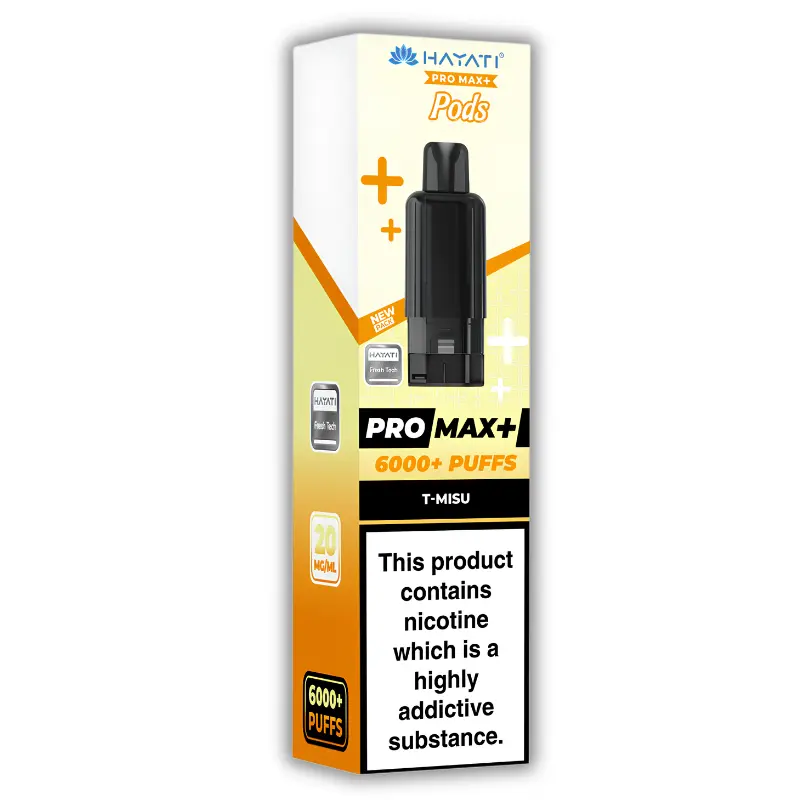
T-Misu Hayati Pro Max Plus Pods
£5.49
✔ In stock — ready to ship
Genuine Hayati
Free over £20
Same-day dispatch
Secure checkout
This is the pod on its own. Twelve millilitres of Hayati's tiramisu liquid at 20mg, already filled, no body in the packet and nothing to screw together. Five pounds forty-nine. It fits the Pro Max Plus and nothing else that Hayati's data for this listing mentions. If you have reached this page you almost certainly own the device already, so the question in front of you is not whether a pudding flavour belongs in a vape. You have settled that one. The question is how many of these to put in the basket, and on a dessert that is a genuinely harder sum than it is on anything else in the range.
None of the tasting is repeated below. The T-Misu Pro Max Plus 6000 Pod Kit page pulls the accord apart layer by layer, explains why coffee and cocoa arrive in vapour as one dark note instead of two separate ones, and works through which parts of a real tiramisu can physically make the trip into an aerosol and which cannot. That analysis applies here unchanged, because it is the same liquid sitting against the same coil. If you have not tasted this flavour yet, start there and come back.
What the kit page is not written to answer is the thing a second purchase actually depends on: not what the liquid tastes like on the first draw, but how many days it goes on tasting like that. Dessert is the one category where those two answers diverge sharply. A heavily sweetened, heavily aromatic blend makes a bigger first impression than almost anything on the shelf, and the size of that impression is exactly what predicts how far it has to fall. Sweetness is the dimension a palate adjusts to fastest. Six days in, plenty of people find that the thing which stopped them in their tracks on Monday has quietly become the thing that is simply there. That is not a fault in the pod. It is a property of rich flavours in general, and it is the single best reason to treat a dessert as a member of a rotation instead of an all-day single. Everything below follows from it: how many to order, whether this should ever be your only pod, and what to do with the half-used one you set down while you were off drinking something lighter.
The flavour, measured in days rather than in draws
Two timescales matter and they are often confused with each other. The short one runs inside a single sitting. Draw on any sweet liquid steadily for twenty minutes and the perceived intensity drops, then comes back within a few minutes of putting it down or taking a drink of water. Nobody finds that surprising and nobody plans around it. The long one runs across days. It is slower, it is much less obvious while it is happening, and it is the one that decides whether one pod or three is the right order.
Day one is not evidence about day six
Liking a flavour on the first evening tells you that the blend is well made and that it suits your taste. It tells you very little about the sixth evening, because the two are answers to different questions. The first is about the liquid. The second is about the relationship between the liquid and a palate that has now had roughly a hundred and fifty exposures to it and has begun treating it as background information rather than news.
The mechanism is ordinary and it applies to every strong repeated sensation, not just to vaping. A system that responds hard to a new signal starts responding less once the signal stops being new. Where flavours differ is in how much of their identity sits in the channels that fade and how much sits in channels that hold. A dessert accord keeps almost all of its identity in two places: a high sweetener load, and a body of heavy, low-volatility aroma. Both of those are adaptable, and nothing else in the blend is doing structural work. Take a bright acidic fruit instead and part of what you are perceiving is sourness, which arrives by a different route and hangs on longer. Take a cold blend and a real share of the effect is a physical sensation at the back of the mouth rather than a taste at all, and sensation of that kind is stubborn in a way that aroma is not.
So the ranking is not intuitive. The loudest liquid on the shelf is frequently the least durable one, because it has the furthest to fall and because so much of what makes it loud is the part that fades. A quiet, slightly tart fruit can still be perfectly legible in week three while a dessert bought the same day has flattened into general sugar. People who buy on first impressions end up with half-finished dessert pods in a drawer for exactly this reason, and they usually blame the pod when what they did was read a first impression as a forecast.
What recedes first, and what that does to the balance
The useful detail is that the fade is not uniform. If everything dropped at the same rate, day six would simply be a quieter version of day one and you would compensate by drawing a little longer. That is not what happens, and the difference is worth knowing before you decide whether you still want this flavour in your rotation.
Sweetness goes first and goes furthest. It is the fastest-adapting part of the blend and it is also the loudest part on arrival, so the drop is large in absolute terms. What that does is uncover things. Sweetness masks. It sits on top of the roasted note, on top of the faint dryness at the end of the exhale, on top of the soft grain underneath, and when it recedes those components come forward without having changed at all. The practical result is that somewhere around the third or fourth day a T-Misu pod often reads drier and more distinctly roasted than it did at the start. A number of people find that stretch the best part of the pod, and they are not imagining it. The blend genuinely is better balanced once the sugar has stopped shouting.
Then the second stage arrives, and this is where the welcome runs out. The aroma side adapts too, more slowly but in the same direction, and once it starts to go there is nothing left underneath to be revealed. The roast softens into warmth, the warmth into a general brown sweetness, and the draw stops resolving into anything you could name. You are still tasting something. You are no longer tasting tiramisu. That is the point at which most people reach for a different pod, which is sensible rather than a failure of the product.
How long each stage takes varies enormously between people, and anyone quoting a fixed number of days is guessing. What is consistent is the order: sweet first, then the balance improves, then the whole thing flattens. That order lets you place yourself on the curve. Gone drier and more coffee-forward, you are early with a good stretch in front of you. Gone vague, you are late, and the fix is a break rather than a new pod.
The anchor this particular liquid does not have
Nothing in the title signals cooling and the product data records no coolant, which is the reliable test across this whole shelf. Every listing that carries Ice or Frozen or Cooler in its name has one, and every listing that does not carry one of those words has none. T-Misu has none. The vapour is warm, thick and uncooled.
On a fruit that is a minor stylistic fact. On a dessert, in the context of this page's argument, it is the whole reason the flavour fades as quickly as it does. Menthol and the synthetic coolants used alongside it do most of their work as a sensation rather than as a flavour, and sensation is the part of the experience that holds up best under repetition. A cold pod therefore has a second anchor: even once you have stopped noticing its fruit, you have not stopped noticing that it is cold. That is why an ice blend tends to stay usable for longer than its flavour alone would justify, and it is why Blackberry Ice and Lychee Ice hold their place in most people's rotations far longer than their flavour complexity would predict. T-Misu is running without that. Every bit of its effect is in the taste and the aroma, which are exactly the two channels that adapt. Cold over a coffee and cream blend would also have been an unpleasant combination for most people, so its absence is a reasonable decision rather than an oversight, but the trade is real and you should price it in.
The sour listings show the same principle from another side. Blue Sour Raspberry and Fizzy Cherry keep an acidic edge that still registers once the sweetness around it has gone quiet. They tire you out in their own way, but they do not go vague. They go sharp. A dessert has no equivalent hard edge to fall back on.
Two fades running at the same time, in the same direction
Here is the part that makes a dessert pod feel like it is deteriorating faster than it should. There are two separate processes going on and they happen to push the experience the same way, so they add up rather than cancelling out.
One is the palate adaptation described above, which is happening in you and reverses when you stop. The other is happening in the pod, and the kit page covers it in detail: a high sweetener load leaves residue on a coil as it passes over, that residue darkens and dulls what comes afterwards, and the coil here cannot be changed. Both of those reduce the apparent brightness and definition of the draw. Both of them hit the roasted top note hardest, because it is the most delicate part of the accord. From inside the experience they are indistinguishable, which is why the drop in a dessert pod around the end of the first week feels steeper than the same drop on a fruit.
The two are worth separating because the remedies are opposite. If the problem is the coil, a break does nothing and the pod is genuinely near the end of its useful life. If the problem is you, a break fixes it completely and the pod has plenty left. Ordering three pods when the real issue was adaptation is an expensive mistake, and it is the mistake this page exists to head off.
A test that tells the two apart
The diagnosis takes three days and costs nothing. Put the pod down entirely and run something unrelated, ideally something cold or tart rather than another sweet blend. Blue Frozen or Berry Lemonade will do the job; another sugar-forward pod will not, because the sweetener channel you are trying to rest is the same one. After three days, go back to the T-Misu and take four or five draws before judging anything.
If the roasted note is back and the sweetness has its old weight, the pod was fine and you were saturated. Most of the recovery happens in the first day or two, so three days is generous rather than marginal. If the draw is still flat, still muddy and still missing its dark end after a proper break, the coil has aged and no amount of resting your palate will bring it back. In that case the pod is finished in the way that matters, regardless of how much liquid is visible in it.
What none of this means
It does not mean the liquid has spoiled, and it does not mean this is a badly made dessert. A pod that has gone quiet on you tastes flat rather than wrong, and the distinction is easy to make once you have met both: spoilage has an off note in it, adaptation has an absence. Every rich blend does this to some degree, roughly in proportion to how rich it is, and a thinner, more tentative dessert would hold up marginally better while also being worth less on the first day.
It also does not mean the answer is to draw harder or more often. Chasing a remembered intensity by extending the draw is the standard response and it fails on two counts. The deficit is in your perception, so more of the same liquid does not address it, and the extra heat accelerates the residue causing the other half of the problem. The response that works is a gap.
What is in the packet
One pod, filled, and nothing else. No body, no cable, no spare. The listing is a consumable and it assumes the hardware is already sitting in your pocket. The pod carries 12ml at 20mg and drops into a Pro Max Plus with no setting to choose, no airflow to adjust and no button to hold. Hayati's data for this listing names the Pro Max Plus and no other device, so that is the only fitment this page will state. Everything else on the same shelf is gathered at Hayati Pro Max Plus Pods, and the wider set of refills across all their platforms sits at Hayati Prefilled Pods and Refills.
The one specification that actually bears on a dessert is a negative one: the coil is part of the pod and cannot be separated from it. On a device where you could change a coil, the liquid and the heating element would be on independent timetables and a heavy blend would simply mean replacing the coil more often. Here they are welded to one schedule. The consequence is that the pod, not the liquid, is the unit you are buying, and the pod's useful life on a rich sweet blend is set by whichever of the two runs out first. On this flavour it is usually the coil.
That is also why the rest of this page is about quantity rather than about hardware. There is nothing to maintain, nothing to dismantle and no part of the device that a dessert treats differently from a fruit, apart from how quickly the pod itself becomes tired. Orientation and temperature while the pod is idle do make a measurable difference on a liquid this thick, and the kit page works through why and what to do about it, so that ground is not covered again here.
The listing, line by line
| Price | £5.49 |
| What arrives | One prefilled pod, no device |
| Device it fits | Hayati Pro Max Plus |
| Profile | Dessert, tiramisu |
| Cooling agent | None recorded in the listing |
| Liquid | 12ml, supplied in the pod |
| Nicotine | 20mg, the only strength listed |
| Laboratory figure | A ceiling of 6,000 puffs, measured on test equipment |
| Coil | Integral, not replaceable |
| Listing reference | t-misu-hayati-pro-max-plus-pods |
| Made by | Hayati |
Four of those rows change meaning when you read them as a restocking buyer rather than a first-time one.
The 6,000 figure first, because it is the row people try hardest to turn into a plan. Hayati generate it on bench equipment using short, evenly spaced, identical draws, which is not how anybody uses a pod, and it is published as an upper bound rather than a typical result. As a comparison between listings on the same platform it is fine. As an input to your reorder arithmetic it is close to useless, and on a dessert it is worse than useless, because the number describes the liquid running out and the thing that actually ends a dessert pod is usually either the coil or your interest in the flavour. Work from millilitres and days instead.
The volume row next. Twelve millilitres means nothing on its own, because what it converts into depends entirely on what share of your sessions this pod takes. Run exclusively it is a modest supply. Run as one flavour in four it covers four times the calendar, which is the fact the next section is built on.
The strength row is the same 20mg that every pod on this shelf carries, so it is not a variable you are choosing between. It reads differently here, though. A very sweet liquid rounds the edge off the throat sensation, so the same dose comes across softer on this pod than on a dry or acidic one. That is a perception effect and not a change in what is in the liquid. Nicotine is addictive whatever it is dissolved in, and the softness of a dessert is not evidence of anything about the dose.
The price row is the one that quietly shapes the decision. Five forty-nine buys one pod, and no quantity break appears anywhere in this product's data, so a basket of six costs six times as much as a basket of one and delivers no saving per millilitre. There is nothing to be gained by ordering ahead, which removes the usual argument for stocking up and leaves only the question of how fast you will actually use them. For the comparable arithmetic on what the body costs when you do need one, the kit listing carries it.
One, two or three: doing the sum honestly
Start from the conclusion, because it is short. For a dessert you have not run before, order one. For a dessert you have run for months and whose place in your week you know, order two. Three is right only in a narrow case, described at the end of this section. The reasoning is worth the space because the instinct on a flavour you enjoy is to buy several, and on this category that instinct is wrong more often than it is right.
The first pod is a test and it cannot be anything else. Not a test of whether the flavour is good, which you may already know, but of your own adaptation rate, which nobody can tell you in advance. The spread between people is wide. Some run a dessert daily for a month without complaint; others find it has gone quiet inside a week. There is no way to place yourself on that spread except by running one and watching, and until you have, you have no basis for a second order. Twelve millilitres is a generous test and £5.49 is a cheap one.
The second pod is a rate calculation, and it is simple arithmetic once you know the rate. Work out roughly what fraction of your sessions this pod took while you were running it. If it took every session, one pod is however long 12ml lasts you and two pods is twice that. If it took one session in three, which is a common landing place for a dessert, one pod covers three times the calendar, and two pods on that schedule is a long commitment to a single flavour. If it took one evening in five, you have bought most of a season.
Multiply that by the thing that makes over-ordering worse than it sounds. The cost of buying too many is not the money, which is small, and it is not waste, because a sealed pod does not evaporate. The cost is that you have locked a slot in your rotation to a decision you made on a single good evening, and rotations drift. Six months from now you may be running something tart and dry and have no appetite at all for cream and coffee, and there will be four pods of it sitting there making the case for themselves. A rotation works best when each slot is cheap to change, and the way to keep it cheap is to hold one spare rather than a stack.
The counter-argument deserves a hearing. A dessert used sparingly goes a long way, so a pod bought now might genuinely be wanted in three months, and two rather than one saves a separate order. That is why two is the right number once the habit is established. It stops being true at three, where the extra pod is no longer covering a gap in supply but betting that a preference will hold over a period nobody can forecast.
Three or more makes sense in exactly one situation: this flavour has occupied a fixed, regular slot for several months, the slot has not moved, and you know your consumption well enough to state it in weeks rather than guess at it. At that point you are not speculating, you are restocking a known rate, and the arithmetic is the same as it would be for anything else you buy on a schedule. Everyone else is better served buying one, running it, and ordering the next when it is half gone.
Should a dessert ever be your only pod?
Usually not, and it is worth being specific about who the exception is rather than stating the rule and moving on.
The case against is everything above. A single-pod setup means continuous exposure to one accord, continuous exposure is what drives adaptation, and a dessert is the profile with the least resistance to it. Run this as your only liquid and you are on the fastest possible route to the flat stage, with nothing to switch to when you get there. The predictable outcome is that you either push through, drawing more to chase something that is not going to come back, or you order a completely different flavour in a hurry and the T-Misu pod ends up half full in a drawer.
The case for is narrow but real, and it turns on how you use the device rather than on how much you like the flavour. Adaptation needs repeated exposure in a fairly short window. Someone who draws in short, widely spaced sessions a handful of times a day is giving their palate a partial reset between each one, and will find a dessert holds up better than the description above suggests. Someone who draws frequently in long runs is compressing a fortnight of exposure into three days. Frequency matters more than enthusiasm, and the two are easy to confuse.
If you are in the second group and you still want this to be your main flavour, the practical fix is not a second flavour of the same kind. Two sweet pods do not rotate against each other in any useful sense, because the channel that is saturated is the sweetener channel and both of them load it. Pairing T-Misu with Caribb Crush or Blueberry B’Gum gives you variety in the aroma but no rest in the part that actually tires, and people who try it often report that neither flavour reads properly after a few days. The pairing that works has to differ on the axis that is fatigued.
What to put beside it
A rotation partner for a dessert has one job: to leave the sweetener channel alone while it is recovering. That narrows the field considerably and it rules out some pods that look like obvious companions.
The cold end is the most effective and the least subtle. Banana Ice is the interesting one, because banana and cream share enough chemistry that you would expect it to blur into the T-Misu, and the coolant changes what the pod is doing enough that it still works as a break. Blackberry Ice is the more straightforward choice, dark enough to feel like a related mood while operating on an entirely different set of receptors. Blue Frozen pushes the cooling harder still and is the strongest reset on this shelf if you want the dessert back quickly.
The lemonade builds are the other reliable direction, and they work through acid rather than cold. Berry Lemonade, Blackcurrant Lemonade and Blue Razz Lemonade all carry a citrus sharpness over their fruit, and that sharpness is the part doing the resetting. They are sweet pods in absolute terms, so they are not resting the sugar channel completely, but the acid gives your palate something else to attend to and the practical effect is close to what a cold pod achieves. Blackcurrant Juice works similarly with more depth and less fizz to it.
The sour listings are the most aggressive reset available without cooling. Blue Sour Raspberry and Fizzy Cherry both lead with acid, and going from one of those straight back to T-Misu makes the dessert read almost as loudly as it did on the first day. The order matters. Cold and sour flatten your ability to read a roasted note for several minutes, so leave a gap between them rather than alternating draw by draw.
Mid-weight fruit sits in the middle and is the honest compromise for most people. Mango Peach Pineapple, Guava Kiwi Passion Fruit and Grape Berry are none of them sharp or cold, so they rest the sugar channel only partially, but they are quick, bright and structurally unlike a dessert in every other respect. They make a comfortable everyday pod with T-Misu held back for the evening, the arrangement most dessert buyers settle into. Blackberry Raspberry and Blueberry Raspberry Cherry do the same job with a little more tartness in the back.
The berry and blue-razz family is enormous on this shelf and largely interchangeable for these purposes. Blue Razz Blackcurrant is the darker end of it, and Mr Blue and Blue Fusion carry names that commit to nothing at all and give you no way to predict where they land. If you want a partner whose character you can rely on, a named fruit is the more predictable purchase than an abstract name, whatever the abstract one turns out to be.
Two pods to be careful with. Cola Lime looks like a good contrast and partly is, but cola shares some of the spiced caramelised character that gives T-Misu its back end, so the two are closer than they appear and the reset is weaker than you would expect from something that tastes so different. Black Mamba is an unknown by name and there is no way to say from the listing whether it rests the same channel or loads it, so it is a poor choice for a job with a specific requirement. Use it as a third flavour by all means, not as the designated partner.
For a broader sweep than this shelf offers, Hayati Pods collects the refills across every platform they make, and recent additions are grouped under New Products. The T-Misu flavour itself exists in exactly two places, this listing and the kit, and nowhere else in the catalogue.
The pod you put down half-finished
Dessert is the format most likely to leave you holding a partly used pod, and the reason is structural rather than accidental. On a fruit, the thing that ends the pod is usually the pod: it runs low, the draw thins, you swap it. On a dessert, the thing that ends the pod is frequently you. You reach the flat stage with five or six millilitres still in there, you want something else, and the pod goes in a drawer with plenty left in it. That interruption is not a mistake and you should not force yourself past it. It does, however, produce a situation worth planning for, because a half-used dessert pod behaves differently on its return than a half-used fruit pod does.
Two things happen during the gap and they pull against each other. Your palate recovers, which is the entire point of the break and it works well. The pod does not recover. The residue that had built on the coil before you stopped is still there when you come back, and the wick has spent the interval sitting fully saturated with a thick, heavily sweetened liquid. So the pod you return to is, if anything, marginally worse than the one you left, while the palate returning to it is considerably better. Those two facts land at the same moment and the result is a confusing first minute.
What that looks like in practice is a handful of opening draws that are heavy, dark and a bit syrupy, followed by a settling into something that is genuinely brighter than the draws you gave up on. People who judge the pod on the first draw conclude it has gone off and bin it. People who give it four or five draws usually find the flavour has come back and there is a decent stretch of pod left. The difference between those two outcomes is about ninety seconds of patience.
The length of the gap is the variable most people get wrong, and they err short. A single day away is close to the worst option available: it is not long enough for the slow part of the adaptation to unwind, and it is exactly long enough for the wick to load up and give you the heavy opening draws. You get the interruption cost without the benefit. Three days or more and the balance flips decisively. If you are going to put a dessert down, put it down properly.
Plan the interruption rather than stumbling into it. Decide in advance that this is an evening pod or a weekend pod, let the gaps happen by design, and the flat stage may never arrive at all. Most people who run a dessert successfully for months are doing exactly that without calling it a technique. Note roughly how much is left when you set it aside, too, because a pod that was nearly empty when you stopped has a well-used coil and may not be worth resuming.
Keep one part-used dessert pod on the go and no more. Two is a signal that you bought ahead of your actual rate, and three means the flavour has stopped earning its slot and the sensible move is to finish what is open and not reorder for a while. That last judgement is unglamorous and it is the one that keeps a rotation healthy. Liking something is not sufficient reason to keep buying it at the rate you first bought it at.
Where and how to leave the pod during the gap does matter on a liquid this viscous, and the kit page sets out the orientation and temperature side of it in full rather than having it repeated here.
Questions people ask on the second order
How many should I order the first time?
One. Not because there is any doubt about the flavour but because the first pod is measuring your own adaptation rate, which varies widely between people and cannot be predicted. Once you know how long 12ml of this actually lasts you in weeks rather than in draws, a second order can be sized properly.
Does a dessert really fade faster than a fruit?
In most people's experience, yes, and the reason is that a dessert keeps nearly all of its identity in sweetness and heavy aroma, which are the two things a palate adjusts to quickest. A fruit built on acid, or any blend carrying a coolant, has a second channel that holds up better under repetition. This one has no such backstop.
Is it going stale, or am I just used to it?
Rest it for three days while running something cold or tart, then take four or five draws before deciding. If the roasted note comes back, the pod was fine and you were saturated. If it is still flat and muddy after a proper break, the coil has aged and the pod is done regardless of how much liquid is left.
Can I make this my only flavour?
You can, and some people do, but it suits a low-frequency pattern far better than a high-frequency one. Adaptation is driven by repeated exposure in a short window, so short spaced sessions hold the flavour together while long back-to-back runs flatten it within days. If you draw a lot, plan on a second pod from the start.
Which pod should I rotate it with?
Something cold or something sour, not something sweet. The channel that needs the rest is the sweetener channel, so pairing a dessert with another sugar-forward blend gives you variety without any actual recovery. An ice pod or a sharp lemonade will bring the tiramisu back far more effectively than a second confectionery flavour.
Why does it taste better after a few days than it did at the start?
Because sweetness fades before the rest of the blend does, and while it is receding it stops masking the roasted note and the dry finish underneath. For a stretch in the middle the accord is genuinely better balanced. That window closes once the aroma side starts adapting too, at which point the whole thing goes vague.
What do I do with the one I left half used?
Pick it up again after three days or more, not after one, and ignore the first few draws. A pod that has been standing has a fully loaded wick and opens heavy and wet before settling. Judge it on the fourth or fifth draw, which is usually where the honest answer is.
Is there any cooling in it?
None. The title carries no Ice, Frozen or Cooler wording and the product data records no coolant, which is the consistent rule across this shelf. The vapour is warm and thick with no menthol edge anywhere in it.
Does buying several bring the price down?
No quantity break appears in this product's data, so each pod is £5.49 whether you buy one or six. That removes the usual reason for stocking up and leaves only the question of how quickly you will get through them.
Should I get the kit instead?
Only if you do not already own a Pro Max Plus body, or you want a charged spare one. This listing is the pod alone and assumes the hardware is already yours. The kit page sets out what the difference in price buys.
What does the 6,000 figure actually tell me?
It is Hayati's own bench measurement for this platform, published as a ceiling and produced with short identical draws under fixed conditions. It is a reasonable way to compare listings against each other and a poor way to forecast your own week, particularly on a flavour whose pod often ends for reasons other than running dry.
Will it fit anything other than a Pro Max Plus?
Hayati's data for this listing names the Pro Max Plus and nothing else, so that is the only compatibility claim worth making. Their other ranges use their own pods and should not be assumed to interchange. Check which device you own before ordering a bare pod.
Where that leaves it
T-Misu as a bare pod is a straightforward restock of a flavour whose full description lives on the kit page. What makes it worth a moment's thought is the quantity. A dessert is the one profile where the right number to buy differs from the number you would buy of a fruit you liked equally, because the loudness that makes it appealing on the first evening is the same loudness that fades, and it fades faster here than anywhere else on this shelf.
Buy one to find out where you sit. Buy two once you know your rate and it has held for a while. Pair it with something cold or sharp rather than something sweet, expect to set it down part-finished at some point and treat that as normal, and give it three days rather than one before you pick it up again. On that basis it can hold a place in a rotation for a very long time. Run as a daily single with nothing beside it, it will go quiet on most people inside a fortnight, and the pod will get the blame for something that is not its doing. The full range is at the Hayati catalogue if you are assembling the rest of the rotation at the same time.
Strictly for adults aged 18 and over. Nicotine is an addictive substance.
You might also like


