
Home / Hayati Pro Max Plus Pods / Double Apple Hayati Pro Max Plus Pods
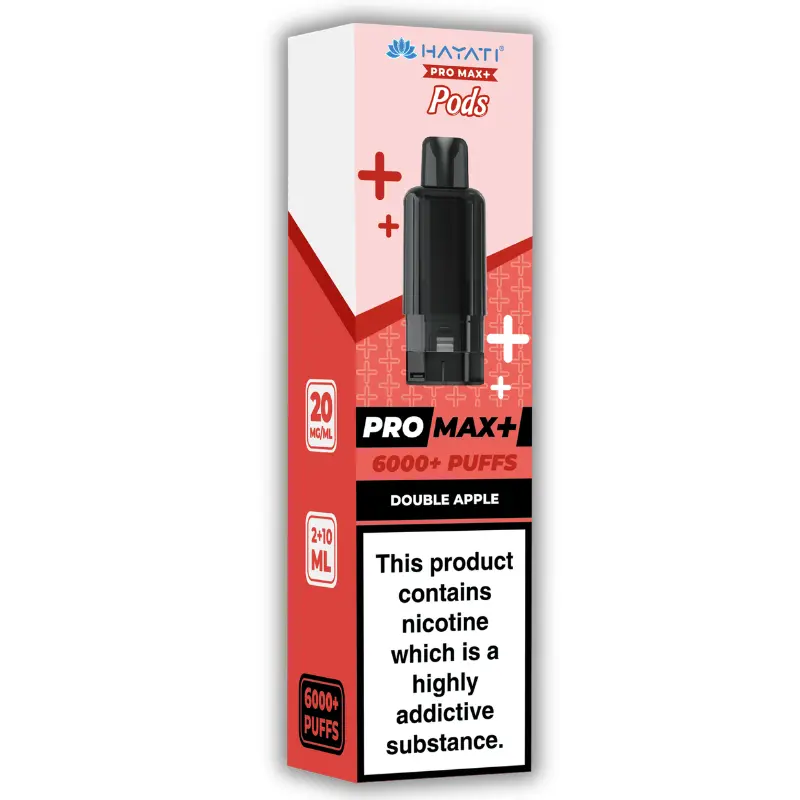
Hayati · Pro Max Plus
Double Apple Hayati Pro Max Plus Pods
£5.49
✔ In stock — ready to ship
Genuine Hayati
Free over £20
Same-day dispatch
Secure checkout
Double Apple Hayati Pro Max Plus Pods is the refill on its own: one prefilled pod, £5.49, holding 12ml of nicotine salt at 20mg, with no device supplied. It seats in a Hayati Pro Max Plus body you already have. Hayati put a manufacturer rating of up to 6,000 puffs against the filled pod, and that figure comes off laboratory equipment rather than off anybody's actual week, so treat it as a bench measurement and nothing more. Everything in that paragraph is ordinary. The listing is one of eighty-nine on the Hayati Pro Max Plus Pods shelf, all at the same price, all the same physical object with different liquid inside.
The interesting part is the two words at the front, because they are borrowed words with a settled meaning, and the meaning is not the one they appear to have.
Read cold, "Double Apple" looks like a claim about intensity. Twice the apple. Apple turned up. That reading is wrong, and it is wrong in a way that matters at the point of purchase, because the phrase was not coined to describe strength. It came into English from the flavour vocabulary of the shisha tobacco trade, where it names a specific construction rather than a quantity: two different apple characters laid over one another, and, in the classic version of the recipe, a third component underneath the fruit that is neither apple nor anything like it. That third component is aniseed.
Which produces the problem this page exists to solve. Two different buyers arrive at this listing with two incompatible expectations, both reasonable. One has never met the phrase before, reads it as an intensity claim, orders it, and is thrown on the second draw by something that tastes faintly of liquorice. The other knows the tradition perfectly well, orders it expecting the anise, and finds a pleasant apple liquid with nothing underneath it. One of those two buyers is going to be disappointed by any given bottle or pod sold under the name, and the name alone cannot tell you which.
So this page does three things. It sets out what the term means in the place it comes from, and why the recipe is built that way. It then checks, carefully and with the actual numbers, whether Hayati's own copy for this listing says anything at all about aniseed or liquorice, because that is the single fact that decides which of the two products you are buying. And it marks, explicitly and every time, the line between what is established about the term and what is inference about this particular liquid. One further thing should be said at the outset and not repeated: this is a nicotine vape liquid in a prefilled pod. It is not a tobacco product, it contains no tobacco, and the only connection to the tradition described below is that a flavour name travelled out of it. Nothing on this page is about anything other than where a phrase on a label came from.
The phrase, and what it was built to mean
It is a recipe, not a dial setting
Start with the arithmetic reading and dispose of it. "Double" here is not doing the job it does in "double strength" or "double espresso". It is doing the job it does in "double act": two of a thing, working against each other, producing something neither could produce alone. The two apples in a traditional double apple are not the same apple served twice. They are chosen to be different, and the difference is the point.
One is the ripe, red-fleshed register. Soft, full, slightly perfumed, the character of an apple that has been sitting in a warm room for a few days. The other is the green register: hard, acidic, stalky, the character of an apple picked a fortnight early. Those are not two intensities of one flavour. They are two chemically distinct things. Ripe apple is carried largely by esters, light volatile molecules that arrive fast and leave fast. Green apple is carried by a different family, the six-carbon aldehydes, which is the reason an unripe apple reads as grassy and slightly bitter rather than as a weaker version of a ripe one. Layering the two gives you an apple with a top and a bottom to it instead of a single flat note.
That much of the construction survives into almost every product carrying the name, and it is the part Hayati describe. But it is not the whole recipe.
Why there is a third thing in it
Even with both apple registers stacked, apple is a short flavour. The esters that carry the ripe side are among the most volatile aroma compounds used in flavour work, which is exactly why they read as fresh and immediate, and it is also why they are gone within a couple of seconds. You can add as much apple as you like and the flavour still ends abruptly. It has no tail.
The classical fix is anethole, the aromatic compound that defines aniseed, star anise and fennel, and which is also the thing that makes liquorice confectionery taste the way it does. Anethole has two properties that make it useful to a blender working with fruit. The first is that it registers as sweet in its own right, and substantially sweeter per unit than sugar, so a small quantity lifts the perceived sweetness of everything around it without adding body. The second is persistence. Where the apple esters flash and vanish, anethole hangs on the soft palate and keeps signalling for ten or fifteen seconds after everything else has stopped. It also carries a faint cool sensation that is not menthol and should never be confused with one.
Put those together and you understand why the traditional blend is shaped the way it is. The two apples supply the arrival and the body. The anise supplies the finish that apple cannot supply for itself. That is the architecture, and the name refers to the architecture, not to how much apple is in it.
How the term drifted, and why nobody standardised it
Nothing polices flavour names. When the phrase migrated from one trade into e-liquid, it migrated as a name rather than as a specification, and producers took it in two directions at once.
One group kept the whole structure. Those liquids have the anise sitting well forward, sometimes nearly level with the fruit, and they taste recognisably like the thing the name descends from. The other group read the two words at face value, exactly as a first-time buyer does, and built a liquid with two apple characters and no third element at all. Both ship. Both are sold under the same two words, on the same shelves, at the same prices. Neither is a fake, because the phrase has no owner and no definition anyone is obliged to honour.
The consequence for a buyer is unglamorous but concrete: the name has roughly the information content of the word "punch". It tells you a category and a rough direction and it does not tell you the ingredient list. If the anise matters to you in either direction, as something you want or as something you avoid, the name is not the place to find out. The description is, and only if the description bothers to say.
What Hayati put on the record for this pod
Everything they state
Here is the whole of the manufacturer's flavour commitment for this listing, laid flat with nothing added.
- Two apples are layered together rather than one apple used twice.
- One of them is crisp and a little sharp.
- The other is sweeter and riper.
- The combined result is fuller and rounder than a single-apple flavour manages.
- The character is described as deeper and more mellow than a tart green-apple liquid.
- It is positioned as a less sugary fruit profile.
- They acknowledge the name will be familiar from shisha menus.
And the commercial and physical facts: 12ml in the pod, nicotine salt at 20mg, £5.49, no device included, a manufacturer rating of up to 6,000 puffs measured on laboratory equipment.
Everything they leave out
This is the list that decides the purchase.
- Aniseed. Not mentioned.
- Liquorice. Not mentioned.
- Anise, star anise, fennel. None of them appear, in any form.
- Any non-fruit component whatsoever. No spice, no herb, no botanical, no beverage base.
- Menthol, ice, koolada or any coolant. Nothing cooling is named and nothing cooling is in the product name.
- A VG/PG ratio. Not published for this listing.
- Coil resistance. Not published for this listing.
So the answer to the question the name raises is that Hayati say nothing about anise on this pod. Their entire flavour description accounts for two apples and then finishes. The acknowledgement that the name comes off a shisha menu is the closest they come to the tradition, and it is an acknowledgement about where the words came from, not a statement about what is in the liquid.
Corroboration, because silence on its own is weak evidence
A description that fails to mention something is ordinarily poor evidence that the thing is absent. Copy gets trimmed. Flavour houses keep secrets. The reasonable default would be to shrug and call it unknown.
Except that in this case the silence can be tested, because the same manufacturer writes copy for four hundred and ninety-two other listings in this catalogue, and we can ask whether Hayati are the kind of writer who mentions aniseed when aniseed is present.
They are. Across the whole catalogue, two listings name it. Both are the H'Berg / P'Man pairing in the Pro Ultra Plus line, and the copy is not coy about it: one of the two describes a subtle aniseed note running quietly underneath the fruit and giving the blend a herbal depth, and the other describes a hint of aniseed sitting behind the fruit with a faintly liquorice-like edge. That is a manufacturer who, when there is anise in the mix at a level low enough to be called a hint, writes the word down anyway and then explains what it does. Twice.
The second piece of corroboration comes from the tradition itself, or rather from what Hayati think the tradition tastes like. Three listings in this catalogue carry the word Shisha in the product name, and all three are built on the same flavour: Apple Mint Grape, with one of them adding Peach Grape Mint alongside it. Hayati's own reading of that register, stated in a product name rather than inferred by anyone, is apple plus grape plus mint. Not apple plus anise. When they set out deliberately to make something in that style, mint is the structural element they reach for.
There is a third, smaller point. The listing's own tags are apple, double apple, and nicotine salt e-liquid. No anise tag, no spice tag, no botanical tag.
Where the established meaning stops and inference begins
Everything above this heading is checkable. The meaning of the term in its original context is documented; the contents of Hayati's description are quotable; the counts across the catalogue are counts. What follows is reasoning, and it should be read as reasoning.
The inference. Given that Hayati name aniseed in plain language when it is present, given that they did not name it here, given that their own house interpretation of the shisha register is mint-led rather than anise-led, and given that every element they do describe for this pod is fruit, the probable answer is that this liquid is a two-apple blend with no anise component. Probable. Not certain, and not something the manufacturer has stated.
What would make that inference wrong. A blender can use anethole below the level at which marketing bothers to mention it, purely as a sweetness lifter and a finish extender, and describe the result as a rounder, mellower apple, which is precisely the phrasing Hayati use. That is a real technique and it is not dishonest of a copywriter to skip it. So the inference is not airtight, and anybody who tells you it is has stopped reading the evidence and started selling.
Setting it out as confidence bands, which is the honest way to hand it over:
- Reasonably confident: two distinguishable apple characters, one leaning sharp and green, one leaning ripe and sweet, blended to read as one fruit rather than as two taking turns.
- Reasonably confident: no cooling agent. Hayati name the coolant in the product title every single time they use one across this shelf, and there is none in this title.
- Reasonably confident: sweetness pitched below confectionery level. They say so directly, and they describe it as the less sugary option.
- Probable: no perceptible aniseed. The reasoning is three paragraphs above and it is an inference from Hayati's own habits as a writer, not a specification.
- Unknown: whether a trace of anethole is present below the threshold at which they would write about it.
- Unknown: the VG/PG ratio and the coil resistance in this pod, neither of which Hayati publish for this listing.
If the anise is the entire reason you clicked, that fourth line is your answer and it is not a yes. The buyer who needs the anise confirmed before spending money cannot have that confirmation from this listing, and the sensible thing is to say so rather than to write a tasting note nobody can stand behind.
The apples themselves, which is most of what you are buying
The ripe half
Taking Hayati at their word, the sweeter and riper of the two apples is what gives the liquid its middle. This is the register that reads as juice rather than as fruit: rounded, a little soft, with the faint floral quality ripe apple develops. It occupies the centre of the tongue and it arrives early, because the compounds responsible are the lightest in the blend and get to you first.
Body is the word for what it contributes. A single sharp apple flavour on its own tends to feel hollow, all edge and no centre, which is exactly what Hayati are distinguishing themselves from when they say this is deeper and more mellow than a tart green apple. The ripe half fills the hole in the middle. It is also, and this matters later, the half that degrades first as a coil tires, because volatility cuts both ways.
The sharp half
The crisp apple does the cutting. Its job is acidity and a snapped-stem freshness that keeps the ripe half from turning syrupy, and it registers along the sides of the tongue where sourness lands rather than in the middle. It should arrive fractionally behind the sweet note and then sit alongside it through the rest of the draw.
Note what Hayati do not claim: they do not say this side leads. The description has neither apple dominating, which is a genuine statement of intent on a shelf where most blends have an obvious front and an obvious back. It also sets a realistic expectation about volume. A flavour engineered so that two components balance is, by construction, a flavour where nothing shouts. If you want to be hit in the face, this is not built for it, and a pod such as Black Mamba Hayati Pro Max Plus Pods or Blue Razz Cherry Hayati Pro Max Plus Pods will get you there faster.
Through a single draw, and the test you can run inside it
On a well-wetted wick the sequence should run roughly as follows. The opening is sweet fruit, immediate, arriving before you have finished the inhale. Through the middle the green character builds underneath it and the texture dries out slightly. By the exhale the two have merged and you are tasting one apple with depth rather than two apples in sequence.
Then comes the part worth paying attention to, which is the three or four seconds after the vapour has gone.
If this pod contains no anise, the finish drops away quickly and it drops away as fruit. Apple fades, the mouth returns to neutral inside a couple of seconds, and nothing is left behind except a slight dryness from the acidity. That is the clean ending of a pure fruit liquid and it is what the evidence above predicts you will get.
If there is anise in it, even a trace, the ending behaves completely differently. Something sweet stays on the soft palate after the apple has gone, it lasts noticeably longer than it should, it carries a faint chill that is not the chill of menthol, and it tastes very slightly medicinal in the way liquorice does. You will not need to concentrate to notice it. Anethole is not a subtle compound at the finish even when it is subtle at the front.
So the question resolves itself on your first draw, without any tasting vocabulary and without comparing it to anything. Draw, exhale, then wait five seconds and pay attention to whether your mouth has gone quiet. Quiet means two apples. Still talking means three components.
Sweetness, placed against the shelf
Hayati position this below the sugary end and describe it as suiting anyone who prefers a less sugary fruit. In practice that should put it around bottled apple juice rather than around confectionery, and it is a meaningfully different place from where a good part of this shelf sits.
The sweet-led end of the Pro Max Plus pod range is easy to identify because it announces itself in the names. Hubba Bubba Hayati Pro Max Plus Pods and Blueberry B'Gum Hayati Pro Max Plus Pods are both built to read as sweets and neither pretends otherwise. Cherry Cola Hayati Pro Max Plus Pods sits in the same sugared territory by way of a beverage base. Against those three, a juice-level apple is a noticeably drier proposition, and if you have been finding the sweeter pods heavy by the middle of the afternoon, that gap is the reason to look at this one.
The reverse is also worth saying plainly. If you like the sweet end, this will read as underpowered rather than as refined. Dryness is a preference, not an achievement, and Hayati are describing a preference.
There is no ice in it, and the absence is deliberate
Nothing cooling is named anywhere in this listing, and on this particular shelf that is a reliable signal rather than an omission, because Hayati are rigidly consistent about labelling cooled pods in the title. Blackberry Ice Hayati Pro Max Plus Pods, Banana Ice Hayati Pro Max Plus Pods, Lychee Ice Hayati Pro Max Plus Pods, Cola Ice Hayati Pro Max Plus Pods and Blue Frozen Hayati Pro Max Plus Pods all put the cooling in the name. Kiwi Cooler Hayati Pro Max Plus Pods does it with a different word and the same intent. This pod does none of that.
Freshness and cold are separate sensations and the distinction is worth keeping hold of here, because an apple flavour with an acidic green half will read as fresh without being cold at any point. The brightness comes from acid. A chill comes from a coolant and there is no coolant listed. If you want apple with an actual cold exhale, Red Apple Ice Hayati Pro Max Plus Pods is the pod that does that, at the same £5.49, and it is the only other apple on the shelf.
What this is not
It is not a sour liquid. Sharp and sour are different targets, and the description points at acidity balancing sweetness rather than at the deliberate pucker a sour flavour aims for. Nothing in the range that is meant to be sour is shy about saying so in the name.
It is not a baked apple, a toffee apple or an apple pie. There is no pastry element, no caramel, no cinnamon, no spice of any description named. Everything Hayati specify is fresh fruit.
It is not a beverage flavour. Where Blackcurrant Juice Hayati Pro Max Plus Pods and the lemonade pods build the drink format into the profile, this is fruit presented as fruit.
And, on the published evidence, it is probably not the full traditional construction that the name descends from, for all the reasons set out above. It carries the name because the name is now the ordinary consumer term for two apples in one liquid, and the association came along attached to it.
The pod, in the few sentences it needs
What arrives is one prefilled pod and nothing else. No device, no cable, no spare. The liquid, the wick and the coil are all inside a single moulded unit that you fit to a Hayati Pro Max Plus body, use, and then replace as a whole when it is finished. Hayati publish no coil resistance for this listing, so the tightness of the draw is a property of the pod you receive and not something you can look up before ordering. Check that the range name on your device matches the range name in this product title before you order, because different Hayati ranges take different pods.
The one number that actually changes how this liquid behaves is 12ml, and it changes it by changing the timescale. A 12ml pod is a commitment of a different order from a small refill. You are not sampling a flavour, you are living with it for however long 12ml takes you, and you cannot decant it, dilute it or rescue the liquid if the flavour turns out not to suit. That is the practical weight behind the anise question: on a bottle you could test the hypothesis for the price of a coffee and abandon it. Here, resolving the question and disliking the answer leaves you holding most of 12ml. It does not make the pod a bad buy. It does mean the question is worth answering before you order rather than after.
The same flavour is also sold as Double Apple Hayati Pro Max Plus 6000 Pod Kit at £7.99 with a device in the box. The difference between the two prices is hardware and nothing else, so the kit is the wrong purchase for anyone who already owns the body, and the right one for anyone who does not. Everything else about how the platform behaves, the charging rhythm, the airflow, the way the contacts wear, is covered on the Pro Max Plus pod shelf and its kit listings rather than repeated here, because none of it is specific to apple.
The figures, and what two of them are doing
Only what Hayati publish for this listing appears below. Where a row is empty it is empty because the specification is silent, not because it has been left out.
| Format | Prefilled replacement pod, device sold separately |
| Capacity | 12ml |
| Nicotine | 20mg nicotine salt |
| Strength options | 20mg only for this flavour |
| Manufacturer puff rating | Up to 6,000, a laboratory estimate |
| Flavour family | Apple |
| Coolant | None listed |
| Non-fruit components | None listed |
| VG/PG | Not published for this listing |
| Coil resistance | Not published for this listing |
| Fits | Hayati Pro Max Plus |
| Price | £5.49 |
Two rows in that table earn a comment and they are both rows about what is missing.
The "non-fruit components" row exists on this page and would be pointless on most others. It is there because the product name implies a non-fruit component and the specification does not list one, and a reader scanning a table deserves to have that contradiction put in front of them rather than buried. Empty means empty. It does not mean secret, and it does not mean confirmed absent either, for the reasons given further up.
The strength row is a list of one. There is no 10mg and no zero-nicotine version of this flavour. What exists instead are two undifferentiated strength listings, Hayati Pro Max Plus Prefilled Pods 10mg and Hayati Pro Max Plus Prefilled Pods Zero Nicotine, which sit on the apple shelf as family defaults rather than as this flavour at a different figure. If 20mg is not the number you want, no amount of hunting will produce Double Apple at another one. Twenty milligrams per millilitre is the maximum permitted in the United Kingdom for a consumer nicotine product of this type, so it is also the top of the range rather than an unusually high figure for it. Nicotine is an addictive substance. That strength is recorded here as a property of the pod and not as a recommendation, and nothing on this page suggests what figure suits any individual.
On price, the arithmetic is one line rather than a paragraph. Every pod on this shelf is £5.49 regardless of how complicated the blend is, which means choosing between them is a flavour decision and never a budget one. A two-part apple costs exactly what a single-note pod costs.
How it sits next to the alternatives
The apple shelf is much smaller than the word suggests
Apple is one of the most common flavour words in vaping and one of the least common actual shelves here. Apple Vapes runs to twenty-four listings across every format the site carries, and once you separate them out the variety thins fast: seven of the twenty-four are Red Apple Ice in different formats, three are Double Apple, four are the Sour Apple pairings, three are the Shisha-named products, and the remaining seven are strength-only listings that sit on the shelf as family defaults rather than as apple flavours in their own right.
Narrow it to the shelf this pod actually lives on and it narrows further. Of the eighty-nine listings on the Pro Max Plus pod shelf, exactly two name an apple: this one and Red Apple Ice. Everything else with "apple" in the title is a pineapple. So the choice, for a Pro Max Plus owner who wants apple, is genuinely a choice between two things.
Against Red Apple Ice, which is the only real comparison
The two apples on the shelf are aimed at different people and the difference is not subtle. Red Apple Ice Hayati Pro Max Plus Pods is a single apple direction, red and sweet, with a declared cooling element doing the work that the green half does here. This pod is two apple characters in balance with no cooling at all.
That produces a clean decision rule. If you want your apple cold, take Red Apple Ice, because no amount of acidity in this pod will produce a chill and the two sensations are not interchangeable. If you want apple with structure and a dry finish, and you would rather the freshness came from the fruit than from a coolant, this is the one. And if you want both cold and complicated, neither of them is quite it, and you are looking at the wider Hayati prefilled pods and refills listing rather than at the apple shelf.
If the finish is what you were actually after
Suppose you came here for the long, sweet, faintly medicinal tail that a traditional double apple has, and the reasoning above has convinced you that you probably will not find it. There is no aniseed-led pod on this shelf and it would be dishonest to point you at one that does not exist. What does exist is a set of pods where something non-fruit runs underneath the fruit and extends it, which is the structural job anise performs even though the mechanism is entirely different.
Blue Razz Mojito Hayati Pro Max Plus Pods runs mint and lime under a berry, and mint is the closest thing on the shelf to a herbal spine. Cherry Cola and Cola Ice use a spiced beverage base under the fruit, and cola bases carry their own botanical complexity that behaves a little like the thing you are missing. None of the three is a replacement for anise. If what you like is the idea of a fruit with something else woven through it rather than apple specifically, that cluster is where to look before you settle.
Sweeter, if this turns out too dry
Should the juice-level pitch land as thin for you, the shelf moves in the other direction easily. Hubba Bubba and Blueberry B'Gum are the confectionery reference points. Guava Kiwi Passion Fruit Hayati Pro Max Plus Pods is fruit rather than sweet but the fruits involved are soft and low in acid, which makes it read sweeter at a similar sugar load. Cherry Berry sits between the two.
Sharper, if it turns out too soft
Going the other way, the lemonades will out-cut an apple comfortably, because a lemonade structure keeps acidity running through the whole draw rather than concentrating it in the middle. Berry Lemonade Hayati Pro Max Plus Pods and Blackcurrant Lemonade Hayati Pro Max Plus Pods are the two straightforward options. Cherry Peach Lemon Hayati Pro Max Plus Pods stacks a citrus against two stone fruits and lands tarter than either. A green apple note is sharp measured against other apples and mild measured against a lemon, and calibrating that in advance saves a disappointment.
The dark fruits, and why they matter to an apple buyer
The largest block on this shelf is dark berry and blackcurrant, and it behaves nothing like apple. Blackberry Raspberry Hayati Pro Max Plus Pods, Blackcurrant Mango Hayati Pro Max Plus Pods and Blackcurrant Juice are the representative three: denser, jammier, sitting lower and later in the draw.
The practical reason an apple buyer should care is rotation. Apple is a light flavour and it loses every contest with a dark one. If you keep two Pro Max Plus pods on the go and alternate, the berry will carry through into the apple and not the other way round, so the apple session directly after a blackcurrant session is not a fair read of the apple. This matters more than usual here because you may well be trying to answer the anise question on those very draws. Run that test on a session that did not follow a dark fruit.
The opaque names, for contrast
Worth one paragraph, because it sharpens what is unusual about this listing. Blue Fusion Hayati Pro Max Plus Pods and Black Mamba are named for a mood and tell you nothing at all about the fruit. Double Apple is the opposite problem and in some ways the trickier one: the name tells you something quite specific, and what it tells you may not be true of the contents. A name that admits it is withholding information is easier to handle than a name that appears to be giving it.
Who should buy this pod
The verdict, stated plainly.
Buy it if you want an apple with two registers rather than one, pitched at juice sweetness, with no cooling, and you are either indifferent to the anise question or actively hoping the answer is no. That last group is larger than it sounds. Plenty of people dislike aniseed and have avoided anything called double apple for exactly that reason, and on the evidence assembled here this is probably the pod that lets them have the flavour without the thing they were avoiding. Probably, not certainly, and the distinction is the whole point of this page.
Buy it also if you already own the device, have had this flavour before and know what it does. A repeat buyer is the one person for whom none of the above is an open question, because they resolved it on their first pod. That is worth stating because it is the ordinary case for a replacement pod listing, and everything uncertain here is uncertain only for a first purchase.
Do not buy it if you need the aniseed confirmed before you spend money, because it cannot be confirmed from anything Hayati publish and 12ml is a poor size on which to run an experiment you might lose. Do not buy it if you want your apple cold, because that is a different pod. And do not buy it if you want a loud flavour, because a blend built so that neither half dominates is by design a quiet one.
On the first draw, expect this. Sweet apple arriving early, a green edge building behind it, the two merging by the exhale into one fruit with more depth than a single apple manages, moderate sweetness, no chill, and then a finish that goes quiet within a couple of seconds. If instead something sweet and faintly liquorice-like is still there after five seconds, the tradition survived into this pod after all, and you have learnt something the listing could not tell you.
Living with the pod
Most general pod advice applies and does not need setting out again. These are the points that change because the liquid is apple and because there is an open question attached to it.
Do not run your anise test on the first three draws. A pod that has just been fitted has a wick that is not fully wetted, and the component that suffers most from that is the volatile ester side, which is to say the ripe apple. On a dry-ish wick the blend reads thin, green and short, and a short finish is exactly the observation you are trying to make. Fit the pod, leave it standing for a few minutes, take half a dozen ordinary draws, and only then pay attention to what happens after the vapour goes. Judging the finish early will hand you a false negative.
Draw slowly and do not chain. A long slow draw through a narrow airway keeps the coil in its comfortable range and lets the two apple characters arrive in the order the blend intends. Pulling hard and repeatedly outruns the wick, and the first casualty is the sweet middle, which flattens the blend into its green half. On this particular liquid that reads as the flavour having changed rather than as the hardware struggling, which is misleading.
Watch for the sweet middle going, not for a burnt taste. Apple is an unusually good early-warning flavour for a tiring coil precisely because its most fragile component is also its most noticeable. A pod that is past its best will still deliver the green edge and the general impression of apple while the juicy centre has quietly gone, so it tastes drier and slightly hollow long before anything tastes scorched. Treat the loss of the middle as the signal. If you wait for the burnt note you have been vaping a spent pod for days.
Store it upright, capped and out of the light. Ester-driven fruit notes are volatile by definition, which is the same property that makes them arrive fast on the draw, and heat accelerates the loss. A pod that has spent a fortnight in a car will have lost part of its top end before you fit it, and the failure mode is a papery flatness where the juice used to be. A drawer at room temperature is all the storage this needs. Keep it out of reach of children and pets.
Temperature changes the balance you taste. Warm liquid is thinner, wicks faster and pushes more vapour per draw, which tips the perceived balance towards the sweeter half. The same pod in a cold room the next morning will read sharper and greener. That swing is normal, and it is more noticeable here than on a single-note pod because the whole design rests on two components of similar weight. If you are trying to characterise the blend, do it twice at different times of day before concluding anything.
A part-used pod is not a spare part. Once a pod has been fitted it holds liquid, a wetted wick and a used coil, and there is no way to empty it or to service it. If you take it off the device to run something else, put it somewhere upright where it will not be knocked, and accept that the flavour on the day you come back to it will have moved a little. Liquid sitting against a warm coil for a week steeps, and apple steeps towards its darker, jammier end.
When it is finished, it is waste electrical equipment. The coil makes it so, even though the pod carries no cell of its own. It does not belong in a household bin. A retailer take-back point or a local recycling centre that accepts small electricals is the right destination, and the pod should go there whole rather than opened.
Questions buyers actually ask about this one
Does Double Apple mean twice as much apple?
No. The phrase describes a construction rather than a concentration. In its original context it means two different apple characters layered together, one sharper and one riper, and traditionally a third element underneath the fruit. Reading it as an intensity claim is the single most common misunderstanding of the name, and it is the reason this page exists.
Is there aniseed in this pod?
Hayati do not say, and their silence is the honest answer rather than a dodge. Their flavour description for this listing covers two apples and stops, with no mention of aniseed, liquorice, anise or fennel. The probable reading, set out at length above, is that there is none, because Hayati name aniseed explicitly on the two other listings in this catalogue that contain it. Probable is not confirmed.
How would I tell, on my own pod?
By the finish, not the front. Take an ordinary draw on a properly wetted wick, exhale, and then wait five seconds without drawing again. A pure fruit blend goes quiet almost immediately. Anethole, the compound behind aniseed and liquorice, sits on the soft palate for ten to fifteen seconds and carries a faint cool, slightly medicinal quality that is not menthol.
Why is the name on the label if the flavour may not include the traditional third component?
Because flavour names are not specifications and nobody polices them. Double Apple has become the ordinary consumer term for two apple characters in one liquid, and producers apply it both to blends that keep the full construction and to blends that do not. Hayati themselves acknowledge the name is familiar from shisha menus, which is a statement about where the words came from rather than about what is in the pod.
Is there any ice or menthol in it?
No coolant appears in the specification and none appears in the product name, which on this shelf is a reliable signal because Hayati label every cooled pod in the title. The freshness the description points at comes from the acidity of the sharper apple, not from a cooling agent. For an apple with an actual chill, Red Apple Ice is the pod on this shelf that does it.
Is this the same liquid as the kit version?
It is the same flavour in the same 12ml format at the same 20mg. The difference between this listing at £5.49 and the kit at £7.99 is that the kit includes a device and this one does not. Anybody who already owns the body is paying twice for hardware by ordering the kit.
What strengths does this flavour come in?
One: 20mg nicotine salt, which is the maximum permitted in the United Kingdom for a consumer product of this kind. There is no lower version of this particular flavour. The undifferentiated 10mg and zero nicotine pod listings are separate products rather than this flavour at another figure.
How long will a pod last me?
Nothing in the specification answers that, because it depends entirely on how you draw and how often. Hayati rate the pod at up to 6,000 puffs, and that figure comes from laboratory equipment taking identical measured draws at fixed intervals, which is not how anybody vapes. Treat it as a comparison between pods rather than as a forecast of your week.
Can I refill it when the liquid runs out?
No. It is a sealed prefilled unit with the coil and wick inside, and there is no fill port and no serviceable part. When the flavour drops off and the pod is spent, it is replaced whole and disposed of as small electrical waste rather than in a household bin.
Will it taste different from a Double Apple I bought from another brand?
Very likely, and that is a property of the name rather than of either product. Because the phrase is not standardised, two liquids sold under it can differ on the most important axis, which is whether the third component is present. Comparing them tells you about those two blends and nothing about the category.
Does apple gunk a coil quickly?
Sweetener load is what shortens coil life in a pod, and Hayati position this below the confectionery pods on that scale, so it should be gentler than the sweet-led options on the same shelf. No sweetener figure is published, so that is inference from their own positioning rather than a stated fact. The first sign of a tiring coil on any apple is the loss of the juicy middle, well before anything reads as burnt.
Which shelves does it appear on?
It sits on the Hayati Pro Max Plus Pods shelf alongside eighty-eight other pods for the same body, on the Apple Vapes shelf as one of twenty-four apple listings across all formats, and in the New Products listing. The full range of replacement pods across every Hayati device is under prefilled pods and refills.
The short version
This is a 12ml prefilled pod of 20mg nicotine salt at £5.49, no device supplied, fitting a Hayati Pro Max Plus body, rated by the manufacturer at up to 6,000 puffs on laboratory equipment. The flavour is two apple characters held in balance, one sharp and green, one ripe and sweet, pitched at juice sweetness rather than sweet-shop sweetness, with no cooling agent listed and none implied by the name.
The name is the part that needs care. Double Apple is a borrowed term with a settled meaning in the trade it came from, and that meaning is a recipe rather than a quantity: two apples, and classically an aniseed note underneath them supplying a finish that apple cannot supply for itself. Hayati's description of this pod names the two apples and says nothing about anise, liquorice or any other non-fruit component. Set against the fact that they write the word aniseed plainly on the two listings in this catalogue that contain it, and that their own Shisha-named products are built on mint and grape rather than anise, the probable conclusion is that this is a two-apple liquid without the third element. That conclusion is an inference from how Hayati write, not a specification, and it is labelled as one everywhere it appears above.
Which leaves a clean recommendation. If you want a rounded, moderately sweet, uncooled apple with more structure than a single note, this is a sound £5.49 and one of only two apples on its shelf. If you specifically want the aniseed, buy it knowing you are testing a hypothesis on 12ml rather than confirming a fact, and the finish on your first draw will tell you the answer within five seconds.
Strictly for adults aged 18 and over. Nicotine is an addictive substance.
You might also like


