
Home / Hayati Pro Max Nic Salts / Lemon Lime Hayati Pro Max Nic Salt
Hayati · Pro Max
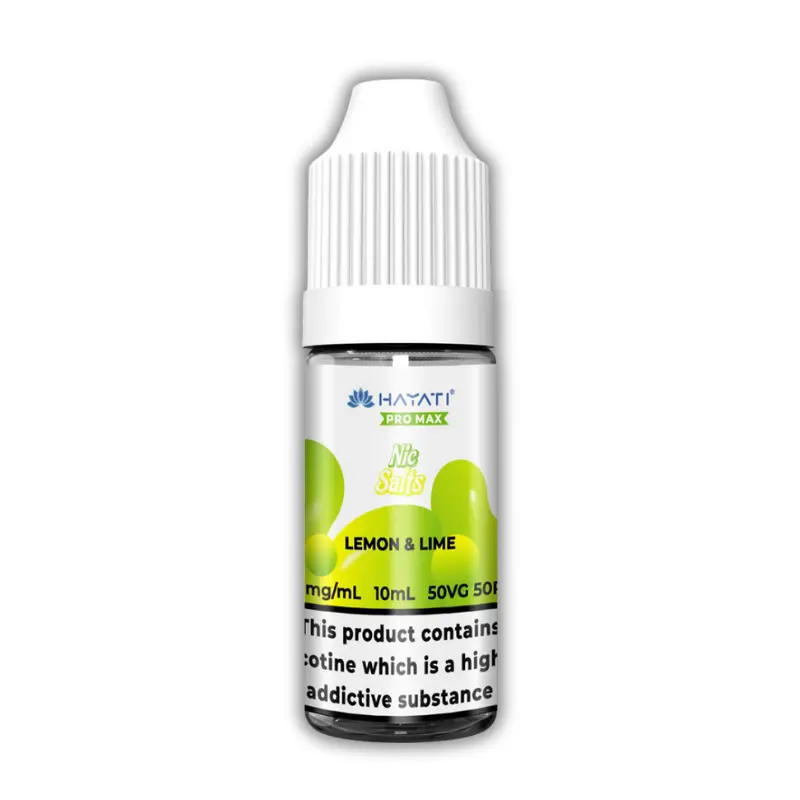
Lemon Lime Hayati Pro Max Nic Salt
£2.49
✔ In stock — ready to ship
Genuine Hayati
Free over £20
Same-day dispatch
Secure checkout
Two pounds forty-nine buys ten millilitres of lemon and lime at ten milligrams of nicotine salt, mixed at an even split of glycerine and glycol, intended for a refillable pod or a restricted mouth-to-lung kit. On the numbers alone there is nothing here to write about. All 65 bottles on the Hayati Pro Max Nic Salts shelf carry the same strength, the same ratio and the same volume, and 64 of them carry the same price, so the specification panel is identical across the range and tells you only which flavour you picked.
What is not identical is the last sentence of the listing. Hayati end this one by telling you to begin at the bottom of the power your device offers and bring it up until the taste lands, and then, unusually, they say what happens if you do not: run a nic salt too hot and it will "mute the fruit and harshen the draw". That is a consequence rather than a preference, and it is the only consequence of its kind printed anywhere in the 492 listings this site sells.
It matters more on this bottle than it would on almost any other, because the symptom Hayati describe is the same symptom this catalogue has already pinned on something else entirely. A lemon-lime that has gone quiet at the finish is the classic presentation of a coil carrying too much residue, and the Lemon Lime Rubik kit page works that through at length: the lime is the light half, it is the first thing a loaded coil stops carrying, and what you are left with is not a weaker lemon-lime but a plain lemon, a profile Hayati decline to sell in any of their 492 listings. That page is right and this one does not rebuild it.
Put the two together and this bottle gives you two independent routes to one silent failure. One of them is caused by heat, arrives without warning, and reverses on the next draw. The other is caused by accumulated residue, arrives gradually, and does not reverse at all. They taste the same. The whole job of this page is to make them separable, because a buyer who reads the first as the second throws away hardware that was working perfectly.
What the listing actually says, and what I found when I counted it
The claim I was handed for this page was that two listings out of 492 tell you how to operate the product, and that this is one of them. I counted, and it is not true. It is not even close to true, and the correction turns out to be more interesting than the claim was.
Operating instructions are ordinary; this one is not ordinary in the way I was told
Plenty of Hayati listings tell the buyer to do something. Eight tell you to let a wick soak before the first draw. Seven tell you to shake a shortfill after adding a shot and leave it to settle. Six mention keeping a bottle upright, four say something about storage, and the nicotine pouch listings give step-by-step placement instructions that are more explicit than anything on the liquid side of the catalogue. If the test is whether a listing tells you how to handle the thing you bought, dozens pass it, and any page built on the idea that only two do would be building on sand.
So the claim narrows. Here is what survives counting, stated as numbers rather than as an impression.
- Four listings in 492 tell you to set your power at the bottom and adjust upward. All four are bottles on this same 65-strong shelf. They are this one, Blue Frozen, the plain Menthol bottle, and Blue Razz Lemonade. Not two. Four.
- Three of those four treat the dial as a taste preference. Blue Frozen tells you to adjust until the balance of fruit and chill suits you. Menthol says until the chill suits you. Blue Razz Lemonade says, simply, to taste. Each of them describes an instrument for arriving at what you personally like, and none of them suggests there is a wrong answer.
- One of the four names a failure. This listing does not say adjust until it suits you. It says the flavour will be muted and the draw will get harsher if you overdo it. That is the difference between a volume knob and a warning, and it is the entire reason this page exists.
- Three listings in 492 pin a faded flavour on the coil. Strawberry GB, Blue Sour Raspberry and the Blue Razz Gummy Bear shortfill each tell you that when the taste dulls it is the element that needs replacing. None of them mentions power. None of them is a Lemon Lime listing.
- Not one listing in 492 names both causes. The catalogue contains both diagnoses and never puts them in the same place, which means a buyer who reads the listings straight through will come away with one explanation for a symptom that has two.
So the narrowed version of the angle, and the one this page is written on, is this: the rarity is not the instruction, it is the consequence attached to it. On the count above, this is the only listing in the range that says heat takes flavour away, and it is the only place where the heat explanation and the residue explanation of the same symptom come within reach of each other. I have said what I narrowed it to because the original framing would have had me telling you something false about 490 other listings on the way to telling you something true about this one.
The conjunction is the useful part
Read Hayati's warning closely and it is not one symptom, it is two, joined by an "and". The fruit goes quiet. The draw gets rougher. Those two things are asserted as a pair, arriving together, from a single cause.
That pairing is the most practically valuable thing on the listing and it is easy to skim past. Residue does not produce the pair. A coil carrying a fortnight of cooked sweetener removes the light aromatic material and leaves the acid and the body behind, so the draw goes hollow while remaining perfectly smooth. Heat produces both at once, because the same excess energy that is destroying the delicate top of the profile is also cooking the carrier and roughening what reaches your throat.
One symptom or two, then, is a discriminator you can run on any draw at no cost, and it comes out of Hayati's own sentence rather than out of anything I have inferred. If the finish has gone and the draw is otherwise as comfortable as it ever was, heat is not your problem. If the finish has gone and the draw has developed an edge, it very probably is.
Why the warning is on this bottle and not on the other sixty-four
Hayati do not explain their editorial decisions and I am not going to pretend to know why one bottle in 65 got a caution the rest did not. What can be said is that if you were going to attach one, this is a sensible place for it. A liquid with two components and no sugar under them has no capacity to absorb a fault. Everything the coil does to it is audible immediately, because there is nothing else going on in the glass for the fault to hide behind. The next section is about that absence, since it is also the reason the flavour is worth buying.
Two fruits, no floor, and why the emptiness underneath is the point
The draw-by-draw analysis of this liquid belongs to the Lemon Lime Rubik kit page and I am citing it rather than writing it again: lemon takes the front of the draw and carries the acid, lime lands at the close with a green, faintly bitter edge, and the lime is the fragile one. That is settled. What has not been examined is what sits underneath the two of them, which turns out to be nothing at all, and what that costs and buys.
The absence, stated flatly
There is no sweetener doing structural work here. There is no coolant. There is no cream, no biscuit, no candy accord, no soda fizz and no third fruit softening the join. Nine of the eleven listings Hayati write for this liquid make the point in one form or another, and the language is consistent enough across eleven independently written descriptions that it is close to a fact rather than a copywriting habit.
There is some sweetness. It is not a dry liquid in the sense that an unsweetened tobacco is dry, and the listing itself says the lemon side is the slightly sweeter of the two, which is true of the fruits as well as of the flavouring. What there is not is a separate sugar layer running underneath both fruits and independent of them. The sweetness such as it is belongs to the lemon, arrives with the lemon, and leaves when the lemon does. Nothing in the recipe persists after the two fruits have finished.
What the absence buys you
The advantage is the one the listing leads with, and it is a real advantage rather than a sales line: the profile does not accumulate. A sweetened liquid deposits a little sugar on your palate every draw, and after an hour the palate has adapted to the level and stopped reporting it, at which point everything tastes flatter and the usual response is to draw harder. That is the mechanism behind flavour fatigue, and it is why so many people keep a sharp bottle in the rotation. This one is that bottle. The acid clears rather than coats, so the hundredth draw of a session reads at roughly the same intensity as the tenth.
It is also the reason the liquid works as a reset. Someone who spends most of their week on Gummy Bear or H'Bubba is running a heavily sugared profile, and after a few days the palate stops hearing the top of it. Two or three fills of something acidic and unsweetened restores the contrast. That is a use for this bottle that has nothing to do with whether you like citrus best.
What the absence costs you
The cost is that there is no reserve. Anything that goes wrong shows up on the first draw it goes wrong on, because the recipe has no second layer to keep the mouth occupied while the first layer is failing.
Consider what happens to a sweetened neighbour when it gets too much heat. On Pink Lemonade or Berry Lemonade, the first thing extra energy does is bring the sugar forward. The top of the profile is being damaged at the same time, but the damage is partly concealed, because the thing arriving in greater quantity is louder than the thing departing. The liquid becomes rounder, heavier and less articulate, and most people register that as a change of character rather than as a fault. They may even prefer it.
Here there is nothing to come forward. The lemon acid is already fully present at the lowest setting that produces vapour at all, because acid does not need much energy to reach you, and the lime's aromatics are the part being destroyed. Add energy and one side of the balance is unchanged while the other side is subtracted from. The profile does not become richer or heavier. It becomes a sour front with an unfinished back, which is a different and less pleasant thing than a rounded liquid, and there is no reading of it under which it is an improvement.
What "harsher" means when nothing is absorbing it
The second half of Hayati's warning deserves the same treatment. A rough draw on a sweet liquid is softened by the sweetness, quite literally: sugars in the aerosol coat the mouth and take the edge off a hot mouthful. That is why a heavily sweetened blend can be run warmer than its specification suggests before anyone complains.
Strip the sugar out and the edge arrives undiluted. What you get is not a burnt taste, which is a later and much more obvious stage, but a scratchy dryness at the back of the throat on the exhale, sitting where the lime's green finish used to be. The two changes occupy the same moment in the draw, which is what makes them easy to confuse with each other and worth separating: the lime has gone from the finish, and something uncomfortable has moved into the space it left.
The two failure states, described so you can tell which you are holding
Both end with a quiet lime. They do not end with the same mouthful.
A heat-degraded draw is loud at the front, bright to the point of being shrill, short, and finished with a dry scratch. The acid is intact or even exaggerated because it is the component least affected. The sensation is of a liquid being pushed rather than one running out.
A residue-degraded draw is quieter overall, comfortable throughout, and simply stops early. There is no scratch, no dryness and no edge. The word people reach for is hollow. Nothing has been added; something has been removed and the space has been left open.
Hold those two descriptions side by side and the practical question becomes answerable, which is the subject of the next two sections.
One symptom, two causes, and only one of them is an accident you can undo
The reason this matters commercially rather than only technically is that the two causes have completely different price tags, and the cheap one masquerades as the expensive one.
The residue route, in brief, because it is not mine
Sweetener and heavier flavour compounds bake onto a heated element over time and form a layer that the liquid has to cross. The layer filters by weight, so the lightest and most volatile material stops arriving first, and on this liquid the lightest material is precisely the half that gives it its name. The Rubik kit page sets out the signal, the order in which the finish disappears, and a rule for when to retire a pod that accounts for the liquid you will be discarding. The Lemon Lime Vapes shelf establishes the underlying naming evidence, that lime is always printed second because it arrives last. Both findings are taken as read here and neither is re-derived.
Two properties of this route matter for what follows. It is cumulative, meaning it only ever gets worse and never spontaneously improves. And it is a function of how much liquid has crossed the element, not of how long you have owned it or how the device is set.
The heat route, which is what this listing is warning about
Excess energy at the element does two things at once to a liquid of this construction. It destroys light aromatic material before that material can leave the wick, and it begins to cook the carrier, which is where the roughness comes from. Neither effect requires any residue to be present. Both can occur on the very first fill of a brand-new element, within a handful of draws, on a device that has never carried anything sweet.
Two properties of this route also matter. It is instantaneous, in that it is a property of the current setting rather than a history, and it is symmetrical, in that lowering the setting removes it completely and immediately. The liquid is not damaged. The liquid still in the bottle was never involved. What was destroyed was the small quantity in the wick at the moment of the draw, and the next draw at a lower setting is made from fresh liquid.
Why they are so easily confused
They both remove the same material from the same place in the draw, so the primary complaint is word-for-word identical: the lime has gone. They can coexist, since an element with a fortnight on it can also be run hot. And the natural response to a quiet flavour makes the diagnosis harder rather than easier, because most people, on finding a liquid has gone faint, turn the power up.
That response is exactly wrong on this bottle, and wrong in both branches. If the cause is heat, more heat deepens the fault you already have. If the cause is residue, more heat cooks the deposit harder and shortens whatever life the element has left, while adding a roughness on top of the hollowness so that you now have both problems. There is no version of this liquid where turning it up when the lime goes quiet is the correct move, which is a strong enough statement that it is worth being sure of, and it follows directly from the fact that the missing component is the light one in both cases.
The asymmetry of getting it wrong
Mistaking heat for residue is the expensive error. You conclude the element is finished, discard a perfectly serviceable one, fit a replacement, run it at the same setting, and get the same result within a fill. Some people repeat this two or three times before concluding the liquid is at fault, at which point they abandon a bottle that never had anything wrong with it. The bottle is £2.49 and the element is not, so the arithmetic is unfavourable in the wrong direction.
Mistaking residue for heat is the cheaper error but not a free one. You spend a week reducing the power in search of a lime that is not coming back, and because a lower setting lifts less aroma out of a partly blocked wick, the liquid gets quieter as you go. You end up running the last few millilitres of the bottle in its worst state and forming a poor opinion of a flavour you were tasting through a spent element.
Separating them, without discarding anything to find out
Three questions settle it in most cases. None of them costs more than a single draw, and they are worth running in this order because the first one is usually decisive on its own.
One: which way does it respond?
Reduce the power by a meaningful amount, not a token one, and take a draw. The direction of the response is the diagnosis, and the magnitude is irrelevant.
If the green finish comes back, even partially, and the scratch on the exhale disappears, the cause was heat. It will come back on the first draw or the second, not after a period of recovery, because nothing needed to recover. Bring the setting up again gently from there and stop below the point where the finish starts to thin.
If the draw simply becomes weaker in every respect, with the lemon fading along with everything else and no green edge reappearing, the cause is not heat. A blocked element gives you less of everything at lower power, because the constraint was never energy. That is a different response and it is not a subtle distinction once you know to look for the direction rather than for an improvement.
The reason this works is that the two causes respond oppositely to the same intervention, which is the strongest kind of test available and the one most people never run because the instinctive intervention is the other way round.
Two: how much liquid has crossed this element?
Residue is an accumulation and accumulations have a floor. A wick that has processed a couple of millilitres of a sweetener-free citrus is not carrying a filtering layer, whatever else may be wrong with it, so a quiet finish early in the life of a fresh element is almost never residue. If the fault appeared within the first fill or two of fitting one, you can set that explanation aside without testing it.
The converse is weaker and worth saying so. A long-serving element does not prove residue, because a long-serving element can also be run hot, and in fact frequently is: people raise the power gradually as a coil ages to compensate for what it has stopped delivering, which is how both faults end up present at once. So the odometer question rules one answer out cleanly and never rules one in.
Worth noting that this liquid is unusually kind to an element in the first place. With no sugar load to cook onto it, a citrus like this deposits far less than Blackcurrant Lemonade or Blue Sour Raspberry would over the same volume. Which cuts both ways: residue is a less likely explanation here than it would be on a sweet bottle, and correspondingly, heat is a more likely one. If you have run sweet liquids for years and formed the habit of blaming the coil, this is the bottle where that habit will mislead you.
Three: is the draw rough, or only empty?
This is the free one, available on any draw without changing anything, and it comes straight out of Hayati's conjunction. Heat delivers a pair of symptoms. Residue delivers one.
Pay attention to the exhale specifically and to the back of the throat rather than to the tongue. A dry scratch there, arriving at the same moment the finish should have arrived, is the signature of the heat route. Comfortable air with nothing in it is the signature of the other. If you have been chain-drawing, wait a few minutes before judging this one, because a rapid cadence produces its own roughness independent of the setting and will give you a false positive.
Reading the three answers together
- Finish returns on lower power, scratch present, element newish. Heat, unambiguously. Settle at a lower setting and the bottle is fine.
- No return on lower power, no scratch, element well used. Residue. The element is done and the Rubik kit page's argument about acting on the signal applies.
- Partial return on lower power, scratch present, element well used. Both. Drop the setting first, since it is free, then replace the element and resist putting the setting back where it was.
- No return, no scratch, element newish. Neither. Something else is wrong, most likely a dry or badly seated wick, or a palate that has been sitting in a sweet liquid all morning and is not currently able to hear a light green note. Try it again the next day before concluding anything about the bottle.
That last row is worth taking seriously rather than treating as a catch-all. Your own palate is the least stable instrument in the chain, and a liquid whose distinguishing feature is a low-intensity aromatic finish is the one most exposed to that instability.
Why this is the one Lemon Lime listing where the question can be asked at all
Hayati sell this liquid eleven times over. The diff across those eleven descriptions belongs to the Rubik kit page and I am not repeating it. One structural fact from that set does belong here, because it is about the format rather than the copy: this is the only one of the eleven that contains a single word of operating guidance.
Eight of the eleven are sealed prefilled hardware, on the Pro Ultra Plus, the Pro Max Plus, the Rubik and the Mini Ultra. Their listings say useful things, but everything they say is about purchase rather than operation: whether a device is included, what a pod holds, what to check before ordering. Not one of them tells you to do anything after you have opened the box, and the reason is that there is nothing to tell you. The element is inside the pod, the output is set by the device, and no dial exists for the buyer to move.
On those eight formats both faults are real and neither is testable. If the lime goes quiet on a sealed pod you cannot lower the power to see whether it comes back, and you cannot replace the element without discarding the liquid it is sitting in. That is precisely why the Rubik kit page has to price a decision taken blind and build a rule with branches: when you cannot test, all you can do is act on a signal at the right moment and accept the cost of being early. Here you can test, so the rule that page derives is not the rule you need.
The remaining two of the eleven are bottles, and they do go into hardware you own, so it is fair to ask why neither of them carries the caution. The 70/30 is a 120ml bottle supplied without nicotine, built for sub-ohm tanks and direct-lung kits, where high power is the entire design intent rather than a risk to be managed. The 50/50 shortfill is also 120ml and also nicotine-free as supplied, so it needs a shot adding before it is the same proposition as this bottle at all. Neither listing says a word about setting anything. This 10ml is the only Lemon Lime that arrives at a usable strength, goes into a device with a dial, and comes with an instruction for the dial.
Which gives the £2.49 a job beyond being the cheapest way into the flavour. It is the only version of this liquid on which you can find out what your own equipment is doing to it, and the answer transfers: if you learn here that your setup runs the lime off the top of a citrus, that is worth knowing before you spend £11.99 on a sealed kit of the same recipe that cannot tell you.
The figures, and the one thing on the label that is wrong
| What is in the bottle | Lemon and lime, two components, no coolant named and no third fruit |
| Volume | 10ml |
| Nicotine | 10mg per millilitre, as a salt |
| Base | 50/50 glycerine to glycol |
| Price | £2.49 |
| Product code | HPM-NS-LEMON-LIME |
| Intended hardware | Refillable pods and restricted mouth-to-lung kits |
| Operating note on the listing | Begin low, raise until the taste lands, and do not overheat it |
| Not published | Coil resistance, target output, flavour house, batch or bottling date |
Take the strength row first, because it is the one that changes what you should expect. Ten milligrams is the lower of the two strengths this format is normally sold at in the UK, where twenty is the legal ceiling for a bottle of this kind. Every one of the 65 bottles on this shelf is ten, so there is no choice to make and no comparison to draw within the range. What ten milligrams means in practice is that it is a strength formulated around a device that produces a small mouthful of vapour per draw, which is the same class of device the base ratio is specified for. The two specifications are pointing at the same hardware from different directions.
The ratio row carries more weight on this bottle than the numbers suggest, and the argument for why a thin base suits a volatile fruit has already been made properly on Double Apple, which works through solvency, wicking speed and top-note survival in an even base. It applies here and I am pointing at it rather than restating it.
Now the label. The web address for this product ends in the plural, and the product's own title is singular. The title on the listing reads Nic Salt; the address reads nic-salts. Across the range, 45 of these bottles use the singular ending and 18 use the plural, with no pattern that would let you predict which, and the majority ending is the singular, so this is the sort of address that gets confidently mistyped into the right-looking wrong thing. The address as published is the working one and is not corrected anywhere on this page. It is worth flagging because a buyer arriving from a link reads the address before they read the title, and a listing whose two names disagree will be misread by real customers, not only by people writing about it.
The final row is the honest one. Hayati publish no target resistance and no recommended output for this liquid, which means the instruction to start low and raise it is given without a destination. That is not a criticism; a bottle sold into every refillable device on the market cannot name a figure. But it does mean the instruction is a direction of travel rather than a setting, and anyone waiting for a number to appear on the bottle will wait indefinitely.
Where it sits among the other sixty-four
The shelf is large, the specification is uniform, and the only real variable is what is in the glass. Sorted by what a buyer is actually choosing between, it falls out like this.
If you want citrus but not this much of it
Lemon Mint takes the lemon and puts a herbal cooling note where the lime's green edge would be. It is the nearest bottle in character and a materially different proposition, because mint is durable in a way lime aromatics are not, so it holds its shape for longer on a tiring element and the failure mode described on this page largely does not apply to it. Lemon Peach Passionfruit keeps the lemon and puts soft stone fruit underneath it, which gives the liquid the floor this one deliberately lacks. Choose that one if what you want is citrus with something to land on.
Fresh Menthol Mojito is the other lime-adjacent bottle on the shelf and it approaches the fruit from the drink side, with menthol doing most of the lifting. If the green note is what you are chasing rather than the sourness, that is the bottle to look at, with the caveat that a heavy coolant tends to sit in front of a light aromatic rather than beside it.
If you want the acid but with a sugar base under it
The lemonades are the obvious neighbours and they are a different kind of drink. Pink Lemonade, Berry Lemonade, Blue Razz Lemonade and Blackcurrant Lemonade all put a sweetened base beneath the citrus, which changes the session profile completely: they accumulate on the palate where this one clears, and they mask a tiring element where this one reports it. Blueberry Raspberry Lemon is the same trade made with berries rather than sugar syrup, with the lemon reduced to a sharpening agent at the top.
Anyone moving from one of those to this bottle should expect the first fill to read as thin rather than as sharp. That is adaptation rather than a fault, and it usually resolves within a day.
If you want sharpness from a different fruit
Blue Sour Raspberry is the shelf's other genuinely acidic bottle, though its sourness is a confectionery sourness sitting on sugar rather than fruit acid running unsupported. Blackberry Raspberry and Blackcurrant Juice take the tartness into dark fruit, which is heavier and rounder and holds up better in a warm car. Kiwi Grape Raspberry and Blueberry Cherry Cranberry are the three-fruit options for anyone who found two components too exposed.
If you want cold instead of sharp
People frequently arrive at a citrus wanting refreshment and leave with a coolant instead, and the two are not the same sensation. Blue Frozen is the coldest bottle here and is worth reading alongside this one for a different reason: it is the other listing that tells you to start low, and its page works through what heavy menthol does to a pod, which is a separate question from what heat does to a fruit. Blackberry Ice and Banana Ice are the gentler iced options, Bru Ice takes the cold into a soft-drink profile, and Black Mint pairs it with dark fruit.
If you want the other end of the shelf entirely
Black Mamba is the bottle that tells you least from its name and the page for it does the work of saying so. The generic Pro Max Nic Salts listing at £2.79 is the only entry on the shelf priced differently from the rest, which is worth a glance if you are working out what you are actually paying for. And the full Hayati E-Liquids range, 105 listings, is where to go if the 10ml format is not what you want in the first place.
The same two fruits in sealed hardware
If the flavour lands and you would rather not fill anything, the citrus appears across the prefilled ranges as well. Lemon Lime / Summer Dream puts it behind a collar opposite a sweeter partner, with the pair's argument already made on its own pages, and the pod version of the same pairing is the refill for anyone who already owns the body. Cola Ice / Orange Lemon Lime is the smaller, cheaper way to meet a three-citrus version of the profile. The Lemon Lime Vapes shelf holds all 21 listings that carry the pairing and ranks them by how much lime actually reaches you, and Lemon Vapes, at 54 listings, is the wider set. If none of that is narrow enough, the full range is 492.
Living with a bottle whose interesting half is the fragile one
Most of the handling advice that belongs on a nic salt page belongs on every nic salt page, so here is only what is specific to this one.
Judge nothing on the first few draws of a fresh fill. A newly wetted wick under-delivers the lightest material in a liquid, which on this bottle is the entire second half of the flavour. The result reads exactly like the heat fault described above: bright at the front, absent at the back. Give it a few minutes and half a dozen draws before you conclude anything, or you will spend the first fill diagnosing a problem that resolves itself.
Keep it out of the light and out of the heat. Citrus aromatics are among the least stable materials used in flavourings and they degrade in the bottle as well as in the wick. A bottle left on a sunny windowsill or in a car through a summer week will have lost some of its lime before it ever reaches a coil, and the loss is permanent. A drawer is enough. There is no need for a fridge. Store it upright with the cap done up, and somewhere children and pets cannot get at it.
Do not run it after something sweet without a gap. If the device has just had a lemonade or a candy blend through it, the residue in the wick will be sitting between this liquid and you, and the first fill will read hollow for reasons that have nothing to do with either bottle. The cleanest arrangement is a dedicated pod, and if that is not practical then at least run a fill through and discard your first impressions of it.
Treat the finish as the gauge, not the front. The lemon acid will report normally for the entire life of the element and will therefore tell you nothing. All the information is at the close of the exhale. That much is the Rubik page's finding rather than mine, and what this page adds is that the same gauge now has two possible readings, so noticing the change is only the first half of the job.
When you do settle on a setting, settle slightly below it. An element delivers a little less as it ages, and the temptation is to compensate by raising the output. On this liquid that trades a small loss for a larger one, because the compensation damages the same component the ageing is already taking. Leaving a margin at the start means the drift has somewhere to go.
Questions this bottle raises
Is there any ice or menthol in it?
No. The title names two fruits and nothing else, and no cooling word appears anywhere in the listing or the specification. The freshness people report from it is fruit acid rather than a coolant, which is a different sensation: acid clears the palate, a coolant numbs it. If cold is what you are after, Blue Frozen is at the far end of that scale.
How sweet is it?
Low, and lower than almost anything else on this shelf. There is some sweetness attached to the lemon, but no separate sugar layer running underneath. That is the defining structural fact about the liquid and the reason it behaves the way it does over a long session and on a tiring element.
My lime has gone quiet. Is the coil finished?
Possibly, and possibly not, which is the whole subject of this page. Lower your power and take one draw. If the green finish comes back, the element was fine and the setting was too high. If everything gets weaker together and nothing returns, the element is the problem. Do the test before you spend anything.
Why does turning the power up make it worse?
Because the component you are trying to recover is the one heat destroys. The lemon acid is already fully present at low output and gains nothing from more energy, while the lime's aromatics are light enough to be broken down before they leave the wick. Adding energy therefore subtracts from one side of a two-sided flavour and adds to neither.
Can I use it in a sub-ohm tank?
It is not specified for one. The base is thin and mixes for the narrow feed channels of a restricted pod, and the strength assumes a device producing a small volume of vapour per draw. If a high-output tank is your hardware, the 70/30 version of the same flavour is the bottle built for it, supplied without nicotine in a much larger bottle.
How does it compare with the prefilled Lemon Lime pods?
Same two fruits, different transaction. The sealed formats come at 20mg with the element built in and nothing for you to adjust, so they are simpler and give you no control. This bottle is 10mg and goes into your own hardware, which means you can find the setting that suits it and can also get that setting wrong. The Rubik kit page is where the sealed-format economics are worked through.
Why is the web address plural when the product is singular?
Nobody knows, and it is not unique to this listing. Forty-five of these bottles end in the singular and eighteen in the plural, with no logic separating them. The address as published works; the title as published is what the bottle is called. It is only worth knowing because it is the kind of small disagreement that produces a dead link when someone retypes it from memory.
Does it gunk a coil quickly?
Less than most things on this shelf, because there is very little sugar in it to cook onto the element. That is one of the quiet advantages of an unsweetened profile, and it is also why a fading finish on this bottle deserves a test rather than an assumption: on a sweet liquid the coil is the safe bet, and here it is not.
What does ten milligrams mean for how it draws?
It is the lower of the two strengths this format is sold at in the UK, where twenty per millilitre is the maximum permitted in a bottle of this size. Every bottle on this shelf is ten, so there is no decision to make within the range. Nicotine is an addictive substance regardless of the figure on the label.
Is it worth buying as a palate reset rather than as a main flavour?
Yes, and that is a legitimate use of it. An acidic, unsweetened liquid does not accumulate on the palate the way a sugared one does, so a few fills of this after a stretch on something sweet restores the contrast. At £2.49 that is a cheap thing to keep in a drawer even if it never becomes your daily bottle.
I have tried the test and nothing changed either way. What now?
Then the variable is probably neither the setting nor the element. The likeliest remaining candidates are a wick that has not saturated properly, a fill that is old enough for the citrus to have degraded in the bottle, or your own palate after a heavy sweet session. Come back to it the next morning before forming a view, since a light green aromatic is exactly the sort of thing a tired palate stops registering.
Where this leaves you
It is a two-component citrus with nothing underneath it, at the shelf's standard strength, ratio and volume, for £2.49. The flavour proposition is straightforward and the Rubik kit page has already characterised it: sharp at the front, green at the close, and the green half is the fragile one.
What this listing adds, alone among the eleven places Hayati sell this liquid, is an instruction and a warning about what happens if you ignore it. The warning turns out to describe a failure that looks identical to the one this catalogue has already attributed to a loaded element, and the two are told apart not by taste but by their response to a change you can make in a second. Lower the power. If the lime comes back, nothing was ever wrong with your hardware.
Buy it if you want a sharp bottle that does not accumulate, if you like the idea of a liquid that reports honestly on what your equipment is doing, or if you are considering one of the sealed Lemon Lime formats and would rather spend £2.49 finding out whether the flavour suits you. Look elsewhere if you want something to sit in all day without thinking about it, because the thing that makes this liquid interesting is the same thing that makes it demanding.
Strictly for adults aged 18 and over. Nicotine is an addictive substance.
You might also like


