
Home / Hayati Pro Max Nic Salts / Pink Lemonade Hayati Pro Max Nic Salt
Hayati · Pro Max
Pink Lemonade Hayati Pro Max Nic Salt
£2.49
✔ In stock — ready to ship
Genuine Hayati
Free over £20
Same-day dispatch
Secure checkout
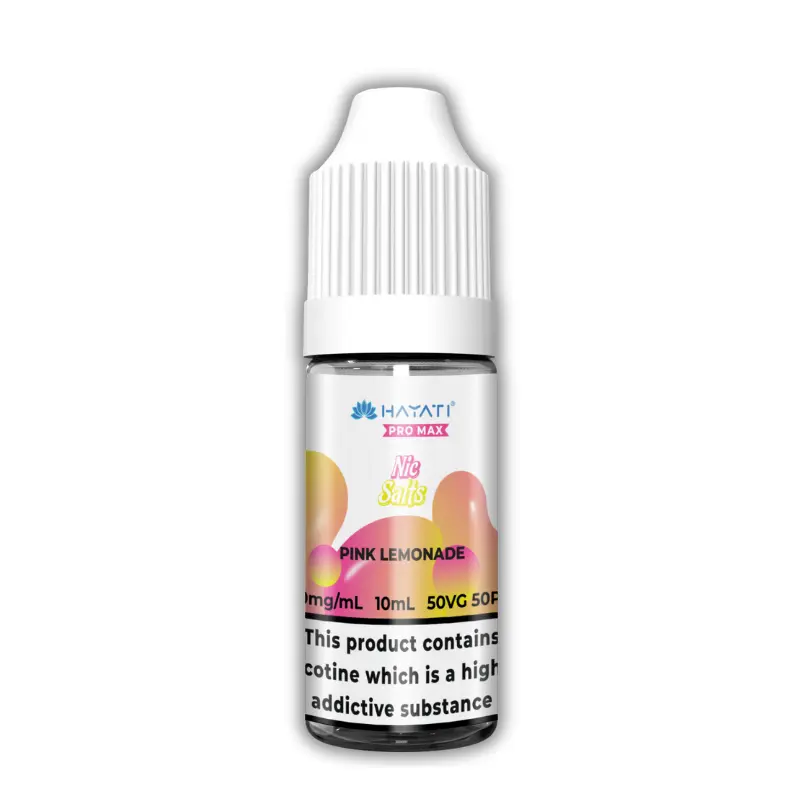
Pink Lemonade in this form is ten millilitres of liquid in a bottle at £2.49, mixed at an even fifty-fifty carrier split, carrying nicotine salt at 10mg per millilitre, filed on the Hayati Pro Max Nic Salts shelf with sixty-four other bottles. There is no device, no cell, nothing to charge and nothing to throw away when it is finished except the bottle. It is the cheapest of the three ways Hayati sell this flavour and the only one of the three that is not a sealed unit.
That last point is the whole reason this page exists and is not a third description of a taste. The flavour argument for Pink Lemonade is finished. The Pink Lemonade Pro Max Plus kit page did it at length: it counted every colour word in the catalogue, sorted them by what the colour is attached to, used Mr Pink as a control and Peach Green Tea as the exception that defines the rule, lined up all three of Hayati's descriptions of this liquid against each other, worked out mechanically what a red fruit does to a lemonade, and read the draw from first contact to finish. The bare pod page then took the repeat buyer's question and a borrowed reference for checking your own palate. Between them they have said what there is to say about the liquid, and none of it is repeated here.
What they could not do is handle it. A pod is closed at the factory and opened by heat, so from purchase to disposal the liquid inside one is never an object in the room with you. A bottle is. You pour it, you see how much is left, you meet the same batch five times on five different days through a wick you replaced yourself. Two things follow from that, and they are what this page is about. The first is that the single literal claim in the name becomes checkable here and nowhere else, because colour is a property of liquid and not of vapour. The second is that the substantive gap the name leaves, which is that nobody outside the factory knows which red fruit is in it, can only be worked at in a format that lets you meet the liquid more than once and put something beside it. Neither point is a reason to buy the bottle instead of the pod. Both are reasons this listing is a different object from the other two rather than a cheaper version of them.
The one literal claim in the name, and the only place it could be tested
What the kit page settled, taken as read
Its argument runs briefly as follows, and the reasoning belongs to that page rather than to this one. Pink is not a fruit. Attached to a fruit, a colour word in this catalogue is either redundant or actively misleading, which is why blue in front of a raspberry has to be read as a code rather than a description. Attached to a drink it behaves differently, because a drink has a default appearance that everybody has seen, and announcing a departure from that default is a report about an ingredient rather than a decoration. Lemonade is pale. Saying a lemonade is pink therefore says that something was put in it, and in ordinary kitchen terms the something is red. That is why a name which contains no fruit at all still manages to point in a direction, and it is also why the direction is all it gives you. Which red fruit, and how much of it, the name cannot reach.
The kit page was also clear that this is a weak ingredient claim rather than a strong one, since plenty of commercial pink lemonades get their colour from colouring and no fruit whatever. It then checked Hayati's own copy for anything that would narrow the candidates and found that across all three descriptions of this liquid, no fruit is ever named. Not once, in three separately written blocks of text, by a company that names fruit freely everywhere else.
A colour belongs to the liquid, and the liquid is only visible here
Set the two findings beside each other and something follows that neither page above was positioned to act on. The name makes exactly one claim that is literally true or literally false of a physical object: the liquid is pink, or it is not. Every other reading of the word, including the good one the kit page built, is an inference about what the copywriter meant. The literal reading is a matter of fact about a fluid.
Vapour has no useful colour. Whatever tint a liquid carries in a bottle, it does not survive being turned into an aerosol in any form a person could report on, so a sealed pod cannot answer the question even while you are using it. It holds the liquid out of sight until the liquid has ceased to be liquid. The kit and the refill are both sealed prefilled pods, which leaves this bottle as the only one of Hayati's three Pink Lemonade listings where the substance the name describes is available for looking at. Whatever the bottle itself is made of, the liquid leaves it and goes somewhere else before it is used, and the person doing the pouring is looking at it while it happens.
So the inspection is genuinely available here and it is available nowhere else in this flavour. The reason to write about it is that it fails, and the way it fails is more useful than a pass would have been.
Why looking will not pay, in three parts
Start with what is published, because that settles more than it sounds. No listing anywhere in this catalogue of 492 states a colour for the liquid it sells. Not this one, not the kit, not the refill, not the forty shortfills on the Hayati E-Liquids shelf, not one of the prefilled pods. Colour is simply not a field Hayati populate. That means there is no published value to compare an observation against, and an observation with nothing to compare it to is not a measurement of anything. If you pour this out and it is pink, you have learned that this bottle is pink. You have not learned that Pink Lemonade is pink, because no version of the product has ever claimed a shade you could hold it to.
Second, the colour of a finished e-liquid is a property of the flavour concentrate and the base rather than of the fruit anybody had in mind. Concentrates arrive with whatever tint their own manufacture gave them, and a great many of them are close to colourless whatever they taste of. A blend can be built to taste emphatically of red fruit and come out of the mixing vessel the colour of weak tea, and another can come out rose-coloured because one component in it happened to be pigmented. Neither outcome tells you the recipe. A pink liquid would confirm only that something pigmented went in, which the name already told you and the kit page already inferred more carefully than an eyeball could. A straw-coloured one would rule out nothing at all.
Third, and this is the part that closes the door, the colour moves on its own. This site has said so twice already in a different context. The Blackberry Raspberry bottle page tells its readers not to judge that liquid by its colour, because dark fruit liquids start amber and go further that way with time and light. The Blackcurrant Lemonade bottle page answers the same question in its FAQ, explaining that nicotine oxidises slowly in contact with air and light and that a gradual darkening is an ordinary bottle ageing rather than a bottle going wrong. Both of those are storage advice and both are correct as storage advice.
Here the same physical fact has a different consequence. If every nicotine liquid drifts towards amber at a rate set by how it has been stored, then the shade in front of you is a function of the recipe and of the bottle's history, and you have no access to the second term. A bottle that has sat under a shop light for four months and a bottle posted out the week it was mixed are not comparable objects even if they hold identical liquid. On a dark fruit this hardly matters, since the pigment swamps the drift. On a pale citrus base it matters completely, because amber and pink are both warm shades in the same part of the range and a modest drift is enough to move one towards the other or to produce something that could plausibly be read as either.
What to do with a claim you cannot check
Nothing, and the honest thing is to say so on the page rather than to leave a buyer to work it out over a bottle. The name's one literal statement is unverifiable in the only format where it is even visible, and it is unverifiable for three independent reasons, any one of which would be enough. There is no published value. The colour tracks the concentrate rather than the fruit. And the shade you see has been modified by storage you know nothing about.
That is worth ten paragraphs rather than none because the invitation is real. A buyer who has read the name, poured the bottle and seen a colour will draw a conclusion from it, and the conclusion will feel like evidence in a way that reading a product description does not, because it came from their own eyes. It is not evidence. The kit page's reading of the word is a better guide to what is in the bottle than the bottle is, which is an odd sentence to write and, as far as this corpus goes, a first.
Ten and twenty are shelf numbers, not recipe numbers
The other visible difference between this listing and its two siblings is the strength. This bottle is 10mg per millilitre. The kit and the refill are both 20mg. A buyer looking at three listings of one flavour, two of which carry twice the nicotine of the third, could reasonably wonder whether the liquid has been reformulated for the lower figure, or whether the bottled version is a lighter build of the same idea. It has not, and it is not, and the way to show that is to count rather than to assert it.
The count, on both sides
Of the 492 listings, 105 are sold as liquid in a bottle. Sixty-five of those are the 10ml salts on this shelf and every one is recorded at 10mg. The Summer Dream bottle page has already put that count on the record, noting as well that sixty-four of the sixty-five carry the same £2.49 and that the base is the same even split throughout, so it is cited here rather than recounted. The other forty bottled listings are the 120ml shortfills, and every one of those is recorded at 0mg, the Lemon Lime 70/30 shortfill among them. Two bottled formats, two strengths, no variation inside either.
The remaining 387 listings divide into eleven nicotine pouch products, four Quokka listings for which no strength is recorded, and 372 sealed prefilled pods and pod kits. Of those 372, three hundred and sixty-five are 20mg. That is the figure that matters: on the prefilled side of this catalogue, the strength is effectively a constant.
Two corrections I had to make to my own starting point
The claim handed to me for this page was that 363 of 370 prefilled listings are 20mg and that the seven exceptions all name their strength in the title. Counted against the catalogue as it stands, both halves need adjusting, and the adjusted version is the better one.
The denominators first. It is 365 of 372, not 363 of 370, which shifts the proportion by nothing worth mentioning but matters for the same reason any published count matters, which is that a reader who checks should find what the page said. The seven exceptions are five Pro Max Plus listings sold as strength variants, two of them at zero, one at 5mg and two at 10mg, plus the two Pro Ultra Plus Shisha 30000 listings at 5mg.
The second half of the claim is the one that genuinely fails. Five of the seven do name their strength in the title, and they do it because the strength is the entire point of the listing: they are the same hardware and the same flavour set offered at a different number, so the number is what distinguishes them from the listing above. The two Shisha listings do not. Their titles carry a range name, a puff figure and nothing about nicotine at all, and a buyer would have to open the listing to discover they are 5mg rather than 20mg like everything else on that platform. So the narrowed and true version is this: where Hayati vary the strength of a prefilled listing deliberately, they say so in the title in five cases out of seven, and the two that stay silent are a distinct product family whose whole specification is unusual. I have narrowed the claim I was given, and the narrowed one still carries the argument.
What the gap does and does not tell you
It carries the argument because the argument only needs the constancy, not the perfection of it. Nicotine strength in this catalogue is a property of the format. Bottled salt: 10mg, every time, across sixty-five different flavours. Sealed prefilled pod: 20mg, in all but seven listings out of 372, and in six of those seven the departure is announced or belongs to a family that departs in several other ways as well. Nobody sat down over Pink Lemonade and decided it should be lighter in a bottle. The bottle is 10mg because bottles are 10mg.
The consequence is narrow and worth stating precisely, because the pod page has already made a related point in the opposite direction and the two must not be confused. That page treated the strength difference as a confound: if you are trying to read a change in your own perception of sourness, moving from 20mg to 10mg changes the sensation you are scoring, so the bottle is a poor instrument for that particular job. That is correct and it stands. What is a confound for a measurement is not thereby evidence about a recipe. The strength gap between these three listings is uninformative about the blend, in either direction. It does not suggest the bottle is a reduced version of the pods, and it does not suggest the pods are an intensified version of the bottle. It tells you which shelf each one is filed on and nothing else.
None of the above is a recommendation about strength. Nicotine is an addictive substance and the numbers on this page are statements of what is in a product, not guidance about what anyone should be using, and there is no ordering implied among them.
Five fillings of the same chamber
What this section is not
Two adjacent arguments are already on this site and this is neither of them. One is the bottle as a forecast: buy the cheap format first, find out whether you like the flavour, and let that decide a more expensive sealed purchase. The Summer Dream bottle page owns that in full, including what does and does not transfer across the strength difference. The other is the borrowed reference, which the Pink Lemonade refill page sets out: when you cannot buy the same liquid in a second prefilled format, you check your own reading against a sibling whose behaviour on the relevant axis you already know.
Neither is the point here. This is not a procedure for deciding whether to buy something else, and nobody needs to run anything. It is about a gap that is peculiar to this flavour, and about the fact that only one of its three listings is shaped in a way that lets a person close it at all.
The gap, restated in one sentence
Hayati have described this liquid three times and have never said what fruit is in it. The name does not say. The kit copy does not say. The refill copy does not say. The text on this listing does not say. A buyer who wants to know is therefore left with their own palate as the only instrument, which is fine, except that a palate has a specific and well-known limitation: it recognises far better than it retrieves.
Recognition and retrieval are different jobs
Almost anybody can tell that two liquids are not the same. Far fewer people, asked to name a fruit from a single unlabelled mouthful and given no options, will produce the right word, and this has nothing to do with how good their palate is. Naming from nothing is a retrieval problem: the correct answer has to be summoned out of every fruit you have ever eaten. Judging whether the thing in your mouth matches a specific candidate you are holding in mind is a recognition problem, and recognition is the easier of the two by a wide margin. The way to turn one into the other is to supply the candidate.
That is why a single encounter with an unnamed blend so often produces a vague answer. It is not that the taster failed to concentrate. It is that they were asked the harder of the two questions, once, with nothing to compare against, on whatever palate the day had left them.
What a bottle is shaped for
A bottle solves both halves of that, and it solves them for reasons of format rather than of flavour. Ten millilitres is not a single serving. Poured into a 2ml chamber it goes five times, and the intervals between those five are yours to choose. The same batch of liquid can be met on Tuesday morning and again on Friday evening and again a fortnight later, which is three readings rather than one, taken on three different palates belonging to the same person.
More useful than the repetition is the alternation. Because the wick in a refillable pod is a small separate consumable rather than part of the product, you can put this liquid through a fresh one, form an impression, and put a candidate through another fresh one an hour later, then come back. A sealed pod cannot do that with itself. Twelve millilitres passes through one element that cannot be swapped, so the comparison you would want, which is this liquid against that one on hardware in the same condition, is available at a bottle and not available at a pod. The rest of the bottled salts shelf exists in the same format, at the same volume, on the same base and at the same price, which means the candidates can be interleaved with it on equal terms.
Worth being honest about the limit of that. Alternating between two liquids on one device introduces carryover, and the lighter and more volatile part of whatever went through first is exactly the part that lingers. Rinsing and re-wicking between reads deals with most of it and takes longer than anybody actually spends. A second cheap pod, kept for the candidate, deals with it better. Neither is free, and the person who does none of this will still get further than a person meeting the liquid once inside a sealed pod, which is the only comparison this section is making.
Why the answer is worth having at all
It changes what you buy next, and very little else. If the red component reads as cherry to you, then the rounder cherry-forward listings on this shelf are the neighbourhood you are shopping in. If it reads as something with seeds and a faint dryness behind it, you are in raspberry territory and the shelf is arranged differently for you. If it reads sour rather than sweet, which the kit page flagged as the one candidate that would push the whole blend the other way, then a great deal of what has been written about this flavour softening a lemonade does not describe your experience of it and you should trust yourself over the page. None of that is a verdict on the product. It is just the difference between buying the next bottle informed and buying it by the label.
What this shelf can and cannot lend you
The interleaving above only works if the candidates exist as products, so here is what is actually on the shelf, counted rather than assumed. Among the sixty-five bottled salts, the red fruits distribute like this: strawberry appears in nine titles, raspberry in eight, cherry in seven, cranberry in two, watermelon in three.
Now the part that matters, which is how many of those appear on their own. Strawberry: none. In all nine it is bound to something else, a second fruit or a confectionery treatment or a mint. Raspberry: none. Every one of the eight pairs it with a berry, a citrus, a kiwi or a blue confectionery note. Cranberry: none, and with only two appearances there was never much chance of it. Cherry is the exception. Fizzy Cherry puts cherry in front of a carbonation impression and nothing else, and carbonation is a texture rather than a fruit, so it is the one single-note red candidate this shelf offers. Cherry Ice is the other near-miss, and the coolant on it disqualifies it for this purpose, since cold suppresses sweetness while it is happening and would move the comparison for a reason unrelated to the fruit.
So the honest position is a good deal narrower than the one I set out with. The bottled shelf can lend you a clean cherry reference and it cannot lend you a clean anything else. For the other three candidates you are reduced to reading a fruit out of a blend, which is a weaker operation and needs saying plainly rather than glossing.
The blended references, ranked by how much they interfere
Blackberry Raspberry is the least bad route to a raspberry reference, because its two components sit close together and the raspberry's seedy, faintly tannic edge is the sharper of the two and stands slightly in front. You are reading through one interfering fruit rather than three. Blue Razz Cherry is a worse cherry reference than Fizzy Cherry for a reason the corpus has established at length, which is that blue raspberry is a confectionery profile assigned by colour rather than grown, so what you would be reading the cherry through is a sweet-counter accord rather than a fruit. Blueberry Raspberry Lemon is interesting for a different reason: it puts a raspberry next to a citrus, which is structurally the nearest thing on the shelf to what this bottle might be, and it names both components. If the pink in your glass reads like the raspberry in that one, you have your answer by a shorter route than any of the above.
For a negative control, Juicy Peach is the shelf's cleanest example of a single named fruit with nothing on top of it, and its usefulness here is as a demonstration rather than a candidate. Run it and you will find out quickly how confidently you can name a fruit you already know is there, which calibrates how much weight to put on your reading of one you do not. Stone fruit is not in the pink lemonade tradition, so a match would be a surprise rather than a result.
The candidates nobody can supply
Strawberry is the most likely single answer on general grounds, because it is the commonest red fruit in commercial pink lemonade and because it is the softest and least acidic of the four, which fits the direction the copy points in. It is also the one this shelf cannot isolate for you at any price. Cranberry is the candidate that would overturn the reading, since it is genuinely sour and would push the blend away from softness rather than towards it, and the shelf cannot isolate that either. Both gaps are real and neither is closeable with anything Hayati sell. A page that pretended otherwise would be selling you a method that does not work.
What remains true after all that narrowing is the comparison this section exists to make. A person with this bottle can get partway to an answer, slowly, with two of the four candidates available only through interference and two not available at all. A person with a sealed Pink Lemonade pod cannot get anywhere at all, because the format gives them one encounter, on one element, with nothing to set beside it. Partway is not much. It is more than nothing, and it is the only respect in which the cheapest of the three listings is the most capable.
The sheet, sorted by what each number belongs to
Everything below comes from this product's own record. Read the right-hand column with one question in mind: is this number about Pink Lemonade, or is it about the shelf Pink Lemonade sits on. Almost all of them are about the shelf, which is the census above expressed as a table.
| Flavour name | Pink Lemonade |
| Full listing | Pink Lemonade Hayati Pro Max Nic Salt |
| Brand | Hayati |
| Format | Bottled e-liquid, no hardware included |
| Volume | 10ml |
| Nicotine | 10mg per millilitre |
| Nicotine form | Nicotine salt |
| Carrier base | 50/50 VG/PG |
| Suited to | Mouth-to-lung refillable pods and compact low-power kits |
| Not intended for | Sub-ohm tanks and high-power hardware |
| Cooling | None stated |
| Colour | Not published |
| Price | £2.49 |
| Product code | HPM-NS-PINK-LEMONADE |
| Filed under | Hayati Pro Max Nic Salts, Hayati E-Liquids, Lemon Vapes, Lemonade Vapes, New Products |
Only the first two rows and the shelf list are specific to this product. The volume, the strength, the form, the base, the intended hardware and the price are identical on sixty-four other listings, which is why a buyer comparing two bottles on this shelf gains nothing from the specification and has to decide on the name alone. That is not a criticism of the range. A uniform format is precisely what makes the interleaving described above possible, since holding volume, strength and base constant across every candidate is a condition no other part of this catalogue meets.
The 50/50 figure earns one further remark, chosen so as not to repeat what the other bottle pages on this shelf already say about viscosity and wicking. Propylene glycol carries small volatile aromatic molecules better than vegetable glycerine does, and a citrus top note is made of exactly those. An even split is therefore the ratio at which the lemon end of this blend stays legible. Push the same concentrate into a high-VG mix built for a sub-ohm tank and the brightness is the first thing to go, which would leave an unnamed red fruit sitting on its own with the component that identifies the drink removed.
Placing it among the bottles beside it
There are five lemonade names in this catalogue and the Lemonade Vapes shelf holds nineteen listings between them. Three of the five have a bottle, and those three are the direct comparison for anybody standing in front of this one.
Blackcurrant Lemonade is the one that names its fruit outright and has the fullest treatment on this site of what that fruit does to a lemonade. Its grip is astringent rather than acidic, which is a tactile sensation rather than a taste, and it sits under the citrus rather than beside it. Take it if you want the dark half of the berry register, which is the half this bottle's name explicitly rules out. It is also the flavour with the widest spread across the catalogue, so if a lemonade earns a permanent place in your rotation it is the one you can keep buying in whatever format suits: a sealed refill at 12ml, or the 22ml version, or the bottle.
Berry Lemonade is the closest structural sibling on the shelf and the comparison is worth drawing carefully, because it has the same problem in a different form. Its own kit page owns the observation that its two words name no fruit either, only a family and a drink. Where the two names differ is in the kind of vagueness. Berry names a category and leaves the members open. Pink names an appearance and leaves the category to be inferred from it. Berry is vague about which; pink is vague about whether there is a fruit in it at all. If you want the sharper of the two, the weight of its copy sits further towards the acid side than this one's does.
Blue Razz Lemonade is the third bottled lemonade and the one that behaves least like the other two. Its apparent sharpness is a sherbet edge from the confectionery accord rather than citric acid from a fruit, so it reads sharp without being sour in the way a lemon is sour. Anybody choosing between it and this one is choosing between two different sensations that both get filed under the same word. The same blend is available as a complete kit if the bottle turns out to be the one you keep.
If the lemon is what you came for
Fifty-four listings carry a lemon or lemonade note and the Lemon Vapes shelf collects them. Among the bottles, Lemon Lime is the one to take if the softening on this listing is precisely what you do not want, since it doubles the citrus rather than cutting it with anything. Lemon Mint puts a herbal cool against the citrus instead of a fruit, which produces a drier finish and a different kind of length. Lemon Peach Passionfruit takes the opposite route from this bottle, keeping the citrus loud and stacking two tropical fruits on top rather than rounding anything off.
If the unnamed fruit is the objection
Then buy something that names what is in it, and this shelf has plenty. Blackcurrant Juice is a single fruit presented as a drink with nothing hidden. Blackberry Ice names a fruit and a treatment. Mango Peach Pineapple lists all three components in order. There is no shortage of specificity on the e-liquid shelf, which makes the silence on this particular listing a choice rather than a house habit, and that is itself a small piece of evidence about how the name was arrived at.
Rotation partners that will not muddy the reading
A softened citrus wants company that is not also a soft red fruit, or the two collapse into one another over a week. Black Mint sits at the far end of the shelf from this and resets the palate between fills more completely than anything fruited would. Cola Ice is a drink flavour built on spice rather than fruit, which gives you a second beverage note without any overlap. Grape GB and Gummy Bear are both confectionery-led and both far enough away to be unmistakable beside this. Bru Ice is the other soft-drink listing on the shelf and the only one whose reference point is not a fruit at all. Blue Razz Mojito brings a herbal element into a sweet blend, which is a different construction again.
If none of these is the flavour and the format is the problem, the whole Hayati range is listed elsewhere on the site, and anything added recently is grouped under new products.
Running a bottle whose end you cannot see coming
The practical notes that follow are chosen for this liquid rather than for the format, since the format advice already exists on the other bottle pages and repeating it would waste the space.
The usual visual cue is missing here, and that is not an advantage. A dark fruit liquid stains a white wick within a few draws, which is cosmetically annoying and diagnostically useless, and the pages for those flavours tell you to ignore it. A pale citrus base stains almost nothing, so your wick will still look serviceable long after it has stopped performing. The absence of a misleading signal is not the same as having a good one, and on this bottle you have neither.
Nor is there a reliable taste signal, for a reason peculiar to this name. On a flavour whose components are named, the standard end-of-coil diagnosis is to notice which named component has receded, because a tiring element loses the light volatile material first and the blend audibly loses a part. That diagnosis needs you to have a name for the part that went missing. Here the red component has no name, on the label or in any of Hayati's three descriptions, so a buyer noticing that the blend has become simpler cannot say which way it simplified or whether it simplified at all. The honest advice is therefore unglamorous: count your fills. If five 2ml fills have gone through one wick and the liquid reads flatter than it did on the first, replace the wick before concluding anything about the liquid.
Keep it capped and out of the light, and for once the reason is not only ageing. Storage slows the amber drift, and on a pale liquid that drift is the thing that removes what little the colour could ever have told you. It will not make the bottle taste wrong; the earlier sections explain why the shade was never informative in the first place. It does mean that a bottle kept on a sunny sill and a bottle kept in a drawer will not look alike after a few months, which is worth knowing before you draw a conclusion from the difference.
Shake it before the first fill and after a long gap. Flavour concentrate and base are not perfectly miscible and a two-part construction settles more noticeably than a single note does, so the first pour out of a bottle that has stood a fortnight can be unrepresentative. Ten seconds is enough. On this liquid the consequence of skipping it is specific: the component you would most want to judge is the one you are least equipped to identify, so an unbalanced first fill is an unbalanced first impression of exactly the thing in question.
Do not judge it on the first two draws of a new wick. Fresh cotton holds liquid that has not yet been through a heat cycle, and a citrus top note reads brighter and thinner in that first minute than it will settle at. Give it a few draws before forming a view, particularly if you are comparing it against something.
Airflow moves the balance in a predictable direction. A tighter draw concentrates the acid and pushes the lemon forward. Opening it up dilutes the acid and lets the sweeter half come through. On a blend whose whole character is the ratio between those two, that adjustment is doing more work than it would on a single fruit, and it is worth a few minutes before deciding the bottle is either too sharp or too soft.
Keep the bottle upright, capped, at room temperature, and out of reach of children and pets. Finished bottles go in household recycling where your local service accepts them.
Questions a buyer of this bottle actually asks
Is this the same liquid as the Pink Lemonade pods?
Hayati publish no formulation for any of the three listings, so nobody outside the factory can confirm it either way. What can be said is that the strength difference between them is not evidence of a different recipe, because bottled salts in this catalogue are 10mg without exception and prefilled pods are 20mg in 365 listings out of 372. The numbers describe the formats.
What colour is the liquid?
Not published, and not published for any of the 492 listings on this site. The colour of a finished e-liquid comes from the concentrate rather than from the fruit, and it drifts towards amber with exposure to air and light at a rate that depends on how the bottle has been stored. Whatever shade arrives, it is not information about the blend.
Which red fruit is in it?
Hayati do not say, in the name or in any of their three descriptions of this liquid. The strongest available reading is the kit page's, which is that the word pink reports that something red went into a pale drink without committing to what. Strawberry is the commonest answer in the wider pink lemonade tradition and that is general knowledge rather than anything Hayati have stated.
Is there any ice or menthol?
None is stated, and this catalogue signals cooling in the title when it is present. Nothing in the name or the listing text points to a coolant, so treat it as an uncooled blend.
How many refills will ten millilitres give me?
That depends entirely on what your pod holds. A 2ml chamber takes five fills out of the bottle before it is empty, and a larger one proportionally fewer. The bottle is a quantity of liquid rather than a number of uses.
Will it work in my sub-ohm tank?
It is not intended for one. The even carrier split is thin by the standards of a high-power tank, and 10mg salt is a good deal more nicotine per draw than that kind of hardware is built around. This belongs in a refillable mouth-to-lung pod or a compact low-power kit.
Is it sweeter or sharper than Blackcurrant Lemonade?
Different rather than simply more or less. Blackcurrant's grip is astringent, which is a tactile sensation, while the red component here is described only as softening the citrus. The blackcurrant reads darker and drier; this one reads rounder. Which is sharper overall depends on which kind of sharpness you are measuring.
Why does the bottle cost so much less than the pods?
Because there is no hardware in it. A sealed pod includes a coil, a wick, a chamber and a housing, all manufactured and all thrown away together, and a kit adds a rechargeable body on top. This listing is liquid and a bottle, which is why every one of the sixty-five bottled salts sits at broadly the same price regardless of flavour.
Does it need steeping?
An even-split salt arrives ready to use and does not need a cupboard the way a heavy bakery mix might. Some people find a bottle opened and left a few days reads slightly rounder at the edges. On this blend the effect would move the one axis you might be trying to judge, so if you care about identifying the red component, read it early rather than late.
How do I know when to change the coil?
Harder than usual on this liquid, for the reasons set out above: the pale base does not discolour a wick, and the unnamed component means you cannot notice a named part going missing. Keep track of how many fills a wick has had and change it on the count rather than waiting for the taste to tell you, because on this flavour it tells you late.
Is the 10mg here weaker than the 20mg in the pods?
Ten milligrams per millilitre is half of twenty milligrams per millilitre, and that is all this page will say about it. Nicotine is an addictive substance, the figure describes what is in the liquid, and choosing between strengths is not something a product page is in a position to advise on.
The short version
Ten millilitres of a lemonade softened by a red fruit nobody has named, at 10mg on an even base, for £2.49. The taste has been written about twice already on this site and this page does not add a third account of it.
What is specific to the bottle is this. It is the only one of Hayati's three Pink Lemonade listings where the liquid is visible at all, which makes it the only place the name's single literal claim could be checked, and checking it turns out to be worthless for three separate reasons: no colour is published for any product in this catalogue, the shade of a finished liquid comes from the concentrate rather than from the fruit, and it drifts with storage you cannot see. The strength difference between this and the two pods is a filing convention and not a recipe signal, which the count across 372 prefilled listings settles. And the bottle is the only format that lets a person work at the question the name leaves open, because ten millilitres is five encounters rather than one and a replaceable wick allows a candidate to be set beside it, although this shelf can supply a clean reference for only one of the four fruits worth testing. That is a modest set of advantages and they are real ones, which is more than the price difference between the three listings would suggest.
Strictly for adults aged 18 and over. Nicotine is an addictive substance.
You might also like


