
Home / Hayati Pro Max Nic Salts / Rocky Candy Orange Hayati Pro Max Nic Salt
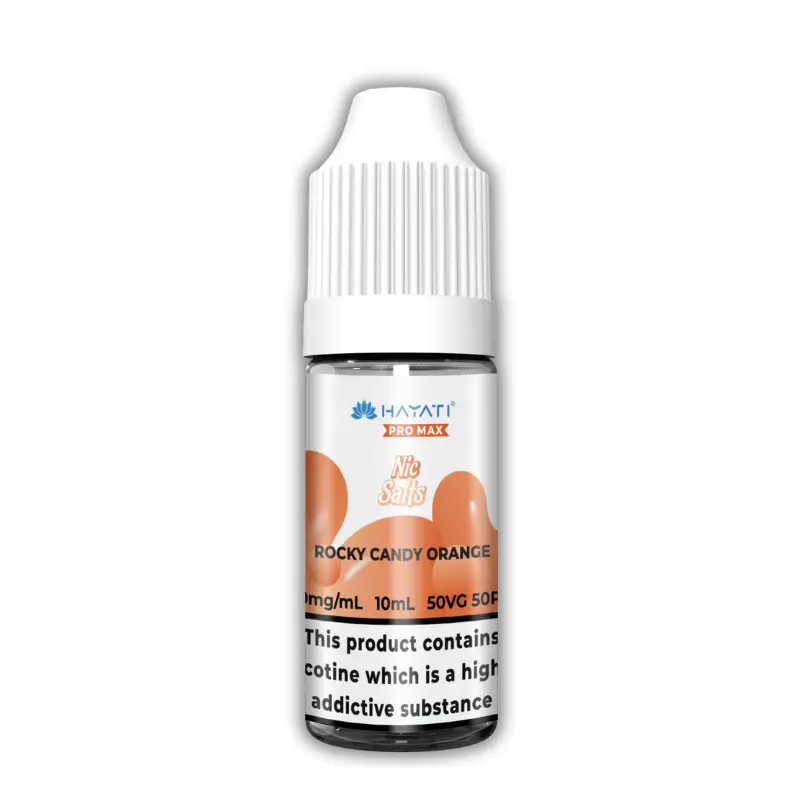
Hayati · Pro Max
Rocky Candy Orange Hayati Pro Max Nic Salt
£2.49
✔ In stock — ready to ship
Genuine Hayati
Free over £20
Same-day dispatch
Secure checkout
Rocky Candy Orange in the Pro Max nic salt format is a £2.49 bottle holding ten millilitres of liquid, carrying 10mg of nicotine per millilitre in salt form, mixed at an even split of vegetable glycerine and propylene glycol, filed under the stock code HPM-NS-ROCKY-CANDY-ORANGE. Liquid is the whole of the purchase. Nothing in the box heats anything, holds any charge or moves any air, and the listing assumes you already own something to pour it into.
Two other pages on this site have already taken this liquid apart, and between them they finished the job. The bare Pro Max Plus pod listing at £5.49 worked on the name, establishing what a texture word can and cannot promise once you accept that an aerosol has no solid in it, and concluding that the confectionery half of the reference is real information while the hardness half was never available. The Pro Max Plus 6000 kit listing at £7.99 then did the flavour chemistry properly: what a candy citrus accord is assembled from, why it reads simpler and flatter in time than the fruit, the two structural absences that separate it from an orange you could peel, and the order in which a coating coil takes the thing apart. Both of those arguments are settled, both are longer and better than a summary of them would be, and neither is going to be run again below. Anybody who wants to know what this tastes like should read the kit page.
What is left is a different kind of question, and it belongs to this listing rather than to the other two, because it is a question about a bottle. Orange barely exists in Hayati's range. That much has been said in passing. What has not been said, and what changes the decision in front of you, is how the scarcity is distributed across the formats. Counted across everything Hayati sell, orange looks thin. Counted across the things you can pour into your own hardware, it is a menu of one item, and this bottle is the item. The consequence is that the usual work of choosing a liquid, comparing four near neighbours and picking the one whose treatment you prefer, is not available here at any price. The question that replaces it is narrower, harder and worth answering carefully.
Running the word through 492 titles
Start with the whole catalogue as it currently stands, because the shelf sizes printed in a link list are generated at one moment and this range grows. Take the word Orange and match it against every title Hayati have on sale. It returns seven listings out of 492.
Seven is a small number and it is smaller than it looks, because those seven are not seven different oranges. They collapse into two flavour families. Four of them belong to a single three-citrus blend, Orange Lemon Lime, which appears twice on Pro Ultra Plus hardware (once as a 25K pod and once as a 25000 prefilled kit, with the pod listing spelling the name with an ampersand), once as a Mini Ultra pod, and once more inside a Mini Ultra kit whose title carries Cola Ice alongside it. The other three are this flavour on three different pieces of packaging: the 12ml pod, the 12ml kit, and the bottle you are reading about.
Two families, then. And here is the part that decides everything below: neither of them is a plain orange. One is a citrus blend in which orange shares the label with two other fruits, so orange is a component rather than the subject. The other is a confectionery construction that the kit page has shown, at length, is deliberately not attempting the fruit. Search all 492 titles for an unmodified orange, something along the lines of Orange, or Orange Ice, or Juicy Orange, the way Hayati name a Juicy Peach or a Blackcurrant Juice, and there is nothing. Not in a bottle, not in a pod, not in a kit, not in a pouch. Hayati do not make a straight orange in any format, and a buyer who came here wanting one is not going to find it further down the page.
Narrowed to the formats you can pour
The catalogue-wide count is the version the sibling pages already used, so it is not this page's contribution. The contribution is what happens when you narrow it to bottles, which is a narrowing nobody has run, and which sharpens the claim considerably rather than softening it.
Hayati sell 105 bottles. They sit together on the Hayati E-Liquids shelf and they divide into exactly three lines: 65 ten-millilitre nicotine salts on the Hayati Pro Max Nic Salts shelf, 20 shortfills of 120ml mixed at fifty-fifty, and 20 more of 120ml at seventy-thirty. Add those and you get 105 with nothing left over.
Of those 105, the number carrying the word Orange is one. This one. Not one family, not one per line, one listing in the entire bottled half of the business. The two 120ml lines between them hold 40 listings and no orange at all. The nic salt shelf holds 65 and holds this.
Follow that through to where it lands. Orange Lemon Lime, the other family and the only route to orange as a fruit rather than as a sweet, exists exclusively on Pro Ultra Plus and Mini Ultra hardware. Every one of its four listings is a sealed prefilled unit at a strength and a configuration set in a factory. There is no version of it you can decant, no version of it in a bottle, and no route by which a person with a refillable pod can get at that recipe. So for anybody whose hardware takes liquid rather than pods, Hayati's complete orange offering is a single bottle at £2.49, and it is a confectionery orange.
Widen the lens by one notch and the picture holds. Fourteen of the 105 bottles name a citrus of any kind in the title. Thirteen of the fourteen are lemon or lime, and five of those thirteen are lemonades, which is a soft-drink construction rather than a fruit. The fourteenth is this orange. On the nic salt shelf specifically the ratio is nine lemon-or-lime listings to one orange, and the lemon-or-lime side includes Berry Lemonade, Blackcurrant Lemonade and Blue Razz Lemonade, all three of which put a berry in front of the citrus. Hayati's bottled citrus is overwhelmingly lemon, frequently carbonated, and usually working behind something else.
A correction to the shelf figure two sibling pages carry
Both Rocky Candy Orange pod pages state, in passing, that the Orange Vapes shelf holds nine products of which seven actually name orange. That figure was true when those pages were written and it is no longer true, so it is worth recording the current count here rather than letting three pages quietly disagree.
The shelf now holds twelve listings. Seven of them name orange, which is the same seven the catalogue-wide search returns, so the orange-named half of the shelf has not changed. What has grown is the other half. Five listings are now merchandised under Orange Vapes without the word appearing in their titles at all: three listings of Blue Fusion, which is a blue-fruit blend sold as a 6000 kit, as bare pods and as Blue Fusion Hayati Pro Max Nic Salt on this very shelf, and two listings of Blue Razz Fruit Twist. None of the five mentions orange anywhere in its own description either, so this is not a case of a fruit being present but unlisted in the title. It is a filing decision.
The number worth carrying forward is therefore twelve listings, seven of them orange-named, two flavour families, and five listings that are on the shelf for reasons Hayati have not published. That last group is a useful reminder about shelf tags in general and it makes the bottled figure sharper, not weaker: of the two bottles filed under Orange Vapes, one is this liquid and the other is a blue-fruit blend. If you filter this shop by orange and then filter again by things you can pour, the result is two listings and only one of them is an orange.
The twenty flavours that got a big bottle, and why this is not one of them
The 40 large bottles deserve a closer look than a line in a census, because their composition says something specific that the nic salt shelf on its own cannot.
The two 120ml lines are not two different menus. They are the same menu printed twice. Twenty flavour names appear in the fifty-fifty line and the identical twenty appear in the seventy-thirty line, one bottle each, every one of them £6.99 and supplied at 0mg. So Hayati have chosen twenty flavours out of everything they make and committed each of them to two large-format bottles, which is a much bigger inventory commitment than a ten-millilitre salt represents.
Cross-reference that roster of twenty against the 65-listing salt shelf and seventeen of the twenty are on both. Three are not: Watermelon Lemon Burst, Vimbull Ice and Pineapple Ice exist as large bottles and have no ten-millilitre version. The overlap runs almost entirely in one direction, which makes the large-bottle roster read less like a separate range and more like a shortlist drawn from the small-bottle one. Whatever the selection criteria were, and Hayati publish none, twenty names were picked out of sixty-five and given the bigger format.
Rocky Candy Orange was not among them, and neither was any other orange. Citrus is on the roster, twice: Lemon Lime appears in both large lines, and Watermelon Lemon Burst appears in both. So it is not that Hayati declined to put a citrus in a 120ml bottle. It is that the citrus they put in one was lemon.
Be careful about what that proves. A product roster is a commercial decision taken with information nobody outside the company has, and it is not a verdict on a recipe. A flavour can be excellent and still miss a shortlist because the volume forecast for it did not clear a threshold, or because it launched after the roster was set, or for reasons of packaging and supply that have nothing to do with the liquid. So the honest reading is narrow: the absence of orange from the large-bottle roster is evidence about expected demand, not evidence about quality, and it should be read as one more data point in the same direction as everything else on this page rather than as a judgement.
What it does establish, practically, is a ceiling. If you buy this bottle and you like it, there is no scaling up. Somebody who finds a flavour they want a standing supply of can usually move from a ten-millilitre salt to a 120ml bottle of the same name and stop reordering every fortnight. That route exists for seventeen of the sixty-five and it does not exist here. Ten millilitres at a time is the largest unit of Rocky Candy Orange that has ever been sold, in any format, including the sealed ones, since the biggest pod of it holds twelve. This is a liquid you buy repeatedly in small quantities or not at all.
Filed under the fruit, not under the register
One more thing the catalogue's structure gives away, and this one is about how the shop itself has decided to classify the liquid.
Every listing on this site sits on a set of shelves. Some of those shelves are about hardware and format, and those are automatic. The interesting ones are the flavour shelves, because somebody had to choose them. Across the 65 bottles the distribution is uneven: three carry no flavour shelf at all, eighteen carry exactly one, and the rest carry between two and five. Mr Pink is one of the three with none, which is its own small story about a name that resolves to nothing filable.
Rocky Candy Orange is one of the eighteen with exactly one, and the one is Orange Vapes. Not Sweet Vapes. That is worth a paragraph because of what sits beside it.
Twelve of the 65 bottles are filed under Sweet Vapes, and ten of the 65 carry a confectionery word in the title: the two gummy bear listings, the two abbreviated to GB, a jelly bean, a bubblegum, a rainbow, an ice pop, a bubblegum-inflected berry blend, and this rocky candy. Seven of those ten are filed under Sweet Vapes. Blue Razz Gummy Bear is, Bubblegum Ice is, H’Bubba is. Three are not, and Rocky Candy Orange is one of the three, alongside Strawberry Jelly Beans and Ice Pop.
So the shop has taken a liquid whose name contains two confectionery words and filed it by its fruit rather than by its register. I cannot tell you why, and inventing a reason would be doing the thing this site tries not to do. What I can tell you is the effect, which is real regardless of the intention. In Hayati's own navigation, this bottle is the orange. It is not presented as a sweet that happens to be orange-flavoured. It is the listing a shopper reaches when they go looking for orange, it is one of only two bottles they will find there, and it is the one of the two that has any orange in it.
That is a slightly awkward position for a liquid the kit page has demonstrated is deliberately not a fruit. The classification and the recipe are pointing in different directions, and the buyer standing between them is the one who has to reconcile it.
Selection is not the question here. Substitution is.
Here is why all of that counting matters rather than being trivia.
The normal shape of a decision on this shelf is a comparison between near neighbours. Somebody who wants blue raspberry has a substantial spread to work through. Blue Razz Cherry puts a stone fruit underneath it. Blue Razz Lemonade puts a carbonated frame around it. Blue Sour Raspberry puts acid at the front. Blue Razz Gummy Bear takes it into confectionery. Blue Frozen pushes cold through it. That buyer is making a selection: the fruit is settled, the range offers several treatments of it, and the job is to pick the treatment. If the first choice is wrong, the second attempt costs £2.49 and stays inside the same fruit.
No part of that is available here. There is one orange, its treatment is fixed, and there is no second orange to go to. The decision in front of you is therefore not a selection at all. It is a substitution question, and it runs like this: the range does not make the orange you probably had in mind, so is the orange it does make an acceptable stand-in for it?
What the two pod pages have already settled
Answering that requires knowing what this liquid is, and that work exists and will be cited rather than repeated. Three findings from the sibling pages carry the whole load.
From the kit page: a confectionery citrus accord is built from a short list of durable, high-impact materials because that is the only kind of material that survives being mixed into boiling sugar, which makes it simpler than the fruit and more even across time than the fruit. It also cannot carry two things the fruit carries, the bitterness that lives in pith and rind and any serious acid load, and the kit page supports the low-acid reading with a count of the twenty-one listings across the catalogue that put Sour in the title. Those are structural absences rather than shortcomings, and no amount of formulation changes them.
From the pod page: the register the name points at is real and specific, and the physical property the name leads with is not deliverable by any liquid in any device. The flavour half of the reference is honest information. The mouthfeel half was never on offer.
From the kit page again: what a coating coil takes first from this particular accord is the identity-bearing fraction rather than the sweetness, so the direction of travel over a long run is towards vaguer and sweeter rather than towards weaker overall.
Put those together and you have a clear picture of the liquid. What nobody has done is turn that picture into an answer to the substitution question, because the substitution question only arises once you know there is nothing else.
Three ways of wanting an orange, and which of them the range can meet
People arriving at an orange listing are not all after the same thing, and separating the cases is the most useful thing this page can do.
The first case: you want a citrus-shaped break from a rotation that has gone entirely to berries. This is by far the most common reason to go looking for an orange on a shelf like this one, and it is the case the substitution works for. What you are after is a profile that does not share aroma chemistry with the things already in your drawer, so that the rest of them start reading as distinct again. A confectionery orange does that as completely as a fruit orange would, because the thing making it different from Blackberry Raspberry or Blueberry Cherry Cranberry is the citrus material, and the citrus material is present. The sugar around it does not undo that. If this is your case, buy the bottle. The substitution is clean and the £2.49 makes it a small thing to test.
The second case: you want the fruit. Peel, juice, an acid spine, the faint bitterness of the membrane, the sense of a thing with edges. The honest answer is that the range does not make it, and the honest answer is not to redirect you to something else and hope. This is where a product page normally starts listing alternatives, and every alternative would be a lie, because there is no orange in this catalogue with acid in it and no orange in this catalogue with any bitterness in it. Orange Lemon Lime comes closest, on the reasonable grounds that lime carries acid and a three-citrus blend is at least aiming at fruit rather than at sugar, but it is not a bottle, it is not orange on its own, and it cannot be got at from a refillable device. So if this is your case, the correct thing to do is not buy this bottle expecting it to grow on you. The gap is structural, the kit page explains precisely why, and a liquid built on a candy template does not become a juice template through familiarity.
What you can do instead, if the requirement is really acid rather than orange specifically, is take the citrus construction the shelf does carry properly. The lemonades named above are the acid-bearing citrus on this shelf and they will give you brightness and a cut at the end of the exhale, at the cost of putting a berry in front of it. That is a compromise in a different direction from the one this bottle asks for, and for some people it is the easier compromise to make.
The third case: you want orange as one voice among several, the way it usually appears in a drink. That exists, and this is the case where the format census bites hardest. Orange Lemon Lime is exactly that construction, it is well distributed across sealed hardware, and it is not available in anything you can pour. There is no arrangement of purchases that puts that recipe into a refillable pod. If the three-citrus idea is what you wanted, the choice is between changing hardware and changing flavour, and nothing on this shelf splits the difference.
Three cases, one of them fully served, one of them not served at all in any format, and one of them served only on sealed hardware. That is a more useful thing to know before spending £2.49 than another paragraph about what rock candy tastes like, and it is only knowable by counting.
What a menu of one takes away from you
The bottled format has a particular advantage that the range-level bottled listing sets out in full: at this price a bottle is a small experiment, and sixty-five of them on one shelf is the fastest route through a range that anybody gets. That argument is sound and it is not being restated. What is worth adding is that the advantage is unevenly distributed, and on this particular bottle a large part of it is missing.
The reason is that cheap experiments are most valuable when they can be run in parallel. Order three blue raspberries in one basket for £7.47 and you learn something none of them tells you alone: which parts of the impression belong to the fruit and which belong to the house. If all three read as over-sweet, that is a fact about Hayati's blue raspberry. If one of them reads cleanly and two do not, that is a fact about those two. The comparison isolates the variable.
Order this bottle and you cannot run that comparison, because there is no second orange to put beside it. Whatever reading you take is confounded in a way you have no route to resolve. Suppose you dislike it. You will not be able to tell whether you dislike orange in vapour generally, whether you dislike confectionery treatments of citrus, or whether you dislike Hayati's execution of this specific recipe. Those are three different conclusions with three different consequences, and the catalogue offers nothing that separates them. A buyer who tries four blue raspberries and dislikes all four has learned something durable. A buyer who tries the one orange and dislikes it has learned almost nothing transferable.
There is a partial way around it and it is worth stating plainly, because it changes what you should put in the basket alongside. Since the fruit axis cannot be held constant, hold the register axis constant instead. Buy this with one or two of the confectionery bottles and read across those. If Blue Razz Gummy Bear and Bubblegum Ice both strike you as over-sweetened in the same way this does, the common factor is Hayati's approach to sugar-led liquids rather than anything about orange, and the useful conclusion is to stay away from the confectionery end of the shelf rather than away from citrus. If those two read fine and this one does not, the problem is the fruit or the execution, and you have at least halved the uncertainty. That is a different comparison from the one you would normally run, it is available, and it produces an answer worth having.
The Summer Dream bottle page sets out a protocol for checking that your own hardware is reporting faithfully before you trust any reading it gives you, and that protocol applies here as it does to any bottle on the shelf. It is a different problem from this one and it is fully covered there, so it is not being rebuilt. The problem this page is describing is not whether your instrument works. It is that even a perfectly working instrument cannot separate a fruit from a treatment when the catalogue provides only one instance of the pair.
Twelve listings against two hundred and twenty-five
It is worth saying plainly why the orange line is this thin, because the explanation is commercial and the alternative explanations are worse.
The Orange Vapes shelf holds twelve listings and seven of them name the fruit. The berry shelf holds 225 of the same 492. Raspberry alone accounts for 119, blueberry for 90, strawberry for 82, cherry for 72. Inside the bottled half the same weighting holds: 36 of the 105 bottles are filed as berry and 2 as orange. A catalogue is a record of what a company expects to sell, and a range that reaches 492 listings gets there by making more of whatever moves. Berry moves. The blue family in particular is the deepest cluster on every shelf in this shop, which is why Black Mamba, Blue Fusion, Blue Razz Cherry and half a dozen others can all coexist as distinguishable products.
None of that is a statement about oranges. It is a statement about a market, and orange has been a small line across the whole trade for as long as anybody has been making these liquids, for reasons that are probably the same reasons the kit page sets out about how hard the fresh fruit is to render faithfully. Read the shelf sizes as a demand signal and nothing else. A twelve-listing orange shelf does not mean orange is a poor flavour. It means not many people go looking for it, which is a fact about buyers.
The one practical consequence is the one this whole page has been circling. In a deep family the range's job is to give you options. In a shallow one it either makes the flavour or it does not, and here it has made exactly one thing and made it in a confectionery register. Somebody who wants the depth of choice that exists in the blue family is not going to find it, and somebody who only wants a citrus that is not lemon has precisely one bottle to try.
The orange line, counted by format
Every figure below was counted from the catalogue as it stands rather than taken from a shelf badge. The format groupings follow Hayati's own range shelves, and the rows add up to 492 with nothing left over.
| Format group | Listings | Orange-named | Which orange |
|---|---|---|---|
| Pro Max Plus 6000 pods and kits | 177 | 2 | Rocky Candy Orange, as a bare pod and as a kit |
| Pro Ultra Plus pods and kits | 104 | 2 | Orange Lemon Lime, as a pod and as a kit |
| 10ml nic salt bottles | 65 | 1 | This listing |
| Mini Ultra pods and kits | 50 | 2 | Orange Lemon Lime, one of the two titled with Cola Ice beside it |
| Rubik pods and kits | 39 | 0 | Nothing |
| 120ml shortfills at fifty-fifty | 20 | 0 | Nothing |
| 120ml bottles at seventy-thirty | 20 | 0 | Nothing |
| Nicotine pouches | 11 | 0 | Nothing |
| Quokka refillable hardware and pods | 4 | 0 | Nothing, and these carry no flavour |
| Pro Max Plus 4000 | 2 | 0 | Nothing |
| Whole catalogue | 492 | 7 | Two flavour families, neither a plain orange |
Three rows do the work. The bottled row is the one this page exists for: one orange in sixty-five, and zero in the forty large bottles below it, so one in 105 across everything you can pour. The two Pro Ultra Plus and Mini Ultra rows are where the other family lives, and the fact that it lives only there is what makes the bottled figure a hard limit rather than a temporary gap. And the Rubik row is worth a glance because it is the third-largest pod family in the range with thirty-nine listings and no orange of any description, which tells you the absence is consistent rather than an accident of one platform.
This bottle's own figures
A bottle's specification sheet is short, and the rows below are the whole of what Hayati publish against this listing plus a few counted facts that put them in context.
| What the money buys | Ten millilitres of liquid, capped, with nothing to power it |
| Ticket | £2.49, which is what 64 of the 65 bottles on this shelf cost |
| Nicotine content | 10mg in every millilitre, in salt form |
| Base mix | Even, glycerine against glycol |
| Flavour as filed | Rocky Candy Orange |
| Flavour shelves it appears on | One, and it is Orange Vapes rather than Sweet Vapes |
| Orange-named bottles in the 105 | This one, and no other |
| Large-bottle version | None. The 120ml roster of twenty does not include it |
| Cooling word in the title | Absent |
| Sour word in the title | Absent |
| Suited to | Small restricted-draw refillable hardware, not wide-open low-resistance tanks |
| Stock code | HPM-NS-ROCKY-CANDY-ORANGE |
| Maker | Hayati |
| Absent from the listing entirely | Sweetener, coolant statement, concentrate list, steeping note |
The nicotine row is a plain content figure and nothing more. Nicotine is addictive, which is the reason the number is printed and the reason to read it. Every listing on this shelf carries the same figure, so there is no option to select between and no comparison to draw within the format. The two sealed Rocky Candy Orange listings are specified at 20mg, which is a difference between the formats rather than a choice anybody made about this flavour, and the Summer Dream bottle page works through what does and does not transfer across that gap when a bottle is being used to predict a pod. This page offers no guidance on strength and has nothing to say about what anybody should be using.
Two rows are counted rather than published, and they are flagged as such. The 64-of-65 price figure comes from adding the shelf up, and the exception is the range-level listing at £2.79. The orange-bottle row is the census above. Everything else on the sheet is Hayati's own.
The base mix is the one row with a practical consequence worth spelling out, and the consequence here is narrow. An even split is thin liquid, and thin liquid moves quickly through the small feed slots of a restricted-draw coil. That suits this format and it is the wrong liquid for a wide-open low-resistance tank, which will pull more through the wick than the mix is designed to supply. What the ratio does to the way a given piece of hardware presents a flavour is a large subject and the Triple Mango bottle page has already worked it out properly, so it is not being redone here. For this liquid the short version is that the bright end of a citrus accord arrives on almost any setup, and the sugar note sits in the heavier fraction, so a warmer configuration tips the balance towards sweetness rather than away from it.
What to put in the basket beside it
Because there is no second orange, the comparison set has to be built along some other axis. Four axes are available and each one answers a different worry.
If what you wanted was the acid
This is the largest group of disappointed buyers and the shelf has a real answer for them, provided they will accept lemon in place of orange. Berry Lemonade is the plainest of the three, with the citrus frame doing structural work behind a general berry. Blackcurrant Lemonade puts a darker, more defined fruit in the same frame. Blue Razz Lemonade takes it into the blue family. All three carry the acid this bottle does not, and all three ask you to accept a berry in front. If you would rather have the sharpness without the citrus, Blue Sour Raspberry declares its acid in the title, which on this range's naming habits means it was put there deliberately.
If what you liked was the register
The confectionery bottles are the real neighbours of this one, as the pod page argued, and they are the comparison this page has recommended running. Blue Razz Gummy Bear is the sweet-shop reading of the blue base. Bubblegum Ice is a confectionery profile with cooling over it, so it separates the sugar question from the temperature question in a way this bottle cannot. H’Bubba is the opaque one of the group, filed as sweet with a title that identifies nothing, and it is worth naming because a buyer who enjoys this orange's register will probably get on with it. Any one of those three, bought in the same order, gives you the cross-reference the orange line cannot supply on its own.
If it is a single fruit you were after
The shelf runs heavily to blends, so the bottles carrying one fruit and nothing else are a short list and they are the closest thing to a structural match for this liquid in a different currency. Juicy Peach is one soft stone fruit with no partner and no coolant. Double Apple is one orchard fruit taken in a slightly different direction by a multiplier in the name. Blackcurrant Juice is a single heavy fruit named after the drink rather than the berry, which puts it in the opposite corner of the same square this bottle occupies: juice implies pulp and tartness where rock implies sugar and clarity.
If the missing cold is the objection
Nothing in this title names a temperature, and the range does mark cooling when it is there. If a chill is what the orange seemed to be lacking, the cooled bottles on this shelf will supply it, though none of them will supply it over a citrus. Blackberry Ice puts a tannic dark berry under it, Blue Frozen pushes it hardest of the group, and Banana Ice is the softest reading of the same idea. For a straight reset rather than a flavour, Fresh Mint is the plainest on the shelf and Black Mint is the more assertive of the two.
The berry crowd this is a break from
Worth naming for contrast rather than as alternatives, because the case for buying an orange here rests on it being unlike them. Blackberry Raspberry pairs two fruits from the same genus, Blueberry Cherry Cranberry puts a dry berry at the back of a three-fruit stack, and Blue Razz Cherry builds a deeper red fruit under a tangier one. They share a great deal of aroma chemistry with each other and none at all with this, which is the entire structural argument for keeping a citrus in a drawer that has gone dark.
Drinks, and the other two ways to buy this flavour
Cola Ice is the shelf's soft-drink route and it is a genuinely different register again, spiced and slightly bitter where this is neither. It is also the flavour Hayati paired with Orange Lemon Lime on that Mini Ultra kit, which is the nearest the two families get to each other anywhere in the catalogue.
As for the same liquid in other packaging, the bare Pro Max Plus pod at £5.49 and the Pro Max Plus 6000 kit at £7.99 are the two sealed routes to this recipe, both at 20mg in twelve millilitres, and each has a page on this site doing work this one deliberately is not: the pod page on the name and what a texture word can promise, the kit page on the flavour chemistry in detail. Which of the three listings suits you is a hardware question rather than a flavour question, since the recipe is the same idea in all three. The rest of the shelf is on Hayati Pro Max Nic Salts, the bottled range as a whole is on Hayati E-Liquids, and everything Hayati sell is on the full Hayati catalogue.
Handling a liquid with no relatives
General bottle handling is covered on the range-level listing and there is no value in a second version of it. What follows is only the part that changes because this is a citrus with no sibling in the catalogue.
Order it with something, not on its own. The standing advice on a £2.49 bottle is to buy one at a time, and that advice normally exists because you might not like it. Here the reason is different and it points the other way. A single orange in a basket produces a result you cannot interpret, for the reason set out above, so the sensible order is this plus one confectionery bottle or one lemonade, depending on which of the two uncertainties you would rather close. Two bottles is five pounds and it converts an uninterpretable reading into a comparison.
Give it a chamber of its own if you can. A refilled pod keeps a trace of whatever was in it before, and the size of the effect depends on how much the two liquids have in common. Two berries overlap heavily enough that the carryover is barely legible. A citrus arriving into a chamber that has been running a dark berry has nothing in common with what preceded it, so the first several draws are a genuine blend of two unrelated things rather than a slightly smudged version of one. This bottle is the liquid in your rotation with the fewest relatives in the range, which makes it the one most disturbed by carryover and the best candidate for a dedicated pod if you own two.
Judge it against a memory you actually have. With four blue raspberries on the shelf you can calibrate against a sibling. With one orange you are calibrating against your own idea of what orange tastes like, and that idea is almost certainly built on the fruit rather than on a sweet. The kit page explains at length why those two are not the same target. Going in expecting the fruit and then measuring the liquid against it produces a reading that says more about the expectation than about the bottle.
Do not stockpile it and do not hoard it either. There is no larger bottle to graduate to, so a supply of this flavour means several ten-millilitre bottles rather than one big one. Against that, an opened bottle drifts slowly once air has been in it, and the light aromatic end of a citrus is the part that goes first, which is the same degradation the kit page describes happening to a pod in a warm pocket. Buying three at once and working through them over a couple of months is fine. Buying six and finding the last two flat is a waste that a berry would have survived better.
Keep the cap on and keep it out of the sun. Every page on this shelf says some version of this and the reason is the same one the kit page gives for this fruit specifically, so it will not be laboured. A drawer at room temperature is entirely adequate, a windowsill is not, and it should live somewhere children and pets cannot reach it.
The one thing a bottle lets you do that nothing else does. Liquid can be poured on top of other liquid, which the range-level listing notes as a general freedom of the format. It has a specific use here. Since Hayati make no orange with acid in it, the only way anybody is getting one is to put a few millilitres of this on top of the last of a lemonade and see what happens. Nobody has formulated that, the result is unpredictable, and it may well be worse than either bottle on its own. It is also the only route that exists, and it costs a fraction of a bottle to find out.
When the bottle is empty. Nothing in this purchase holds a cell or a heating element, so the empty bottle and cap go out with ordinary plastics rather than through the electrical route a spent pod needs. Liquid you have decided against is not something to pour down a drain; cap it and use whatever your local authority offers for household chemicals.
Questions that come up on an orange nobody can compare
Is this really the only orange Hayati sell in a bottle?
Yes. Hayati sell 105 bottles in total, being 65 ten-millilitre salts and two lines of twenty 120ml bottles each, and one of the 105 has orange in the title. The two large-bottle lines carry no orange at all. Every other orange in the catalogue is a sealed prefilled pod or kit.
Is there a plain orange anywhere in the range?
No. Seven of the 492 titles carry the word, and they reduce to two flavour families. One is this confectionery construction and the other is Orange Lemon Lime, a three-citrus blend. Nothing is named simply Orange, or Orange Ice, or anything equivalent, in any format.
The Orange Vapes shelf shows twelve products. Why do only seven have orange in the name?
Five listings are merchandised there without the word appearing in their titles or their descriptions: three of Blue Fusion and two of Blue Razz Fruit Twist. Hayati publish no reason. Two sibling pages on this site quote an older figure of nine products, which was correct when they were written, so the current count is twelve.
Can I get Orange Lemon Lime in a bottle?
Not at any price. Its four listings are all sealed prefilled units, two on Pro Ultra Plus hardware and two on Mini Ultra. There is no decantable version, so a refillable device has no route to that recipe.
What does this one actually taste like?
A confectionery orange rather than a fruit one: simplified, sweet, even across a draw, with no rind bitterness and, on the naming evidence, very little acid. The Pro Max Plus 6000 kit page does the full account of how a candy citrus accord is built and how it arrives, and it is a better answer than a summary of it.
Is there any cooling or sourness in it?
Neither is declared, and this range puts a word in the title when either is present. That is a naming convention rather than a published specification, so treat it as good evidence rather than proof. Seventeen bottles on this shelf do declare cooling if that is what you want instead.
If I try it and dislike it, does that mean I dislike orange?
You will not be able to tell, and that is the specific cost of a one-item menu. Disliking this bottle is consistent with disliking citrus in vapour, disliking confectionery treatments generally, or disliking this particular execution, and the catalogue offers no second orange to separate the three. Running a confectionery bottle from another fruit alongside it closes at least one of those questions.
Why does a 492-product range have so little orange in it?
Because the range is built to demand and the demand is in berry. The berry shelf runs to 225 listings against twelve on the orange shelf, and raspberry on its own accounts for 119. That is a commercial pattern rather than a statement about the fruit, and it is the same pattern across most of the trade.
Is it the same strength as the Rocky Candy Orange pods?
No. This bottle is 10mg per millilitre and both sealed versions are specified at 20mg, which is a difference between the formats rather than a decision about this flavour. Nicotine is addictive and this page gives no guidance on strength. The Summer Dream bottle page sets out what transfers across that gap and what does not.
Can I buy a bigger bottle of it?
There is not one. Twenty flavours have a 120ml version, in two base ratios each, and this is not among the twenty. Seventeen of those twenty also exist as ten-millilitre salts, so the large-bottle roster reads as a shortlist drawn from this shelf, and orange did not make it. The largest unit of this liquid ever sold is the twelve-millilitre sealed pod.
Why is it filed under Orange Vapes and not Sweet Vapes?
Hayati do not say. What is countable is that ten bottles on this shelf carry a confectionery word in the title and seven of the ten are filed under Sweet Vapes, while this one, Strawberry Jelly Beans and Ice Pop are not. The effect is that a shopper browsing by fruit reaches a sweet, and a shopper browsing by register never reaches this at all.
Will it work in a sub-ohm tank?
It is the wrong liquid for one. An even base is thin, and a wide low-resistance coil draws more through a wick per second than that mix is intended to supply. This is mixed for small restricted-draw refillables. The 120ml bottles on the wider e-liquid shelf exist for higher-glycerine hardware, and they are supplied without nicotine.
What should I buy with it?
One bottle whose job is to hold something constant. A confectionery liquid from a different fruit tests whether the sweetness is the range's habit or this recipe's, and a lemonade tests whether what you were missing was acid rather than orange. Either turns an isolated reading into a comparison, which is the thing this flavour's position in the catalogue otherwise denies you.
Where that leaves it
Ten millilitres of a confectionery orange at £2.49, 10mg in salt form, an even base, no hardware in the purchase. The flavour argument on this liquid is finished and it lives on the two Pro Max Plus listings, one of which took apart the name and one of which took apart the accord.
What this listing adds is a count and its consequence. Seven of Hayati's 492 titles carry the word Orange, reducing to two flavour families, neither of which is a plain orange. Narrow to bottles and the figure collapses: one orange-named listing in 105, none at all in the forty large bottles, and the other family confined to sealed Pro Ultra Plus and Mini Ultra hardware where no refillable device can reach it. The shop's own navigation then files this bottle under the fruit rather than under the register, so it stands as the range's orange despite being built not to be one.
That turns the purchase into a substitution rather than a selection, and the answer divides by what you came for. Wanting a citrus-shaped break from a drawer of berries: the substitution works, buy it, and £2.49 makes it a small thing to establish. Wanting the fruit, with acid and a trace of bitterness: the range does not make it, no listing on this shelf is a near miss, and the honest advice is to buy a lemonade for the acid or to accept that this catalogue has nothing for you. Wanting orange as one voice in a blend: that recipe exists and it cannot be got into a bottle.
The last thing worth carrying away is what the single-item menu costs you after the purchase rather than before it. With no sibling to read across, a negative result tells you very little, so order it beside something that holds one variable still. A confectionery bottle from another fruit or one of the lemonades will do it, and five pounds spent that way answers a question that £2.49 spent on its own cannot.
Strictly for adults aged 18 and over. Nicotine is an addictive substance.
You might also like


