
Home / Hayati Pro Max Plus Prefilled Pod Kit / Peach Green Tea Hayati Pro Max Plus 6000 Pod Kit
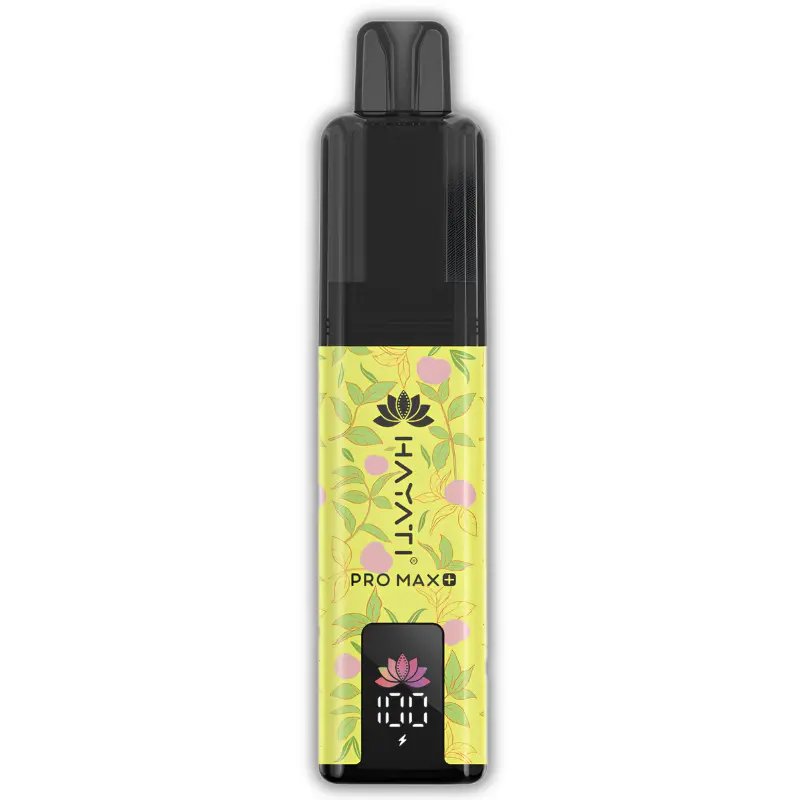
Hayati · Pro Max Plus
Peach Green Tea Hayati Pro Max Plus 6000 Pod Kit
£7.99
✔ In stock — ready to ship
Genuine Hayati
Free over £20
Same-day dispatch
Secure checkout
Peach Green Tea is built around the one note on this shelf that is not a fruit, not a confection and not a soft drink. It is tea. Everything else in the Pro Max Plus family is some arrangement of berries, stone fruit, citrus, cola or lemonade, and this listing quietly steps outside all of those categories to do something none of them attempt. The commercial side is ordinary: £7.99 buys a rechargeable body and a pod that arrives holding 12ml of 20mg liquid, exactly as the other kits in the range do. The flavour is not ordinary at all, and the gap between it and its nearest neighbour is wider than the usual half-step between one berry blend and the next.
Tea is a texture before it is a taste. What green tea contributes to a glass is not sweetness and not acidity but astringency, that faint drying grip across the tongue and the inside of the cheek that makes the next mouthful taste sharper than it would on its own. Almost nothing on a vape shelf does this. Fruit liquids work on two dials, sugar and acid, and both of those are additive. Tannin is subtractive. It takes something away from the mouth and leaves a surface that other flavours then land on differently. Pairing it with peach is not decoration, it is structural: peach is the softest, roundest, least defined fruit in common use, all texture and perfume with very little edge to it, and it goes vague on its own over 12ml. Put something dry underneath it and the softness suddenly has a shape.
That is the theory, and the theory is sound. The practice is harder, which is what most of this page is about. Tea is notoriously difficult to render in vapour, it fails in two specific and recognisable ways when it fails, and a tannic liquid ages on a coil along a completely different curve from a sweet one. All three of those are worth knowing before you spend £7.99 on a format that gives you no way out of the flavour once you have started it.
Why tea is the hardest thing on this shelf to get right
Here is the honest problem. The character of green tea in a cup comes largely from compounds that do not behave well in a heated glycerine base. Astringency in real tea comes from polyphenols, the same family responsible for the pucker in red wine and unripe fruit, and those are heavy, water-soluble molecules that do not carry into vapour in any useful quantity. The savoury, slightly marine depth of a good sencha comes from amino acids, which do not carry either. What a flavourist is left with is the volatile fraction, the part that actually evaporates, and in green tea that fraction is a handful of green, grassy, faintly floral aromatics and not much else.
So a tea vape is always a reconstruction rather than a reproduction. The flavourist has to build something that reads as tea using notes that are available, and there are two well-worn roads out of that problem. Both of them lead somewhere slightly wrong.
The first road is floral. Lean on the aromatic top end and the liquid heads toward jasmine, then toward soap, then toward the inside of a drawer that once held a scented liner. This is the failure mode people mean when they say a tea vape tastes like perfume. It is not that the flavourist added perfume. It is that the honest aromatic signature of green tea, isolated from the body and the tannin that normally holds it down, is genuinely quite close to a light floral, and without the drag of the tannin underneath it floats free and reads as cosmetic rather than drinkable.
The second road is vegetal. Lean instead on the green, leafy, herbaceous end and the liquid heads toward cut grass, then toward dried grass, then toward hay and the vague dustiness of a bale in a barn. This is the other common complaint. It is closer to the plant than the floral failure is, but it is closer to the plant as a plant rather than as a drink, and after half a pod it starts to feel like inhaling a garden rather than a beverage.
A tea liquid that works has to sit in the narrow lane between those two, and it has to stay there while a coil heats it thousands of times. Very few manage it across a whole pod. This one lands nearer the vegetal side than the floral side, which is the more forgiving of the two errors to make, and it is not a pure success. There is a real, recognisable green tea impression on the exhale for most of the pod's life, and there are stretches, usually when the device is warm and you have been drawing frequently, when that impression slides toward dried grass. It does not cross into soap. It does not smell of a bathroom shelf. If floral-tasting tea vapes are the thing that has put you off the category, this is not one of them.
Worth saying plainly: if you have tried two or three tea liquids from other makers and concluded that the whole category does not work, nothing here will change your mind. The limitation is chemical and it applies to every tea liquid on every shelf. What this one offers is a reasonable version of a difficult thing, propped up by a peach that is doing a lot of load-bearing work.
The flavour, from the first draw to the last third
Take the inhale first, because that is where the peach lives and it is the part that will feel familiar. The fruit arrives immediately and it arrives soft. This is not the bright, wet, nectar-forward peach of a juice blend. It is riper than that and less acidic, with the perfumed quality real peach skin has when the fruit is a day past perfect, and there is no sharp edge on it anywhere. Nothing bites. On the inhale alone you could mistake this for a plain peach liquid with the sweetness turned down, and for the first half second that is effectively what it is.
Then the exhale arrives and the whole thing changes character. The tea comes up underneath the fruit rather than after it, so there is a moment where both are present and the peach is being pulled downward. What you notice first is not a flavour but a sensation: a drying across the middle of the tongue and along the sides, mild but unmistakable, the same feeling you get from the second cup of a pot that has been left to stand slightly too long. Behind that sensation there is a green, leafy, faintly bitter note that reads as tea if you are expecting tea and reads as something herbal and unnamed if you are not. It is quiet. It never shouts over the peach. Its job is to hold the peach down and stop it drifting off into perfume, and it does that job consistently.
The finish is the most distinctive part and the reason this pod is worth a look even if you rarely go outside fruit. Most liquids in this range finish sweet, which means the taste that stays in your mouth between draws is a residue of sugar. This one finishes dry. The peach fades out over two or three seconds and the astringency stays, so what you are left with is an empty, slightly puckered mouth rather than a coated one. Some people find that unsatisfying and want the sweetness to linger. Others find it is precisely what makes a liquid tolerable across a whole day, because a dry finish does not build up the way a sweet one does.
On sweetness, plainly: this is one of the least sweet things in the Pro Max Plus catalogue. Set it against the deliberately confected end of the shelf, something like Blueberry B’Gum, and the difference is not a matter of degree, it is a matter of intent. That one is built to taste like a sweet. This one is built to taste like a drink that has had no sugar added to it. There is sweetener present, because the peach would collapse without some, but it sits well below the level of the fruit blends and well below the level of anything with lemonade in the name. If you have been drifting toward the sourer, drier listings because everything tastes like syrup after a fortnight, this is the far end of that drift.
No cooling. Nothing in the name flags a coolant, the product data does not record one, and none is detectable in the vapour. What does happen, and what people sometimes report as cooling, is that a dry finish leaves the mouth feeling fresher than a sweet finish does. That is astringency doing its trick, not menthol. If you want actual cold with your fruit, the shelf has plenty, and Blue Frozen or Blackberry Ice will do it properly. Adding cold to this recipe would be a mistake anyway, because menthol and tannin compete for the same real estate at the back of the palate and the tea would lose.
What it is not, item by item, because a peach-and-tea name invites several wrong assumptions. It is not the bottled peach iced tea sold in supermarkets, which is a sugar delivery system with a tea-flavoured hint somewhere in it; this is considerably drier and the tea is a bigger share of the total. It is not a hot, malty, milky tea; there is no black tea depth here at all, no tannic weight of the builder's-brew kind, nothing creamy. It is not a dessert. It is not floral in the jasmine sense, though on a hot device you will catch a floral edge for a draw or two. And it is not a subtle liquid in the sense of being weak: the peach is perfectly loud, it is just that the thing sitting underneath the peach is unusual.
Over the length of the pod the balance shifts, and it shifts in a direction worth anticipating. Fruit aromatics are volatile and they deplete first. Tannin-adjacent notes are heavier and they deplete last. So the peach is at its fullest in the opening third, holds roughly steady through the middle, and is measurably thinner in the final quarter, while the green tea stays about where it started. The practical result is that the last portion of this pod is a drier, more herbal, less fruity liquid than the first portion was. On a two-fruit blend that drift would be a nuisance. Here it is closer to a feature, because the thing it drifts toward is the thing that makes the pod interesting in the first place. Some people prefer the final third. That is not a common thing to be able to say about a prefilled pod.
Room temperature changes it more than it changes a sweet liquid. Warm the device up with a run of draws and the green note stews, moving from fresh leaf toward dried leaf, and the peach turns slightly cooked and jammy. Let it sit for ten minutes and both reset. This is the single biggest variable in how the pod tastes on any given day, and it is entirely under your control, which the next section gets into.
Condensate, and where this device puts it
Hardware first, briefly, because it is shared with every listing on the Pro Max Plus Prefilled Pod Kit shelf while the flavour is not. Two items come out of the carton: a rechargeable body with a cell rated at 850mAh, and one pod that arrives already holding its 12ml at 20mg. Hayati's data for this listing stops there. It itemises no cable, no spare, and no charging connector, so this page names none. Some listings on this platform break the pod volume into a 2ml chamber at the coil plus a 10ml reserve; this listing records only the total, and Hayati do not publish how the liquid moves internally, so neither will this page. There is no button, no airflow collar and no wattage control. You draw, it fires.
The thing worth spending the rest of this section on is what happens to vapour after it leaves the coil, because on a dry liquid you notice it and on a sweet one you often do not.
Air enters the body low down, passes across a heated wick, and leaves as a mixture of vapour and very fine droplets at somewhere close to the boiling point of the base. It then travels up a narrow channel to the mouthpiece. That channel is at room temperature. Hot saturated vapour meeting a cool wall does the only thing physics allows, which is to condense back into liquid on that wall, and the narrower and cooler the channel the more of it condenses. Over a session a film accumulates along the inside of the mouthpiece and pools in the tighter bends of the path. None of this is a fault, none of it is a leak, and no pod design avoids it. It is simply what a chimney does.
Where it becomes a flavour question is the first draw after a pause. That draw pulls the accumulated film along with the fresh vapour, and condensate is not the same thing as the liquid in the pod. It is the heavier, less volatile fraction, the part that did not stay airborne, which means it is depleted in bright aromatics and concentrated in everything else. On a sweet berry pod that returning film reads as a brief syrupy blip and most people never register it. On this pod it reads as stewed tea. The first pull of the morning, or the first after an hour in a jacket pocket, has a noticeably darker, more bitter, more hay-like character than the second one does, because you are tasting the fraction of this liquid that is least fruit and most tannin. It clears within two or three draws.
Several things move that dial. Cold makes it worse, because the temperature gap between vapour and channel is larger, so a device left in a cold room or a car overnight will give you a thicker first draw than one that has been indoors. Long draws make it worse than short ones, because more vapour passes the same cool surface. Chain-drawing makes it better in the moment, since the channel warms and stops condensing so efficiently, and then worse afterwards, because a warm device sitting idle cools through the exact range where condensation is heaviest. A device carried lying flat will tend to hold more of the film near the mouthpiece than one carried upright, simply because that is where gravity puts it.
What to do about it is undramatic. Point the mouthpiece down onto a folded tissue and give the body a couple of firm taps before the first draw of a session, and most of the pooled film comes out. Let a cold device reach room temperature before you use it rather than drawing on it straight away. If you hear a soft gurgle, that is the airflow pulling through liquid rather than past it, and a tap clears it. Do not try to poke anything into the channel and do not try to wipe out the inside of the pod, because unlike a refillable tank there is nothing here you can dismantle and reassemble. Tap, wait, draw. That is the entire maintenance routine for this device, and on a tannic liquid it makes more difference to what you taste than anything else you can do.
The numbers on the listing
| Price | £7.99 |
| Product code | HPM-6K-KIT-PEACH-GREEN-TEA |
| Flavour as listed | Peach Green Tea |
| Made by | Hayati |
| Nicotine | 20mg, single strength |
| Liquid volume | 12ml, supplied in the pod |
| Cell | 850mAh, rechargeable |
| Cooling | None recorded in the product data |
| Hayati's puff figure | Up to 6,000, a bench measurement |
| In the carton | Body and one filled pod |
| Range | Pro Max Plus, full listing name Peach Green Tea Hayati Pro Max Plus 6000 Pod Kit |
Most of those rows are administrative. Three of them change how the liquid behaves, and they change it in ways that are specific to a dry profile rather than generic to the format.
The strength, first. Twenty milligrams is the legal ceiling in the UK and the listing gives the number without describing the formulation, so the number is all this page will state. What is worth knowing is that the same 20mg presents differently depending on what surrounds it. A cooled pod partially camouflages nicotine, because menthol occupies some of the same throat sensation and your attention gets divided. This pod camouflages nothing. There is no coolant and the sweetener level is low, so the 20mg here reads at close to its full prominence, and the astringency does not soften it because tannin works on the tongue and the cheeks rather than the throat. If you are moving here from something cold and sweet on the same shelf, expect this one to feel more present on the same draw. Nicotine is addictive, and how much you use is entirely your own business.
The volume, second. Twelve millilitres in a single unit is the format's basic bargain and the basic cost. The bargain is fewer interruptions. The cost is that you have committed to one flavour for the duration, with no collar to turn and no second tank to switch to, and on a liquid that drifts drier across its life you will be living with that drift whether you enjoy it or not. Given this liquid drifts toward its more interesting end rather than away from it, that cost is lighter here than on most.
The price, third, because the arithmetic is simple and nobody spells it out. This kit is £7.99. The same flavour as a bare pod is £5.49. The difference is £2.50, and £2.50 is what the body costs you. That makes the first purchase obvious and every subsequent one equally obvious in the other direction: buy the kit once, then buy pods. The only reason to buy a second kit is that you want a second body, either as a spare or because the old one has stopped holding charge for as long as it used to. Hayati publish no cycle rating for the cell, so there is no figure to quote and no way to predict when that point arrives.
What the listing does not record is worth naming so you know why this page is silent on it. No carrier ratio. No coil resistance. No statement of what, if anything, produces the dry character. No connector type. Those absences are in the source data, not in the writing.
Where it sits among the peaches, and among everything else
Start with the comparison that matters most, because it isolates exactly one variable. There is a peach and mango pairing in the range, available as half of the Cherry Ice and Peach Mango Mini Ultra kit at £3.99, and it uses recognisably the same soft, ripe, perfumed peach that sits on the inhale here. The difference is what is underneath it. There, the peach is propped up by mango, which is another soft sweet fruit, so the two of them reinforce each other and the result is round, generous and entirely without edges. Here the peach is propped up by something that actively takes sweetness out of the mouth. Same fruit, opposite counterweight. If you want to understand what tea is doing to this recipe, that pairing is the control experiment, and it is cheap enough to run.
Against the plain peach, Juicy Peach is the straightforward version: more nectar, more sweetness, wetter in the mouth, and no structure other than the fruit itself. It is the better choice if peach is the thing you actually want and you would rather nothing complicated it. It is also the one that goes vague fastest over a full pod, for the reason given earlier, which is that peach on its own has very little to hold onto.
Peach Aura takes the abstract route instead. The second word names an intention rather than an ingredient, so the recipe is not disclosed and what you get is peach plus something unstated. It occupies a similar position in the range, which is peach with a modifier, but the modifier here is named, described and audible, and there it is not. Preference between them is mostly a preference about knowing what you are drinking.
White Peach Raspberry is the closest thing on the shelf to a structured peach that is not this one, but it structures the fruit with acid rather than tannin. Raspberry brings sharpness and a little tartness, and sharpness cuts through softness in a way that feels immediate and bright. Tannin does the opposite: it dries the mouth out so the softness has somewhere to land. Both solve the same problem. One solves it loudly, the other quietly. If the phrase "grown-up flavour" appeals to you, this is the quiet one.
Two further peach blends widen the field rather than sharpening it. Cherry Peach Lemon runs three registers, with citrus doing the lifting and cherry adding depth, and the peach ends up as the middle voice rather than the lead. Mango Peach Pineapple is the tropical committee, generous and warm and sweet throughout, with no dry element anywhere in it. The entire peach section runs to 32 listings, and it is worth a look purely because the word covers such different things depending on what is standing next to it.
Step outside peach and the interesting comparisons are with the other listings that lean toward drink rather than dessert. Cola Ice is the nearest thing the shelf has to another beverage profile with a bitter component, since cola carries a spiced, faintly medicinal bitterness under its sugar, though it is cold and sweet where this is neither. Berry Lemonade and Blackcurrant Lemonade are drinks too, but they are sugared soft drinks and they solve the flatness problem with acid and carbonation-style tingle rather than dryness. Blackcurrant Juice gets closest to a genuine dry finish among the fruits, because blackcurrant skin carries a real tannic bite, and of the non-tea listings it is the one a Peach Green Tea drinker is most likely to get along with.
For contrast in the other direction, the shelf's loud end is well represented. Black Mamba and Midnight Dream both hide their recipes behind a name and both hit considerably harder. Guava Kiwi Passion Fruit is three tropical fruits with nothing restraining them. Blue Fusion and Blackcurrant Mango sit in the middle of the sweetness range. Lemon Pineapple and Lemon Lime go at the problem with citrus acid, which is the most common alternative to sweetness on this shelf and a completely different sensation from tannin. Banana Ice is the other soft, low-acid fruit in the family and it solves its own vagueness with cold instead.
On rotation, which is where this pod earns its place for a lot of people: a dry liquid and a sweet one alternate better than two sweet ones do, because each resets your palate for the other. Pair this with something emphatic like Blueberry Raspberry or Blackberry Raspberry and both taste better than either does run solo for a week. If you are ordering a body and a flavour separately rather than together, the undifferentiated Pro Max Plus 6000 kit listing is the one to check, and the full prefilled pod kit range runs to 171 entries across several device families. Recent additions land in New Products first, and everything Hayati make is in the full catalogue if you would rather browse than be steered.
Handling a dry liquid over 12ml
Almost all the standard prefilled-pod advice applies here, so rather than repeat it, this section covers the places where a tannic liquid diverges from a sweet one. There are four, and they matter.
The first is coil ageing, which runs on an opposite curve. Sweet liquids gunk coils quickly, because sucralose and similar sweeteners caramelise on hot wire and build a crust that dulls the flavour long before the liquid is gone. This pod carries much less of that, so the coil should stay functional for longer than it would on a confectionery blend. The catch is the failure mode when it does start to tire. A sweet liquid goes muted, then slightly burnt-sugar, then flat, and the transition is gradual and forgiving. A tannic liquid goes bitter. The dryness that was pleasant turns into something sharp and ashy at the back of the throat, and it does so over the course of maybe fifty draws rather than gradually across days. When this pod turns, it turns decisively, and there is no point persevering through it.
The second is draw pace, which changes the taste here more than it would on most liquids in the range. Tannin becomes more aggressive with heat. Draw quickly and repeatedly and you push the coil hotter, the green note stews toward hay, and the astringency stops being a texture and starts being a bitterness. Draw slowly, with a gap of fifteen or twenty seconds between pulls, and the coil stays cooler, the peach keeps its perfume, and the tea stays on the fresh side of the line. Nobody counts seconds between draws in real life, but knowing which direction the dial turns is useful when the pod suddenly tastes worse than it did yesterday and nothing about the pod has changed.
The third is cumulative palate dryness. Astringency builds. Ten draws in twenty minutes on a sweet pod leaves your mouth coated; ten draws in twenty minutes on this one leaves it genuinely dry, and the eleventh draw tastes stronger and more bitter than the first did because there is no longer any moisture buffering it. A glass of water resets it completely and the liquid tastes as it did at the start. This is not a complaint about the pod, it is how tannin works in a cup as well, and it explains most of the cases where someone says a tea liquid "went off" halfway through an evening.
The fourth is heat in storage. Warmth stews a tea note faster than it damages a fruit one, because the green aromatics are the fragile part and the peach is comparatively robust. A pod that has spent an afternoon on a sunny windowsill or in a car will have moved noticeably toward the dried-grass end and will not move back. Somewhere dark and roughly room temperature is all that is required, and lying the device flat rather than standing it upright makes the first-draw condensate worse for the reasons covered earlier. Upright, out of the sun, and use it within a sensible span rather than stockpiling six of them for next year.
Beyond those four, the ordinary things still hold. Give a new pod a minute or two after fitting it before the first draw, so the wick is properly wetted. If the vapour thins and the taste goes papery mid-session, you have outrun the wick and a short rest fixes it. If the body stops firing, charge it, and note that a regulated device gives no gradual warning before it does. And when the liquid genuinely runs out, replace the pod rather than chasing the last few draws, because a wick running dry is how a perfectly good coil gets ruined in thirty seconds.
Common questions about Peach Green Tea
Does it actually taste like green tea?
It tastes like a reconstruction of green tea, which is the most any vape liquid manages, and this one is a decent reconstruction. You get the drying astringency and a green, leafy, slightly bitter note on the exhale. You do not get the savoury depth or the mineral quality of brewed leaf, because those parts do not carry into vapour at all.
Is the peach the main flavour or is the tea?
Peach leads on the inhale and tea takes over on the exhale and the finish. By volume of impression the peach is probably the bigger share for the first two thirds of the pod, and the tea catches up in the last third as the fruit aromatics deplete. Neither one is background.
How sweet is it?
Low, and deliberately so. It sits near the dry end of the whole Pro Max Plus catalogue, well below the lemonades and nowhere near the confectionery blends. There is some sweetener holding the peach up, but the finish is dry rather than sugary and nothing coats your mouth afterwards.
Is there any cooling in it?
No. The name carries no cooling marker, the product data records none, and none is detectable. The freshness some people notice is the dry finish rather than menthol, which is a different sensation in a similar place.
Why does the first draw of the day taste bitter?
That is condensate. Vapour recondenses on the cool inside of the airflow path between sessions, and the film that collects there is concentrated in the heavier, more tannic part of the liquid. Tap the mouthpiece down onto a tissue before you start and it clears in a draw or two.
How does it compare with the Peach Mango?
Same soft, ripe, perfumed peach, opposite supporting cast. Mango is another sweet round fruit, so that pairing is generous and edgeless. Here the peach has something dry underneath it instead, which gives it definition but makes the whole thing less comforting.
The tea has started tasting like hay. What happened?
Two likely causes. Either the device has been running warm, from frequent draws or from sitting somewhere hot, which stews the green note toward dried leaf and reverses once it cools. Or the coil is tiring, in which case the dryness will also have turned sharp and slightly ashy and no amount of resting will bring it back.
What is the point of buying the kit rather than the pod?
The kit includes a body, the pod does not, and the difference in price is £2.50. Buy the kit if you do not already own a Pro Max Plus device or you want a spare body. Otherwise the bare pod is the cheaper restock and does exactly the same thing.
What does the 6,000 figure mean?
Hayati rate the pod at up to 6,000 puffs, measured on laboratory equipment under fixed conditions rather than by anyone in normal use. Treat it as a way of ranking pod sizes against each other, not as a prediction of days. Your own draw length can move the real number by a factor of two in either direction.
Is it worth trying if I only ever vape fruit?
Possibly, with a caveat. The peach on the inhale is familiar enough that nothing feels alien, so the entry point is gentle. The finish is genuinely different from anything else on the shelf, and a fair number of people who like sweet fruit find a dry finish unsatisfying rather than refreshing. Buying one and rotating it against a fruit pod is a cheaper way to find out than committing to it as a daily.
Can the pod be refilled?
It is supplied prefilled and Hayati do not publish it as a refillable pod, so treat it as a single-use consumable and fit a replacement when it is spent. Replacement pods for this platform are sold separately and the matching flavour is listed on its own.
Does it come in other nicotine strengths?
This listing records one strength, 20mg, and no other option is published for it. If a different strength existed for this flavour it would appear as a separate listing rather than as a choice on this one.
Where this leaves you
Peach Green Tea is a kit at £7.99 containing a rechargeable 850mAh body and one pod holding 12ml of 20mg liquid, rated by Hayati at up to 6,000 puffs on laboratory equipment. That part is identical to eighty-odd other listings on the same shelf. What is not identical is the flavour, which pairs a soft, ripe, perfumed peach with a green tea note that dries the mouth instead of sweetening it, and which finishes empty rather than sugary. It is among the least sweet things Hayati make in this format, and it is the only one built on a note that is not a fruit, a sweet or a soft drink.
It suits a specific person. Someone who has grown tired of syrup, who wants a liquid that stays tolerable across a long day, and who is willing to accept that a tea note in vapour is always an approximation and sometimes wanders toward dried grass. It does not suit someone who wants their peach loud, wet and uncomplicated, and for that reader the plain peach and the tropical blends on the same shelf are the better buy. Try it against the matching bare pod on your second order, keep it out of the sun, tap the mouthpiece before the first draw of the day, and stop when the dryness turns bitter rather than pushing through it.
Strictly for adults aged 18 and over. Nicotine is an addictive substance.
You might also like


