
Home / Hayati Pods / Mr Blue Hayati Rubik Pods
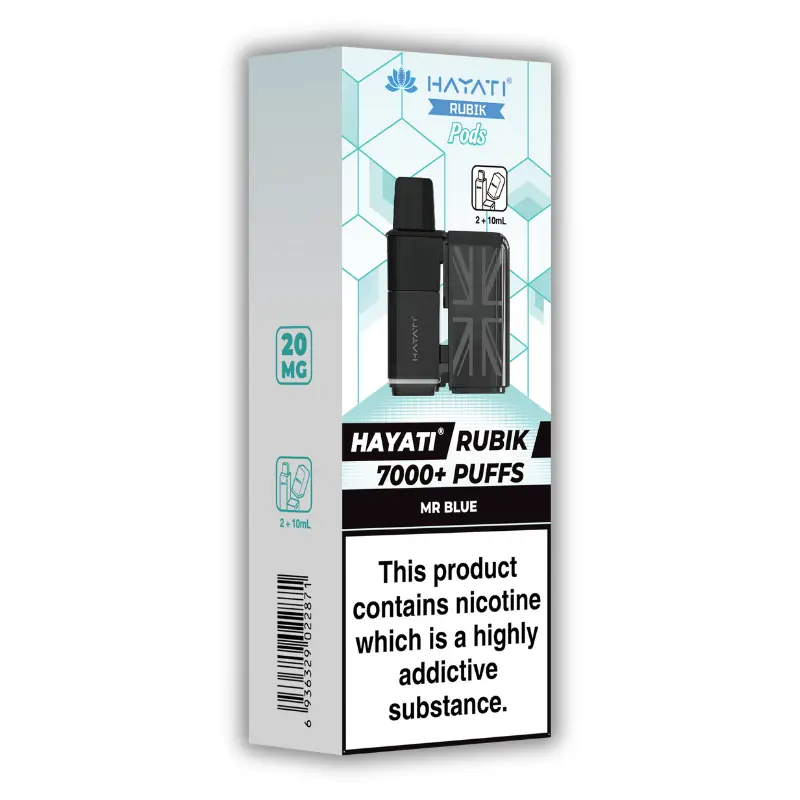
Hayati · Rubik
Mr Blue Hayati Rubik Pods
£3.99
✔ In stock — ready to ship
Genuine Hayati
Free over £20
Same-day dispatch
Secure checkout
£3.99 buys one sealed Rubik pod, prefilled with 12ml of liquid at 20mg nicotine salt, in the flavour Hayati print as Mr Blue. There is no device in the packet. Hayati put a full pod at up to 7,000 puffs, a figure produced on test apparatus under a fixed draw pattern and therefore a laboratory estimate of one coil's workload rather than a forecast of anybody's fortnight. If what you are missing is the body rather than the liquid, the Mr Blue Hayati Rubik Prefilled Pod Kit at £5.99 is this same pod with a Rubik attached to it.
Six pages on this site have already worked this flavour over, and between them the naming question, the colour question, the distribution question, the listing diff and the cross-format arithmetic are all finished. None of that is repeated below. What none of them could cover, because all six are written for somebody deciding, is the only thing that actually happens on a bare refill listing: the purchase after the purchase after the purchase.
The kit twin closes on a confidence table, and two of its rows are marked Unknown. Where this liquid's sweetness sits against the rest of its shelf. Whether it can be told apart from the named blues at the same price. That page says plainly that those two rows are the ones carrying the decision, and that neither can be settled from anything Hayati publish. The natural assumption, and the one I was handed, is that a repeat buyer has quietly settled both by the third pod, and that this page's job is to describe the answer.
The assumption does not survive contact with the two rows. Read them again and notice what kind of sentences they are. Both are comparative. Neither is a property of this liquid at all: one places it against eighteen other pods, the other against five named blues. A comparative claim needs two objects, and a repeat purchase produces one object three times. Three consecutive pods of Mr Blue, with nothing beside them, close neither row and never will, however long you keep buying.
That inversion is what this page is about. The buyer best placed to answer the kit page's two open questions is not the one who has committed to the flavour. It is the one who has not, because committing to a flavour is precisely the behaviour that stops you ever having anything else in the house to measure it against. What pod three does close, it closes in a currency that cannot leave your own mouth, and the whole practical burden of this listing follows from that.
What repetition actually settles, and what it cannot touch
Start with what does get closed, because it is real and it is worth having. The Mr Blue Pro Ultra Plus pods page established the split that makes this legible: a descriptive name does two separate jobs, predicting before purchase and identifying after it, and on this flavour those two jobs come apart completely. The name predicts nothing. As an index on something you have already met it is better than most of the titles around it, because it is unique in the catalogue and cannot be confused with a neighbour. That finding is settled and I am building on it rather than restating it.
Repetition closes the identification side and closes it hard. By the third pod the liquid is recognisable to you within two draws. You know what arrives first and roughly what the exhale does. You know what a pod of it feels like when it is fresh, and you have some sense of what it turns into when the coil has done most of its work. That is a substantial body of private knowledge and it is exactly what a chooser lacks.
Now look at what it is knowledge of. It is knowledge of this, which is a pointing word, and the thing it points at is an impression you have no vocabulary for. Hayati have no sweetness-level vocabulary anywhere in the catalogue, a point the kit page makes and I have no reason to re-establish, so there is no scale published for you to read your impression onto. Your own words are not much better, because the name gave you no words to start from. A peach drinker arrives at pod three with the word peach already in hand and can say less than a real one, more than a sweet. You arrive at pod three with a colour and a courtesy title.
The result is a curious kind of expertise. You are, after three pods, one of the few people alive who could pick this liquid out of a handful of blues, and you are no better placed than a stranger to say a single informative sentence about it. Familiarity has gone up steeply and describability has not moved at all. Those two usually rise together, which is why the gap is easy to miss until you try to tell somebody what you are drinking and find there is nothing at the end of the sentence.
The two rows, taken one at a time
Sweetness against the rest of the shelf. This row cannot be closed by repetition even in principle, because a position on a shelf is not a fact about one product. The Hayati Rubik Pods shelf holds nineteen listings and every one of them is £3.99, so the shelf is a real and evenly priced comparison set. Tasting all of it costs £75.81. Tasting the eighteen that are not this one costs £71.82. Nobody does that, and nobody should be told to. What a repeat buyer typically has instead is one or two other flavours met at some point in the past, in a different device, at an unremembered coil depth, in a month they could not name. That is not a position. It is a rumour.
Distinguishable from the named blues. This row is closable, and it is closable cheaply, but only by doing something a settled buyer has stopped doing. Six of the nineteen pods on this shelf are blue-titled and five of the six name a fruit, a pattern the kit page counted on the kit shelf and which carries straight across. Any one of those five costs £3.99 and closes the row for that one pairing. But the reason you are on a refill listing is that you have stopped buying things to find out about them. The behaviour that closes the row and the behaviour that brings you here are opposites, and the longer you have been settled the less likely the row is ever to close.
So the honest correction to the angle I started with is this. Pod three closes recognition and leaves both comparative rows exactly where the kit page left them, unless you did something deliberate. It is not that the refill buyer knows more. It is that the refill buyer knows something different, of a kind that does not answer either of the questions a buyer actually asks out loud.
Four things the private answer will not do
Suppose you did the deliberate thing. Suppose that at some point you had this pod and a named one going at the same time and you formed a view: sweeter than that, less acid than that, heavier at the back than that. That is a position, it is genuine, and it is the best information anybody has about this liquid, including me. It is also fragile in four specific ways, and the four are worth separating because they have different remedies.
It is relative to whatever happened to be beside it
A position is always a position against something, and the something was not chosen by a laboratory. It was whatever else was in the house that week. If the pod you happened to have open beside it was Blue Sour Raspberry Hayati Rubik Pods, your Mr Blue reads as notably mild. If it was Blue Razz GB Hayati Rubik Pods, with a declared confectionery reading, it may read as comparatively restrained instead. Both impressions are accurate readings of a genuine comparison and they point in opposite directions. Neither is a fact about Mr Blue.
This is not a defect in your palate. It is what a comparison is. The trouble is that the memory does not store the comparison, it stores the conclusion, and the conclusion arrives in your head as a property of the liquid rather than as a relation between two of them. Six months later you remember that Mr Blue is mild. You do not remember that mild meant mild next to a pod with the word Sour in its title.
It does not move to another platform
Mr Blue is printed on thirteen listings, and the kit page counted them and the formats they cover. What that page also says, and it is the load-bearing part here, is that Hayati publish nothing at all confirming that the recipe behind the name is the same one in each of them. A liquid mixed for a 120ml bottle and a liquid mixed for a 12ml prefilled pod at 20mg are not obviously the same liquid, and the only evidence that they are is a shared name.
So a position formed on the Rubik is a position about the Rubik pod. Carrying it to Mr Blue Hayati Pro Max Plus Pods or to Mr Blue Hayati Pro Ultra Plus Pods means assuming both that the liquid is the same and that the hardware does nothing to it, and the second assumption is one Hayati's own copy contradicts elsewhere. This matters more on a refill than on a kit. A refill buyer is the person most likely to change device eventually, and the thing they will want to bring with them is the one thing that does not travel.
It cannot be handed to anybody
An unshared preference is a strange object. Ask somebody what they drink and they will say lemon, or mint, or a berry mix, and the other person gets most of the way there. Say Mr Blue and you have said the name of a stock keeping unit. If they have had it, the name works perfectly, which is the Pro Ultra Plus page's point about a unique index. If they have not, the name transmits nothing whatsoever, and you cannot repair it by elaborating, because you do not have the words either.
The practical cost shows up in the two places people actually swap this sort of information: recommending a flavour to somebody who uses the same hardware, and being recommended one. A buyer on Juicy Peach Hayati Rubik Pods can tell you their pod is peach and slightly candied and you will know roughly whether to bother. You can tell them yours is blue. That exchange is not symmetrical, and after three pods it is still not symmetrical, which is the part that surprises people who assume experience eventually converts into description.
It is never reloaded by the label
This is the one I think is genuinely underrated, and it is specific to a name that describes nothing.
A flavour memory fades between pods, and for most listings the label quietly repairs it. Read the word peach and something reconstitutes. You can also go and eat a peach, which is a hard reset on the reference, freely available, and accurate enough for the purpose. Seventeen of the nineteen pods on this shelf give you that: the kit page counted the twenty kits and found eighteen naming something you could put in a bowl, a glass or a paper bag, and the pod shelf is the same set less Fizzy Cherry, so the count carries at seventeen of nineteen with the same two exceptions.
Mr Blue is one of the two, and it fails in a slightly different way from the other. The honorific has no referent outside the product at all, which the kit page establishes and which is the whole basis of its naming argument. The colour does have a referent, but the Pro Ultra Plus pods page showed that blue in this catalogue indexes two different things, the invented sweet-counter blue and the grown berry, and that Hayati never choose between them. So going off to taste something blue in order to refresh your memory is not merely unhelpful. It is a coin toss between two targets that sit a long way apart, and if it lands on the wrong one you have now overwritten a faint accurate memory with a confident wrong one.
Between pods, then, there is no maintenance available. The memory decays and nothing in the world tops it up. For a flavour that names a fruit this is a minor inconvenience. For this one it means that the private answer you built at pod three is a wasting asset from the moment you finish the pod, and the only thing that preserves it is writing it down.
The instruction, and why it has to name something
Write the position down, against a named product from this shelf, while both are still in the house.
That is the entire recommendation and it takes three minutes. Not a description, because you cannot write one and the attempt will produce adjectives you will not believe in a month. A comparison, with the other thing named. Two or three lines is plenty:
- Which of the two arrives sooner in the draw, and which sits further back.
- Which is sweeter, and whether the gap is obvious or marginal.
- Whether anything is working against the sweetness on either, and on which one it is stronger.
- Whether you could tell them apart with your eyes shut, and how confident you were.
- The name of the other pod, in full, and the date.
The last line is the one that does the work, and it is the reason this instruction is different from writing a tasting note. A note written in your own words is a record of an impression, and an impression of a nameless liquid is not checkable by you or anybody else later. A note written against a named product is a record of a relation, and the named half of it is public. Anybody can buy it. You can buy it again. It exists on this shelf at a fixed price with a description attached. The anchor is the part of pod three's lesson that survives contact with time, hardware and other people, and it survives precisely because it is the part that is not private.
It is worth being clear about how this differs from the advice the Mr Blue Pro Max Plus pods page gives, because that page also tells a restocker to write something down and the two notes are not the same note. That one is a baseline against yourself: a record of a fresh pod of this liquid, kept so that a later pod can be checked against it for batch and age. It answers is this the same as last time. The note described here answers where does this sit, which is a question about the shelf rather than about the batch, and it needs a second product in it to mean anything. Both are worth having and they are not substitutes. If you only ever write one, write the one with another product's name in it, because that is the one somebody other than you can act on.
Not every anchor survives a change of hardware
The obvious next question is which named product to use, and the obvious answer is whichever one you happen to have. That is fine for the immediate purpose and it is wrong for the durable one, because anchors differ enormously in how far they travel, and nobody appears to have checked by how much.
Here is the count. Mr Blue appears on all five of Hayati's title families: the Rubik, the Mini Ultra, the Pro Max Plus, the Pro Ultra Plus and the Pro Max bottles, which between them are the seven formats the kit page counted, the bottle family accounting for three of the seven. Of the eighteen other pods on this shelf, the picture is very uneven.
| How far an anchor travels | Flavours on this shelf | What it means for the note |
|---|---|---|
| All five families, so anywhere Mr Blue goes | Blue Sour Raspberry, Blue Razz Cherry, Blueberry Raspberry, Strawberry Raspberry Ice, Juicy Peach, Lemon Lime, Summer Dream | The comparison can be re-run on whatever you move to |
| Four families | Blue Razz GB (no bottle), Watermelon Ice and Fresh Mint (no Mini Ultra) | Re-runnable unless you move to the missing one |
| Three families, always Rubik, Pro Max Plus and the bottles | Blueberry Cherry Cranberry, Banana Ice, Pineapple Ice, Red Apple Ice, Strawberry Kiwi, Triple Mango | Dead on the Mini Ultra and the Pro Ultra Plus |
| Two families | Vim Ice | Rubik and Pro Max Plus only |
| One family | Lemon Cola Ice | Exists nowhere but the Rubik, so the note dies with the platform |
Seven of the eighteen reach every family Mr Blue reaches. One reaches nothing else at all. That is a real spread and it converts directly into advice: if the note is meant to outlive the device, anchor it to one of the seven.
The finding also sharpens something the kit page left open. That page proposes two references for its blind test and treats them as interchangeable, which they are for its purpose, since it is asking a yes or no question on one shelf on one week. For a durable note they are not interchangeable at all. Blue Sour Raspberry is on all five families. Blue Razz GB is on four, missing only the bottles, so a note anchored to it stops working the day you decide to put this flavour into your own refillable hardware. If you expect to stay inside prefilled pods, either is fine. If the bottle is a plausible destination, the sour one is the anchor that keeps working.
Read the same table a second way and it answers the handing-it-over problem too. A note is transmissible to somebody else only if they can obtain both halves of it. Tell a Pro Ultra Plus owner that your pod is sweeter than Blueberry Raspberry and they can act on it, because both exist on their platform as Blueberry Raspberry Hayati Pro Ultra Plus Pods and the single-flavour Mr Blue pod. Tell them it is sweeter than Lemon Cola Ice and you have told them nothing they can use, because that flavour does not exist on their hardware. The anchor is not just a memory aid. It is the interface between your experience and somebody else's shelf, and a badly chosen one has no connector on the far end.
The narrow window in which the reading is worth anything
One more constraint on the note, and it is the reason for the phrase while both are still in the house.
Neither pod holds still. Both are sealed units with one coil each, and both change as that coil accumulates work, which on a sweetened liquid means the light material at the front thins out before the heavy material behind it. The kit page makes this point about Mr Blue specifically and the Pro Max Plus pods page turns it into a rule about comparing a new pod with an old one. The consequence for a two-pod comparison is one step on from both: the two pods are not drifting in step. They are separate coils with separate histories, so a pod opened on Monday and a pod opened a fortnight earlier are being read at two different points on two different curves, and any gap you observe is part liquid and part arithmetic of wear.
Which gives a simple working rule. Do the comparison in the first third of both pods, ideally in the first few days of both, and write down roughly how far into each you were. A reading taken with one pod fresh and the other nearly finished is not a reading about the two liquids. It is mostly a reading about the second coil, and it will reliably tell you that Mr Blue is the sweeter one, because that is what a tiring coil does to any sweetened blend on this shelf.
One flavour here has a kit and no refill
A short section, because it is a small fact with a sharp edge for anybody thinking three pods ahead.
The Rubik kit shelf carries twenty flavours. The pod shelf carries nineteen. The two lists are otherwise identical, and the flavour that exists as a complete kit with no matching bare refill is Fizzy Cherry. Somebody who bought that kit, liked it and came back for a second pod finds there is not one, and their options are another whole kit or a different flavour.
Nothing published says why, and it would be a mistake to read it as a judgement on the liquid. Ranges move; a refill may exist later or may have existed earlier. The useful generalisation is narrower and it applies to every prefilled platform, this one included: a kit purchase is a bet that the refill will be there, and on this shelf that bet is currently running at nineteen out of twenty. Mr Blue is in no danger on that front, being the most widely stocked coined name Hayati sell, but it is worth knowing that the refill is a separate commercial decision from the kit and not an automatic consequence of it.
The pod itself, which takes a paragraph
What arrives is one prefilled pod and nothing else. Twelve millilitres of liquid, 20mg nicotine salt, sealed, with the coil inside the unit and neither part replaceable, so the pod and its coil are retired together. There is nothing to fill, prime or assemble and no setting to choose. The whole 12ml passes through that single coil from first draw to last, which is the reason every observation on this page is tied to how far through the pod you are.
The 20mg is the UK maximum for a prefilled pod of this kind and it is the figure on every prefilled listing Hayati sell, so it separates this pod from no neighbour. What it does mean in practice is that there is no lighter version of this flavour in this format, and the strength is not a variable you can use to change the experience. Hayati publish no coil resistance, no carrier ratio and no airflow detail for any listing in the Hayati Rubik range, so this page states none, and any page that states one has taken it from somewhere other than the manufacturer.
On fitment, briefly and once: match the range word on your own device to the range word in this title before ordering, since a retail listing is not a hardware specification and should not be treated as one.
The figures, ordered by what a restocker needs
| Field | Value |
|---|---|
| This listing | One prefilled Rubik pod, no device |
| Price | £3.99 |
| Liquid | 12ml, prefilled and sealed |
| Nicotine | 20mg nicotine salt |
| Manufacturer puff figure | Up to 7,000 for a full pod, a laboratory estimate |
| Price of the complete kit | £5.99 |
| Other pods on this shelf | 18, every one of them £3.99 |
| Named blues on this shelf | 5 |
| Anchors that reach every family this flavour reaches | 7 of 18 |
| Cooling | None declared, in the title or in any listing of this flavour |
| Named fruit components | None published |
| Coil resistance and carrier ratio | Not published for this range |
Two of those rows are the ones a returning buyer actually uses. The flat £3.99 across the shelf is what makes an anchor cheap: every possible comparison costs exactly what this pod costs, which is unusual and which removes price as a reason to pick one reference over another. And the blank rows at the bottom are the same blanks the kit page found, unchanged by anything a third pod teaches you, which is the clearest single demonstration that private knowledge and published knowledge are separate quantities here. You can know this liquid thoroughly and the specification will still say nothing.
The per-millilitre arithmetic is not worth rebuilding, since the Mr Blue Pro Ultra Plus pods page lays out the whole cross-format ladder including this pod's 33.3p. The one line from it that bears on a Rubik owner is that this is the cheapest prefilled route into the flavour anywhere in the catalogue, and that the only cheaper option at all is the 10ml bottle, which is a different strength in a different base and needs hardware you may not have.
Anchors, neighbours and where to go next
The five named blues, which are the anchors that matter most
These are the comparisons that close the kit page's second Unknown row, and all five are on this shelf at £3.99. Blue Sour Raspberry Hayati Rubik Pods is the acid end and the most portable anchor of the five. Blue Razz GB Hayati Rubik Pods declares the sweet-counter reading in its own title, which makes it the reference for the confectionery ceiling. Blueberry Raspberry Hayati Rubik Pods is the plainest two-berry reading in the range and is also the flavour Hayati themselves put beside this one: the Blueberry Raspberry/Mr Blue Hayati Pro Ultra Plus 25K Pods listing ranks Mr Blue as the vaguer of the pair, which is the only place in the catalogue Hayati compare this flavour with anything. Blue Razz Cherry Hayati Rubik Pods puts a stone fruit underneath the blue, and Blueberry Cherry Cranberry Hayati Rubik Pods is the one that puts a genuinely unsweet berry at the bottom, which makes it the most informative anchor if what you want to locate is the floor rather than the ceiling.
Anchors from outside the blue corner
A blue anchor tells you where this sits within its own territory. A non-blue one tells you something coarser and sometimes more useful, which is where it sits in the range overall. Juicy Peach Hayati Rubik Pods is the best of these for the specific purpose of this page, because it is the case the whole reload argument turns on: a name with a referent you can go and buy, on the same shelf, at the same price, reaching the same five families. Strawberry Kiwi Hayati Rubik Pods uses one of the range's less common fruits. For cooled references there is Strawberry Raspberry Ice Hayati Rubik Pods, which travels to all five families, along with Pineapple Ice Hayati Rubik Pods and Banana Ice Hayati Rubik Pods, both of which stop at three.
The same name on hardware you might move to
If a change of device is on the horizon, the flavour goes with you in several places and the note may not. Mr Blue Hayati Pro Max Plus Pods is the nearest construction to this one, also a 12ml prefilled pod at 20mg, and that page is where the batch-to-batch baseline question is worked out properly. Mr Blue Hayati Pro Ultra Plus Pods is the 22ml version and the page that took the colour itself apart. On the same larger platform, the divided pod pairing it with Blueberry Raspberry puts both halves of the most informative comparison into one purchase, with a rotating mouthpiece selecting which reserve feeds the coil, though it is a more expensive way to obtain a comparison that costs £3.99 twice here.
If the blue is what you want and the vagueness is not
Several blues on the larger platform declare more than this one does. Blue Sour Raspberry Hayati Pro Max Plus Pods and Blue Razz GB Hayati Pro Max Plus Pods are the same two reference points a step up in size. Blue Frozen Hayati Pro Max Plus Pods is the cooled reading of a bare blue, which is the one thing this liquid is reliably not. Blue Fusion Hayati Pro Max Plus Pods is the other bare blue whose second word is about formulation rather than contents, and Blue Razz Fruit Twist Hayati Pro Max Plus Pods puts the blue against a mixed-fruit backdrop. For a blue with something darker underneath, Blueberry Pomegranate Hayati Pro Max Plus Pods and Blackberry Ice Hayati Pro Max Plus Pods both go somewhere this one does not.
Elsewhere in the range
On the smallest format, Blueberry Straw’ Menthol Hayati Mini Ultra Pods at £3.49 is a cooled blue in a 4ml pod. Among the divided pods, Grape GB / Blue Razz GB Hayati Pro Ultra Plus 25K Pods and Blueberry Cotton K / Raspberry Cotton K Hayati Pro Ultra Plus Pods both pair two declared confectionery readings, and Blueberry Raspberry Lemon Hayati Pro Ultra Plus 25K Pods adds a citrus lift to the berry pairing. All thirteen listings carrying this flavour name sit together on the Mr Blue Vapes shelf, which is the fastest way to compare what the name costs in each format. The wider filing is at Blueberry Vapes and Berry Vapes, the refill listings across every Hayati platform are at Hayati Prefilled Pods & Refills, and everything is at the full Hayati range.
Running a refill you have no words for
General handling advice is not reprinted here. These are the points where the ordinary routine changes because the liquid is sweet, uncooled, and unnamed, and because you are on your third one rather than your first.
Open the anchor and the refill within a day of each other, or not at all. The comparison is only worth making while both coils are near the start of their working life, for the reason set out above. If the anchor has been going a fortnight, do not bother: buy the anchor fresh when you next order this, and run them together from new. Two pods and £7.98 buys the only piece of information about this liquid that anybody can act on.
Write the position, not the impression. The temptation on a third pod is to finally attempt a description, and the result will be four adjectives that could apply to two thirds of the shelf. A sentence of the form sweeter than X, less sharp than X, arrives at about the same point in the draw is worth more than a paragraph of your own vocabulary, because X is a thing anybody can buy.
Assess early in the pod and do not chain while you are doing it. A warm coil pushes the sugar forward and shortens whatever acid is present, and on a liquid whose acid the kit page found consistently played down by every writer who has described it, the small thing you are trying to read is the first thing heat removes. A run of quick draws will make this pod read as syrup, including a perfectly good one.
Rule the cell out before you blame the pod. The output is regulated, so a low battery produces a thin draw that reads a great deal like a tiring coil. On a comparison between two pods that is doubly misleading, since you may be comparing a full device with a half-empty one and attributing the difference to the liquid. Charge first, then read.
Know the end from the middle. On this profile the finish announces itself as sugar with nothing behind it, followed by a dry edge that does not clear after an hour off the device. That is the coil rather than a bad pod. Pushing past it is worth avoiding here more than elsewhere, because the memory you spoil is the only record you have of a flavour you cannot look up.
Date the packet before it goes in the drawer. A restocker tends to hold two or three pods at a time, and a sweetened fruit liquid is worked on by heat and light while it waits. A month written on the packet costs nothing and rules out the most common false alarm, which is attributing a storage effect to a recipe change. Keep them somewhere shaded and at room temperature, well away from sunny windowsills and parked cars, and where children and pets cannot reach them.
Disposal. A finished pod still holds a coil and a film of liquid that never wicked, so it belongs with small electrical waste rather than in the household bin. Most vape retailers operate a collection bin and councils run sites that take small electricals. A regular restocker generates more of these objects than anybody else, which is a reason to have found the nearest one.
Questions a returning buyer asks
Is this the same liquid as the kit, or just the same name?
It is the same listing's pod without the body attached, so on this platform it is the same product. What is not established is anything across platforms: Hayati publish nothing confirming that the Mr Blue in a Rubik pod is the same recipe as the Mr Blue in a Pro Max Plus pod or a bottle, and the kit page says so plainly. Within the Rubik line you are buying what you already have.
After three pods, do I know what it tastes like?
You know it well enough to recognise it instantly and not well enough to describe it to anybody. Those two things usually arrive together and on this flavour they do not, because the name gave you no vocabulary to start from and Hayati publish no sweetness scale to read your impression onto. That gap is the reason for the whole comparison exercise on this page.
Which pod should I buy alongside it?
One of the seven on this shelf that exist on all five of Hayati's title families, so the comparison still works if you change device later. Blue Sour Raspberry and Blueberry Raspberry are the two most informative of those for a blue, sitting at the acid end and the plain-berry middle. Blue Razz GB is an excellent reference in every respect except that it is absent from the bottle range.
Why not just write down what it tastes like in my own words?
Because nobody, including you in six months, can check a private description of a liquid that names nothing. A note saying sweet and smooth is unfalsifiable in exactly the way the name is. A note saying sweeter than Blue Razz GB is a claim about two objects, both of which can be bought again for £3.99, and it is the only form of the note that another person can use.
Can I not just re-read the label to remember it?
There is nothing in the label to re-read. The honorific points at nothing outside the product, and the colour points at two different things, the invented sweet-counter blue and the grown berry, which the Pro Ultra Plus pods page separates and shows Hayati never choosing between. A peach drinker can eat a peach and reset the reference. There is no equivalent move available here.
How much liquid, and how long does a pod run?
Twelve millilitres, sealed, through one coil. Hayati rate a full pod at up to 7,000 puffs and that is a laboratory estimate produced on test equipment under standardised conditions, not a measurement of anybody's use. How long it actually runs depends on draw length and how often you reach for the device, and no real pattern matches a test bench.
Is there any cooling in it?
None is declared anywhere. The title carries no cold word and no listing of this flavour mentions ice, menthol, mint or frozen, and the kit page confirmed that across all thirteen. Hayati name cooling in the title whenever it is present, so the silence is reliable. If you want the cooled version of a bare blue, Blue Frozen on the larger platform is the nearest thing.
Will the same flavour taste the same if I change device?
Unknown, and the honest answer is that nothing published lets anybody say. The same name appears on thirteen listings across five title families and Hayati confirm nothing about the recipes matching. On top of that, hardware acts on a liquid independently of the recipe, so a difference you notice could be either. Treat a cross-format move as a fresh comparison rather than a continuation.
Why is it filed under Blueberry Vapes if no blueberry is named?
Because the tag follows the word blue in the title rather than a known recipe. The kit page cites the count of unsupported fruit tags in this catalogue and this listing is one of them, so the shelf should carry no weight in a purchase decision. It is useful for browsing and it is not evidence.
Every kit on this shelf has a matching pod, doesn't it?
Nineteen of the twenty do. Fizzy Cherry is sold as a complete kit with no bare refill listed, so somebody who settles on that flavour cannot restock it the cheap way. Nothing published explains it and it may change. It is worth knowing before committing to any prefilled flavour that the refill is a separate decision from the kit.
When should I stop rebuying it?
The Mr Blue Pro Max Plus pods page answers that one properly and the signal it gives is that you have stopped noticing the pod in your hand. The only thing worth adding here is that the signal is much easier to read if you wrote something down earlier, because noticing that you have stopped noticing requires a record of what noticing felt like, and a flavour you never had words for leaves no such trace on its own.
Is £3.99 a good price for this?
It is the flat price of all nineteen pods on this shelf, so it is not a judgement on the flavour and nothing here costs more for naming less. Across the whole catalogue it is the cheapest prefilled route into this flavour, per the cross-format ladder on the Pro Ultra Plus pods page, where this pod works out at 33.3p per millilitre. Only the 10ml bottle is cheaper, at a different strength in a different base.
The position, plainly
£3.99 buys twelve millilitres of a settled flavour at 20mg, in a sealed pod for a device you already own, rated by the manufacturer at up to 7,000 puffs as a laboratory estimate. For anybody who has been here before, that is the correct purchase and there is very little to decide.
What is worth deciding is whether to spend a second £3.99 at the same time. The kit page ends with two questions it cannot answer and marks both Unknown: where this sits for sweetness on its shelf, and whether it can be told from the named blues beside it. It is tempting to think a few repeat pods have quietly answered them. They have not, and they cannot, because both are comparisons and buying the same thing three times produces no comparison at all. Settling on a flavour is the thing that stops you ever finding out where it sits.
The remedy is small and it has a deadline. One named pod from this shelf, opened within a day of this one, read in the first third of both, and written down as a relation rather than a description, with the other product's name and the date in it. That note is portable, checkable, and transmissible to another person, which is three things no amount of private familiarity with a liquid called Mr Blue will ever be. Choose the anchor from the seven that travel as widely as this flavour does and the note keeps working after you change device. Choose Lemon Cola Ice and it stops at the edge of the Rubik.
Buy it plainly if the liquid is already yours. Buy an anchor with it if you would ever like to be able to say what it is.
Strictly for adults aged 18 and over. Nicotine is an addictive substance.
You might also like


