
Home / Hayati Pro Max Nic Salts / H’Bubba Hayati Pro Max Nic Salt
Hayati · Pro Max
H’Bubba Hayati Pro Max Nic Salt
£2.49
✔ In stock — ready to ship
Genuine Hayati
Free over £20
Same-day dispatch
Secure checkout
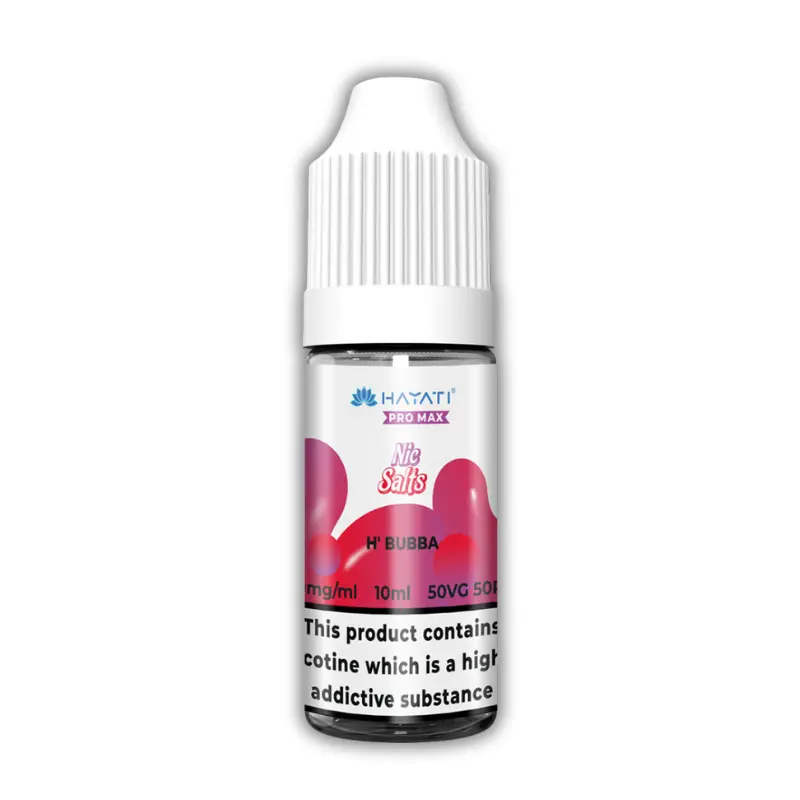
H’Bubba Hayati Pro Max Nic Salt is £2.49 for a 10ml bottle of bubblegum-flavoured liquid, mixed as a nicotine salt at 10mg and supplied with nothing else at all. No device, no pod, no coil, no charger, no puff figure. A bottle, a cap, and ten millilitres of somebody else's flavouring in a base that is half vegetable glycerine and half propylene glycol.
Hayati sell this gum seven times over. Six of those seven are hardware with a flavour attached, running from £5.49 for a replacement pod to £11.99 for a complete kit, and every one of them is locked to a device: a Pro Max Plus or a Pro Ultra Plus, bought from Hayati, filled by Hayati, thrown away by you. This bottle is the seventh, and it is not a smaller version of the other six. It is a different kind of object that happens to contain the same idea.
That is easy to assert and it sounds like the sort of thing a retailer says. What makes it worth a page is that Hayati's own product data proves it, in a way nobody buying a bottle would think to look for. The catalogue keeps two sets of books. There is a field for a base ratio and a field for a bottle size, and there is a field for a pod capacity and a field for a battery, and in 492 listings the two sets never once appear together. Exactly 105 listings publish a VG/PG ratio. All 105 are bottles. Not one of the other 387 publishes one, and going the other way, not one of the 105 publishes a puff figure while 372 of the 387 do. The blanks in this listing are not gaps in Hayati's disclosure. They are the outline of what is being sold.
So this page does three things. It runs that census properly and says what follows from it for a buyer holding £2.49. It lines up all seven H’Bubba descriptions against each other and reports where they agree, where they do not, and which words are doing real work rather than filling space. And it reads the four sentences Hayati wrote about the taste closely enough to separate their claims from their rule-outs, because on a flavour this well covered elsewhere in the corpus, reading the listing carefully is worth more than inventing a tasting note.
Seven listings, one gum, and only one of them sells you a liquid
Start with the set, because the argument depends on it being complete and on the prices being right.
Searching all 492 listings for the H’Bubba marker returns seven. One is this bottle at £2.49. Two are replacement pods at £5.49 and £7.99. Four are complete kits at £7.99, £7.99, £11.99 and £11.99. Two of the seven pair the gum with a single fruit, two pair it with two fruits behind a rotating collar, and three sell the gum on its own with no fruit named anywhere.
That count of seven is not mine and is not re-derived here. Our Strawberry H’Bubba Hayati Pro Max Plus Pods page built the full census of Hayati's shortened names, found nine distinct markers across 77 listings, established that H’Bubba sits on seven of them, and worked out which of the clippings a buyer can decode and which are locked. That page also settled what the marker points at, why Hayati decline to print the unclipped name, and why a gum reference behaves differently from a gelatine-sweet reference. All of that is taken as done. Our Strawberry Watermelon Bubblegum Hayati Pro Max Nic Salt page carries the companion finding, that the catalogue spells this confection four different ways across twenty listings with no rule governing which appears where, and that reading a spelling as a signal about the liquid is reading something that is not there.
What neither page had cause to do is sort the seven by what kind of purchase they are, because neither was a bottle looking at six pieces of hardware.
Sorted that way the set splits cleanly and the split is not close. Six listings require a Hayati device by name. The two Pro Max Plus items are locked to that body, the four Pro Ultra Plus items to theirs, and a pod bought for one will not go anywhere near the other. Four of the six ship the body in the box and two expect you to own it already. All six publish a liquid volume you cannot alter, a nicotine strength you cannot alter, a manufacturer's puff rating produced under laboratory conditions rather than by anyone actually using one, and a battery figure. All six are sealed. When the coil in one of them tires, the liquid still in it goes in the bin with it.
This bottle publishes none of that, because none of it exists to publish. There is no capacity, because the capacity is whatever your pod holds. There is no battery, because the battery is yours and Hayati have never seen it. There is no puff rating, because a puff rating is a measurement of a specific sealed device under fixed conditions and there is no device here to measure. What there is instead is a base ratio and a bottle size, which is precisely the pair of numbers the other six do not carry.
The price gap follows from that and is worth stating plainly rather than as a saving. £2.49 buys ten millilitres of liquid. £11.99 buys twenty-two millilitres of liquid and a body to run it in. These are not the same purchase at two price points and the second is not four times the first. One of them assumes you already own the expensive part, and the whole of the difference between the two figures is hardware, packaging and the convenience of never having to unscrew anything. A buyer reaching for the bottle because the number is smaller has probably not made a saving. A buyer reaching for it because they already own a pod kit and want to choose their own coil has made a genuinely different decision, and that is who this listing is written for.
One more asymmetry before the census, because it is the one with money attached. Of the seven listings, this is the only one whose description tells you anything about what the sweetness does. Hayati's copy here says candy flavours are sweetener-heavy by their nature and that pods or coils will want replacing rather more often than they would on a mint or a citrus. None of the other six mentions a coil at all. That is not because the liquid behaves differently inside a sealed pod. It is because the consequence lands on a different person.
A number the catalogue prints 105 times and withholds 387 times
Here is the count, run against the product data as it stands rather than against any shelf figure quoted elsewhere, and reported in both directions because the second direction is what makes it persuasive.
The catalogue holds 492 listings. A VG/PG ratio is published on exactly 105 of them. A bottle size is published on exactly 105 of them. Those are not two overlapping sets of similar size, they are the same 105 listings: every listing with a ratio has a bottle size and every listing with a bottle size has a ratio, with no exceptions in either direction. A pod or tank capacity is published on 375 listings, and the number of listings carrying both a capacity and a ratio is zero. Twelve listings carry neither, of which eleven are nicotine pouches and one is a pack of refillable pods sold empty.
Run the same exercise on the puff figure and it mirrors. No bottle in the 105 publishes one. Of the 387 that are not bottles, 372 do. A battery figure appears on 174 listings, and not a single one of them is a bottle.
Four fields, four clean partitions, and the same line running through all of them. The catalogue is not one list with inconsistent record-keeping. It is two lists printed in one grid, and the boundary between them is not the flavour, the shelf, the brand or the price. It is whether the thing being sold is a liquid or an object with liquid inside it.
One honest correction to the way that count is usually stated, including in the brief I was handed. The figure 105 is the count of listings carrying the ratio in their structured specification. Five of those 105 never mention it in their descriptive copy: Strawberry GB Hayati Pro Max Nic Salts, Cherry Berry Hayati Pro Max Nic Salts, Lemon Mint Hayati Pro Max Nic Salt, Banana Ice Hayati Pro Max Nic Salts and one blue raspberry lemonade. So a reader skimming the paragraph rather than the specification will find the ratio on 100 bottles rather than 105. The partition itself is untouched by that, since all five are bottles and none of the 387 gains a ratio in either place, but the number is worth stating correctly. A field can be published and invisible at the same time.
A second correction, smaller in scope and offered the same way. Four of the 387 are not prefilled pods or kits at all. They are the refillable Quokka listings, three devices and one pack of empty pods, and they are the most useful members of the 387 for this argument rather than an embarrassment to it. Those four publish no flavour, no nicotine strength and no ratio, because the buyer supplies all three. They are this bottle's mirror image: a device with no liquid named, filed in a catalogue where this listing is a liquid with no device named. Between them they make up one complete purchase that the prefilled listings sell as a single object, and the two halves have different fields filled in for exactly that reason.
Why this is not the argument the matched-pair page already made
There is a closely related finding in the corpus and it needs crediting rather than re-running, partly because it is good and partly because the difference between it and this one is where the interesting part lives.
The bottled strawberry watermelon gum page counted coil-wear warnings, found that they appear only on bottles and never on a prefilled pod or kit, and explained the asymmetry commercially: a sealed pod retires its coil along with its liquid, so the coil cost is already inside the price and the buyer is never billed separately for it. Nothing to warn about, because nothing the buyer can do and nothing extra they will pay. Makers warn about costs their buyers notice. That reasoning is sound and it is not rebuilt here.
Two things to add to it, one factual and one structural.
The factual one is a recount, offered because this corpus asks writers to count a claim before repeating it as much as before contradicting it. Reading every description in the catalogue for a sentence telling the buyer that the sweetness will shorten the life of a coil or a pod returns nine listings, not eight, and five of them sit on the 65-bottle nic salt shelf rather than four. The five are this bottle, Bubblegum Ice Hayati Pro Max Nic Salt, the strawberry watermelon gum, Strawberry GB and a strawberry jelly bean. The remaining four are 120ml shortfills, two of them rainbow and two of them a blue raspberry gummy. Seven of the nine name a sweet in the title. Every one of the nine is a bottle, which is the part that mattered and which the recount confirms rather than disturbs.
The structural addition is the point of this section. A coil warning has a cost attached to it, so the commercial explanation fits it snugly. A base ratio has no cost attached to it at all. It warns of nothing, it saves nobody anything, and printing it on a pod would not expose Hayati to a bill the buyer would otherwise not see. Yet it follows exactly the same line, and so does the puff figure, and so does the battery, and the puff figure runs the opposite way from the warning while obeying the same rule. Whatever governs this is not about hiding costs.
The rule that covers all four fields is duller and more general: the catalogue publishes a fact where the buyer has a decision that turns on it, and withholds it where no decision exists. A ratio on a sealed pod is a manufacturing detail with nothing attached to it, because you cannot act on it, cannot change it and cannot match it to anything. The same number on a bottle is the single fact that determines whether the liquid will wick properly in the coil you already own. It is the same number carrying a completely different status depending on which side of the counter the hardware sits. A puff rating works in reverse. It is answerable about a sealed system and meaningless about ten millilitres going into a device Hayati have never specified, which is why not one of the 105 carries one and why nobody should want them to.
The practical consequence is a caution about arithmetic, and it is the most useful thing on this page for anyone weighing the bottle against a kit. You cannot divide across the line. The temptation in this family is obvious: £2.49 for ten millilitres against £11.99 for twenty-two millilitres and a device, with a manufacturer's laboratory rating of up to 25,000 puffs sitting on one of them and nothing at all on the other. Those numbers were produced by different methods for different purposes and Hayati publish no exchange rate between them. A puff rating is a laboratory estimate of a particular sealed assembly, not a conversion factor for millilitres, and the number of puffs you would get from this bottle depends on a coil, a wattage and a draw length that live entirely at your end. Within the liquid column the comparison works, because all 65 bottles on the Hayati Pro Max Nic Salts shelf are the same volume at the same strength in the same base and 64 of them are the same £2.49, so the only variable left is the flavour. Within the hardware column it works too. Across the line it does not, and a page that offers you the sum is making one up.
What the 50/50 licenses you to conclude
The ratio on this listing is an even split between vegetable glycerine and propylene glycol. Our Grape GB Hayati Pro Max Nic Salts page works through what those two carriers physically do, how an even split behaves when it is asked to ferry a heavy sweetener load, and why that combination reaches hot metal quickly. That is the mechanism and it is settled. What follows here is narrower and is about the number as a published statement rather than as chemistry.
Read as a differentiator, the figure is worthless on this shelf. Every single one of the 65 bottles filed under Hayati Pro Max Nic Salts is an even split. There is no bottle among them where the ratio tells you anything you did not already know from the shelf name, and choosing between this and Gummy Bear Hayati Pro Max Nic Salt or Blue Razz Gummy Bear Hayati Pro Max Nic Salt on the strength of it would be choosing on a constant. Widen to the whole 105 and a second value finally appears, but only among the 120ml shortfills, where twenty are even splits and twenty run heavier on the glycerine. The variation is real and it is entirely outside the shelf this bottle sits on.
Read as a fitment statement, which is what it is for, the figure does its job in one sentence. It tells you the liquid is thin, that it will feed a small high-resistance coil without starving it, and that a low-resistance tank is the wrong home for it. That is the decision the number exists to inform, and it is a decision only a bottle buyer has to make, which is the whole reason the number is printed on 105 listings and withheld from 387.
There is a third reading, less flattering and worth airing. Printing a ratio that is identical across an entire shelf is partly a signal of category rather than a specification: it says this is a pod liquid, in the shorthand the trade uses. That is a fair criticism of the number's information content and it is not a criticism of the number being there. A constant you can rely on is still useful, particularly when the thing it rules out is expensive to get wrong.
Ten milligrams, taken on its own
The strength is 10mg per millilitre, formulated as a nicotine salt. Nicotine is an addictive substance and the figure is on the listing so that you can match it against what you already use, not as a recommendation about what you should.
Stated on its own, away from the ratio, it is the cleanest single line of evidence that this bottle is not the same kind of product as its six relatives. Every one of the six is 20mg. This is the only member of the family at 10mg, and the reason is structural rather than a matter of taste. A sealed pod has one strength for its whole life and no way to adjust it, so it is filled at the maximum the market allows. A bottle can be bought at whatever concentration suits, which is why the catalogue's 10mg listings number 67 against 365 at 20mg, and why 65 of those 67 are the bottles on this one shelf.
Inside the shelf the figure is another constant. All 65 bottles are 10mg, so it separates this from Rainbow Hayati Pro Max Nic Salt or Mr Pink Hayati Pro Max Nic Salt not at all. Across the line dividing liquids from hardware it separates almost everything. That is the same pattern the ratio shows, running through a different field, and two independent fields agreeing on where the boundary sits is worth more than either of them alone.
One thing the salt preparation is worth noting for on a liquid built the way this one is. Sweetness and throat sensation compete for a vaper's attention, and a liquid carrying a heavy sweetener load alongside an abrasive nicotine is an uncomfortable combination. A salt at this concentration is undemanding at the back of the throat, which on a bottle with no acid and no cooling in it means there is very little sensation of any kind in the draw apart from warmth and sugar. Whether that reads as generous or as slightly bare is a genuine split between people and it is covered below.
Seven descriptions of the same gum, lined up against each other
Hayati write fresh copy for every listing, which means seven independent attempts at describing one flavour exist in the catalogue and can be compared. Where all seven agree you have the closest thing to a fact the data will give you. Where only one asserts something, that is either the most interesting line on the page or a copywriter's variation, and saying which is the work.
The brief I was given for this page said the seven agree on soft, sugary and rounded. Counted, that is not right, and the corrected version is more informative than the version handed over.
Soft appears on all seven. Sweet appears on all seven. Rounded appears on five of the seven, absent from both listings that put two fruits behind a collar. Sugary appears on four, absent from the two plainest gum listings and from one of the dual-fruit pair. So one of the three words in the claim is unanimous, one is on a clear majority and one is on a minority, and the three do not travel together: only three of the seven use all three.
Worse for the claim, the unanimous word is the one that proves least. Soft is on 207 of the 492 listings in this catalogue, which is over two in five. A word that generic being present on all seven descriptions of anything is what you would expect from chance and house habit, not evidence about a recipe. Sweet is on 464 of 492 and is therefore worth precisely nothing as a distinguishing observation, however confidently any listing asserts it. Rounded is on 101 and sugary on 109, so both are ordinary vocabulary too.
What survives the frequency check is a different word entirely. Some form of confectionery appears on only 34 listings in the whole catalogue, which makes it genuinely uncommon, and five of those 34 are H’Bubba listings. A family that is 1.4 per cent of the catalogue carries 15 per cent of its confectionery vocabulary. That is a real concentration and it is the firmest lexical finding in the set: whatever else the seven writers disagreed about, five of them independently reached for the rarest available word for a sweet-counter product.
The bottle is the odd one out, and it is the only one that talks about an object
Now the part the diff produced that nothing else would have.
This bottle is one of the two listings in the seven that does not use a confectionery word. What it uses instead is candy, chewy, classic and lingers, and every one of those four is unique to this listing within the family. Chewy appears on only 14 listings in 492. The other six describe a register. This one describes a physical thing you put in your mouth and keep in your mouth.
Run it the other way and the pattern holds. Three of the seven use the phrase sweeter end, which is positioning language: it places the flavour on a range relative to its neighbours. Only four listings in the entire catalogue use that phrase and three of them are H’Bubba hardware. Not one of the three is this bottle. Two of the seven say the gum sits at a sweeter end of the range, one says it suits people who favour dessert-style flavours, and all of those are listings selling a device with a flavour attached, where the flavour's job is to justify picking this body over the identical body with a different liquid in it.
The bottle has no such job. Nobody is choosing between bodies. So its copy spends its words on duration (it lingers, each puff feels long and full), on texture (chewy), on what is absent (nothing sharp pulling focus away) and on a consequence (pods and coils will want changing sooner). That is a sensory and practical register rather than a comparative one, and it is the register a listing falls into when the liquid is the entire product.
Two cautions on that reading, because it is an inference about how copy gets written and not a fact about a recipe. Seven descriptions written at different times by people with different briefs will differ for reasons that have nothing to do with the liquid, and a pattern across seven items is a small sample however clean it looks. And the direction could run the other way: it may be that whoever writes bottle copy at Hayati simply writes in a more sensory style, and the pattern is about the writer rather than the format. What can be said without inferring anything is that the same recipe has produced two distinguishable kinds of description, that the split lines up exactly with the liquid and hardware boundary the specification fields already drew, and that a buyer who reads only the hardware listings will come away with a positioning statement while a buyer who reads this one comes away with something closer to a description.
There is a small filing curiosity that fits the same shape and is worth a sentence. In the catalogue's own structured data the three plain gum listings, including this one, all resolve to a single internal flavour name, which is the unclipped two-word version rather than the clipped one printed on the shelf. So the naming inconsistency the corpus has documented at title level is already resolved one layer down, where customers never see it. The two strawberry listings, meanwhile, are spelled differently from each other in that same field, one with an apostrophe and one without, for what is supposed to be the same flavour. Nothing follows from that for the taste. It is worth knowing only as confirmation that the spellings carry no information, which is the finding the corpus already reached from the other direction.
Reading the four sentences Hayati wrote about the taste
The flavour question on this liquid is well covered elsewhere and this page is not going to pretend otherwise. What a gum accord is built from, why it transfers into vapour efficiently, how a gum reference differs from a gelatine-sweet one, and what happens when a fruit word is placed in front of the marker are all worked out at length on the Strawberry H’Bubba pods page and on the bottled strawberry watermelon gum page. Neither is repeated. Both are worth reading if the chemistry is what you came for.
What has not been done is the small, unglamorous job of reading this listing's own flavour copy as evidence, separating what it claims from what it merely rules out. Four sentences, taken in order.
The first is a claim of dominance. The gum stays centre stage from inhale to exhale. That is a claim about the shape of a draw rather than its content, and it is a stronger statement than it looks, because most listings on this shelf describe a sequence: something leads, something follows, something finishes. Cherry Berry stacks cherry over a berry medley. Cola Lime Hayati Pro Max Nic Salt has a sweet start and a citrus-sharp finish. This one is claiming no sequence at all, a flat line from beginning to end. If you like a draw that develops, that is a reason to look elsewhere, and the listing has told you so in its first sentence.
The second is not a claim at all, it is three rule-outs wearing one coat. Nothing sharp pulls focus away. Unpacked, that says there is no acid, no sour element and nothing cooling, because those are the three things that would pull focus on this shelf. Rule-outs are the most reliable sentences in a product description, far more so than adjectives, because a writer inventing a positive is embellishing while a writer inventing an absence is contradicting their own product. Take this one at close to face value. It is also consistent with everything the corpus has found about this family, which is that gum listings in this range are a warm category with cooling appearing on almost none of them.
The third is a durational claim and it is the only one in the family. The flavour lingers afterwards and each puff feels long and full. No other H’Bubba listing says anything about how long the taste stays. It is the one genuinely new piece of sensory information in the set, and it is also the property most likely to decide whether you finish the bottle, because a long sweet finish with no acid and no chill to truncate it is either the point of the purchase or the thing that eventually tires you out. There is no middle position on that and people divide sharply.
The fourth is Hayati comparing their own products. They describe it as the plainer choice set against those listings in the range that put a fruit alongside the gum, which is an unusually direct thing for a product description to do, and which points at a specific set of neighbours: the gum listings where a fruit word sits in front of the marker. Their claim, in effect, is that the plain version is the baseline and the fruited ones are variations. That is consistent with the structural reading the Strawberry H’Bubba page reached independently, from the observation that a gum can be sold as a complete flavour with nothing in front of it while a gelatine treatment cannot. Two different routes to the same conclusion is worth more than either.
What none of the four sentences does is tell you how sweet it is in any calibrated sense, what the sweetener is, or how much flavouring is in it. Hayati publish no ingredient list, no concentrate loading and no sweetener figure for this or any bottle, so anybody offering you a number for the sweetness has produced it themselves. The most that can be said from the published material is the direction: this is a confectionery liquid with no counterweight of any kind in it, and the listing's own coil warning implies a sweetener load heavy enough for Hayati to think it worth mentioning on one of only nine listings in 492 where they mention it at all.
The published figures, arranged by what is present and what is absent
Most spec tables on this site run container, strength, ratio, price. This one runs the other way round, leading with the fields that decide whether this is the right kind of product for you and closing with the blanks, because on this listing the blanks are the argument.
| What you receive | A 10ml bottle of liquid and nothing else. No device, no pod, no coil |
| Base, as published | 50/50 vegetable glycerine to propylene glycol. One of 105 listings in 492 that publish a ratio, all of them bottles |
| Pod or tank capacity | Not published, and not applicable. Published on 375 listings, none of them a bottle |
| Puff figure | None. No bottle in the catalogue carries one, against 372 of the 387 non-bottle listings |
| Battery | None. The device is yours, and Hayati publish a battery figure on 174 listings, not one of which is a bottle |
| Nicotine | 10mg in every millilitre, as a salt. The only one of the seven H’Bubba listings below 20mg |
| Volume | 10ml, one bottle, matching all 64 of its shelfmates |
| Coil-wear note in the maker's own copy | Present. One of nine listings in 492 that carry one, and all nine are bottles |
| Cooling | None named, and none implied by the flavour construction |
| Acid or sour element | None named |
| Fruit named | None. One of three H’Bubba listings sold as a gum with nothing in front of it |
| Suited to | A refillable pod kit or other low-power device drawn on tightly. Not a sub-ohm liquid |
| Price | £2.49 |
| Product code | HPM-NS-HBUBBA |
| Brand and range | Hayati, Pro Max Nic Salts |
Three rows deserve a note beyond their contents. The capacity row is empty on purpose and should be read as information rather than as an omission, for all the reasons set out above: an empty cell here is what it looks like when the buyer owns that part of the product. The coil-wear row is high in the table rather than buried at the bottom because it is the row with a recurring cost behind it that the price row does not capture. And the cooling row being empty is a substantive fact about what this liquid is like to use across a long session, not a missing feature, which is exactly why Bubblegum Ice exists as a separate listing at the same £2.49.
What sits near it on the shelf, and who should buy which
Sixty-five bottles share this shelf and a good third of them are in some sort of sweet register, so the useful comparisons are close ones.
The nearest neighbour by a distance is Bubblegum Ice Hayati Pro Max Nic Salt, which is the same gum with a cooling agent over it, and which is the single most useful link on this page because Hayati themselves name this bottle in its description. Their listing says the iced version is the one to take if H’Bubba feels a touch too rich, which is a retailer telling you outright that the plain one is the heavier of the two. Take them at their word. If you have read the durational claim above and thought it sounded like a lot, the cooled version shortens the finish and gives you something to break the sugar against. If a long warm sweetness is the reason you are here, the cooling will get in the way of it.
For the confectionery register without the gum, Gummy Bear Hayati Pro Max Nic Salt is the closest thing on the shelf. Its own copy describes a mix of fruit notes rather than one fruit, which is a different structure from this: a gelatine sweet needs a fruit to carry, while a gum accord is complete on its own. That is the distinction the Strawberry H’Bubba page works out properly. Practically, Gummy Bear gives you fruit inside the sweetness and this gives you no fruit at all. Blue Razz Gummy Bear Hayati Pro Max Nic Salt is the same register with a named berry and a little tang, and Strawberry GB Hayati Pro Max Nic Salts is the plainest statement of the gelatine idea on the shelf.
For gum with fruit in it, the bottled option is Strawberry Watermelon Bubblegum Hayati Pro Max Nic Salt, which is three components where this is one. Its page is the long one on what a confectionery treatment does to fruit names, and it is the bottle Hayati's fourth sentence is implicitly pointing at when it calls this one the plainer choice. If you want to know whether the fruit survives the gum, that page has the answer and this one does not.
For sweet without confectionery, Rainbow Hayati Pro Max Nic Salt spreads across a medley of fruits with a little tang to stop it going flat, and Mr Pink Hayati Pro Max Nic Salt is a red and pink fruit blend named for a colour rather than an ingredient. Both are sweet and neither is a sweet-counter flavour, which is a real difference in kind rather than degree. Blue Fusion Hayati Pro Max Nic Salt and Black Mamba Hayati Pro Max Nic Salts are the other two on the shelf whose names withhold the ingredients, and both trade the certainty of a named fruit for whatever the blend turns out to be.
If the sweetness is the problem rather than the flavour, the shelf's answer is acid or cold and there is plenty of both. Fizzy Cherry Hayati Pro Max Nic Salt and Cherry Ice Hayati Pro Max Nic Salt come at it from two directions, one with carbonated sharpness and one with chill. Berry Lemonade Hayati Pro Max Nic Salt and Blackcurrant Lemonade Hayati Pro Max Nic Salts put the sugar inside a drink structure where the acid keeps it in line. Cola Lime does the same with a citrus wedge against a caramel-tinged base.
At the far end, if what you actually want is the opposite of this, the shelf's structural opposites are the mints and the citrus pairings, which is not a coincidence: they are precisely the two registers Hayati's own coil note on this listing uses as its point of comparison. Black Mint Hayati Pro Max Nic Salt is mint with a darker note behind it and Lemon Mint puts zest against herb and tastes more like a cold drink than a sweet. Neither carries anything like this sweetener load. For cold fruit rather than cold herb, Banana Ice is mellow and chilled, and White Peach Raspberry Hayati Pro Max Nic Salts and Blue Razz Mojito Hayati Pro Max Nic Salts both keep fruit in the front with something fresher behind it.
Two more worth naming for people who rotate. Triple Mango Hayati Pro Max Nic Salt is sweet without being confectionery, which makes it a plausible partner rather than a competitor for a bottle like this, and Hayati Pro Max Shisha Nic Salts runs apple, grape and mint together at the same price and is the most different thing on the shelf from a plain gum.
For the shelves themselves: the 65 bottles are filed under Hayati Pro Max Nic Salts, the wider liquid range including the 120ml shortfills under Hayati E-Liquids, and the sweet register across every format under Sweet Vapes, where 18 of the 61 entries are bottles and the rest are hardware. The New Products listing carries all 492, which is the set every count on this page was run against, and all Hayati products is the same population arranged differently.
Running a bottle whose entire job is sugar
The general advice about sweet liquids is in the corpus several times over and there is no sense in restating it. What follows is only the part that is specific to this bottle, which means the part that follows from having no acid, no cooling and no fruit in it.
Start with the warning Hayati themselves printed, because the exact wording matters. Their sentence says that a sweetener-heavy candy liquid will have you swapping pods and coils somewhat sooner than a mint would, or a citrus. Note what that licenses and what it does not. It is a comparison against two specific registers rather than a general claim, and the magnitude in it is modest rather than dramatic. It is also one of only nine such sentences in 492 listings, which suggests the writer thought this particular liquid warranted it rather than reaching for a standard caveat. Treat it as a real signal with modest magnitude, and set your expectations against what a mint costs you in coils rather than against nothing.
The harder problem is that this liquid gives you a poor read on when to act. A citrus tells you a coil is finished by losing its zest first. A cooled liquid tells you by losing its chill. Both have a bright volatile element that goes before anything else does, which is an early warning you can act on. This bottle has neither, and the finding that a gum accord has its own such instrument, in the light top of the ester stack, belongs to the strawberry watermelon gum page and is worth reading if you want the detail. What is specific here is that this liquid has no second component to lose, so the change you are listening for is a change within one accord rather than one element dropping out from beside another. It is a subtler signal than the two-component version and it takes more attention to catch.
A practical substitute, since the sensory signal is weak: on a liquid this heavily sweetened, count millilitres rather than days. You know roughly how much liquid a coil handles in your device on an ordinary fruit. Assume a shorter run on this one, decide the figure before you start rather than after the flavour has already gone, and change on the number. That takes the judgement out of a situation where your palate is the least reliable instrument available, because a slow decline and a slow adaptation feel identical from the inside.
Two smaller points. Refill before the pod is dry rather than after, which matters more here than on a thin fruit because a wick running low on a sugar-laden liquid is the fastest route to a taste you will not get rid of. And keep the bottle somewhere dark and cool, upright, well away from anywhere children or animals can reach, with the cap properly seated. Sweetened liquid that has been left warm and bright for months does not become dangerous, it becomes duller and darker, and on a flavour with nothing sharp in it to hold the line there is not much left once the top of it has gone.
Finally, the rotation question, which is the one this bottle raises more sharply than most. A single-note sweet flavour with no counterweight is the classic candidate for running alongside something rather than alone. If you keep two things going, the partner that works is the one that is different in kind and not merely in fruit: a mint, a citrus or a cold drink construction rather than another sweet. Putting this next to Gummy Bear gives you two versions of the same idea and no contrast at all, which is how people end up finding that nothing on the shelf reads as sweet any more.
Questions this listing actually raises
Is there any ice, menthol or cooling in this?
No. Nothing in the title and nothing in the description names a cooling element, and the description's own phrasing rules out anything sharp pulling focus from the gum, which covers cold as well as acid. If you want the same gum with a chill over it, Hayati sell Bubblegum Ice as a separate 10ml bottle at the same price.
What is the difference between this and the H’Bubba pods or kits?
The liquid is presented as the same flavour. The product is not the same product. This is ten millilitres of liquid at 10mg with no hardware, and the others are sealed 12ml or 22ml pods at 20mg locked to a specific Hayati device, priced from £5.49 to £11.99. You choose the coil, the power and the draw on this one and Hayati choose all three on the others.
Why does the bottle publish a VG/PG ratio when the pods do not?
Because you have a decision that turns on it and a pod buyer does not. The ratio tells you the liquid is thin enough for a small high-resistance coil and wrong for a low-resistance tank, which is only actionable if you own the coil. Across the whole catalogue the pattern is absolute: 105 listings publish a ratio and every one is a bottle, while none of the other 387 publishes one.
How many puffs will I get from the 10ml?
Nobody can tell you, and Hayati do not try. No bottle in the catalogue carries a puff figure, because a puff figure is a laboratory estimate of a particular sealed device and there is no device here to estimate. The six H’Bubba hardware listings are rated by the manufacturer at up to 6,000 or up to 25,000 depending on the model, and those are laboratory figures for those assemblies rather than a conversion rate you can apply to millilitres.
Will it work in the device I already own?
It is built for a refillable pod kit or another low-power device taken on a tight, restricted draw, and the even base split is what makes it suit a small high-resistance coil. It is not a sub-ohm liquid and a low-resistance tank will push far more vapour and nicotine than the mix is designed for, while smearing the flavour. Beyond that, Hayati publish no recommended wattage for this liquid and this page will not invent one.
Is it sweeter than the other gum options?
Hayati's own listing for Bubblegum Ice says that one is the pick if this feels too rich, which is as close to an answer as the published material gives. Against the fruited gums there is no published sweetness figure for any bottle on the shelf, so a comparison would be a guess. What can be said is that this one has no acid, no cooling and no fruit, so there is nothing in it working against the sugar.
Why is this 10mg when the pods are 20mg?
A sealed pod has one strength for its whole life, so it is filled at the maximum the UK market allows. A bottle can be bought at a lower concentration, and every one of the 65 bottles on this shelf is 10mg. The figure is there so you can match it to what you already use. Nicotine is addictive and the number is not a recommendation.
Does the flavour hold up as the bottle goes down?
The liquid in the bottle does not change as you use it. What changes is the coil, and on a sweetener-heavy liquid that happens faster than on a plain fruit, which is what Hayati's own note about replacing pods and coils is about. If the flavour is fading, suspect the coil before the bottle.
How does the spelling relate to the Hubba Bubba products in the range?
The corpus has counted this and the conclusion is that you cannot read anything into it. Hayati use four different spellings of this one confection across twenty listings with no rule governing which appears where, and our Strawberry H’Bubba pods page sets out the whole naming system. In the catalogue's own internal data this bottle and the two plain gum pods all resolve to the unclipped two-word name, one layer below what you see on the shelf.
Can I compare the £2.49 here against the £11.99 kit on value?
Not directly, and the numbers published do not support the sum. One price buys liquid alone and the other buys liquid plus a body, and the only figures attached to the second are a volume and a laboratory puff estimate with no published relationship to millilitres. Within the bottles the comparison works, because all 65 are the same volume and strength and 64 of the 65 cost the same £2.49, so flavour is the only variable.
Is there any fruit in it at all?
None is named. This is one of three H’Bubba listings in the catalogue sold as a gum on its own, with no fruit word anywhere in the title. The fruited versions exist as separate products, and in bottled form the nearest is the strawberry watermelon gum on the same shelf.
Where that leaves it
H’Bubba Hayati Pro Max Nic Salt is £2.49 for ten millilitres of a plain bubblegum flavour: sweet throughout, warm, with no acid, no cooling and no fruit named, and with a long finish that is either the reason to buy it or the reason it eventually tires you. It comes as a nicotine salt at 10mg in an even base split, and it arrives as a bottle with nothing else in the box.
The case for reading it as a different kind of product from the six H’Bubba pods and kits does not rest on that description. It rests on a count. The catalogue publishes a base ratio on 105 of its 492 listings and every one of them is a bottle; it publishes a puff figure on 372 and not one of them is; the capacity and ratio fields never once co-occur. The same boundary shows up again in the strength, where this is the only member of the family below 20mg, and again in the copy itself, where this is the only one of the seven that describes a chewy candy rather than a confectionery register and the only one that tells you the sweetness has a consequence. Four independent fields and one lexical pattern all drawing the same line is about as much evidence as a product catalogue can give you about what it thinks it is selling.
Buy it if you own a refillable pod kit, want a straightforward sweet-counter flavour with nothing complicating it, and would rather choose your own coil and draw than have Hayati choose them. Look at the cooled version or at something with acid in it if a long unbroken sweetness sounds like too much, and look at the kits if you would rather not refill anything. Expect to get through coils a little faster than you would on a mint or a citrus, because the listing says so and it is one of only nine in the range that bothers to.
Strictly for adults aged 18 and over. Nicotine is an addictive substance.
You might also like


