
Home / Hayati Pro Max Nic Salts / Fizzy Cherry Hayati Pro Max Nic Salt
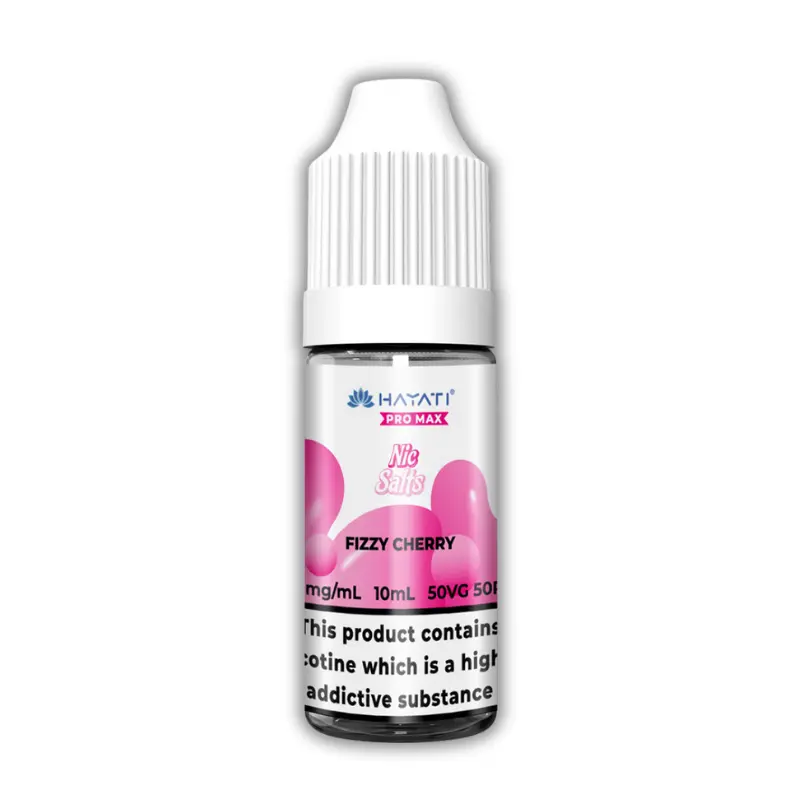
Hayati · Pro Max
Fizzy Cherry Hayati Pro Max Nic Salt
£2.49
✔ In stock — ready to ship
Genuine Hayati
Free over £20
Same-day dispatch
Secure checkout
Fizzy Cherry is a 10ml bottle of nicotine salt at 10mg, mixed at 50:50 VG/PG, priced at £2.49 and filed under the code HPM-NS-FIZZY-CHERRY. Every one of those figures is shared with almost every other bottle on the Hayati Pro Max Nic Salts shelf. Sixty-five listings sit there. Sixty-four of them are £2.49 and one is £2.79. All sixty-five are 10ml. All sixty-five are 10mg. All sixty-five are 50:50. The specification is not a way of telling them apart, because on this shelf there is nothing to tell apart.
What does differ is the copy, and on this shelf the copy behaves in a way it behaves nowhere else in the catalogue. Twenty-two of these sixty-five bottles name a different Hayati flavour inside their own description and tell you when to buy that one instead. That is roughly a third of the shelf. No other shelf in the 492-listing range comes close to it, and two shelves never do it at all. The bottled line is where the manufacturer does part of the comparing for you, and this page is mostly about what that habit is worth and where it breaks down.
Fizzy Cherry sits at one of only two points on that shelf where the pointer comes back. It names Cherry Ice, and Cherry Ice names it in return. Both bottles are £2.49. Both are 10ml. Both are 10mg. Both are 50:50. Both are cherry, and neither is plain cherry, because no plain cherry exists anywhere in the 492 listings. So the two bottles differ on exactly one published thing: what has been done to the fruit. One has been given an acid lift and one has been given a coolant, and each listing describes the other as the version without its own treatment.
That is the decision this page is about. Not which fruit, because the fruit is settled. Not what to pay, because the price is settled. Not the base or the strength, because the manufacturer fixed both across all sixty-five bottles. Only the treatment, held up against a comparison the manufacturer has already half made and then declined to finish.
The shelf that does its own comparing, counted
The claim handed to me was that the bottled shelf is the only part of this catalogue where Hayati compare their own products for the buyer. I counted it rather than repeating it, because this shop has a standing rule about rarity claims, and the count moved the numbers.
What was counted, and how
A listing counts as making a comparison when its own description names another Hayati flavour by name and places this product against it. "If Blackberry Raspberry feels too busy for you, this is the colder one" counts. A listing naming its own flavour twice does not count. A pod listing pointing at the kit of the same flavour does not count either, because that is a format pointer, not a comparison: it tells you where to buy the device, not which liquid to prefer. A dual-flavour pod naming the two halves it already contains does not count, for the same reason.
Applying that consistently across all 492 descriptions gives the following. On the bottled shelf, 22 of 65. On the Pro Max Plus shelves, pods and kits together, 18 of 179. On Pro Ultra Plus, 8 of 104. On the Mini Ultra, 6 of 50. On the Rubik, 0 of 39. On the two 120ml shortfill shelves, 0 of 40.
The brief I was working from put the bottled figure at 21 and the Pro Max Plus figure at 28. Both were slightly off, in opposite directions, and the gap in each case came from the boundary cases above. Two bottled listings that a mechanical search misses are worth naming, because they show what the machine cannot see: Bubblegum Ice points at H'Bubba using an apostrophe form that does not appear in the product data at all, and Blueberry Raspberry Lemon points at the plain two-berry bottle whose name is contained inside its own. Neither turns up unless you read the sentences. The Pro Max Plus figure fell rather than rose, because a large share of what looks like comparison on that shelf is a pod telling you where to find its own kit.
What the ratios actually say
A third of the bottled shelf compares itself to a neighbour. A tenth of the Pro Max Plus shelf does. Under a tenth of the Pro Ultra Plus shelf does, and the eight that do are all of one narrow kind: they tell you the same liquid is also sold behind a collar alongside something else. That is a merchandising note, not an opinion about taste. On the Rubik and on both shortfill shelves the habit is simply absent, which is the most informative number in the set, because it shows the difference is editorial rather than accidental. Thirty-nine Rubik descriptions and forty shortfill descriptions were written by people who never once thought to mention a second flavour.
So the shape of the claim survives. The bottled shelf does the comparing about three times as often as the next shelf, and two whole shelves never do it. The word "only" does not survive, and I have dropped it.
Why the bottles can afford it and the pods cannot
The reason is structural rather than editorial, and once you see it the whole pattern falls into place. A Pro Max Plus pod has a kit twin. A Pro Ultra Plus pod has a kit twin. A Rubik pod has a kit twin. Every one of those listings has an obvious thing to point at that is not a rival: the same liquid in the other box. The copywriter's one spare sentence gets spent on the cross-sell, because the cross-sell is free money and a comparison is not.
A 10ml bottle has no twin. There is no kit version of a bottle, no device to upsell, no second SKU of the same liquid at a different level of commitment on the same shelf. The only thing a bottle can point at is another bottle, which means the only pointer available is a genuine comparison, and a comparison always costs the manufacturer something because it names a case in which you should buy something else.
There is a second reason, and it is the price. At £2.49 the bottle is the cheapest thing Hayati sell that contains nicotine. A buyer choosing between two of them is not making a serious financial decision, so a listing can afford to say "buy the other one" without much risk. The same sentence on an £11.99 kit would be expensive to write. This is inference rather than something Hayati state, and I am flagging it as inference, but the correlation between price and candour across the six shelves is hard to miss once the counts are in front of you.
Twenty-two pointers, and the two that come back
A pointer is not a conversation. Most of the twenty-two are one-way: bottle A says something about bottle B, and bottle B has never heard of bottle A. Mr Pink calls itself the pink counterpart to Mr Blue, and Mr Blue's own description mentions nobody. Black Mint positions itself above two lighter mints, and neither of those two lighter mints acknowledges it. Blackberry Ice offers itself as the simpler option if Blackberry Raspberry is too busy, and Blackberry Raspberry says nothing back. Blue Fusion places itself beside Mad Blue, and Mad Blue points somewhere else entirely.
Follow all twenty-two and you get a graph with a lot of arrows and almost no loops. Reading it is a reasonable way to spend five minutes on the Hayati Pro Max Nic Salts shelf if you are undecided, because an arrow tells you which bottle its author considered the nearest thing on the shelf, and that is information the specification cannot give you.
The two loops
Exactly two pairs on the bottled shelf point at each other. This bottle and Cherry Ice are one. Berry Lemonade and Blue Razz Lemonade are the other: the mixed-berry bottle calls itself the less specific of the pair, and the blue raspberry bottle offers itself as the blue-fruit version of the same idea. That is the whole set. Two loops in sixty-five listings.
A loop is worth more than an arrow because it removes the possibility that the comparison is a sales device. A one-way pointer can always be read as the weaker product borrowing credibility from the stronger. When both descriptions independently name the other as the near neighbour, two different pieces of copy have arrived at the same reading of the shelf, and the pairing is a fact about the range rather than a claim about one product.
Where the claim had to be narrowed
I was given this as "the one place in the catalogue where the comparison is returned". It is not, and the correction is worth having on the page rather than buried.
Run the same reciprocity test across all 492 listings and there are nine reciprocal pairs, not two. Two are on the bottled shelf. Three are on the Pro Max Plus kit shelf, where Blue Sour Raspberry and Red Sour Raspberry each name the other, Hubba Bubba and Strawberry H'Bubba each name the other, and Double Menthol and Fresh Mint each name the other. Two are on the Pro Max Plus pod shelf, where Cola Ice and Cola Lime point at each other and Double Menthol and Spearmint point at each other. Two are on the Mini Ultra pod shelf, where Grape GB and Strawberry GB use near-mirrored sentences about each other, and the plain two-berry pod and its menthol version each acknowledge the other. Pro Ultra Plus has none. Rubik has none. The shortfills have none.
So reciprocity is not unique to the bottles, and it is not even unusual on the Pro Max Plus shelves. What remains true, and what I have written the rest of this page on, is narrower and sharper than what I was handed.
What survives the narrowing
Look at what changes between the two halves of each of those nine pairs. Blue Sour Raspberry and Red Sour Raspberry keep the treatment word and change the colour. Grape GB and Strawberry GB keep the treatment and change the fruit. Berry Lemonade and Blue Razz Lemonade keep the format and change the fruit. Hubba Bubba and Strawberry H'Bubba keep the gum and add a fruit. Cola Ice and Cola Lime keep the cola and add a second ingredient to one side. The two mint pairs are not one material treated two ways at all; they are different mint materials. The plain two-berry Mini Ultra pod and its menthol twin do hold the fruit still, but one side has no treatment on it whatsoever, which makes that a question of whether to add cooling rather than which treatment to take.
One pair in nine keeps the same single fruit, puts a treatment word on both sides, and changes nothing else. This one. Fizzy Cherry and Cherry Ice are the only reciprocal pair in the catalogue where both names describe something done to the fruit, the fruit is identical, and no ingredient is added or removed on either side. That is what I narrowed the claim to, and I think it is a better claim than the one I started with, because it is the version that actually makes the purchase decision legible.
Everything the manufacturer has held still
It is worth setting out plainly how little is left to vary, because the usual experience of choosing between two vape liquids is that four or five things move at once and you cannot tell which one you are reacting to.
- Price. £2.49 for both. There is no premium for either treatment.
- Volume. 10ml for both, which is the size every nicotine-containing bottle in this range comes in.
- Nicotine. 10mg of salt for both, with no strength options attached to either listing.
- Base. 50:50 VG/PG for both.
- Fruit. Cherry for both, single, with nothing else named in either description.
- Shelf. Both sit on the same four shelves: the nic salt line, Cherry Vapes, Hayati E-Liquids and the new arrivals listing.
Six variables, all frozen, by the manufacturer, in advance. What is left is one word in each name. That is an unusually clean experiment to be handed by a retailer, and it is the reason this pair is worth a page rather than a paragraph.
It is also worth saying what the shelf does not offer, since it bears on the choice. There is no untreated cherry bottle. There is no untreated cherry listing anywhere in the 492, on any hardware, at any price. Seven of the sixty-five bottles have cherry in the name and every one of them has done something to it: chilled it, carbonated the impression of it, dropped it into a cola, set it against blue raspberry, or buried it in a three-fruit mix. If you want to know what Hayati's cherry tastes like with nothing on top, the catalogue has no answer, and the closest you will get is picking whichever treatment you think interferes least.
Two treatments, and the price of each
Taken as settled, and not re-argued here
Three things about this liquid are already established on other pages in this shop and are used here rather than rebuilt. The Fizzy Cherry Hayati Rubik Prefilled Pod Kit page lined up all six listings of this recipe side by side, ran the carbonation question to the ground, and showed that a vapour cannot carry bubbles, so the fizz has to be produced by acid and by speed rather than by texture. That page also established that no coolant is named on any of the six Fizzy Cherry listings, and took the cherry kernel question, which is the reason a cherry liquid can read as almond when the sugar around it thins out. The Fizzy Cherry Hayati Pro Max Plus Pods page established what happens to an acid-forward cherry as a coil tires, which is that the shape of the draw goes before the strength does. None of that is re-derived below. What follows is the part those pages deliberately left alone, which is what the two treatments cost the person choosing between them.
The acid route, and its bill
Hayati describe this bottle as sharp and tongue-tingling, with the sharpness lifting the fruit so that the sweetness does not settle, and they describe the finish as lively and lingering. Read against the settled mechanism, that is a description of a sharp organic acid doing three jobs at once: it pulls the sweetness down without removing any sugar, it triggers the mouth-watering response that a person reads as brightness, and it finishes quickly, because acid is perceived early in a draw and is gone before the exhale properly begins.
The bill for that comes in three parts, and none of them is hidden.
The first is that acid works on the front of the draw and abandons the back. Everything the treatment does has happened by the time you breathe out. What you exhale is the fruit and the sweetener with nothing holding them down, which is why Hayati's own line about a lingering cherry note is accurate rather than promotional. If what you want from a cherry is a long clean finish, acid is the wrong tool, because it is not present at the end of the draw to give you one.
The second is that acid is a reset rather than a brake. It clears the palate between draws, which is genuinely useful across the five pod fills a 10ml bottle gives you, but it does nothing to the total sweetness load. Over a long session the sweetness accumulates on the palate and the acid keeps knocking it back, and the two run against each other all day. Some people find that keeps a sweet liquid drinkable for hours. Others find the repeated sharpness tiring in a way that a cool liquid is not, because a cool liquid does its work without asking anything of the tongue.
The third is the one people underestimate: acid is dull on a tired coil in a specific way. As a coil gunks, the aromatic top of the cherry fades first, but the acid does not fade, because it is not a volatile aroma compound doing the work. The result late in a pod is a liquid that is still sharp and no longer especially fruity. That is a more disappointing end state than a flat sweet cherry, because the sharpness that made sense next to the fruit has nothing left to sharpen.
The coolant route, and its bill
Cherry Ice takes the other road. A coolant does not touch the sugar at all. It adds a sensation alongside the fruit, which the palate reads as the fruit being fresher, and unlike acid it is present from early in the inhale right through the exhale and for several seconds after it.
Its bill is longer, and this is the part of the comparison the two listings leave you to work out.
Coolants are chemically stable in a way that fruit aromatics are not, so they outlast the flavour they were added to. That is worked through in detail on the two Cherry Ice Hayati Pro Ultra Plus pages, which took the question of what happens when the cold survives the fruit, and on the Blue Frozen bottle page, which counted the cooling vocabulary across the whole catalogue and found that Ice, Frozen and Cooler are not a graded scale and never appear alongside a mint word. Those findings hold here and are not recounted. The consequence for a 10ml bottle is that the last fill of a cold bottle is colder in proportion to its fruit than the first fill was, and the drift is slow enough that you will not notice it happening.
Coolants also adapt you to themselves. Cold receptors get less responsive to repeated exposure, so a cold bottle used exclusively feels less cold after a fortnight than it did on day one, which is the single most common reason somebody concludes a menthol liquid has been reformulated when it has not. The Blue Frozen page owns that argument and I am citing it rather than restating the mechanism.
And the third item on the coolant bill is physical, which is why it belongs on a bottle page rather than a pod page. Coolant material soaks into the plastic housing and the silicone seals of a refillable pod and carries over into whatever you fill it with next. Over a 10ml bottle, meaning five fills of a 2ml pod, that is five opportunities for the pod to take on a cold character it does not give back.
The asymmetry nobody prices
This is the part of the comparison I think is genuinely load-bearing and which neither listing mentions, because it only shows up once you treat the two bottles as a pair rather than as options.
The two treatments are not equally reversible, and the reason is the pod rather than the liquid. If you fill a pod with this bottle, use it, empty it and refill it with something else, the acid leaves nothing behind. Acid is not a residue; it is consumed with the liquid. The next fill tastes like the next fill.
Do the same with a cold bottle and the pod keeps a trace. Not enough to ruin a fill, but enough that a delicate fruit run afterwards reads as slightly cooled and slightly thinner than it should. That matters at this price point specifically, because £2.49 for 10ml is what people buy when they want to try something without committing, and the whole point of a cheap trial is that you can back out of it. Backing out of an acid bottle costs you nothing. Backing out of a cold bottle costs you a pod, or a fill or two of whatever you try next.
So if you are genuinely undecided between the two treatments and you intend to run both at some point, there is an ordering argument for taking this one first. It is not an argument about which is better. It is an argument about which mistake is cheaper to unmake, and it is the only asymmetry between the two bottles that survives once price, volume, strength, base and fruit have all been held still by the manufacturer.
Who should take which, said plainly
Take the acid bottle if you want the cherry to stay the loudest thing in the draw, if you use one liquid for long stretches and want something that keeps resetting your palate, if you rotate pods between liquids and do not want carryover, or if you already know that heavy cooling tires you out. Take the cold bottle if you want a finish that continues after the exhale, if you use cherry as a refresher rather than as a flavour you sit inside, if you already run other cold liquids and have a pod dedicated to them, or if a sharp liquid makes your mouth feel worked rather than rinsed.
If you have no view either way, the honest answer is that the difference between these two is smaller than the difference between either of them and a third bottle on the same shelf, and at £2.49 each the cheapest way to settle it is to buy both and run them a week apart rather than side by side. Running them on the same day is the one method that will not work, because the coolant carries over and the second one is not a clean read.
The bottle itself, which is the short part
This is 10ml of liquid in a bottle and nothing else. No device, no pod, no coil. The 50:50 base is thin, which is what a small high-resistance coil in a refillable pod or a low-powered mouth-to-lung kit needs in order to wick without starving. Sub-ohm tanks run hot and draw loosely and are the wrong home for a 10mg salt at this ratio.
Ten millilitres fills a 2ml pod five times, or a 3ml pod three times with a little left over. That number matters more on this liquid than on most, because the acid character is a property of a fresh coil, and five fills through one worn coil will not taste the same as five fills across two. If you are buying this specifically to judge the treatment rather than to get through a week, judge it on a fill that went into a coil under a day old.
On hardware, the only thing to check is that whatever you own takes a refillable pod or a standard MTL coil, since this is a bottle rather than a system and Hayati publish nothing about it being tied to any particular device. The nicotine is a salt at 10mg, which is half the UK ceiling for a bottle of this kind, and there are no strength variants attached to the listing.
The figures, and the rows that stay blank
| Product code | HPM-NS-FIZZY-CHERRY |
| Flavour as filed | Fizzy Cherry |
| Price | £2.49 |
| Nicotine | 10mg nicotine salt |
| Base | 50:50 VG/PG |
| Bottle | 10ml |
| Shelves it sits on | Hayati Pro Max Nic Salts, Cherry Vapes, Hayati E-Liquids, New Products |
| Brand | Hayati |
| Coolant | None named on this listing |
| Sweetener load | Not published |
| Acid used | Not published |
| Strength options | None attached |
Four of those rows are blank on purpose, and the blanks are more interesting than the numbers. The price, the volume, the strength and the ratio are identical across sixty-four of the sixty-five bottles on this shelf, so they tell you nothing about this one. The last four rows are the properties that would actually distinguish it, and Hayati publish none of them.
The sweetener load is the one that would settle the most. Both descriptions in this pair claim their treatment stops the sweetness building up, and neither says how much sweetness there was to start with. Two liquids can make that same claim and be at completely different places on the scale. Without the figure, the claim is directional rather than quantitative, and the only way to place either bottle is to run a fill and see whether the palate fatigue arrives on draw fifteen or draw fifty.
The acid is the other one. "Sharp" is doing a lot of work in the description and it covers a wide range of materials with quite different behaviour: some finish instantly, some hang around the sides of the tongue, some read as fruit and some read as sweets. Nothing on the record narrows it, and I am not going to guess at it from the flavour name, because guessing a physical property from a product name is the error this shop's pages have most often had to correct.
Placing it against the rest of the shelf
The other six cherry bottles
Seven of the sixty-five bottles put cherry in the name. Cherry Ice is the paired one and is covered above. Of the remaining five, two treat cherry as the lead and three fold it into something larger.
Cherry Berry is the nearest thing to this bottle that is not its pair: cherry in front, a mixed-berry bed underneath, and no cooling. It owns the full draw-by-draw for a cherry-led bottle on this shelf, including the almond question and where the sweetness sits, and if you want a cherry with body rather than a cherry with an edge, that is the one. Cherry Cola puts the cherry inside a cola accord, which changes the register entirely: the spiced caramel depth of a cola is a different kind of sweetness from a fruit sweetness, and the cherry becomes a modifier rather than the subject. Its own description places it between two cola bottles rather than beside the cherries, which tells you how Hayati file it.
Blue Razz Cherry sets cherry against a confectionery blue raspberry and uses the cherry for weight, which is the opposite job from the one it does here. Strawberry Cherry Cranberry and Blueberry Cherry Cranberry both put cherry in the middle of three fruits with cranberry doing the sharpening at the end. Those two are worth knowing about if what appeals to you here is the sharpness rather than the cherry, because cranberry supplies a tartness that sits at the end of the draw rather than the beginning, which is the one thing acid cannot do. The pair of them are also the clearest example on the shelf of a one-way pointer, since the blueberry version names the strawberry version and gets nothing back.
The rest of the graph, if you want to read it
Some of the other twenty-two pointers are useful in their own right. Cola Lime offers itself as a rotation partner to Cola Ice rather than as a replacement for it, which is a different kind of pointer from most and worth noticing if you like to run two things at once. Berry Lemonade describes itself as the less specific option next to Blackcurrant Lemonade, which is an unusually candid thing for a listing to say about itself. Black Mamba is named in somebody else's description as the darker option, which is more informative than its own description is, since its name gives a buyer nothing.
If you want contrast rather than a near neighbour, the shelf has plenty and none of it is cherry. Blue Frozen is the cold end of the range and is the right partner for a sharp red fruit precisely because it shares nothing with it. Fresh Menthol Mojito pushes the cold further and adds lime, which is a citrus sharpness rather than a fruit-acid one and lands in a different part of the mouth. Banana Ice is soft, rounded and slow, which is about as far from this liquid's behaviour as the shelf goes. Grape GB and Bubblegum Ice are the confectionery corner, and both are sweeter than this without the acid to hold the sweetness back, so they suit a different kind of day rather than a different hour of the same one.
Two more are worth a look if what you actually like here is the sharpness. Blue Sour Raspberry puts the sourness in the name and applies it to a confectionery berry rather than a fruit. Blueberry Raspberry Lemon uses citrus zest for the lift instead, which arrives later in the draw than an acid does and finishes drier.
Shelves rather than bottles
If none of the above settles it, the three shelves this bottle sits on are each a different way of narrowing down. Cherry Vapes collects all 72 cherry listings across every format, which is the right place to look if you have decided on the fruit and not the hardware. Hayati E-Liquids holds 105 bottles including the 120ml zero-nicotine shortfills, which is where to go if 10ml is the wrong size for you. The full Hayati range is 492 listings and is worth browsing only with something specific in mind.
Living with ten millilitres of an acid-forward cherry
Most of the standard handling advice applies here as it does to any 50:50 salt, so this section only covers the parts that change because of what this particular liquid is.
Prime properly, and prime for the acid rather than for the coil. A dry or half-wet wick on a fresh fill gives you a first draw that is all sharpness and no fruit, because the acid registers instantly and the aromatic cherry needs saturated cotton to come through. Fill, leave it a few minutes, then take two or three gentle draws before you form an opinion. People who decide they dislike this liquid on draw one are usually reacting to an unprimed wick rather than to the recipe.
Watch the fruit, not the sharpness, to know when a coil is done. This is the opposite of the advice that suits a cold bottle. On a cooled liquid the coolant keeps performing after the fruit has gone, so the coil feels fine long after it is finished. Here the acid keeps performing instead, and the failure mode is a liquid that still tastes keen and no longer tastes of cherry. When the fruit narrows to a generic red and the sharpness is still at full strength, the coil is the problem, not the bottle.
Between fills of different liquids, this one is unusually forgiving. Rinse and dry the pod and there is nothing left to carry over. That is worth knowing if you own one pod and several bottles, and it is the practical version of the reversibility point made earlier.
Store it upright with the cap on, away from direct light and heat. A sweetened fruit liquid darkens with light exposure and warmth, and a darkened bottle usually tastes duller at the top end rather than spoiled. Keep it out of reach of children and pets. The bottle is plastic and belongs in household recycling once it is empty and rinsed, which is the whole disposal question for a bottle, since there is no battery and no electronics in this purchase at all. That is one genuine advantage of the 10ml format over every prefilled pod in this catalogue and it almost never gets mentioned.
Finally, a note on the five fills. If you are buying this to decide between the two cherry treatments, do not spend all five fills on the comparison. Two fills is enough to know whether a sharp cherry suits you, and the remaining three tell you the more useful thing, which is whether it still suits you on day nine. Most liquids in this price bracket are pleasant for two days. The question that decides a repeat purchase is what happens after that.
Questions this listing raises
Is it actually carbonated?
No, and nothing in a bottle or a pod can be. That question has been worked through fully on the Fizzy Cherry Rubik kit page in this shop, which also found that the word carbonated appears exactly once in all 492 Hayati descriptions and that the one occurrence is on this listing, as a simile rather than a claim. What the liquid does instead is use sharpness and speed to produce part of what fizz feels like. It reads as lively. It does not read as something poured from a can.
What is the actual difference between this and Cherry Ice?
One published thing: the treatment. Both are £2.49, both are 10ml, both are 10mg, both are 50:50, both are single cherry. This one uses an acid lift that works on the front of the draw and is gone by the exhale. That one uses a coolant that arrives early and continues after the exhale. Each listing describes the other in exactly those terms, which is the only pair of Hayati descriptions in the catalogue to hold a fruit still and vary only what has been done to it.
Is there any cooling in this bottle?
None is named on this listing, and the Rubik page established that none is named on any of the six listings of this recipe. Hayati are consistent about putting a cooling word in a product name when a coolant is present, and eleven of the sixty-five bottles on this shelf do carry one. This is not among them.
Why does the shelf have no plain cherry?
Because there is no plain cherry anywhere in the catalogue. Thirteen distinct cherry flavour names exist across all 492 listings and every one of them either treats the cherry or pairs it with something. If you want a cherry with nothing on top, the closest available choice is deciding which treatment gets in the way least, which on the available evidence is a question about whether you would rather the interference sat at the start of the draw or at the end of it.
How sweet is it?
Sweet, and clearly above the middle of this shelf, though the sharpness keeps it from settling. Hayati's own description says the sweetness and the tang hold each other in check and neither takes over, which is directionally useful and not a measurement. The sweetener load is not published anywhere in this range, and without it no honest number can be put on it. What can be said is that the acid changes how the sweetness behaves over time rather than how much of it there is.
Will I taste almond?
Possibly, late in a pod, and the reason is chemistry rather than an added ingredient. That is set out properly on the Cherry Berry bottle page and on the Cherry Ice Pro Ultra Plus pages, which took the kernel question between them. In short, the material that makes anything read as cherry is closely related to the material that reads as almond, and it tends to surface when the sweetness around it thins out.
Can I run this and Cherry Ice from the same pod?
You can, but not usefully in the same week, and the order matters. Coolant material soaks into pod plastics and seals and carries into the next fill, so a cold liquid followed by this one gives you a reading of this one that is not clean. The reverse works: acid leaves nothing behind. If you are comparing the two, run this first, or use two pods.
How many pod fills does the bottle give?
Five fills of a 2ml pod, or a little over three of a 3ml one. How long each fill lasts depends entirely on your device, your coil and your habits, so any figure in days would be invented. What is worth planning is coil age rather than volume, since the sharp character of this liquid is at its most accurate on a coil under a day old.
What hardware does it need?
A refillable pod or a low-powered mouth-to-lung kit with a higher-resistance coil. The 50:50 ratio is thin enough to wick through a small coil without starving it, and a 10mg salt is aimed at a tight, restricted draw rather than a loose one. High-wattage sub-ohm tanks are the wrong pairing for both the ratio and the strength.
Is there a different strength or a bigger bottle?
Not on this listing, which is 10mg only with no options attached. Six listings of this recipe exist in total across the catalogue, including two 120ml zero-nicotine shortfills, and the Hayati E-Liquids shelf is where the larger bottles sit. Nothing in between 10ml and 120ml is offered for this flavour.
Is the pointer in the description a recommendation or a sales line?
It is hard to read it as a pure sales line, because it is reciprocated. A one-way pointer can always be the weaker product borrowing from the stronger, but when both descriptions independently name the other as the near neighbour, two separate pieces of copy have reached the same view of the shelf. Only two pairs on this shelf do that, and this is one of them.
How will I know if this is not the right treatment for me?
Within about a day and a half, which is unusually quick. If the sharpness makes your mouth feel worked rather than rinsed, or if you find yourself reaching for something else after twenty minutes, the acid is not the tool you want and the cold version will suit you better. If instead the fruit feels thin and you want the finish to continue after you exhale, that is also a vote for the cold one, because acid cannot supply a long finish at all.
The short version
Fizzy Cherry is a £2.49 bottle holding 10ml of 10mg nicotine salt at 50:50, and everything in that sentence is true of sixty-four other bottles on the same shelf. What is not shared is its position in the shelf's own referral graph. Twenty-two of these sixty-five listings name a rival, which is about three times the rate of any other shelf in the catalogue and infinitely more than the Rubik and the shortfills, where it never happens. Two of the twenty-two are reciprocated, and this is one of them.
The claim I was given, that this was the one returned comparison in the catalogue, did not survive counting. There are nine reciprocal pairs across all 492 listings. What survives, and what the page is built on, is that this is the only one of the nine in which the fruit is identical, both names describe a treatment, and nothing is added or taken away on either side. Price, volume, strength and base were already frozen by the manufacturer across the whole shelf. That leaves a genuinely single-variable choice, which is rare enough to be worth pointing out.
The variable is acid against coolant. Acid works at the front of the draw, resets the palate between pulls, leaves nothing in your pod and gives you no finish after the exhale. A coolant works throughout, continues after the exhale, outlasts the fruit it was added to, dulls you to itself over a fortnight and leaves a trace in the pod you used it in. At the same price, on the same shelf, the first is the one you can back out of more cheaply. That is the argument for starting here, and it is not an argument that either bottle is the better one.
Strictly for adults aged 18 and over. Nicotine is an addictive substance.
You might also like


