
Home / Hayati Pro Max Plus Pods / Lychee Ice Hayati Pro Max Plus Pods
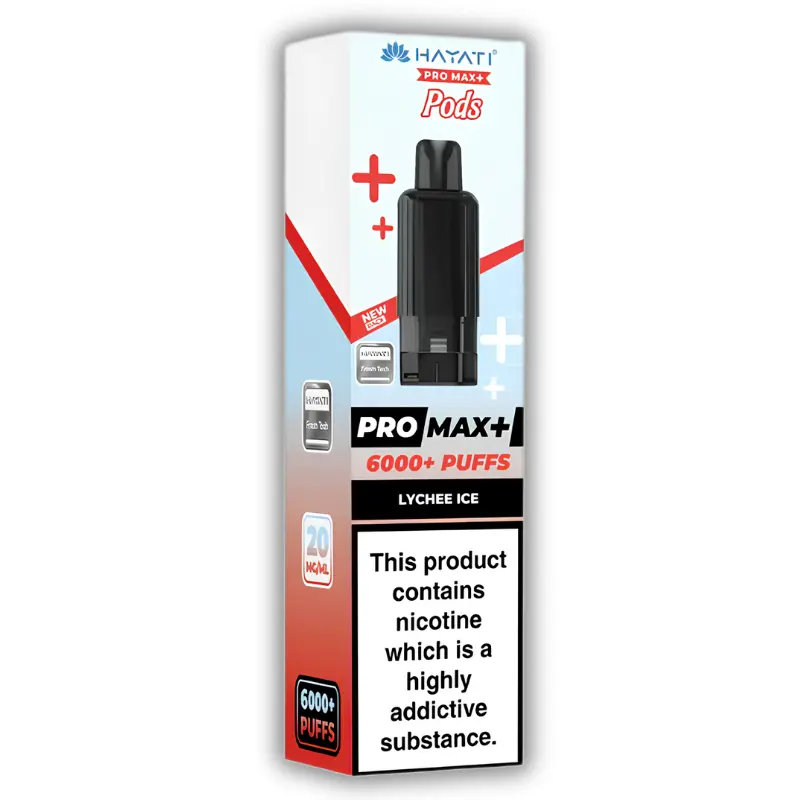
Hayati · Pro Max Plus
Lychee Ice Hayati Pro Max Plus Pods
£5.49
✔ In stock — ready to ship
Genuine Hayati
Free over £20
Same-day dispatch
Secure checkout
Five pounds forty-nine buys one sealed pod holding twelve millilitres of liquid at 20mg, and that is the whole of it. No body in the packet, nothing to assemble. The listing assumes a Hayati Pro Max Plus was bought some time ago and only the liquid is still in question, which makes this a restocking page. The flavour itself has been taken apart properly on Lychee Ice Hayati Pro Max Plus 6000 Pod Kit, the complete version at £7.99: the rose-family aromatics, why the light coolant dose is doing structural work, the disagreement with the cooled strawberry listing over floors and chill, the rosewater self-test. None of that is repeated here.
One conclusion from that page does need carrying forward, because it is the only finding in the range that changes how a pod should be bought rather than how it tastes. Reasoning from the chemistry of the fruit and the modest size of the chill, that page concluded that this liquid is at its most difficult when the pod is brand new. Aromatic output is highest at the start, the floral note is therefore most exposed at the start, and the late stage of the pod, once the top notes have thinned out, is the version that a floral-wary vaper would have picked off the shelf if it had ever been sold as a separate product. The pod, in other words, improves into its run.
Take that for exactly what it is. Hayati publish a name, a volume, a strength and a bench figure, and nothing whatever about how a flavour moves between the first millilitre and the twelfth. The claim is a reasoned conclusion drawn from what lychee is made of and what coolants do to sweetness, not a measurement. This page reasons onward from it, which stacks one inference on another, and both layers should be held loosely.
Because almost every other listing in this catalogue is assumed to run the opposite way. A pod is at its best new and declines from there: that is the default shape, and it is roughly correct for a citrus, a lemonade or a sharp berry. Invert the curve and three things change about a repeat purchase, none of them obvious from the listing. Finishing pods matters more here than anywhere else on the shelf. A rotation is the wrong way to own this flavour. And the first pod of a restock is a step backwards rather than a fresh start.
What the kit page argued, and how firm any of it is
A short recap, no more, because the reasoning belongs to the other page and doing it twice would waste the length this one needs for its own work.
The case rests on two facts about the fruit. Lychee has no acid and no body, so nothing in it is structural, and everything identifiable about it is carried by small volatile aromatics of the rose family held in place by a large sugar load. Coolants suppress perceived sweetness. The kit page's answer to how Hayati avoided wrecking it is that the coolant dose was kept small on purpose, which makes the chill load-bearing rather than decorative.
The arc across a pod follows from the same chemistry. Fine aromatics are the first thing any working coil stops delivering cleanly. On a liquid with a base or an acid underneath, losing them costs you definition and leaves something behind. Here there is nothing behind them, so the fruit becomes unnameable somewhere in the middle third and the last third arrives as mild sweetness with a cool edge and no particular identity. The kit page's observation is that a minority of people prefer the pod in exactly that state, and that they are not being perverse: the perfume risk leaves with the aromatics, so what remains is the thing they wanted without the thing they did not.
Three caveats before any of that gets used as a foundation. The first is that the direction of the curve depends entirely on who is holding the device. If you like lychee at full volume, if rose and muscat read as food to you, then this same arc is a plain decline and everything below should be read backwards. The improvement is not a property of the liquid. It is a property of the match between the liquid and a particular reader. The second is that coil behaviour is not uniform. A pod that runs hot early will travel the curve faster than one that does not, and nothing on the packet tells you which you have. The third is that the whole model would be overturned by a single published aromatic decay profile, and there is no such document for this product or for any of its eighty-eight neighbours on Hayati Pro Max Plus Pods. Where a page infers, it should say so, and this one is inferring from an inference.
Why the shape is the strange part, not the direction
Plenty of liquids change across a pod. Nearly all of them get worse, and the reasons are mechanical rather than mysterious. Residue builds on the coil, sweeteners caramelise onto it, the wick carries a history of everything already through it, and the finest aromatic detail is the first casualty of all three. Every one of those processes subtracts. That is the entire model of pod ageing, and it holds up.
Subtraction is only a loss when the thing subtracted is the thing you were buying. That is the hidden assumption in the default curve, and it is correct almost everywhere. Take the top notes off Blackcurrant Lemonade Hayati Pro Max Plus Pods and the lemonade goes flat, leaving a duller blackcurrant. Take them off Kiwi Cooler Hayati Pro Max Plus Pods and the green, sappy edge that separates it from every other chilled fruit is the first casualty. The same subtraction on Blue Razz Lemonade Hayati Pro Max Plus Pods removes the brightness the name is promising. In each case what disappears is the selling point.
For a pod to improve as it empties, one condition has to be met: its dominant note and its main liability have to be the same substance. That is a rare arrangement. Sweetness is not a liability by itself, acid is robust and does not fade first, and body barely fades at all. Volatile aromatics fade first and reliably, so the only candidates are liquids whose entire risk sits in their volatiles, which in practice means a fruit with nothing else to its name.
Lychee qualifies about as completely as a fruit can. What makes it recognisable and what makes it smell of a bathroom shelf are not two different things that happen to sit near each other. They are one set of molecules being read two ways depending on how much sugar signal arrives alongside them. Strip them out and you remove the identity and the hazard in a single movement. Nothing else on this shelf is built like that. The nearest thing is Smooth Strawberry Ice Hayati Pro Max Plus Pods, which shares the rose-adjacent top notes and the same perfume failure mode, but that recipe carries a low creamy base, and a base does not fade the way aromatics do. Losing the top of a cooled strawberry leaves the floor exposed rather than the risk removed, which is an ordinary decline. The arc here is not a better version of that. It is a different arc.
Worth saying plainly: nothing about the recipe gets better. The liquid degrades exactly as it should. It is the match between the degraded liquid and a particular buyer that improves, which is a strange thing to find on a product page and the reason it is worth one.
The first consequence: finishing a pod matters more here than anywhere
Almost everyone abandons the last stretch of a pod sometimes, and the habit is so ordinary it barely registers as a decision. A new order arrives and the half-empty one gets displaced. The flavour goes quiet and it feels finished before it is. A faint suspicion of dryness sets in and you swap rather than investigate. Two or three millilitres get parked in a drawer and eventually thrown out.
On the ordinary curve the habit is defensible on flavour grounds, whatever it does to the money. You are discarding the weakest portion of a declining product, and the last two millilitres of a tired citrus pod really are worth less than the first draw of a fresh one. It costs you something, but what it costs is the worst part.
Here the arithmetic runs the other way, and that single reversal is the most practically useful thing on this page. If the kit page's reading holds, the final third is not the worn-out end of a good product. It is the only stretch of the pod that carries no perfume risk at all, and for a substantial number of people it is the reason to own the flavour in the first place. Discarding it is not trimming the tail. It is throwing away the part of the purchase that the argument for the purchase depends on.
There is a trap folded inside that, and it is a nasty one. If you have always abandoned the last third, on this flavour as on every other, then you have never actually tasted the state being described. Your entire impression of Lychee Ice will have been formed in the first two thirds of a series of pods, which is precisely the stretch where the floral note is loudest and most likely to put you off. You could have bought this four times and disliked it four times without once reaching the version that suits you. The habit does not merely cost you the good part; it hides the good part, and then it hides the fact that it is hiding anything, because a flavour you have judged consistently feels thoroughly judged.
The obvious objection is that a faded pod and a failing pod can feel similar, and nobody should persevere with something scorched on the strength of a theory. Fair, and here the two are easier to separate than usual. The kit page makes the point that an overheated wick on this liquid announces itself not as a burnt taste but as a sharp, chemical, cheap-fragrance note. That is diagnostic, because the two end-states point in opposite directions. The mellow late stage is quieter and less floral than the pod was a week earlier. A pod in trouble is sharper and more floral than it was, with a harshness mellowness never has. Quiet and anonymous means keep going. Loud and chemical means stop, and no amount of curve theory should talk you past it.
The money is the smaller half of this, and stranded liquid is handled as an economic question on other pages in the range. The point here is not that abandoning four millilitres wastes about two pounds. It is that on this one listing those four millilitres are not the offcuts.
The second consequence: run it singly, not in a rotation
A four-pod rotation is a common and sensible way to own prefilled pods. Four bodies or one body and four pods, a different flavour depending on the hour or the mood, nothing gets boring, each pod lasts a month instead of a week. For most of this shelf it is the best available arrangement. For this listing it is close to the worst, for two reasons that stack.
The first is timing. If the good part arrives in the final third, a rotation pushes that arrival back by however many ways you divide your usage. A pod that would reach its late stage in five or six days of sole use reaches it in three or four weeks inside a rotation of four. Nothing is lost in principle, since the liquid still travels the same distance. What changes is how much of your time with the flavour is spent in the stretch you were hoping to get past. Across a month of rotating, most of your encounters with Lychee Ice are with an early-stage pod, which is the condition the whole argument says to be patient with.
The second reason is the one that actually decides it. Rotations are where pods go to be abandoned. Anything in a rotation competes for slots, and slots are finite in a way that enthusiasm is not. A new flavour arrives, something gets edged out, and the thing edged out is usually whichever pod is furthest through its life, because a nearly empty pod feels like the cheapest thing to drop. Here the nearly empty pod is the one that has just become worth having. A rotation is structurally biased towards discarding pods at exactly the point where this one turns, which is the abandonment problem again, built into the method rather than left to a lapse of attention.
A third factor sits underneath both, and it belongs to another page. The cooled strawberry pods listing sets out how a palate acclimatises to a repeated sensation and how a gap resets that acclimatisation, treating the process as a trap, which for coolant tolerance it is. On a loud aromatic the same mechanism runs in the buyer's favour: continuous exposure makes a dominant floral note less insistent, and an interval away restores the full force of the first encounter. Whatever weight you give that, it points the same way. Rotation reinstates the conditions of a first meeting over and over, and this is a flavour whose first meeting is its least flattering.
Then there is the ordering rule. The kit page is firm that this liquid should never follow a mint, a menthol or a heavily iced pod, because arriving with a chilled palate and suppressed sweetness perception is the exact state in which lychee reads as fragrance. That is a constraint on any rotation containing it, and on this shelf it is a punishing one. Count the neighbours whose names declare a coolant and you are into Pineapple Ice Hayati Pro Max Plus Pods, Red Apple Ice Hayati Pro Max Plus Pods, Watermelon Ice Hayati Pro Max Plus Pods, Strawberry Raspberry Ice, Ice Pop and several more before you have finished the obvious ones. Roughly a third of the pods on this shelf carry a cooling word in the title, and the ninety-eight listings filed under Ice Vapes make the scale of that clear. Pick a rotation partner at random from the same shelf and there is a fair chance you have picked the one thing that should not immediately precede it.
The recommendation is unusually specific for a product page. Buy one, fit it, and run it to the end before fitting anything else. If that sounds austere, the compensation is that monotony is doing useful work here rather than being endured: sole use is the only route to the state this pod is being recommended for.
If rotating is non-negotiable, two adjustments help. Make this the constant rather than the guest, so it is the pod that stays fitted and the others take turns around it. And if the appeal of rotating is variety inside a single session, a two-profile format answers that without parking anything half finished: Cherry Ice / Peach Mango Hayati Pro Ultra Plus 25K Pods at £7.99 carries two liquids in one pod, and Cola Ice Hayati Pro Ultra Plus 25000 Prefilled Pod Kit at £11.99 is the complete device version of the same idea. Neither is lychee. Both remove the reason most people rotate in the first place.
The third consequence: a restock resets you to the beginning
Here is the sequence almost everyone who commits to this flavour will experience, and almost nobody is warned about. You finish a pod in its quiet, mellow, faintly cold late stage, having grown fond of it there. You open the replacement. The first draw is louder, sweeter and markedly more floral than anything you have tasted in a fortnight. The immediate reading is that something has changed: a different batch, a stronger mix, a bad one.
Nothing has changed. That is the curve resetting, and it resets completely, because every pod leaves the factory at the top of its own aromatic output. The jump feels large precisely in proportion to how far down the curve you were when the old pod ran out, which means the buyers most likely to be alarmed are the ones who followed the advice above and finished properly. Do it right and the reset hits you harder.
Worth dwelling on how counter-intuitive that is. On a normal declining product a new unit feels like relief: the thing you liked has come back. Here it feels like a regression to the version you were putting up with, and the better your last fortnight was, the worse the comparison. A restock on this listing is a return to the start, and the start is the difficult end.
Which has a direct bearing on judging a batch. Comparing the new pod against your most recent impression of the old one is comparing the first day of one against the twentieth day of another, and it will tell you the batch has got stronger every single time, on every pod, forever. The comparison that carries information is against the old pod's first evening, not its last. Recency makes that hard, because the freshest memory is always the wrong one, and no amount of good intention changes which memory surfaces first. Simply knowing the trap exists is most of the defence: when the new pod seems wrong, the first question is not what changed in the factory but where on the curve each side of the comparison sits.
Genuine batch variation does exist and a repeat buyer is well placed to spot it, but that is a separate subject with its own page in this range. The distinction that belongs here is narrower. A curve reset is predictable, happens on every pod without exception, and is loudest in the first day or two before settling. Variation between batches is not patterned that way. Stronger on day one and back in line by day three is the curve. Still different on day five, when both pods should be at comparable points, is worth taking seriously.
The practical instruction is short. Do not judge a restock on the evening it arrives, for the same reason the kit page says not to judge the flavour on the evening you first meet it. The pod has not yet become the thing you reordered.
One asymmetry worth knowing about if you order more than one at a time. The kit page notes that warm storage costs the top aromatics first, which on most liquids is straightforward damage. Here that loss runs in the same direction as the change you were going to accept anyway. Warmth does other things to a liquid besides thinning its volatiles, so a spare should still be kept cool and dark, but the regret attached to a pod that has sat a while is smaller on this flavour than on a bright citrus, where the same storage would remove the entire reason for buying it.
The pod on its own
One pod in the packet, prefilled and sealed, with the coil built in and discarded along with it. It fits a Hayati Pro Max Plus body, not included. There is no filling and no maintenance beyond fitting it, and the hardware story is identical across the eighty-nine listings on this shelf, which is why this section links out rather than repeating what the range has covered many times over on Hayati Prefilled Pods & Refills.
The specification that earns its place on this particular page is the twelve millilitres, read for what it does to the arc rather than for value. Volume sets the length of the curve. A two millilitre pod of this liquid would run through its whole aromatic decline inside a day or two, which is short enough that you would experience the change as inconsistency rather than as a progression, and the late state would arrive and depart before it registered as a state at all. Twelve millilitres is long enough that the early pod and the late pod feel like two related but distinguishable liquids, with a recognisable middle between them. The argument this page is built on only exists because the format is generous. On a smaller pod there would be nothing to say.
Hayati quote up to 6,000 puffs for it, a figure from bench equipment drawing to a set schedule under controlled conditions rather than a forecast of anything. It ranks capacity between pods and does that job reasonably. What it cannot do is tell you where in the pod you are, which is the only measurement this page would actually want, and no counter of any kind is fitted to the device. Two facts the supplied listing does not record, and which this page therefore will not assert: the carrier ratio of the liquid and the resistance of the coil. Neither appears in the product data, and a figure you have read on a sibling listing is not evidence about this one.
The listing in figures, read as an arc
| Line | What the listing actually supports |
|---|---|
| Cost of one reorder | £5.49 |
| In the packet | A single prefilled pod, no device |
| Body required | Hayati Pro Max Plus, owned separately |
| Liquid supplied | 12ml, filled and sealed before it ships |
| Nicotine | 20mg |
| Profile as named | Lychee Ice |
| Cooling level | Declared by the name, quantified nowhere in the range |
| Bench figure | Hayati quote up to 6,000 puffs, a laboratory estimate |
| How the flavour moves across the pod | Not published by anyone |
| Fill date or batch marking | Absent from the listing |
| Carrier ratio | Not published against this product |
| Coil resistance | Not published against this product |
| Catalogue reference | hpm-plus-pods-lychee-ice |
| Maker | Hayati |
| Filed under | Hayati Pro Max Plus Pods, Hayati Pods, Hayati Prefilled Pods & Refills, Exotic Vapes, Ice Vapes, New Products |
Two of those rows are the interesting ones, and they are both blanks. There is no fill date and no batch marking anywhere on the listing, so a pod's age when it reaches you is unknown and unknowable from this page. There is no description of how the liquid behaves between the first millilitre and the last, which on a product whose central peculiarity is exactly that is a considerable omission. Nobody in the trade publishes the second figure, so it is not a criticism of Hayati specifically, but it does mean the entire argument above rests on reasoning rather than on anything printed.
Every other row describes the moment of delivery: how much liquid, at what strength, for what price, with what capacity claimed. All of it is true and none of it separates this pod from the eighty-eight others on the shelf, which carry the same volume, strength, price and bench figure. Two liquids with identical rows can behave completely differently over a fortnight.
On price, 12ml at £5.49 comes to roughly 46p a millilitre, and the complete kit costs two pounds fifty more because a rechargeable body travels with it. If a body is already in the house there is no reason to buy the kit again, and the usual accumulation problem applies: buy kits repeatedly and you end up with several identical-looking devices of different ages and no way to distinguish them.
Neighbours, sorted by the shape of their arc
Most comparison sections on this shelf sort by flavour family. Sorting by how a pod behaves over a fortnight is more useful here, because that is the axis this listing is unusual on. Everything below is an expectation drawn from what each profile is built out of rather than a measured result.
The ones that fall away fastest
Acid-forward and citrus-led blends decline fastest, because brightness lives in the volatiles and goes first while the sugar underneath stays put. Cherry Peach Lemon Hayati Pro Max Plus Pods loses its lemon before anything else, which tips the balance towards the stone fruit and makes a three-part blend behave like a two-part one. The two lemonades above thin in the same way. Guava Kiwi Passion Fruit Hayati Pro Max Plus Pods has three sources of aromatic complexity and therefore three things to lose. If you habitually abandon the last third of a pod, these are the listings where the habit costs you least, and a reasonable argument for buying them if that is how you operate.
The ones that hold roughly level
Sweet, low-volatility profiles with something structural underneath them change least. Cola Ice Hayati Pro Max Plus Pods and Cherry Cola Hayati Pro Max Plus Pods are built on a spiced soft-drink accord that is not delicate. Banana Ice Hayati Pro Max Plus Pods and Mango Banana Hayati Pro Max Plus Pods are weighted low, with the flavour sitting in a heavier register that survives a working coil better than a top note does. Triple Mango Hayati Pro Max Plus Pods is the same idea concentrated. These are the pods to own if consistency across a fortnight is what you value, and they are the direct opposite of this listing in that respect: nothing much to wait for, nothing much to lose.
The ones whose arc cannot be guessed
Several neighbours are named for a mood rather than an ingredient, which makes their behaviour over a pod unpredictable for a reason that is entirely avoidable. Galaxy Aura Hayati Pro Max Plus Pods, Midnight Dream Hayati Pro Max Plus Pods, Black Mamba Hayati Pro Max Plus Pods and Blue Fusion name no fruit at all, so there is no way to work out which component will fade first or whether losing it would help or hurt. Whatever else is true of Lychee Ice, the name is doing its job: one fruit, one treatment, and enough information to reason about. That is not a small advantage on a shelf this size.
The one that shares the chemistry and not the arc
Smooth Strawberry Ice deserves a second mention because the relationship is close and easy to misread. Same rose-adjacent top notes, same perfume failure mode, and its own page argues at length about the role of a floor. What it also has is a low creamy base, and that base is why its curve is ordinary: strip the top and the fruit loses definition while the body stays. Lychee has no body to be left holding. Same chemistry at the top, different shape over twelve millilitres, and anyone reasoning from one to the other will get the ending wrong.
Where to go if the early pod is the problem
Two honest exits if the first third of this keeps defeating you. One is a pale, mild fruit without the rose character: Dragon Berries Hayati Pro Max Plus Pods keeps some of the light, faintly floral quality that dragon fruit shares with lychee but sets berries against it that supply acidity lychee has not got, so there is nothing standing unaccompanied at any point in the pod. The other is to abandon the floral register entirely and buy acid, where Blue Razz Pineapple Hayati Pro Max Plus Pods and Blackberry Ice Hayati Pro Max Plus Pods both go in the opposite direction from this one and never risk reading as fragrance at any stage. The fifty-five listings on Exotic Vapes are mostly tropical rather than floral, which makes that shelf a poor guide to this pod but a good source of alternatives to it, and the full four hundred and ninety-two products sit on All Hayati products for anyone browsing more widely. Slug endings in this catalogue are inconsistent enough that guessing a URL from a name usually fails, so search by the complete listing title.
Running one of these properly
Handling advice on this listing is mostly the same as anywhere else, so what follows is only the parts the arc actually changes.
Fit it and leave it fitted. The practical version of sole use is not keeping a second pod within easy reach while this one is in play. Temptation is the mechanism by which pods get stranded, and the drawer is where it lives.
Do not form a verdict in the first two days, on the first pod or on any pod after it. The kit page gives that rule for a new flavour, and it applies with equal force to a restock: a replacement starts at the same point on the same curve, so the evening it arrives is the least representative it will have.
Mind what precedes it, which is the kit page's rotation rule and the one piece of handling advice on this liquid that changes the result most. A chilled palate suppresses sweetness perception, and suppressed sweetness is the condition under which this reads as fragrance rather than fruit. Anything iced immediately before it works against you, and so does toothpaste for a good while afterwards.
Keep draws short and unhurried, for the reasons about coil temperature the kit page sets out. The consequence for a restocking buyer is worth naming though: draw technique matters most at the start of a pod and least at the end, because the aromatics it pushes up are abundant early and thin later. Be careful in the first few days and relax about it afterwards.
Store spares cool, dark and somewhere children and pets cannot reach them, away from radiators and windowsills. The asymmetry noted earlier changes how much a lapse costs you here, not whether to bother.
Know the two endings apart. Quiet, round and anonymous is the late stage and worth staying with. Sharp, chemical and harsh is a pod in difficulty and worth stopping for. Confusing the two in either direction is the main way this advice could go wrong.
Questions that come up on a second order
Does this pod genuinely get better as it empties?
For some people, and the claim is a reasoned one rather than a published fact. The argument runs that lychee's identity and its perfume risk are carried by the same volatile aromatics, so losing them removes both at once, leaving a mild sweetness with a cool finish. If you enjoy the fruit at full volume the same process is a plain decline. Nobody publishes decay data for any pod in this range, so treat it as a useful way of thinking rather than a measurement.
Why does my new pod taste so much stronger than the end of the last one?
Because every pod restarts at the top of its own aromatic output, and you were comparing it against a pod that had travelled most of the way down. The gap feels widest for people who finish their pods properly, which is slightly unfair. Give it two or three days before drawing any conclusion.
Is a louder new pod evidence of a different batch?
Usually not. A curve reset happens on every single pod and settles within a few days. If the difference is still obvious on day five, when both pods should be at comparable points, that is a better reason to suspect genuine variation. Comparing a new pod against your memory of the last one's final week will always suggest a change, because you are comparing two different stages.
Should I put this in a four-pod rotation?
It is a poor candidate. Rotating stretches the time before the pod reaches its late stage, keeps re-exposing you to the early stage that most people find hardest, and makes it more likely the pod gets edged out of the rotation before it turns. If you do rotate, make this the pod that stays fitted rather than one of the ones taking turns.
What if I do not want to give up rotating?
Then either run this one as the constant and rotate the others around it, or get your variety from a format that carries two liquids in a single pod so nothing has to be parked half finished. The two-profile pods in the Pro Ultra Plus range do that. Neither approach is lychee-specific; both remove the reason pods get stranded.
Is it worth finishing the last few millilitres when the flavour has gone faint?
On this listing more than most, yes. The faint stage is the one a floral-wary vaper is arguably buying the pod for, and discarding it removes the part of the purchase that the case for the purchase rests on. If you habitually bin the last third, you may never have tasted the version of this liquid being described.
How do I tell the mellow late stage from a pod in trouble?
By direction. The late stage is quieter, rounder and less floral than the pod was a week before. A pod that is struggling goes sharper and more chemical, with a harshness at the back of the throat, and on this flavour that failure mode can be mistaken for the perfume note. Quiet means carry on, sharp means stop.
Does this listing include a device?
No. One prefilled pod and nothing else. It needs a Hayati Pro Max Plus body you already own, and the complete version with a rechargeable body is the 6000 Pod Kit listing at £7.99.
Should I order two at once?
Reasonable on this flavour if you already know it suits you, and more forgiving than on most, because a spare that has sat for a while loses its top aromatics first and that loss runs in the same direction as the change you were going to accept anyway. Keep any spare cool and dark regardless. If you are still deciding whether the flavour is for you, one is plenty.
How cold is it?
Light. There is very little chill on the inhale, a modest lift at the end of the exhale, and it clears quickly. The kit listing covers why the dose is small and why increasing it would break the recipe. Anyone arriving from the heavily iced end of the range will find it barely registers.
What does the 6,000 figure mean on a pod like this?
It is Hayati's own bench estimate, produced by equipment drawing to a fixed schedule under laboratory conditions, and it ranks capacity rather than predicting days. On this flavour it is less informative than usual, because the thing that changes across a pod is the character of the liquid rather than the amount left, and no counter tells you where on that arc you are.
Where that leaves a restocking buyer
This is one sealed pod, 12ml at 20mg, £5.49, for a Hayati Pro Max Plus you already own. The flavour is pale, sweet, distinctly floral and lightly chilled, and the full account of it sits on the kit listing rather than here.
What this page adds is the buying consequence of one conclusion that page reached. If the pod really is at its most difficult when new and most agreeable when nearly finished, three ordinary habits become mistakes on this listing. Abandoning the last third throws away the best of it rather than the worst. Holding it in a rotation delays the good stretch and makes it likelier the pod is discarded before reaching it. And treating a restock as a return to peak sets you up to misread a predictable reset as a change in the product. Run it singly, finish it, and judge each new pod on its third day rather than its first.
All of that stands on an inference rather than a published figure. If lychee at full volume is what you want, the curve described here is a decline and the advice inverts. If the floral note is the part you are wary of, the last third is where this pod becomes the thing you were after, and getting there requires nothing except not stopping.
Strictly for adults aged 18 and over. Nicotine is an addictive substance.
You might also like


