
Home / Hayati Pro Max Plus Pods / Ice Pop Hayati Pro Max Plus Pods
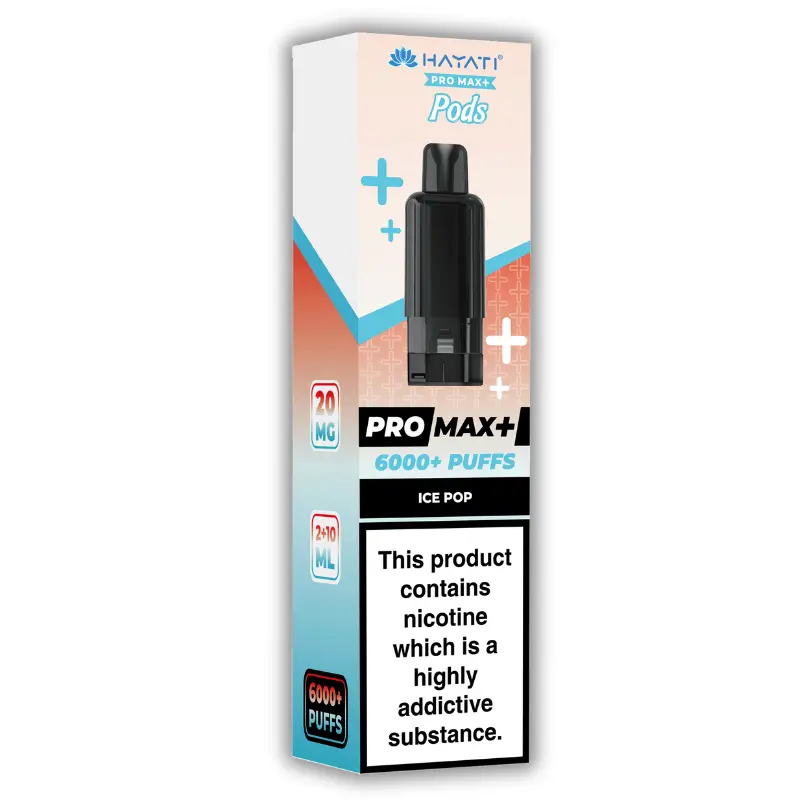
Hayati · Pro Max Plus
Ice Pop Hayati Pro Max Plus Pods
£5.49
✔ In stock — ready to ship
Genuine Hayati
Free over £20
Same-day dispatch
Secure checkout
Ice Pop Hayati Pro Max Plus Pods is the refill on its own. £5.49 buys a single prefilled pod holding twelve millilitres of liquid at 20mg nicotine salt, with no body in the carton and no way to draw on it unless a Pro Max Plus is already in your pocket. Hayati put a bench number against it, rated by the manufacturer at up to 6,000 puffs, produced by apparatus running a fixed draw pattern rather than by a person going about their week. One liquid runs the whole twelve millilitres. There is no collar, no second reserve and nothing to change your mind towards once the pod is in the bay.
That is the transaction. The question this page is about is a different one, and it is the question a refill buyer actually has, because a refill buyer has already settled everything else. You own the device. You have had this liquid before, or you are about to have it for the first time and will then have it repeatedly. The decision that keeps coming back is not which flavour. It is when is this pod finished, and Ice Pop makes that decision harder than any other cold pod on its shelf for a reason that has nothing to do with the liquid and everything to do with what Hayati chose to call it.
Here is the argument in one paragraph, so you can decide whether the next six thousand words are for you. This pod sells two things at once. It sells cold, and it sells sweet fruit. Those two things do not fail together. They fail on separate clocks, by separate routes, at separate speeds, and the one that survives is the one that tells you least. A pod that has run past its useful life still arrives cold and still arrives sweet. What has left is the fruit, and on this particular listing you were never told what the fruit was, so when it goes you have no word for the thing that went. The usual retirement signal, which is noticing that the named flavour has thinned, is simply not available here. Something has to replace it. What replaces it is a ratio.
Three listings of one liquid, and not one of them names a fruit
Before any of that, the flavour itself, because this is the first page on this site about Ice Pop in any format and the flavour question is open rather than inherited. The most useful thing available is not a tasting note from anybody. It is the fact that Hayati have written this liquid up three separate times and can be read against themselves.
Ice Pop appears three times in the 492 listings this shop carries. There is a 10ml bottle in the Pro Max Nic Salt line at £2.49, at 10mg in a 50/50 carrier, aimed at a mouth-to-lung device you fill yourself. There is the Ice Pop Hayati Pro Max Plus Pod Kit at £7.99, which is this same twelve millilitres with a body attached. And there is this listing, the bare pod at £5.49. Three descriptions, written separately, for one recipe family.
Line them up and the interesting thing is what all three agree on and what none of them will say.
All three put sweetness first and cold second, in that order, as an order rather than as a list. All three reach for frozen fruit as the reference. All three describe the cold as the thing that ends the draw rather than the thing that starts it. The pod listing calls the sweetness uncomplicated and says the chill carries it off before it can accumulate. The kit listing says the fruit side sits on the sweet end rather than the sharp end. The bottle listing gives the clearest statement of what the name is doing, and it is the sentence this whole page turns on: the name points at a fruit lolly, so what you should expect is bright sweet fruit and a cold finish, "rather than a single, specific fruit".
That is Hayati, on their own product, telling you there is no fruit to name. It is not an inference drawn from a vague title by somebody writing retail copy. It is in the manufacturer's own description, in the format where they had the most room to be specific and chose not to be. And the other two listings are consistent with it: neither the kit nor the pod names a fruit either, in a combined three paragraphs of flavour writing. Across three descriptions of one liquid, the count of named fruits is zero.
Take that seriously rather than treating it as a gap to fill. The catalogue is full of listings that name their fruit to the point of tedium. Strawberry and raspberry. Blackcurrant and mango. Blueberry and pomegranate. Hayati are not shy about ingredients when there are ingredients to be shy about. When three consecutive descriptions of one liquid decline to name a fruit, and one of them says explicitly that a single fruit is not what is on offer, the honest reading is that the blend genuinely does not resolve into one. It is a composite sweet fruit character, of the sort that a red or a tropical lolly has, where the flavouring is aiming at the category rather than at a species.
The Sunset Aura pods page on this site established the general shape of this problem for mood-named listings: when the label tells you nothing, your own memory of the last pod becomes the only description of the liquid in existence, and there is nothing external to check it against. That finding holds here and I am not going to re-derive it. But Ice Pop is a different case in one respect that matters, and the difference is worth stating precisely.
Sunset Aura is a mood. It refers to nothing edible. Ice Pop refers to a real, specific, physical object that most adults in Britain could draw from memory. The name is not evasive in the way a mood name is evasive. It is doing something stranger. It names a format of confection rather than a flavour of one, and an ice lolly is defined by its shape, its stick and its temperature, not by what is in it. Naming a liquid Ice Pop is like naming one Boiled Sweet or Fizzy Drink. You now know a great deal about the register, the sugar level and the temperature, and nothing whatever about the ingredient.
So the information gap here is not a copywriting failure and not a withheld detail. It is what the name means. The name is honest and it is also empty on the one axis that decides whether you like a fruit liquid, which is which fruit.
What you can say with reasonable confidence, from the three listings taken together: the sweetness is high and arrives early, the sweetness is not counterweighted by a named acid, the cooling is present on every draw and is positioned as the finish, and the fruit character is composite and sits towards the bright red or tropical end rather than the dark or the earthy end. What you cannot say at all: which fruit, how many fruits, how much coolant, and whether the fruit or the cold is the larger part of the recipe by weight. That last one is not published anywhere for any Hayati product and I will come back to it, because it is precisely the number the cadence argument would like to have and cannot get.
Eleven of eighty-nine, and the one that puts the cold first
Now the structural point, which I was handed as a claim and have counted, because a claim of the form "this is the only one" is worth exactly as much as the count behind it.
The Hayati Pro Max Plus Pods shelf carries 89 listings as the catalogue stands today. Eleven of those 89 titles contain the word Ice. Here they are, in full, because a list is more useful than a number:
- Banana Ice Hayati Pro Max Plus Pods
- Blackberry Ice Hayati Pro Max Plus Pods
- Cola Ice Hayati Pro Max Plus Pods
- Lychee Ice Hayati Pro Max Plus Pods
- Pineapple Ice Hayati Pro Max Plus Pods
- Red Apple Ice Hayati Pro Max Plus Pods
- Smooth Strawberry Ice Hayati Pro Max Plus Pods
- Strawberry Raspberry Ice Hayati Pro Max Plus Pods
- Vim Ice Hayati Pro Max Plus Pods
- Watermelon Ice Hayati Pro Max Plus Pods
- Ice Pop Hayati Pro Max Plus Pods, this listing
Ten of the eleven are built the same way: a subject, then the cold word. Banana then Ice. Blackberry then Ice. Cola then Ice. The subject tells you what is being cooled and the cold word tells you that it has been. Ice Pop is the eleventh, and it is the only one on the shelf where the cold word comes first and there is no subject anywhere in the title for it to be attached to. Pop is not a fruit. Pop is the lolly.
That is the claim as it was handed to me and it survives the count intact, so I am stating the real figure rather than a softer version. But two honest qualifications belong with it, because the ten are not equally informative and pretending they are would overstate the case.
The first is Vim Ice. It does follow the subject-then-cold pattern, but the subject is a cordial reference rather than a fruit, and other pages in this range describe that name as cryptic in its own right. So the true reading is that nine of the eleven titles name a plain edible subject, one names an oblique one, and one names no subject at all. Ice Pop is still alone in the third category. It is simply not alone in being hard to read.
The second qualification runs the other way and is more interesting. The title is not the only place Hayati record that a pod is cold. Fourteen of the 89 pods on this shelf are also filed on the Ice Vapes shelf, which carries 98 listings across the whole range. Those fourteen are the eleven above plus three more: Kiwi Cooler Hayati Pro Max Plus Pods, Blue Frozen Hayati Pro Max Plus Pods and Black Mamba Hayati Pro Max Plus Pods. The filing catches three cold pods the Ice vocabulary misses, and it misses none in the other direction. Black Mamba is the striking one: a title with no temperature word in it at all, filed with the cold pods, so a buyer who reads only titles will not know it is cooled and a buyer who browses the shelf will.
For the range-wide picture of Hayati's cooling vocabulary, the Blue Frozen pods page has already done the census across all 492 listings and there is no point doing it twice. Its findings, which I am citing rather than recounting: Ice dominates at 90 listings resolving to 21 distinct flavour names, Frozen and Cooler each name a single flavour sold two or three ways, Chill and Freeze appear nowhere, and nothing in the data supports reading the words as a graded scale of coldness. That page also noted, in passing, that Ice Pop and Ice Cold are the two titles that put the cold word at the front where it is doing a different job.
My contribution is what that means on one shelf for one buyer, which that page had no reason to work out. Across all 492 listings, four titles lead with a word from the ice family. Three of them are the three Ice Pop listings, which is one liquid counted three times. The fourth is Ice Cold Hayati Nicotine Pouches, which is not a vape liquid at all. So among every e-liquid Hayati sell in every format, Ice Pop is the only product whose name puts the cold first and supplies nothing for it to be the cold of. That is not a curiosity about naming. It is the reason the rest of this page exists, because a buyer who has no fruit word has no way to describe what a tiring pod has lost.
Two clocks, and why only one of them stops
A pod is not a single product with a single life. It is two deliverables sharing one coil, and on this listing the two are cold and sweet fruit.
Take the fruit first. What happens to the aromatic side of a heavily sweetened liquid over the life of a pod has already been worked out properly on this site, on the Blueberry B'Gum pods page, and I am not going to rebuild it. The short form of what that page established: sweeteners in confectionery-register liquids do not vaporise away cleanly, a portion of them bakes onto the wire and into the wick as an insulating crust, and that crust throttles heat transfer and wicking while adding a scorched note of its own. The order of loss is the part that matters. The high volatile aromatics are the first thing to go, because they are the most fragile and the most dependent on a clean coil running at temperature. The sweetness is among the last, partly because it is robust and partly because the sweetener is the agent doing the damage. That page also makes the point that the decline is slow enough for your palate to track it downwards without registering an event.
Every word of that applies to Ice Pop, which is a sweet liquid with no named acid to counterweight it and therefore sits at the sweeter end of the shelf and runs that curve at the faster end of the shelf's range. So the fruit is on the coil's clock. It fades because the hardware is changing.
Cold is not on that clock, and the reason is that cold is not delivered the way fruit is delivered.
The fruit in a draw reaches you as aroma. It is volatile material carried in vapour and read at the back of the nose, and it is the part of the recipe most exposed to everything the crust does, because a crust that lowers the temperature of vaporisation preferentially strips out the lightest and most fragile components. Cold reaches you differently. Coolant is registered as a sensation in the mouth and throat, on contact, as a physical event rather than a smelled one. You do not identify cooling the way you identify a raspberry. You notice it happening to you.
The consequence is an asymmetry. A signal that depends on a delicate set of volatiles arriving intact is fragile. A signal that only needs the coolant to make contact is not, or at least is far less so. As the coil accumulates residue and the fruit thins, the cold keeps reporting. It may report a little less loudly, because less liquid is being vaporised per draw overall, but it does not lose its character in the way an aroma loses its character. It is the same sensation, somewhat quieter, on every draw until the liquid runs out.
I should tag the confidence here honestly rather than let a neat argument pass as a measurement. Hayati publish no coolant dose for this pod or for any other in the range, and no bench data on how cooling intensity behaves over a pod's life exists in anything I can check. What I am confident about, because it follows from how the two signals are delivered, is the direction: the aromatic side degrades faster than the cooling side. What I cannot give you is the ratio of the two rates, which would need numbers nobody publishes. Treat the direction as reliable and any implied speed as a guess.
So here is the end state this pod converges on, and it is worth naming precisely because it is the thing you will be sitting in without realising. The pod still arrives cold. The pod still arrives sweet. The fruit is gone. You are drawing on sugar and chill with nothing between them, and it is not unpleasant, which is exactly the problem. An unpleasant pod gets binned. This one does not become unpleasant. It becomes blank.
Now put that together with the naming finding from the previous section, because the two combine into something that only happens on this listing.
On Watermelon Ice, a pod reaching the same state produces a specific, nameable complaint. The melon has gone. You know it has gone because the word melon is printed on the packet, sitting in your head as a description to check the draw against, and the moment the draw stops matching the word you have registered an event. The label is doing diagnostic work for you and it costs you nothing. The same is true on Blackberry Ice, on Lychee Ice, on Pineapple Ice, on all nine of the plainly named cold pods. The title is a free reference standard.
Ice Pop gives you no such standard, and not because Hayati were careless. Because there is no fruit to name. So when the fruit goes, what you experience is not "the mango has faded". It is a vague sense that the pod has gone a bit flat, arriving without a noun attached, easy to attribute to your own palate, to the weather, to a heavy lunch, to having used it too much that morning. The loss is real and the vocabulary for it does not exist. That is a genuinely unusual position for a buyer to be in, and as far as the count goes it is unique to this liquid among every e-liquid in the range.
The signal is a ratio, not a volume
If intensity cannot be your guide, something else has to be, and the something else falls out of the mechanism above.
Do not wait for the pod to get weaker. It will get somewhat weaker and the point at which it does is far past the point you should have acted, because the sweetness and the cold are both robust enough to keep the draw feeling substantial long after the interesting part has left. Waiting for weakness means waiting for the liquid to run out, which is a different event entirely and has nothing to do with whether the pod is still good.
Watch the proportions instead. Specifically, watch how much of each draw is cold and how much is fruit, and watch which of the two arrives first.
A fresh Ice Pod pod, on all three of Hayati's own descriptions, arrives in a particular order: sweet fruit at the front, cooling at the back, the chill closing the draw rather than opening it. That order is not decoration, it is a measurable property of the draw and it is the property that changes. As the fruit thins, two things happen to the order. The cold becomes a larger share of what you are receiving, because the other share is shrinking. And at some point the cold stops being the finish and starts being the first thing you notice, because there is no longer enough fruit in front of it to get there first.
The reversal of arrival order is the retirement signal. When the cold reaches you before the sweetness does, on several consecutive draws, across a session where nothing else has changed, the pod has done its work. That is a readable event. It does not need a fruit word. It does not need you to remember how strong anything was last Tuesday. It needs only that you can tell the order of two things inside a two-second draw, which everybody can do once they know to try.
To use it you need a baseline, and the only time to take one is in the first two days of a new pod. Do it deliberately and once. Take a normal draw, and afterwards name the first thing that arrived and the second thing that arrived. Write it down, or at least say it out loud, because the whole point is to fix a memory that is external to your current palate rather than one that will drift along with it. You are recording an order, not a description, which is what makes this work on a liquid nobody can describe.
Then repeat that same two-word test once every few days. The Blueberry B'Gum page is right that a slow decline is tracked down by the palate and does not announce itself, and that is exactly why a recorded order beats a remembered intensity. Your sense of how strong something is recalibrates constantly. Your record of which of two things came first does not.
One cross-check is worth building in, because an order can also be disturbed by things that are not the pod. A heavy meal, a cold morning, a day of heavy use, dehydration: all of these flatten the fruit side more than the cold side and can fake the reversal for an afternoon. So before you act on a reversal, draw on something named and non-cold from your rotation and confirm that it still reads correctly. If Blackcurrant Mango or Grape Berry still gives you the fruit it advertises, your palate is fine and the Ice Pop pod is the variable. If the named pod has also gone quiet, the problem is you and the answer is to try again tomorrow. That is the cheapest diagnostic available and it requires nothing you do not already own.
Keeping a named, warm, uncooled pod in rotation alongside this one is therefore not just a pleasure decision. It is the instrument you read this pod against. Blueberry Pomegranate, Blueberry Raspberry and Berry Lemonade all work for the purpose, and a rotation partner with a named acid in it works best, because acid is the thing whose absence is easiest to notice.
The Ice Pop bottle in the nic salt line is tempting as a reference standard and it is worth a caution. It is the same flavour family, so it will tell you roughly what the fruit side is meant to be doing. It is also 10mg rather than 20mg, in a published 50/50 carrier, on whatever device you put it in rather than on this coil. Three variables have changed. Use it as a reminder of the profile, not as a controlled comparison, and do not conclude your pod is finished because a bottle on other hardware tastes livelier.
The pod as an object, briefly
There is not much hardware here and the range's device has been written about at length elsewhere, so this section is deliberately short.
What arrives is one prefilled pod and nothing else. No body, no cell, no cable, no spare. The liquid is twelve millilitres in total, held as a 2ml chamber at the coil together with a 10ml reserve, and Hayati publish nothing at all about the route liquid takes between the two, so nobody should tell you how that part works. The coil is built into the pod and is not a serviceable item. There is no fill opening and the pod is not intended to be topped up.
That last point is the specification that actually matters for a liquid like this one, and it is why the whole page is framed as a purchase decision rather than a maintenance one. On a device with a replaceable coil, a fading flavour is a two-pound problem you fix with a spare part while keeping the liquid. Here the coil, the wick and the twelve millilitres are one sealed unit with one price on it. There is no way to refresh the coil without discarding the liquid and no way to keep the liquid without keeping the coil. So the retirement signal described above is not advice about cleaning something. It is a signal to spend £5.49.
On fitment, one sentence and then I will leave it: check the range name printed on your device against the range name in this title before ordering, because Hayati make several pod families that are not interchangeable. For everything else about the device itself, the rest of the Pro Max Plus pod shelf and the kit listings cover it.
What the listing states, and what discarding it early costs
The table below is arranged around the argument on this page rather than around the usual order, so the cooling and naming rows come before the commercial ones.
| Subject named in the title for the cold | None. The cold word leads and nothing follows it but the confection |
| Fruit identified by Hayati | None, across all three listings of this liquid |
| Cooling agent and dose | Not published, here or anywhere in the range |
| Sweetness | High and early, with no acid named as a counterweight |
| Arrival order when fresh | Sweet fruit first, cooling as the finish |
| Liquid supplied | 12ml, as a 2ml chamber at the coil plus a 10ml reserve |
| Nicotine | 20mg per ml, nicotine salt |
| Coil | Integrated in the pod, not replaceable, resistance not published |
| Carrier ratio | Not published against this listing |
| Manufacturer puff figure | Rated by the manufacturer at up to 6,000 puffs, a laboratory estimate |
| Device | Not included. A Hayati Pro Max Plus is required |
| Price | £5.49 |
| Cost per millilitre | 45.75p |
| Same liquid, other formats | Kit with device £7.99; 10ml nic salt bottle at 10mg, £2.49 |
Two of those rows deserve prose, and they are the two that decide whether you can afford to act on the signal.
Start with the per-millilitre figure, because it is what makes the retirement decision tractable. £5.49 across twelve millilitres is 45.75p per ml. That number is not interesting on its own. What is interesting is what it does to the cost of stopping early.
Suppose the arrival order reverses with roughly two millilitres left. Binning the pod at that moment costs you 92p. Suppose you catch it earlier, with three millilitres left, which is where a careful reader of the ratio is likely to land. That costs £1.37. Those are the whole numbers involved. Not a proportion, not a fraction of a pod, not seventeen or twenty-five per cent of anything: ninety-two pence and one pound thirty-seven.
People consistently overestimate this, and the reason is that they think in millilitres. Two millilitres out of twelve sounds like a sixth of the product and a sixth of the product sounds wasteful. Two millilitres in pence sounds like what it is, which is less than a bus fare, against several days of vaping something blank. Once the arithmetic is in front of you the decision is not close. The expensive mistake is not discarding liquid early. It is spending four days drawing on a pod that stopped delivering the thing you paid for, then buying the replacement anyway.
The second row worth prose is the one recording what is not included. The pod is the only thing you discard. There is no cell in it, nothing charges, and the body stays on your desk regardless of how many pods pass through it. That is the structural advantage of buying the refill rather than the kit, and it is why the retirement question is even worth thinking about: the cost of being decisive is bounded at £5.49 and it never touches the hardware. Somebody retiring a disposable early is throwing away a battery. You are throwing away a coil and some liquid.
On the kit comparison, which every page on this shelf has to make and which I will make in one go. The Ice Pop kit at £7.99 is the same twelve millilitres with a body included. The difference between the two prices is what the device line on your first invoice costs you, and it is a one-off: every subsequent Ice Pop purchase is this listing. If you already have a Pro Max Plus, buying the kit is buying a second body you did not need. If you do not, the kit is the only one of the two you can actually use.
Which of the neighbours to reach for instead, and why
Everything above has an obvious implication for shopping, and it is not "avoid this pod". It is that Ice Pop asks slightly more attention of you than its neighbours do, and whether that trade is worth it depends on what you want from a cold pod.
The case for buying it anyway is straightforward. A composite sweet fruit character has a real advantage over a named one: it does not get boring in the way a single fruit gets boring, because there is no single note for your palate to fix on and tire of. Anyone who has run a mono-fruit pod for a fortnight knows the feeling of the fruit becoming furniture. A blend aimed at a category rather than a species resists that for longer. The absence of a name on the packet and the absence of a fixed note in the glass are the same fact, and the second one is an advantage.
The case against is equally straightforward and it is the one this page has spent its length on. You will not be able to say what is wrong when something goes wrong, and you will be relying on a procedure rather than a label.
If that trade does not appeal, the nine plainly named cold pods on this shelf are all the same price and all supply the label you would be giving up. Watermelon Ice is the closest match in register: sweet, light, high water content in the flavour, cold on the finish. It is the pod to take if you want the Ice Pop experience with a word attached to it. Smooth Strawberry Ice and Strawberry Raspberry Ice both sit in the red end that Ice Pop's lolly reference points towards, with the second of the two carrying an acid edge that the first does not. Red Apple Ice is the driest of the group and the one whose fruit is most legible when tired, because apple has a distinctive sharpness that goes noticeably rather than quietly.
Banana Ice is worth separating out, because banana is the fruit whose loss is hardest to miss. It is a high, distinctive, slightly artificial note and when it starts dropping out you know immediately. If the whole difficulty described on this page bothers you, that is the pod that has the least of it. The same flavour is also available as Banana Ice Hayati Rubik Pods at £3.99, for a different and smaller Hayati device, and the lower price there reflects a smaller pod rather than a discount on the same thing.
Cola Ice is the interesting outlier among the eleven and its own page makes the argument properly: cooling a cola is a different operation from cooling a fruit, because the cola accord is built from warm materials and the coolant is arguing with something rather than adding to nothing. That is worth reading if you want the other half of the picture on what cold does in a recipe. The same flavour turns up on a smaller device as Cola Ice Hayati Mini Ultra Pods at £3.49, again a smaller pod rather than a bargain. Lychee Ice and Vim Ice round out the group at the floral and the cordial ends respectively.
Outside the eleven, three pods are cold without saying so in the title and each is relevant here for a different reason. Blue Frozen is the one whose page carries the cooling census, and the flavour itself is a blue-fruit composite that has the same no-single-fruit character Ice Pop has, arrived at by a colour word rather than a confection word. Kiwi Cooler names its fruit and cools it under a different word, and is the only Cooler in the range. Black Mamba is the inverse of Ice Pop's problem: a name that tells you nothing about anything, filed with the cold pods, so the temperature is a surprise rather than a promise.
Fresh Mint is the pod for anybody who reads all of the above and concludes they would rather not have the fruit variable at all. A mint pod has no fruit to lose, so the ratio problem does not arise: what you buy is the cold, and the cold is the durable half. It is also the natural rotation partner for a heavy sweet pod, for exactly the reason that it shares nothing with it.
Among the other mood-named listings, Blue Fusion and Fruit Twist face a version of Ice Pop's information gap without the cold complication, and the Sunset Aura pods page is where the general treatment of that problem lives. Blue Razz Mojito and Grape GB are both named clearly enough to check yourself against and both sit at the same £5.49.
On strength, the shelf also carries Hayati Pro Max Plus Prefilled Pods Zero Nicotine (0mg) at the same price, which is the listing to look at if the 20mg on this pod is not what you want. Note that this is a strength-led listing rather than an Ice Pop listing: changing strength on this range means changing what is in the pod, not adjusting a dial.
Living with a sweet cold pod
Practical handling, anchored to this pod rather than stated in general, because general advice is available everywhere and is worth less than specific advice.
The first draws. A pod that has been sitting in a box needs its wick properly wet before it is worked hard. On a liquid this sweet that matters more than usual, because dry-firing a sweetened liquid is precisely how you start the crust early. Two or three unhurried draws with no hurry between them, before you settle into normal use, costs you nothing and buys you a slower decline. The cold, incidentally, will read stronger than usual on those first draws, which is a property of a fresh coil rather than of the recipe.
Take a baseline. This is the specific instruction from the ratio section and it belongs in the handling list too, because it is a thing you do once with a new pod and then forget until you need it. First or second day, one draw, two words: what arrived first, what arrived second. That is the whole procedure.
Heat and light. Warmth is the enemy here for a reason that is particular to this liquid. A warm pod does not just age faster, it also reads differently on the axis you are trying to measure: cooling is perceived against your own mouth temperature and against the temperature of the vapour, so a pod that has spent an afternoon on a dashboard will give you a distorted reading of the ratio as well as an accelerated decline. A drawer, a bag, a jacket pocket. Not a windowsill and not a car.
Rhythm of use. Sweet liquids punish long unbroken runs more than lean ones do, because residue builds fastest when the coil is working hardest and never getting a moment to rewet. Spacing draws out is worth more on Ice Pop than it would be on a thin citrus pod. This is also the practical reason a two-pod rotation suits this liquid: alternating gives the coil recovery time and gives you the named reference pod you need for the cross-check.
When the reversal comes. Confirm it against a named pod, confirm it on a second day, then act. Do not try to revive it. The crust does not clear and there is no serviceable part inside the pod to work on, so anything you do beyond confirming the reading is time spent not buying the replacement. A pod with liquid left in it is not a pod worth continuing with.
Disposal. A pod with a coil in it is electrical waste and it also still contains nicotine-bearing liquid, so it does not belong in a household bin either way. Vape retailers and local authority sites take them back. The one thing specific to a pod retired early rather than run dry is that it will have several millilitres of liquid still in it, so it wants keeping upright and bagged until you can hand it in rather than loose in a pocket.
Storage of spares. If you keep a second pod ahead, keep it flat, cool and out of reach of children and pets, and use them in the order you bought them. A sweetened liquid stored warm for months will read darker and duller on its first draw than a fresh one, which will confuse the baseline you are trying to take.
Questions a repeat buyer actually asks
What fruit is in Ice Pop?
Hayati do not say, on any of the three listings for this liquid. The nic salt listing goes furthest and states that the name points at a fruit lolly and that what to expect is bright sweet fruit with a cold finish "rather than a single, specific fruit". That is the manufacturer declining to name one, not a retailer being vague. The honest description is a composite sweet fruit character in the red or tropical register, with the specific ingredient unpublished.
How cold is it compared with the other Ice pods?
Nobody can tell you, because Hayati publish no coolant dose for any listing in the range. The Blue Frozen pods page counted the whole catalogue's cooling vocabulary and found no evidence that Ice, Frozen and Cooler are graded terms, so you cannot read intensity off the word either. All that can responsibly be said is that every one of these pods is noticeably cooled and that the differences between them are not documented.
When should I replace the pod?
When the cold reaches you before the sweetness does, on several consecutive draws, having confirmed the same day that a named pod in your rotation still reads correctly. That is a different test from waiting for the pod to feel weak, and it fires considerably earlier. The reasoning is in the ratio section above.
What does it cost me to bin it before it is empty?
45.75p per millilitre, so 92p to discard the last two millilitres and £1.37 to discard the last three. Nothing else goes in the bin with it, because there is no cell or body in a refill pod. Set that against several days of drawing on something blank and the arithmetic makes the case on its own.
Should I buy the kit instead?
Only if you do not already own a Pro Max Plus. The Ice Pop kit at £7.99 is this same twelve millilitres with a device attached, so for an existing owner it is a spare body you are paying for. If you have no device, it is the only one of the two listings you can actually use.
Is the £2.49 nic salt bottle the same liquid?
It is the same flavour, prepared differently. The bottle is 10ml at 10mg in a published 50/50 carrier, for a device you fill yourself; this pod is 12ml at 20mg on a coil whose resistance Hayati do not publish. Expect the family resemblance to be obvious and the details not to line up, and do not use one to judge whether the other has gone off.
Will these pods fit my device?
They are made for the Hayati Pro Max Plus and nothing else is stated. Hayati produce several pod families whose names are similar, so match the range name on the device to the range name in this title before you order. Do not take a compatibility decision from a retail page, ours included.
Is 6,000 puffs what I will actually get?
It is a figure rated by the manufacturer at up to 6,000 puffs, produced in a laboratory by equipment drawing to a fixed pattern. It is useful for ranking one pod against another and close to useless as a forecast of your own week, because draw length, frequency and depth all vary and none of them match the machine. Treat it as a label, not a promise.
Can I refill the pod when it runs out?
No. It arrives prefilled, there is no opening intended for topping it up, and the coil inside is not a serviceable part. When the liquid is gone, or when the ratio test says it is done, the pod is replaced rather than refreshed.
Why does the title put the word Ice first?
Because Ice Pop is the name of a confection rather than a fruit with cooling added, so there is no subject for the cold word to follow. It is the only listing on the 89-pod Pro Max Plus Pods shelf built that way, and across all 492 listings only four titles lead with an ice-family word, three of which are this same liquid in three formats.
Is this too sweet for all-day use?
It is at the sweeter end of its shelf and has no acid named against it, which is the combination most likely to tire a palate over a long session. Many people run it as one half of a rotation for that reason rather than alone. Fresh Mint and the named berry pods are the usual partners, and a rotation also gives you the reference pod the ratio test needs.
Is there anything on the shelf with the same character but a clearer label?
Watermelon Ice is the nearest in register, sweet and light and cooled on the finish, with the fruit named. Strawberry Raspberry Ice sits in the same red end with an acid edge that Ice Pop does not have. Both are £5.49, the same as this one.
The short version
Ice Pop on the Pro Max Plus is twelve millilitres of sweet, cooled, composite fruit at 20mg, sold as a bare refill at £5.49 for somebody who already owns the device. Hayati decline to name a fruit on any of the three listings that carry this liquid, and on the bottle they say outright that a single specific fruit is not what the name is pointing at. That is not a gap in the copy. It is what the name means, because an ice lolly is a format rather than a flavour.
The consequence is the whole argument of this page. The pod sells cold and it sells fruit, the fruit runs on the coil's clock and thins as residue builds, and the cold keeps reporting because it is felt rather than smelled. So the pod ends up cold and sweet with the fruit gone, still perfectly drawable, no longer worth drawing. On any of the nine plainly named cold pods you would notice, because the packet would have told you what to look for. Here it cannot, so watch the order of arrival instead: sweet then cold when the pod is good, cold then sweet when it is finished. Confirm against a named pod, then spend the 92p and replace it.
Buy it if you want a cold sweet pod that does not fix on one note and does not tire the way a mono-fruit does, and you do not mind running a two-word test every few days. Buy something with its fruit on the label if you would rather the packet did that work for you.
Strictly for adults aged 18 and over. Nicotine is an addictive substance.
You might also like


