
Home / Hayati Pro Max Plus Pods / Blackcurrant Juice Hayati Pro Max Plus Pods
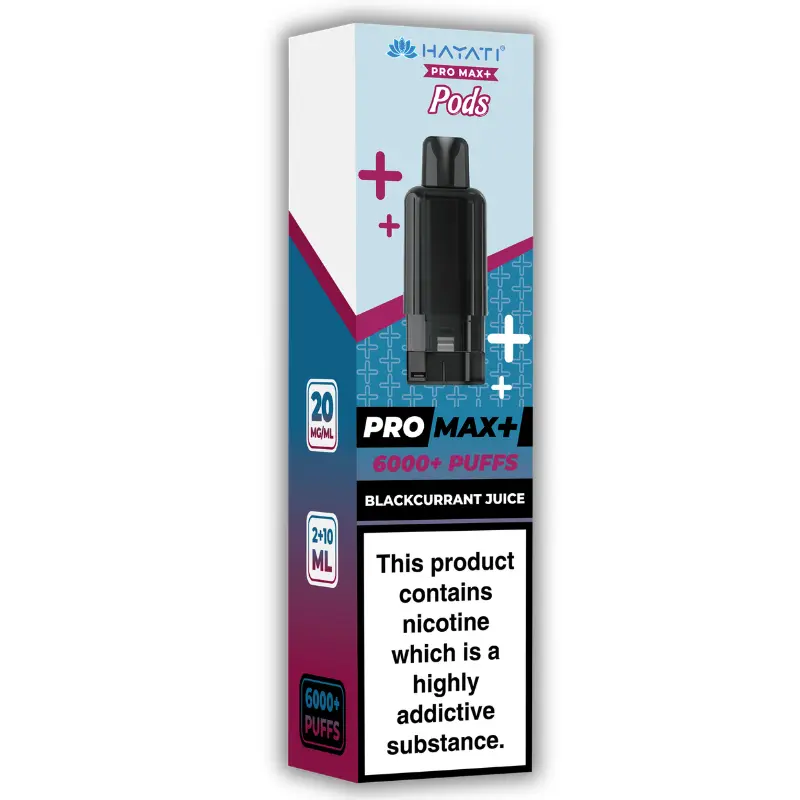
Hayati · Pro Max Plus
Blackcurrant Juice Hayati Pro Max Plus Pods
£5.49
✔ In stock — ready to ship
Genuine Hayati
Free over £20
Same-day dispatch
Secure checkout
Five pounds forty-nine buys one sealed Pro Max Plus pod, prefilled at the factory with 12ml of Blackcurrant Juice at 20mg nicotine salt, rated by Hayati at up to 6,000 puffs on their own test rig. The pack holds the pod and nothing else. No body, no lead, no spare, so this listing only works for somebody who already owns the device. Anyone who does not can take the Blackcurrant Juice pod kit at £7.99 instead, which carries the identical liquid with hardware attached, and the £2.50 between the two listings is the whole of the difference.
That is the transaction. Now the part worth reading, which is not about this pod on its own.
Hayati sell blackcurrant sixteen separate times. Not sixteen variations on a theme and not sixteen sizes of one thing: sixteen listings carrying five genuinely different liquids, spread across four devices and six price points, and the only thing distinguishing most of them is a single word sitting next to the fruit. Juice. Lemonade. Mango. Cotton K. A buyer who knows they like blackcurrant walks into that and has no way of telling whether they are looking at near-duplicates or at products with nothing in common beyond a shared ingredient. The honest answer is the second one, and the words doing the work are the easiest words on the page to skim past.
So this page is a map. Every blackcurrant Hayati list, counted and sorted, with what each modifier is actually claiming, where this listing sits among them, and which buyer each one serves. By the end the useful thing is not knowing about this pod. It is being able to look at any modifier anywhere in the range and know what question it answers.
One warning before the count, because it applies to the whole exercise. These are Hayati's words in a product title, not a specification. There is no ingredient list, no flavour brief and no target profile published against any listing in this catalogue. A naming pattern is evidence about naming. Where it supports an inference about taste I will say so and show the reasoning, and where it does not I will say that too.
Counting the blackcurrants
Sixteen on the shelf, eighteen in the data
Start with the flat number, since the angle deserves testing rather than repeating. Searching the catalogue for blackcurrant in the product title returns sixteen listings. The Blackcurrant Vapes shelf also holds sixteen, and the two sets are identical, so the shelf is complete against its own criterion.
Except that two further listings hold a blackcurrant liquid and do not appear on it. Both sit in the Pro Ultra Plus range under generic titles that name no flavour at all, and both carry Blackcurrant Cotton K / Blue Raspberry in their flavour field, described in their own text as blackcurrant against candy floss. They are the same pairing as the two listings that do say so in the title. A buyer browsing the blackcurrant shelf will never see them.
Why they fall off is visible in the data and worth stating carefully. Every one of the sixteen shelf members carries a plain blackcurrant tag alongside its longer flavour tag. The two generic listings carry only the compound string, written without spaces around the oblique, and no bare fruit tag at all. Sixteen out of sixteen against nought out of two is a clean enough split that the shelf is very probably built from the bare tag, though that is my reading of the pattern rather than something Hayati document, and a different mechanism producing the same result would look identical from outside.
The practical point survives either explanation. Eighteen listings in this catalogue contain blackcurrant. Sixteen say so in the title. A flavour shelf is a useful starting point and not an inventory, and the gap between those two numbers is the sort of thing that only turns up if somebody counts.
Sixteen listings, five liquids
The sixteen collapse a long way once you stop counting listings and start counting recipes, because most of the duplication is format rather than flavour. Kit and bare pod are the same liquid twice. A bottle is the same flavour again in a form you pour yourself.
Five blends, then, and here is the whole map.
| Blackcurrant Juice | Pro Max Plus pods £5.49 (this listing) | Pro Max Plus kit £7.99 | Pro Max nic salt bottle £2.49 | 3 listings, 2 platforms |
| Blackcurrant Lemonade | Pro Max Plus pods £5.49 | Pro Max Plus kit £7.99 | Pro Max nic salt bottle £2.49 | Pro Ultra Plus pods £7.99 | Pro Ultra Plus kit £11.99 | Mini Ultra pods £3.49 | Mini Ultra dual kit with Straw' Lemonade £3.99 | 7 listings, 4 platforms |
| Blackcurrant Mango | Pro Max Plus pods £5.49 | Pro Max Plus kit £7.99 | 2 listings, 1 platform |
| Blue Razz Blackcurrant | Pro Max Plus pods £5.49 | Pro Max Plus kit £7.99 | 2 listings, 1 platform |
| Blackcurrant Cotton K / Blue Raspberry | Pro Ultra Plus pods £7.99 | Pro Ultra Plus kit £11.99 | plus the same pairing again under two generic Pro Ultra Plus titles | 2 listings named, 2 more unnamed, 1 platform |
Three of those five never leave the Pro Max Plus. One of them reaches everything Hayati make. One exists only on the largest format. That distribution is itself information, and I will come back to it, but the first thing to take from the table is how far apart the five sit. Blackcurrant Juice and Blackcurrant Cotton K share a fruit, a brand and nothing else. Putting them in the same shopping decision because they both say blackcurrant is like choosing between a glass of squash and a bag of sweets on the grounds that both are purple.
Four kinds of modifier, answering four different questions
Sort the five blends by what the word next to the fruit is doing and they fall into four classes. The classes matter more than the individual products, because they generalise to the rest of the catalogue.
A drink modifier names a state. Juice and Lemonade both do this. Neither adds a fruit. Both say something about how diluted the blackcurrant is, how much sugar is carrying it and what texture it arrives with. Juice claims undiluted and still. Lemonade claims lengthened and sharpened. The fruit underneath is nominally the same fruit in both, and the modifier is a statement about the glass it is served in.
A second-fruit modifier names a handover. Blackcurrant Mango and Blue Razz Blackcurrant both do this. The claim is that two things happen in sequence and the blackcurrant does not have the draw to itself. What you are buying is the relationship between them, and the fruit you liked is now sharing its runtime.
A confectionery modifier changes the register of the sugar. Cotton K does this, and Hayati's own description for those listings spells it out as candy floss, so the reading is theirs rather than mine. This is the class people most often misjudge, because it looks like a flavour note and behaves like a structural change. Sugar stops carrying the fruit and becomes the thing being tasted, with the fruit pointing at a direction. The same move happens elsewhere in the range under the initials GB, which appear on seven flavour names and almost certainly abbreviate gummy bear, given that both Gummy Bear and Blue Razz Gummy Bear are also listed in full in the same catalogue.
A temperature modifier adds a coolant and leaves the fruit alone. Ice, Frozen and Cooler make up the largest modifier family Hayati use, appearing on twenty-seven of the hundred and sixty distinct flavour names in the catalogue. And here is the result that surprised me: not one of them is a blackcurrant. There is no iced blackcurrant anywhere in this range. Sixteen listings, nought cooled. Anyone who wants dark fruit with a cold finish has to leave the fruit behind and take something like Blackberry Ice, or accept an unnamed dark blend such as the Vim Ice and Vimbull Ice listings, which read as chilled purple cordial in their own descriptions without ever putting the fruit in the title.
Four classes, and the fourth one is defined by its absence here. That is a real piece of buying information and it took counting to find.
Where Juice sits, and why it is the odd one
Run the modifiers against the whole catalogue rather than just the blackcurrant corner and this listing turns out to be holding a very unusual word.
Lemonade appears on six of the hundred and sixty flavour names. Cola appears on six, mojito on four, Cotton K on four, GB on seven. Juice appears on two. This one, and Tropical Sour Juice, which exists as a Pro Max Plus pod and kit pair and nowhere else. Out of a hundred and sixty names, Hayati have used the word juice twice.
That rarity is not decoration, because of what the word has to do. Every other modifier in the set names something joining the party. Lemonade brings citrus and lift. Mango brings a second fruit. Cotton K brings sugar in a different shape. Blue Razz brings a confectionery accord. Juice brings nothing. It is the only modifier on the blackcurrant map that describes an absence, and its entire claim is that the fruit is presented on its own, undiluted, with no partner and no treatment.
Which makes it a harder word to use than it looks, and probably explains why it appears twice rather than twenty times. A modifier promising a second element gives the mixer somewhere to go if the base reads thin. Juice removes that option in advance. The word commits to a single fruit filling a whole pod with no rescue available, and only a fruit with real mass can take it. Blackcurrant has mass. Most do not.
Note also that the blackcurrant map has no bare entry. There is no listing called simply Blackcurrant. All sixteen carry a modifier, which is not inevitable, because the catalogue does allow unmodified names: Blueberry, Cola, Coffee, Tobacco, Menthol, Bubblegum and Gummy Bear all stand alone. Blackcurrant never does. Juice is the closest thing to a bare blackcurrant Hayati sell, and it gets there by using a word that means the absence of everything else rather than by dropping the modifier altogether.
The pattern in the word order, and how far to trust it
One smaller thing the map throws up, offered as an observation with its sample size attached.
Both fruit pairings put blackcurrant on one side of the name and something else on the other, and they disagree about which side. Blackcurrant Mango leads with the berry. Blue Razz Blackcurrant trails it. In Hayati's own flavour text for the first, the blackcurrant arrives before the mango moves in. In their text for the second, blue raspberry is the subject and the blackcurrant supplies depth underneath it. So in both cases the name order matches the described order.
Two out of two is a pattern and not a rule. It is consistent with the listing copy having been written from the name rather than from the liquid, which would produce exactly this correlation while telling you nothing about the recipe. Treat it as a weak prior worth about what it cost you: if a Hayati title names two fruits, the first one is more likely than not to be the one you notice first, and that is as strong as the evidence gets.
What the map is good for, and what it is not
Worth being blunt about the limits, because a well-drawn map invites more confidence than the territory has earned.
Reliable, because it is countable: how many blackcurrant listings exist, which platforms they sit on, what they cost, how many are duplicated as kit and pod, which modifiers recur and how often, and that nothing in the set is cooled. All of that comes straight out of Hayati's own listing data and anybody can check it.
Probable, because it follows from the words with only one step of reasoning: that Juice and Lemonade differ in dilution and sharpness, that Cotton K is sweeter in a different register than either, that a pairing splits the attention. These are what the modifiers conventionally mean, and Hayati's own flavour text is consistent with them in every case. They are still readings of marketing language.
Unknown, and it is the axis most likely to decide your purchase: how big any of these differences actually are in the mouth. A modifier tells you the intent of a name. It does not tell you whether the Juice and the Lemonade are two clearly separate liquids or two adjustments of one base that most people could not reliably tell apart blind. Hayati publish nothing that would settle it, this page has not tasted them side by side, and anybody claiming otherwise on a retail listing is guessing in a confident voice.
So the map narrows the field and does not close it. If the difference between two modifiers matters enough to you that being wrong would waste a pod, the cheap route is to buy the smallest format of the one you are unsure about rather than reasoning harder about a word.
Reading Juice as a claim about this pod
What the word puts in, and what it deliberately leaves out
Having placed the modifier on the map, the useful question becomes what it promises about the 12ml in your hand.
Juice claims the fruit as a drink rather than as an ingredient. That distinction does most of the work. A drink is something already made up and ready, with its sugar level settled by whoever made it, and the word implies that no further adjustment is happening in the bottle. Nothing is being lengthened with water or fizz, nothing sharper is arriving to lift it, nothing colder is arriving to reset it, and no second fruit is taking a turn. One thing, at full volume, for as long as the pod lasts.
Contrast it with the adjectival version a few listings away. Juicy Peach uses juicy as a texture word describing a fruit, which is a completely different claim: that peach has moisture and gives it up readily. Juice as a noun names the drink the fruit becomes. One word describes the fruit, the other replaces it. The two are a letter apart in the catalogue and they are not making the same promise.
The reference standard, already settled elsewhere
There is a prior question about what British buyers mean by blackcurrant at all, and it has been worked out at length on the page for Blackcurrant Lemonade Hayati Pro Ultra Plus 25K Pods. I am citing it rather than re-running it, because it is a long argument and repeating it here would be padding.
The conclusion, in one sentence: for a British buyer the reference standard for blackcurrant is the sweetened cordial rather than the berry, because the fruit is grown here commercially and eaten by almost nobody, so the drink formed the memory and the drink is what a vape gets judged against. That page also shows why the usual complaint about blackcurrant liquids tasting like squash is a description of a blend hitting its target rather than missing it.
What follows for this listing specifically, and this part is mine. If the standard is a drink, then a blackcurrant modified by the word Juice is not making a smaller claim than one modified by Lemonade. It is making a different one within the same category. Lemonade says the cordial has been lengthened with something fizzy and sharp. Juice says it has not been lengthened at all. Both are drinks; one is the neat version.
Which sets up the trap in the word. Neat cordial is not a drink anybody consumes, and the map cannot tell you which of two quite different things Hayati mean by Juice: the thick, syrupy, faintly medicinal character of concentrate before water, or the ready-made purple carton drink that arrives already diluted and sweetened. Hayati's own text describes a smooth, sweetened, juice-style profile with the tang kept and the harshness removed, which points firmly at the second reading. Their description is marketing copy before it is a specification, but it is the only evidence either way, and it says carton rather than concentrate.
The draw, in the order it should arrive
Reconstructed from the construction rather than measured, since no flavour breakdown is published for this or any listing in the range.
The opening should announce weight before it announces identity. Dark fruit sits low on the palate and arrives as density rather than as brightness, so the first instant registers as something substantial before it registers as a particular berry. That is the opposite of how a citrus or a green apple pod opens, and anyone moving across from one of those will read the first half-second as slow when it is really just bottom-heavy.
The middle is where a single-fruit liquid either holds or sags, and where the absence of a modifier is felt rather than read. There is no handover. Nothing arrives to take over from the blackcurrant, because nothing else is in the pod. What fills the space a partner would occupy is sweetness rising through the draw, which is the standard way of keeping a lone fruit from thinning out halfway. Expect the balance at the end of the inhale to sit a little sweeter than it did at the start.
The finish should be the most useful part, and it is where an uncooled dark fruit does its best work. With no menthol closing the draw and no citrus cutting across it, the exhale is simply the fruit continuing, fading slowly rather than being switched off. Blackcurrant carries a faint drying grip at the back of the swallow, inherited from the skin of the actual berry, and it usually survives even heavy sweetening. If that grip is present you have a blackcurrant. If the finish is only sweet and only purple, you have a dark berry accord wearing the name, which is the one complaint about liquids like this that holds up under any standard.
Sweetness, placed against its own siblings
Sweetness is the axis people most want a number for and the one least suited to giving them one, so here is a relative placement instead, using the map.
The two confectionery-modified blackcurrants sit at the top, by design and by announcement. Blackcurrant Cotton K / Blue Raspberry has candy floss in the name and is not pretending to be anything else. Below them, the drink-modified pair. Lemonade should read slightly less sweet in the mouth than Juice for a structural reason rather than a recipe reason: citrus acid cuts a sweet impression even when the sugar level has not moved, so a sharpened blend tastes drier than the same blend unsharpened. Juice, having nothing cutting it, presents whatever sweetness it has undisguised.
That puts this listing above the middle of the Pro Max Plus shelf without putting it at the top. Expect distinctly sweet and expect it to stay that way, because there is no second element arriving to relieve it. Whether that is restful or wearing depends entirely on the person and on the hour, and the honest version is that single-note sweet liquids are excellent for the first stretch of a session and start asking something of you after that.
Anyone who wants dark fruit with the sugar pulled back has to leave the blackcurrant map. Blueberry Cherry Cranberry brings a cranberry edge that keeps the sweetness in check, and Cherry Sour Raspberry uses an explicit sour modifier, which is a fifth class of word this map does not contain: none of the sixteen blackcurrants is sour-labelled either.
Nothing cold, and that is a range-wide fact
There is no ice, menthol, frost or coolant specified against this product, none described in its text, and nothing in the name pointing at one. The finish runs warm.
Ordinarily that would be a one-line disclaimer. The map makes it a bigger point than that, because dark fruit is the profile the wider trade most often chills, to the extent that plenty of buyers assume a blackcurrant will be cold unless told otherwise. In this catalogue it never is. Not in any of the sixteen. If a cold dark berry is what you are after, the blackcurrant shelf cannot supply it at any price or on any device, and continuing to shop it is wasted effort. Blue Frozen and the Ice listings are where that requirement is met, at the cost of the fruit you came for.
Six things this pod is not
- Not cooled. No coolant of any kind appears in the specification, and nothing in the blend substitutes for one.
- Not a blend. One fruit fills all 12ml. There is no second note to wait for and no point in the pod where something changes.
- Not sour. Blackcurrant has acidity, the sweetening covers most of it, and nothing here is built to pucker. A sour-labelled listing is a different purchase.
- Not the raw berry. Juice names a drink, and a liquid accurate to the fruit off the bush would read as harsh and unfamiliar to nearly everyone buying it.
- Not a confectionery build. Sweet, yes, but with a drink shape rather than a sweet-counter shape, which is the whole distinction between this and the Cotton K pairing.
- Not configurable. One strength, one volume, one flavour. No options are published against the listing.
Which blackcurrant is actually yours
The map earns its keep here. Five blends, four modifier classes, and a different buyer behind each.
If you want the fruit and nothing standing in front of it
This listing, and it is the only one on the map that offers it. Juice is the sole blackcurrant Hayati sell with no partner, no citrus, no sugar in confectionery register and no coolant. If what you like about blackcurrant is blackcurrant, every other option on the map is diluting the thing you came for, and four of the five are doing it deliberately.
Two caveats attach. A single note across 12ml asks more of a flavour than a blend does, because there is no second element to break up the repetition, and people who find that restful and people who find it monotonous are both reporting accurately about themselves. And the same liquid exists in a 10ml bottle at £2.49 in the Pro Max nic salt line at 10mg, which is a cheaper way to find out where you fall, though it needs a refillable device and a coil of your own rather than this one.
If you want it lengthened and sharpened
Lemonade, which is the most widely stocked blackcurrant Hayati make and available on more hardware than anything else on the map. Blackcurrant Lemonade on this same device at £5.49 is the direct swap, identical in price, format and fitment, differing only in the modifier. On the larger format the Pro Ultra Plus pod holds 22ml at £7.99, and at the small end the Mini Ultra version at £3.49 is the least expensive route to a verdict on the profile, on its own device rather than this one.
Seven listings across four platforms is the widest distribution of any blackcurrant in the range, and that is worth reading. A retailer stocks the version that sells. Lemonade travelling everywhere while Juice stays on one platform and a bit is evidence about commercial confidence rather than about quality, but it does suggest the sharpened version is the one most buyers reach for, and anyone undecided between the two is choosing between the popular reading of this fruit and the minority one.
If the lemonade construction appeals more than the specific fruit underneath it, Berry Lemonade runs the same idea with an unnamed dark fruit in the base, which is a looser proposition and correspondingly harder to be disappointed by.
If you want a second fruit in the pod
Two options, and they differ in what the partner is for. Blackcurrant Mango puts a soft tropical fruit against the tart berry, which is a contrast pairing: the mango is there to round off an edge, and Hayati's text describes the two trading places across a session. Blue Razz Blackcurrant is closer to a reinforcement pairing, since blue raspberry is a confectionery accord rather than a fruit and shares the tart streak, so the two stack rather than alternate. That one is also the bridge for anyone who normally buys blue and is curious about dark, or the reverse.
Both exist as kit and as bare pod at the standard £7.99 and £5.49. Neither is on any platform other than this one, so a Pro Ultra Plus owner cannot have either.
For three-fruit constructions with no blackcurrant at all, Mango Peach Pineapple shows what the tropical side looks like without a dark anchor, and Blackberry Raspberry keeps the dark register with two berries and no drink framing.
If you want it as a sweet rather than as a drink
Cotton K, on the Pro Ultra Plus only, and it is the biggest jump on the map. Sugar moves from carrying the fruit to being the subject, the blackcurrant becomes a direction rather than a flavour, and the listing is a dual pod with a rotating collar that selects between the blackcurrant side and a blue raspberry side sharing one coil. Different platform, different price, different kind of sweetness and a different thing to do with your hands. Anyone who has enjoyed a gummy or candyfloss liquid and assumed a blackcurrant listing would be similar is in for a genuine surprise in one direction or the other.
The equivalent move without leaving this device is Grape GB, where the same initials apply the same treatment to a different fruit, and it is a fair preview of what the confectionery register does to a dark fruit generally.
Sideways, out of blackcurrant entirely
Several routes keep some part of what this pod offers and change the rest. Mixed Berries is the generic version of the dark register, useful mainly as a reference point: if you cannot tell it apart from this one, the specificity you are paying for here is not reaching you. Blue Razz Cherry and Blue Sour Raspberry work the confectionery accord with a fruit attached. Cherry Cola and Cola Ice are drink-modified listings built on a different drink, and the second of those shows a modifier stack in action, with a drink word and a temperature word both applied to one base.
And then the listings whose names are modifiers with no fruit at all. Fruit Twist, Blue Razz Fruit Twist and Black Mamba name a mood rather than an ingredient, which is the one case where the map cannot help you, because there is no modifier to decode and nothing in the title that resolves into a fruit. Those are bought on trust or not at all.
The object in the packet
Short section, because the hardware under this liquid is shared with roughly ninety other listings and has been described at length across the Pro Max Plus pods shelf. What is worth saying here is only what bears on a single-fruit drink profile.
One sealed prefilled pod arrives and that is the entire contents. It is filled at the factory, holds 12ml, and contains its own coil, fixed in place and not serviceable. Nothing can be taken out, rinsed, rewicked or exchanged, so the coil you start with is the coil you finish with, and it goes out of use with the last of the liquid. No refilling arrangement is published and the pod should be treated as a committed unit rather than a vessel you own.
The specification that matters for this particular liquid is the coil being sealed and singular, because a sweetened single-fruit blend works that mesh harder than a dry or citrus-led one would. There is more sugar in the liquid and nothing sharp cutting through it, which is the standing condition for residue building up faster than it otherwise might. That shows up in the handling notes below and it is the one hardware fact this flavour genuinely changes.
On fitment, the listing names a Hayati Pro Max Plus and says nothing further. Check the range name printed on your device against the range name in this title and do not reason past it, because a retail page is not where an unanswered hardware question gets settled. Beyond that, Hayati publish no coil resistance, no wick material, no airflow figure and no pod dimensions for this product. Other listings will state some of those without hesitation, and whatever they are quoting, it is not this listing's data. The wider prefilled pods and refills shelf carries the rest of the format.
The sheet, with the map alongside it
Rows ordered by how much they change a decision rather than by the order a spec sheet usually runs.
| What the modifier claims | Juice: the fruit as a still drink, undiluted, no partner and no treatment |
| Modifier class | Drink. Two of the four classes present in the blackcurrant range |
| Siblings under the same modifier | Two. The £7.99 kit, and a 10ml Pro Max bottle at £2.49 |
| Rarity of the word | Juice appears on two of the catalogue's hundred and sixty flavour names |
| Cooling | None here, and none on any of the sixteen blackcurrant listings |
| Flavour name as listed | Blackcurrant Juice |
| Volume | 12ml, prefilled and sealed at the factory |
| Nicotine | 20mg nicotine salt. No alternative strength is published |
| Price | £5.49, which works out at roughly 46p per millilitre |
| Manufacturer rating | Up to 6,000 puffs, produced on Hayati's own equipment |
| Supplied with | The pod alone. Device purchased separately |
| Coil | One, sealed in, carrying the whole volume |
| Listing reference | Hayati, blackcurrant-juice-hayati-pro-max-plus-pods |
Three rows repay attention and the rest are there so nothing has to be hunted for.
The price row is more interesting on this product than on most, because the map gives it context. Across the blackcurrant listings the per-millilitre figure ranges from roughly 25p on the £2.49 bottle to about 87p on the £3.49 Mini Ultra pod, with this one at around 46p and the £7.99 Pro Ultra Plus pod at about 36p. Those are not like-for-like, since the bottle is 10mg rather than 20mg and needs hardware and a coil of your own, while the bigger pod runs on a different device. What the spread does show is that the cheapest way into a blackcurrant on the map is not the cheapest listing, and the most expensive way per millilitre is the smallest pod, which is exactly what you would expect and still catches people out.
The rating row exists to be attributed, not relied on. Up to 6,000 puffs is Hayati's own figure from Hayati's bench, generated by equipment drawing to a set pattern that is not published alongside it. Read it as a statement about the workload one non-serviceable coil is built to absorb rather than as a forecast about a person, and do not set it against the ratings printed on the Pro Ultra Plus or Mini Ultra formats, which come from different hardware and were never calibrated against one another.
The nicotine row offers no choice. 20mg salt is the only strength listed against this product and the salt formulation is what this format uses throughout. Nicotine is addictive. Which strength suits a given person is not a question for a shop page to answer.
Running a single-note pod down to the last of it
General pod handling applies here as everywhere. What follows is the part that actually differs for an uncooled, sweetened, single-fruit liquid in a sealed 12ml unit.
Take your reading in the first day or two. A blend gives you several things to track and a single note gives you one, which makes early attention more valuable rather than less. Establish whether the drying grip at the back of the swallow is there while the coil is new. Later you will be assessing liquid and mesh together with no way to separate them, and most people who conclude a flavour was disappointing are in fact describing its final third.
Give it a longer draw than a bright liquid needs. Weighty aromatics need a moment of contact before they register, so a short sharp pull on this profile returns mostly sugar and a vague purple impression. The fruit fills out on a slower draw. This is not advice about technique in general, it is specific to a flavour whose interest sits in the middle and bottom rather than the top.
Watch the texture before you watch the flavour. On a sweet, uncooled blend the first thing to go is usually not the taste but the release. As residue gathers, the draw starts to sit on the tongue instead of clearing off it, while the fruit remains perfectly identifiable. That shift is the earliest honest signal the pod has turned its corner, and it beats counting days or guessing at millilitres.
Expect no compensation when it fades. This is the specific cost of the Juice modifier and the reason it deserves its own note. On a blend, a tiring coil takes the top note first and leaves the base, so there is still something to taste. Here there is only the base. When the blackcurrant thins there is nothing underneath it, so the decline is felt as a straightforward reduction rather than as a change of character. Buyers coming from a blend often read that as the pod failing early when it is simply failing visibly.
Do not pull harder to chase it. The draw is narrow by design and force extracts nothing extra. Harder pulls run the coil hotter and empty the wick faster than it refills, and on a sugared liquid both of those accelerate exactly the residue problem described above. Chasing a fading pod brings the fade on sooner.
Let a rested pod settle before judging it. Leave one part-used for a week or two and the liquid stands against a static wick, so the first pulls arrive heavy and slightly stewed. On a sweet dark fruit that presents as syrup, which is this flavour at its least appealing. Three or four unhurried draws bring it back and it is not a fault.
Keep spares cool and out of daylight. A drawer or a cupboard is enough. Heat and light work on the delicate end of a liquid first, and since this one has no citrus or coolant sitting on top, what a warm windowsill costs you is depth in the middle rather than brightness at the edge. Nicotine products belong where children and pets cannot reach them, sealed spares included.
Decide the endgame in advance. A 12ml pod has a long enough tail that there is a real choice at the end: run it out and accept a diminished version for the last stretch, or retire it the day the fruit stops showing up properly. Either is defensible. Having no policy and wavering for a fortnight gets you the worst of both.
Dispose of it properly. A spent pod still holds a coil and the dregs of a nicotine liquid, so it does not belong in the household bin. Vape shops and council recycling points take them, and nothing inside is worth salvaging.
Questions the map raises
How many blackcurrant flavours do Hayati actually sell?
Sixteen listings name blackcurrant in the title and all sixteen sit on the Blackcurrant Vapes shelf. Those sixteen carry five distinct blends between them, because kit and bare pod versions of the same liquid are counted separately. Two further Pro Ultra Plus listings hold a blackcurrant liquid under a generic title and do not appear on the flavour shelf, which makes eighteen in the data against sixteen on display.
What is the difference between Blackcurrant Juice and Blackcurrant Lemonade?
Both are drink modifiers applied to the same fruit, so the difference is the state rather than the ingredient. Juice claims the fruit undiluted and unsharpened, with nothing added. Lemonade claims it lengthened with citrus, which cuts the sweet impression and lifts the finish. How large that difference is in the mouth is not something the names can settle, and Hayati publish nothing that would.
Is there any ice or menthol in this one?
None is specified and none is described. More usefully, none of the sixteen blackcurrant listings in the range is cooled, so the entire flavour shelf is warm-finishing. Anyone who wants a chilled dark fruit has to move to a listing with Ice or Frozen in its name and accept a different fruit underneath it.
Is this the same liquid as the Blackcurrant Juice kit?
Yes, as far as the listing data shows. The kit at £7.99 carries the same flavour with a rechargeable Pro Max Plus device in the box, and this listing is the pod on its own at £5.49. The £2.50 between them buys the hardware, so anyone who already owns the device is paying for something twice by ordering the kit.
Does the word Juice mean it is less sweet?
Probably the opposite, and for a structural reason rather than a recipe one. Acid cuts a sweet impression, so a blend with citrus over it reads drier than the same blend without. Juice has nothing cutting it, which means whatever sweetness is in the liquid arrives undisguised. Expect it to sit above the middle of this shelf.
What does Cotton K mean on the other blackcurrant listings?
Hayati's own text for those listings describes it as candy floss, so it is a confectionery modifier rather than a fruit one. It changes the register of the sugar instead of adding a flavour: sweetness becomes the subject and the fruit points at a direction. That pairing is also a dual pod on the Pro Ultra Plus with a rotating collar selecting between two sides, so it differs in hardware as well as in taste.
Why is Blackcurrant Lemonade on four devices and this one on two?
Seven Lemonade listings across the Pro Max Plus, Pro Ultra Plus, Mini Ultra and Pro Max bottle ranges against three for Juice is a real difference in how widely each is stocked. The plain reading is that the sharpened version sells better, since stock follows demand, though that is inference from distribution rather than anything published. It says nothing about which is the better liquid and something about which is the more popular one.
Can I tell from a Hayati name which fruit I will taste first?
Weakly at best. Both blackcurrant pairings in the range put the fruit Hayati's own text describes as arriving first at the front of the name, which is two cases out of two and consistent with the copy having been written from the title. Treat it as a mild prior rather than a specification, and do not pay extra for it.
What is the cheapest way to find out whether I like blackcurrant in this range?
The 10ml Pro Max nic salt bottle at £2.49 is the lowest outlay, at roughly 25p per millilitre, but it is 10mg rather than 20mg and needs a refillable device and your own coil. Within the prefilled formats the Mini Ultra pod at £3.49 is the smallest commitment in cash terms while being the most expensive per millilitre. Neither is an exact preview of this pod, since hardware changes how a liquid presents.
Can the pod be refilled when it runs out?
No filling arrangement is published and the description makes no provision for one, so treat it as a sealed single-use unit. The coil cannot be swapped either, which means even a topped-up pod would be drawing through mesh that has already worked through 12ml of a sweetened liquid.
Will a blackcurrant pod from another Hayati range fit this device?
The listing names a Hayati Pro Max Plus and offers no compatibility table, no dimensions and no cross-range guidance. Match the range name printed on your device to the range name in the title and go no further than that. Several blackcurrant listings in this catalogue are built for other hardware, and two dark rectangles in a drawer can belong to quite different devices.
Is Blackcurrant Juice a single flavour or a dual pod?
Single. The title carries one flavour name with no oblique, which on this format marks one liquid filling the whole pod, and the Pro Max Plus pods have no rotating collar to select anything with. The dual arrangement on the blackcurrant map belongs to the Cotton K pairing and the Mini Ultra lemonade kit, both on other hardware.
The short version
What £5.49 buys: one sealed pod holding 12ml of 20mg nicotine salt for a Pro Max Plus you already own, filled with a single uncooled dark fruit, rated by Hayati at up to 6,000 puffs on their own equipment. Sweet, weighty, slow to open, and finishing with the fruit fading rather than being cut off by anything.
The argument of this page is that the fruit is not the decision. Hayati sell blackcurrant sixteen times, in five different blends, across four devices and seven prices, and the only thing separating most of them is one word. Juice means undiluted and unpartnered, and it is the rarest modifier in the catalogue, used twice in a hundred and sixty names. Lemonade means lengthened and sharpened, and it is the one the range is most confident in, stocked on everything. A second fruit means the blackcurrant is sharing the draw. Cotton K means the sugar has changed register and the fruit has become a direction. Nothing in the sixteen is cooled, and nothing is sour-labelled, so two things a dark-fruit buyer might reasonably want are simply not available under this name at all.
Carry the classes rather than the products and the range stops being ninety near-identical purple rectangles. A drink word tells you about state. A fruit word tells you about a handover. A confectionery word tells you about sugar. A temperature word tells you about the finish. A mood word tells you nothing, and the listings that use one are bought on trust. That test works on any name across the full Hayati catalogue, which is more than any single tasting note will do for you.
The limit stands where it stood at the top. These are Hayati's words, not a specification, and a naming pattern is evidence about naming. The map tells you reliably what is on sale, what it costs and how it is sorted. It tells you probably what each modifier intends. It does not tell you how far apart any two of them land in the mouth, and if that difference is what your purchase turns on, the cheap answer is a small pod rather than a longer argument.
Strictly for adults aged 18 and over. Nicotine is an addictive substance.
You might also like


