
Home / Hayati Pro Max Plus Pods / Pineapple Ice Hayati Pro Max Plus Pods
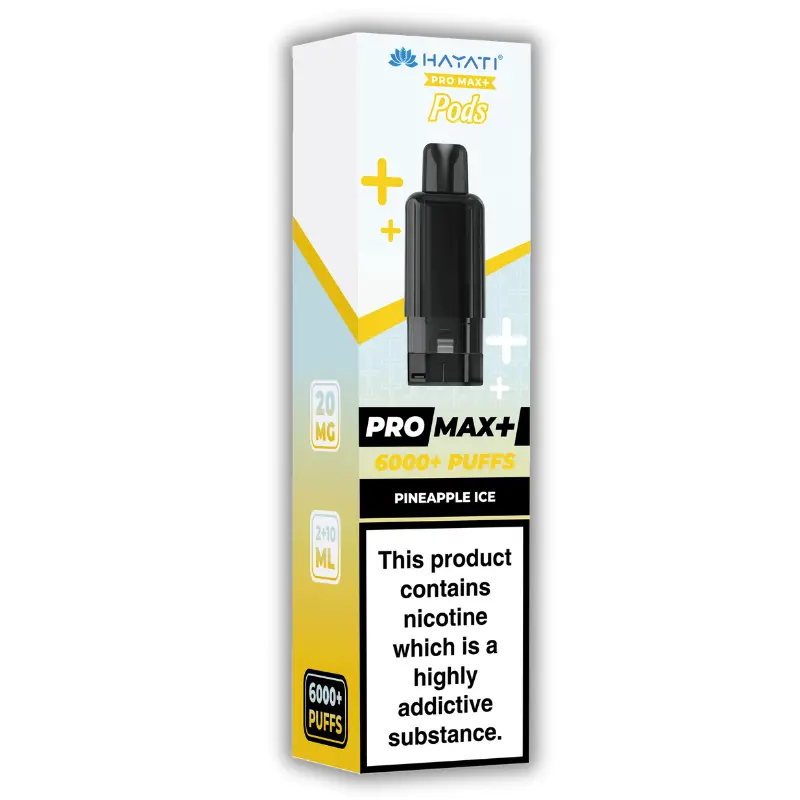
Hayati · Pro Max Plus
Pineapple Ice Hayati Pro Max Plus Pods
£5.49
✔ In stock — ready to ship
Genuine Hayati
Free over £20
Same-day dispatch
Secure checkout
Pineapple Ice Hayati Pro Max Plus Pods is a sealed refill: one prefilled pod carrying 12ml of liquid at 20mg nicotine salt, priced at £5.49, with no device in the pack. Hayati give it a laboratory figure of up to 6,000 puffs for a full pod, measured on test equipment drawing to a fixed schedule rather than by anybody using one. The flavour is a bright, acidic pineapple with a cooling agent laid over it. If you have arrived here you almost certainly own the body already, you have decided you like this liquid, and what you want is another one.
That makes this a restocking page, and restocking pages normally have an easy job. The bare pod is the cheap way to keep a device running, the kit price is the thing you paid once and will not pay again, and the arithmetic points one way. On this particular liquid it does not. Pineapple Ice is sold six times over across Hayati's formats, and two of those six are sealed pods at 20mg holding exactly 12ml each. This one is £5.49. The other, Pineapple Ice Hayati Rubik Pods, is £3.99. Same volume, same strength, same flavour name, different shelf, and a gap of £1.50 that recurs on every pod you buy for as long as you own this device.
So the argument this page makes is the reverse of the usual one. This refill is not the price floor for its own liquid. Something cheaper, sealed, identical in the two numbers that describe what is inside it, is sitting two shelves away. That is worth saying plainly on the listing rather than leaving a buyer to find it by accident, and it is worth saying with the counting done, because the interesting questions are how often this happens across the shelf, what the extra £1.50 actually purchased, and whether an existing owner can do anything useful with the information. The flavour argument is not here. It was settled at length on the Pineapple Ice Hayati Rubik Prefilled Pod Kit page, which is cited below rather than rewritten.
Six listings, and the two that do not belong on the ladder
Start by laying out every way this shop sells Pineapple Ice, because a price comparison is only as good as the list it runs over. There are six entries in the catalogue carrying the name, and they split into three pairs.
- Two sealed pods at 20mg, both holding 12ml: this one at £5.49 and the Rubik pod at £3.99.
- Two complete kits at 20mg, both holding 12ml: the Pineapple Ice Hayati Pro Max Plus Pod Kit at £7.99 and the Rubik kit at £5.99.
- Two bottles at 0mg, both holding 120ml, both £6.99: a 70/30 blend and a 50/50 shortfill.
The first four are directly comparable with each other. The last two are not, and the reason they come off the ladder needs stating carefully, because the obvious reason is wrong. It is tempting to wave them away as sub-ohm liquid for a different kind of hardware. Read the two listings and only one of them fits that description. The 70/30 bottle is written for sub-ohm tanks and direct-to-lung coils. The 50/50 shortfill says the opposite: it is aimed at mouth-to-lung pod kits and low-power setups, which is much closer to the sort of device you are holding than to a cloud machine.
The real reason the bottles leave the list
What actually disqualifies both of them is not the carrier ratio. It is that they are 0mg and they are not pods. A shortfill is bought empty of nicotine and filled by you into hardware that opens. This product does neither. It arrives sealed, at 20mg, with nothing to fill and nothing to add, and that is the whole proposition of a prefilled pod. Converting a 120ml bottle into something equivalent to what you are buying here would need a nicotine addition and a refillable device, and neither is a small footnote.
There is a second problem with treating the bottles as a cheaper route, and it is a hole in the catalogue rather than an argument. Nowhere in the 492 listings on this shop is a nicotine shot sold. Not one product in the range exists to be added to a shortfill. So the bottle route cannot even be costed from this shop's own inventory, let alone compared like for like with £5.49. Five point eight three pence per millilitre looks like a demolition of everything else on the list until you notice it is the price of liquid with the nicotine left out and the hardware left out, which is to say the price of the one component that is cheap in every format.
That leaves four listings that genuinely describe the same purchase in different wrappers, and among those four, exactly two are the thing a repeat buyer wants, which is a sealed pod with no device attached. Those two are the comparison.
Two sealed pods, one liquid, two prices
Lay the pair side by side and almost nothing varies. Both hold 12ml. Both are 20mg. Both are prefilled and sealed. Both carry the same flavour name and describe it in similar terms. Neither includes a device. Divide price by volume and this pod works out at 45.75p per millilitre against the Rubik pod's 33.25p, a difference of £1.50 on the ticket.
Getting the percentage right matters more than it sounds, because the same £1.50 produces two very different-looking figures depending on which end you start from. As a premium added to the cheaper pod it is 37.6 per cent. As a saving taken off the dearer one it is 27.3 per cent. Both are correct arithmetic on the same gap. The Vim Ice Rubik kit page on this site, which worked the two platforms out in detail before this page existed, quotes the second of those, and this page quotes the first only because it is writing from the expensive side looking down rather than the cheap side looking up. Nobody is contradicting anybody. It is one number viewed from two positions, and a reader who spots both should know that.
The broader money question, meaning what a millilitre costs across every prefilled format Hayati list, was also settled on that page. It built the full table, found that the Rubik refill is the cheapest millilitre of sealed Hayati liquid on the shop, found that the Pro Ultra Plus refill runs it close at 22ml a pod, and found that the Mini Ultra has the lowest ticket price and nearly the highest unit cost. That work is cited here and is not rebuilt. What this page adds sits on top of it: not which platform is cheap in general, but what it means for a specific liquid that a specific buyer has already chosen, on a device they have already bought.
What does not differ, which is the interesting part
A price gap between two products usually resolves into something. Here it does not resolve into volume, because both pods hold twelve millilitres. It does not resolve into strength, because both are 20mg, which is the maximum this format may carry in the UK and therefore the ceiling rather than a choice. It does not resolve into the published puff figure either, and that one runs the wrong way, which the census further down deals with properly.
What it plainly does resolve into is the body. A Pro Max Plus kit is £7.99 and a Pro Max Plus pod is £5.49, so that platform charges £2.50 for the device the first time you buy in. A Rubik kit is £5.99 and a Rubik pod is £3.99, so that platform charges £2.00. Those two body charges are stable across their shelves: all 88 Pro Max Plus kits carry the same £7.99 and all 89 pods on the Hayati Pro Max Plus Pods shelf carry the same £5.49, with no exceptions in either direction. But the body charge is a one-off. It cannot explain a gap that reappears on every pod. Fifty pence of the £2.00 kit gap is the difference in body charge, and the remaining £1.50 is attached to the pod, which is the part you buy again.
So the honest description of the £1.50 is that it is a standing charge on the liquid, levied by the shelf rather than by anything in the pod. Hayati publish no coil resistance for either platform, no carrier ratio for either liquid, and no statement anywhere that the two pods differ in construction. The difference could be in the atomiser, the shell, the packaging, the margin or nothing at all. What can be said is what is printed, and what is printed is identical on the two numbers that describe the contents.
How unusual this is, counted rather than assumed
An argument of the shape "your refill has a cheaper identical twin" is only worth reading if it is rare enough to be news and common enough not to be a freak. Both of those needed checking rather than asserting, so here is the count, taken from the catalogue as it stands today.
The Rubik pod shelf holds nineteen flavours. Eighteen of those nineteen are also sold as Pro Max Plus pods. The single exception is Lemon Cola Ice, which exists on the Rubik and nowhere else in a sealed pod. Looking the other way, the Pro Max Plus pod shelf holds eighty-nine flavours, of which those same eighteen have a cheaper identical twin and seventy-one do not. So this is not a quirk of Pineapple Ice. Roughly one Pro Max Plus refill in five sits directly above a £3.99 pod holding the same liquid at the same volume and strength, and four in five do not.
That is the shelf-wide pattern, and it is the honest scope of the claim. Now the narrowing, because the angle this page was given claimed more than the numbers support.
The narrowing: one of seven, not one of one
The version of this argument handed to me described Pineapple Ice as the cleanest controlled comparison available, on the grounds that nothing else in the range muddies it. Counting says that is overstated as a superlative and correct as a description, so here is the corrected form.
Of the eighteen flavours sold as both a Rubik pod and a Pro Max Plus pod, eleven are also sold in at least one other sealed format, which means their price picture has three or four entries in it rather than two. Seven are not. For those seven, the comparison really is a clean pair: two sealed pods, two prices, nothing else in the catalogue to complicate the reading. The seven are Banana Ice, Blueberry Cherry Cranberry, Pineapple Ice, Red Apple Ice, Strawberry Kiwi, Triple Mango and Vim Ice.
So Pineapple Ice is one of seven, not the only one, and this page says so rather than claiming a distinction it does not hold. The correction improves the argument rather than weakening it. A finding that applies to seven listings is a pattern in how the catalogue is built. A finding that applies to one is an anecdote. And knowing the other six is directly useful, because anybody who takes the reasoning here seriously can apply it to six more flavours without redoing any of the work.
For contrast, look at what a muddied case looks like. Watermelon Ice Hayati Pro Max Plus Pods is one of the eighteen, so it does have a £3.99 Rubik pod beneath it holding the same twelve millilitres. It also has a 22ml Pro Ultra Plus pod above it at £7.99, which asks more on the ticket and works out lower per millilitre. Three sealed formats, two volumes, and the answer to which is cheapest depends entirely on which of those two things you are measuring. A different tangle shows up on Cola Ice Hayati Pro Max Plus Pods, which has no Rubik version at all but does have a 4ml Mini Ultra pod sitting at a lower ticket and a much higher unit cost, with Cola Ice Hayati Pro Ultra Plus 25K Pods at the top of the same stack. Cherry Berry is filed in that same three-format arrangement. Those are interesting problems and they are not this one. Here there are two numbers and one of them is smaller.
The refill that is not the floor
Put the scope and the pair together and the position of this listing becomes precise. For seventy-one of the eighty-nine flavours on this shelf, £5.49 is genuinely the lowest price at which the liquid can be bought sealed, because no other Hayati pod carries that flavour at all. Blue Razz Mojito is one of those. So is Blackcurrant Juice, and so is Grape Berry. On those pages a refill page can say the ordinary thing, which is that this is the floor and the kit price was the only premium you will ever pay.
This page cannot say that. The floor for this liquid is £3.99 and it is on another shelf. What a buyer standing here is paying for is not access to Pineapple Ice, because Pineapple Ice is available for less. It is access to Pineapple Ice on the hardware they own.
That distinction sounds like a technicality and it is the whole point. Hayati price by platform, not by flavour. Every pod on this shelf is £5.49 whatever is in it, and the catalogue offers no mechanism by which a flavour could cost more or less than its neighbours. So the £1.50 is not a pineapple premium, it is a Pro Max Plus premium, and it applies equally to all eighteen of the flavours that appear in both places. A buyer who reads it as the flavour being dearer here has misread which variable is moving.
There is a version of this that deserves saying without any spin on it. If your only interest is minimising what Pineapple Ice costs you per millilitre, and you are prepared to hold a second device, this is the wrong listing and the Rubik pod is the right one. That is not a criticism of the product. The pod does what it says, at a price that is uniform across an eighty-nine flavour shelf, and the reason you are on the expensive side of the comparison is a decision you made when you bought the body, not a decision you are making now.
The defection sum, and why it is shorter than it looks
An existing owner reading the above has an obvious next question, and it is not one the platform-choice arguments answer, because those are written for somebody who has not bought anything yet. The question is: given that I already own a Pro Max Plus, is it worth anything to me that the same liquid is cheaper elsewhere?
Ordinarily the answer would be no, because switching platforms means buying a device, and a device is a lump of money that has to be earned back at £1.50 a pod. Fifteen pods to recover a £20 body would be a bad trade for most people. But the numbers on this pair are unusual, and working them through gives an answer that surprised me.
The entry ticket to the cheaper platform is a Rubik kit at £5.99, and that kit is not an empty device. It ships with 12ml of Pineapple Ice already in it, at the same 20mg. So the comparison is not "a pod versus a pod plus a device". It is "£5.49 for twelve millilitres" against "£5.99 for twelve millilitres and a body". The body costs fifty pence more than the liquid you were going to buy anyway.
Run the two positions forward one purchase at a time. Buy the Pro Max Plus pod and you are £5.49 down for one pod's worth of liquid. Buy the Rubik kit instead and you are £5.99 down for the same twelve millilitres, so you are fifty pence behind. On the next purchase the staying buyer spends another £5.49 and the switching buyer spends £3.99, a £1.50 swing that wipes out the fifty pence and leaves a pound in hand. You are ahead from the second pod onwards, and the gap widens by £1.50 every time after that.
A payback measured in one pod is not something most hardware decisions offer, and it exists here for a structural reason rather than a promotional one. The cheap platform's complete kit is priced fifty pence above the dear platform's bare refill. Across the whole shop only two complete devices carry a ticket within a pound of this pod's £5.49, and one of them, the Mini Ultra kit at £3.99, is actually cheaper than a bare Pro Max Plus refill while holding a third as much liquid. That is the sort of thing that happens when four platforms are priced independently and nothing in the catalogue ever lines them up.
I do not repeat the longer projection, the one that runs consumption forward over a year and totals both columns, because the Vim Ice Rubik kit page already did that properly and arriving at the same totals by a slightly different route would add nothing. The crossover is the part that is specific to somebody who already owns hardware, and the crossover is two pods.
What the sum leaves out, stated honestly
Several things, and they are not small. You would be holding two devices, with two charging routines and two pods in flight, and the flavour you like would be on whichever one you remembered to bring. Pods and bodies do not move between Hayati's ranges, so check the range name printed on your device against the range name in this title before ordering anything, and do not take a fitment decision from a retail page, this one included.
You would also be narrowing your own options. The Rubik pod shelf carries nineteen flavours. This shelf carries eighty-nine. If Pineapple Ice is the only thing you ever buy, that costs you nothing at all, and if you rotate through four or five liquids then most of them will not exist on the cheaper platform and you will be running both devices anyway. The saving is real only on the eighteen flavours that appear in both places, and it is worth almost nothing to somebody whose rotation lives mainly among the other seventy-one.
And the £5.99 is money spent today against savings collected later, which is the same reason people keep paying standing charges everywhere else. Fifty pence of exposure and a one-pod crossover makes that easier to stomach than most, but a buyer who dislikes owning a device they did not plan to own is entitled to weigh that against thirty pence a millilitre and decide it is not worth the bother. This page does not think there is a correct answer. It thinks the number should be on the listing rather than discoverable only by somebody who happens to browse two shelves in the same session.
The published figure follows the body, not the pod
One number does differ between the two listings, and it goes in the direction nobody expects. Hayati rate this pod on the bench at up to 6,000 puffs. They rate the £3.99 Rubik pod at up to 7,000, on the same twelve millilitres, at the same strength, for the same liquid. The cheaper pod carries the higher published figure.
The Vim Ice Rubik kit page found this first and did the structural work on it, dividing each range's rating by its volume and getting a spread from 375 rated puffs per millilitre on the Mini Ultra to 1,136 on the Pro Ultra Plus. Its conclusion, which stands and is not re-derived here, is that a gap of that size between two ranges sits inside so much variation across the four that it cannot be read as evidence about atomisers. Whatever explains the spread, nobody outside the factory can say which explanation it is.
What this page can add is a census, because a single pair of numbers and a shelf-wide pattern are different kinds of evidence. Every one of the nineteen listings on the Rubik pod shelf quotes 7,000. Every one of the eighty-nine listings on this shelf quotes 6,000. There is not a single exception in either direction across 108 sealed pod listings, which tells you at once that the figure is not a measurement of any individual pod. It is a property of the shelf, printed once and copied out.
Two further details sharpen that. The first is that the figure is indifferent to nicotine. Three of the eighty-nine listings on this shelf are not 20mg at all, carrying 5mg, 10mg and 0mg respectively, and all three quote the same 6,000 and cost the same £5.49. A pod with no nicotine in it and a pod at the legal ceiling are given identical ratings and identical prices. The second is the one that matters to somebody buying this liquid: the same recipe, in the same volume, at the same strength, is published at 6,000 on one shelf and 7,000 on another. The figure cannot be describing the liquid, because the liquid did not change. It is describing which body Hayati expect it to be plugged into.
The practical consequence is narrow and worth having. Do not use a puff rating to choose between the two Pineapple Ice pods, in either direction. It is a manufacturer's laboratory estimate produced under controlled draw conditions on two different test setups, it is not comparable across ranges, and treating the seventeen per cent difference as a reason to prefer one pod would be reading a number as if it were a measurement of the thing you are buying. The volume figure, twelve millilitres, is the one that is directly comparable, and it is the same on both.
What the £2.50 bought, and what it did not
The body premium on this platform is £2.50, paid once when you bought the kit. It is worth being clear about what that purchase actually secured, because the answer is different from what a kit page would tell you.
It bought a device, obviously. Beyond that it bought a shelf: eighty-nine flavours on this range against nineteen on the Rubik, which is the real difference between the two platforms and the only one Hayati have put on the record. Somebody who wants Lychee Ice, or Blackberry Raspberry, or Blueberry Pomegranate, or any of the other seventy-one flavours that exist only here, paid £2.50 for the ability to buy them and got exactly what they paid for. The library is the product.
What the £2.50 did not buy is any claim on this particular liquid. Pineapple Ice is in the short library as well as the long one. So on this flavour, and on the other seventeen like it, the platform premium delivered a device and a range you are not using, and the £1.50 on every pod is a subscription to a catalogue you could have reached most of the way into for less. That is not a scandal. It is what happens when a price is set per shelf rather than per product, and it is the exact inverse of the situation on the seventy-one exclusive flavours, where the same premium is buying something you genuinely cannot get otherwise.
Price as a shelf label
One more observation falls out of the counting and it reframes how to read any price on this shop. Across 492 listings there are thirteen distinct prices. Within the Pro Max Plus pod shelf there is exactly one, and it does not move for strength, for flavour family, or for anything else. Ninety listings in the whole catalogue carry the £5.49 ticket. Eighty-nine of them are the twelve millilitre pods on this shelf. The ninetieth is a Pro Max Plus 4000 refill holding seven millilitres, and Hayati do not publish whether that pod and this one share a fitting, so the shared price should be read as a filing decision and not as any sort of compatibility statement.
Which means the price on a Hayati listing carries almost no information about the product. It tells you which shelf you are standing on. It does not tell you how much liquid you are getting, what strength it is, or how it compares with the same flavour thirty listings away. A shopper sorting by price is sorting by platform without being told that is what they are doing, and the whole of this page exists because of that one fact.
The flavour, which belongs to another page
Nothing above touches what the liquid tastes like, deliberately. The Pineapple Ice Hayati Rubik Prefilled Pod Kit page, which is not in this listing's link set and is therefore named rather than linked, worked the flavour out at length and reached a verdict this page has no intention of relitigating.
The short form, cited rather than rebuilt: pineapple already supplies an edge of its own through its acid, so a cooling agent laid over it is not filling a gap but doing the same job by an unrelated mechanism, and the two of them end up competing for the same description rather than complementing each other. That page's conclusion is that the pairing makes the draw sharper overall and the pineapple less specific, because the coolant supplies edge without supplying identity, and attention spent on the cold is attention not spent on the fruit. It also predicts the wear behaviour, which runs opposite to most sweet liquids: a tiring pod on this flavour reads sharper and more anonymous rather than weaker, because the fragile aromatic part goes first and the acid and the coolant both stay.
That same page also lined up all six Pineapple Ice descriptions and found them disagreeing about whether the ice softens the fruit or sharpens it, which is a fact about how six pieces of copy were written rather than about six recipes. If any of that is the open question for you, read it there. If you are here, the flavour question is presumably closed, which is what makes the price question the one worth answering.
The pod itself, briefly
In the pack: one sealed prefilled pod holding twelve millilitres at 20mg, and nothing else. No device, no spare, no bottle, no accessory. It is not refillable and it does not come apart, so the liquid in it is the liquid you have.
Hayati publish no coil resistance for this range, no carrier ratio for the liquid and no description of the airflow or the wicking, so none of those is stated here, and a page that does state them has taken them from somewhere other than the manufacturer. The one specification that changes how this purchase behaves is the twelve millilitres. That is a long run on a single flavour with no way to switch mid-pod, which is a reason to buy it because you already know you like cold pineapple rather than because you are curious. Everything else about the platform lives on the Hayati Prefilled Pods and Refills shelf alongside the other 200 sealed refills the brand sells.
The figures, and what each one decides
| What is published | Figure | What it settles |
|---|---|---|
| Cheapest sealed 12ml of this liquid | £3.99, on another shelf | This listing is not the floor for Pineapple Ice |
| This listing | £5.49 | 45.75p per millilitre, uniform across all 89 pods here |
| Recurring gap between the two pods | £1.50 | Charged per pod, not once; the part that compounds |
| Liquid in the pod | 12ml | Identical on both platforms, so directly comparable |
| Nicotine | 20mg salt | The UK ceiling for this format; strength does not move the price |
| Manufacturer's bench figure | Up to 6,000 puffs | A shelf constant, not comparable with the Rubik's 7,000 |
| Supplied as | Sealed pod, no device | Not refillable, nothing to open, nothing to add |
| Kit price on this platform | £7.99 | A £2.50 body charge, paid once, already behind you |
| Coil resistance | Not published | Draw character cannot be predicted from a figure nobody prints |
| Cooling intensity | Not published | Has to be placed by comparison rather than read off the label |
Two rows deserve a note. The 20mg is the maximum permitted in a prefilled pod in the UK, and it is worth knowing that it is a legal ceiling rather than a position Hayati chose; nicotine is an addictive substance, and on this shelf three listings carry lower figures at the same price while every other one sits at the ceiling. The bench figure is the row most often misread. It is an estimate produced by test equipment drawing on a fixed schedule, it describes a laboratory rather than a week, and the census above shows it varying with the shelf rather than with the contents.
The two unpublished rows are there on purpose. A specification table that quietly omits what the manufacturer has not said invites the reader to assume it was measured and found unremarkable. Hayati say nothing about the coil in any of the 89 listings on this shelf, and nothing about how cold the cooling is in any of the 98 entries on the Ice Vapes shelf, so both blanks are real and both are worth seeing.
Neighbours, sorted by what they cost you
Most comparison sections on this site sort by taste. This one sorts by money first, because that is the argument the page has been making, and by flavour second.
The same liquid, the other way to buy it
The Pineapple Ice Hayati Rubik Pods listing is the whole comparison in one link: twelve millilitres, 20mg, sealed, £3.99, useless to you unless you own or buy the matching body. The Pineapple Ice Hayati Pro Max Plus Pod Kit at £7.99 is the listing you most likely came through originally, and it is the one to send anybody who asks you what device you are using, since it bundles the £2.50 body charge with a first pod.
The other six clean pairs
If the reasoning here is useful, it transfers directly to six more flavours without any further counting. Banana Ice Hayati Pro Max Plus Pods and Banana Ice Hayati Rubik Pods are the pair you can see both halves of from here, and the gap between them is the same £1.50 on the same twelve millilitres. Red Apple Ice Hayati Pro Max Plus Pods, Blueberry Cherry Cranberry Hayati Pro Max Plus Pods and Vim Ice Hayati Pro Max Plus Pods are in the same position, and Vim Ice is the one whose companion listing on the Rubik carries the fullest treatment of the two-platform money question.
Where £5.49 really is the floor
Seventy-one flavours on this shelf have no cheaper sealed twin anywhere, and on those the ordinary refill logic applies without qualification. Blue Razz Mojito, Blackcurrant Juice, Grape Berry, Blackberry Raspberry and Blueberry Pomegranate are all in that group. If your rotation is mostly built from flavours like those, the platform premium is buying you something concrete and the argument on this page is largely academic for you.
Cheaper per millilitre, at a higher ticket
Seventeen flavours on this shelf also exist as Pro Ultra Plus pods, which cost £7.99 and hold 22ml, so they work out lower per millilitre while asking for more money and a bigger commitment to one flavour at a time. Cola Ice Hayati Pro Ultra Plus 25K Pods and Cherry Ice Hayati Pro Ultra Plus 25K Pods show what that format looks like. Pineapple Ice is not among them, so that route is closed for this liquid, but Blue Razz Pineapple/Strawberry Ice Hayati Pro Ultra Plus 25K Pods is the nearest the larger format comes to putting pineapple in your hand.
Pineapple, if the fruit is what you are actually buying
Twenty-one listings in the catalogue name pineapple and the Pineapple Vapes shelf collects all of them. Within this range, Pineapple Lemon Burst hands the cutting job to lemon and leaves pineapple as the body of the blend, and Lemon Pineapple does the same thing from the other side of the name. Blue Razz Pineapple reverses the roles and puts the pineapple in charge of cutting a candied berry. Mango Peach Pineapple buries it in a thicker tropical blend where its job is to keep the whole thing from turning heavy. All four are £5.49, like everything else here, and all four are uncooled.
Cold, if that is the axis that matters
Ninety of the 492 titles in the catalogue carry the word Ice and the Ice Vapes shelf holds 98 entries once the other cooling words are folded in. Whether those words are graded was settled by census on the Blue Frozen Hayati Pro Max Plus Pods page, which found that they are not, so the Ice in this title is a category marker rather than a dial setting. Watermelon Ice is the cooled fruit that costs the same and reads softest, and Kiwi Cooler is the one that uses a different cooling word for no documented reason. Both sit on the same Hayati Pods shelf as everything discussed here, and the full range is on the Hayati catalogue if none of this is close enough.
Living with a pod you bought on a price argument
Give a fresh pod a minute seated in the body before the first draw. That advice is on every page of this kind and the reason it is worth repeating here is specific: the part of this liquid that a hot, under-wicked first pull destroys is the volatile fruit top, which is the only component that says pineapple rather than merely saying sharp. Lose it on draw one and the pod opens tasting like a cold acidic nothing, which is exactly the state the Rubik kit page predicts for a pod at the end of its life.
Draw length is the one variable you control and on this flavour it moves the balance in a direction people find backwards. A longer, slower pull gives the coolant more time to accumulate and gives the fruit no extra time at all, because the aromatic part arrives early and leaves. So if the pineapple is what you want from a pod you have deliberately rebought, shorter draws spaced further apart will give you more of it than long ones will.
Store it at room temperature, upright, out of direct sun, and away from children and pets. Heat is the specific enemy here rather than a generic one: warmth costs you the lightest molecules first, and on this liquid those are precisely the ones carrying the fruit's identity. A chilled pod is not a solution either, since cold liquid wicks more slowly for the first few draws.
On part-used pods, the advice follows from the wear behaviour rather than from general caution. Swapping this flavour out mid-pod and returning to it weeks later does not give you a weaker pineapple, it gives you a vaguer one, because what departs is the identifying part and what remains is the acid and the cold. If you rotate, rotate fast. If you are going to leave it, it is usually better to finish the pod and buy fresh when you want the flavour again, and at £5.49 that is a small enough decision not to agonise over.
A spent pod is a different disposal question from a spent kit, which is worth knowing if you have only ever thrown away complete devices before. There is no cell in a bare refill. What there is, is a coil and whatever liquid the wick has held on to, which still contains nicotine, so it should not go in with the household rubbish and is best taken to a retailer with an electricals take-back point or a local facility that handles small electricals.
Questions a repeat buyer asks about the price
Is the Rubik pod actually the same liquid, or just the same name?
Hayati publish no recipe for either, so the honest answer is that the two listings agree on everything they state and nobody outside the factory can confirm what is in the tank. Both say Pineapple Ice, both say 12ml, both say 20mg, and both describe a sweet, sharp pineapple with cooling on the finish. There is no published difference, and a difference in marketing adjectives between two listings is evidence about two copywriters rather than two mixes.
Why is this pod £1.50 more than the Rubik one?
Because the price is attached to the shelf rather than to the contents. All 89 pods on this shelf are £5.49 and all 19 Rubik pods are £3.99, regardless of flavour or even of nicotine strength. Hayati never state what the difference between the two platforms consists of, in any of the listings, so the gap could be hardware, packaging, margin or nothing, and this page declines to guess.
Should I buy a Rubik kit just to get the cheaper pods?
The arithmetic is more favourable than it sounds, because the £5.99 kit includes 12ml of the same flavour, so it costs fifty pence more than the pod you were going to buy and you are ahead from the second pod onwards. Whether it is worth it depends on how much of your rotation lives on this shelf, since only eighteen of these 89 flavours exist on the Rubik at all. If Pineapple Ice is most of what you buy, the sum is straightforward. If it is one of five liquids you rotate, you will be running two devices to save money on one of them.
Does the higher puff rating mean the Rubik pod goes further?
No, and it should not be read that way in either direction. Both figures are manufacturer laboratory estimates produced on test equipment, each shelf quotes one number for every listing on it without exception, and the same liquid at the same volume carries 6,000 here and 7,000 there. A figure that changes when the body changes and never changes when the contents change is describing the platform, not the pod.
What about the 120ml bottles at £6.99, which look far cheaper per millilitre?
They are 0mg shortfills, so they arrive without any nicotine in them, and they need a device you can open and fill. This pod is sealed at 20mg and does neither. No nicotine shot is listed anywhere among the 492 products on this shop, so the bottle route cannot even be priced properly from here, which is why this page leaves both bottles off the comparison rather than putting a flattering number next to them.
Does a lower nicotine strength cost less on this shelf?
No. Three of the 89 listings here carry 5mg, 10mg and 0mg rather than the usual 20mg, and all three are £5.49, exactly like everything else. Strength is not a priced variable in this range, and 20mg is the legal maximum for a prefilled pod in the UK rather than a choice Hayati made.
Is £5.49 a bad price for a 12ml sealed pod?
It is 45.75p per millilitre, which puts it in the middle of the four sealed formats Hayati sell rather than at either end. The Rubik refill and the 22ml Pro Ultra Plus pod both work out lower per millilitre, and the 4ml Mini Ultra pod works out roughly twice as high despite having the lowest ticket price of the four. The full table across every format is on the Vim Ice Rubik kit page and is not reproduced here.
How many other flavours on this shelf have a cheaper twin?
Eighteen of the 89, counted today. Seventy-one have no cheaper sealed version of the same liquid anywhere in the catalogue, so for four listings in five the ordinary refill logic holds and this shelf really is the floor. Of the eighteen, seven have a clean two-listing comparison with nothing else complicating it, and Pineapple Ice is one of those seven.
What does this pod taste like?
Sweet, acidic pineapple with cooling arriving at the finish, and the full treatment of how those two interact is on the Pineapple Ice Hayati Rubik Prefilled Pod Kit page rather than here. Its verdict, in one line, is that the coolant adds an edge without adding any information about the fruit, so the draw ends up sharper overall and the pineapple ends up less specific than it is in the compounds. This page deliberately does not restate the argument behind that.
Will the flavour change as the pod empties?
According to the analysis on that same page, yes, and in an unusual direction: a tiring pod on this liquid reads sharper and more anonymous rather than weaker, because the fragile aromatic part goes first while the acid and the coolant both stay. The practical signal to watch for is whether the fruit still arrives ahead of the cold on the first draw of the day. When it stops doing that, the useful part of the pod is behind you.
Can I refill this pod once it is empty?
No. It is a sealed prefilled pod with no fill port and nothing designed to come apart, so the twelve millilitres it arrives with is all of it. That is the trade the format makes: nothing to measure, nothing to spill, and no way to put anything else in it.
The short version
This is a sealed 12ml refill at 20mg for a device you already own, at £5.49, with a manufacturer's laboratory figure of up to 6,000 puffs and a flavour whose analysis lives on another page. What is unusual about it, and the reason this listing reads differently from most refill listings, is that it is not the cheapest way to buy its own liquid. A sealed pod holding the same twelve millilitres at the same strength is £3.99 on the Rubik shelf, and the £1.50 between them is charged every time rather than once.
That is a shelf-wide pattern rather than a quirk of this flavour: eighteen of the 89 refills here sit above a cheaper identical pod and seventy-one do not, and Pineapple Ice is one of seven where the comparison is genuinely a clean pair. The premium bought a platform and a library of 89 flavours, which is worth real money to anybody using it, and on this liquid specifically it bought nothing that the cheaper shelf does not also sell. Whether to act on that is a fifty pence question with a two-pod payback, and it is yours to answer. What this page can do is put the number where you can see it.
Strictly for adults aged 18 and over. Nicotine is an addictive substance.
You might also like


