
Home / Hayati Pro Max Plus Pods / Fizzy Cherry Hayati Pro Max Plus Pods
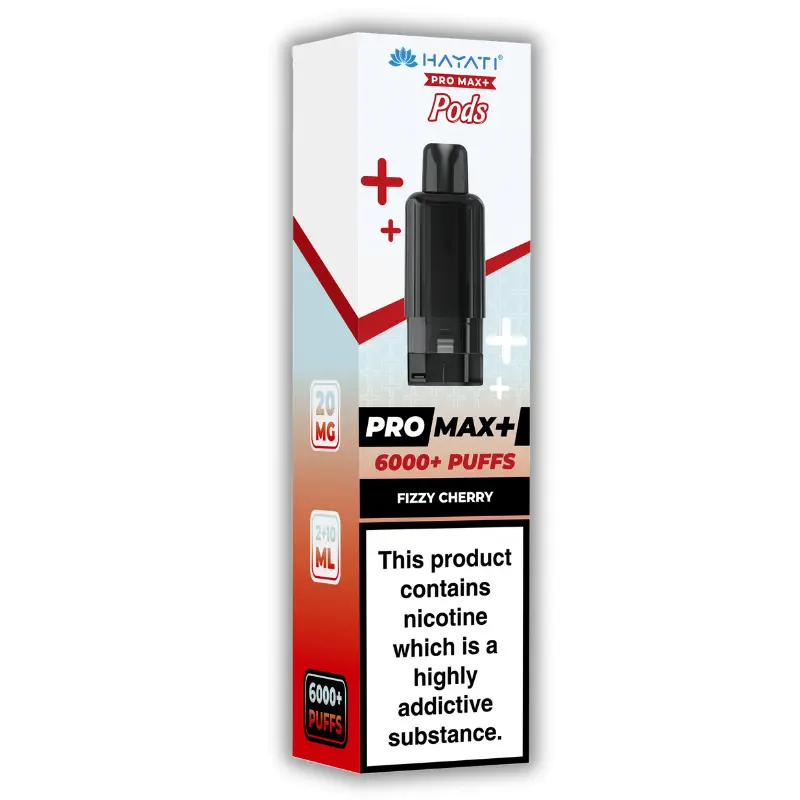
Hayati · Pro Max Plus
Fizzy Cherry Hayati Pro Max Plus Pods
£5.49
✔ In stock — ready to ship
Genuine Hayati
Free over £20
Same-day dispatch
Secure checkout
Fizzy Cherry Hayati Pro Max Plus Pods is a refill for a device you already own. Twelve millilitres of liquid at 20mg nicotine salt, £5.49, no body in the packet, and a coil built into the pod rather than sold separately. Hayati put a figure against a full pod of up to 6,000 puffs, rated by the manufacturer on test equipment drawing to a fixed schedule, which is a bench estimate for ranking one pod against another and not a description of anybody's fortnight. Check the range name printed on your device against the range name in this title before ordering.
Buying a bare pod means two decisions are already behind you. You own the hardware and you have settled on the flavour, so the material a first-encounter page spends itself on, whether the fruit is any good and whether the device is worth the money, has nothing left to tell you. The Fizzy Cherry Hayati Pro Max Plus Pod Kit at £7.99 exists for the reader who has not made those decisions. This listing is £2.50 cheaper because you made them already.
What remains is a narrower question and a more awkward one. Not whether to buy this pod, but when to stop using the one you have. On most liquids that question barely deserves a paragraph, because the answer is that you run it until it stops producing vapour and then you fit another. On this one the answer arrives earlier, it arrives in a form you can actually measure, and acting on it costs real money while leaving you holding something that is still perfectly drinkable. That combination is unusual enough to be worth the length, and it is what this page is about.
Two pages in this shop have already done the work this argument stands on and neither is rebuilt here. The Fizzy Cherry Rubik kit page established what the fizz in the name actually is, which is not a texture at all but a property of timing. The Blueberry B'Gum pods page established the mechanism by which a pod's flavour declines. Put those two findings next to each other and a consequence falls out that neither page had a reason to reach, because neither was writing about replacement.
You did not buy an ingredient. You bought a rate.
Start with the shelf, because the shelf makes the point faster than an argument does. There are 89 listings on the Hayati Pro Max Plus Pods shelf. Fifteen of the 89 carry a cooling word in the title, so their second term names a temperature. The great majority of the rest name fruits: Blackcurrant Mango, Strawberry Kiwi, Mango Peach Pineapple, three nouns or two, each one a thing that could in principle be weighed out.
A small group name something else. Four carry Sour, which names a magnitude on a single axis. Smooth and Juicy turn up twice and once, and both describe how a liquid sits rather than what happens to it. A handful borrow words from drinks branding, Crush and Punch and Twist, which describe nothing about the liquid at all. And exactly two titles on the shelf name an event, something that occurs quickly and then finishes: Pineapple Lemon Burst, and this one.
That is worth dwelling on because of what it implies about ownership. If you bought Blackcurrant Juice, the thing you paid for is a material. It can be present in larger or smaller amounts, and when a pod tires, what you notice is that there is less of it. If you bought this pod, the thing you paid for is a behaviour. The Rubik page worked out in detail what that behaviour is: with no coolant anywhere in this flavour, and with carbonation being flatly unavailable to any liquid in an aerosol, what produces the impression of fizz here is the shape of the flavour in time. A steep arrival, a short hold, a quick clearing. Same loudness as a heavy liquid, different envelope, and the envelope is what your mouth is reading as lively.
Six separate Hayati descriptions of this liquid were written by different hands, and the Rubik page lined all six up. Every one of them defined the sparkling element by what it prevents rather than by what it adds, and what all six said it prevents is heaviness and settling. Those are not textures and they are not tastes. They are statements about how long something stays in your mouth. The copy, without anybody apparently intending it, describes a duration.
So the object you own is a rate of arrival and departure. Now ask what happens to a rate.
Why the shape goes before the volume does
The Blueberry B'Gum pods page sets out the decline mechanism properly and there is no value in a second account of it, so here is only what this page needs. Sweetened liquid does not vaporise cleanly. A fraction of the sweetener bakes onto the wire and into the wick as an insulating residue, that residue slows heat transfer and slows feeding, and the components of the recipe are lost in a predictable order. The most volatile material goes first, because it is the most dependent on a clean coil running at temperature. The heavy material and the sweetness survive longest, partly because they are more robust and partly because the sweetener is itself the thing doing the damage.
Now overlay the Rubik page's finding. The liveliness in this liquid is carried by the fast-decaying top end. That is what a steep onset and a short decay mean at the level of materials: the notes that arrive quickly and leave quickly are the light, volatile ones, and the notes that hang about are the heavy ones. The fraction of this recipe that produces its defining property is, by definition, the same fraction that a residue-laden coil takes first.
The two findings therefore meet at a specific and slightly unexpected place. This pod does not fade. It flattens.
The distinction matters more than it sounds. A fading pod gets quieter, and the usual complaint about a tired pod is that the flavour has thinned out, that you are drawing harder for less. That is a loss of amplitude. What this liquid loses is not amplitude. The cherry is still there, the sweetness is still there, the nicotine is entirely unaffected because nicotine is not what residue removes. What goes is the timing: the arrival gets softer at the front and the finish stops clearing. You end up with the same quantity of the same fruit, delivered over a longer interval, which is the precise definition of the state the copy on all six listings promised you would not reach.
The Rubik page named that end state when it was arguing about sweetener load, and called it a rounder, slower cherry syrup. That page reached it hypothetically, as the thing a heavy sweetener dose would produce from day one. The point here is that a light dose gets there too, just later, and the coil takes it there rather than the recipe.
The signal, and why it can be counted
Here is the practical consequence, and it is the reason this page exists rather than a general note about tired pods.
The B'Gum page identified a real problem with noticing decline: your palate tracks a slow change downwards and recalibrates as it goes, so a pod can lose most of what you bought it for while you carry on drawing and register nothing. That is a correct account of intensity, and it is correct because an intensity judgment has no external reference. Ask yourself how sweet this pod is today compared with a fortnight ago and you are comparing a present sensation with a memory of a sensation, which is the least reliable comparison a person can make. There is no unit and there is no yardstick.
A duration is different, because a clock is outside your mouth.
The measurement takes about fifteen seconds and it goes like this. Take one draw at your usual length, exhale, and then start counting from the moment the vapour has left. What you are timing is how long it takes for your mouth to read as clear rather than sweet. Do not try to rate the sweetness. Just note the number at which the sensation stops. On a fresh pod of this liquid the clearing is quick, which is the whole design and what six independent writers were pointing at. On a flattened one the sweetness is still sitting there when you reach a count the fresh pod never reached.
That is a threshold crossing measured against an external clock, and it is far more robust than a magnitude estimate. Adaptation shifts what a given intensity feels like. It does not shift the second hand. If a fresh pod clears at three and the pod in your hand is still sweet at eight, the change is not a matter of opinion and no amount of palate drift explains it away.
I want to narrow that claim rather than oversell it, because a threshold judgment is not perfectly immune to drift either. Deciding when your mouth reads as clear is still a judgment, and it moves with hydration, with what you last ate or drank, with the temperature of the room and with how much you have been drawing in the previous hour. Coffee in particular will wreck the reading. So the measurement is reliable as a comparison and unreliable as an absolute, which means the protocol matters: take it at roughly the same time of day, with a mouth that has had nothing in it for a few minutes, at the same draw length. Under those conditions it is a genuinely usable instrument. Under any other conditions it is a guess with a number attached to it, which is worse than no number.
One more thing the protocol requires, and it is the part people get wrong. You need the baseline, and the only time you can take the baseline is on the first day of a pod, which is exactly when you have no reason to think you will need it. So the instruction is not "measure the pod when you suspect it has gone". It is "measure the pod on the day it arrives, write the number down somewhere, and forget about it". Two numbers a fortnight apart is an argument. One number is an anecdote.
The Rubik page proposed a version of this count for an entirely different purpose, as a way of working out on a fresh pod whether the sweetener load is high or low by attending to what is left four or five seconds after the vapour has gone. Same gesture, different question. That page was asking what the recipe is. This page is asking what the coil has done to it since, which needs the same reading taken twice.
How early the signal lands, tested rather than asserted
The claim I was working towards here was that this pod announces its decline unusually early. Having set it against the corpus properly, that is too strong in one direction and not strong enough in another, so here is the version that survives.
It is not unusually early in clock time. Whether a coil crusts fast or slowly is governed by sweetener load, and the sweetener load in this liquid is not published, here or on any of the other five listings of it, or anywhere in the range. The B'Gum page makes a good case that confectionery-register liquids run the decline curve faster than the shelf average because they carry more sweetener, which would put something like Berry Lemonade or a bubblegum profile ahead of this one rather than behind it. I have no basis for ranking this pod against those and will not invent one.
What is true, and what the original claim was reaching for, is a different thing. The proportion of the recipe that has to be lost before the pod stops being the product named on the label is smaller here than on a pod named for a fruit. A blackcurrant pod can shed a good deal of its top end and still be recognisably blackcurrant, because the identity of a fruit lives partly in materials that residue does not touch first. This pod's identity lives entirely in the fraction that goes first. So the signal is early relative to the pod's own liquid, not early relative to the calendar, and the practical upshot is the one that matters: when you notice, there is more left in the pod than there would be on a rounder flavour.
How much more is not knowable precisely and I would not trust anyone who told you otherwise. A reasonable band, from the mechanism rather than from measurement, is somewhere between a quarter and a half of the pod still unused. That sets up the expensive part.
What is left when the shape has gone, and where it lands on the shelf
A pod that has flattened is not a spent pod in the ordinary sense. It is not burnt, it is not thin, and it is not producing the scorched-sugar note that a genuinely finished coil produces at the very end. It is a sweet cherry with a slow finish. Somebody handed that pod without being told its history would describe it as a perfectly serviceable cherry liquid, which is exactly why the decision is awkward. You are being asked to throw away something that works.
The version of this argument I was given said that what you are left with is close to something the shop already sells three rows along, and named Cherry Cola. Ten of the 89 listings on this shelf have cherry in the title, this one among them, so the neighbours are certainly there. But the specific identification does not survive a look at what those ten listings actually say, and the correction is more useful than the original, so here it is set out in full.
Read the flavour paragraph of each of the ten and one pattern runs through nine of them. Cherry is the depth. It is the thing underneath that supplies body and darkness, and something else on top supplies the lift. Cherry Sour Raspberry leads with the tang and puts cherry underneath it for depth. Strawberry Cherry Cranberry uses the verb outright: strawberry sweetens, cherry deepens, cranberry sharpens. Blueberry Cherry Cranberry does the same, with cherry adding depth between a soft blueberry and a dry cranberry finish. Blue Razz Cherry puts cherry underneath the candied blue raspberry as body. Blueberry Raspberry Cherry and Strawberry Raspberry Cherry both use it for the dark end of a red-fruit stack. Cherry Peach Lemon gives cherry the rich sweetness and hands the lift to the lemon. Cherry Berry has cherry leading with deep, dark sweetness and a mix of berries supplying the brighter, tangier notes. And this pod does the same thing with a texture word standing in for the second fruit.
Nine out of ten, then, and the exception runs the other way. Cherry Cola is the only listing among the ten where cherry is not the base. There the cola is the base, dark and caramel-sweet, and the cherry is the brightness laid over it. Hayati's own copy is explicit that the cherry is what makes the cola taste fuller.
Which means Cherry Cola is the wrong destination for this argument, and in fact it is the furthest of the ten from where a flattened Fizzy Cherry ends up. The two products are not converging, they are moving apart. A cola accord is built out of caramel, vanilla and warm spice, and those are heavy, durable materials that residue does not remove early. Cherry Cola keeps being cherry cola for a long time, because nothing about its identity depends on a fast envelope. This pod stops being what it was the moment the envelope goes. Two liquids whose defining materials sit at opposite ends of the volatility range cannot end up in the same place.
The honest nearest neighbour is Cherry Berry, and it is the only other listing on this shelf where cherry both leads and supplies the depth while something else provides the lift. A flattened Fizzy Cherry is approximately Cherry Berry with the berries taken out. That is the most accurate description I can give of the end state, and notice what it actually says: what you are left with is not a product anyone sells. It is a product minus the part that made it a product. Nobody has ever put a pod on this shelf that is a deep sweet cherry and nothing else, which tells you something about whether it would be worth buying.
There is a second-order point in that comparison worth having. Cherry Berry's own listing claims it stays enjoyable right through the pod rather than wearing thin, and credits the berry tang for it. Whether or not that is true, the structural reason it could be true is that a berry note is a material and not an envelope. Materials thin out gradually and stay recognisable while they do. An envelope does not thin out, it collapses. So the two pods behave differently over their lives even though they start in similar territory, and if what you want is a cherry that degrades gracefully rather than one that degrades interestingly, the berry build is the one with the structural argument behind it.
Worth noting for completeness that the cherry family is much larger than these ten. There are 72 listings on the Cherry Vapes shelf and 62 titles across the catalogue with cherry in them, spread over every format Hayati sell, so the ten above are only the ones that share this pod's hardware.
What acting on the signal costs, and what not acting on it costs
The arithmetic on discarding a part-used Pro Max Plus pod has already been worked through on the Ice Pop pods page, which is the other listing in this batch taking a replacement-cadence line, and its figures apply here unchanged because the price and the volume are identical. Twelve millilitres at £5.49 is 45.75p per millilitre. Three millilitres discarded is £1.37. The working is on that page and I am not going to reproduce it.
What is different here is where the decision point sits, and that changes the size of the number rather than the method. That page is reasoning about a liquid whose signal is a reversal in the order two sensations arrive, which is a late signal because it needs one component to have degraded past another. This page is reasoning about a signal that fires when the fastest fraction thins, which is the first thing to happen to anything. So the relevant band is not two or three millilitres. On the reasoning above it is somewhere between three and six.
Laid out plainly, at 45.75p per millilitre: £1.37 to walk away from three millilitres, £1.83 from four, £2.29 from five, £2.75 from six. The top of that range is half the price of the pod. A buyer who acts decisively on every pod is therefore running at somewhere between £6.86 and £8.24 per replacement cycle rather than £5.49, which is a real difference over a year and not a rounding error.
Against which, the cost of not acting. That one is genuinely unknown and I am not going to pretend otherwise. It is some number of further draws of a liquid you did not choose, spread over some number of days, at no additional cash cost. Whether that is a bad deal depends entirely on how much the thing you did choose was worth to you, and nobody writing a product page has access to that number.
So the trade is priced and not decided. Three readings of it are all defensible.
- If you bought this for the cherry. Plenty of people buy a flavour for its fruit and treat the descriptor as packaging. On that reading the flattening costs you very little, the remaining liquid is a cherry pod and still doing its job, and paying £2.29 to avoid it would be paying for a property you were never attending to. Run it out.
- If you bought this for the fizz. Then the signal is the end of the product. What is in your hand after it fires is not a diminished version of what you bought, it is a different liquid that happens to share a fruit with it, and continuing is buying nothing. The £1.83 is the price of not spending a week on a pod you would not have chosen off the shelf.
- If you do not know which of those you are. Most people do not, and the measurement above is how you find out. Take the reading when the pod is new, take it again when you think something has changed, and then carry on using the pod for three more days on purpose. If those three days are fine, you are the first reader. If they are irritating, you are the second, and you now know that for every pod after this one.
There is one thing that makes the decision harder than it needs to be, and it is a gap in the published information rather than anything about the liquid. You cannot see how much is left. No Hayati listing in the entire catalogue of 492 describes a visible liquid level on a pod, on this range or any other, so nothing on the record supports estimating the remaining volume by eye. Which means the only instrument you have for judging how much you are about to throw away is how long you have been using it, and the only instrument you have for judging whether to throw it away is the taste, which is the thing that has changed. The two measurements you need are on different scales and neither one calibrates the other.
The practical workaround is unglamorous and it works: note the date you fit the pod. A count of days is not a volume, but across two or three pods it converges on one, and it is the only handle available.
The second pod is where this becomes a cadence rather than a decision
Everything above describes a judgment made once, and made badly, because the first pod of any flavour is the one where you have no reference for anything. The argument only becomes useful on the second.
Here is what changes. On pod one you are measuring a liquid you have never measured before, so the fresh reading and the tired reading both arrive as surprises and you have no idea which part of the interval between them was the good part. On pod two you already hold a number for what fresh looks like on this specific liquid, you already know roughly how many days elapsed before the reading moved, and you know from experience how the three-extra-days test went. That converts a taste judgment into a date, and a date is the thing you can actually organise around.
A date lets you order in advance instead of reacting, which removes the worst outcome available here. The bad case is not discarding liquid early and it is not running a flat pod. It is running a flat pod for a fortnight because the replacement had not arrived, which combines the cost of the wasted interval with none of the saving.
Two honest limits on that. The first is that the date cannot be looked up, only measured, because the variable that sets it is sweetener load and nobody publishes it. Your pod and a pod from another batch could plausibly differ. The second is more interesting and it cuts against ordering too far ahead, which is covered in the handling section below: a spare that has been sitting in a warm room is not the same pod as a fresh one, and it degrades along precisely the axis this liquid is built on. Ordering early buys you continuity and costs you a little of the thing you were trying to protect. One spare is sensible. A drawer of them is self-defeating on this particular flavour in a way it would not be on a heavier one.
The other thing pod two gives you is an answer to a question pod one cannot even pose, which is whether you still want this flavour. A single-fruit pod at twelve millilitres is a long uninterrupted run at one profile, and a buyer who has been through three of them knows something about their own tolerance for it that no description could have told them. If the answer turns out to be no, the shelf is right there and the nearest exits are all at the same price: Cherry Berry for the same fruit with variety in it, Cherry Sour Raspberry for more acid and less subtlety about it, Cherry Cola if what you actually liked was the drink register rather than the fruit.
The figures, ordered by how much they bear on the decision
The table below is arranged around the argument on this page rather than in the order a spec sheet would print. The rows that decide when you replace the pod come first, the commercial rows come next, and the blanks come last, because on this liquid two of the blanks would tell you more than most of the numbers.
| What sets the replacement date | Sweetener load, which governs how fast residue builds on the coil. Not published for this pod or anywhere in the range |
| What is lost first | The fast-arriving, fast-clearing fraction, which is the fraction carrying this liquid's defining property |
| What survives longest | The cherry itself, the sweetness and the nicotine, which residue does not remove early |
| Signal to watch | How many seconds after the exhale the mouth reads as clear, measured against a baseline taken when the pod was new |
| Liquid supplied | 12ml, factory filled, one pod |
| Cost of one millilitre | 45.75p at this listing's price |
| Price | £5.49, pod only |
| Nicotine | 20mg per ml, nicotine salt, which is the UK ceiling for this format and identical across the shelf |
| Manufacturer puff figure | Rated by the manufacturer at up to 6,000 puffs for a full pod, a laboratory estimate rather than a forecast |
| Cooling | None named, on this listing or on any of the other five listings of this liquid |
| Coil | Built into the pod and not replaceable. Resistance is not published anywhere in this range |
| Reading the level | No route published. No Hayati listing in 492 describes a visible liquid level |
| Device | Not supplied. The kit version is the same pod plus a device, for £2.50 more |
Two of those rows carry most of the weight and they are both blanks. Sweetener load is the figure that would let you predict the replacement date instead of measuring it, and coil resistance is the figure that would let you predict how hot the liquid runs, which governs how fast residue accumulates in the first place. Neither is published and neither is going to be. Everything practical on this page is a workaround for their absence.
The 20mg is worth a word because it is a ceiling rather than a choice, so it carries no information about this flavour as against the one beside it. If a different strength is what you are after, the range is sold unflavoured at three other strengths as Hayati Pro Max Plus Prefilled Pods 10mg, at 5mg, and at zero, and a lower strength changes the arithmetic on this page slightly: less nicotine means more draws to arrive at the same place, which means more work done on the coil over a pod's life.
The puff figure is last among the numbers on purpose. A bench rating describes a machine drawing to a schedule on a fresh coil, and the entire subject of this page is what a coil stops doing after a few days of real use. The two things are not measuring each other.
Where it sits against the neighbours
Two different comparisons are worth making and they answer different questions. One is about the fruit, for a reader who has settled on cherry. The other is about durability, for a reader who has been persuaded by the argument above and now wants to know which pods on this shelf are less exposed to it.
Among the cherries on this hardware
The ten cherry listings were classified above and the classification is the useful thing, so this is only what it implies for buying. Eight of the ten use cherry as the dark floor under something louder, which means the cherry is not the first thing you taste and is not what you would be choosing them for. Strawberry Raspberry Cherry and Blueberry Raspberry Cherry are red-fruit and dark-fruit stacks respectively, with cherry doing structural work at the bottom. Blueberry Cherry Cranberry and Strawberry Cherry Cranberry both put a cranberry snap on the end, which is the driest finish available in the group. Buying any of those four expecting a cherry pod is the common misread on this shelf.
Two are properly cherry-led and they are the direct comparisons: Cherry Berry, discussed at length above, and this one. Cherry Peach Lemon sits between the two groups, with cherry named first and given the sweetness, but with two other fruits each doing declared work.
The same cherry runs across other hardware if you want it in a different format. Blue Razz Cherry Hayati Rubik Pods at £3.99 and Blue Razz Cherry Hayati Mini Ultra Pods at £3.49 are the cheaper platforms, Blue Razz Cherry Hayati Pro Ultra Plus Pods is the same blend on a much larger pod, and Cherry Berry Hayati Mini Ultra Pods is the smallest way to try the nearest neighbour to this liquid before committing twelve millilitres to it. There is also a divided listing, Blueberry Raspberry / Blueberry Raspberry Cherry, which keeps two related blends in one pod and selects between them with a rotating mouthpiece. Its own page handles what that arrangement is for.
One curiosity for anyone browsing the cherry tag rather than the fruit: Sakura Grape is filed with the cherries because sakura is cherry blossom, which is a flower and not a stone fruit, so it will not taste of anything discussed on this page.
Among the pods less exposed to this problem
If the argument above has put you off, the question becomes which flavours on this shelf carry their identity in something more durable than a fast top end. Two kinds qualify.
Cooled pods are the obvious group, because a coolant is a physical event on the surfaces of the mouth rather than an aroma, and it is markedly more robust than a volatile top note. The Cola Ice pods page established that a coolant is the only component in a liquid producing a sensation you feel rather than smell, and the Ice Pop page built its whole argument on the coolant outlasting the fruit beside it. Blue Frozen and Banana Ice are two of the fifteen cooled listings here, and both will still be telling you something on the day this pod has stopped.
The other group is the heavy and dark, where the identity sits in materials that residue does not take early. Blackcurrant Mango and Blackberry Raspberry are built on deep fruit rather than on lift, and Cola Lime has an actual cola accord under the citrus, which is the same durability point made about Cherry Cola further up. None of those is a better pod than this one. They are pods with a flatter decline curve, which is a different property and only worth paying for if the decline is what bothers you.
Two more sit in the middle and are worth a line each. Blue Razz Lemonade is the other drink-adjacent build on this shelf that leans on brightness, so it faces a version of the same problem. Galaxy Aura is named for a mood rather than an ingredient, and its own page works through what that does and does not tell you, which is a different kind of uncertainty from the one on this page. The full range across every format is on the all Hayati products listing, and every refill in stock sits on the Hayati Prefilled Pods & Refills shelf.
Handling, with one item that matters more than the rest
Most of the standard advice applies here in the standard way and does not need padding out. The pod arrives filled and closed, so there is nothing to prime. Leaving it upright for an hour after it has been through the post lets liquid that has shifted in transit settle back against the wick, which is worth doing on any prefilled pod and is not specific to this one.
Draw length is a real variable on this liquid and it is worth knowing which way it pushes. A longer, slower draw puts more liquid through the coil per pull and gives the heavy end more of the mouth. A shorter one weights things towards the front of the profile. If the pod reads as syrupy in its first day, try shortening before concluding the recipe is wrong, and if it reads as thin, lengthen. Once the flattening has started, neither direction recovers the envelope, because draw length changes the balance between what is there and does not put back what the coil has stopped rendering.
Chain-drawing is worse here than the shelf average, for a mechanical reason rather than a general one. A coil that has not had time to re-wet runs hotter and dry-spots, and every dry spot on a sweetened liquid deposits a fresh patch of residue that never comes off. Since residue takes the fast fraction first, and the fast fraction is what you paid for, drawing hard on this pod is a direct trade of the property you bought against a slightly quicker nicotine delivery. Fifteen or twenty seconds between pulls is cheap by comparison.
Storage is the item that deserves more than a line, and it is the one that cuts against ordering spares in bulk. The material producing a steep arrival is by definition the most volatile material in the liquid, which makes it the first thing lost through an imperfect seal and the most affected by a warm room going through daily temperature cycles. The Rubik kit page makes this point and states the consequence precisely: a pod that has spent a summer somewhere warm will not taste wrong, it will taste slower. Slower is the one failure this recipe exists to avoid.
Which produces a genuine tension with the cadence argument above, and it should be stated rather than smoothed over. Ordering ahead protects you from running a flat pod while you wait for a replacement. Ordering far ahead means the replacement arrives already a little way down the same curve, so the pod you fit is not the pod you measured your baseline against. On a heavy fruit or a cooled pod this would barely matter. On this one it matters, because the stored pod loses exactly the fraction the argument is about. Somewhere dark and cool at room temperature, one spare rather than six, and use them in the order you bought them.
When a pod is finished, it is finished as a unit. There is no route published for topping it up and no way to get at the coil, so the liquid and the coil reach the end together and the whole assembly is replaced. That also means the flattening problem cannot be solved by cleaning anything: the residue is on a part you cannot reach, inside a part you cannot open.
A spent pod still has a coil in it and, if you have retired it early on the reasoning above, several millilitres of liquid too, which puts it outside the household bin. Vape hardware falls under the UK electrical waste rules, so it belongs at a shop that takes vape returns or at a council recycling point, and a part-used one wants keeping upright and bagged until you get there. Anything with nicotine in it should be kept where children and pets cannot reach it.
Questions a repeat buyer actually asks
How do I know this pod is finished if it still tastes strong?
Strength is the wrong thing to watch on this liquid. What goes first is the timing, not the volume, so a tiring pod delivers the same amount of cherry over a longer interval rather than less of it. The measurement is how many seconds after the exhale your mouth reads as clear, compared against a reading you took when the pod was new.
Why would the shape go before the strength does?
Sweetened liquid leaves residue on the coil, and the most volatile materials in a recipe are the first casualties because they are the most dependent on a clean coil at temperature. The Blueberry B'Gum pods page sets that mechanism out in full. On this liquid the fast, volatile fraction is the same fraction that produces the effect the name is describing, so the defining property and the most fragile property are the same thing.
What does it cost to bin a pod that still has liquid in it?
45.75p per millilitre, so £1.37 for three millilitres, £1.83 for four and £2.75 for six. The Ice Pop pods page works the per-millilitre arithmetic through in detail. What differs here is where the decision lands: this signal fires earlier in a pod's life than a signal based on one component outlasting another, so the sum in play is larger.
Can I see how much is left?
Nothing on the record supports it. No Hayati listing in the whole catalogue of 492 describes a visible liquid level on any pod in any range, so treat any estimate of the remaining volume as a guess. Noting the date you fitted the pod is the only practical handle, and it becomes useful from the second pod onwards.
Is a flattened pod actually unpleasant?
No, and that is what makes the decision awkward rather than obvious. It is not burnt and it is not thin. It is a sweet cherry with a slow finish, which plenty of people would be happy with if they had bought it deliberately. The question is not whether it is drinkable but whether it is what you paid for.
Does it turn into Cherry Cola at the end?
No, and that is worth correcting because it sounds plausible. A cola accord is built from caramel, vanilla and warm spice, which are heavy, durable materials that residue removes late. Cherry Cola keeps its identity for a long time precisely because nothing in it depends on a fast finish. The nearest thing on this shelf to a flattened Fizzy Cherry is Cherry Berry with the berries removed, which is not a product anybody sells.
Should I buy the kit instead?
Only if you do not already own a Pro Max Plus. The Fizzy Cherry Hayati Pro Max Plus Pod Kit is £7.99 and this is £5.49, so the device costs £2.50 and you pay it once. Since the retirement question recurs on every pod and the hardware does not, the £2.50 has no bearing on any decision discussed here.
Does a spare in the drawer age the same way?
Along the same axis, yes, though through evaporation and heat cycling rather than through a coil. The volatile fraction is the most vulnerable to both. The consequence for this flavour specifically is that a long-stored spare starts its life slightly flatter than a fresh one, so buying a stack of them undercuts the thing you were trying to protect.
Is there any cooling in this one?
None is named on this listing, and none on any of the other five listings of the same liquid. Hayati are consistent about putting a cooling word in a title when a coolant is present, and this title has none. That absence is relevant to the argument on this page, because a coolant is the most durable sensation a liquid can carry and this one has nothing of the sort behind the fruit.
Will the second pod behave like the first?
Probably close enough to plan around, though the variable that governs it, sweetener load, is not published and could vary between batches. The point of the second pod is that you arrive at it holding a baseline number and an approximate date, which converts the whole question from a taste judgment into a diary entry.
Is this a daily flavour or a rotation one?
The one thing all six descriptions of this liquid agree on is that the treatment exists to keep the sweetness from accumulating, which is an argument for daily use. Against that, twelve millilitres of a single fruit is a long uninterrupted run with no way to change direction partway, and a second pod in rotation means each one spends longer in storage, where this particular recipe is vulnerable. A mint or a cooled pod alongside costs less on that axis than a second fruit would.
What is in the packet, and can I refill it?
One prefilled pod holding 12ml at 20mg nicotine salt, and nothing else. No device, no charger, no spare. There is no published route for refilling it and no access to the coil, so the pod is replaced rather than serviced.
The short version
Fizzy Cherry Hayati Pro Max Plus Pods is £5.49 for twelve millilitres of sweet cherry at 20mg nicotine salt, no device, rated by the manufacturer at up to 6,000 puffs as a bench estimate. The flavour argument for this liquid belongs to the Fizzy Cherry Rubik kit page, which established that the sparkle in the name is a matter of timing rather than texture: a steep arrival and a quick clearing, not anything you feel.
The consequence for a repeat buyer is the subject here. A tiring coil takes the fastest materials first, so this pod flattens rather than fades, losing its shape while keeping its strength. That gives you a signal you can actually count, which is how long the sweetness sits in your mouth after the exhale, and it fires with a good deal of liquid still in the pod. Acting on it means writing off between £1.37 and £2.75. Not acting means an unknown stretch of a cherry you did not pick, since what is left is not Cherry Cola, as I was told, but something closer to Cherry Berry with the berries taken out, which nobody sells because nobody would buy it.
Which of those two costs is worse is not something a product page can decide for you. What it can do is give you the number, tell you how to take the reading, and point out that the reading is only worth anything if you take it on the first day, when you have no reason to think you will need it.
Strictly for adults aged 18 and over. Nicotine is an addictive substance.
You might also like


