
Home / Hayati Pro Max Plus Pods / Cherry Peach Lemon Hayati Pro Max Plus Pods
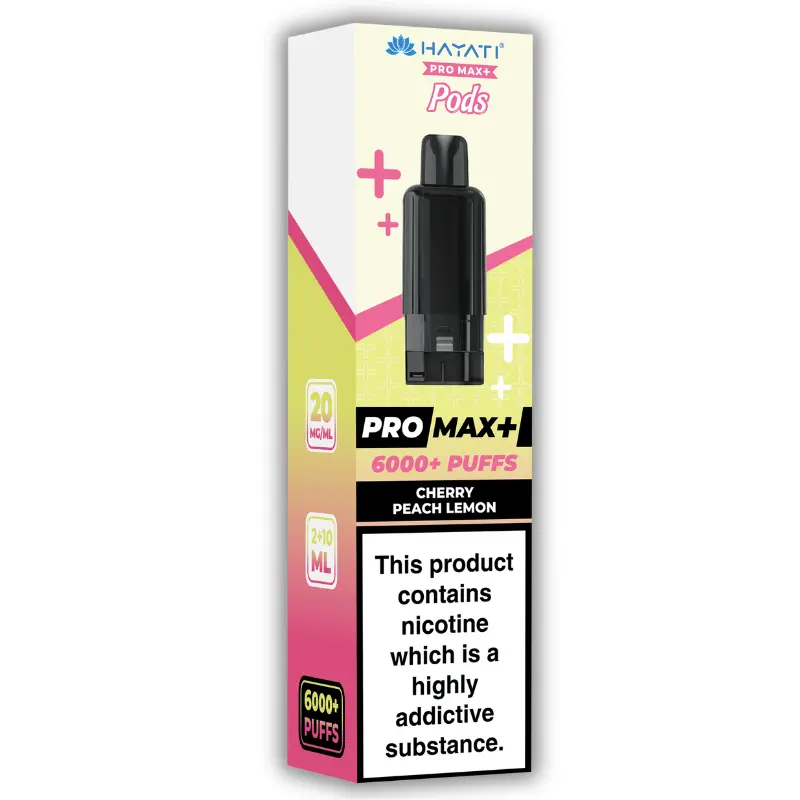
Hayati · Pro Max Plus
Cherry Peach Lemon Hayati Pro Max Plus Pods
£5.49
✔ In stock — ready to ship
Genuine Hayati
Free over £20
Same-day dispatch
Secure checkout
Five pounds forty-nine buys one sealed pod and nothing besides. Inside it sits 12ml of liquid at 20mg in salt form, filled and closed at the factory, with a mesh coil enclosed alongside it and no route in to either. A Hayati Pro Max Plus body is assumed to be in your pocket already, because this pack contains no hardware and will not get you anywhere on its own. The figure Hayati attach to a full pod tops out at 6,000 puffs, which is a laboratory estimate taken off bench equipment drawing to a timer, and it is worth roughly what any such estimate is worth when you are trying to plan a fortnight.
That specification is shared, more or less exactly, with the eighty-eight other listings on the same shelf, so it cannot be the reason to read any further. The reason to read further is a claim attached to this particular blend, which I was handed and then went and checked.
Two pages on this site have already taken a three-fruit blend apart and come back with bad news for the count. The Pro Ultra Plus Orange Lemon & Lime page worked out that three citrus fruits cannot separate into three voices, because they share one principal acid and a peel-oil base built on the same dominant terpene, so what you get is one citrus with three regions of itself reinforced. The Guava Kiwi Passion Fruit pods page came at it from the buyer's side and concluded that a three-part blend cannot be unbundled at all: the ratio is sealed, the parts are not separately purchasable, and a preference for one third of a recipe has nowhere to spend itself.
Cherry Peach Lemon arrives with a reputation for being the one that escapes both findings, on the grounds that its three fruits come from genuinely different corners of the plant kingdom rather than from one family. A stone fruit, a red drupe and a citrus, three different acids, three different aroma classes, three different positions in a draw. It sounds right. It is the sort of thing that sounds right.
It is also wrong at the first check, and the way in which it is wrong turns out to be more interesting than the claim would have been if it had held. What follows spends its length on that, because the correction produces a better reason to buy this pod than the original argument did, and a clearer picture of how it is most likely to disappoint you.
Three names, two genera: counting the claim before building on it
The shelf this pod sits on holds eighty-nine listings. Eight of them name three separate fruits in the title. Here they are, with the number of botanical families each one spans:
- Guava Kiwi Passion Fruit: three families. Myrtaceae, Actinidiaceae, Passifloraceae.
- Mango Peach Pineapple: three families. Anacardiaceae, Rosaceae, Bromeliaceae.
- Cherry Peach Lemon: two families. Rosaceae and Rutaceae.
- Blueberry Raspberry Cherry: two families. Rosaceae and Ericaceae.
- Blueberry Cherry Cranberry: two families.
- Strawberry Cherry Cranberry: two families.
- Strawberry Raspberry Blueberry: two families.
- Strawberry Raspberry Cherry: one family. All three are Rosaceae.
Read that list and the assigned premise falls over twice. This blend is not the family-diverse outlier of the eight; it is joint third, tied with four others, spanning two families. And the listing held up as the failure case, Guava Kiwi Passion Fruit, has strictly more taxonomic spread than this one does. So does Mango Peach Pineapple. If family distance were the mechanism by which a three-fruit blend separates into three audible parts, the tropical trio would be the success story and this would be the also-ran, and the page that examined the tropical trio found precisely the opposite.
Go one rank finer and it gets worse before it gets better. Cherry and peach are not merely in the same family. They are in the same genus. Sweet cherry is Prunus avium and peach is Prunus persica, which makes them closer relatives than lemon and lime are, since those two at least belong to different species within a genus that has been hybridised past easy description. Cherry and peach are also the same kind of fruit in the structural sense, single-seeded drupes with a hard stone in the middle, and they ripen on trees that a botanist would have to look twice at to tell apart in winter.
Of the eight three-fruit listings on this shelf, two contain a repeated genus. One is Blueberry Cherry Cranberry, where blueberry and cranberry are both Vaccinium. The other is this one. So the blend sold to me as the family-diverse exception is, on a count, one of the two least diverse constructions on the shelf at the level that actually matters for chemistry.
That is the correction, and it needs stating before anything else because the whole of the rest of the page depends on it. Family is not the variable. Taxonomy is a record of ancestry, not of flavour chemistry, and two fruits can share a genus and taste nothing alike while two fruits from opposite ends of the plant kingdom can converge on the same handful of aroma compounds. The citrus trio did not fail because the three fruits were relatives. It failed because they shared one acid and one terpene base, which happens to be a consequence of their relatedness but is not the same fact. Guava and passion fruit do not overlap because they are cousins. They are not cousins. They overlap because both route a large part of their character through sulphur-bearing compounds, an accident of biosynthesis rather than of descent.
So the useful question is not how far apart these three fruits sit on a family tree. It is whether they are carrying their identities in the same chemical currency. That question has a different and much more encouraging answer, and it is worth working through properly rather than asserting.
What actually keeps two fruits apart in a blend
Two things have to be true for a named fruit in a mixture to remain identifiable. Both are testable in principle, though neither is published for this liquid, so everything in this section is inference from what these fruits are generally built from, and I will say so again where it matters most.
Test one: do they share a principal acid?
The sourness channel is settled work on this site and I am not going to rebuild it. The Cherry Sour Raspberry pods page establishes that acidity is registered as a magnitude rather than an identity: your tongue reports how sharp something is, not which acid did the sharpening, and three separate acid sources therefore produce one louder sourness rather than three distinguishable ones. The Orange Lemon & Lime page pushed that further, to one acid arriving from three directions.
Apply it here. Sweet cherry is a malic-acid fruit, with malic well ahead of anything else present. Peach is also malic-led, with citric present in a secondary role and the ratio between them varying considerably by cultivar and ripeness. Lemon is citric to an almost comical degree, and at a concentration neither soft fruit approaches.
So two of the three share a principal acid, and the third brings a different one at a volume that swamps both. On the acid channel this is not a three-source blend. It is functionally a one-source blend with a soft malic background nobody will pick out from underneath, which means the sourness of this pod is a single number set at the factory, exactly as it was on the citrus trio, and exactly as unmodulated across a draw. Anyone who reads three fruit names and expects the sharpness to arrive in stages is going to be disappointed for the same structural reason twice over.
That is one test failed, and it is the test that the assigned angle claimed this blend would pass. Different principal acids was supposed to be the first pillar. It is not there. Two of three share one, and the third is loud enough to render the question academic.
Test two: do their signatures sit in the same aroma class?
Here the picture changes completely, and this is where the blend earns whatever it earns.
No fruit was squeezed into this pod, and the practical consequence is that what a vape liquid means by cherry, peach or lemon is whichever set of aroma chemicals the industry reaches for when it wants that impression. Those defaults are stable, widely used and genuinely different from one another, which makes them a better basis for reasoning than the composition of an actual fruit would be.
Lemon in a liquid is carried by the peel fraction rather than the juice: a limonene-dominated base with citral, the combined geranial and neral, doing the identifying work on top of it. These are small, light, fast-moving molecules. They arrive first and they leave first.
Cherry is carried, overwhelmingly, by benzaldehyde. It is an aromatic aldehyde, mid-weight, and it is the single most recognisable note in the confectionery register of red fruit. The Cherry Sour Raspberry pages note in passing how exposed a cherry recipe is because of it, and I will come back to that rather than repeat it.
Peach is carried by lactones, principally gamma-decalactone and delta-decalactone, and the White Peach Raspberry pods page sets out at length why the industry treats that family as the peach note regardless of which peach is being targeted. Lactones are heavier than either of the other two signatures, slower to volatilise, and they persist on the palate after the vapour itself has gone.
Three different chemical classes, then: a terpene-and-terpenoid-aldehyde top, an aromatic aldehyde middle, a lactone base. That is a real separation and it is the one the assigned angle was groping towards without naming. It has nothing to do with family. Peach and cherry are congeners and their working signatures come from entirely different cupboards. Guava and passion fruit are not remotely related and their signatures overlap badly. Chemistry is not obliged to respect ancestry, and in this range it repeatedly does not.
The congener problem does bite, and here is where
One honest qualification, because the separation is not as clean as the previous paragraph implies. Peach and cherry do share a compound, and it is benzaldehyde. The stone of a peach and the stone of a cherry both carry amygdalin, which breaks down to benzaldehyde, and the almond-adjacent note that gives cherry its identity is available in the peach kernel too. A formulator building a stone-fruit blend has a benzaldehyde dial that serves both fruits at once, and the economical construction of a cherry-and-peach liquid is to build one stone-fruit body with a benzaldehyde spine and then decorate it, rather than to construct two separate profiles and combine them.
If that is what happened here, and I have no way to know whether it did, then the cherry and peach in this pod are not two voices. They are one stone-fruit voice with a lactone tail, and the pod contains two things rather than three. This is the same failure the citrus trio suffered, arriving from a different direction and at a different point in the structure.
Which leaves the honest summary of the chemistry: this blend passes the aroma-class test on two of its three pairs and is at genuine risk on the third. Lemon against cherry is a wide gap. Lemon against peach is a wide gap. Cherry against peach is the narrow one, and it is narrow for exactly the reason the family count exposed. The assigned angle had the right conclusion about separability and the wrong reason for it, and it identified the wrong pair as the safe one.
The draw, front to back
What follows is a reasoned expectation rather than a transcript, built from the compound classes above and from what a restricted mouth-to-lung draw does to them. Hayati publish a flavour name, a volume, a strength and a puff figure. They do not publish proportions, and no page should pretend otherwise.
The opening belongs to lemon, whatever the label order suggests
The listing puts cherry first and describes the blend as running from rich to soft to sharp. I do not think that is the order you will meet, and the reason is physical rather than a matter of taste. Citric acid is non-volatile and rides into the aerosol in the liquid fraction, landing on the sides of the tongue immediately. Citral and limonene are the lightest aromatic material in the recipe and they come off the coil first. Sharpness therefore arrives at the front of the draw, not at the back of it, because nothing else in the pod can get there before it.
So expect the first thing to reach you to be brightness and acid together, with very little delay between them. It is an abrupt opening by the standards of a berry pod, where sweetness usually gets there ahead of everything and the sharpness follows. Whether you read that as lively or as thin depends largely on how heavily the lemon has been dosed, which is the question the whole back half of this page turns on.
The middle belongs to cherry, and the question is which cherry
Benzaldehyde is heavier than citral and lighter than a lactone, so it occupies the middle of the draw by default. It is also the loudest single identity in the pod: nothing else in the recipe announces itself as clearly or as quickly, and a person who has never thought about what a cherry note is made of will still name it without hesitation the moment it arrives.
The listing describes cherry here as deep and rich rather than tart, which points at the dark end of the register, closer to a preserved or syruped black cherry than to a fresh sour one. That reading is consistent with the absence of any sour marker in the title, and it is the more common construction in this range in any case. Of the cherry listings Hayati sell, the tart ones announce themselves: Cherry Sour Raspberry says so in the name. This one does not, so the reasonable expectation is the sweet, dark, slightly syrupy version.
There is a specific hazard in that register and it is worth naming. Benzaldehyde pushed hard stops reading as fruit and starts reading as almond, marzipan or the flavouring in something medicinal. The line is not far away, and a liquid that crosses it does not taste bad so much as it stops tasting like cherry. Nothing about the listing tells you where this recipe sits relative to that line, and nobody who has not run a pod can tell you either.
The tail belongs to peach, and it arrives last
Lactones are the heaviest aromatic material in the pod, which puts them at the back of the draw and, more importantly, after it. The characteristic of a lactone-carried note is that it persists: the vapour has gone, the acid has finished doing its work on the tongue, and there is still something soft, faintly creamy and unmistakably stone-fruit sitting in the mouth.
That persistence is the most distinctive structural feature of this liquid and it is the thing worth paying attention to on a first pod. It also means peach is the only component of the three that you assess in the gap between draws rather than during one. If you sample this pod by taking a pull, deciding what you think, and taking another, you will systematically under-report the peach, because you are covering it over before it has finished arriving.
There is a second consequence, less obvious and more important for what comes later. A lactone is quiet. It does not have the volume of benzaldehyde or the immediacy of citral, and it is perceived at a lower intensity than either even when it is present in comparable quantity. Peach in this blend is not competing on loudness. It is competing on duration, which is a weaker position to compete from, and it is the reason peach is the component most easily lost here.
Sweetness, and why this construction can run leaner than a citrus one
Placed on a scale running from a dry, unsweetened liquid at one end to an outright confectionery blend at the other, expect this to sit a little above the middle. Sweeter than the citrus pods, less sweet than anything built on a lemonade base or a bubblegum note.
The mechanism is worth a paragraph because it runs the opposite way to the one a citrus page has to explain. Acid suppresses perceived sweetness, so a liquid built on three sharp fruits has to carry a heavy sweetener load simply to arrive at a moderate reading, and the result tastes tart while being formulated sweet. This blend has one sharp fruit rather than three, and it has something the citrus pods do not: lactones read as sweet without being sweeteners. A decalactone note is perceived as creamy, round and soft, and it contributes a substantial part of what a taster will describe as sweetness while contributing nothing to the sugar-substitute load.
Which means, as an inference rather than a published fact, that this pod can reach a given perceived sweetness on less added sweetener than a tart citrus pod needs to reach the same point. If that is right, it has a practical consequence for the coil, since sweetener residue is the main mechanism by which a mesh surface gets steadily worse at its job. I would expect this blend to be gentler on its coil than its perceived sweetness suggests, and considerably gentler than a lemonade construction. I would not bet anything expensive on it, because the sweetener load is not published and the inference rests on the lactone dosing being meaningful, which is exactly the thing most at risk.
Nothing cold in it
No coolant is named and no temperature word appears in the title. Hayati mark cooled listings plainly, and the absence of such a word is reliable across the range, so the freshness in the opening is acid and citral rather than anything acting on a cold receptor.
The absence matters differently here than it does on a citrus pod. On a pure citrus, a coolant is the component that survives coil ageing and keeps the liquid feeling alive when the fruit has gone quiet, and its absence removes a backstop. On this blend the backstop is the lactone tail, which is heavy, stable and slow, and the absence of cold is arguably a positive: a coolant sits at the front of a draw and in the airway, precisely where the lemon already is, and adding one would push the loudest and fastest part of the profile further forward at the expense of the quietest and slowest part. If you want the three-band structure to be audible at all, you want it uncooled. Somebody who wants cold and something red in the same pod is better served by Cherry Ice on the Pro Ultra Plus, which is a single fruit and a coolant and makes no attempt at a structure.
What it is not
Not a lemonade. There is no carbonated impression, no diluted sugar-water base and no fizz. That is the line separating it from Blackcurrant Lemonade and Blue Razz Lemonade, on both of which the citrus is a carrier for something else rather than a component in its own right. Six of the twenty-four distinct lemon flavours Hayati list are lemonade constructions, so this is a real distinction and not a pedantic one.
Not effervescent either, which separates it from Fizzy Cherry, where a prickle sits over the red fruit as a sensation rather than a taste.
Not a sour listing. The sharpness is fruit acid, immediate and dry, rather than a dosed sour treatment that makes the mouth water and sits around afterwards. Blue Sour Raspberry declares the treatment in its name and behaves quite differently for it.
Not a berry stack. Cherry in this range almost always turns up inside a group of red and dark berries, and three of the eight three-fruit listings on the shelf are exactly that construction. This one takes the cherry out of that setting entirely, which is most of what makes it unusual.
Not two liquids. Some listings elsewhere in the Hayati range carry an oblique in the title and hold two separate reserves in one pod with a collar to select between them. This is a single recipe filling all 12ml, so the three fruits are components rather than options, and there is nothing to switch.
Is a blend you can take apart actually better?
Suppose the separation works. Suppose lemon, cherry and peach really do arrive in three distinguishable bands, which on the chemistry is plausible for two of the three pairs. Is that what you want from 12ml?
The case in favour is straightforward and mostly correct. A blend with audible parts is more interesting to drink attentively, gives you something to notice, and resists palate adaptation better than a homogeneous one, because the palate habituates to a steady signal faster than to a changing one. It also hands you a diagnostic, which I will come to, and which is genuinely useful on a sealed pod where you have no other instrumentation.
The case against is less obvious and I think it is underrated. A draw on a restricted device lasts two or three seconds. Sequence within that window is real but it is at the edge of what attention can resolve, and holding three bands apart requires you to be paying attention to your vape, which almost nobody is doing at eleven in the morning on a Tuesday. Most of the time a three-band blend is not experienced as three bands. It is experienced as one composite impression with a slightly odd shape, and the shape reads as busy rather than as structured.
There is a second cost and it shows up later. A composite you cannot take apart is easy to live with, because there is nothing to track and nothing to get bored of individually. A blend that keeps announcing its parts asks something of you every time, and over 12ml, which is a fortnight or more for most people, that becomes tiring in a way that a rounder liquid does not. The Orange Lemon & Lime page reached a version of this conclusion from the opposite direction, arguing that proportion beats excitement over a long pod. I would put it slightly differently for this product: legibility is a first-pod virtue and a fifth-pod liability, and the 12ml format is structurally biased against it.
The third consideration is the one the Guava Kiwi Passion Fruit page owns, and it applies here with full force and no modification, so I will state it once and move on. A blend that separates gives you component-level opinions, and component-level opinions have nothing to spend themselves on, because the pod is the smallest unit sold and no version of this recipe exists with more peach in it. Separation makes you a more informed buyer of a product you cannot adjust. That is not nothing, but it is worth knowing that clarity about what you like here converts into shopping elsewhere rather than into a better version of this.
So: three separable voices is a genuine feature and a mixed blessing. It is worth paying for if you rotate this against other pods and meet it fresh each time. It is worth less if this is the only thing you run, because the structure that makes pod one interesting is the structure that makes pod five feel like work.
Where this one is most likely to go wrong
Good bones do not guarantee a good building. The structure described above is available to the formulator; nothing says they used it. Here are the three ways this recipe most plausibly fails, in descending order of likelihood, all of them inferences from how these materials behave rather than from anything published.
Lemon takes the whole thing
This is the one to worry about and it is worth being blunt about why. Citric acid and a limonene-led lemon base are among the cheapest things in a flavour house's inventory. They are also the most immediately effective: acid and citral hit at the front of the first draw, and the front of the first draw is what decides whether somebody likes a liquid. A formulator under cost pressure who wants a blend to read fresh and bright has one very cheap lever and it is the lemon.
Push it and two things happen at once. The acid rises, which suppresses perceived sweetness across the whole draw and takes the rounded quality out of the cherry. And the citral occupies the front of the profile so completely that everything arriving behind it is heard in its shadow. Neither effect destroys the blend. Both of them quietly delete the peach, because the peach is the quietest component and the one furthest from the front.
The likely result is a perfectly pleasant cherry lemonade impression in which the third fruit is not audible at all. It would not taste bad. It would taste like a competent two-fruit liquid, and most buyers would never know that a third fruit had been paid for and not delivered. That is what makes this failure mode the dangerous one: it does not produce complaints, it produces indifference, and indifference is indistinguishable from a recipe that simply is not very interesting.
Peach is the fragile one, but not in the way you would expect
The citrus page identified fragility as an evaporative problem: the compounds that distinguish three citrus fruits are the most volatile in the recipe, so they go first with heat, with storage and with coil age, and a citrus pod becomes less like its own name over its life.
Peach is fragile in the opposite sense and it is worth drawing the distinction clearly, because the handling advice that follows from it is different. Lactones are heavy and stable. They survive a warm drawer better than citral does, they survive a tired coil reasonably well, and they do not evaporate out of a part-used pod at anything like the rate a light citrus top note does. Chemically, peach is the durable part of this blend.
What peach is vulnerable to is being covered up. It is quiet, it is slow, and it arrives after two louder things. Every one of the plausible recipe errors, more lemon, more sweetener, more benzaldehyde, buries it, and none of them removes it. So the peach in a badly balanced version of this pod is present and inaudible, which is a strange place for a named fruit to be and a difficult thing for a buyer to diagnose, since what you notice is an absence rather than a fault.
There is a second, narrower peach risk at the other end of the dial. Over-dose the lactones and peach stops reading as fresh fruit and starts reading as tinned: soft, cooked, faintly creamy, syrupy. The usable window for a peach note is narrower than for either of the other two fruits, which is a further reason to expect a cautious formulator to dose it conservatively, which loops straight back to it being inaudible.
Cherry and peach merge into one stone fruit
The third failure is the congener problem stated earlier and it deserves its place in this list rather than only in the chemistry section. If the cherry note and the peach note are both built over a shared benzaldehyde spine, which is the cheap way to construct a stone-fruit body, then the two do not separate and the pod contains a stone-fruit impression with a lemon on top. Two things, not three, and the failure looks identical from the outside to the blend simply being well integrated.
That is the awkward part. A blend whose cherry and peach have merged and a blend whose cherry and peach are beautifully balanced produce fairly similar first impressions, and telling them apart requires the diagnostic in the handling section below. Nobody should pretend to know from a listing which of the two Hayati have made.
What the failures have in common
Notice that all three routes to disappointment end in the same place: a two-component liquid with a third fruit on the label. Lemon drowning peach gives you cherry and lemon. Benzaldehyde merging the stone fruits gives you stone fruit and lemon. A conservative lactone dose gives you cherry and lemon again. Three separate mechanisms, one outcome, and it is the outcome the two earlier three-fruit pages also arrived at by their own routes.
Which suggests something slightly uncomfortable about three-fruit blends in general, and I will come back to it in the verdict.
The pod itself, in brief
The hardware has been covered exhaustively across the ninety-odd listings that share this device, and the Pro Max Plus pods shelf will take you to the pages that cover it. What arrives here is one sealed pod in a wrapper. No body, no cable, no spare. The price is the reliable signal on this shelf: this listing is £5.49 and contains liquid only, while the Cherry Peach Lemon kit at £7.99 pairs the identical recipe with the hardware, so the cheaper listing is the wrong purchase for anyone without a device already.
If one line on the sheet deserves attention for this particular liquid, it is the fixed coil. A single mesh element sits inside the pod, processes the whole 12ml, and cannot be reached, rewicked or replaced. Its condition at any given moment simply is the condition you are vaping in. On a blend whose three components sit in three different weight bands, that matters more than usual, because a coil does not lose its ability to carry all three at the same rate. Heavier aromatic material goes first as residue builds, which puts the lactone tail at the front of the queue for loss, so the fruit most easily masked by a recipe error is also the fruit most easily lost to a worn coil. Both problems point at the same casualty.
One fitment note and then nothing further on it: match the range name printed on your device to the range name in this title, because Hayati publish no cross-compatibility chart and a hardware fitting is not something to take off a retail page, this one included.
The sheet, read for a three-band blend
The table below is grouped by what each figure actually decides rather than by the usual hardware-then-liquid order, because on this product the interesting division is between the things that set the taste, the things that set the purchase, and the things nobody has published at all.
| What sets the taste | |
| Named fruits | Cherry, peach and lemon, in one liquid |
| Proportions between them | Not published, at any point, in any form |
| Principal acids | Inferred: malic from both stone fruits, citric from the lemon, citric loudest |
| Aroma classes at work | Inferred: citrus peel terpenes, an aromatic aldehyde, stone-fruit lactones |
| Cooling | None named and none implied by the title |
| What sets the purchase | |
| Price of one pod | £5.49 |
| What is in the wrapper | A single prefilled pod, and nothing else at all |
| Liquid held | 12ml, filled before the pod was closed |
| Nicotine | 20mg, salt form, the only figure offered on this listing |
| Device required | A Hayati Pro Max Plus already in your possession |
| Maker's puff figure | Up to 6,000 for a full pod, produced in laboratory conditions |
| Coil | Mesh, enclosed in the pod, not serviceable or replaceable |
| What the listing does not say | |
| Coil resistance | Absent from this product's data |
| Carrier ratio | Absent |
| Flavour concentrations | Absent, as they are for every pod in the catalogue |
| Fill or batch date | Absent from the listing and not printed on the packet |
| Catalogue reference | cherry-peach-lemon-hayati-pro-max-plus-pods |
| Maker | Hayati |
The second row is the one that governs this entire page, and it is the row that says nothing. Every argument above about which fruit dominates, whether the peach survives and whether the cherry has merged into it turns on proportions that Hayati have never published and are under no obligation to publish. I have marked inference as inference throughout, and the reason for the marking is this row. A page that reasons carefully from compound classes and then states the outcome as though it had tasted the finished recipe has told you something it does not know.
The nicotine row is fixed at 20mg in salt form, which is the ceiling permitted in the United Kingdom and the standard figure for a prefilled pod of this sort. Nicotine is addictive; the number is there to be read rather than acted on, and nothing on this page is advice about which figure suits anybody. Hayati do publish range-level listings at 10mg and 5mg, and this product's data does not state whether Cherry Peach Lemon is among the flavours offered on either, so do not assume it is.
The three absent rows at the bottom are ordinary rather than suspicious. No prefilled pod in this catalogue publishes a resistance, a carrier ratio or a concentration, and any page quoting percentages for a recipe nobody has released has moved from description into invention. The missing fill date is the one that occasionally has practical consequences, since a pod's age is not something a buyer can check.
Which neighbour you should buy instead
The subtraction question is the useful one on a blend like this: not what each fruit contributes, but which listing you should be looking at if one of them is the whole of your interest. Every route below costs you something, because none of these is this recipe with a fruit removed. They are other recipes that happen to contain something similar.
If the peach is what you are here for
This is the best-served case and also the most likely, since peach is the component this blend is most at risk of failing to deliver and therefore the one people most often go looking for afterwards.
Juicy Peach is the direct answer: one fruit, no competition, and the lactone note promoted from the tail of a draw to the whole of it. Hayati list peach as a single-fruit flavour across more formats than any other fruit in the range, which tells you it stands up alone, and what you give up is everything the lemon was doing. A peach liquid with no acid in it is round and soft and can become wearing over 12ml in a way this blend will not, because there is nothing cutting it.
Peach Green Tea is the interesting alternative and the one I would push harder. It pairs peach with something that is not a fruit at all, which means the peach has no other fruit to be masked by and the partner contributes a dry, slightly tannic quality rather than more sweetness. If your complaint about this pod turns out to be that the peach was inaudible, that is a more useful direction than buying a louder peach.
Peach Aura names a fruit and then a mood, which means the peach is confirmed and whatever sits with it is not. Hayati publish nothing about what the second half of that name refers to, so it is a known quantity next to an unknown one, and a page that told you what it tastes like would be guessing.
The whole Peach Vapes shelf runs to thirty-two listings across every format Hayati make, which is short enough to read through in a sitting, and worth doing if peach is genuinely the thing rather than an accident of this blend.
If the cherry is what you are here for
Thicker ground, since cherry is one of the most heavily represented fruits in the range: the Cherry Vapes shelf holds seventy-two listings. The useful thing to know is that cherry here nearly always appears inside a red or dark group, so moving towards cherry usually means moving towards berries.
Cherry Berry is the simplest expression, cherry with an unspecified berry partner behind it, which removes the acid and the lactone tail in one move. Blue Razz Cherry puts it against the sweetest and most synthetic partner on the shelf, which is the furthest thing from this blend's construction while keeping the same lead fruit.
Cherry Cola is worth a line of its own because it leans into the benzaldehyde rather than trying to keep it in check. The cola note and the cherry note reinforce each other in the aromatic-aldehyde register, and the result is unambiguously confectionery. If the thing you liked about this pod was the cherry specifically, and you found the lemon got in its way, that is where the lemon has been removed entirely.
The three-fruit berry stacks, Blueberry Raspberry Cherry, Blueberry Cherry Cranberry and Strawberry Cherry Cranberry, keep the three-part shape and move the whole thing into a family where the components overlap far more than they do here. They are the direct comparison for anyone testing whether they like the structure or the fruits, and they come with precisely the same sealed-ratio problem.
If the lemon is what you are here for
Then this is probably the wrong purchase, and I would rather say so. Lemon appears in twenty-four distinct flavours across the Hayati range, and in almost all of them it is doing one of two jobs: carrying a lemonade construction, or pairing with lime. Lemon Lime is the undiluted version of the sharp end, two fruits that the Orange Lemon & Lime page established cannot really separate from each other, which makes it a single emphatic citrus rather than a blend. It is drier and narrower than this pod and it gives the palate nothing soft to land on.
The lemonade route runs through Blackcurrant Lemonade and Blue Razz Lemonade, both linked above, where the citrus becomes a base rather than a component. The broader Lemon Vapes shelf collects fifty-four listings, and scanning it makes the point better than a paragraph can: this pod is one of only two places in the entire catalogue where lemon meets a stone fruit in a single liquid.
The other cherry-and-peach product, and why it is built differently
This is the comparison I find most revealing and it is worth its own heading. Across all 492 listings Hayati sell, cherry and peach appear together in exactly five. Two of them are this flavour and its kit. The other three are the same dual-reservoir product in different formats, of which Cherry Ice / Peach Mango on the Pro Ultra Plus is the pod version.
That listing is one 22ml pod divided into two internal reserves with a rotating collar selecting which one feeds a shared coil. Hayati put cherry on one side and peach on the other and gave you a mechanism for keeping them apart. They did not blend them. They are separated by construction, selectable dozens of times a session, and the only way the two ever meet is as carryover on the shared wick after you turn the collar.
Read those two products next to each other and the range is effectively offering two opinions about the same pair of fruits. One says cherry and peach are close enough that they should be kept in separate compartments and alternated. The other, this one, says they are distinct enough to sit in one recipe, and adds a lemon to widen the gap between them. Both cannot be the right answer, and it is at least suggestive that the blended version needed a third fruit from another family to make it work while the separated version did not.
If you want fewer moving parts
A defensible response to everything on this page. Blackcurrant Juice is the straightforward single-idea listing: one fruit, no structure to track, and a preference that maps directly onto a repeat purchase with nothing lost in translation. Three components is where the arithmetic starts working against a buyer, and two is usually manageable.
At the other extreme, Blue Fusion names no fruit whatsoever, which means there are no components to have opinions about in the first place. That is a different proposition rather than a worse one, and the honest note is that a mood name tells you nothing about what is in the pod.
For browsing the full set side by side, prefilled pods and refills puts every pod in the catalogue in one place across systems, which is the sensible view if you are still deciding rather than restocking.
Handling a blend whose quietest part matters most
General pod advice applies here as everywhere. What follows is the narrower set that behaves differently because of how this particular liquid is built.
The peach tail is your instrument. This is the single most useful thing on the page for anyone who has already bought the pod, and it runs opposite to the advice a citrus page has to give. On a citrus blend, the bright top note is the canary, because volatile material goes first. Here the canary is at the bottom: lactones are the heaviest aromatic material in the recipe and a coil loaded with residue stops lifting heavy material before it stops lifting light material. So the soft stone-fruit note that sits in your mouth after the vapour has gone is both the last thing to arrive and the first thing to disappear. While it is still there, the coil is in good condition and you are getting the recipe as designed. When draws start finishing abruptly with nothing left behind, you are in the back portion of the pod's useful life, and no amount of drawing harder will bring it back.
That same tail settles the merged-stone-fruit question. If you want to know whether the cherry and peach in your pod are two things or one, take a draw and then wait five seconds without taking another. What remains is lactone. If the note that lingers is recognisably peach rather than a continuation of the cherry, the two have been built separately. If what lingers is the same red confectionery note you got in the middle of the draw, only fainter, they have merged, and you have bought a stone-fruit liquid with a lemon on it. That test takes one draw and it is the only one available to you.
Draw length selects which fruit you get. A short brisk pull brings the acid and the citral forward and leaves the heavier material behind, so a hurried session tastes like lemon and sweetener. A long slow pull moves more liquid across the coil and gives the lactones time to arrive, which pushes the whole profile towards the peach end. Nothing on this device offers a wattage or an airflow adjustment, so this is the whole of your control over the balance, and on a three-band liquid it is worth more than it would be on a single fruit.
Store spares somewhere cool and dark, but expect a different kind of loss. Sustained warmth strips the lightest material first, which here means the lemon top note rather than the fruit that distinguishes the blend. A badly stored pod of this shifts towards cherry and peach rather than away from them, which is the opposite of what happens to a citrus pod in the same drawer. It is not an argument for keeping it on a windowsill. It does mean that a slightly aged spare loses its brightness rather than its identity, which is the less damaging of the two failures.
Let it stand upright for a couple of minutes before the first draw. A wick pulled on dry gives a scorched note, and on this liquid there is no dense sugary body for that note to hide behind. A bad first impression on a pod you cannot rebalance afterwards is not recoverable.
Judge it on a rested palate and early in a session. Quiet notes go first under fatigue, and the quiet note here is the one carrying the third fruit. A verdict formed at the end of a long evening will consistently under-rate the peach and over-rate the lemon, which is exactly the wrong reading to take into a reorder decision.
Do not chain it. Consecutive pulls run the coil hot, and a hot coil drives off the light fraction before it reaches you while cooking the heavy fraction. Both ends of this profile suffer, which is unusual; on most liquids chaining costs you one end or the other. Ten or fifteen seconds between draws is enough.
Rotate it against something without a tail. A second lactone-carrying liquid in the rotation will blunt your ability to hear this one, because the palate adapts to a sustained soft note faster than to a sharp one. Something acid-led or something cooled works better as the alternate than another stone fruit does.
Keep pods and device somewhere children and pets cannot get to them. A sealed pod is not a locked one, and a spare in a bag counts the same as the one in use.
Know when it is finished, and where it goes. Thinning vapour with a flat scorched edge that a rest does not fix means the liquid has gone, and there is no port to fill and no coil to swap. A spent pod still contains its mesh element and a film of unvaporised liquid, which is why it belongs in a vape retailer's disposal bin or at the electricals point of a household waste centre rather than in the kitchen bin.
Questions this pod raises
Can you actually taste three separate fruits in it?
Probably two clearly and the third only if the recipe has been built carefully. Lemon and cherry occupy genuinely different territory and should be easy to hold apart. Peach is the one at risk, because it is the quietest component, arrives last and can be masked by a heavy lemon dose without being removed from the recipe. The test in the handling section, waiting five seconds after a draw, is the way to find out on your own pod.
Is it true that the three fruits come from different families?
No, and it is worth correcting because the claim circulates. Cherry and peach are in the same botanical genus, Prunus, and are both single-stone drupes. Only the lemon sits in a different family. Of the eight three-fruit listings on this shelf, this is one of only two containing two members of a single genus, so it is among the less diverse constructions rather than the most.
Does that mean it tastes like one fruit, the way the citrus trios do?
Not necessarily, and this is the useful part. Family relationship turns out not to be the thing that decides separability. What decides it is whether two fruits carry their identity in the same chemical currency, and cherry and peach do not: cherry works through an aromatic aldehyde and peach through lactones, which are quite different materials behaving differently in a draw. They do share one compound, which is the risk, but they are not a foregone conclusion the way three citrus fruits are.
Which fruit is likely to be loudest?
Lemon at the front and cherry through the middle, with peach behind both. The ordering is set by how quickly each type of compound leaves a coil and reaches you, not by the order of the names on the listing. Sharpness arrives first because the acid is carried in the liquid fraction and the citrus top note is the lightest aromatic material in the recipe.
Is there any cooling in it?
None is named and none is implied. Hayati mark cooled listings with a temperature word in the title and this title is three fruit names. The freshness in the opening comes from citric acid and the lemon top note rather than from anything acting on a cold receptor, which is a different sensation once you have had the two side by side.
How sweet is it?
A little above the middle of the range, and probably carrying less added sweetener than that reading suggests. Lactones contribute a creamy roundness that registers as sweetness without being a sweetener, so a peach-carrying blend can reach a given perceived level on a lighter sweetener load than a tart citrus liquid needs. That is an inference from what the materials do, not a published figure.
Does the device come with it?
It does not. £5.49 buys the pod alone and assumes a Pro Max Plus body you already own. The kit listing at £7.99 pairs the same liquid with the hardware, and across this shelf the price is the most reliable indicator of which of the two you are looking at.
How much liquid am I committing to?
Twelve millilitres, which is the only quantity this flavour is sold in. There is no sample size, no smaller pod and no way to buy part of the recipe, so every purchase is a full pod of a ratio somebody else fixed. On a blend you are uncertain about, that is the number worth weighing rather than the price.
Can I get a version with more peach in it?
No. The proportions were set and sealed before the pod was packed, and Hayati publish no variant of this blend at a different balance. The closest available move is a listing where peach leads instead of supporting, which is a different liquid rather than an adjusted version of this one, and it will not taste like the peach part of this pod extracted.
Why does my pod seem to lose the soft note before it runs out?
Because heavier aromatic compounds are the first casualty as residue builds on a mesh surface, and the peach note in this blend is carried by the heaviest material in it. The acid and the sweetener are unaffected, so a tired pod shifts towards sharp and sweet with less behind it. That progression is more pronounced here than on a blend whose character sits in lighter compounds.
What about the puff figure?
Hayati's number for a full pod is up to 6,000, and it comes from test equipment drawing at a fixed length and interval under laboratory conditions, which resembles nobody's actual use. Treat it as a way of ranking one listing against another rather than as a forecast of how long a pod will last you, since draw length and frequency move the real figure a long way.
Is a lower strength available for this flavour?
Not on this listing, which supplies 20mg in salt form with no alternative attached. Hayati do publish separate range-level listings at 10mg and 5mg, and this product's data does not say whether Cherry Peach Lemon appears among the flavours offered on them, so it should not be assumed. Nicotine is addictive and the figure is a fact to read rather than a recommendation.
The verdict, stated plainly
£5.49 buys one sealed 12ml pod of a three-fruit liquid at 20mg nicotine salt, uncooled, for a Pro Max Plus body you supply yourself, with a manufacturer's laboratory figure of up to 6,000 puffs on a full pod.
The claim that this blend works because its fruits come from different families does not survive a count. Two of the three are congeners, it ranks joint third of the eight three-fruit listings on its shelf for family spread, and the blend held up as the cautionary tale has more taxonomic distance in it than this one does. Family is not the mechanism and never was.
What is the mechanism is compound class, and on that measure the blend has a genuinely good structure that the original claim got to by accident. A citrus top carried by light terpenes, a cherry middle carried by an aromatic aldehyde, and a peach tail carried by heavy lactones occupy three different weight bands and three different positions in a draw. Two of the three pairs in this recipe are widely separated. That is a better foundation than three citrus fruits have, and it is the honest reason to prefer this pod over a trio from one family.
So does family diversity deliver what it promises? It does not, because it promises the wrong thing. The blend separates, if it separates, for reasons that have nothing to do with how its fruits are classified, and the pair most at risk of collapsing into one voice is the pair the original argument treated as safe. The answer to the question I was set is no, arrived at with the conclusion partly intact and the reasoning replaced.
The practical verdict is narrower and less comfortable. Three good bones do not guarantee three audible fruits, the cheapest lever available to a formulator is the one that deletes the quietest component, and every plausible failure of this recipe ends in the same two-fruit place. Buy it if you want a red, soft-edged liquid with a sharp opening and a stone-fruit note that stays in your mouth after the vapour has gone, and if the idea of hearing a blend in stages appeals to you. Buy something single-fruited if you would rather your preferences convert straight into purchases. And test the peach on your first pod rather than assuming it, because it is the component the label is charging for and the component the recipe is most likely to have quietly left behind.
Strictly for adults aged 18 and over. Nicotine is an addictive substance.
You might also like


