
Home / Hayati Pro Max Plus Pods / Fruit Twist Hayati Pro Max Plus Pods
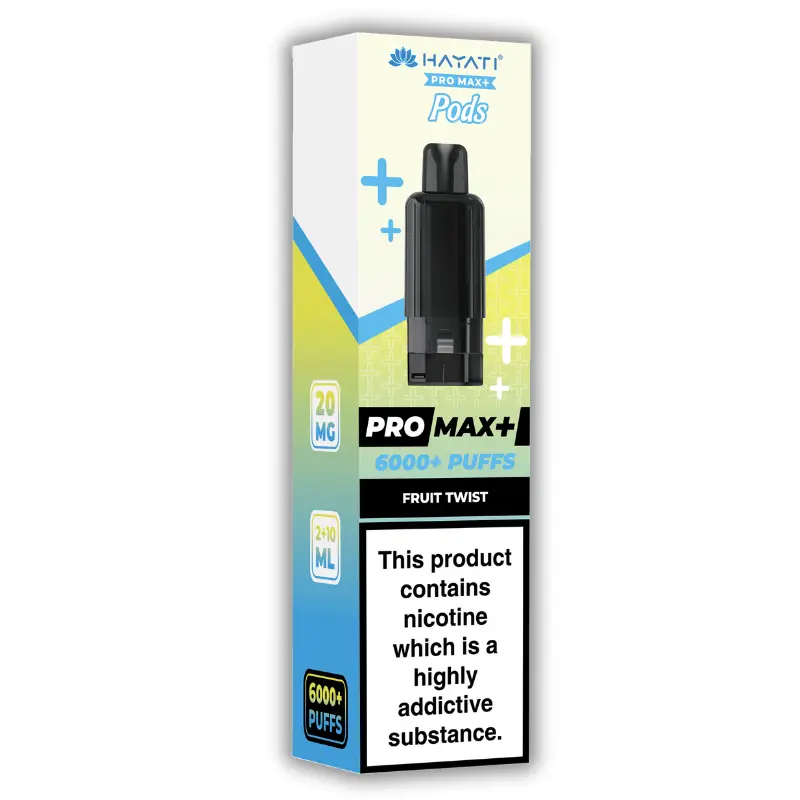
Hayati · Pro Max Plus
Fruit Twist Hayati Pro Max Plus Pods
£5.49
✔ In stock — ready to ship
Genuine Hayati
Free over £20
Same-day dispatch
Secure checkout
Fruit Twist Hayati Pro Max Plus Pods is a single prefilled refill: 12ml of liquid at 20mg nicotine salt, £5.49, no device anywhere in the pack. One flavour throughout, no oblique in the title and nothing on the mouthpiece to turn, so every millilitre in it is the same liquid. The manufacturer's rating is up to 6,000 puffs, produced on a rig rather than by a person, which makes it usable for putting two products in order and close to worthless as a guide to how long your fortnight will go.
The person buying it owns a Pro Max Plus already and has almost certainly run this liquid before. That narrows the job of this page considerably, because the obvious work has been done. Six pages on this site have already written about Fruit Twist at length, counted rather than guessed at, and between them they have settled the naming question, worked out what the phrase denotes across the whole range, priced the kit against the pod, analysed the blue-raspberry version draw by draw and taken the watermelon-led version apart twice over. None of that gets repeated below. Repeating it would waste your time and mine.
What none of those pages could do is answer a question, because answering it requires somebody with the liquid in their mouth. The Fruit Twist Pro Ultra Plus 25K Pods page closes by naming two findings that would overturn its own conclusions, and one of them is whether this liquid is genuinely tart or whether the tartness exists only in the copy. That page could not resolve it. Neither can this one. The difference is that the reader of this listing can, at a lower cost than any other listing in the catalogue offers, and holding the answer changes which of several products is the right one to buy next.
So this page does three things. It reports a count that narrows the question and takes some of the drama out of it, because the tart vocabulary that looks distinctive on this listing turns out to be the house register on this shelf. It reduces the four-question method the sibling page proposed to the one question that has a purchase attached to it. And it says plainly what each possible answer is worth in money, including the answer that sends you somewhere cheaper than here.
What is already established, and where
Taking someone else's finding and re-deriving it badly is worse than citing it, so here is the map of what exists, in the order it becomes relevant.
The census belongs to the Fruit Twist Pro Ultra Plus 25K Pods page. It established that the phrase appears in exactly eight titles across the catalogue, that those eight collapse into three distinct flavour identities rather than eight products, that neither of the suffixed identities crosses between the two hardware lines, and that the word "twist" never appears anywhere in the range except inside that fixed phrase. It went further and looked at how the range files these products, finding that no Fruit Twist listing anywhere has ever been given a descriptive shelf on account of its Fruit Twist component, and it disclosed the one anomalous tag rather than tidying it away. It also ran a control case against a second generic fruit word before drawing conclusions from those empty fields. That work is thorough and it is not being repeated here. Where the argument below rests on any of it, it rests on it as a citation.
The economics of buying the same liquid with a device attached belong to the Fruit Twist Pro Ultra Plus 25000 Prefilled Pod Kit page, which broke the £11.99 into its parts and worked out what the difference between a kit and a bare pod actually purchases on that platform. The equivalent sum on this platform appears further down, but only as one line of arithmetic, because the reasoning is theirs.
The draw-by-draw flavour analysis of the blue-raspberry version sits on the Blue Razz Fruit Twist Hayati Pro Max Plus 6000 Pod Kit page, along with its account of where in the draw the mixed-fruit component actually shows up. That is a different liquid from this one, or at least a differently named one, so it is a neighbour rather than a twin, and it is cited here for one specific sentence rather than for its conclusions.
Most usefully for anyone reading a bare refill listing, Blue Razz Fruit Twist Hayati Pro Max Plus Pods is the other £5.49 refill in this group, and it has already taken the strongest general argument available to a repeat buyer: that somebody on their second and third identical pod holds repeated observations of one recipe on one device, which nobody else has, and that keeping a short record of how the liquid behaves from full to empty is worth doing. If what you want is a method for tracking how a pod ages, that page has it, worked out properly, and this page is not going to produce a second version of it.
The twin of this listing, Fruit Twist Hayati Pro Max Plus Pod Kit at £7.99, is not written yet. It bundles this same liquid with a rechargeable device. Whenever it appears, the flavour case for the plain version will be its to make, because a kit page is addressed to somebody who has not tasted the thing. This page is addressed to somebody who has.
The tart claim, counted
The interesting property of this listing is what its own description says. Hayati describe the blend as several fruits run together into one sweet mixture with a sharper note running through it, and they say that sharper note lifts each draw. The opening line of the listing attaches a tangy streak to the pod directly. Both statements put acidity in this liquid.
Before building anything on that, two corrections to how the claim is usually reported.
The first is small and worth getting right. It is often said that this listing glosses the tang as the twist itself. Read carefully, it does not quite. This listing uses a participle, describing the sharper note as twisting through the mixture, which implies the connection grammatically without asserting it. The explicit gloss, the one that states outright that the sharp streak is what earns the product the word in its name, is on the kit listing rather than on this one. That matters a little, because an explicit gloss is a stronger piece of evidence than a participle, and the stronger piece of evidence is attached to the product that costs £2.50 more.
The second correction is larger and it is the reason this section exists. The tart claim reads as distinctive. It is not. I counted.
Across the 89 listings on Hayati Pro Max Plus Pods, 60 use at least one word from the tart family in their description. Taking that family as tang, tangy, tart, sharp, sour, zesty or acidic, the breakdown runs: 35 listings use some form of tang, of which 24 use the word tangy exactly; 22 use tart; 32 use sharp; and only 5 use sour. Narrowing to the two least ambiguous members of the family, tang and tart alone, still gives 48 of 89. Whichever way the family is drawn, somewhere between half and two thirds of this shelf is described as having an acid edge of some kind.
That is a base rate, and a base rate changes what an observation is worth. A listing that says tangy on a shelf where two listings in three say something of the sort is not making a claim about this liquid in particular. It is writing in the register the shelf is written in.
The counts hold at range level too, and this is where they bear directly on the sibling page's finding. Of the 179 listings in the catalogue whose title contains Pro Max Plus, 118 carry a tart-family word, which is 66 per cent. Of the 104 whose title contains Pro Ultra Plus, 51 do, which is 49 per cent. Across all 492 products the figure is 300, or 61 per cent. Narrowing to tang and tart only moves the two platform figures to 54 per cent and 41 per cent, which is a smaller gap in the same direction.
So the two hardware lines are not described in the same voice. The Pro Max Plus copy reaches for an acid word appreciably more often than the Pro Ultra Plus copy does, independently of any particular flavour, and that difference exists before you look at Fruit Twist at all.
What the platform split is actually worth
The observation the sibling page made is real: all four Pro Max Plus listings carrying the Fruit Twist phrase put an acid note in the blend, and none of the four Pro Ultra Plus ones mentions acidity at any point. Four to nothing, split cleanly along the hardware line, looks like a finding.
Against the base rates it looks thinner. Reading the eight listings as eight independent observations, the chance of all four Pro Max Plus ones carrying a tart word by the shelf's own habits is about 19 per cent, and the chance of all four Pro Ultra Plus ones omitting one is about 7 per cent. Multiplied, that puts the observed split at roughly one chance in eighty, which would be worth taking seriously.
But the eight are plainly not eight independent observations. They arrive as four matched pairs, a bare pod and a kit for each identity, and within each pair the two descriptions make the same claims in different words. Whoever wrote the pod listing had the kit listing in front of them, or wrote both in one sitting. Treating the set as four independent pieces of copy rather than eight puts the odds of the same split at roughly one in nine on the broad family and one in ten on the narrow one. Two ways of counting, the same answer.
One chance in nine is not nothing. It is also not the kind of number anyone should spend money on. A coincidence that turns up once in nine tries turns up constantly in a catalogue of 492 products, and a reader who treats it as established has mistaken a suggestive pattern for a fact.
Where that leaves the three explanations the sibling page set out, which were two separate formulations sharing a name, one formulation written up twice by people not working from each other's notes, and a writer inferring a sharp turn from the ordinary English meaning of "twist" and writing the inference down as description. This count does not choose between them and I am not going to pretend it does. What it does is move a modest amount of weight towards the second, because it demonstrates that the two platforms' copy differs systematically in exactly this vocabulary, across hundreds of listings that have nothing to do with Fruit Twist. A house style that reaches for an acid word two thirds of the time on one line and half the time on the other will generate splits like this one on its own.
The third explanation survives too, and the count gives it a small push as well. If a writer with no flavour notes decided that the word "twist" implies a sharp turn, that decision would have been easiest to make on the platform whose copy already leans that way. The two explanations are not exclusive and the evidence does not separate them.
What follows for you, before you spend anything
Three things follow, and the third is the useful one.
Do not buy this pod because the listing says tangy. That word is at the shelf's base rate and carries close to no information. If an acid edge is what you actually want, the shelf contains products that say so in the title rather than in the description, and Blue Sour Raspberry Hayati Pro Max Plus Pods is the clearest of them, described as starting with a pucker before it finishes sweet. Five listings out of 89 use the word sour at all, so that one is genuinely unusual in a way this one is not.
Do not treat the platform split as evidence that the two Fruit Twists are different liquids. It might be. Nothing establishes it, the odds are roughly one in nine that it would look like this anyway, and a buyer who concludes otherwise will make a purchasing decision on a coin that is only slightly weighted.
And this is the part worth the page: the question is still open, it is answerable, and answering it costs less here than anywhere else in the catalogue. Four written pages could not settle whether this liquid has any acidity in it. One pod does. The rest of this page is about how to get an answer that means something, and what each possible answer is worth.
One question, not four
The sibling page proposed four questions for characterising an unnamed blend, in a deliberate order, and as a general method for an unidentified liquid it is sound. Three of those four are not worth your time on this particular purchase, for a reason that has to do with what you already know rather than with the method.
You have run this liquid. You know roughly which fruit family it lands in, or you know that it does not land in one cleanly, which is itself an answer. You know roughly how sweet it is relative to the last named pod you finished. You know whether there is a single note you can name. Those three questions are answered for you by the first pod you ever bought, and a repeat purchase does not improve the answers.
The fourth question is different because it is contested. Two listings say there is acidity here and two say nothing about it. Your own experience of the liquid is the only evidence anyone can add, and unlike the other three, the answer has a purchase attached to it in both directions.
So, in one sentence: is any acidity present, and if it is, does it show up while you are drawing in or only once you breathe out?
Why the position matters as much as the presence
Splitting the question in two is not fussiness. The two positions behave differently and they lead to different products.
Acid at the front of the draw is a lead property. It is the first thing the liquid does, it sets the shape of everything after it, and it is the reason people describe a blend as bright or as having a lift. On this shelf that construction is common and usually announced in the title, since the citrus half of a pairing generally does the job. Blue Razz Lemonade Hayati Pro Max Plus Pods puts a crisp citrus lift over a candied base, and Cola Lime Hayati Pro Max Plus Pods runs a zesty lime through a sweet, faintly spiced cola. In both cases the acid is a component you could point at.
Acid on the exhale is a finish property and it does something else entirely. It shortens the tail, stops the sweetness sitting on the palate afterwards, and makes a liquid easier to run for a long stretch without the flavour accumulating. It is also much less noticeable, which is why a listing can describe a liquid as lively without a reader ever identifying what is making it lively.
If this liquid's tang is a lead property, it is a flavour you chose. If it is a finish property, it is a liquid you tolerate well, which is a different thing and points at different neighbours. And if it is neither, the description was describing the name.
Taking the reading so that it means something
Four practical constraints, all of them specific to measuring acidity rather than general handling advice.
Use a calibration standard from the same shelf and the same session. Acidity is almost impossible to judge in the abstract, because the palate rescales to whatever it has been running, and a liquid that reads as tart after a week of cream reads as flat after a week of lemonade. The fix is to hold a known acid beside it. Berry Lemonade Hayati Pro Max Plus Pods is the straightforward citrus reference, described by Hayati as sharp lemonade meeting jammy berries. Blackcurrant Juice Hayati Pro Max Plus Pods is the fruit-acid reference, where the tartness is the blackcurrant's own rather than a citrus bolted on. Draw one of those, then draw this, and the comparison does the work that an adjective cannot.
Separate acid from cold. Cooling produces a sensation that a great many people report as sharpness, and on a liquid with no named coolant that confusion is easy to fall into. Nothing in this listing's title or description names a cooling agent, and the cooling-vocabulary census on the Blue Frozen pods page established that this range signposts cold in the product name rather than in the copy, with no grading between the terms it uses. Blue Frozen Hayati Pro Max Plus Pods announces its chill in the title and Double Menthol Hayati Pro Max Plus Pods announces even more of it. This one announces nothing, so read it as uncooled and treat any cold-feeling sensation as something other than a coolant.
Separate acid from nicotine. At 20mg the nicotine contributes its own sensation towards the back of the throat, and on a blend with no strong competing edge it has room to be noticed. That sensation sits further back and later than a fruit acid does, and it does not change with the fruit. If you have run a named sour on this device you already know the difference in your own mouth, which is the only place the distinction can be drawn.
Take the reading when the pod has done some work but is not near the end. A pod fitted minutes ago sits wetter than it will ever sit again and presents sweeter for it. A pod approaching retirement has lost definition across the board, and the fine edges go before the sugar does. Somewhere in the first third, on a single unhurried draw rather than four in a row, is when the liquid is presenting most honestly.
What each answer is worth in money
This is the part that justifies bothering. Three outcomes, three different purchases, and the arithmetic is worth having in front of you before you taste anything.
If there is acidity and it leads
Then the Pro Max Plus copy was describing a liquid rather than a name, you have confirmed something four pages could not, and the immediate consequence is that you now know what you like about this pod. An acid lead over a mixed-fruit body is a specific construction, and the catalogue sells better-specified versions of it.
The closest of them is the one this page has been circling. Blue Razz Fruit Twist is the same phrase with a named fruit in front, and Hayati's copy for it says something unusual: the fruit-twist component is what rounds the tang off, softening a sharp blue raspberry with a juicier sweetness. Read next to your own listing, those two accounts contradict each other, because here the fruit-twist component apparently is the tang and there it is the thing that tames one. The sibling page flagged that contradiction and could not resolve it. What matters for your purchase is narrower and does not need it resolved: if you have established that you want an acid lead, the blue razz version is the listing where an acid lead is explicitly what you are buying, at the same £5.49, the same 12ml and on the same shelf. You would be moving from a liquid whose acidity is disputed to one whose acidity is the headline.
Beyond that pairing, the shelf offers several ways to buy a lead acid on purpose. Blackcurrant Lemonade Hayati Pro Max Plus Pods runs a zesty citrus against a jammy berry and meets in the middle. Blackcurrant Mango Hayati Pro Max Plus Pods puts the tart dark berry first and lets soft tropical fruit arrive afterwards, which is the same structure in reverse order. Kiwi Cooler Hayati Pro Max Plus Pods uses kiwi's own sweet-sharp character and finishes cool, and is the lightest of the group. All three tell you in advance what the acid is made of, which this one does not.
If there is acidity but it arrives on the exhale
Then the tang is doing a structural job rather than a flavour one, and what you have is a blend that resets itself at the end of each draw. That is a genuinely useful property in a 12ml pod, because a sweet liquid that does not accumulate is a liquid you can run for a week without tiring of it, and it is the property most likely to explain why this pod suits you when a similar one does not.
The purchase consequence runs sideways rather than up. A finish-side acid makes this a good daily liquid and a poor centrepiece, which means the thing to spend money on next is not a sharper version of the same idea but a rotation partner that contrasts with it. Fresh Mint Hayati Pro Max Plus Pods is the standard answer, green and herbal rather than a bare menthol, and it resets the palate between stretches of fruit. Mango Banana Hayati Pro Max Plus Pods works from the opposite direction, a thick, mellow, creamy tropical blend with no edge at all, so the contrast is textural instead of thermal. Banana Ice Hayati Pro Max Plus Pods splits the difference, soft fruit with a cold exhale.
Buying a second sweet mixed fruit alongside this one is the mistake to avoid in this case. Two unspecific sweet blends in the same rotation smear together, and within a month you will not be able to say which of them you preferred, which makes the reorder a guess.
If there is no acidity at all
Then the Pro Ultra Plus copy was the accurate account and the Pro Max Plus copy was written from the name. That is the single most valuable finding available here, because it corrects a claim that appears on two listings and, in weakened form, on pages that have read them.
It also has a price consequence, and it is the one place this page recommends against itself. Fruit Twist Hayati Pro Ultra Plus 25K Pods is a 22ml pod at £7.99, which works out at 36.32p per millilitre. This pod is 12ml at £5.49, which is 45.75p per millilitre. That is a premium of 9.43p on every millilitre, or £1.13 across the pod, for the smaller format. If the liquids are the same, the larger pod is the cheaper route to it by a comfortable margin.
Whether they are the same is exactly what nobody has established, and I am not going to assert it. The two identities do not cross platforms, the copy for them differs in the one respect this page has spent a thousand words on, and no published statement links the formulations. Treat the per-millilitre comparison as conditional on a question that is still open. The condition matters more than the arithmetic: buying a 22ml pod of something that turns out not to be the liquid you wanted costs more than the saving.
A hardware condition attaches as well. That pod runs on a Pro Ultra Plus body, which is not the device this one fits, and ordering a bare refill with no device to put it in is the single most frequent way this kind of purchase goes wrong.
The cost of running the test
Worth stating plainly, because it is the argument for this listing rather than another. Of the four listings that sell the plain Fruit Twist liquid, this is the cheapest by £2.50. The kit version of the same liquid on this platform is £7.99, the Pro Ultra Plus pod is £7.99, and the Pro Ultra Plus kit is £11.99. At £5.49 this is the lowest total outlay at which the question can be answered at all.
Per millilitre it is not the cheapest, and the two figures point in opposite directions, which is worth holding both of at once. The 22ml pod is better value for liquid and a larger commitment to an unresolved question. This one is dearer per millilitre and cheaper to be wrong about. On a purchase whose point is settling a doubt, the second consideration is the one that should decide it.
One more figure, because it removes a distraction. Every one of the 89 products on the Pro Max Plus pods shelf is priced at £5.49. Not most of them, all of them. So nothing about this pod's price tells you anything about this pod: it is not cheap for the shelf and it is not dear for the shelf, because the shelf has one price. The only price comparison available for this liquid runs across platforms, which is why the section above is the only place money appears.
The pod itself, which is the short part
Eighty-nine listings share this exact format, counted on the shelf rather than estimated, and the hardware behind them has been described exhaustively elsewhere on this site. This section is therefore deliberately short and points at the shelf for the remainder.
The pack holds one prefilled pod. That is the entire contents: no body, no charging lead, no spare parts, no instructions to follow because there is nothing to put together and nothing to pour in. The 12ml at 20mg is already inside and closed in. A single coil fitted during manufacture works through all 12ml and is finished when the pod is; its resistance does not appear in the product data and is therefore not quoted on this page. Pods for different Hayati ranges are not interchangeable, so check the range name printed on your device against the range name in this title before ordering.
The specification that matters most for the argument above is the one that sounds least interesting: this is a single-flavour pod. There is no second reserve and no collar on the mouthpiece, so there is nothing to select and nothing carried over from a side you were running a minute ago. That is worth naming because a divided pod would make the acidity reading almost impossible to take. Sharing one coil and one airflow path between two liquids means the first draws after any change are contaminated by the previous one, and the property being measured here is a subtle edge that would not survive it. This pod gives an uncontaminated reading by construction, which is a small accidental advantage and the only reason the hardware gets a mention in a page about flavour.
The other specification worth a sentence is the 12ml itself. Twelve millilitres is one uninterrupted commitment to one liquid, with no way to change your mind partway and no way to dilute it. That makes it a poor format for hedging and a decent one for a controlled observation, since the thing being observed does not change under you.
The numbers, and what each one is for
| Acid edge | Claimed here and on the kit, unmentioned on either Pro Ultra Plus listing of the name. Open |
| Fruit named in the title | None. The constituents are not specified by Hayati |
| Cost per millilitre | 45.75p |
| Ticket price | £5.49, shared with every one of the 89 pods on this shelf |
| Volume | 12ml, closed before it leaves the factory |
| Strength | 20mg nicotine salt, the sole figure this listing records |
| Cold | No coolant word in the title, none in the description |
| Sides to choose between | One liquid only. Nothing rotates, nothing is held back, nothing is selected |
| Coil | Permanent, unserviceable, discarded with the pod it sits in |
| Laboratory rating | Hayati state up to 6,000 puffs |
| Body in the pack | None. Fits a Pro Max Plus you have already |
| Made by | Hayati |
Three of those rows are unusual enough to explain, and they are the three that would normally be left out.
The acidity row does not belong in a specification table by any ordinary standard, and it is here because on this product it functions as one. A specification is the set of things a buyer needs to know that they cannot see, and for this liquid the disputed acid edge is the largest of those. Writing it in as "tangy" would be repeating an unverified claim in the voice reserved for the volume and the price, which is precisely the failure this page exists to avoid. Writing it in as unresolved, with the evidence on both sides named, is the honest version.
The cost-per-millilitre row is there because it is the only number on this listing that can be compared with anything. The price cannot, since the shelf is uniform. The puff rating cannot, since it is a laboratory figure produced under conditions no person reproduces. Volume against price is the one comparison that survives contact with another platform, and the section above uses it.
The strength row shows 20mg because the United Kingdom allows no more and this listing offers no less. Nicotine is addictive. Which concentration a person uses is a decision for them, and a shop page has no standing to advise on it. The point specific to this liquid is narrower: nicotine produces a sensation of its own at the back of the throat, and where a blend has no confirmed sharp edge occupying that space, the same figure reads as more prominent. Coming to this pod straight off a declared sour, expect an identical number to feel unlike itself.
Where it sits among its neighbours
The comparison job on a refill page is not choosing a flavour, since you have already chosen. It is deciding what to buy alongside it, or instead of it, once the question above has an answer. The neighbours below are grouped by what they would tell you rather than by how similar they taste.
The other listings that refuse to name a fruit
This shelf has a small population of products whose titles describe an impression rather than a content, and they are the closest relatives of this one in the only respect that is definitely true of it. Black Mamba Hayati Pro Max Plus Pods is the extreme case, a house blend whose title gestures at a mood and whose own copy admits it is gesturing. Galaxy Aura Hayati Pro Max Plus Pods belongs to a family of Aura names that work the same way, and the Sunset Aura pods page is where the method for reading those names was established, including the point that the honest thing to do with an unspecified blend is to say so rather than invent a tasting note.
Worth noting the contrast inside that family. Peach Aura Hayati Pro Max Plus Pods carries the same abstract second word and a completely specified first one, so it is the version of the naming problem where the buyer actually knows something, and Hayati's copy for it says as much. If the unspecified part of this pod is what bothers you rather than what interests you, that listing is the demonstration that the range is capable of telling you.
Blue Fusion Hayati Pro Max Plus Pods sits between the two camps. The title is abstract, the copy is not, and it describes a blue raspberry tang rounded off by a deeper blueberry. That construction, a tang that something else rounds off, is the same one the blue razz version of this flavour uses, which makes it a useful third data point for anyone trying to work out what these descriptions are actually tracking.
Named acids, if the answer turns out to be yes
Should your reading confirm a genuine acid edge, the products worth putting beside it are the ones where the acid is specified and therefore predictable. Blackberry Raspberry Hayati Pro Max Plus Pods is the straightforward version: a deep, earthy berry with a brighter, sharper one lifting it, and nothing else going on. Blueberry Raspberry Cherry Hayati Pro Max Plus Pods adds a third named component and a darker, rounder finish, so it is the same idea with more body and slightly less edge.
Double Apple Hayati Pro Max Plus Pods is the outlier in this group and the most interesting comparison in it. The construction is two apples layered, one crisp and slightly sharp against one riper and sweeter, which is a named, specified version of the exact thing this pod is vaguely described as doing. If you want to know what "a sharper note running through a sweeter one" tastes like when somebody has committed to what both notes are, that is where to find out.
Sweetness without an edge, if the answer turns out to be no
Blue Razz GB Hayati Pro Max Plus Pods is the shelf's declared confection, described as pushed further towards sweets with a rounded, sugared finish and explicitly less sharp than the alternatives. If your reading finds no acid in this pod and you are content with that, it is the version of the same territory that admits what it is. Mango Peach Pineapple Hayati Pro Max Plus Pods is the tropical equivalent, thick and honeyed underneath with pineapple providing the only lift, and it is a specified blend rather than an unspecified one, which is its main advantage over this pod.
The rest of the range
The full set of refills for this device is on Hayati Pro Max Plus Pods, all 89 of them at the same price. Every Hayati pod across every device sits on Hayati Pods, which runs to 202 listings, and the wider refill range including bottles and other formats is on Hayati Prefilled Pods & Refills at 201. Anything recently added surfaces on New Products, and the whole catalogue of 492 is on the All Hayati products page.
A note on that last figure, since this page has leaned on catalogue counts throughout. Every number quoted here was taken from the product data as it stands today rather than from another page, including the shelf sizes. Counts on this site have been wrong before and been corrected, and a figure copied from a sibling page is a figure that has stopped being checked.
Running the pod so the reading survives
Handling advice for a sealed pod is mostly the same everywhere. What follows is the part that changes because of what you are trying to observe.
Give the wick two or three minutes to soak before the first proper pull, and go gently on the opening few. That is ordinary advice with a non-ordinary reason attached here: a wick that has been run dry leaves a papery character underneath the flavour, and somebody hunting for a faint acid edge will either lose the edge behind it or decide the papery note was the edge. Both errors corrupt the measurement, and neither announces itself.
Take the acidity reading before you take anything else seriously. The edge, if it exists, is the most fragile property in this liquid and the first thing to stop presenting as the coil accumulates work. Sweetness is the last thing to go. That ordering means a pod two thirds down can read as sweeter and flatter than the same pod at a third, and somebody who takes their only reading late will conclude there is no acid in the liquid when what they have measured is the coil. This is the single most likely way to get a wrong answer to the question this page is about.
Do not read it straight after something sour or something cold. Both rescale the palate in the direction that matters, and a mild tang after a declared sour reads as nothing at all. If you are rotating, put a gap in, or take the reading on the first pod of the day.
Retire it on the flavour rather than on the window. A sealed pod flattens before it empties, and on a liquid with no named lead there is no specific note that goes missing to tell you. Watch the general indicators instead: vapour falling away, a drier-feeling draw, or the blend losing definition while the sweetness stays where it was. Drawing harder at that point moves liquid faster across a hotter coil and improves nothing.
Store spares out of sunlight and away from anywhere warm, and keep them where children and pets cannot reach them. Warmth thins the liquid, and thin liquid in a sealed pod finds the mouthpiece before it finds the coil. Heat also works against you specifically here, since the volatile top end of a blend is what degrades first and the top end is where an acid note lives.
Write down the answer, in three words, somewhere you will find it. "Acid on exhale" or "no acid, sweet" is enough, and it is worth more than any description on any page including this one, because it is about the pod you ran on the device you own. A blend with no fruit in its name decays faster in memory than a named one, and within a month you will have replaced whatever you tasted with the word "fruity" unless you recorded something better.
Finally, keep the full listing name. A title with no fruit in it is awkward to search for later, the same phrase appears on eight products at four different prices across two hardware lines, and the version you want is identified only by the words after the flavour name.
Questions a repeat buyer asks
Does the kit version contain a different liquid?
It does not. That £7.99 listing wraps this identical 12ml of Fruit Twist at 20mg around a rechargeable body, and what you are looking at here is the same pod with the body taken out. Owners of a Pro Max Plus want this one. The £2.50 separating them buys hardware and nothing else.
Is it the same liquid as the Pro Ultra Plus Fruit Twist?
Nobody knows, and there is a documented reason for the doubt: this platform's copy puts an acid note in the blend and the other platform's copy is silent on the point. Two recipes would explain it. So would two batches of writing produced months apart by people who never compared notes. The vocabulary counts on this page show the two platforms do differ systematically in exactly that word choice, which pushes towards the second reading without closing the matter.
So is it tart or not?
Nobody writing about it can tell you, which is the honest answer and the reason this page is structured the way it is. Hayati's copy for this listing says yes, Hayati's copy for the same name on the other platform is silent, and the tart vocabulary on this shelf is common enough that its presence here carries little weight on its own. One pod settles it for you, which is more than eight listings and six earlier pages between them have managed.
How common is the word "tangy" on this shelf?
Twenty-four of the 89 Pro Max Plus pod listings use it, and 60 of the 89 use some word from the tart family once tang, tart, sharp, sour, zesty and acidic are all counted. Across the whole 492-product catalogue the figure is 300. It is house vocabulary rather than a distinguishing claim, which is worth knowing before you read any description on this site.
Which fruits are actually in it?
Not stated here, and not stated on any of the other seven listings that use the phrase. The Fruit Twist Pro Ultra Plus pods page went through the naming and the shelf tagging thoroughly and showed that the Fruit Twist half of a title has never once earned a product a place on a fruit shelf in this catalogue. Anybody who hands you a list of constituents invented it.
Is there any cooling in it?
Nothing in the title or the description names a coolant, and in this range the cold is declared in the product name rather than buried in the copy. Read it as uncooled. That matters for the acidity question, because a cooling agent produces a sensation many people report as sharpness and would make the reading much harder to take.
Does the pod have a collar or two sides to it?
Neither. One blend fills the whole 12ml, the title carries no oblique, and the description sets out a single flavour, so the mouthpiece is fixed and no choice is on offer. Convenient, as it happens: where a pod is divided, both halves feed one coil, and the draws immediately following a change read as a muddle of the two.
What does the 6,000 figure mean?
Hayati rate the pod at that number under laboratory conditions, which means a rig pulling identical draws on a timer until nothing is left. As a way of ranking one product beside another it is serviceable. As a forecast of your own week it is close to useless, because how long you pull moves the true figure enormously. Log the day you fit the pod and the day you bin it, and after two pods your own number is better than theirs.
Why is this dearer per millilitre than the Pro Ultra Plus pod?
Because it is a smaller pod at a lower total price: 12ml at £5.49 works out at 45.75p per millilitre against 36.32p for the 22ml pod at £7.99. The larger pod is better value for liquid, needs different hardware, and is a bigger commitment to a flavour whose description is disputed. Whether the two are even the same liquid is unestablished, so the comparison is conditional.
Is there a cheaper way to buy this flavour?
Not on this platform. All 89 pods on the Pro Max Plus pods shelf are £5.49, and of the four listings selling the plain Fruit Twist liquid across both platforms, this is the lowest total outlay by £2.50. It is the cheapest place to find out what the liquid is, whatever you do afterwards.
What strength does it come in?
One only: 20mg nicotine salt, the ceiling this country allows. Where Hayati sell something weaker it is filed as its own listing with its own price, not offered as a choice on this page. Nicotine is addictive and the strength a person settles on is theirs to settle.
Should I order more than one?
If you have run it before and know you want it, the usual argument for a spare applies and nothing here changes it. If you are buying it to answer the question this page is about, order one, because a second identical pod cannot answer it any better than the first and commits you to 24ml of something you have not characterised yet.
Can I top it up rather than replacing it?
No. This is a replacement part, not a tank. The 12ml goes in before dispatch, the pod is closed when it reaches you, the coil inside is fixed for the life of the unit, and no opening for adding liquid is described anywhere in the product data. When the flavour goes, the whole thing goes.
The short version
One prefilled pod, 12ml at 20mg nicotine salt, £5.49, no device, for a Pro Max Plus you already own. Hayati rate it at up to 6,000 puffs under laboratory conditions and do not say which fruits are in it.
The naming, the census across all eight Fruit Twist listings, the kit arithmetic on the other platform and the flavour analysis of the blue-raspberry version are all written elsewhere on this site and are cited above rather than repeated. What was left open was whether this liquid has any acidity in it, since the two Pro Max Plus listings say it does and the two Pro Ultra Plus ones say nothing, and this page adds one thing to that: the tart vocabulary those two listings use is at the base rate for the shelf and for the platform, so the split is worth about one chance in nine rather than the striking finding it looks like. The question is still open. It is now a smaller question.
Answering it costs one pod and this is the cheapest pod that can answer it. If the acid is there and it leads, you want a listing that names its acid, and the blue razz version of this same phrase is the one whose copy says so outright. If it is there but sits on the exhale, you have a daily liquid rather than a centrepiece, and the money belongs on a contrasting rotation partner. And if it is not there at all, the other platform's description was the accurate one, the 22ml pod is 36.32p per millilitre against this pod's 45.75p, and whether that is the same liquid is a question nobody has settled and this page will not pretend to.
Strictly for adults aged 18 and over. Nicotine is an addictive substance.
You might also like


