Home / Hayati Pro Max Plus Pods / Double Menthol Hayati Pro Max Plus Pods
Hayati · Pro Max Plus
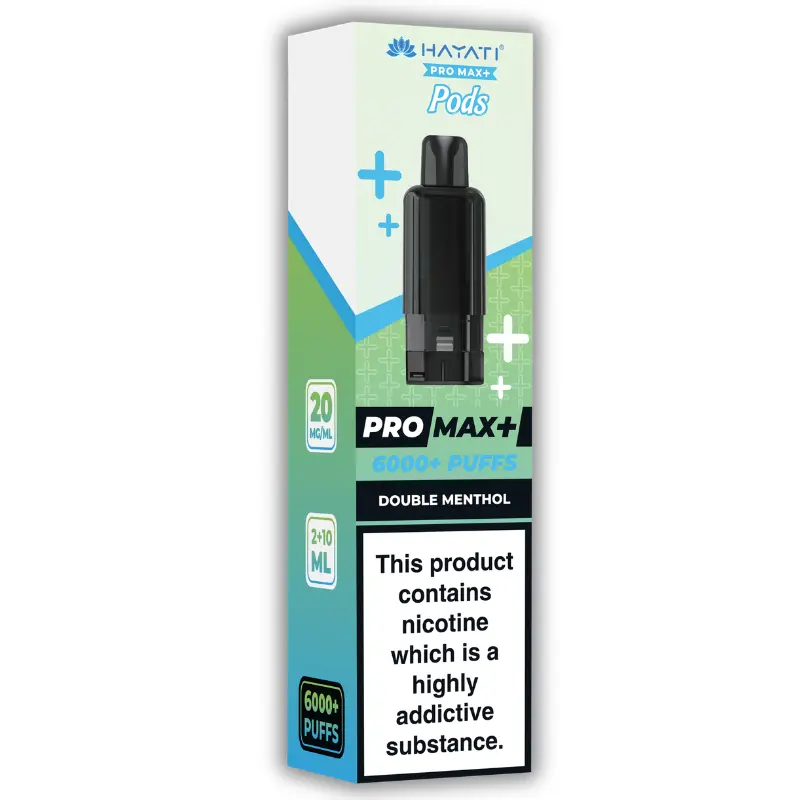
Double Menthol Hayati Pro Max Plus Pods
£5.49
✔ In stock — ready to ship
Genuine Hayati
Free over £20
Same-day dispatch
Secure checkout
Double Menthol Hayati Pro Max Plus Pods is a replacement pod and nothing more. One prefilled unit, twelve millilitres of liquid at 20mg nicotine salt, £5.49, built to seat in a Pro Max Plus body you already own. No device arrives in the packet. If the hardware is not already in a pocket or a drawer, the Double Menthol Hayati Pro Max Plus 6000 Pod Kit puts the same liquid in a box with something to run it in, and the two listings differ in exactly one respect: whether a device is included.
That is the ordinary half of this listing. The half that earns it a page is the first word of the name.
There are 492 products in the Hayati catalogue. Four flavour names in that list put a number in front of the thing being described: Double Apple, Double Menthol, Triple Melon and Triple Mango. Fourteen individual listings carry one of those four names across the various formats. Twelve of the fourteen apply the number to a fruit. Two apply it to a sensation, and both of those two are this liquid, sold as a pod and sold as a kit.
That is not a trivia point. A number in front of a fruit and a number in front of a coolant are making different kinds of promise, and they behave differently once the pod is in the device, because the thing a fruit does to you and the thing menthol does to you run through different machinery with different limits. A fruit is read by your nose. Menthol is read by a receptor that reports temperature, and a receptor population has a finite response in a way that a nose does not. Past a point, adding more menthol stops buying you proportionally more cold and starts buying you something else entirely.
What follows sets out what that means for someone deciding whether to spend £5.49 on this rather than on one of the cooled fruits sitting beside it. Three things "double" could honestly denote, what each would actually feel like on the draw, why the distinction matters far more on this listing than on any fruit listing in the range, and the awkward fact that the pod most likely to feel extreme on day one is the pod most likely to feel unremarkable by day ten.
The only number in this range that is not counting fruit
Start with the count rather than the assertion, because the vague version of this claim is weaker than the real one and easy to overstate.
What the catalogue actually contains
Across all 492 listings, 121 carry a word in the title that signals cold or mint: Ice, Frozen, Cooler, Frost, Menthol, Mint, Spearmint. Those resolve to 45 distinct flavour names. So roughly one listing in four is selling some quantity of chill, which makes cold one of the largest single themes in the range and means this pod is not competing for a niche. It is competing in a crowd.
Narrow to the word menthol and the crowd thins dramatically. Seven titles in 492 contain it. Four of those seven attach it to a fruit: three Mini Ultra listings built on blueberry and strawberry or blueberry and raspberry, and a nic salt called Fresh Menthol Mojito. That leaves three listings in the entire catalogue whose flavour name is the compound and nothing else: this pod, its kit, and a bottle called simply Menthol. Of those three, two carry a magnitude in front of the compound, and they are the pod and kit of this flavour.
On the Hayati Pro Max Plus Pods shelf specifically, which runs to 89 names, sixteen carry a cold or mint word. Nine of those sixteen are a fruit with Ice or Cooler after it. Two are drinks with Ice after them. One is a colour with Frozen after it. One names a frozen confection. Two name a plant, Spearmint and Fresh Mint. One names the molecule. Thirteen of the sixteen, in other words, give you something to taste and then tell you how cold it will be. This is the one that gives you only the second part.
The Menthol Vapes shelf is worth a separate note, because it is small and it is not what a buyer assumes. Twelve products sit on it. Seven have menthol in the title. Five do not: Kiwi Cooler is filed there along with its kit, and so are all three versions of Black Mamba. So the shelf is nine of the 121 cold-signalling listings, which means shopping for cold by browsing that shelf shows you about seven per cent of the cold liquids Hayati sell. Useful for finding this pod. Close to useless as a survey of your options.
Why a number on a fruit has something to point at
Take the other three numbered names in turn, because the contrast is the whole argument.
Triple Melon has an obvious referent. Melons come in varieties that taste materially different from each other, and a blend of three of them is a describable composition: you could in principle list which three. The number is a count of ingredients. Triple Mango works the same way, either three mango cultivars or three treatments of mango, ripe and green and dried, and again the number is pointing at something that could be enumerated. Double Apple has a history outside vaping, where it conventionally denotes a two-part apple construction, commonly red apple against green, sometimes apple with an aniseed edge underneath it. Hayati do not publish which convention they are following, so that last one is a probable rather than a certainty, but the structural point survives the hedge: the number has a composition it could plausibly be describing.
In all three cases, if you doubled or trebled what is in the bottle, you would get a fuller and more layered version of the same fruit family. More material for your nose to read. The flavour would get denser, its balance would shift, and it might get too much, but it would remain recognisably the thing named on the label.
Menthol has no equivalent. There is one menthol. It is a single compound, and the phrase "double menthol" cannot mean two menthols the way triple melon means three melons, because the second menthol would be the same as the first. The number therefore cannot be a count of ingredients. It has to be a statement about quantity, or about the number of things producing the effect, or about nothing at all.
Look along the same shelf and the pattern sharpens further. Fizzy Cherry names a physical sensation, carbonation, and attaches it to a fruit that you can taste. Blue Sour Raspberry names a taste, sourness, and attaches it to a fruit. Cherry Peach Lemon does not bother with a modifier at all and simply lists three fruits in the order they are meant to arrive. Each of those titles hands you an identity plus a qualifier. This one hands you a qualifier with the identity removed and a magnitude bolted to the front.
Another page in this corpus makes a related argument about the word Bomb, which appears on four Hayati listings and names a magnitude rather than an identity. That is the same family of problem and it is worth reading if you are weighing up a Fruit Bomb listing. The case here is sharper, though, and for a specific reason. Bomb is a magnitude applied to fruit, and fruit has no hard limit on how much of it you can perceive before the experience changes character. Double is a magnitude applied to a sensation that does have one.
A receptor saturates. A nose does not, at least not like that.
This is the part that makes the naming question a practical one rather than a semantic one.
What the cold in this pod actually is
The chill you feel from a menthol liquid is not a temperature. The vapour leaving the coil is warm, and it is still warm when it hits your palate. What happens is that menthol molecules bind to a cold-sensing ion channel in the tissue of the mouth and throat, the channel known as TRPM8, and the channel fires the signal it would fire if the surface had genuinely dropped several degrees. Your brain receives a temperature report and has no way of telling it apart from a real one.
The Lemon & Mint page on the Pro Ultra Plus pods works through the broader version of this, the distinction between a sensation and an aroma, and sets out why a formulator can put cold in a liquid with no mint plant involved at all. I am not going to rebuild that argument here; it belongs there and it is better told in full. What matters for this listing is one consequence of it. A sensation of this kind is a switch being thrown, not a description being read. And a switch has a limited number of positions.
What happens when you keep adding
There is a finite population of these channels in the tissue of your mouth and throat. At low concentrations, adding menthol recruits more of them and the perceived cold rises more or less with the dose. That is the intuitive region, and it is where most cooled fruit liquids sit.
Keep raising the concentration and two things happen at once. The first is straightforward saturation: once a large share of the available channels are already firing, additional menthol has progressively fewer left to recruit, so the curve of perceived cold against dose flattens. You are paying for cold that has nowhere to go. This is not unique to menthol, and perceived intensity of almost any stimulus grows more slowly than the stimulus itself, but a coolant runs into it hard because the receptor doing the work is a single named channel rather than a broad family.
The second thing is the one that actually changes the product. At higher concentrations menthol stops confining itself to the cold channel and begins activating a second one, a channel that reports pungency rather than temperature. The standard account of why strong menthol prickles is precisely this: a different receptor, recruited later, producing a different quality of sensation. What comes back is not more cold. It is a sharp, needling, slightly stinging quality at the back of the throat and up inside the nose on the exhale, the thing people describe when they say a liquid is harsh, or catches, or bites.
So the dose-response for a strong menthol has an unusual shape. Cold rises, then flattens. Prickle stays near zero, then rises. There is a region where you are adding concentration and almost all of what you get back is the second curve. A buyer in that region experiences the liquid as more aggressive without experiencing it as colder, and then quite reasonably reports that the pod is harsh rather than that it is intense.
Worth naming the limits of what I am telling you. Where exactly the flattening starts is a function of the specific formulation, the coil temperature, the airflow and the individual palate, and none of those four are published for this pod. Individual sensitivity to menthol varies considerably between people, so the same liquid genuinely lands in different parts of the curve for different buyers. What is not in doubt is the shape: the cold does not scale indefinitely, and something else does.
Why doubling a fruit is a different kind of act
Aroma runs on entirely different hardware. Instead of one named channel reporting one property, you have a large repertoire of olfactory receptor types reading a mixture combinatorially, most of the signal arriving retronasally, up the back of the throat rather than through the nostrils. The identity of a fruit is not one receptor firing harder. It is a pattern across many of them.
Raise the concentration of a fruit aroma and that pattern gets louder, but it also gets wider. Components that were below threshold come into audibility. The balance between the light top of the profile and the heavy base shifts, usually towards the base. A doubled strawberry stops reading as fresh fruit and starts reading as jam, which is a real change and can be a change for the worse, but it is a change within the category of flavour. It is still strawberry. Your nose has not been handed a second, unrelated sensation.
Aroma has diminishing returns too, and I am not claiming otherwise. Double the concentration of anything and you do not get double the perceived intensity; the relationship is compressive for smell as it is for almost everything else. The difference is in what happens at the far end. Push a fruit and you get a heavier, sweeter, more confected version of that fruit. Push a coolant and you cross over into a different sensory channel that most people do not enjoy and did not think they were buying.
That asymmetry is the whole of my case. On Blackcurrant Mango or Grape Berry, an instruction to make it twice as loud has a coherent and predictable outcome. On a menthol, the same instruction produces a liquid whose extra content arrives mostly as sharpness. The Spearmint pods page in this same range works through the related distinction between carvone, which is what makes spearmint taste of spearmint, and menthol, which is what makes peppermint feel cold. That page is the right place to understand why the two mints are different in kind rather than in volume, and it establishes the point I am leaning on here: menthol is a sensation first and a flavour second.
What that leaves the word "double" doing
Put the two halves together. On a fruit, a multiplier is a claim about composition, and it is a claim you can evaluate by tasting. On a coolant, a multiplier is a claim about a quantity that is running into a ceiling, and the part of the experience that keeps growing past the ceiling is not the part the name is advertising.
None of which means the pod is bad. It means the label is describing an input rather than an output, and on this particular ingredient the input and the output part company sooner than a buyer expects. A buyer reading "double" and picturing twice the cold of a standard menthol is picturing something the receptor cannot supply.
Three things "double" could honestly denote
Hayati publish a flavour name, a volume, a strength and a price. They publish no ingredient list, no coolant type and no concentration, so nobody outside the factory can say which of the following applies. What can be done is to set out the three candidates properly, because they are genuinely different products and the difference is larger than the gap between most named flavours on this shelf.
Reading one: two sources of cooling
The trade has access to purpose-built cooling compounds that hit the same cold channel with little or no smell of their own. A formulator wanting more chill without more prickle has an obvious move available: keep the menthol at a sensible level and add a second, quieter coolant alongside it. "Double" would then be a fairly literal description of two cooling agents rather than one.
The perceptual result would be distinctive and reasonably easy to recognise. Two compounds with different onset rates and different persistence produce cold in two phases rather than one. You would get a fast front that lands almost as the vapour arrives, then a second, broader wave that builds over the following seconds and outlasts the exhale by a long margin, sometimes half a minute. The overall level of cold could be genuinely high while the prickling component stayed moderate, because neither compound has been pushed to the top of its own curve.
This is the version of the product that would most honestly deserve the name, and it is also the version that would feel least aggressive relative to how cold it is. If that is what is in the pod, the word double is doing real work and describing something true.
Reading two: one source, more of it
The simpler formulation is a single menthol at an elevated concentration. This is what most people assume the name means, and it is the reading with the least happy arithmetic.
Doubling the menthol does not double the cold, for the reasons above. What it does is move the peak earlier and make it arrive faster, which reads as intensity, and it raises the prickling component substantially, which also reads as intensity. A buyer running this pod would experience a liquid that is unmistakably more forceful than an ordinary menthol. Whether it is more cold is a separate question, and the honest answer is that a good part of the extra force is the second channel rather than the first.
The tells for this version are specific. Cold and sharpness arrive together rather than in sequence. The sharpness scales steeply with draw length, because a longer draw is a larger dose delivered to the same tissue, so a four-second pull is not just more of a two-second pull but disproportionately sharper. The sensation is concentrated in the throat rather than spread across the palate. And the cold fades relatively quickly after the exhale, because a single fast-acting compound has a single decay.
Nothing about this version makes it a poor pod. Plenty of people want exactly that forceful quality and are not troubled by the prickle. But somebody buying on the expectation of twice the chill of a standard menthol is going to find the extra content showed up somewhere other than where they were looking.
Reading three: a word doing no formulation work at all
The third possibility is that "double" is an intensifier in the ordinary retail sense, a signal that this is the strong one in the range, with no specific relationship to how the liquid was built. Hayati's own feed text reaches for a volume-knob metaphor to describe it, which is consistent with this reading and consistent with the other two as well, so it settles nothing.
The perceptual result would be a competent, forceful single-note menthol, comparable to other strong menthols and distinguished from them by nothing in particular. Not a failure. Just a name that promised a mechanism and delivered a category.
I would put this reading and reading two ahead of reading one in probability, on the general grounds that the simpler formulation is cheaper and that intensifier words in this catalogue mostly behave as intensifiers. That is an inference from naming patterns, not a specification, and a naming pattern has been wrong before.
Telling which one you have, in the first five minutes
You cannot resolve this from the listing. You can get most of the way there from the pod, and the tests below cost nothing.
The first thing to attend to is the shape of the cold in time, not its size. Take one slow draw, exhale, and then do nothing for thirty seconds while paying attention. A single-compound formulation gives you one event: a rise, a peak, a decay, done. Two compounds give you a step. The front arrives, appears to settle, and is then followed by a second broadening that is still present when you expected it to be gone. If you find yourself noticing cold at twenty-five or thirty seconds that you had stopped tracking at ten, there is more than one thing in there.
The second is the ratio of cold to sharpness, and the way to read it is to vary the draw. Take a deliberately short pull, about a second and a half, and note where it sits on both axes. Then take a deliberately long one, four seconds or so. If the cold rose a little and the throat sharpness rose a lot, you are on the flat part of the cold curve and the steep part of the other one, which points at reading two. If both rose together in proportion, you are lower down the curve than the name suggests.
The third is geography. Cold that is spread broadly across the soft palate and the roof of the mouth behaves differently from cold that is concentrated in a narrow band at the back of the throat. A broad distribution is more typical of a formulation carrying a quieter secondary coolant; a narrow, throat-weighted one is more typical of menthol carried hard on its own.
The cold-water check that the Lemon & Mint page sets out is worth running here too, and I will not repeat its reasoning. Run it as that page describes and treat the size of the effect as a rough gauge of total coolant load rather than of which compounds are present, because it cannot distinguish between them.
Confident, probable, unknown
Reasonably confident. This is a single prefilled pod with one liquid in it and no way to change what it is doing. There is a substantial amount of cooling in it, because the listing says so plainly and there is no reason to doubt it. No fruit and no sweetener is named, so the flavour content is thin by design. The nicotine is fixed at 20mg and the fill is twelve millilitres.
Probable. That the cold sits high enough to be on the flattening part of its curve, which is what a magnitude word on a coolant usually signals. That there is a noticeable prickling component in the throat, which follows from the same reasoning. That it is a single-compound build rather than a two-coolant one, on the grounds of commercial default rather than any evidence about this liquid.
Unknown. Which coolants are in it, at what concentration, and in what proportion. Whether the "double" refers to a dose, a count of ingredients or nothing. How the coil temperature interacts with the coolant load, since neither the resistance nor the wattage is published. And, most awkwardly for a buyer, exactly how cold this is relative to any specific rival, because there is no scale on which anyone publishes that number.
What is actually in the vapour
With the naming question settled as far as it can be, here is the liquid itself.
The inhale
The cold lands first and it lands early, before you have finished drawing. It is not evenly distributed: the edges of the tongue and the roof of the mouth register it before the centre does, and the throat picks it up a beat later as the vapour travels. That sequencing is worth noticing on your first pod because it is different from a cooled fruit, where the fruit aroma and the chill arrive close enough together to read as one event. Here there is nothing arriving alongside the cold to distract from it, so the staging is audible.
Underneath the cold there is very little body. The liquid has no fruit in it and no obvious sweetener, which means the mouthfeel is thin and slightly dry rather than round. That is a consequence of what the recipe leaves out rather than a flaw, but it does mean the vapour can feel less substantial than a fruit pod at the same draw length even while it is doing more to your palate.
Draw length matters more on this pod than on almost anything else on the shelf, and it matters in a way that is not intuitive. On Blackberry Raspberry, a longer pull gives you more of the same fruit. Here, a longer pull moves you along a curve where the two components are growing at different rates, so a long draw and a short draw are qualitatively different experiences of the same liquid rather than two sizes of one experience. This is, in practice, the only meaningful control you have over the product.
The exhale, and the aroma nobody expects
Menthol does have a smell of its own, separate from what it does to the cold channel, and most buyers never consciously register it because the sensation is so much louder. It is thin, high and slightly camphorous, with a dry woody edge and a faint sweetness sitting behind it. If you have ever smelled crystalline menthol on its own, that is the note. It is not the smell of a peppermint leaf, which is a far more complex thing with green and grassy components that this liquid does not have.
The place to catch it is the exhale, and specifically the part of the exhale that goes out through the nose. Push the vapour entirely out through the mouth and the aroma is mostly lost, leaving you with the sensation and not much else, which is exactly how a lot of people end up describing this pod as tasting of nothing. Send a portion of it out through the nose and the camphorous note becomes obvious. Whether you enjoy it is a separate matter, and a meaningful minority of people find it medicinal in a way they do not like. That reaction is common and it is not a defect in the palate reporting it.
The finish is long, which is characteristic of coolants generally and is one of the few properties of this pod that is unambiguous. Thirty seconds after an exhale, with nothing else in your mouth, there is still a cold band across the soft palate. Drawing in plain air afterwards exaggerates it, because the tissue is still reporting cold and the moving air makes the report louder.
Sweetness, and why menthol counterfeits it
Menthol produces a faint impression of sweetness even where no sugar or sweetener is present. This catches people out on comparisons, because it means a pure menthol does not read as bare in the way an equivalently unsweetened fruit would.
Even allowing for that, this pod sits at the bottom of the shelf's sweetness range and there is nothing close underneath it. Place it against Hubba Bubba or Blueberry B'Gum, both of which are built on a confectionery sweetness, and the distance is enormous. Place it against a soft-drink profile like Berry Lemonade or Blackcurrant Lemonade and the distance is still large. Even the plainest fruit on the shelf, something like Blackcurrant Juice, carries a sugar impression this does not have.
That low sweetness has a practical upside that is easy to miss. Sweeteners are what build residue on a coil fastest, and a liquid without much in it tends to hold its character across a longer run than a heavily confected one does. It also means the pod does not cloy. Twelve millilitres of a sugared bubblegum is a commitment; twelve millilitres of this is a commitment of a different kind, and palate fatigue is not the mechanism that will get you.
What this is not
It is not a mint. Spearmint and Fresh Mint both sit on this same shelf and both name a plant, which means both carry green, leafy, faintly bitter aromatic content that this liquid does not have. Anyone arriving here expecting a herb will find a compound instead. The Spearmint pods page explains why that distinction is a difference of kind and not of degree, and it is the right page to read if you are choosing between the two.
It is not a cooled fruit. Banana Ice puts a soft, rounded fruit in front of the chill and lets the chill sit behind it. Blackberry Ice does the same with a darker berry. Blue Frozen puts a heavy chill behind a blue-fruit profile that the name declines to specify. In all three the cold is a treatment applied to something. Here it is the subject.
It is not a mojito construction, which needs mint against lime with a sweet body underneath, and there is no third element here of any kind. It is not a menthol with a fruit hiding in it: no fruit is named, and on a shelf where Hayati name fruit obsessively, the absence is meaningful. And it is not an unspecified mood name of the sort that Black Mamba or Blue Fusion present, where the title conceals the contents. This title conceals nothing. It names the active ingredient and its magnitude, and the only thing it withholds is what the magnitude is measured against.
Extreme in week one, ordinary in week three
There is one more property of strong coolants that a buyer should have in front of them before spending, and it is the one most likely to affect whether this pod gets finished.
A palate adapts to a coolant faster than it adapts to almost anything else. Sustained and repeated exposure reduces the perceived intensity of the sensation, and the effect is substantial rather than marginal. This is well established and I am taking it as given rather than working through the receptor-level account, which would be a re-run of the argument above in a different key.
The buying consequence is a paradox worth stating flatly. The product most likely to feel extreme on day one is the product most likely to feel ordinary by day ten. A liquid built to sit near the top of the cold curve has nowhere further to go when your sensitivity drops, whereas a moderate one still has headroom. Somebody two weeks into a Double Menthol pod who reports that it has gone weak is usually reporting a change in themselves rather than a change in the liquid, and the giveaway is that the prickling component tends to fade more slowly than the cold does, so what remains is the sharp part with less chill attached. If your pod seems to have become harsher and less cold at the same time, that pattern is the signature.
Three practical things follow. First, do not judge this pod on its first hour. A first-draw impression of a strong coolant is the least representative reading you will ever take of it, because it is the reading taken at maximum sensitivity. Second, do not treat perceived weakening as a reason to look for something colder, because the same thing will happen to that one and the ceiling does not move. Third, and this is the useful one, keeping something uncooled in the rotation preserves the contrast. Running Mango Banana or Blue Razz Fruit Twist alongside this and switching between them keeps the cold reading as cold, in a way that running this one exclusively does not.
The Spearmint pods page recommends giving a difficult flavour three days before reaching a verdict, on the grounds that exposure builds a competing reference. That advice is sound there and it runs the other way here. On this pod, three days of exposure is exactly what removes the thing you bought it for, so the verdict you want is the one taken across a fortnight rather than the one taken on day three.
The pod itself, briefly
There is not much hardware in this purchase and the page should not pretend there is. One prefilled pod arrives, holding twelve millilitres of liquid at 20mg nicotine salt. No device, no accessories, no spare. Hayati list the pod as a 2ml chamber at the coil with a 10ml reserve behind it, twelve millilitres in total, and they do not publish how the liquid travels from one part to the other, so neither will I.
The one published figure worth commenting on for this liquid is the puff rating, which Hayati put at up to 6,000. That is a laboratory number, produced by a machine repeating an identical draw at a fixed interval, and on this pod in particular it is worth less than usual as a personal forecast. Draw length is the only control you have over how this liquid behaves, and it varies far more between individuals on a strong coolant than it does on a fruit, because people adjust their draw to the sensation without noticing they are doing it. A machine has no such feedback loop.
The specification that would matter most here is the coil, and Hayati publish neither its resistance nor its material. That gap has an unusually direct bearing on this pod, because coolants sit at the durable end of the ingredient spectrum. The light volatile fraction that gives a fruit or a herb its identity is what a tired coil loses first; a coolant is heavier and less reactive and survives the process comparatively well. So this pod ages differently from its neighbours: where a citrus goes quiet and vague in its last quarter, this one tends to hold its chill and lose the small amount of camphorous aroma sitting on top of it. Since you cannot rewick or replace anything, that is a property to be aware of rather than managed. Match the range name printed on your device to the range name in the title before ordering, and take no compatibility decision from a retail page. Everything else in this format sits on Hayati Pods, and the wider group including bottles is on Hayati Prefilled Pods & Refills.
Specifications, and what each line changes
| Listed as | Double Menthol Hayati Pro Max Plus Pods |
| Price | £5.49 |
| Flavour type | Double Menthol. No fruit or sweetener named |
| Device in the pack | None. Pro Max Plus body required |
| Filled volume | 12ml |
| Nicotine | 20mg per millilitre, salt |
| Manufacturer puff rating | Up to 6,000, a laboratory figure |
| Refillable | No. Prefilled, finished as a unit |
| Coil | Not published by Hayati |
| Shelves | Pro Max Plus Pods, Hayati Pods, Prefilled Pods & Refills, Menthol Vapes, New Products |
Two of those rows do more work than the rest. The 20mg figure is the maximum nicotine strength permitted for sale in the United Kingdom, and there is no lower option on this listing, so it is a fixed property of the purchase rather than a choice. Nicotine is addictive, and a salt formulation at that concentration is designed for a narrow, restricted mouth-to-lung draw rather than a loose, airy one. That interacts with everything above about draw length: the draw style the liquid expects is also the draw style that keeps you lower down the cold curve, which is convenient.
The twelve-millilitre figure is the other one, and it lands differently on this product than on a fruit. Twelve millilitres of a flavour you can grow tired of is a risk you can price. Twelve millilitres of a sensation you will adapt to is a different kind of risk, because the thing that changes is not your opinion of the liquid but your ability to perceive it. Somebody who wants to sample a hard menthol before committing that volume has a cheaper route available on another platform: the Blueberry Straw' Menthol Hayati Mini Ultra Pods are £3.49 and put menthol behind a fruit, which is not the same experience but does tell you how you get on with the compound.
What the table does not contain is as important as what it does. No wattage. No airflow rating. No coolant identity or concentration. No indication of where this sits on any intensity scale relative to other menthols, which is the single number a buyer of this pod would most like to have and the one nobody in the category publishes.
Against the neighbours
There are 89 pods on this shelf and the useful comparisons are not the obvious ones.
Against the cooled fruits
The nine fruit-plus-Ice listings are the closest thing to direct competition, and the choice between them and this comes down to one question: do you want the cold to be the event or the setting?
On Kiwi Cooler, the chill works as a structural element, giving a fairly soft green fruit an edge it would not otherwise have. Take the cold out and the fruit becomes flabby. On Blackberry Ice, the cold cuts a dark, jammy berry and stops it turning syrupy over twelve millilitres. On Banana Ice, it does something similar to a fruit that is even rounder and would be heavy going uncooled. In each case, the cold is in service of something.
There is also a masking effect that runs in one direction only. A coolant firing across the mouth and throat raises the threshold at which fine aromatic detail registers, so the more cold there is, the less of the fruit you hear. On a cooled fruit that is a trade-off the formulator has had to manage. Here there is no fruit to mask, so the coolant load can go higher without costing anything, which is a genuine argument for a dedicated menthol over an aggressively iced fruit if cold is what you are actually buying. You get more of it, and you lose nothing you wanted.
The counter-argument is boredom, and it is a real one. Twelve millilitres of a single sensation with almost no flavour underneath is monotonous in a way that Blue Frozen is not, and monotony compounds with adaptation. Nothing new arrives on draw four hundred.
Against the two plant mints
Spearmint and Fresh Mint are the other two non-fruit names on this shelf, and neither is a substitute for this. Both carry real aromatic content, green and leafy, and both are considerably gentler. A buyer who tries this pod, finds the prickle too much and concludes that mint is not for them has drawn the wrong conclusion from the wrong product, because the thing they disliked is not a property that a herb-led mint has. The move from here to Spearmint is a move across a category boundary, not down a volume scale, which is exactly the point that page makes at length.
Against a menthol that sits behind a fruit
The Blueberry Straw' Menthol Hayati Mini Ultra Pods are the only other pod listing in the range that names menthol in the title, and they are a useful contrast rather than an alternative. There, the menthol is a component working alongside two berries, and the name tells you both what you are tasting and how it is treated. Different platform, smaller pod, £3.49. If the appeal of this listing is the cold rather than the absence of flavour, that one is worth a look before you commit twelve millilitres.
Against the uncooled shelf
For anyone building a rotation rather than buying a single pod, the most useful neighbours are the ones with no cold in them at all, because they are what makes this one keep working. Cherry Peach Lemon gives you three named fruits in a defined order and no chill. Blackcurrant Mango pairs a sharp dark fruit with a soft tropical one. Mad Blue and Blue Razz GB both work the blue-raspberry register with sugar and acid rather than temperature. Any of those alternated with this will keep your sensitivity to the cold higher than running this alone will.
Against the kit
The Double Menthol Hayati Pro Max Plus 6000 Pod Kit is £7.99 and contains a device. This pod is £5.49 and does not. The liquid is identical, so the decision is purely about whether you have the hardware. Where it gets interesting is on a second purchase: a buyer who already owns a device and wants two pods running in parallel, one cooled and one not, is better served by two bare pods than by a second kit, and swapping between them mid-day is the most effective single thing you can do to stop the cold flattening out. Browse the rest of the range on the full Hayati catalogue if you are stocking up.
Handling a pod whose active ingredient is a sensation
Most of the standard advice about getting the best out of a prefilled pod applies here, and most of it is written with fruit in mind. The parts that change are worth setting out.
Rest it before the first draw. Give a new pod several minutes upright in the device before you use it, so the wick is fully wetted. A dry first draw on this liquid is unpleasant in a specific way: the coolant carries perfectly well through a scorched draw while the small amount of aroma does not, so you get the sharp part with nothing on top of it, which is the single worst impression this pod can make.
Treat draw length as a dose control. On a fruit, draw length is a volume knob. Here it moves you along two curves that are rising at different rates, so it changes the character of the liquid and not just the amount. If the pod is prickling more than you want, a shorter pull is a more effective remedy than anything else available to you, and it costs less cold than you would expect precisely because of the flattening described above.
Do not draw repeatedly in quick succession. Back-to-back draws stack dose on tissue that has not recovered from the last one, which pushes you towards the sharp end of the response quickly. It also accelerates within-session adaptation, so the fifth draw in two minutes is both sharper and less cold than the first. Twenty or thirty seconds between draws makes a noticeable difference on this pod and almost none on a fruit.
Watch the carryover into whatever comes next. A coolant leaves the tissue sensitised for some minutes, so anything you taste immediately afterwards reads colder and less detailed than it is. If you are running this alongside a fruit pod, give it a few minutes and a mouthful of water before switching, or the fruit will seem thinner than it actually is. This is the commonest reason people report that a perfectly good fruit pod has gone off.
Storage. Keep a spare pod upright, away from heat and out of direct sunlight, in a drawer rather than a car or a windowsill. Warmth is the enemy of the small aromatic fraction here, and since that fraction is already the quieter half of this liquid, it has less to lose before the pod becomes pure sensation. Keep it out of reach of children and pets.
Knowing when it is done. Most pods announce the end with a flavour that goes vague and then unpleasant. This one does not, because the coolant outlasts the aroma. What you tend to notice instead is that the vapour becomes thinner and the cold arrives with an edge on it that was not there before. That is the signal to stop. Pushing on past it does not gain you anything.
Disposal. A spent pod still contains a coil and traces of liquid, so it does not belong in household waste. Take it to a retailer take-back point or a household recycling centre that accepts electrical waste.
Questions buyers actually ask
Does "double" mean twice as cold as an ordinary menthol?
No, and it could not, because the cold-sensing receptor that menthol acts on has a finite response. Above a certain concentration, additional menthol produces progressively less extra cold and progressively more prickling sharpness in the throat and nose. Expect this to be forceful. Do not expect the forcefulness to be entirely made of chill.
Is there any fruit or sweetness in it?
No fruit and no sweetener is named in the listing, and on a shelf where Hayati name fruit at every opportunity the omission is meaningful. Menthol does produce a faint impression of sweetness on its own, so it will not read as completely bare, but it sits at the very bottom of this shelf's sweetness range.
How does this differ from Spearmint or Fresh Mint?
Those two name a plant and carry genuine green, leafy aromatic content. This one names a compound and is a sensation with very little flavour attached. The difference is one of kind rather than of strength, so turning a menthol down does not produce a spearmint. The Spearmint pods page in this range works through why.
Why does it feel less cold after a couple of weeks?
Because your palate adapts to coolants faster than to almost anything else, and a liquid built near the top of the cold curve has no headroom left when that happens. The liquid has not changed. Alternating with something uncooled preserves the contrast far better than chasing a colder pod does.
Does a device come with it?
No. This listing is the pod on its own at £5.49 and assumes a Pro Max Plus body already in your possession. The kit version is £7.99 with the same liquid and a device in the box.
Can I refill it once the liquid is gone?
No. It arrives prefilled with twelve millilitres and is finished as a unit when that is used up. There is no serviceable part, so the coil cannot be changed or rewicked either.
How long does one pod last?
Hayati's rating is up to 6,000 puffs, which is a laboratory estimate produced by a machine taking identical draws at a fixed interval. It is useful for ranking products against each other and weak as a personal forecast, and weaker than usual here because draw length varies a great deal between individuals on a strong coolant.
Is the throat sharpness a fault in the pod?
Not necessarily. A prickling quality at the back of the throat is a normal consequence of menthol at higher concentrations, arriving through a different receptor than the cold does. Sensitivity varies considerably between people, so the same pod genuinely lands differently for different buyers. Shortening the draw is the most effective adjustment available.
Will it work in my device?
Match the range name printed on your device to the range name in the title before you order, and do not take a compatibility decision from a retail page, this one included. Hayati sell several pod formats that look broadly similar and are not interchangeable.
What nicotine strength options are there?
One. This pod is 20mg per millilitre in a salt formulation, which is the maximum permitted for sale in the United Kingdom, and there is no alternative strength on this listing. Nicotine is addictive.
Is it worth trying a smaller menthol first?
Twelve millilitres is a substantial commitment to a single sensation. The Blueberry Straw' Menthol Mini Ultra pods are £3.49 on a different platform and put menthol behind two berries, so they are not the same experience, but they will tell you how you get on with the compound before you commit to a full pod of it undiluted.
Does it taste of anything at all, or is it purely cold?
There is a real aroma, thin and camphorous with a dry woody edge, but it is much quieter than the sensation and it mostly escapes anyone who exhales entirely through the mouth. Send a portion of the exhale through the nose and it becomes obvious. Some people find that note medicinal and dislike it, which is a common reaction rather than an unusual one.
The short version
Double Menthol Hayati Pro Max Plus Pods is a twelve-millilitre prefilled pod at 20mg, £5.49, no device included, and it is one of only three listings in a 492-product catalogue whose flavour name is a coolant and nothing else. What separates it from every other numbered name in the range is that the number is applied to a sensation rather than to a fruit, and a sensation delivered through a single receptor has a ceiling that a fruit delivered through a nose does not. That is why "double" here is not the same kind of claim as it is on Double Apple or Triple Melon, and why the extra content a buyer is paying for arrives partly as sharpness rather than entirely as chill.
Buy it if cold is the property you actually want, you are content for there to be very little flavour underneath it, and you are not troubled by a prickling edge in the throat. Buy something else if you want a mint, if you want a fruit with cold applied to it, or if twelve millilitres of one unvarying sensation sounds like a long fortnight. And whichever you choose, keep something uncooled in the rotation, because the fastest way to lose the thing this pod is for is to use nothing else.
Strictly for adults aged 18 and over. Nicotine is an addictive substance.
You might also like