
Home / Hayati Pro Max Plus Pods / Peach Aura Hayati Pro Max Plus Pods
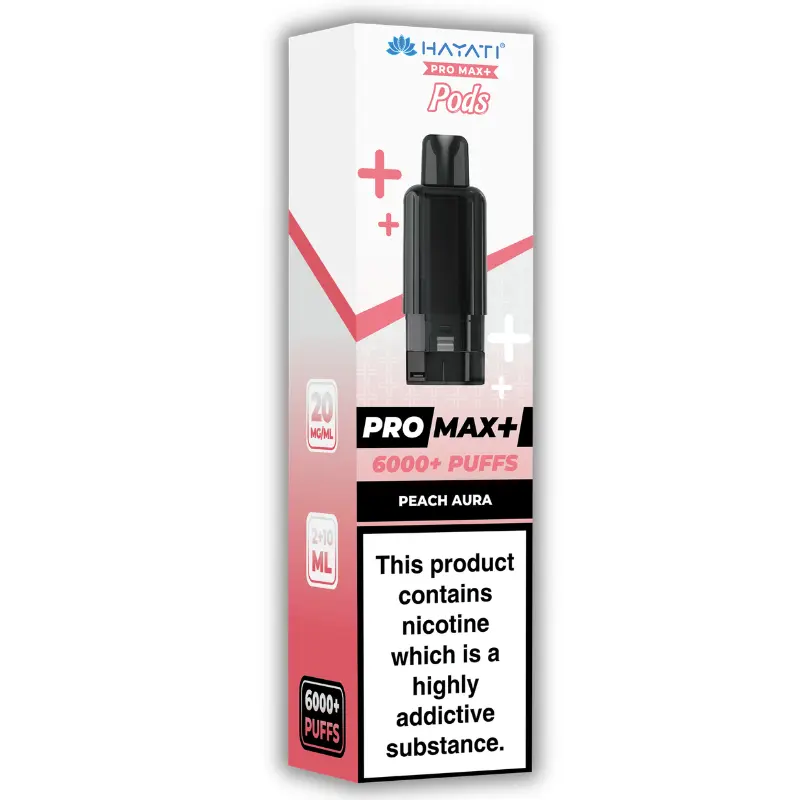
Hayati · Pro Max Plus
Peach Aura Hayati Pro Max Plus Pods
£5.49
✔ In stock — ready to ship
Genuine Hayati
Free over £20
Same-day dispatch
Secure checkout
Five pounds forty-nine buys one Peach Aura pod for the Hayati Pro Max Plus, supplied already holding 12ml of liquid at 20mg, with no body in the packet and no way to run it unless a Pro Max Plus is already yours. That narrows the audience to people restocking rather than people choosing, and it means the hardware questions are settled before anybody arrives here. What is not settled, and what this page is about, is the name.
Peach Aura is the odd one out in a very small family. Hayati attach the word Aura to three flavours and six listings in total, and two of those flavours are Sunset Aura and Galaxy Aura, neither of which names anything a person can taste. This one does. It puts an actual fruit in the first slot and then keeps the suffix, which makes it the only listing in the family where you can watch the two halves of the name behave differently side by side. One half tells you the fruit. The other half has already been shown, elsewhere in this corpus, to tell you nothing.
That is the useful property of this listing and the reason it gets a page of its own rather than a paraphrase of the kit page. Every other atmospheric name in the range leaves you with nothing to hold. This one hands you something solid and then attaches something hollow to it, and because the solid part is fixed, the hollow part can finally be measured. If peach is the flavour either way, what exactly is the buyer getting for the second word?
The answer turns out to be interesting rather than damning, and it is not the same answer in all three of the readings that survive scrutiny. What follows sets out the readings, weighs them against what Hayati have actually published, counts the claims before making them, and then does the part a buyer can act on: puts this listing next to the peaches on the same shelf that say what they are, at the same money, and works out what the uncertainty costs. The one thing this page will not do is describe a liquid nobody writing it has tasted.
Half a name that works, and half already shown not to
Treat the title as two slots rather than as a phrase, because the slots are doing unrelated jobs.
The suffix question was settled on the Midnight Dream kit page, and it was settled by pointing at this listing. The argument there runs that a coined second word like Dream or Aura is a series label rather than a description, and the proof offered was Peach Aura: nobody writes a real fruit in front of Aura unless Aura is free of flavour meaning, because otherwise the two words would be competing to describe the same liquid. That page reached its conclusion by looking over here. This page is not going to re-derive it, and not going to pretend the reasoning is original. The suffix carries no ingredient information. Take that as established and move on to the part it leaves open.
What it leaves open is the difference between carrying no ingredient information and carrying no information at all. Those are not the same claim, and the Midnight Dream argument only establishes the first. A word can fail to name a fruit and still be doing work. Ice names no fruit either, and it is one of the most load-bearing words in this catalogue. So the question this listing is uniquely placed to answer is not whether Aura names a flavour, which is closed, but whether it modifies one.
The first slot, by contrast, behaves exactly like the first slot on every declared listing around it. Peach is a fruit, it is one of the more distinctive fruits in the vaping repertoire because its character sits in aroma rather than in acid, and the catalogue backs the word up in its own filing. This product sits on five shelves and exactly one of them describes taste: Peach Vapes, which holds 32 listings across the whole catalogue. The product tags are peach, peach aura and nicotine salt e-liquid. Nothing in that record contradicts the word in the title, and nothing in it adds to the word either.
That is worth pausing on, because it is the first piece of real evidence about the suffix and it comes from Hayati's own back office rather than from their copywriting. Sunset Aura, which names no fruit, is filed on Exotic Vapes. Galaxy Aura, which also names no fruit, is filed on Berry Vapes and Exotic Vapes. Peach Aura is filed on Peach Vapes and nowhere else. Whoever assigned those shelves read the first word of each title, put the product where the first word pointed, and, where the first word pointed nowhere, reached for the two broadest buckets available. Across all six Aura listings, the word Aura has generated precisely zero shelf assignments. There is no Aura shelf. The kit versions of Sunset and Galaxy pick up Sweet Vapes as well; the Peach Aura kit does not, and neither does this pod.
Two readings of that are available and both are worth stating. The deflationary one is that the merchandiser saw a fruit, filed the fruit, and the suffix contributed nothing to a single decision anybody made about this product internally. The generous one is that filing collapses to the fruit whenever a fruit is present, so the absence of extra shelves tells you about the filing rule and not about the word. The second reading is fair, and it is why this is evidence rather than proof. What tips it slightly is the Sweet Vapes line: a merchandiser who thought Aura denoted a soft, sweet register had an obvious shelf available for it and used that shelf on the other two Auras. They did not use it here.
Counting the hybrid before leaning on it
The framing above calls this the hybrid listing, half informative and half empty, and a claim of that shape deserves counting rather than repeating. This corpus has a record of assigned angles containing rarity claims that fell apart the moment somebody checked, so here is the check.
The Hayati Pro Max Plus Pods shelf holds 89 listings. Four of them name a strength instead of a flavour, including Hayati Pro Max Plus Pods 20mg, and an earlier count in this corpus found that those listings do have a flavour in the underlying product data, as a family default, so they are not naming nothing so much as naming something else. Set them aside.
Of the remaining 85, fourteen put no tastable ingredient in the title at all. Black Mamba, Blue Fusion, Caribb Crush and Ice Pop are on that list, along with Blue Frozen, Fruit Twist, Mad Blue, Mr Blue, Pipeline Punch, Vim Ice, Summer Dream, Midnight Dream, Sunset Aura and Galaxy Aura. Some of those are arguable. Ice Pop names a form and a coolant, Fruit Twist names a family and a process, and the blue names are read by trade convention as the raspberry confection profile, which is a convention about naming rather than a statement of contents. Fourteen is the honest figure with the line drawn at whether a literal edible thing appears in the words.
Now the hybrids, meaning titles where a real ingredient sits next to a word that names nothing tastable. Peach Aura is one. So are Grape GB, Strawberry GB, Blue Razz GB, Blueberry B’Gum, Strawberry H’Bubba, Sakura Grape and Rocky Candy Orange. That is eight, and at least two of the eight are judgement calls: Blackcurrant Juice puts a form word next to a fruit and could be counted, and Blue Razz Fruit Twist stacks two conventions on each other. Call it eight with a margin of two either way.
So the strong version of the claim is dead. This is not the only hybrid on the shelf, it is one of roughly eight, and anybody who told you otherwise had not counted. What survives is a narrower claim, and the narrowing is where it gets useful.
Look at what the empty modifiers in that group actually are. B’Gum and H’Bubba are contractions pointing at bubblegum, which is a tastable confection, so they are opaque spellings of a real flavour reference rather than empty words. Rocky Candy points at confectionery. Sakura points at cherry blossom, which is an aroma term even if an unusual one. That leaves two genuinely contentless modifiers in the range: GB and Aura.
GB appears on 27 listings across the catalogue and every single one of them has a named fruit or the razz accord in front of it. Grape GB, Strawberry GB, Blue Razz GB, Red Razz GB. GB never appears attached to an abstraction, so there is no way to test what it contributes, because it has no contentless partner to be compared against. Dream sits on the other side of the same problem: Summer Dream and Midnight Dream are its only two flavours and neither names an ingredient, so Dream never appears attached to a fruit.
Aura is the only coined modifier in this catalogue that appears on both sides of that line. Two of its three flavours name nothing, one names a fruit, and all six listings sit on the same hardware at the same two prices. That is the narrowed claim, it survives counting, and it is the whole reason this listing can price the suffix when no other listing in the range can. The bolder version would have read better and it was not true.
One caution belongs here rather than in a footnote, because the corpus has a scar from it. A naming pattern is evidence about naming. It tells you how a title was arrived at, which department signed it off and what the range needed on the day. It does not tell you what is in a pod, and the step from one to the other is exactly where pages on this site have gone wrong before: two of them once reasoned from the name Pro Max Plus 4000 to flatly opposite conclusions about which pods that device accepts, and Hayati do not publish the answer either way, so both were inventions dressed as facts. Everything in this section is an argument about words. Where it turns into an argument about liquid, the join is marked.
Three things the empty half could be doing
Granting that Aura names no ingredient, there are three honest accounts of why the word is on the box. They are not equally strong and they are not mutually exclusive, so the job is weighing rather than picking.
One: it is series branding, and the buyer is meant to recognise a family
Hayati's own listing text supports this directly. Their copy for Galaxy Aura says the Aura blends are named for mood rather than ingredients, which is a company describing its own naming convention rather than describing a liquid, and it is the single most reliable sentence Hayati have published about any of these three products. A family is a structure. If a buyer liked one Aura, the label invites them to try the next, and on a grid of several hundred thumbnails a repeated word is a cheap way to get a second look.
The case against is a count, and it is a bad one for this reading. A series label built to earn shelf recognition gets spread. Summer Dream, which is the other coined name in the range, appears on eleven listings in its own right and on two more as half of a dual pod, and it turns up on the Pro Ultra Plus, the Mini Ultra, the Rubik, the Pro Max Plus, as a nic salt and as a shortfill. It has been pushed onto every format Hayati make. Aura has three flavours, six listings, and one device family. Peach Aura itself exists twice in the entire catalogue: this pod and the Peach Aura Hayati Pro Max Plus 6000 Pod Kit at £7.99, both containing the same 12ml.
There is a second problem with the branding reading, which is that the family is incoherent as a family. Sunset is a time of day, Galaxy is astronomy, Peach is produce. Three words from three unrelated domains, joined by a suffix, do not build the kind of recognition a series name is supposed to build. Compare that with a real merchandising family, where the members share a construction: the four Blue Razz pods on this shelf tell you at a glance that they are variations on one accord.
Branding is therefore real but minor. The word does make this listing findable as one of a set, and being one of a set of three on one device is not worth very much.
Two: it signals a treatment, so the word names nothing but modifies something
This is the reading worth the most attention, because if it holds then the suffix is earning its place even though it points at no ingredient. The claim would be that Aura marks a register: a soft, aromatic, rounded handling of whatever the first word names, as against a sharp or syrupy one.
The evidence for it is consistency. Hayati's copy across all three Auras pushes in the same direction. The Sunset text calls it gentle rather than sharp or icy. The Galaxy text promises a smooth, rounded finish instead of a sharp or sour one. Both of the Peach Aura listings, this pod and the kit, describe the fruit as soft and fragrant and specifically deny tang. Three flavours, four listings, one consistent register. Consistency of that kind is not nothing, and a page that waved it away would be being clever rather than honest.
Three things cut against it, and together they cut deep.
The first is that a reading which agrees with the name is not independent of the name. Whoever wrote that copy had the word Aura in front of them, thought about what an aura is, and arrived at soft and airy by the same short route any reader would. That is the name restated by somebody with a commercial interest, not a second source confirming it. The Midnight Dream page made this point about its own listing copy and it applies here without modification.
The second is a test the range itself supplies, and it is the most damaging single observation on this page. If Aura marked a softer handling than a plain peach, then a plain peach ought to read as less soft. Compare the copy for Juicy Peach, which sits on this shelf at this price with no suffix at all. Hayati describe that one as soft, ripe and honeyed too. The same vocabulary, unprompted by any coined word, attaches to the listing that is supposed to be the unmodified reference. If the modifier and the unmodified version get described identically, the modifier is not modifying anything in the description.
The third is that the treatment reading never gets stated as a specification. It lives entirely in prose, in hedged verbs. Hayati's word for what the suffix does is suggests. No number, no scale, no field in the product data. Contrast that with every commercial figure on the same listing, which is given flat and unqualified.
Where that leaves it: there is one thin difference between the two copy blocks, and it is the only differential in the entire published record. Hayati's Juicy Peach text mentions a small fresh tang at the close. Both Peach Aura texts explicitly rule tang out. So on the maker's own account, the distinction between the two solo peaches on this shelf is the presence or absence of a short sharp note at the end of the exhale, and nothing else. That is a real, testable, actionable claim, and it is also the weakest sort of evidence: retailer prose about an unpublished formulation, plausibly derived from the word rather than from the mixing sheet. Mark it probable at best.
Three: the range needed a name and this one was going spare
The least flattering reading is also the one with the most concrete mechanism behind it, and it is specific to this product in a way the other two are not.
Here is the mechanism. Hayati already sell a solo peach on this exact shelf at this exact price. Juicy Peach is not a niche listing either: counting the whole catalogue, it appears on ten listings in its own right and three more as half of a dual pod, spread across the Pro Ultra Plus, the Mini Ultra, the Rubik, the Pro Max Plus, a nic salt and two shortfills, and it has a dedicated flavour shelf of its own holding 13 products. It is one of the most heavily deployed flavours Hayati make.
Now suppose a second solo peach needs a listing. It cannot be called Peach, because that collides with the incumbent in every search box and on every grid. White Peach is spoken for by White Peach Raspberry. Peach plus a second fruit is spoken for several times over. What the new listing needs is a distinguishing word, and it needs one urgently, because two indistinguishable peach listings at £5.49 on one shelf is a merchandising problem before it is anything else. A coined suffix already in use on the same hardware costs nothing and solves it immediately.
On this reading the suffix is a disambiguator. Its function is to make the listing addressable, not to describe the liquid, and the information it carries is exhausted by the sentence this is the peach that is not the other peach.
The evidence for it is the narrow footprint already counted, the incoherence of the family, the absence of any Aura shelf or Aura tag structure in the catalogue, and the fact that the word arrived on a range large enough to have run out of unused fruit combinations. The corpus established that last point on the Sunset Aura page and it is not re-argued here.
The evidence against is that disambiguation and branding are hard to tell apart from outside, and that a company genuinely out of names would more likely have reached for another adjective than for a word already carrying two siblings.
Weighing them
All three are partly true, which is usually what happens when a naming decision gets made in a meeting rather than derived from a formulation. The proportions, as far as the published record supports them:
- Disambiguation is the strongest. It explains the timing, it explains why a fruit-named listing would take a suffix at all, and it needs no assumptions beyond the existence of a second solo peach on the same shelf.
- Series branding is real but small. The family exists and Hayati acknowledge it in their own copy. It spans three flavours on one device, which limits what recognition it can buy anybody.
- The treatment signal is possible and unproven. The register language is consistent across the family, which is genuine support, and it is undermined by appearing verbatim on the plainly named peach it is supposed to distinguish this one from.
Every line in that list is an inference from the catalogue and the listing text. None of it is a specification, none of it came from Hayati's formulation department, and a buyer who treats any of it as settled is doing something this page has spent two thousand words advising against.
What the record supports about the peach, and what it does not
Set the evidence out flat, because a page that reasons carefully about a name and then gets loose about the liquid has undone its own work.
What Hayati state for this listing:
- The product is Peach Aura, supplied as a replacement pod for the Pro Max Plus, with no device included.
- The pod arrives holding 12ml of liquid at 20mg nicotine.
- Hayati quote a ceiling of 6,000 puffs for the pod, which is a bench figure produced on test equipment rather than a measurement of anybody's use.
- The price is £5.49 and the stock reference is the listing handle itself.
- It is filed on five shelves, of which one describes flavour.
- One strength is offered. No alternative concentration is listed against this flavour.
- The liquid is a nicotine salt, per the product tagging.
What Hayati do not state:
- Which peach. No cultivar, no flesh colour, no white or yellow distinction of the kind the range is demonstrably capable of making when it wants to.
- Whether anything else is in the blend alongside the peach.
- Any figure for sweetness, acidity or cooling, for this or for any listing in the range.
- The ratio of vegetable glycerine to propylene glycol.
- The resistance of the coil inside the pod.
- Whether the liquid differs from Juicy Peach at all, beyond the two products having separate titles and separate stock codes.
That last blank deserves saying out loud rather than leaving on a list. Nothing published anywhere confirms that Peach Aura and Juicy Peach are different formulations. They are different listings, which is a fact about the catalogue, and the copy for each describes them slightly differently, which is a fact about the copy. Neither of those is a fact about liquid. It would be unusual for a manufacturer to ship one mix under two names on one shelf, and unusual is not the same as impossible, and the honest position is that the difference between them is asserted by prose and confirmed by nothing.
Here is the claim list with confidence attached, which is the format this corpus uses for listings whose name outruns their data.
- Reasonably confident, peach leads. The title names it, the catalogue files it on the peach shelf, and the tags carry it. Those signals are not independent of each other, since the filing almost certainly followed the title, but three weak agreeing signals beat none.
- Reasonably confident, no headline coolant. Hayati mark cooling in the title whenever it is present, which is why Banana Ice and Blackberry Ice announce it and this does not. The qualification is that no cooling figure is published for anything in the range, so an absent marker means no headline coolant rather than a guarantee of a completely warm liquid.
- Reasonably confident, single fruit. Every other peach on this shelf that contains a second component names it, in the title, in the order it matters. A range that consistently declares its second fruit has no obvious reason to conceal one here.
- Probable, sweet rather than tart. No acid word appears anywhere in the listing, sharpness is a selling point that gets stated when it is there, and both of Hayati's own texts for this liquid deny tang.
- Probable, aroma-led rather than jammy. Peach is a fruit whose character sits in its perfume. A soft handling of it, which is what the register language points at, would put the interest in the top end.
- Uncertain, what the suffix denotes. Branding, treatment or disambiguation, weighed above, with disambiguation ahead on the evidence.
- Uncertain and decisive, the close. Whether there is a short tang at the end of the exhale is the only published difference between this and the plainly named solo peach beside it, and it rests entirely on retailer prose.
- Unknown, the mechanical properties. Carrier ratio, coil resistance and sweetener loading are absent from this product's data and are not estimated here.
Reading the close yourself, on the pod in your hand
Since the record will not settle the one axis that separates this from its plainly named neighbour, settle it yourself. The advantage of a bare pod page is that most people reading it have the liquid already, which makes them the only party in this entire discussion with access to the evidence.
Ask one question and make it the right one. Not is this nice, which you have already answered by arriving at a reorder page, but does anything sharpen at the end. That is the axis the copy claims, it is the axis that would distinguish a treated peach from a plain one, and it is answerable in about a minute.
Take one slow draw on a rested palate, early in a session, not after coffee and not after anything sweet. Exhale fully. Then stop and pay attention to the ten seconds afterwards rather than to the draw itself, because the draw is sweet on any peach and tells you nothing. What you are listening for is whether a small brightness arrives late, the sort that makes the sides of the tongue register something rather than the middle. Present means tang. Absent means the copy's claim about this pod is holding up.
Record it as yes or no. Not as a description. Descriptions drift, they take colour from whatever you read last, and two of them a week apart cannot be compared. A binary can. Take the reading on four or five separate occasions across a few days and go with the majority, because a single reading on a tired palate is worth very little.
Anyone who wants the comparison rather than the reading needs a reference, and the reference is Juicy Peach at the same £5.49 on the same body. Run the same test on that pod and compare the two answers rather than the two experiences. If both come back the same way, the two listings are doing the same thing under two names and the suffix bought you nothing at all. If they differ, the suffix bought you a real formulation difference that Hayati declined to specify. That is a result either way, and it is a better one than any product page can hand you.
Do not try to name the peach variety on the first pod. The range does specify flesh colour when it chooses to, and this listing did not, so there is no answer waiting to be found. Placing the liquid is achievable. Identifying it mostly is not.
The pod itself, which is the short part
Roughly ninety listings share this pod format and the hardware has been covered to exhaustion elsewhere, so this section is deliberately brief and then gets out of the way.
What arrives is one item. A sealed pod carrying 12ml of liquid at 20mg, ready to work the moment it is seated. There is no filling, no priming from a bottle, no coil to fit and nothing to buy alongside it. The pod is not designed to be topped up, so when the liquid is gone the whole unit is finished, coil included. Check that the range name printed on your device matches the range name in this listing's title before ordering, and that is the whole of the compatibility question.
The one specification that actually matters for this particular liquid is the 12ml fill, and it matters because of what this page has spent its length on. Twelve millilitres is a long commitment to a single soft fruit with no coolant and no second component to break it up. On a declared two-fruit pod the second fruit gives the palate something to notice on day six. Here there is one note, held for the entire pod, and the verdict you reach at the end will be different from the one you reach on the first evening. That is not a criticism of the liquid. It is a property of buying one fruit in this quantity, and it is the reason the running-order advice further down is worth more on this listing than it would be on a busier blend.
Everything else about the platform, meaning how the pod seats, what shifts as a device ages and what else the body accepts, belongs on the Hayati Prefilled Pods & Refills shelf and on the kit listings, where it is set out properly. Repeating it here would spend words the naming question needs.
The figures, including the ones nobody entered
The table runs the liquid first, then the commercial lines, then the fields Hayati left blank. The blanks are printed on purpose. On a listing whose name is half empty, the empty rows are part of the subject, and setting them out stops a reader assuming the information exists somewhere they have not looked.
| Row | What the listing gives |
|---|---|
| Liquid in the pod | 12ml, filled before despatch |
| Nicotine concentration | 20mg, nicotine salt |
| Other strengths of this flavour | None listed |
| Fruit named in the title | Peach |
| Second component named | None |
| Cooling word in the title | None |
| Maker's puff ceiling | 6,000, a bench figure |
| Supplied as | Pod only, no device of any kind |
| Price | £5.49 |
| Same liquid with hardware | Peach Aura Pro Max Plus 6000 Pod Kit, £7.99 |
| Other formats of this flavour | None in the catalogue |
| Flavour shelf | Peach Vapes, 32 listings |
| Non-flavour shelves | Four, covering format and recency |
| Peach cultivar or flesh colour | Not specified |
| Vegetable glycerine to propylene glycol | Not given for this listing |
| Coil resistance | Not given for this listing |
| Sweetness or acidity rating | Published for nothing in the range |
| Brand | Hayati |
Three of those rows need a sentence attached. The 20mg entry is a concentration and nothing more. It describes what is dissolved in the liquid, 20mg is the maximum concentration permitted for sale in the United Kingdom, nicotine is addictive, and the figure is not offered here as a suggestion for any particular person.
The 6,000 figure belongs to Hayati and came off test equipment as a ceiling. A machine drawing at a fixed length and a fixed interval produces a number that no human use reproduces, so the honest use of the figure is comparing products measured the same way, never forecasting how long a pod will sit in your pocket. On a single-fruit pod there is an additional wrinkle: people tend to work steadily through a flavour they are comfortable with rather than reaching for it in bursts, so whatever the real figure is, it will arrive as a steady flat line rather than as a spike.
The two blank mechanical rows are the ones most often filled in wrongly by somebody else. A carrier ratio governs how dense the vapour is and how readily liquid moves through a wick. A resistance figure governs how tight the draw feels and how warm the vapour runs. Neither appears in this product's data, so neither is stated here, and any number for either that turns up on another site has been carried over from a different listing or assumed outright.
Against the peaches that say what they are
Here is the part a buyer can act on. Five other peach listings share this shelf, all at £5.49, all on the same body, and the naming differences between them are not decoration. They are the only information anybody has.
Start with the direct rival, because the whole page has been building to it. Juicy Peach is the solo peach with an English modifier instead of a coined one. It is worth noting that this corpus has already examined the word juicy and found it thinner than it looks: it describes a ripeness and a texture, it applies to any peach of any flesh colour at the right moment, and it narrows the field very little. So the comparison here is not empty against informative. It is one near-empty modifier against another, one made of ordinary English and one invented, and the practical differences between the two listings are these. Juicy Peach has a thirteen-strong footprint and appears on cheaper hardware and in bottled form, so it can be sampled for less and carried onto other devices. Peach Aura exists twice, on one device, and £5.49 is the floor. Juicy Peach's copy claims a tang at the close and this one's denies it. Everything else about them is identical on paper.
The listing that beats both of them on specificity is White Peach Raspberry, and it is the right reference point for anyone frustrated by this page. That title names a flesh colour, which is a real horticultural distinction with consequences for how the fruit eats, and then names its second fruit as well. It is the proof that this range can specify a peach precisely when it decides to, which is what makes the silence here a choice rather than a limitation. The trade-off is that the raspberry is there to sharpen the blend, so it is the opposite purchase to a soft solo peach rather than a more detailed version of one.
Peach Green Tea takes the third approach available to a modifier slot, which is to use it for a co-ingredient. Tea brings a light astringency and a faint bitterness that a fruit alone does not have, and the result reads closer to a drink than to a sweet. If what appeals about Peach Aura is the idea of a restrained peach rather than a sugary one, that listing pursues restraint by a declared route instead of an implied one, which is a materially better buy for the same money if restraint is the actual target.
Two listings use the slot for more fruit. Cherry Peach Lemon puts a stone fruit between a dark berry and a citrus, so the peach becomes the middle of a structure rather than the subject. Mango Peach Pineapple buries it in a warm tropical stack where it functions as the soft element holding the two sharper ones together. Both are worth knowing about for the same reason: if you like peach but find twelve millilitres of nothing but peach a long way to go, those are the listings that keep the fruit and add an event.
Off this shelf, Cherry Ice/Peach Mango Hayati Pro Ultra Plus 25K Pods at £7.99 is the other way of addressing the same problem, on different hardware, by putting two flavours in one pod with a collar that selects between them. Peach is present there but partnered with mango and set against a cooled cherry, so it is a different and busier proposition, and it only makes sense for somebody who already owns a Pro Ultra Plus body.
Anybody who wants the opposite of everything above has plenty of choice at the same price. Lemon Pineapple is the acid end of this shelf and the sharpest thing you can buy without a coolant in the title. Blackcurrant Mango puts a dark lead on a warm base and tells you both halves in two words. Blackberry Raspberry and Blueberry Raspberry Cherry are the plainest recipe names on the grid, two and three fruits respectively with nothing withheld. Dragon Berries sits between the two naming styles, giving you a fruit family and an unusual member of it.
For structure rather than fruit, Berry Lemonade sets a berry blend inside a carbonated citrus frame and Blue Razz Lemonade does the same job on the confection side. Those are different architectures rather than different fruits, and they answer a want that no solo peach can.
The summary, phrased for the person actually holding this pod and deciding whether to order another. Reorder it if the soft aromatic register is what you want and you have tested the close and found it clean, because on that evidence the suffix did denote something and you now have first-hand confirmation of a claim the listing only implied. Switch to Juicy Peach if your test came back the same for both, because at identical money the flavour with the wider footprint is easier to find again, easier to sample on cheaper hardware and easier to replace when a shelf runs dry. Switch to White Peach Raspberry or Peach Green Tea if what you actually wanted was a peach with something specified alongside it, because both of those name what this one leaves implied. And browse the Hayati Pods shelf or the full Hayati range if this has convinced you that a name you cannot parse is not worth the same money as one you can.
One point on the premium, since the angle asks for it. There is no monetary premium here. Peach Aura costs exactly what every other pod on this shelf costs, including the ones that tell you everything. The premium is paid in predictability rather than in money, which means the rational question is not whether the suffix is worth £5.49, but whether you would rather spend an identical £5.49 on a listing that leaves nothing to test.
Handling an aroma-led pod with no second landmark
General pod handling applies here as everywhere. The specific part concerns a soft single fruit whose interest lives in its perfume, which behaves differently in storage and in rotation from the busy blends most of this advice was written for.
Position it early in a rotation rather than late. A peach of this description carries no coolant, no acid and no dark weight, which means it is the flavour most easily flattened by whatever came before it. Run it after something sharp or something sweet and heavy and it will read as thin and faintly generic, and you will blame the pod. Run it first, on a palate that has not been worked, and it is legible. That is the reverse of the advice a dark sweet blend needs, and the reason is the same in both cases: the quiet flavour loses.
Heat is the enemy of an aroma-led liquid specifically. The compounds that make a peach smell like a peach are the volatile end of the blend, and they are the first thing to go when a pod spends an afternoon on a car dashboard or on a windowsill in the sun. A blend built on sweetness and body survives that with a shrug. This one goes quiet, and quiet is most of what you paid for. Room temperature, upright, out of direct light, and away from anything that gets warm.
Storage has one further condition that has nothing to do with flavour. Anything holding nicotine belongs where children and pets cannot get to it, and a sealed spare pod in a drawer is exactly the sort of object that gets left on a kitchen surface instead.
Knowing when the pod is finished is harder on this profile than on most, and the usual advice misleads. On a blend with a coolant or an acid, the end of a pod announces itself with a harsh edge. On a soft fruit there is nothing bright for the harshness to contrast against, so the decline shows up first as the perfume narrowing: the fruit is still there, still sweet, but flatter and less specific, as though somebody turned down the top end. Treat that narrowing plus a drop in vapour volume as the signal, rather than waiting for a scorched taste that a sweet soft liquid will half conceal.
Draw length is the only variable you have, and it does more on this liquid than on a busy one. A short, gentle pull favours the aromatic top of the peach. A long hard one pushes the sweetness forward and the perfume back, which on a three-fruit blend just changes the balance and on a solo fruit takes away the thing that makes it distinctive. If the pod has started to read as generic, try drawing shorter before concluding it is spent.
Do not buy three at once on the strength of the name. Twelve millilitres of a single soft fruit is already a long run, the question of whether it stays interesting to the last millilitre is a real one, and the answer arrives somewhere in the middle of the first pod. One is the correct order, and a second only after the halfway mark has been passed with the verdict intact.
When the pod is done it is electrical waste rather than household rubbish, because there is a heating element sealed inside it along with a film of residual liquid. Retailers selling vaping hardware generally accept spent units back over the counter, and household waste recycling centres list them separately from general refuse. The residue is the reason it should not go in with the recycling at home.
Questions about a name that is half information
Does Aura tell me anything about the flavour?
Not about the ingredients, no. That question was settled elsewhere in this corpus, and it was settled by pointing at this very listing: a company does not write a real fruit in front of a word that also describes flavour. What remains arguable is whether the suffix marks a register, meaning a softer handling of the peach, and the evidence for that is Hayati's own prose rather than any specification.
How is this different from Juicy Peach?
On the published record, by one thing. Hayati's text for Juicy Peach mentions a small tang at the end of the exhale and both of their texts for this one specifically deny tang. Everything else is identical on paper: same shelf, same £5.49, same 12ml at 20mg, same body. Nothing published confirms the two liquids differ beyond that sentence.
Is Peach Aura part of a range I should know about?
There are three Aura flavours and six listings, all on the Pro Max Plus, and the other two name no fruit at all. Hayati's own copy refers to them as a family. It is a small family on one device, so the label buys less recognition than a series name usually would.
Which kind of peach is it?
Not specified. The range demonstrably can specify one, because White Peach Raspberry names a flesh colour and that is a real distinction with real consequences for how the fruit eats. This listing declines to, so there is no answer to find rather than an answer hidden somewhere.
Is there any ice or cooling in it?
Probably not. Hayati put a cooling word in the title whenever a coolant is present, which is why several pods on this shelf announce it and this one does not. The caveat is that no cooling strength is published for any product in the range, so an absent marker indicates no headline coolant rather than a guarantee of none at all.
Is anything else in the blend besides peach?
Nothing else is named, and the range is consistent about naming second components: every other peach on this shelf that contains one puts it in the title. That makes a single-fruit reading reasonably confident, though it is an inference from naming behaviour rather than a stated ingredient list.
Can I get this flavour in a cheaper format to sample it?
No. Peach Aura exists in exactly two listings, this pod at £5.49 and the matching kit at £7.99, both holding the same 12ml. There is no bottle, no smaller pod and no version on cheaper hardware, so £5.49 is the smallest amount of it anyone can buy.
What is in the packet for the money?
One sealed pod holding 12ml of liquid at 20mg, and nothing else at all. No device, no charging accessory, no spare. It does nothing without a Pro Max Plus body you already own, which is why the kit listing exists at £7.99 for anyone who does not have one.
How reliable is the 6,000 puff figure?
It is Hayati's ceiling, produced on bench equipment drawing at a fixed length and interval. Real use never reproduces a laboratory maximum, so the sensible use of the number is comparing products measured the same way rather than predicting how long this pod will last you.
Is there a lower-strength version?
Not for this flavour. One concentration is listed against Peach Aura, which is 20mg, and no alternative appears in the product data. Nicotine is addictive and the figure states what the liquid contains.
Should I reorder this or move to a pod that names its contents?
Test the close first. Take four or five readings on whether anything sharpens ten seconds after the exhale, and compare that answer against the same test on a plainly named peach. If the answers match, the suffix bought you nothing and the plainly named listing is the easier one to keep buying. If they differ, you have confirmed a formulation difference the listing only implied.
What the suffix is worth, plainly
Peach Aura is a replacement pod at £5.49 carrying 12ml of liquid at 20mg, with no device in the packet, a maker's bench ceiling of 6,000 puffs, and one flavour shelf to its name. The peach in the title is real and the catalogue backs it. The word after it has been shown, on the corpus's own established argument, to name no ingredient, and this is the one listing in the range where that word sits beside something solid enough to measure it against.
Measured, it comes to this. The strongest account of the suffix is that it exists to keep this listing distinguishable from the solo peach already on the same shelf at the same price, which is a job about the catalogue rather than about the liquid. A weaker but real account is that it marks a family of three, on one device, which is a small amount of shelf recognition. The account most flattering to the buyer, that it signals a softer and less tangy handling of the fruit, is supported by consistent language across the family and undermined by the same language turning up on the plainly named peach it is meant to distinguish this one from. Each of those is an inference with its working shown above, and none is a specification.
What the buyer gets that a plainly named peach does not is therefore not more flavour information. It is strictly less, at the same money, with one testable implication attached: that the close is clean rather than tangy. If that axis matters to you, it is answerable in a minute on a pod you already own, and the answer is worth more than anything a listing could have told you. If it does not matter to you, the shelf is full of peaches that specify a cultivar, a partner fruit or a co-ingredient for the identical £5.49, and there is no reason to pay the same for a word that names nothing.
Strictly for adults aged 18 and over. Nicotine is an addictive substance.
You might also like


