Home / Hayati Pro Max Plus Pods / Lemon Pineapple Hayati Pro Max Plus Pods
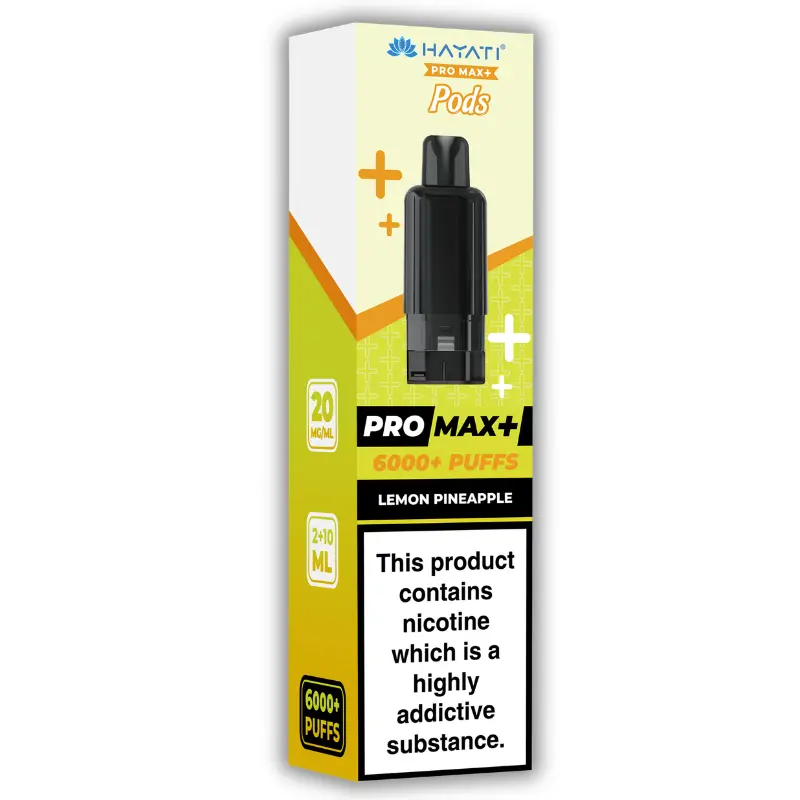
Hayati · Pro Max Plus
Lemon Pineapple Hayati Pro Max Plus Pods
£5.49
✔ In stock — ready to ship
Genuine Hayati
Free over £20
Same-day dispatch
Secure checkout
Lemon Pineapple arrives as one sealed pod, filled at the factory, shaped to drop into a Hayati Pro Max Plus body and sold on its own at £5.49 with no device alongside it. Inside sits 12ml of liquid at 20mg, and Hayati attach a rating of up to 6,000 puffs to it, a figure produced by a machine under laboratory conditions rather than by anybody holding the thing in their hand. Two fruits are named and nothing else is. No coolant, no soft or creamy element, no drink or dessert framing. That is the entire specification, and on its own it would justify a fairly short page.
What makes this listing worth more than a short page is the one sitting beside it. Pineapple Lemon Burst is also a Pro Max Plus pod, also £5.49, also on the same 89-product shelf, and it names the same two fruits the other way round. Nothing else separates the two entries. Same format, same volume, same strength, same price, same manufacturer, same shelf, same photograph style. The only difference a buyer can actually see at the point of purchase is which fruit is printed first.
That arrangement deserves to be taken seriously, because it converts an ordinary shopping decision into something much closer to a test. If word order in a two-fruit name carries information, this is precisely the pair where the information would show up, and a reader who learns to read it picks up a small permanent edge every time they scan a shelf full of blended flavours. If the order carries nothing, then two listings are competing for the same £5.49 on the strength of a typographical difference, and a buyer is owed that fact before they pay rather than afterwards.
The Pineapple Lemon Burst pods page has already delivered a verdict on the second half of that. It names Lemon Pineapple as the purchase most often wasted on this shelf, on the grounds that reversing the fruits in a name changes the label without changing the stimulus. This page does not re-argue the point, and it does not need to. It asks the question sitting underneath it, which nobody has yet checked against the catalogue: is there any evidence at all, anywhere in Hayati's own data, that the order of fruits in a product name means something?
Two names, two fruits, and an experiment nobody ran
The claim that this pair is unusual is the sort of thing a product page asserts casually and never checks. So before anything else, here is the check. Everything that follows was counted in the same catalogue this shop lists from, so the numbers describe what is actually purchasable here rather than what the range looks like from memory.
How rare the reversal actually is
There are 492 Hayati listings in the catalogue. Strip the hardware name off each title and 173 distinct flavour-name strings remain. Some of those are dual listings with two names divided by an oblique, and splitting those into their halves leaves 152 distinct flavour names in total. Of those 152, exactly 50 name two or more different fruits. That is the population in which a word-order question can even arise: 50 names, everything else being either a single fruit, a mood word, a drink, a confectionery reference or a strength-only entry.
Within those 50, nine fruit combinations are used by more than one name. Strawberry and watermelon appear under three separate names. Lemon and lime appear twice. Strawberry and banana, strawberry and guava, blueberry and raspberry, strawberry and raspberry, orange with lemon and lime, all doubled up. Reusing a fruit pairing under a second name is therefore fairly normal for Hayati, which matters, because it means the opportunity to reverse an order comes up regularly.
Of those nine repeated combinations, how many appear in more than one order? Two. Strawberry, cherry and cranberry appear as Strawberry Cherry Cranberry and, separately, as Straw' Cranberry Cherry. Lemon and pineapple appear as Lemon Pineapple and as Pineapple Lemon Burst. That is the complete list. Seven of the nine repeated combinations keep the fruits in the same order every time, even when the rest of the name changes: Strawberry Watermelon and Strawberry Watermelon Bubblegum and Straw' Watermelon B'Gum all put strawberry first, Blueberry Raspberry and Blueberry Raspberry Menthol both put blueberry first, and so on.
Tighten the test one notch and the number falls further. A strict reversal, meaning the same words in the opposite order with nothing added and nothing removed, occurs zero times in 492 listings. Both of the two reorderings also change a word. One gains "Burst"; the other abbreviates strawberry. So this is not a pattern with a handful of instances that can be cross-referenced against each other. It is two cases, and one of them is malformed.
The second filter is the one that leaves this page with a genuinely singular pair. Of the two reorderings, only lemon and pineapple puts both names on the same shelf at the same price. Strawberry Cherry Cranberry exists as a nic salt at £2.49, a Pro Max Plus kit at £7.99 and a Pro Max Plus pod at £5.49, while its reordered twin Straw' Cranberry Cherry exists on the Mini Ultra range at £3.49 and nowhere else. Those two never meet. A buyer is never choosing between them, because they are choosing a device first. Lemon Pineapple and Pineapple Lemon Burst do meet, on the Pro Max Plus pod shelf, at an identical price, in the same scroll.
So the framing that brought this page into existence survives counting, and in fact comes out stronger than it went in. This is not one of several reversed pairs. It is one of two in the whole catalogue, and the only one where the reversal is the sole variable a buyer is asked to price.
What the order would have to mean for it to be worth money
Naming conventions in flavoured products are not arbitrary in principle. The most natural convention, and the one most people assume without articulating it, is that the fruit printed first is the fruit that dominates: it arrives earliest, it occupies the most volume, it is the note you would name if somebody handed you the liquid unlabelled. Under that convention, Lemon Pineapple is a citrus liquid with tropical support and Pineapple Lemon Burst is a tropical liquid with citrus cutting across it. Two genuinely different drinks wearing very similar labels.
If Hayati observed that convention reliably, the order would be a real specification and reading it would be worth learning, right across the range. You could look at Blackcurrant Mango and know the blackcurrant is the body. You could look at Cherry Peach Lemon and know the lemon is the trim rather than the structure. Three-fruit names would become a ranking rather than a list. That is a meaningful amount of information to get free from a title, and it would settle this purchase in ten seconds.
The convention is testable, which is the useful part. Hayati write their own flavour paragraph for every listing, and those paragraphs say which fruit does what. If the naming convention is real and observed, the paragraphs should consistently lead with the first-named fruit. If it is decoration, they should not. What follows is that test, run three ways, and then the two pieces of evidence that decide it.
Test one: does the copy follow the name?
Take every single-flavour listing whose title names two or more different fruits and which carries a flavour paragraph long enough to mention at least two of them. That is 137 listings. In each one, note which of the named fruits the flavour paragraph mentions first.
The first-named fruit leads the paragraph in 120 of them, or 87.6%. It does not in 17, or 12.4%.
Taken alone, that looks like a convention. Nearly nine listings in ten put the fruit that leads the description at the front of the title, and a coin would not produce that. Somebody at Hayati is broadly writing titles and descriptions in the same order, most of the time, and a reader who assumed the first fruit leads would be right far more often than wrong.
The trouble is what that number actually measures. It measures agreement between two pieces of text written by the same person in the same sitting, not agreement between a name and a liquid. A copywriter given a title and asked for a paragraph will naturally recite the fruits in the order they were handed. The 87.6% is therefore consistent with a real convention about flavour, and equally consistent with nothing more than the ordinary habit of reading a title left to right before writing about it. On its own it proves that Hayati are internally tidy. It does not prove the tidiness is about the liquid.
Test two: does the copy agree with itself?
There is a way to separate those two explanations. Many Hayati flavours exist on several platforms at once. The same recipe turns up as a Pro Max Plus pod, a nic salt, a Mini Ultra pod, a Rubik pod and a shortfill, each with its own separately written description. If the order in the name tracks something real about the liquid, then every description of the same name should agree about which fruit leads, because the liquid does not change when the packaging does.
Thirty-three multi-fruit names appear on two or more listings with usable flavour text. Twenty-four of them give a consistent lead fruit across every listing. Nine do not. That is 27% of repeated names where Hayati's own copy contradicts itself about which fruit is in front, for a recipe sold under one name.
The examples are worth spelling out, because the pattern in them is instructive. Blue Razz Cherry appears on eleven listings; eight lead with the blue raspberry and three lead with the cherry. Blueberry Cherry Cranberry appears on seven listings and manages three different answers: four lead with blueberry, two with cranberry and one with cherry. Blueberry Raspberry appears on eleven and nine of them lead with blueberry. Strawberry Guava appears on three and two of them lead with guava, which is to say the majority of its own descriptions contradict its own title. Strawberry Kiwi, Mango Peach Pineapple and Guava Kiwi Passion Fruit are all in the same condition.
The inference here needs marking as an inference, so here it is explicitly. A 27% self-contradiction rate does not prove the copy is unrelated to the liquid. It could mean several writers tasted the same liquid and honestly disagreed, which happens, or that different formats genuinely present a blend differently, which is plausible for a 70/30 shortfill run through a large coil against a small pod. What it does prove is narrower and sufficient: Hayati's description of which fruit leads is not stable enough to be treated as a measurement. If the same name can be described three different ways, the name cannot be carrying the information those descriptions disagree about.
Test three: the pair itself, which is where it falls apart
Now apply all of that to the four listings that matter. Lemon Pineapple and Pineapple Lemon Burst each exist twice, as a bare pod and as a kit with the device included. Four descriptions, two names, two fruits. If the order means anything, the two lemon-first descriptions should lead with lemon and the two pineapple-first descriptions should lead with pineapple.
Here is what they actually do. The Lemon Pineapple pod listing, this one, leads with the lemon. The Lemon Pineapple kit leads with the pineapple, describing it as the body and putting the lemon on top of it as a sharpener. The Pineapple Lemon Burst pod listing leads with the lemon. The Pineapple Lemon Burst kit leads with the pineapple, in a sentence structured almost identically to the one on the Lemon Pineapple kit.
Read that again with the names removed. Both pod listings say lemon leads. Both kit listings say pineapple leads. The split is two against two, and it does not follow the name at all. It follows the format.
That finding is worse for the naming convention than a random split would have been. A random split would have suggested sloppiness. This is a clean pattern, and it is a pattern in the wrong variable. Whether a listing includes a device cannot possibly change which fruit arrives first in the liquid, because it is the same 12ml prefilled pod inside either box. The kit adds hardware to the purchase and adds nothing to the pod. So the only variable that predicts Hayati's stated lead fruit across these four listings is one that has no physical relationship to the liquid whatsoever, and the variable a buyer is being asked to pay attention to predicts precisely nothing.
The likeliest explanation, and it is offered as a probable reading rather than a certainty, is that kit copy and pod copy were written as two separate batches by two different hands or in two different sittings, and each batch settled into its own habit. On that reading the lead fruit in these paragraphs records who was typing, not what is in the pod.
The sentence that gives the game away
One detail in this listing's own source text is worth dwelling on, because it is unusually candid. Hayati's flavour paragraph for Lemon Pineapple does not merely assert that the citrus leads. It offers a justification for why the citrus leads, and the justification is that lemon is the first word in the name.
That is circular, and it is circular in a specific and revealing way. The description is not reporting a property of the liquid and then noting that the name happens to match. It is reading the name and deriving the description from it. Anybody who has written product copy at volume will recognise the move immediately: with 492 listings to fill, the title is the only reliable input, so the title becomes the source. It is not dishonest, and it is not unusual. It is simply not evidence about the liquid, and it cannot be used as evidence, because the thing it is derived from is the thing we were trying to test.
Once that sentence is noticed, the 87.6% concordance from test one loses most of its remaining weight. Of course the descriptions follow the titles: at least one of them says out loud that it was written from the title. The correlation is an artefact of the process, not a finding about flavour.
The Burst grammar, which should have settled it in the other direction
There is a fair objection to everything above, and it deserves a proper answer rather than a dismissal. "Pineapple Lemon Burst" is not simply "Pineapple Lemon" with the fruits swapped. It is a three-token name, and the third token might be doing grammatical work that changes how the first two should be read.
The catalogue contains exactly two names ending in "Lemon Burst": Pineapple Lemon Burst and Watermelon Lemon Burst. Both descriptions of Watermelon Lemon Burst, one for a 70/30 liquid and one for a 50/50 shortfill, agree with each other completely. In both, the watermelon lays down a soft, light base and the lemon is the thing that bursts through it. The grammar of the sub-family is therefore clear and consistent: the first fruit is the foundation, "Lemon Burst" is a single unit naming the sharp element that cuts across it, and the name reads as base plus interruption rather than as a ranking.
Applied to Pineapple Lemon Burst, that grammar predicts a pineapple-bodied liquid with lemon slicing through it. Which is exactly what the Pineapple Lemon Burst kit description says. It is also exactly what the Pineapple Lemon Burst pod description contradicts, by putting the lemon first and having the pineapple take over afterwards. So even the one naming convention in this corner of the range that is internally consistent across two listings gets broken by the third listing that should have obeyed it.
Note what this does to the comparison, though, because it is the one place where the two names might genuinely differ. If the Burst grammar is taken at face value, Pineapple Lemon Burst is making a structural claim that Lemon Pineapple is not: it claims a soft base with a sharp interruption. Lemon Pineapple, a bare two-word name with no modifier, claims nothing structural at all. That is a real asymmetry between the two titles, and it is the only one. It is also, being a claim about grammar rather than about liquid, not something to spend money on.
The control pair, which quietly confirms it
The other reordering in the catalogue behaves like a control, and it is useful precisely because the two names never compete for the same buyer.
Strawberry Cherry Cranberry and Straw' Cranberry Cherry name the same three red fruits in different sequences. Their descriptions do follow their titles: the first recites strawberry, then cherry, then cranberry, and the second recites strawberry, then cranberry, then cherry. On test one they both count as obedient. But read past the order and look at what each fruit is said to be doing, and the two accounts are identical. In both, strawberry supplies soft sweetness. In both, cherry supplies depth and body. In both, cranberry supplies the dry tartness that keeps the blend from going syrupy, and in both it is singled out as the element that defines the character.
The roles are the same. Only the recitation order changed, and it changed to match the label. That is as close to a controlled demonstration as this catalogue offers: hand a writer two different orderings of the same three fruits and they will recite them in the order given while assigning every fruit the same job. The order is being copied, not measured.
The verdict, graded
Setting out the confidence levels separately is more honest than a single flat conclusion, because these claims are not all equally solid.
- Reasonably confident. The order of fruits in a Hayati name is not a reliable guide to which fruit leads the liquid. Hayati's own copy contradicts itself on 27% of repeated names, splits two against two on this exact pair, splits along format rather than name, and in this listing's case openly derives the lead fruit from the title.
- Reasonably confident. This pair is the only same-price, same-shelf reversal in 492 listings, so nobody should expect another chance to learn the rule from experience. There is no third case to check yourself against.
- Probable. Lemon Pineapple and Pineapple Lemon Burst are the same recipe, or near enough that the difference is smaller than ordinary batch variation. The fruits are identical, the price is identical, the format is identical, and Hayati's four descriptions of them assign lemon and pineapple the same two jobs throughout: lemon is the sharp one, pineapple is the sweet one with the body. Nothing in the data suggests two separate formulations, and nothing confirms they are one.
- Unknown, and it is the axis that would decide the purchase. Whether the two liquids differ measurably in the ratio of lemon to pineapple. Hayati publish no ratio, no flavour concentration, no formulation reference and no batch coding for either. There is no document that would settle it, and no way to settle it from the listings.
- Unknown. Whether the naming difference was ever intended to signal anything. It is equally consistent with two liquids developed separately and named descriptively, and with one supplier line listed twice under two labels. Both happen in this trade.
The practical form of all that: buy one of the two. Do not buy both expecting a comparison, because the most likely outcome is that you spend £10.98 to discover you cannot tell them apart, which is a finding you can have here for nothing. If you want a reason to pick, prefer the bare two-word name when you want no structural promise made to you, and prefer the Burst name if you would rather have a title that at least commits to a shape. That is a preference about labelling, and it should be priced accordingly, which is to say at zero.
What is actually in the pod, and how much of it is knowable
Everything above is about the label. This section is about the liquid, and it is written with the previous section's conclusion in force: Hayati's stated balance for this pod is a description derived partly from its own title, so it gets reported as their account rather than repeated as fact.
Their account is that the citrus leads and the tropical fruit supports, with the lemon supplying a bright, lemonade-adjacent sharpness and the pineapple filling out the middle so the blend does not read as thin. That is a coherent description of a liquid and there is no particular reason to doubt it. It is simply not independent of the name it appears under, and a buyer should hold it slightly more loosely than they would hold the volume or the strength.
The two fruits, and what each of them can and cannot do
What can be said with more confidence comes from the fruits themselves, because lemon and pineapple behave in fairly predictable ways in a vaporised 20mg liquid regardless of who wrote the copy.
Lemon in this category is almost always a bright, high-pitched note that arrives early and leaves quickly. It occupies the front of the mouth, it registers as acidity more than as sweetness, and it has very little weight. A lemon note is the first thing you notice on a fresh pod and among the first things to fade as a coil accumulates residue. It does not linger, and it does not fill space. Used alone, it reads as thin, which is why a straight lemon liquid is rare and a lemon paired with something is common.
Pineapple does the opposite job. It carries genuine body, it is sweet before it is sharp, and it has a slightly resinous, almost waxy quality at the back of the palate that stays after the first impression has gone. Pineapple is also one of the fruits that reads most clearly as itself: where a generic red berry can be almost anything, pineapple is recognisably pineapple. Its acidity is real but it is a rounder acidity than citrus, arriving as tang rather than as bite.
Put together, those two give a liquid with a fast, sharp opening and a broader, sweeter close, in whichever proportion the formulation happens to use. The sequence is not really negotiable: lemon arrives first because lemon arrives first, as a property of the aroma compound rather than of the recipe. That is worth knowing because it explains something about this whole argument. Both fruits could be present in any ratio and the lemon would still be the first thing you register, which is a large part of why descriptions of these two liquids keep disagreeing. The order of arrival and the order of dominance are different questions, and the copy does not distinguish them.
Sweetness, and the absence of anything cold
Nothing in the listing indicates a coolant. Hayati signal cooling explicitly when it is present, and 34 of the 152 flavour names in the catalogue carry an Ice, Frozen, Cooler, Menthol, Mint or Cold word in them. This name carries none, and the description mentions none. Expect a room-temperature fruit liquid with no menthol lift at all. If cold is part of what you want from a citrus pod, Pineapple Ice is the listing that puts the same tropical fruit behind a coolant, and it is a cleanly different product rather than a variation on this one.
On sweetness, expect it to sit in the middle of the Pro Max Plus range rather than at either end. Two acidic fruits with no cream, custard, biscuit or bubblegum element cannot reach the sweetness of something like Blue Razz Fruit Twist or a confectionery-framed pod, and the pineapple keeps it well clear of the austerity of a pure citrus. It is tangy-sweet rather than sugary, and the acid gives it a slightly drying finish that some people find makes it easier to run for long stretches and others find tiring by the afternoon.
What it is not
It is not a lemonade. The distinction matters because four of its shelf neighbours are, and they are a different sort of drink. A lemonade profile in this range means a sweetened, slightly rounded, carbonated-feeling base that softens whatever fruit is sitting on it, which is what Pink Lemonade, Berry Lemonade, Blackcurrant Lemonade and Blue Razz Lemonade all do. This pod has no such base. The lemon here is fruit, not a drink, and it hits without anything underneath it to cushion the landing.
It is not a tropical blend in the usual sense either. Tropical, in this range, generally means two or three soft fruits layered for weight, as in Mango Peach Pineapple. One tropical fruit with a citrus on top is a much narrower proposition, and it will feel sparse next to those if sparseness is not what you were after.
And it is not a sour liquid. Acidity and sourness are separate axes. Hayati make genuinely sour listings, with Blue Sour Raspberry the obvious one on this shelf, and they use the word when they mean it. This pod is acidic in the way fruit is acidic, without the puckering additive that a sour listing carries.
Reading it for yourself, since the listings cannot
Given that Hayati's own descriptions of this pair disagree, the only reliable account of what is in your pod is the one you produce. This takes about five minutes with a fresh pod and is worth doing once, because the result generalises to everything else you buy in this profile.
Start cold, before the device has been used that day, and take a single draw of about three seconds without deciding anything in advance. Pay attention only to the first half-second and note which fruit is there. That is the arrival note, and it will almost certainly be the lemon.
Wait thirty seconds and take a second draw, this time holding the vapour briefly and paying attention to what is still present as it clears. That is the finish, and it will almost certainly be the pineapple. Neither of those two findings distinguishes anything, because they would be true of any lemon and pineapple liquid at any ratio.
The useful measurement is the third one. Take four or five ordinary draws in a row at your normal pace, then stop and ask which of the two fruits you would name if somebody asked what you had been vaping. That answer is the dominance question, and it is the only one that separates a citrus-led liquid from a pineapple-led one. Write it down, in one word, before you look at the label again. If you ever buy the reversed listing, run the same test on it, in the same three steps, and compare the one-word answers rather than your impressions. That is the whole natural experiment, and you can run it for £5.49 at a time.
The pod, briefly, and the one number that bears on this
The hardware side of this purchase is short because there is very little of it. What arrives is a single sealed pod containing 12ml at 20mg, and no device. The Hayati Pro Max Plus body is bought separately, and if you are reading this page you almost certainly own one already, since nobody buys a bare pod speculatively. Check that the range name on your device matches the range name in this title before ordering, because Hayati make several pod ranges and they are not interchangeable.
The one specification that actually bears on a liquid like this is the 12ml volume, and it bears on it for a reason specific to citrus rather than for the obvious reason. Twelve millilitres is a long run for a single coil. That is convenient, but a bright lemon note is the part of a blend that degrades earliest as a coil ages, so on a pod this size the flavour you are assessing at the end is measurably not the flavour you assessed at the start. On a sweeter, heavier blend the drift is easier to ignore. On this one it lands directly on the element the whole page has been arguing about, which means any conclusion you draw about lemon dominance should be drawn early in the pod's life rather than late.
Everything else about the platform, the device itself and the rest of the flavours it takes, is covered on the Pro Max Plus pod shelf, which is the right place to browse rather than reading it repeated here. The pod is not refillable and there is no user-serviceable part inside it.
The listing in rows
The table below is ordered to put the naming question at the top, because that is the axis this particular purchase turns on, and to put the unpublished items together at the bottom so the gaps are visible as a group rather than scattered.
| Name as printed | Lemon Pineapple |
| Reversed twin, same shelf | Pineapple Lemon Burst, also £5.49 |
| Fruits named | Lemon, pineapple |
| Cooling word in the name | None |
| Format | Single prefilled replacement pod |
| Device supplied | No, Pro Max Plus bought separately |
| Liquid volume | 12ml |
| Nicotine | 20mg |
| Manufacturer capacity figure | Up to 6,000 puffs, obtained on laboratory equipment |
| Price | £5.49 |
| Maker | Hayati |
| Catalogue slug | lemon-pineapple-hayati-pro-max-plus-pods |
| Carrier ratio | Not published |
| Coil resistance | Not published |
| Flavour ratio of lemon to pineapple | Not published, and not inferable from the name |
Two rows deserve a note. The 20mg strength is the maximum permitted in a UK consumer nicotine product, so it is not a choice Hayati made about this flavour in particular, and it tells you nothing about how the liquid is balanced. If a lower strength suits you better, the same platform is sold as 5mg prefilled pods and as 20mg prefilled pods under generic listings where the flavour is set as a family default rather than named in the title.
The capacity figure is the other one worth handling carefully. Six thousand is a laboratory output, generated by a machine taking uniform draws at a fixed interval, and no human draws that way. It is best read as a rough indication of how much liquid is in the pod rather than as a forecast of how long yours will last, which depends entirely on how you use it.
Where to go instead, and how to handle the next lookalike pair
The comparison section on most pages exists to rank neighbours. This one has a second job, which is to leave the reader with a procedure, since the whole argument above only pays off if it generalises past this one pair.
A rule for two listings that look the same
When two listings on a shelf look like near-duplicates and you are trying to work out whether the difference is real, four checks settle it quickly and in this order.
First, check whether the difference is a fruit or a modifier. Modifiers are load-bearing and fruit order is not. Ice, Frozen, Cooler, Menthol, Mint, Sour, Fizzy, Lemonade and Mojito all describe a treatment applied to the fruit, and Hayati use them consistently, which is why 34 of the 152 names in the catalogue carry a cooling word and none of them are cold by accident. A difference in modifiers is a real difference in product. A difference in fruit sequence, on the evidence above, is not.
Second, if one name has an extra fruit and the other does not, believe it. An added fruit is a compositional claim and it has to be in the liquid to be on the label. Pineapple appearing in Blue Razz Pineapple means the pineapple is there. The order it appears in does not tell you how much.
Third, read both flavour paragraphs, and do not compare the order in which the fruits are recited. Compare the jobs assigned to them. If one listing says a fruit sweetens and the other says the same fruit sharpens, that is a difference worth investigating. If both assign the same jobs in a different sequence, you are reading one drink described twice, which is exactly what the strawberry, cherry and cranberry pair turned out to be.
Fourth, if a flavour exists on more than one platform, read two or three of those descriptions before trusting any of them. Where they agree, the account is probably stable. Where they disagree, as they do for a quarter of repeated names here, treat the whole paragraph as atmosphere and buy on format, price and modifier instead.
The neighbours worth naming
If the honest conclusion is that this pod and its reversed twin are interchangeable, then the useful comparisons are not against the twin at all. They are against the pods that change one thing you can verify.
For the same citrus register without the tropical half, Lemon Lime is the obvious move. It removes the sweeter body entirely and leaves two citrus fruits standing on their own, which makes it drier, more angular and considerably less forgiving over a long session. Take it if your finding from the test above was that you wanted the lemon louder rather than the pineapple quieter.
For the tropical half with a coolant instead of the citrus, Pineapple Ice is the single-variable swap. Same fruit in the lead position, acid replaced by cold, and whichever way you react to it you learn something about which of the two elements you were actually enjoying.
For the tropical half with more weight underneath it, Mango Peach Pineapple stacks three soft fruits and removes the sharp edge altogether. That is a genuinely different shape of liquid, not a variation, and it suits a completely different mood. Blackcurrant Juice does something comparable from the dark-fruit end, with a rounder body and a tartness that sits lower in the mouth than citrus does.
For the lemonade treatment, the four lemonade pods named earlier are all sweeter and rounder than this, and Pink Lemonade is the closest of them to a citrus-led profile. If what appealed about this listing was the lemonade-like brightness rather than the pineapple, that is where to look, and it is a better answer than the reversed twin.
If you are rotating rather than replacing, the useful neighbour is one that sits as far from this as possible, so the two do not blur into each other. Blackberry Raspberry and Blackberry Ice are dark and low where this is bright and high. Cola Ice leaves fruit behind for a drink profile entirely, and the apple, banana and cherry listings on the same shelf are further still. A rotation partner that shares no fruit with this one is the arrangement most likely to keep both tasting like themselves.
Two listings on the shelf are named for a mood rather than an ingredient, and they are worth mentioning here only as a contrast. Blue Fusion and Black Mamba name no fruit at all, so a buyer cannot even attempt the sort of reading this page has been doing. Between a name that gives you two fruits in an unreliable order and a name that gives you none, the first is still substantially more informative. The argument here is that fruit order carries no signal, not that fruit names carry none.
If you would rather have the device alongside the flavour, the Lemon Pineapple kit puts the same pod in a box with a Pro Max Plus body for £7.99, which is the cheapest way into the platform if you do not already own one. And if you want to look through the full range yourself rather than take a page's word for any of it, the same pod appears under Lemon Vapes and Pineapple Vapes, which are the two shelves where reversed and near-reversed names sit closest together and the counting exercise above is easiest to repeat. Hayati Prefilled Pods and Refills holds every refill across every range, and the full Hayati catalogue is where the 492-listing figure comes from.
Running the pod
Practical handling for this particular liquid, with the citrus question kept in view throughout, because that is what distinguishes the advice here from the generic version.
Give a new pod a few minutes seated in the device before the first draw. A pod that has travelled cold and been opened immediately has not had time for the wick to take up liquid evenly, and the penalty for rushing shows up first as a harsh, slightly scorched top note. On a citrus-led blend that harshness is easy to mistake for the lemon being sharper than expected, which is exactly the observation this page has asked you not to draw conclusions from. Wait, then taste.
Draw slowly and for longer rather than quickly and repeatedly. The restricted, narrow mouth-to-lung path on this platform rewards a measured pull, and a series of short sharp draws in quick succession outruns the wick's ability to keep up. The result is a thin, dry draw that flattens the pineapple first, leaving the lemon exposed and sour. Give it several seconds between draws and the balance restores itself.
Expect the lemon to fade before the pineapple does. Bright citrus is the most volatile element in most blends and the first casualty of a coil that has accumulated residue from a sweetened liquid. What that means in practice is a pod that drifts steadily toward its tropical half across its life, which is worth anticipating so it does not read as a fault. A pod that tasted citrus-forward on day one and pineapple-forward on day nine has not changed recipe. It has changed coil condition.
Store it upright, out of direct sunlight and away from heat. Light degrades citrus aroma compounds faster than it degrades most other flavour categories, so a pod left on a sunny windowsill for a fortnight is a worse proposition here than it would be with a dark berry or a dessert blend. A drawer is fine. A glovebox in summer is not.
On a part-used pod, the thing to manage is the seal rather than the liquid. If you swap this out to run something else for a few days, put the pod somewhere it will sit level and take the mouthpiece nowhere near lint or pocket debris. Coming back to a pod that has sat for a week is fine, but expect the first two or three draws to be muted while the wick resaturates, and do not judge it until after that.
Stop using it when the flavour goes flat and slightly burnt regardless of how long you wait between draws, which is the signal that the coil rather than the liquid has reached its limit. There is no way to refill it and no way to change the coil, so a spent pod is a spent pod. Keep it out of reach of children and pets while it is in use and while it is waiting to be disposed of. When it is finished, it contains electronics and should go to a retailer take-back point or a household electrical recycling facility rather than into general waste.
Questions this listing raises
Is Lemon Pineapple actually different from Pineapple Lemon Burst?
Probably not in any way you could detect. They name the same two fruits at the same price in the same format on the same shelf, and Hayati's four descriptions of the pair assign lemon and pineapple the same two jobs throughout. No ratio is published for either, so nothing can confirm they are identical, but nothing in the catalogue suggests two separate recipes.
So does the order of fruits in the name mean anything?
Not reliably. Hayati's descriptions do lead with the first-named fruit 87.6% of the time, but their copy contradicts itself on 27% of flavours that appear on more than one listing, and on this pair specifically the stated lead fruit tracks whether the listing is a kit or a pod rather than what the name says. A variable that cannot touch the liquid should not predict the description better than the name does.
How many reversed pairs like this are there?
Two, in 492 listings. This one, and Strawberry Cherry Cranberry against Straw' Cranberry Cherry. Neither is a strict word-for-word reversal, since one adds "Burst" and the other abbreviates strawberry, and only this pair puts both names on the same shelf at the same price.
Should I buy both and compare them?
That is £10.98 to answer a question this page has already answered as far as the available evidence allows. If you are going to do it anyway, run the same three-step tasting on each and compare the one-word answers rather than your impressions, because impressions taken a fortnight apart on differently aged coils are not comparable.
Is there any ice or menthol in it?
No. Hayati name cooling explicitly when it is present, and 34 of the 152 flavour names in the catalogue carry an Ice, Frozen, Cooler, Menthol, Mint or Cold word. This name carries none and the description mentions none, so expect a room-temperature fruit liquid.
How sweet is it?
Mid-range for the shelf. Two acidic fruits with no cream, biscuit or confectionery element cannot reach the sweetness of a bubblegum or dessert pod, and the pineapple keeps it clear of the dryness of a pure citrus. Tangy-sweet with a slightly drying finish is the fair description.
What comes in the box?
One prefilled pod and nothing else. No device, no charging accessory, no spare. The Hayati Pro Max Plus body is a separate purchase, and the kit listing is the route to one if you do not have it.
Can I refill it once the liquid is gone?
No. It is a sealed prefilled pod with a coil inside that cannot be replaced, so when the flavour turns flat and slightly burnt the pod has reached the end of its life. Replace it rather than trying to open it.
Will it fit a Pro Max Plus 4000?
Hayati do not publish whether the 4000 takes a standard 12ml Pro Max Plus pod, and this page will not guess. A fitment answer is not something to take from a retail page, ours included. Match the range name on your device to the range name in the product title and buy accordingly.
Why does the flavour seem to change as the pod empties?
Bright citrus degrades earlier than sweeter, heavier notes as a coil accumulates residue, so a lemon-led blend drifts toward its second fruit over a 12ml run. That is coil condition rather than a change of recipe, and it is more noticeable here than it would be on a dark fruit or a dessert.
Is a lower nicotine strength available in this flavour?
Not under this name. Hayati list generic 5mg and 20mg Pro Max Plus prefilled pods where the flavour is set as a family default rather than printed in the title, which is the route to a lower strength on this platform. The 20mg here is the UK maximum for a consumer nicotine product.
What is the single most useful thing to check before buying a lookalike pair?
Whether the difference between the two names is a modifier or just a rearrangement. Ice, Sour, Fizzy, Menthol, Lemonade and Mojito describe treatments and are applied consistently. A rearranged fruit sequence, on everything counted here, is a difference in typography.
The short version
A 12ml prefilled pod at 20mg for the Hayati Pro Max Plus, £5.49, device not included, rated by Hayati at up to 6,000 puffs under laboratory conditions. Two fruits, no coolant, a sharp citrus arrival and a sweeter tropical finish, sitting in the middle of the shelf for sweetness and toward the dry end for texture.
The reason to read a page about it rather than just clicking is the listing next to it. Lemon Pineapple and Pineapple Lemon Burst are the only pair in 492 Hayati listings that name the same fruits in the opposite order at the same price on the same shelf, which makes them the one place in this catalogue where a buyer could plausibly learn what word order signals. Counting says it signals nothing dependable: the manufacturer's own copy disagrees with itself on a quarter of repeated flavours, splits evenly on this pair, splits along kit against pod rather than along the name, and in this listing's case reasons from the title to the tasting note rather than the other way round.
So buy this pod if you want a bright lemon over a sweet pineapple, and buy exactly one of the two. If you are looking for a genuine change rather than a different label, change a modifier rather than a word order: add cold, remove the sweet half, or move to a different fruit family entirely. That is a decision the catalogue can actually support.
Strictly for adults aged 18 and over. Nicotine is an addictive substance.
You might also like