
Home / Hayati Pro Max Plus Pods / Pineapple Lemon Burst Hayati Pro Max Plus Pods
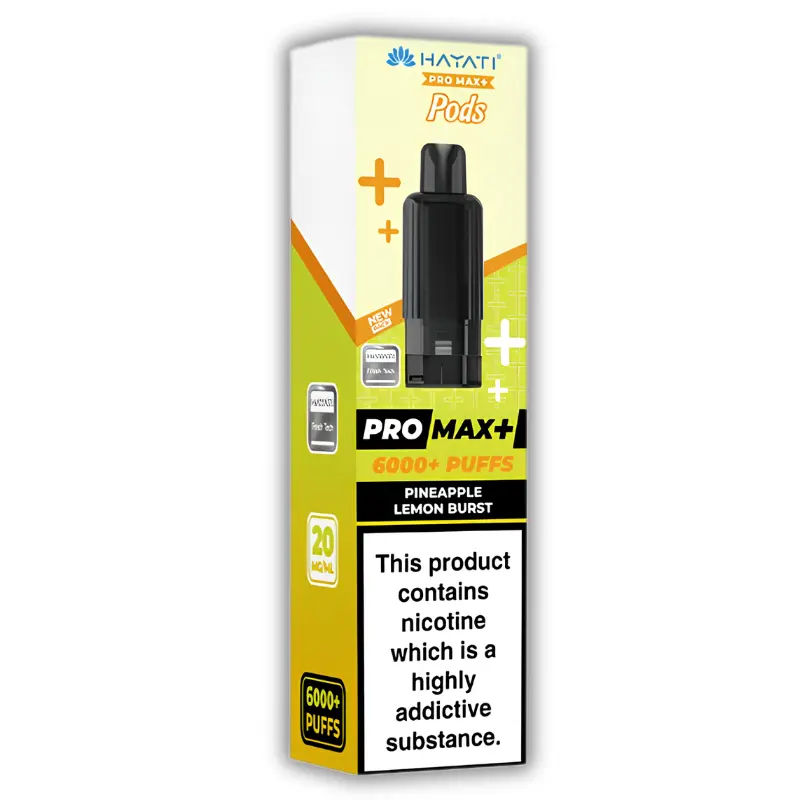
Hayati · Pro Max Plus
Pineapple Lemon Burst Hayati Pro Max Plus Pods
£5.49
✔ In stock — ready to ship
Genuine Hayati
Free over £20
Same-day dispatch
Secure checkout
What is on sale here is the refill by itself: a single Pineapple Lemon Burst pod holding 12ml at 20mg, £5.49, with no device alongside it. You buy it when a Pro Max Plus body is already on the desk and the only thing that has run out is the liquid. Hayati's laboratory rating for the pod is up to 6,000 puffs, a capacity figure taken off a test rig rather than a forecast of how your week will go.
Almost nobody arrives at a bare pod without history. This gets bought by someone who has had the flavour before, liked it enough to want it again, and is now completing a transaction that takes about eleven seconds. The flavour question was settled a while ago. What is actually in front of you is a different question, and it is one product pages rarely raise, because raising it is not obviously in the seller's interest: is this still the pod you ought to be buying?
The full account of what the liquid tastes like sits on the Pineapple Lemon Burst 6000 pod kit page, which takes the blend apart in detail and covers the hardware as well. Repeating it here would waste the space. This page assumes you already know how it tastes and spends its length on the decision a repeat buyer genuinely has to make, which is what to do about a flavour you have no complaint about that has quietly stopped earning its place in the basket.
Odd argument for a page that would rather you bought the pod, admittedly. It gets made anyway, because the alternative is a paragraph of adjectives you read eight pods ago and a button.
The purchase that stopped being a decision
A first purchase is a decision. You compared things, weighed a couple against each other, picked. A reorder is usually not a decision at all. It is the absence of one, and that is precisely what makes it efficient: nothing about it demands your attention.
The trouble is that an absence of decisions has no natural end. Nothing in the process ever asks the question again. The listing does not change. The price does not change. The pod that turns up is the same pod. There is no prompt, no anniversary, no moment at which the transaction pauses and says "you have now bought this eleven times, do you still want it". So the reorder carries on for exactly as long as nothing goes wrong, and going wrong is a much higher bar than most people assume.
Two easy cases, and the one that is not
Consider the ways a long-running flavour habit can end.
The first is that the flavour turns on you. Something shifts, three draws in you think no, and the decision makes itself. Nobody needs advice for that. The second is straightforward boredom, the kind you can feel: you open the drawer, see the same pod, and something in you sags. That also resolves on its own, because the discomfort is doing the work. You will stop.
Then there is the third case, which is the one worth 5,000 words. The flavour is fine. You have no complaint. You would not describe yourself as bored, and if a friend asked you would say you like it, and you would not be lying. Liking is a low bar and this pod clears it every single time. Nothing is wrong. Nothing prompts a review. The reorder is unopposed, and an unopposed reorder can run for a year.
What "fine" is actually covering for
Two quite different states produce that same flat word. In the first, you are still getting something out of the pod: there is a moment on the first draw of the day where the fruit lands and you notice it. In the second, you get nothing out of the pod and you also get nothing bad from it, and the absence of anything to complain about is being read as satisfaction.
From the inside, during use, those two states are almost indistinguishable. That is not a failure of self-knowledge, it is a structural problem with when the question gets asked. "Am I still enjoying this?" is nearly always asked mid-draw, by someone who has the thing in their mouth and has already paid for it. Both of those conditions bias the answer upward. The pod is right there, it is doing something, and the honest report is yes.
A feeling is therefore useless here and a test is not. There is a workable one further down, costing one pod and about a week. First, though, why this particular liquid is more exposed to the problem than most of its shelf-mates.
Why a bright citrus is the likeliest flavour to go invisible
An acid-forward blend sells itself on contrast. Look at how anyone describes one, including this page: bright, sharp, quick, a lift. Every one of those words is comparative. Bright against what? Sharp compared with what? The reference point is whatever else has recently been in your mouth, and on a single-flavour habit the answer to that is this liquid, all week, for months.
A flavour whose main property is contrast is therefore the flavour most exposed to having its contrast removed. This is not a defect in the recipe and it is not something Hayati could have designed around. It follows from the profile. The qualities that made you pick it are the qualities that need a background to be measured against, and a daily habit gradually turns them into the background.
The second reason is about shape rather than intensity. Most of what this blend has to give lands in the opening moment of a draw and thins out from there, which the kit page sets out in more detail. Front-loading like that is thrilling under attention and nearly undetectable without it. A long, sweet, sustained profile keeps presenting itself right through to the finish, so it gets several chances to catch a distracted palate. A burst gets one, and a burst nobody attended to did not, as far as you are concerned, happen.
Third, this liquid leaves very little behind. The finish is short and it does not coat. A heavier pod stays with you in the gaps between draws and keeps quietly reminding you what you are vaping, whereas this one is gone in a couple of seconds. Add the three together and "still fine, no complaints, been buying it since spring" is not a surprising outcome for a pineapple and lemon pod. It is the predictable one.
Which parts of this blend go quiet first, and which do not
Adaptation does not flatten a flavour evenly. It takes the most repetitive parts out first and leaves the rest standing, which means a liquid you have run for months is not a faded version of the original so much as a differently balanced one. Knowing which components drop out is what lets you diagnose your own reading rather than just registering that something is off.
The pineapple's ester lift carries the most information in the blend and is the most event-like thing in it. It is also brief, and it is identical on every single draw. High-information, short-duration and utterly repetitive is the worst possible combination for staying noticeable. That element goes quiet first, and because it is the part that supplies the fruit's identity, its departure takes most of the character with it.
Acid does not go quiet in the same way, and this is the crux of the whole problem. Sourness is not only an aroma. Part of it registers as a physical event at the back of the throat and along the sides of the tongue, and physical events are much harder to tune out than aromatic detail. So what survives a long habit with this pod is the sensation, not the flavour. You carry on feeling the liquid and gradually stop tasting it.
That is why "fine" is so convincing here, and why it can hold for a year. Something is definitely still happening on every draw. There is a prickle, there is a sharpening, the pod is unmistakably working. The part that has gone is the part you cannot easily notice the absence of, because what replaces a missing aroma is nothing at all rather than a gap you can point to.
The sweetness in the middle is the third component and the least distinctive. It is the element that keeps a dessert pod noticeable long after its detail has gone, and this blend does not carry much of it. Take away the ester lift, leave the acid, and there is not enough sugar underneath to give you a second thing to hold on to. On a rounder liquid, adaptation leaves you with a sweet fruit you have stopped examining. Here it leaves you with a sharpness attached to nothing in particular.
One consequence deserves stating plainly, because it is the single most common misreading among people who have run this flavour for a long time. Sharp with the fruit missing is also roughly what a tired pod tastes like. The kit page covers the mechanical version of that problem, including a seating fault that mimics a spent pod, and there is no sense in restating it here. The point for a repeat buyer is that the adapted state and the worn state resemble each other closely enough that you cannot tell them apart from the taste alone. You can only tell them apart from the circumstances, which is why every part of the test below happens on a fresh pod and in its first third. Judge this at the two-thirds mark and you are measuring a coil, not a relationship.
A test you can run with one pod
What follows is not elegant and it is not a measurement. It is a procedure for getting a usable answer out of a situation designed to prevent one. It takes one pod, a week of calendar time, and two written sentences. The writing matters more than it sounds like it should, because the whole difficulty here is that your impression of the pod during use is contaminated, and something written down before the draw cannot be revised afterwards to match it.
Step zero: one sentence, cold
Before you open the new pod, and without the old one in your hand, write one sentence describing what this liquid does. Not a score. A description. Which fruit arrives first, whether the finish is long or short, whether the middle of the draw is sweet, where the acid sits.
Be clear about what this step is not. It is not a test of how accurate your memory is. Flavour memory is poor in everyone, it drifts, and checking a recollection against the real thing tells you almost nothing. What is being examined is whether a description exists at all. If what comes out is the name on the packet plus one adjective, that is a reading rather than a verdict, but someone still engaged with a liquid usually has more than a label to hand.
Step one: three attended draws
Fresh pod, first third, first use of the day, before food and before coffee. Coffee is worth singling out because it is acidic itself and it flattens the top of a citrus blend for a good while afterwards.
Take three draws and give them your actual attention, the way you would a first pod. Keep them short. On a front-loaded liquid the whole payload is at the front, so a long pull adds acid and vapour without adding any more information to work with. Ask specific questions rather than general ones. Does the pineapple arrive separately from the lemon, or do they turn up as one undifferentiated brightness? Is there a finish at all, or does it stop dead? Does anything happen in the middle of the draw?
Now write the second sentence, and compare it with the first. The comparison you care about is not "was I right". It is "did attention add anything". If paying attention produced a noticeably richer description than memory did, then the liquid is still supplying you with material and you have simply been running it on autopilot. That is a completely different diagnosis from a flavour that has run out, and it does not call for a different pod. It calls for the first draw of the day being taken deliberately, which costs nothing.
If attention produced nothing your memory did not already have, park the finding and carry on to step two. One session is not enough to conclude anything, and a single flat morning can be caused by a dozen things that have nothing to do with the pod.
Step two: the interval, which is the part that cannot be faked
Put the pod away for four to seven days and run something else. It genuinely does not matter much what, provided it is not another citrus, because a second acid blend keeps the same part of the palate occupied and defeats the purpose. Any soft fruit will do. A mint will do.
This is the only part of the test that costs real time, and it is also the only part that cannot be shortcut, because there is no way to un-adapt to something while you are still using it. A week is the minimum interval that reliably does anything. Longer is better if you can manage it. Shorter tends to produce an ambiguous result you will then over-interpret.
Resist making this the week you also try three new flavours. Comparison against novelty is a different experiment and it will swamp yours, since almost anything unfamiliar reads as more interesting for a day or two. What you want here is a pod you are neutral about.
Step three: the return, which is the whole test
Go back to the Pineapple Lemon Burst pod on the first use of a day, cold, before anything else has been in your mouth. Three draws, attention on, then stop and decide. You are not looking for pleasure, which is too vague to be measured. You are looking for an event. Did something arrive?
There are three honest outcomes.
It arrives. The pineapple lands, the lemon separates out behind it, and there is a small moment of recognition that feels like something rather than nothing. That is a flavour you still like, and the finding is worth more than the reassurance, because it also hands you the cheapest maintenance available. A week away restores a good deal of what months of continuous use flatten. Build one in occasionally and you get more out of every pod you buy, at no extra cost.
Recognition and nothing else. You know exactly what it is. It is correct. It tastes the way it is supposed to. Nothing happens. This is the outcome the page exists for, and the difficult thing about it is that you will not be able to explain what is wrong, because nothing is wrong. The pod is doing everything it did on the day you first bought it. You have stopped receiving it, and a week away did not bring it back. That is the point at which continuing to rebuy it means paying £5.49 for something you are no longer getting.
It arrives and it is more than you remembered. A week off can also reveal that the acid is sharper than the level you had been treating as normal. That is not a verdict against the flavour, and it is not the same finding as the one above. It suggests you had adapted to the intensity rather than to the identity, and the remedies are different: shorter draws, or the same fruit with something soft underneath it.
What the test cannot tell you
Being straight about the limits is what makes the rest worth running. It says nothing about the quality of the pod, which is unchanged throughout, and it is one uncontrolled observation on one morning. A week is also a short interval, and some people need a fortnight.
Most importantly, it cannot distinguish "I have stopped noticing this flavour" from "I have stopped noticing flavour". If the flat result worries you, there is a follow-up that separates the two: run the same three attended draws on a completely unrelated pod, something dark or sweet or cold. If that one also produces recognition and nothing else, the finding is about your attention in general and not about pineapple and lemon, and swapping the pod will not fix it.
The case for buying the same thing forever
Everything above can be read as an argument that constancy is a mistake, and that reading would be wrong. Plenty of people want one flavour and no decisions, and they are not making an error. They are paying a known price for a known benefit, which is the definition of a sensible trade.
The benefit is usually undervalued. Every reorder you do not think about is a small quantity of attention handed back to something that matters more, and a pod requiring no consideration never interrupts you, never disappoints you, and never leaves you in front of a shelf of eighty-nine listings at eleven at night.
Variety has costs this page should not pretend away either. Twelve millilitres is not a sample, so a flavour that turns out not to suit you is a long mistake rather than a cheap one. And a pod you actively like less is a worse outcome than a pod you have stopped noticing, which is the trade nobody mentions when they recommend mixing things up.
There is a further position that deserves respect rather than correction. Being noticed may not be what you want from the pod. If you chose this one because it is quick and light, gets out of the way, and does not leave a coating you are still tasting an hour later, and it still does all of that, then "I have stopped noticing it" might be the specification being met rather than a failure. The test still gives you information in that case. It simply does not oblige you to act on it.
The distinction the page is actually drawing is between a default and a settled choice. A settled choice is one you have tested and returned to. If you have taken a week off this pod at some point and come back to it gladly, you have already run the experiment and this page has nothing to tell you. A default is one you have never examined, and the only claim being made is that an unexamined purchase repeated forty times is worth examining once.
Worth saying plainly too: a flat result does not compel you to buy something different. Taking a week off and then buying the same pod again is a legitimate response, and so is shrugging and carrying on. Doing nothing counts as a decision, provided it is one you made.
What actually turns up
The box holds one thing. A single prefilled pod carrying 12ml at 20mg, sealed, with its coil and wick already inside it and matched to the liquid. No device, no accessories, nothing to assemble. If you do not already own a Pro Max Plus body, this is the wrong listing and the kit is the right one.
The pod is a closed unit with no port for topping it up and nothing serviceable inside, so a spent one is replaced whole. That is the trade every prefilled format makes: you give up the ability to intervene and you get a coil that arrives correctly wicked, with no chance of fitting it wrong. On an acid-led liquid the second half of that trade is worth slightly more than usual, since the volatile top of this blend is what suffers first when a coil is mismatched to what sits on it.
The one number that shapes how this pod is actually used is 12ml, which for a single sealed unit is a lot of liquid to be committed to in one go. It is also the number that makes the whole subject of this page matter: a reorder is not a small purchase repeated often, it is a fortnight or more of your vaping decided in eleven seconds. Everything else about how the device behaves, charging rhythm, airflow, the contacts, is documented once on the Pro Max Plus pod shelf and on the kit page rather than eighty-nine times over.
The listing, and the rows that cannot help you
| Sold as | One prefilled pod, no device included |
| Fits | Hayati Pro Max Plus |
| Liquid inside | 12ml |
| Nicotine strength | 20mg |
| Fruits named | Pineapple, lemon |
| Coolant | None indicated anywhere in the listing |
| Carrier ratio | Not published by Hayati |
| Hayati's capacity figure | Up to 6,000 puffs, obtained in laboratory conditions |
| Price | £5.49 |
| Made by | Hayati |
| Catalogue reference | pineapple-lemon-burst-hayati-pro-max-plus-pods |
| Also listed under | Pineapple Vapes, Lemon Vapes, New Products, Hayati Pods, Hayati Prefilled Pods & Refills, Hayati Pro Max Plus Pods |
Here is the useful observation about that table, and it is not about any individual row. Every figure in it is identical to the one that was there when you bought your first of these, and will be identical on your fortieth. The specification is perfectly stable. That stability is exactly what makes a reorder feel like a settled matter, and it is also why the table cannot answer the question this page is about. The listing has not changed. You have.
Two rows are worth a moment anyway. The 20mg is the UK ceiling and the only strength recorded against this flavour, and it reads more pointed on this recipe than the same figure does on a rounded one, because the throat is receiving acid from two fruits at the same time as the nicotine. If you have been running this pod for months and have concluded the strength suits you, notice that you have been assessing it under adapted conditions, and that a week away tends to sharpen it back up.
The carrier ratio is the absence that matters most. Hayati do not publish how this pod splits between vegetable glycerine and propylene glycol, and on an acid-led liquid that split governs how legible the volatile top is. Knowing it would change nothing you do, because nothing inside a sealed unit is adjustable. Record it as unknown rather than borrowing a figure from another product, and treat any specification you read on a sibling page as unverified until the listing itself states it.
The capacity figure ranks this pod against others and does nothing else. It comes off equipment drawing at fixed intervals, while real use moves by a factor of two either way on draw length alone.
Where to go, depending on what the test said
These are organised by outcome rather than by fruit, because "similar flavours" is not a useful category when the problem is that a flavour has become inaudible to you.
If it arrived: buy it again, and build in the gap
Nothing to change. Reorder the same pod and put a deliberate week between two of them every so often. If you want a second body so that an alternate pod can be kept loaded rather than swapped in and out, the Pineapple Lemon Burst pod kit at £7.99 is the cheapest route to one, since it comes with a pod of this flavour anyway. Buying a kit purely for the device is a reasonable move exactly once.
The move that wastes £5.49, and why people keep making it
Lemon Pineapple is the first thing most people reach for, because it looks like a change while feeling reassuringly close. It is the same two fruits with the order reversed, and the kit page describes picking between the two as close to a coin toss. Follow the logic: if you have stopped registering pineapple and lemon, a pod of lemon and pineapple will not register either. It is a change of label, not of stimulus. Try it if you are curious about the ordering, not if you are trying to escape adaptation.
The same caution applies to Lemon Lime, which is drier and more austere but not different in kind. Two citrus fruits with no tropical sweetness is a shift along the same axis, and if the acid has become background noise, more acid will not bring it forward. It is a good pod and the wrong prescription here.
If it went flat: change one thing, not everything
Hold the fruit constant and change the treatment, or hold the treatment constant and change the fruit, so the result tells you something. Change both and you end up with a pod you either like or do not, and no idea why.
Pineapple Ice keeps the fruit and swaps acid for cold. Both are ways of stopping a pineapple from becoming heavy, but a coolant thins the body and lengthens the finish, where acid thins it and shortens it. Since the finish is one of the elements that has probably gone quiet on you, lengthening it is a genuine change rather than a cosmetic one.
Mango Peach Pineapple keeps the pineapple and gives it a floor to stand on, with mango supplying body and peach a rounded sweetness. The pineapple stops leading and starts lifting. That is the most direct answer to a blend that has been reduced to sharpness with nothing underneath. Blue Razz Pineapple gets to a similar place with a confected sweetness instead of fruit flesh, which is a bigger jump in character and a smaller one in construction.
If what you want back is brightness, delivered a different way
Several listings use citrus as a drink rather than as an acid source, and the mouthfeel difference is larger than the fruit difference. Pink Lemonade is the plainest of them, soft-edged and sweetened. Berry Lemonade runs an unspecified berry over the same base, Blue Razz Lemonade does it with the blue note, and Blackcurrant Lemonade puts a darker, tarter fruit over it. All four give you a middle of the draw that this pod does not have.
Cherry Peach Lemon is worth naming separately, because it keeps lemon as a distinct third component rather than folding it into a base. If it is citrus specifically that you want to be able to hear again, having something for it to stand apart from is more effective than having more of it.
If the finding was that you need a bigger change than a fruit
Dark fruits are the largest available move that stays in recognisable territory. Blackcurrant Mango holds a tart top over genuine flesh, Blackberry Raspberry sits lower and rounder, Blueberry Pomegranate keeps an astringent edge without the citrus scrape, and Blackcurrant Juice is the most single-minded of them. Blackberry Ice adds cold to a dark fruit, which gives you freshness without acidity.
Further out again are the constructed profiles, which change the category rather than the fruit. Fizzy Cherry and Blue Razz Cherry work a confected sharpness that behaves differently from fruit acid. Hubba Bubba is a sweet chewing-gum accord and about as far from this pod as the shelf goes. Banana Ice is the soft, low-acid option, and Black Mamba carries a name describing a mood instead of a fruit, so its contents are not knowable from the listing.
Changing platform is the biggest reset of all, since it alters the draw as well as the liquid. Blueberry Raspberry Lemon on the Pro Ultra Plus keeps a lemon in the blend while putting everything else on different hardware, which answers a larger question than the one you started with.
Browsing it yourself
If you would rather look than be told, the pineapple shelf gathers twenty listings across every platform, and the lemon shelf runs to fifty-four. The general Pro Max Plus 20mg pod listing is where the flavour options for this device are set out together, the prefilled pods and refills shelf covers every Hayati pod sold without a device, and the full Hayati range is there if your next purchase is not a pod at all.
Running a pod you intend to assess
Ordinary handling for this format is covered on the shelf pages. What follows are the points that change when the pod has a job beyond being vaped, which is to give you a reading you can trust.
Date it. Note the day it goes in, on the pod or in your phone. Without that, the first third is guesswork, and the first third is the only window in which the test means anything. Two or three dated pods also give you your own capacity figure, which beats a laboratory one.
Stand it upright for a couple of minutes after unwrapping, and keep the opening draws short. The reason to bother specifically on a test pod is that a wick stressed in the first minute produces a dull, papery quality that is easy to mistake for the exact flat result you are looking out for. Ruin the first thirty seconds and you have contaminated the measurement before you started it.
Take your reading before the day starts. Coffee, toothpaste and anything sweet all sit on top of a citrus blend, and none wear off as fast as people assume. The first use of the morning is the only consistently comparable moment available.
Keep the draws short even outside the test. This is not general advice, it follows from where the flavour sits in the inhale. A long pull on a front-loaded liquid adds vapour and acid to a payload that has already been delivered. If you have noticed yourself pulling longer over recent months, that is itself a signal worth logging, because escalation is usually a response to something having gone quiet.
Store spares somewhere cool, dark and dull. Heat thins liquid and thinned liquid finds its way past seals, so a drawer beats a windowsill and a parked car in July is the worst option available. A pod that has been cooked in a bag for a fortnight is not a fair test subject. Keep spares where only an adult in the household will come across them.
Keep one unrelated pod in the drawer. Not as a rotation, simply so the interval in step two does not require an emergency purchase. The test collapses if the only way to take a week off is to buy something in a hurry, because you will end up comparing this pod against novelty instead of against absence.
Questions from people buying this again
I have bought this pod eight times and I still like it. Is the page telling me I am wrong?
No. It is saying that "I like it" collected during use, by someone who has already bought it, is weak evidence either way. If you run the week-off test and it comes back positive, you have a settled choice rather than a default, and nothing here applies to you. Plenty of people genuinely want one flavour and no decisions.
How long does the break need to be?
Four to seven days as a minimum, and longer is better if you can arrange it. Under four days the result tends to be ambiguous and people read too much into it. A fortnight gives the clearest reading, though few are willing to spend that long on it.
Can I run the test on a pod I am already halfway through?
Not reliably. This blend loses its tropical top faster than its neighbours as the coil loads up, so a flat reading late in a pod is more likely to be the coil than adaptation. Use a fresh pod and stay within the first third, otherwise the two causes are impossible to separate.
What if I do not want to take a week off it?
Then take the reading you can get, which is step zero and step one: write a description from memory, then take three attended draws and see whether attention adds anything. That will distinguish autopilot from genuine flatness, which is a useful result on its own. It will not settle the adaptation question, since only absence does that.
Does anything else come with it?
No, the pod alone at £5.49, intended for a Pro Max Plus body you already have. If you need the hardware too, the kit version of this flavour is the listing to look at instead.
Is the kit version filled with something different?
No. Same flavour, same 12ml, same 20mg. What separates the two listings is the device rather than the liquid, and the lower price here reflects the body you are not being sent.
Does this one have a coolant in it?
Nothing in the listing indicates one. There is no Ice, Frozen or Cooler designation in the name and no coolant appears in the supplied facts, so this page treats it as uncooled. The prickle people sometimes read as cold is acid from the two fruits.
What does the 6,000 figure actually represent?
It is Hayati's own capacity estimate, produced on laboratory equipment drawing at fixed intervals. It is fair for comparing one pod against another and close to useless as a prediction of days, because draw length and frequency vary enormously. Your own dated pods will give you a better number within a month.
If the test comes back flat, what is the smallest change worth making?
Keep the pineapple and alter what is around it. Pineapple Ice swaps the acid for cold, and Mango Peach Pineapple puts soft fruit underneath it. Both are single-variable changes, so whichever way they go you learn something. Reversing the fruit order in the name is the one move that reliably teaches you nothing.
How do I tell whether the problem is this flavour or me?
Run the same three attended draws on something unrelated, ideally dark or sweet or cold. If that pod also gives you recognition and nothing else, the finding is about attention generally rather than about this blend, and buying a different flavour will not address it. If the unrelated pod produces an obvious reaction, the result stands.
Is 20mg the only strength here?
It is the only figure recorded against this listing, and 20mg is the UK maximum. Other strengths exist elsewhere in the Hayati range but not as a stated option for this flavour in this pod, so check the individual listing rather than assuming one is available.
The short version
One Pineapple Lemon Burst pod for the Hayati Pro Max Plus, 12ml at 20mg, £5.49, no device. Hayati's laboratory figure for it is up to 6,000 puffs. The flavour analysis and the hardware both live on the kit page, and this one is written for the person who has already bought it more than once.
For that person the live question is not whether the pod is good. It is whether a purchase that has stopped being a decision is still the right one. A bright, front-loaded, short-finishing citrus is the profile most likely to become background, because contrast is its whole proposition and a daily habit removes the contrast. The end state is a pod that is still fine, that you have no complaint about, and that you have stopped receiving.
The test costs one pod and a week. Write a description cold, take three attended draws on a fresh pod, set it aside for four to seven days, then return and see whether anything arrives. Something arriving means reorder it and keep building in the gap. Recognition and nothing else means you are paying for something you no longer get, and the remedy is a change of construction rather than a change of fruit name. If you weigh all that and still want one flavour and no decisions, that is a coherent position, provided it is a position rather than an accident.
Strictly for adults aged 18 and over. Nicotine is an addictive substance.
You might also like


