
Home / Hayati Pro Max Plus Prefilled Pod Kit / Spearmint Hayati Pro Max Plus 6000 Pod Kit
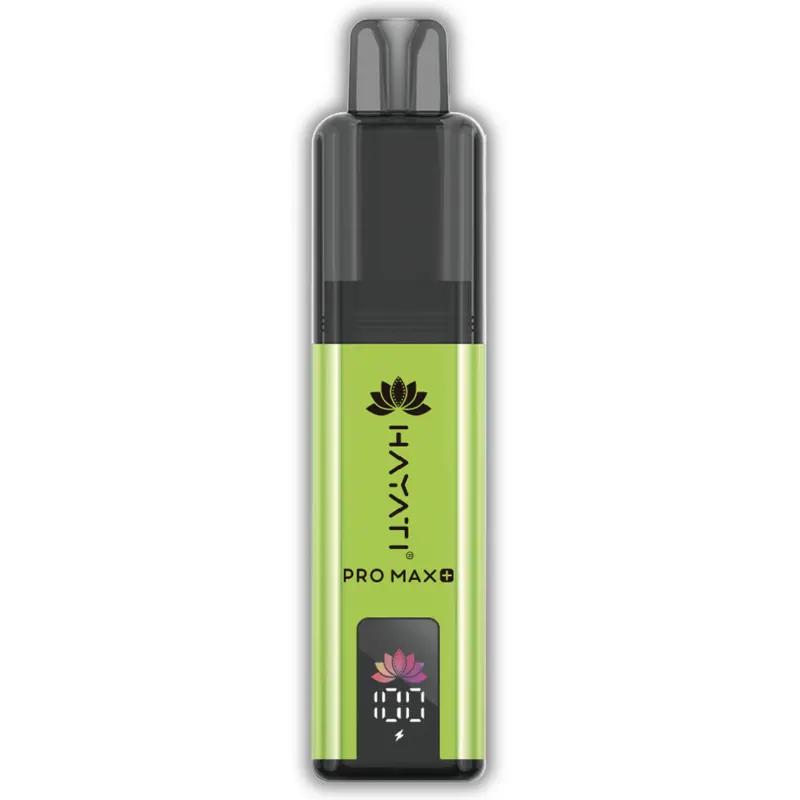
Hayati · Pro Max Plus
Spearmint Hayati Pro Max Plus 6000 Pod Kit
£7.99
✔ In stock — ready to ship
Genuine Hayati
Free over £20
Same-day dispatch
Secure checkout
Spearmint Hayati Pro Max Plus 6000 Pod Kit is the complete package at £7.99: an 850mAh rechargeable body, boxed with one factory-filled pod carrying 12ml of liquid at 20mg nicotine salt, flavour named on the front, nothing to measure and nothing to screw together. Hayati rate the pod at up to 6,000 puffs. That number is generated in a laboratory by equipment repeating one identical draw at a fixed interval, which makes it a way of ranking listings against each other and a poor forecast of anybody's actual week, so it appears here once and is not used again as though it meant something.
Everything above takes a paragraph because it is the same paragraph every kit on this platform gets. The reason this listing needs more than that is the word in front of the brand name, and it is worth being precise about why.
Of the 88 listings on the Hayati Pro Max Plus Prefilled Pod Kit shelf, four carry no flavour word in the title at all, being strength or family listings. Of the 84 that do carry one, exactly two are a single word long. T-Misu is one. Spearmint is the other. Everything else on that shelf is a compound: two fruits, three fruits, a fruit and a coolant, a fruit and a drink format, a fruit and a confectionery reference. This pod contains one aromatic idea and no supporting cast, and that single structural fact governs how it opens, how it behaves over twelve millilitres, what a tiring coil takes away from it first, and which kind of vaper will get on with it.
The other thing governing this page is a division of labour with its sibling listing. The bare pod, Spearmint Hayati Pro Max Plus Pods at £5.49, carries the identical liquid for a body you already own, and that page took the naming question: why the word arrives in most British heads attached to a product people use rather than a flavour people enjoy, because the reference laid down early is a tube at a basin and a stick of gum, not a plant in a pot. It also established, by counting, that Spearmint is the only listing in the entire 492-product Hayati catalogue that names a mint by botanical species rather than by adjective. Both of those findings are taken as settled here and are not rebuilt. What that page deliberately did not do, and what this one does at length, is the flavour.
What is already answered, and what this page is for
Two arguments about mint have been worked through elsewhere in this catalogue and repeating them would waste your time and mine.
The first is the naming argument above. Its practical upshot is that a good many buyers arrive at this listing holding a measuring stick built for a functional product, on which mildness reads as failure, and that the association fades with exposure rather than with willpower. If you have not read it and the association is your sticking point, read it there.
The second is the question of what the word mint even denotes in a vape liquid, which our Lemon and Mint Pro Ultra Plus page sets out in full. Its conclusion, briefly, is that mint on a label can mean a green plant aroma detected by the nose, or a cold signal produced by a compound docking with a temperature receptor, and that those are two unrelated kinds of thing wearing one word. That page makes the herb-versus-coolant distinction properly and I am not going to rebuild it. I only need one consequence of it: this liquid sits firmly on the aroma side, and almost everything interesting about it follows from that.
Which leaves the actual job. What garden spearmint tastes like when it is treated as food. What its dominant aromatic does inside a draw, and how differently that behaves from the compound most vapers assume is in a mint pod. What twelve millilitres of a single herb feels like across the life of a pod, as the coil goes from new to tired. And who should buy this and who very clearly should not.
Spearmint is a cooking herb before it is anything else
The mint growing in a pot on a British kitchen windowsill is spearmint. So is the mint in the garden bed that has quietly taken over the garden bed next to it. It is not a specialist plant, it is not an exotic one, and the version on the label of this pod is the same species as the one in the sauce that goes with lamb. That much is common knowledge once it is pointed out, and it is almost never pointed out.
How the leaf is actually used, and why the habits are informative
Look at how cooks handle it and the plant tells you what kind of flavour it is. Mint is added raw, or it is added in the last thirty seconds, and there is a reason for that discipline: the aromatics that make it worth having are fugitive, and sustained heat drives them off and leaves a dull, hay-like residue behind. A sprig dropped into a pan of new potatoes perfumes the water faintly and contributes almost nothing to the potato, which is precisely what you would expect of a compound that cannot survive a rolling boil. Nobody roasts mint.
Bruising rather than chopping is the other tell. The leaf is pressed in the bottom of a glass to rupture the oil cells without shredding the tissue, because tearing releases bitter green compounds along with the aromatic ones. A chopped leaf and a bruised leaf from the same plant do not taste the same, and the difference is entirely about how much of the harsh fraction comes out with the pleasant one.
Then there is the sugar. Steeped spearmint, taken on its own with nothing added, is thin and faintly bitter, which is why every traditional preparation built on steeping it carries a serious quantity of sugar alongside. The sweetness is not decoration. It is load-bearing, because it fills in underneath a flavour that is otherwise all top and no middle. That fact turns out to matter a great deal for a vape liquid, because a formulator building a spearmint has the same problem and reaches for the same solution, and it explains why this pod is noticeably sweeter than people expect a mint to be.
The last habit worth borrowing is the distinction between fresh leaf and dried. Dried mint is not weaker fresh mint; it is a different flavour. The green top goes during drying and what remains is dusty, hay-ish, slightly sweet and rather flat. Hold that comparison in mind, because it is the single most useful reference point for what happens to this pod in its final couple of millilitres, and I will come back to it.
The three layers, in the order they land
Taken on its own, with nothing attached to it, culinary spearmint resolves into three things arriving at slightly different moments.
First is sweetness, and it is genuine rather than added. Herbs in the sweet family, which includes basil and the fronds of fennel, carry a perceptible sugar-like quality that sits right at the front and is over within a second or so. It is light. It does not coat. But it is there before anything else, and in a vape liquid it is the layer most likely to be reinforced by the formulator for the reason given above.
Second, and the largest part by volume, is the green body. Grassy is the word everybody reaches for and it is the right one: this is the smell of a cut lawn and a snapped stem, broad rather than sharp, with a faint waxiness to it that belongs to the surface of a leaf rather than to its inside. The green body is what a spearmint actually is. Everything else is at its edges. In this pod it occupies the middle of the draw and most of the exhale, and it is the part of the profile that bears no resemblance whatsoever to the functional product the name summons.
Third is the outer margin, which is narrow and easy to miss until somebody names it, at which point most people find it immediately and cannot unfind it. There is a faint anise or caraway lift around the edges of a strong spearmint. It is not an off note and it is not contamination. It is a property of the molecule, and the explanation is the next subsection, because it is genuinely one of the more elegant facts in flavour chemistry.
What is absent from all three layers is any kind of bite. No astringency. Nothing chalky, nothing scouring, no numbing and no medicinal sharpness. Left alone, the leaf is a warm flavour rather than a cold one, and a warm spearmint is a perfectly coherent thing that almost nobody has met, because virtually every manufactured version arrives pre-chilled.
The caraway shadow, explained
Carvone is the compound that makes spearmint smell of spearmint. It comes in two mirror-image forms, chemically identical in every respect except handedness, in the way a left glove and a right glove are identical. One of those forms smells of spearmint. The other smells of caraway seed. Same atoms, same bonds, opposite geometry, and two aromas that nobody would ever guess were related.
Human olfactory receptors are shaped objects and they discriminate between the two, which is why a caraway-heavy rye loaf does not taste of mint. But the discrimination is not perfect at the margins, and a high concentration of one will throw a faint shadow of the other. That is the anise-adjacent edge you can find in this liquid on a long draw, and it is a sign of a spearmint being carried at a decent concentration rather than a sign of anything being wrong with it. People who like caraway tend to like this pod more than average. People who actively dislike aniseed occasionally find that edge is the thing they cannot get past, and that is a legitimate reason to walk away from it.
The register, stated plainly
Pulling those together into one description a buyer can act on: this is sweet, soft, grassy and only lightly cooled. It is quiet rather than loud, rounded rather than sharp, and it reads as a plant rather than as a manufactured sensation. If your mental model of a mint liquid is something bright, hard-edged and synthetic that arrives like a slap, this is not that, will not become that at any airflow or draw length, and was not built to be that. Being clear about the register in advance saves more disappointed purchases than any other sentence on this page.
Carvone does not behave like menthol inside a draw
The compound comparison itself is settled on the pod page: menthol and carvone are separate molecules doing separate jobs, and spearmint is not peppermint with the volume turned down. Agreed, cited, moving on. What has not been covered anywhere, and what changes how you actually use this kit, is the timing. The two behave completely differently across the seconds of a single draw and across the hours of a session, and almost every complaint this flavour attracts traces back to one of those differences.
A signal fires; a smell has to travel
Menthol produces cold by binding to a receptor that reports temperature. That is a switch being thrown. It is fast, it is mechanical, it works on a tired palate and a blocked nose, and the sensation persists after the molecule has gone because the receptor stays open for a while. Nothing about it depends on you paying attention.
Carvone is an odour. It has to reach the olfactory tissue at the top of the nasal cavity, which in eating and vaping happens from behind, as vapour rises from the back of the mouth on the way out. That route is slower than a receptor event, it is easily disrupted, and it delivers detail rather than a single loud signal. Nothing goes numb. Nothing tightens. The green stays legible because there is no wall of cold standing in front of it.
The practical consequence arrives immediately: the amount of this flavour you perceive depends heavily on how you exhale, and that is not true of a cooled liquid.
The exhale most people waste
Exhale entirely through the mouth and you have vented the vapour without routing much of it past the sensor that detects the thing you paid for. You will still get the sweetness, which is a tongue event, and a trace of green. You will lose most of the body. On a heavily cooled pod this barely matters, because the cold is already firing in your mouth and throat regardless of where the vapour goes next.
Let a portion of the exhale go out through the nose, even a small one, and the profile roughly doubles in size. This is the single most effective adjustment anyone can make to this particular liquid and it costs nothing. It is also why two people can run the same pod and describe it in incompatible terms: one of them is smelling it and the other is not.
Draw length pulls in the same direction. A short, hard pull collects the sweet front and very little else, and the sweet front is the least characteristic part of the profile. A slower mouth-to-lung pull of two or three seconds gives the green body time to build behind the sweetness, and the caraway edge only shows up at the longer end of that range. The gap between a quick snatched draw and a patient one is larger on this pod than on almost anything else in the range, because a blend has several components taking turns and this has one doing all the work.
Why the flavour fades over an hour when a chill does not
Here is the part that catches people out, and it is a property of aromas in general rather than a defect in this liquid.
Olfactory receptors adapt quickly. Sustained exposure to a constant smell reduces the perceived intensity of it, sometimes dramatically, within minutes. Taste adapts too but more slowly, and a receptor-driven sensation like cold barely adapts at all within a session, which is why a heavily mentholated pod is still delivering an obvious chill two hours in.
Run an aroma-led liquid steadily for an hour and it will seem to get quieter. The liquid has not changed, the coil has not degraded in an hour, and nothing has gone wrong. Your nose has simply stopped reporting a signal that has not varied. Step outside, have a cup of tea, talk to somebody for ten minutes, come back, and the first draw is as green as it was at the start. Vapers who run one flavour all day and expect constant intensity find this frustrating. Vapers who use a mint in rotation with something else never notice it at all, because the alternation resets the adaptation continuously.
That difference has a second consequence which is mostly an advantage. Carvone leaves. Two or three ordinary exhalations later and the flavour has gone, with no film left on the tongue and nothing accumulating at the back of the throat. A cooled pod stacks up over a session until the throat feels permanently chilled and you start noticing it between draws. This one does not stack. You can put it down mid-session and eat something without the food tasting of pod, which is not true of a strongly cooled liquid and is the reason a fair number of people keep a herb pod specifically for mealtimes.
How cool it actually is
There is a coolness here and it is mild. Placed against the cooling range this catalogue covers, it sits near the bottom, well below anything with Ice or Frozen in the title and below Double Menthol by a very wide margin. It builds gently over the length of a pull rather than announcing itself at the front, and it registers as a broadening at the back of the throat rather than as a bite.
Where it comes from is not published. Hayati give no ingredient breakdown for this listing, and cooling compounds are routinely dosed alongside mint aromas in liquids of this type, so nobody can tell you from a retail page whether what you are feeling is an added agent or simply the aroma's own faint contribution. Anyone who states which is guessing, this page included, so the honest description is of the effect rather than its cause.
If cold is the property you are buying, stop here and buy something built for it. Blue Frozen and Blackberry Ice both put a serious chill behind a dark fruit, Banana Ice does it behind a soft one, and Cola Ice does it behind a drink. None of them will disappoint you on that axis and this one will.
Twelve millilitres of one herb
A pod is not a tasting sample. Twelve millilitres is a long acquaintance, and a liquid that is pleasant for four draws is not necessarily a liquid you want for two weeks. Single-component flavours behave differently over that distance from blends, in ways that are predictable once stated.
A blend has somewhere to hide and this does not
Go back to the count at the top: two single-word flavour names out of 84 on the kit shelf. Nearly everything this competes with is built from two or three components, and multi-component blends are forgiving in a specific way. When one element weakens, the others cover for it, and the overall impression stays recognisable even after the profile has quietly lost a third of its structure. A vaper running Cherry Peach Lemon will usually lose the lemon first and still be perfectly happy with a cherry and peach pod, often without registering that anything has changed.
One herb has no understudy. Whatever the coil takes is simply gone, and the loss shows up as a change in character rather than as a change in balance. That makes this pod a more demanding thing to live with in the last quarter and, as compensation, a much more legible instrument for telling you the actual state of your hardware. Several of the people who keep one in rotation do so partly for that reason.
The opening millilitres
A new pod runs at its greenest. The top notes are all present, the grassy fraction is at its most obvious, the caraway edge is easiest to find, and the sweetness sits properly behind the green rather than in front of it. If you want a reference point for judging the rest of the pod, this is it, and it is worth taking two or three deliberate draws in the first ten minutes and paying attention, because you cannot get this reading back later.
Give the pod a minute or two in the device before the first pull. There is nothing exotic about this, the wick simply needs to be wet through, and a dry first draw on a green aromatic gives you a scorched impression that is nobody's fair introduction to the liquid. Prefilled pods normally arrive with the wick already saturated, so this is a precaution rather than a procedure.
The long middle, which is most of the pod
Somewhere in the first millilitre the profile settles into what it is going to be for the bulk of the twelve, and this plateau is the honest version of the flavour. Sweet front, green body, light cool, short dry finish. Nothing develops, nothing evolves, nothing surprises. That is a fair description and not a criticism: a plateau is exactly what somebody wants from a pod they intend to run all day, and the flavours that constantly do something interesting are also the flavours that get tiring by four in the afternoon.
One genuine advantage shows up here and it is worth spelling out, because it is the strongest practical argument for a low-sugar liquid. The tongue adapts to sustained sweetness, so a heavily sugared pod appears to fade across a day even while it is delivering exactly what it delivered at breakfast. A liquid carrying little perceptible sugar largely escapes that. Against Berry Lemonade or Blue Razz GB, both of which are frankly sweet and popular for entirely good reasons, this pod holds its position from morning to evening far better. It starts quieter and it finishes at the same volume it started, which for a single-flavour user is often the more valuable property.
There is a caveat on that, and it cuts the other way. Sweetness perception is suppressed by both acid and cooling, so a cold or sour liquid can carry a large sweetener load without tasting of it. This liquid has very little of either mask, which means what you taste is close to what is there, and low perceived sweetness here is a better guide to actual sweetener content than it would be on a cooled fruit. That is inference rather than published fact, since no ingredient breakdown exists for this listing, but it is inference with a clear mechanism behind it rather than a guess.
What a tiring coil takes first
Coils do not fail in one go. They age, and ageing means residue accumulating on the wire, local hot spots developing, and wicking slowing down. The flavour consequence is not uniform loss; it is selective loss, and what goes first is whatever is most volatile and most heat-sensitive.
On this pod, that is the grassy top. The broad green fraction is the first casualty, and it thins gradually rather than disappearing at a stroke. What survives longest is the sweetness and the deeper, heavier part of the carvone body, which is why a pod in its last stretch reads sweeter and flatter than the same pod did at the start, and why the proportions invert: the sweetness that used to sit behind the green ends up sitting in front of it.
That is the dried-mint comparison from earlier, and it is remarkably exact. The late-pod register is the fresh-to-dried transition happening in miniature over a fortnight: the bright top gone, a dusty and slightly hay-like sweetness left behind. It is not unpleasant. It is simply a different flavour from the one you bought, and once you have named it you will spot the moment it arrives.
Blends do not announce coil wear this legibly. If you want to know honestly how your device is doing, a single-herb pod will tell you several days before a three-fruit blend does.
Two different faults, both of which get called the same thing
People describe a failing mint pod as having gone soapy, and that word is used for two separate problems with two separate fixes. Separating them is worth the paragraph.
Soapiness proper is a heat artefact. Push a green aromatic too hot and the profile shifts toward something soapy and faintly medicinal, and it happens on a healthy coil as readily as on a tired one. The cause is almost always chain-drawing: three or four long pulls in quick succession with no pause, which lets the coil run hotter than the liquid tolerates. The fix is a twenty or thirty second gap between draws, and the flavour comes back within two or three pulls. If soapiness appears early in a pod's life, this is what it is, and the pod is fine.
The hay-like flatness described above is the other thing, and it is end of life. It arrives gradually, it does not respond to resting the device, and it does not come back. When the green has thinned to the point that the sweetness is the most prominent thing left, the pod has given you what it has. Continuing past that is not unpleasant so much as pointless, and since the last of the liquid is worth only pennies there is no economy in persisting.
The distinguishing test is simple. Put the device down for half an hour. Heat artefacts clear; wear does not.
Telling your palate apart from your coil
One more diagnostic, because it saves people from replacing pods that have nothing wrong with them. Olfactory adaptation and coil wear produce the same complaint, which is that the flavour has got quieter, and they need opposite responses.
Judge the pod on the first draw of the morning and only on that draw. Overnight your nose has fully reset, so draw one on day nine is directly comparable with draw one on day two. If the morning draw is still as green as it was at the start of the pod, the coil is fine and what you noticed yesterday afternoon was adaptation. If the morning draw has flattened, the coil has aged and the pod is heading for the end of its life. That comparison is only available because you took a proper reading in the first ten minutes, which is why the earlier suggestion was worth the trouble.
Who this suits, and who should walk straight past
Blunt version, because the register of this liquid makes it a genuinely poor purchase for some people and a very good one for others, and adjectives do not sort them.
It suits anybody who likes herbs as food. If basil, fennel, coriander or dill are things you actively enjoy rather than tolerate, the green body of this pod is a flavour you already have a taste for and you will get on with it quickly. It suits a single-flavour user who resents the apparent fade of a sugared liquid across a working day. It suits somebody who wants a pod they can put down and pick up without a residue of cold sitting in their throat. And it suits anybody who has grown tired of red and blue fruit, which is the overwhelming centre of gravity of this shelf, and wants a register that is not another berry.
It does not suit anyone buying cold, for reasons covered above and not worth repeating. It does not suit anybody who wants a loud pod, because this one is quiet by construction and turning the volume up is not among the things a fixed-output device lets you do. It does not suit somebody who exhales exclusively through the mouth and has no intention of changing, since a large part of what they would be paying for will not reach the sensor that detects it. And it does not suit a person whose association with the functional product survives an entire pod, which the sibling page treats properly and estimates as a real minority rather than a rarity.
The hardware, briefly
The box holds two things: the Pro Max Plus body, rated by Hayati at 850mAh and rechargeable, and one pod already filled with the 12ml of Spearmint at 20mg that the title names. The pod is prefilled and not meant to be topped up, so when it is empty the pod is finished as a unit and the body carries on with the next one. There is no second pod, no spare and no liquid bottle in the package.
The specification that matters most for this particular liquid is the one Hayati do not publish, which is the coil. No resistance, no wattage window and no material appear anywhere in this listing's data, and that gap is worth naming rather than quietly filling. It matters more here than it would on a berry pod for the reason given in the fault section: a green aromatic is heat-sensitive, and the difference between a coil run at the right temperature and one run hot is the difference between grassy and soapy. The mitigation is that there is nothing to adjust on this device anyway. No airflow collar, no wattage control, no modes. In this one case the absence of controls works in the liquid's favour, since the factory setting is the setting the flavour was matched to, and the only heat variable left in your hands is how fast you chain your draws.
On fitment, match the range name printed on your device to the range name in this listing's title, and do not assume that a pod of roughly the right size will seat in a body from a different family. The rest of the hardware picture, including every other flavour made for this body, sits on the Hayati Pod Kits listing and the wider Hayati Prefilled Pod Kits shelf, which between them cover the whole prefilled side of the range across several platforms.
The numbers, and the two that actually govern anything
| Flavour as listed | Spearmint |
| Register | Herbal, sweet, lightly cooled |
| Price | £7.99 |
| In the box | Pro Max Plus device plus one prefilled pod |
| Nicotine strength | 20mg nicotine salt |
| Liquid volume | 12ml, factory filled |
| Battery | 850mAh, rechargeable |
| Puff rating | Up to 6,000 per Hayati, a laboratory estimate |
| Refillable | No. The pod is replaced as a whole |
| Coil specification | Not published by Hayati for this listing |
| VG/PG ratio | Not published by Hayati for this listing |
| Brand | Hayati |
| Shelves | Pro Max Plus Prefilled Pod Kit, Hayati Pod Kits, Prefilled Pod Kits, Mint Vapes, New Products |
Two of those rows are blank on purpose. A retailer who supplies a coil resistance or a VG/PG ratio the manufacturer never stated has invented a specification, and a buyer planning around an invented number is worse off than one who knows the number is missing. If either of those figures decides your purchase, the honest answer is that this listing cannot decide it for you.
The strength row deserves more attention on this page than it would get on a sugared one, for a reason nobody mentions. Nicotine carries a slightly peppery character of its own in the throat, and sweetness masks it. A liquid with a heavy sugar load hides some of that texture; a low-sweetness herb does not. The same 20mg concentration therefore reads a little firmer here than it does in a lemonade or a gummy-referent pod, and somebody moving to this pod from one of those may register that difference and misattribute it to a higher strength. It is not higher. 20mg is the UK maximum for a nicotine-containing e-liquid and it is what nearly everything prefilled in this range carries. What has changed is what else is in front of it. Nicotine is an addictive substance, which is a plain fact about the contents rather than a property being sold.
The volume row is the one that governs the rest of this page. Twelve millilitres is enough liquid that the arc described earlier actually happens to you rather than being a theoretical concern, and it is the reason a single-component flavour deserves a longer write-up than a blend does. A three-fruit pod is the same pod at the end as at the start for most practical purposes. This one is not.
Where it sits against the rest of the shelf
The other names on the shelf that are not food
Fresh Mint Hayati Pro Max Plus Pod Kit is the comparison nearly every buyer is actually making, and the difference is real once you know what to listen for. Fresh Mint is a descriptor rather than a plant, and it reads as the conventional idea of mint: brighter, harder-edged, more cold-forward, less green. Spearmint is softer, sweeter and considerably more herbal, and it leans on aroma where Fresh Mint leans on sensation. Put crudely, one of them tastes of a leaf and the other tastes of the concept. If Fresh Mint has felt thin or generic to you, this is the step across. If this one feels too quiet, Fresh Mint is the step back.
Double Menthol, also on this shelf as a kit, is the third of the non-food names and it is a different proposition again. It is named for a compound and therefore for a sensation, and nobody reading that title is expecting a flavour. If the cold is the point, that is where the cold is. Smooth Tobacco is the fourth, and it is the only non-mint entry in that small group.
Worth knowing how thin the mint coverage is across the wider range. Fresh Mint appears on eleven listings spread across six different Hayati platforms, from pods to bottles. Spearmint appears three times in 492 products: this kit, the bare pod, and a 10ml nicotine salt bottle for refillable hardware. The whole family, every format included, is on the Mint Vapes shelf, which runs to 19 listings and is one of the shortest flavour-family shelves in the catalogue. If you are on the larger Pro Ultra Plus platform instead, there is no spearmint made for it at all and Fresh Mint Hayati Pro Ultra Plus 25000 Prefilled Pod Kit is the nearest available thing.
Against the sugar-led pods
This is the widest gap on the shelf and there is no point softening it. Blackcurrant Lemonade, Cherry Sour Raspberry, Hubba Bubba and Ice Pop are all built on confectionery or soft-drink sweetness with a great deal happening at once. Against any of them Spearmint reads as close to dry, and a first draw taken straight after one of those will read as almost nothing at all while the palate recalibrates. Thirty seconds of nothing in between fixes that entirely, and a verdict reached without that gap is not a verdict on the pod.
The trade is the one set out earlier: less immediate impact, far less apparent fade over a long day, and less sweetener going onto the coil, which on the balance of mechanism rather than published data should mean the coil stays legible for longer.
Against the berries, which are most of the shelf
Dark fruit dominates this platform. Mixed Berries, Blueberry Raspberry, Grape Berry, Blackberry Raspberry, Blue Razz Cherry, Blue Razz Fruit Twist and Blueberry Pomegranate are all variations on a red or blue theme, and they are excellent at what they do. They also all occupy roughly the same region of flavour space, which is why a rotation built entirely from this shelf tends to blur.
A herb is the largest available step away from that region, larger than moving between two berries and larger than moving from a berry to a citrus. Whether you want a large step is a matter of taste, but if you have ever found yourself unable to tell two of your own pods apart, the problem is that they were neighbours, and this one is not a neighbour of anything on the shelf.
If what you want is uncomplicated rather than herbal
Not everybody drawn to a one-word name actually wants mint. Some people want simplicity, which is a different appetite. Blackcurrant Juice is one idea executed directly, and Double Apple is a single fruit treated in the round. Both give you the restfulness of a pod that is not trying to do four things at once, without asking you to like a herb. They are the fairer comparison for anyone whose interest is in a quiet liquid rather than in a green one.
For a middle position, a blend that leads with one clear thing and keeps the rest quiet is the sensible hedge. Blackcurrant Mango and Blue Razz Pineapple are both legible rather than busy, and either is easier company than a three-fruit blend without going all the way to a single herb.
The slot this occupies in a rotation
Plenty of people buy a mint not to run all day but to sit between other things, and that use is worth naming even though the argument for it belongs to another page. Two properties make this one well suited to it. The flavour clears quickly rather than lingering, which was covered above, and it occupies a part of flavour space nothing else on this shelf goes near, so it functions as a genuine break rather than as a variation. Anyone assembling a first rotation around this kit would do well to pair it with something from the opposite corner: Blue Razz Blackcurrant or Black Mamba are as far from a herb as this shelf goes. Whatever has arrived most recently is on the New Products listing, and the full spread is in the complete Hayati catalogue if you want to see what else exists before committing to a second pod.
Living with the kit
Green aromatics are the most volatile thing in any liquid and the first to walk out of it, so warmth is the variable to manage with this flavour specifically. A kit carried in a trouser pocket all day runs warm, wicks faster and drifts sweeter, because the sugar-like front survives heat better than the grassy fraction does. A device left on a car dashboard over a weekend loses that top permanently, and what comes back is the sweetness with a vague impression of mint behind it. Cold does the reverse and is temporary: a pod left somewhere chilly overnight feeds slowly and tastes thin for the first few draws, then corrects itself as it reaches room temperature.
Store a spare pod upright, in the dark, at ordinary room temperature, and treat that as a real instruction here rather than generic advice, because a berry pod tolerates neglect that this one does not. Keep the whole kit out of reach of children and pets, as with anything holding nicotine.
Part-used pods need a specific word with this flavour. A herb pod is the one most likely to be swapped out half full when something more interesting arrives, and a month in a drawer costs it the same top notes that heat costs it. Returning to a pod you set aside in March and finding it flatter than you remember is loss of the volatile fraction, not a fault and not a bad batch. Use a part-used one within a few weeks rather than treating it as indefinitely stable.
Aroma carryover in the device body is mild and self-correcting. Mint aromatics soak into plastic, which is a genuine nuisance in a tank you intend to reuse, but here the liquid stays inside a sealed pod and the only surfaces that see it are the airway and the mouthpiece. A trace of green on the first draws of whatever pod follows this one is normal and clears within a few minutes. If it bothers you, following this with something assertive shifts it faster than following it with a mild fruit will.
Charge the body before the pod is empty rather than after. Nothing dramatic happens if you do not, but running the device down to nothing repeatedly is a habit worth avoiding on any rechargeable, and there is no reason to make the last two millilitres of a pod compete with a tired cell for your impression of the flavour.
At the end of its life the kit is two separate disposal problems and people forget the first one. A spent pod holds a coil and a residue of liquid, so it does not belong in a household bin; it goes to a retail take-back point or a recycling facility that accepts electricals. The body, when you eventually retire it, contains a lithium cell and goes the same way, never into general waste and never into a bin where it might be crushed. Keeping a bag for empty pods somewhere obvious makes the whole thing less of a chore, because they accumulate faster than anyone expects.
Questions buyers actually ask
Is this the same plant as the mint in my garden?
Yes. Garden mint in Britain is spearmint, the same species named on this listing, and so is the mint used in sauce, in cordial and in tea. The liquid is aimed squarely at that culinary reference rather than at any other one.
Why does it taste faintly of caraway or aniseed?
Because the compound that makes spearmint smell of spearmint has a mirror-image twin that smells of caraway, and at a decent concentration one throws a faint shadow of the other. It is a property of the molecule rather than a fault. Most people only notice it once it has been pointed out, and then always notice it.
How much cooling is in it?
Not much. It builds across a long pull instead of arriving at the front, and it registers as a broadening at the back of the throat rather than a bite. It sits well below anything on this shelf carrying Ice or Frozen in the name, and nothing you do with draw length will raise it.
Why does it seem to fade after an hour?
Because aromas adapt and cold sensations do not. Your nose reduces its response to a smell that has not changed for a while, which is a property of noses rather than of this liquid. Ten minutes away from the device restores it completely, and judging the pod on the first draw of the morning gives you a reading that is not affected.
Does it matter how I exhale?
More than on any other pod in the range. This flavour is mostly detected by the nose from behind the mouth, so venting the whole exhale through your lips throws away a large part of it. Letting even a small portion go out through the nose roughly doubles what you perceive.
Mine has turned soapy. Is the pod faulty?
Probably not. Soapiness in a green aromatic is usually a heat artefact from several long draws taken in quick succession, and a gap of twenty or thirty seconds between pulls clears it within a few draws. If resting the device for half an hour makes no difference and the flavour has gone flat and hay-like rather than soapy, that is the end of the pod's life instead.
How sweet is it?
Sweeter than people expect from a mint and much less sweet than nearly everything else on this shelf. The sweetness arrives at the very front, fades within a second or so, and reads as the natural sweetness of a herb rather than as confectionery. Next to a lemonade or a bubblegum pod it will read as almost dry.
Will the flavour change over the twelve millilitres?
Yes, and more noticeably than a blend would. The grassy top thins first as the coil ages, leaving the sweetness in front rather than behind, so a late pod reads flatter and sweeter than a new one. The comparison that fits is fresh mint against dried mint, which are different flavours rather than different strengths of the same one.
Can I tell whether it is my palate or the coil?
Compare first draws of the morning, when your nose has reset overnight. If day nine draw one is as green as day two draw one, the coil is fine and what you noticed in the afternoon was adaptation. If the morning draw has flattened, the coil has aged.
Is it an all-day flavour or a between-flavours one?
It works as either, for different reasons. As an all-day liquid it holds its perceived volume from morning to evening better than a sugared pod does, because there is little sweetness for the tongue to adapt to. As a break between other things it clears quickly and sits nowhere near the rest of this shelf, so it functions as a genuine change of direction.
What is the difference between this and the pod listing?
The liquid is identical: 12ml of Spearmint at 20mg in both. This listing adds the device, and the pod listing at £5.49 assumes you already have one. After the first purchase the pod is the only part anybody replaces.
Is there a bottled version for a refillable device?
Spearmint appears three times in the 492-product catalogue: this kit, the bare pod, and a 10ml nicotine salt bottle intended for refillable hardware. That is unusually narrow coverage for a flavour, and it is worth knowing before you build a rotation around it.
The short version
Spearmint Hayati Pro Max Plus 6000 Pod Kit is an 850mAh device and a 12ml prefilled pod at 20mg, £7.99 for both, carrying a single culinary herb and nothing else. The register is sweet at the front, grassy and soft through the middle, lightly cooled rather than cold, and short and dry at the finish. It is quiet, it is consistent, and it is nothing like the sharp synthetic mint of a manufactured product, which is the expectation it most often has to overcome.
What makes it worth a longer page than a berry pod is that it is one of only two single-word flavour names among the 84 named listings on this shelf. A single aromatic has no second component to hide behind, so it opens greener than it finishes, it tells you honestly when the coil is tiring, and it fades over a session in a way that is your nose adapting rather than the pod failing. The compound doing the work arrives as a smell rather than as a chill, which means how you exhale changes how much of it you get, and it leaves no residue behind between draws. Buy it if you like herbs as food, if you want a low-sweetness liquid that does not appear to fade across a day, or if you want the largest available step away from a shelf full of berries. Do not buy it for cold. There are a dozen listings here that will do cold properly and this one will not do it at all.
Strictly for adults aged 18 and over. Nicotine is an addictive substance.
You might also like


