
Home / Hayati Pro Max Plus Pods / Spearmint Hayati Pro Max Plus Pods
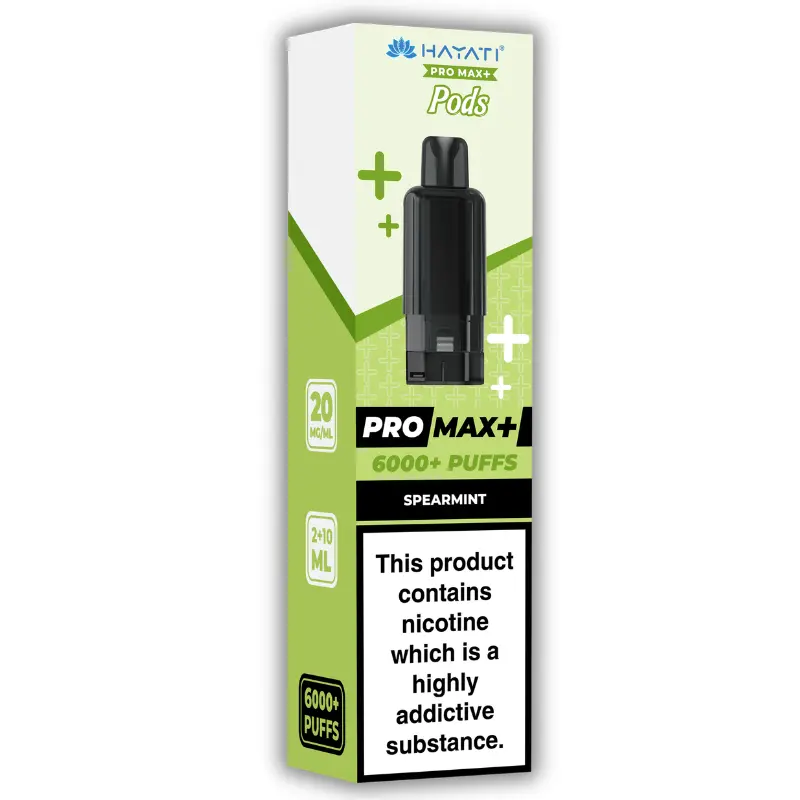
Hayati · Pro Max Plus
Spearmint Hayati Pro Max Plus Pods
£5.49
✔ In stock — ready to ship
Genuine Hayati
Free over £20
Same-day dispatch
Secure checkout
Spearmint Hayati Pro Max Plus Pods is a refill and nothing more: one prefilled pod carrying 12ml of liquid at 20mg nicotine, listed at £5.49, made to drop into a Pro Max Plus body that is already in your pocket. No device comes with it. If you do not own the hardware, the Spearmint Hayati Pro Max Plus 6000 Pod Kit puts the identical liquid in a box with a device at £7.99, and the liquid is the only thing the two listings have in common.
Now the part that earns this particular refill a page of its own. Count the names on the Hayati Pro Max Plus Pods shelf and there are eighty-nine of them. Sixty-nine name something a person eats or drinks for pleasure: a fruit, a juice, a lemonade, a cola, a sweet, a dessert, a cocktail. Twelve name a mood or a colour and disclose nothing whatsoever. Four are strength listings with no flavour word in the title at all. That leaves four names pointing at something nobody consumes for enjoyment, and Spearmint is one of them.
The consequence is unusual and it shapes everything below. For most British adults the word spearmint does not summon a plant, a dish or a drink. It summons a tube at a basin and a stick of gum in a coat pocket: two products that are used rather than enjoyed, chosen on whether they work rather than on whether they taste good. That reference was laid down early, it has been topped up every single day since, and it arrives faster than anything you could reason your way to. A buyer therefore opens this listing already holding a yardstick, and it is a yardstick built for a functional product.
Which means this liquid gets graded against a standard it never set out to meet. The rest of this page works through what that does to the buying decision: why the association is so stubborn, what a functional reference does to your attention, how the culinary spearmint actually differs from the version in the tube, whether the filing can be put down at all, and what an adult vaper should genuinely expect from twelve millilitres of it.
The only name on this shelf you already have an opinion about
Start with the count, because the claim is easy to overstate and the real numbers are more interesting than the vague version.
What eighty-nine listings actually break down into
Of the eighty-nine pods on this shelf, sixty-nine carry a name whose referent is edible or drinkable. That is the overwhelming majority and it sets the shelf's default register. Twelve more are mood names that resolve to nothing on inspection: Black Mamba, Blue Fusion and Galaxy Aura sit in that group, and a buyer approaching any of them has no prior expectation at all, because there is nothing in the name to have an expectation about. Four listings name a nicotine strength and leave the flavour to the family default.
The remaining four name something that is not consumed for pleasure: Spearmint, Fresh Mint, Double Menthol and Smooth Tobacco. Three of those four are in the mint family, which is worth noticing, because it says the effect described here is not unique to this pod. It is, however, sharpest here, and the reason is a distinction between the three mint names rather than anything about the shelf.
Fresh Mint is a descriptor. It names a quality, not a plant, and so it sets a loose expectation that a buyer can bend in either direction. Double Menthol names a compound and, through it, a sensation; nobody reads that title and imagines flavour at all, they imagine cold. Spearmint is different in kind. It names a specific botanical variety, Mentha spicata, and it is the only name across the whole 492-listing Hayati catalogue that identifies a mint by species rather than by adjective. The word peppermint appears nowhere in the range. Black Mint and Frosted Mint, elsewhere in the catalogue, are descriptors again.
So the narrow and defensible version of the claim is this. Spearmint is the one listing in the entire range that names an edible culinary herb, and it is also the listing whose name most reliably summons a non-food product in the reader's head. Those two facts sit uncomfortably together, and the gap between them is the whole buying problem.
Why the filing is so difficult to shift
Associations of this kind are not held as opinions. They are held as reflexes, and three things make this one unusually firm.
It was formed early, before anyone had a competing reference to weigh it against. Most people meet the flavour in a tube long before they meet it in a bowl of new potatoes, and the first filing of anything is the one everything else gets sorted against. Second, it has been reinforced by daily repetition for decades, which is a rate of practice no food flavour in the catalogue comes close to. You might eat a mango fifty times in your life. You meet mint in that other register several thousand times, and every repetition strengthens the same link.
Third, and least obvious, the reinforcement always happens in the same physical setting with the same accompanying sensations. Flavour memory is heavily context-bound. It is not only the taste that is filed but the whole package: the room, the time of day, the texture, the foam, the grit, the rinse. That bundling is why the association arrives complete rather than as a bare flavour note, and it is why arguing with it on paper accomplishes very little. The reader can accept every word of this section and still get a flash of the tube on draw one.
Worth saying plainly: none of that is a defect in the buyer. It is how flavour learning works, and a retailer telling you to simply ignore an association built over twenty thousand repetitions is not being honest with you. What can be done is narrower and more practical, and it is set out further down.
What a functional reference does to your judgement
Here is where the problem stops being a curiosity and starts costing people money. The reference product is not merely a different flavour. It belongs to a different category of thing, and categories carry their own rules for how you evaluate a member.
Food and drink are judged on a pleasure scale. You rate them, you have preferences within them, you notice nuance, you go back for a second helping of the ones you like. Functional products are judged pass or fail on efficacy. You do not have a favourite among them in the way you have a favourite fruit; you have one that works and several that do not. Nobody lingers over a functional product trying to decide whether it is more interesting than last week's.
When that second rulebook gets applied to a flavoured liquid, three specific misreadings follow.
Intensity mistaken for quality
A functional product with a strong flavour reads as effective and one with a mild flavour reads as weak. That heuristic is not mad in its home category, where the sting really is a proxy for the active ingredient doing something. Transplanted onto a vape pod it is simply wrong, and it is the single commonest complaint about this liquid.
Spearmint at the concentration used here is deliberately gentle. A buyer running the functional rulebook takes three short draws, registers that nothing is stinging, concludes the pod is underpowered, and either sends it to the back of a drawer or writes it off as a weak batch. In flavour terms the pod is doing exactly what it was built to do. In functional terms it has failed a test that was never the right test.
The tell for this misreading is very consistent: people who make it describe the pod as thin, faint or watery rather than as unpleasant. Those are efficacy words, not taste words. If your own reaction to the first few draws lands in that vocabulary, the rulebook is the thing to examine before the pod is.
The flavour nobody actually tastes
Second consequence, and subtler. You do not taste a utility item, you use one. Attention is reserved for things that reward it, and the whole point of a functional product is that it does not require any.
The result is a pod that people run for a fortnight and then cannot describe. Ask a vaper what their sugared fruit pod tastes like and you get a small essay: which berry leads, how the acid sits, whether the sweetness cloys by the afternoon. Ask the same person about the spearmint pod that spent a week in the same pocket and you often get one word back. Nothing was wrong with the liquid. It was simply never being attended to, because the name put it in the bin marked useful rather than the bin marked interesting.
This matters commercially as well as aesthetically. A flavour you never taste is a flavour you cannot judge, which means you cannot tell whether a second pod is worth buying, whether this batch is as good as the last, or whether you actually like it or merely tolerate it. The buyer who pays attention for the first two hours ends up better informed about their own rotation than the one who does not.
Restocking instead of choosing
Third, and this one belongs specifically to a bare pod rather than a kit. You do not crave a utility item. You notice its absence. Nobody looks forward to a tube; they notice the tube has run out and they replace it without a moment's deliberation.
A lot of spearmint reordering happens exactly like that. The pod in the device is empty, a replacement goes in the basket, and no decision is made at all. There is nothing wrong with a standing order, and £5.49 is a small enough sum that the frictionless version is defensible. But a purchase made without deliberation is also a purchase never reviewed, and pods bought that way tend to outlive the reason they were introduced. If you have been restocking this one for six months, the useful question is not whether it is good, it is whether you would put it in the basket today given the state of the rest of your rotation. Sometimes the answer is obviously yes. Sometimes it turns out you have been buying a habit.
The other spearmint, the one that goes into food
All of the above assumes the functional reference is the only one available. It is not. Britain has a second and entirely separate spearmint tradition, it is an old one, and most people carry it without ever connecting it to the word on the label.
Garden mint is the same plant
The mint grown in British gardens, sold in supermarket herb pots and chopped into mint sauce for a Sunday roast is spearmint. So is the mint thrown into a pan of new potatoes, the mint in a jug of cordial, the mint muddled into a mojito, the mint steeped for tea across North Africa, the mint chopped raw into tabbouleh, and the mint blitzed into a chutney alongside coriander and green chilli. All the same species. All food.
That is a large body of experience and almost nobody activates it when they read a pod label. The word on the tube and the leaf in the sauce do not feel like the same thing, and they are filed in separate drawers, one marked utility and one marked cooking. The liquid in this pod is unambiguously aimed at the second drawer. Whether a buyer opens that drawer is more or less the whole question.
There is a straightforward way to test whether your own second reference is intact. Think about mint sauce, specifically the green in it before the vinegar takes over, and notice whether that reads as a food flavour to you. For most people it plainly does. That is the same aromatic that is in the pod, presented without the vinegar, the sugar and the chopped texture.
What the herb tastes like when nothing else is attached
Culinary spearmint is sweet. Not sugared, but naturally sweet in the way basil and fennel fronds are sweet, with the sweetness sitting at the very front and fading within a second or two. Behind it the character is soft, broad and green: grassy, faintly waxy, closer to the smell of a bruised leaf than to the taste of anything confected. There is a slight anise or caraway edge at the outer margin of it, which is chemically unsurprising given what the plant's dominant aromatic is related to, and which most people recognise instantly once it has been named for them.
What the herb does not have is a bite. There is no astringency, nothing scoured or chalky, no medicinal sharpness and no numbing. Left to itself the leaf is a warm flavour rather than a cold one, and warm spearmint is a completely coherent thing that simply gets very little exposure because almost every manufactured version is cooled.
Held against that description, the liquid in this pod is recognisably the herb rather than the tube. The sweet front is there and it is light. The green body is there and it is the largest part of the profile. A modest coolness rides along with it, more noticeable on the exhale and through the nose than on the tongue, and it accumulates across a long draw rather than landing at the start of a short one. The finish is short and dry, which is to say the flavour stops rather than lingering as a film.
Where the harsh register in the tube actually comes from
This is the part that resolves the apparent contradiction. If spearmint the herb is soft and sweet, why does the flavour most people remember have an edge to it?
Because in the functional product the mint is not on its own. It sits with a set of non-flavour components that do the bulk of the sensory work, and the whole bundle gets remembered under the heading of the flavour. Strip those away and what remains is not what the memory supplies. Texture accounts for a good deal of it, foam for more, and most of the cold in that memory belongs to a separate cooling agent rather than to the mint aroma at all. There is also frequently a dryness that has nothing to do with mint and everything to do with detergents, and it is that dryness, more than anything, that people are describing when they say something tastes of the tube.
Chewing gum works the same trick from the other end. Gum mints are sweetened hard, cooled hard and built around a very narrow slice of the spearmint profile, and the flavour is inseparable from several minutes of mechanical chewing and a sweetness that decays in a distinctive curve. Take away the chewing and the sugar crash and you are again left with something the memory does not quite match.
The honest conclusion is that the remembered spearmint is a composite, most of whose parts are not spearmint. A liquid cannot reproduce it and is not trying to. Interestingly the shelf carries a gum-referent pod too, Blueberry B’Gum, and nobody files that one as a utility item, because the name leads with a fruit. Same product category behind it, opposite filing, entirely because of which word came first.
Two mints, two compounds, one very common mistake
The second thing a buyer needs settled is the relationship between spearmint and menthol, because conflating them is the most frequent error about this flavour and it leads directly to disappointed purchases.
They are not the same molecule and they do not do the same job
Menthol is the dominant aromatic of peppermint. Its most important property in a liquid has nothing to do with taste: it binds to the receptor in the mouth and throat that detects cold, and triggering that receptor produces a genuine sensation of chill at ordinary temperature. Menthol is therefore a sensation first and a flavour second. It fires whether or not you are paying attention to taste, and once it is firing it raises the threshold at which fine aromatic detail registers, which is why heavily cooled liquids tend to read as one big impression rather than several small ones.
Carvone is the dominant aromatic of spearmint, and it does very nearly the opposite. It is a flavour and an aroma with very little cold-receptor activity, so it registers as taste and smell rather than as a physical event. Nothing goes numb. Nothing tightens at the back of the throat. The green detail stays legible precisely because there is no wall of cold standing in front of it.
That is not a matter of degree, and the framing "spearmint is mild peppermint" gets it wrong in a way that matters. Turning menthol down does not produce spearmint; it produces weak peppermint, which is a different and duller thing. The two flavours differ on axis, not on volume.
Why almost everybody conflates them anyway
The reason connects back to the argument above. In the functional products where most people learned the word mint, the aroma and the coolant arrive together, every time, in fixed proportion. They were never encountered separately, so they were learned as a single unit. Under those conditions a person cannot reasonably be expected to know which part of the memory is the leaf and which part is the chemistry, because nothing in their experience has ever separated the two.
Vaping is one of the few contexts where they routinely come apart, because a liquid can carry mint aroma with no coolant, coolant with no mint aroma, or any mixture. Once you have met a warm mint and a flavourless chill separately, the two halves of the old memory pull apart and stay apart, and that is a small permanent upgrade to how you read every mint product afterwards.
What that means for the cool in this specific pod
There is a real coolness in this liquid and it is modest. Where it comes from is not something Hayati publish. Cooling agents are commonly dosed alongside a mint aroma in liquids of this kind, and there is no ingredient breakdown on this listing that would let anyone say whether that is happening here or whether what you are feeling is the aroma alone. Anybody telling you which it is on a retail page is guessing, this page included, so the useful description is of the effect rather than its cause.
The effect is a lift rather than a front. It builds over the length of a draw instead of announcing itself, it is more evident through the nose on the exhale than on the tongue, and it never reaches the level that an Ice or Frozen title implies. If cold is the property you are actually buying, this pod cannot supply it at any draw length or airflow setting, and the honest advice is to buy something built for it instead. Double Menthol on this same shelf is named for the sensation rather than for a plant. Blue Frozen and Blackberry Ice both put a serious chill behind a fruit, and Banana Ice does the same with a softer one.
Can the association be set aside, and what to do if it will not go
Direct answer first: not by deciding to. A reflex built by repetition is not dismantled by an argument, and any page promising otherwise is selling. What can be done is to change the conditions under which the flavour is met, because context-bound associations are weaker when the context is missing. Five things genuinely help, and they cost nothing to try.
Take the first draws somewhere that supplies none of the old cues. A pod tried at a basin, first thing, is being handed every contextual prompt the association owns. The same pod at a kitchen table after a meal is being handed none of them, and people frequently report that those two first impressions are not recognisably of the same liquid.
Give the food reference a hand up. Have something with fresh mint in it in the same hour, mint sauce, mint in a salad, mint tea, whatever is to hand, and the culinary drawer opens on its own. Once it is open the pod goes into it. This sounds like a gimmick and it is the single most effective item on the list.
Lengthen the draw. A short, quick pull collects the sweet front and very little else, and the sweet front is the most tube-adjacent part of the profile. Three seconds or so of steady mouth-to-lung pull lets the green body fill in behind it, and the green body is the part that does not resemble the functional product at all. People who pull hard and briefly on this pod are, quite literally, tasting only the fraction that triggers the wrong memory.
Do not run it straight after something sugared. Coming off a heavily sweetened pod, a low-sweetness herb reads as almost nothing for two or three draws while the palate recalibrates, and into that gap the memory happily inserts an astringency the liquid does not have. Thirty seconds of nothing in between solves it completely.
Give it three days before reaching a verdict. Exposure builds a competing reference, and a competing reference is the only thing that actually weakens the original one. Most people who end up keeping this pod report that the tube stops being the first thing that arrives somewhere around the third day, and that after a week it does not arrive at all unless they go looking for it.
And the failure case, stated properly, because it is real. For a minority of people the filing does not shift, and the flavour goes on reading as a product rather than a pleasure no matter what the surrounding conditions are. That is not stubbornness and it is not a fault in the liquid. If a full pod has been through the device and the association is still arriving on every draw, the correct move is to stop rather than to persist. Fresh Mint is the obvious next stop, because a descriptor name carries much less baggage than a species name does. Failing that, a cooled fruit gives you a comparable break in a rotation with none of the associative freight, and there is no rule anywhere that says a rotation has to contain a mint.
The pod, briefly
There is not much hardware in this purchase and the page should not pretend otherwise. What arrives is a single prefilled pod holding 12ml of liquid at 20mg nicotine, and that is the entire contents. There is no device, no charging accessory and no spare. The pod is prefilled and not intended to be topped up, so when the liquid is gone the pod is finished as a unit.
The specification that matters most for this particular liquid is the coil, and Hayati do not publish its resistance, its wattage window or its material. That gap is worth naming rather than filling, because spearmint is more sensitive to heat than a fruit is: push a mint aroma too hot and it turns soapy and slightly medicinal, which is the commonest reason a mint pod gets returned as faulty when nothing is wrong with it. On a device with no user controls there is nothing to adjust anyway, which in this one instance is an advantage, since the factory setting is the setting the liquid was matched to.
On fitment, match the range name printed on your device to the range name in this listing's title before ordering, and if they do not match, do not order on the assumption that a pod of similar size will seat. Everything else about the hardware, including what the rest of the family looks like, sits on the Hayati Prefilled Pods & Refills shelf and on the wider Hayati Pods listing, which runs to 202 products across every Hayati platform.
Specifications
| Listed price | £5.49 |
| What arrives | One prefilled pod. No device included |
| Flavour as listed | Spearmint |
| Liquid volume | 12ml |
| Nicotine strength | 20mg |
| Device required | Hayati Pro Max Plus |
| Manufacturer puff rating | Up to 6,000, a laboratory figure |
| VG/PG ratio | Not published for this listing |
| Coil resistance | Not published for this listing |
| Brand | Hayati |
| Listed on | Pro Max Plus Pods, Hayati Pods, Prefilled Pods & Refills, Mint Vapes, New Products |
Two of those rows say nothing, and they are there on purpose. A retail page that quietly supplies a VG/PG ratio or a coil resistance the manufacturer never stated is inventing a specification, and a buyer who plans around an invented number is worse off than one who knows the number is missing.
Take the price and the volume together and the arithmetic is the most useful single fact on the table. £5.49 for 12ml works out at roughly 46p per millilitre, which is the number to carry when cross-shopping, because a pod's headline price on its own tells you nothing about what a millilitre costs. It also tells you what stranded liquid is worth: abandon a pod with two millilitres still in it and you have thrown away about 92p, which is not a crisis but is a reason not to retire one prematurely.
The puff rating deserves a caveat with this flavour more than most. Hayati rate the pod at up to 6,000 puffs, and that figure comes from a machine drawing to a fixed script rather than from anyone vaping. It is a poor forecast generally, and it is a particularly poor one here, because spearmint specifically rewards a longer, slower draw. A vaper who has taken the advice above and lengthened their pull is consuming more liquid per activation than the test protocol does, so the gap between the rated figure and reality is wider for this pod than for a fruit people take short sharp hits on.
The 20mg figure is a plain statement of concentration and nothing more. It is the only strength this listing comes in, and the plain Hayati Pro Max Plus Prefilled Pods 5mg listing is where a lower-concentration pod for this device sits, though that is the unflavoured family default rather than spearmint. Nicotine is an addictive substance, which is a fact about the contents rather than a feature of them.
Where it sits among the other eighty-eight
The other mint on the shelf
Fresh Mint Hayati Pro Max Plus Pods is the direct neighbour and the comparison most buyers are actually making. The difference is not subtle once you know what to listen for. Fresh Mint is the brighter, more conventional reading of the profile: less green, less rounded, more of the crisp sensation most people picture on hearing the word. Spearmint is softer, sweeter and considerably more herbal, and it carries less of the cold. If the version in front of you feels too quiet, Fresh Mint is the step sideways. If Fresh Mint has felt too plain and you want to taste a leaf rather than an idea, this is the one.
Worth flagging what is not argued here. The case for buying a mint specifically as the second pod in a rotation, as something whose job is to make the pod either side of it taste better, is worked through on the Fresh Mint pods page and is not repeated on this one. Likewise the broader question of what the word mint even denotes in a liquid, whether it names a green aroma or a cold sensation with no smell of its own, is set out at length on our Lemon and Mint Pro Ultra Plus page. Both arguments are good and neither of them is this page's subject.
Against the cooled fruits
A large slice of this shelf is fruit plus coolant, and those pods are solving a different problem. They hand you a flavour and a sensation at the same time and the sensation usually leads, which is why Blackberry Raspberry with a chill behind it reads first as cold and second as berry. Spearmint inverts the relationship completely: the herb is the content and the coolness is a minor supporting element that could be removed without changing what the pod is.
Practically, that inversion means you can run this one for a long stretch without the cumulative throat chill that cooled pods build up over an hour, and it means each draw carries less information but more focus. Whether that is an improvement depends entirely on what you want from a pod, and anyone who wants the sensation should take the sensation.
Against the sugar-led pods
The gap here is the widest on the shelf and it is worth being blunt about. Berry Lemonade, Blackcurrant Lemonade, Grape GB, Blue Razz GB and Cherry Sour Raspberry are all sugar-forward with a great deal going on, and they are popular for entirely good reasons. Against any of them this pod reads as almost dry.
Low sweetness has one concrete practical upshot that heavy sweetness does not. The tongue adapts to sustained sugar, so a sweet pod appears to fade over a long day even while it is delivering at full strength; a low-sweetness profile resists that effect and tastes much the same at five in the afternoon as it did at nine in the morning. That consistency is the main argument for a herb pod for anyone who runs one flavour all day rather than swapping about. A second, quieter advantage is that there is much less sweetener to caramelise on a hot coil, so the flavour stays recognisable for longer in the pod's life.
Against a single fruit with nothing added
Not every alternative is busy. Juicy Peach and Blackcurrant Juice are both essentially one thing done properly, and they are the fairer comparison for anyone who likes simplicity rather than specifically likes mint. The difference is that a single fruit still sits in the pleasure category, so it gets attended to and enjoyed in the ordinary way, whereas a single herb has to climb out of the utility bin first. If you like the idea of an uncomplicated pod but have no attachment to mint, the single fruits give you the same restfulness with none of the associative work.
For a middle position, Lemon Lime is the one to look at: acidic rather than sugared, so it shares some of the low-cloy character without being remotely herbal.
Against the names that tell you nothing
There is a neat symmetry between this pod and the twelve mood names on the shelf, and it cuts in an unexpected direction. Dragon Berries is at least gesturing at fruit; Black Mamba, Blue Fusion and Galaxy Aura are not gesturing at anything. A buyer opening one of those has no expectation to be wrong about, which is uncomfortable but honest, and a first pod is the only way to find out what is in it.
Spearmint has the opposite problem, and there is a reasonable case that the opposite problem is the harder one. A name that tells you nothing leaves you open. A name that tells you something incorrect sets a specific expectation the liquid then fails, and a wrong expectation takes more work to dislodge than no expectation does. Nobody is disappointed by Galaxy Aura in the way people are disappointed by a spearmint that turned out not to be what they had in mind. If you value knowing in advance, the described flavours are the less risky purchase in the ordinary retail sense, but only when the description lands in the right category in your head.
The same flavour on other hardware
Spearmint appears exactly three times across the 492-listing Hayati catalogue: this pod, the kit that includes the device, and a 10ml nicotine salt bottle for refillable hardware. That is unusually thin coverage for a flavour, and it tells you something about how the range treats it. Blackcurrant Mango and the other fruit blends appear across several platforms; the one named herb does not.
If you are on the larger Pro Ultra Plus hardware rather than this one, there is no spearmint for it at all, and Fresh Mint Hayati Pro Ultra Plus Pods at £7.99 is the nearest thing available. The complete picture across formats sits on the Mint Vapes shelf, which runs to 19 listings and is one of the shorter flavour-family shelves in the catalogue, against 225 on the berry shelf. Anything that has landed recently is on the New Products listing, and the whole range is in the full Hayati catalogue if you want to see the spread before committing.
Handling, storage and the end of a pod
Green aromatics are the most volatile thing in any liquid and the first to go, which makes warmth the thing to manage with this pod specifically. A pod carried in a trouser pocket all day runs warm, wicks faster and tastes noticeably sweeter, because the sweet front survives heat better than the grassy top does. Left in a hot car for a weekend, the top note flattens permanently and what you are left with is the sweetness and a vague impression of mint. A pod left somewhere cold overnight has the reverse problem for the first few draws, thinner and slower to feed, but that one corrects itself as soon as the pod warms to room temperature.
Keep a spare somewhere dark, upright and at ordinary room temperature, and treat that as more important here than it would be with a berry pod. Out of reach of children and pets, as with anything containing nicotine.
Part-used pods deserve a specific warning with this flavour, because this is the pod most likely to be set aside half full. It is the utility item in a lot of rotations, so it gets displaced whenever something more interesting arrives, and it can sit in a drawer for a month. When you come back to it the sweetness will be roughly as you left it and the green will have thinned, which is why a returning pod so often reads as flatter than remembered. That is loss of the volatile fraction rather than anything having gone wrong. Store it upright, capped end up, and use it within a few weeks rather than treating it as indefinitely shelf-stable.
Aroma persistence is worth a word, and here the pod format helps. Mint aromatics soak into plastic, which is a real nuisance in a refillable tank you intend to reuse. This pod is a sealed disposable unit, so the liquid never touches anything you keep, and the only surfaces that retain any aroma are the airway and mouthpiece of the device body itself. A faint mint character on the first draws of whatever pod follows this one is normal and it clears within a few minutes of vaping. If it bothers you, running something assertive next, Blue Razz Cherry for instance, covers it faster than a mild fruit will.
Knowing when the pod is finished is less obvious with this liquid than with a sugared one, and the usual signal does not apply. A sweet pod on its last legs gives you a scorched note that makes the decision for you. This one has very little sweetener to burn, so instead the green narrows first: the grassy top recedes, the light sweetness becomes the most prominent thing left, and the whole profile starts reading slightly soapy. Soapiness is the end-of-life signal here. When it shows up, the pod has given you what it has, and continuing past that point is not unpleasant so much as pointless.
When it is done, a spent pod holds a coil and a small residue of liquid, so it does not belong in a kitchen bin. Take it to a retail take-back point or a local recycling facility that accepts electricals. Empty pods accumulate faster than people expect, so keeping a bag for them somewhere obvious is more practical than dealing with each one individually.
Questions people ask before reordering
Does it taste like toothpaste?
No, and the reason is that most of what you remember from the tube is not mint. Texture, foam, a separate cooling agent and the dryness that detergents leave behind all get bundled into the memory under the heading of the flavour. Strip those out and the mint underneath is a sweet, soft, grassy herb, which is what is in this pod.
Is spearmint just peppermint with the volume turned down?
No. They are separate plants with separate dominant aromatics and the difference is one of kind rather than degree. Peppermint leads on menthol, which acts on a cold receptor and produces a physical chill; spearmint leads on carvone, which is a taste and an aroma with very little cold-receptor activity. Turning menthol down gives you weak peppermint, not spearmint.
How cold is it, really?
Mild. There is a coolness and it is genuine, but it builds across the length of a draw rather than arriving at the front of it, and it registers more through the nose on the exhale than on the tongue. It does not approach the level that an Ice or Frozen title on this shelf implies.
Is there menthol in it?
Hayati publish no ingredient breakdown for this listing, so nobody can tell you from a retail page. Cooling agents are commonly dosed alongside mint aromas in liquids of this type, and the modest chill you feel may come from one or may come from the aroma itself. What can be said is what the effect is, which is a lift rather than a front.
How sweet is it?
Sweeter than people expect from a mint and much less sweet than almost anything else on this shelf. The sweetness sits at the front of the draw, fades within a second or two, and reads as the natural sweetness of a herb rather than as added sugar. Next to a lemonade or a gummy-referent pod it is close to dry.
Mine tastes soapy. What is wrong?
Two likely causes. Either the pod is near the end of its life, in which case the grassy top has gone and the soapiness is the signal to change it, or you are drawing very hard and running the coil hotter than the liquid likes. A slower, longer pull usually fixes the second case within a few draws.
Will the toothpaste association ever go away?
For most people it fades with exposure rather than with effort, and the usual report is that it stops arriving first somewhere around the third day. Meeting the flavour away from the setting that usually supplies it helps, and having something with fresh mint in it in the same hour helps more. For a minority it does not shift at all, and after one full pod the sensible move is to try a different flavour rather than persist.
Is a device included at this price?
No. £5.49 buys one prefilled 12ml pod and nothing else, on the assumption that you already have the body. If you do not, the kit listing at £7.99 pairs the same liquid with a device, and the £2.50 difference is the cheapest way anyone will ever acquire the hardware.
Is the liquid in the pod identical to the liquid in the kit?
Yes. Both listings carry 12ml of Spearmint at 20mg. The kit exists so that a first purchase includes a device; after that, the pod is the only part you replace.
How long will one pod last me?
That depends on your draw length and how often you vape, and any specific figure would be a guess. The manufacturer rating of up to 6,000 puffs comes from a machine drawing to a fixed script, and it is a weaker guide here than on most pods because this flavour rewards a longer pull than the test protocol uses. The reliable number is the volume: 12ml, at roughly 46p per millilitre.
Should I buy two at once?
One is enough to answer the only question that matters, which is whether the association shifts for you. If it does, a second pod is a sensible thing to have in a drawer. If it does not, you have spent £5.49 finding out rather than £10.98.
What else is worth trying if I want a break from fruit but not a mint?
An acidic pod rather than a sugared one gets you part of the way, since the low-cloy quality is what most people are actually after. Lemon Lime is the clearest example on this shelf. Beyond that, the honest answer is that mint is the only non-fruit register the Pro Max Plus Pods shelf offers apart from one tobacco flavour, so the choice is narrower than the eighty-nine listings suggest.
The short version
Spearmint Hayati Pro Max Plus Pods is a 12ml prefilled pod at 20mg nicotine, £5.49, for a Pro Max Plus device you already own. The liquid is a soft, sweet, grassy herb with a modest coolness that accumulates over a long draw, a short dry finish and very little sugar. On the flavour alone it is a competent and rather pleasant thing that does one job properly.
The reason it needs more explanation than a fruit pod is that sixty-nine of the eighty-nine names on this shelf point at something eaten for pleasure and this one does not. Most British adults have spearmint filed under a product that gets used, not a flavour that gets enjoyed, and that filing brings the wrong yardstick with it: mildness read as failure, a flavour never actually tasted, a pod reordered without a decision. The plant itself is a cooking herb with a long British history in sauce, salad and cordial, and it is sweet and soft rather than sharp and synthetic. If you can get the liquid into that second drawer, the pod is a good one. If after a full pod it is still reading as the tube, it is not going to, and Fresh Mint or a cooled fruit is where to go next.
Strictly for adults aged 18 and over. Nicotine is an addictive substance.
You might also like


