
Home / Hayati Pro Max Plus Pods / Triple Melon Hayati Pro Max Plus Pods
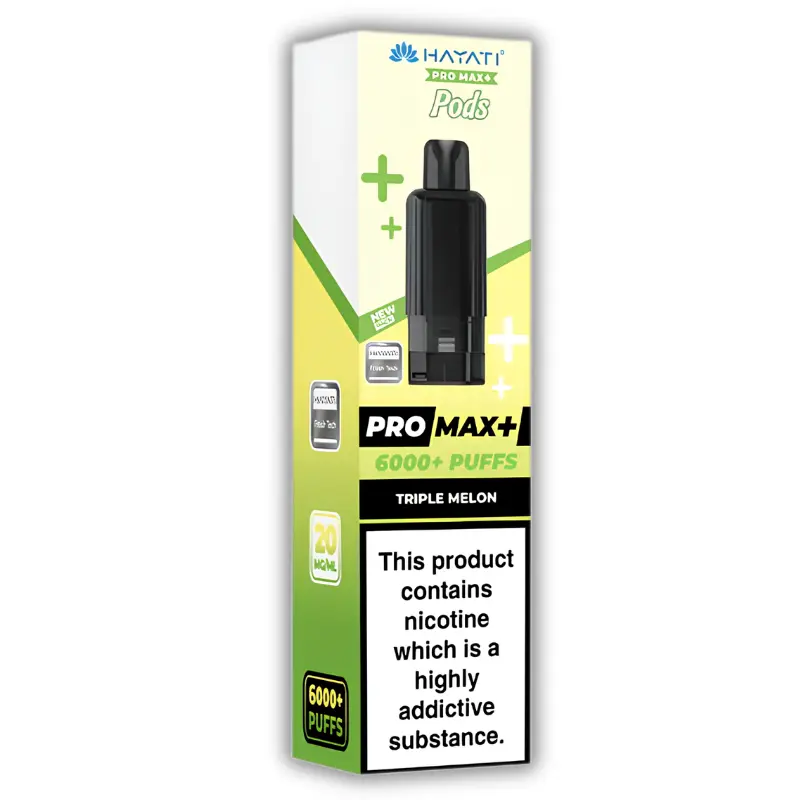
Hayati · Pro Max Plus
Triple Melon Hayati Pro Max Plus Pods
£5.49
✔ In stock — ready to ship
Genuine Hayati
Free over £20
Same-day dispatch
Secure checkout
This listing is the refill on its own. One Triple Melon pod, filled at the factory, 12ml of liquid at 20mg, £5.49, and nothing else in the packet. There is no body, which means the purchase only works if a Pro Max Plus is already sitting on your desk. Almost nobody lands on a bare pod by accident. You land here because you have had this one before and you are getting another.
Which makes this a different page from Triple Melon Hayati Pro Max Plus 6000 Pod Kit. That is the listing where the liquid gets taken apart at length: which melons appear to be in it, why three fruits from one family blur into something closer to one and a half, what an acid-free recipe does to a long session, and how the profile thins as the pod tires. All of that is worked out over there and there is no sense in writing it twice. If the taste itself is still the open question for you, read the kit page and come back.
What is left for this page is the decision nobody looks at directly, because it does not present itself as a decision. Buying a flavour the first time is obviously a choice, with hesitation in it and a page like this one to help. Buying it the fourth time feels like restocking, filed mentally alongside kitchen roll and batteries. It is not restocking. Hayati list close to five hundred lines across the whole catalogue, and the single shelf this pod sits on, Hayati Pro Max Plus Pods, holds eighty-nine of them by itself. Every pod you order occupies one slot in a year that contains a small and fixed number of slots. Filling one with something you already know is a perfectly reasonable thing to do. It is still a thing you did.
Melon sharpens the question rather than raising it. It is the fruit most likely to be described as easy: soft, sweet, unaggressive, with nothing in it to push back against. A flavour that is hard to dislike is a flavour that is easy to keep buying, and those two properties look identical from the inside while being completely different reasons to hand over £5.49. Telling them apart is the job of this page.
The reorder is a decision in disguise
Start with the arithmetic, because it is the part people never do and it changes the shape of the question.
Whatever your rate of use, your annual pod count is a real number and it is smaller than it feels. If a 12ml pod sees you through a week, that is fifty-two pods and roughly £285 a year at this price. If it takes a fortnight, that is twenty-six pods and about £143. Either way, the number of pods you will ever fit is not open-ended. It is a budget, denominated in pods rather than pounds, and it is fully spent by the end of the year whether or not you paid attention to how.
Now put the catalogue next to it. Eighty-nine listings share this shelf. Widen to Hayati Pods and the count goes past two hundred; the broader Hayati Prefilled Pods & Refills shelf is the same order of size. At twenty-six pods a year, working through one shelf takes three and a half years of buying nothing twice. Working through two hundred takes the better part of a decade. Nobody does that and nobody should try, but the numbers make one thing plain: you are not sampling this range. You are taking a very small sample of it, and the sample is chosen by whatever you happen to reorder.
The word that fits is allocation. Each £5.49 is a unit of a fixed annual allocation, and there are only two things you can spend a unit on. You can spend it on certainty, which is what this pod is, or you can spend it on information, which is what any listing you have not tried is. Certainty and information are both worth having. They are not the same good, and you cannot buy the second with a pod you have already bought.
What makes this invisible is that a reorder arrives with no friction attached. The listing is in your history, the price has not moved, the flavour was fine last time, and nothing in that sequence asks you a question. A year of non-decisions adds up to a strategy you never chose. People finish twelve months having spent £143 on one flavour and describe themselves as someone who likes melon, when the accurate description is someone who never had a reason to reconsider on any particular Tuesday.
None of which means the allocation was wrong. It means it was made by default rather than on purpose, and the same outcome reached deliberately is worth considerably more than the one reached by drift.
Why this flavour in particular becomes a standing order
Some liquids get rebought because they are loved. Others get rebought because nothing ever prompts a change. Melon belongs firmly to the second group, and understanding why is more useful than another description of how it tastes.
Consider what actually drives a switch. Almost always it is a refusal: a morning where you pick up the device, anticipate the flavour, and find you cannot face it. Heavy sweets do that. Aniseed does that. Anything with a strong aromatic signature does that eventually, because a strong signature is exactly what a palate tires of. Triple Melon has very little signature to tire of. It is low in acid, carries no bitterness, has no coolant and no sharp edge anywhere, and the result is that the refusal moment more or less never arrives. That is a real property and it is worth paying for. It is also not evidence that you prefer this to the eighty-eight other things on the shelf. It is evidence that this one never gave you a reason to look.
Two different things get called liking a flavour and they come apart here. One is a high ceiling, the peak of how good the flavour gets on a good draw on a good day. The other is a high floor, the worst it ever gets. Melon is a floor flavour. Its whole character is that the bad days are not very bad. Buyers who have never separated the two end up optimising for the floor without noticing, and then feel vaguely unenthusiastic about a product that is doing precisely what they selected it for.
There is a memory problem stacked on top. Distinctive flavours leave distinct recollections. You can remember specific occasions with a sour blend or a strong menthol because the experience had edges on it. A quiet blend leaves a much thinner record, so when you go to decide whether to reorder, the evidence you consult is not a set of remembered experiences. It is a general impression, and general impressions are sticky, self-confirming and extremely hard to update. You are effectively taking a recommendation from a previous version of yourself who left no notes.
Then there is the shape of the downside. Ordering something unfamiliar risks 12ml of a liquid you dislike, and that outcome is vivid, easy to picture and mildly annoying for as long as it takes to deal with. Ordering the melon again risks nothing at all. A person weighing those two will pick the second nearly every time, even when the expected return favours the first, because the possible loss is concrete and the possible gain is abstract. The loss is also smaller than it feels, which is the part worth holding on to. A disappointing pod costs £5.49 and does not have to be finished. Very few purchases at that price generate anything like the caution this one does.
Nothing to dislike, nothing much to remember, and a downside to changing that reads as larger than it is. That combination is what a safe flavour actually consists of, and melon is its clearest example on this shelf.
The case for one flavour you never think about
Everything above sets up an argument against loyalty. The argument against is only half of it, and the half people expect, so here is the other half made as strongly as it deserves, because for a fair number of readers it wins.
A default converts a recurring decision into a non-event. That is its entire function and it is not a small one. With a settled pod you order without reading anything, you order early because there is no hesitation to delay you, and you never reach Thursday evening with an empty device and no plan. Every buyer who runs a rotation of six flavours has, at some point, run out of all six at once because no single one felt urgent enough to reorder. A default does not have that failure mode.
You never waste a slot. The allocation argument cuts both ways. Spend every unit on information and a real fraction of your year goes on liquids you did not enjoy, which is its own waste and a more immediate one. Twelve millilitres is a long commitment to something that turned out wrong. A reader with three bad experiments behind them is not being irrational when they go back to the melon.
A fixed point is a measuring instrument. This is the underrated one and it is the best reason on the list. If everything in your rotation moves at once, you lose the ability to tell whether the new blackcurrant is genuinely good or whether you simply had a receptive week. Keep one liquid constant across months and you acquire a reference, something whose taste you know well enough that any drift in your own perception shows up against it. Triple Melon is unusually well suited to this because it is quiet and stable. A loud flavour makes a poor ruler. Used this way, loyalty stops being inertia and becomes method: the default is not the point of the rotation, it is the thing the rotation is measured against.
Not every purchase has to be interesting. There is a strain of thinking that treats a large range as an obligation, as though eighty-nine listings were eighty-nine things you ought to hold opinions about. Some people want their pod to be furniture: present, functional, requiring no thought. That is not a failure of curiosity. The size of the range is a fact about Hayati's catalogue, not a demand on your attention.
If you read the paragraphs above and recognised yourself in most of them, the honest advice is to buy the pod, buy it early, and stop reading. The rest of this page is for the reader who recognised themselves in one or two and felt something snag on the others.
What the standing order quietly costs
Four costs, roughly in order of how often they actually bite.
Recognition replaces tasting. The kit page deals with what happens inside a single long session on an acid-free blend. This is the slower version and it works differently. A profile you have had continuously for a year stops being evaluated at all. You do not taste it and conclude that it is good; you identify it and move on. The tell is easy to check and appears in the test section below. What matters here is that the experience you are paying for is not the one you had when you chose it, and the gap widens the longer the run goes on.
The menu moved and your choice did not. The New Products shelf runs to hundreds of lines, and a range this size turns over. The set of options you chose melon from is not the set that exists today. Even a decision that was correct when you made it becomes out of date simply by being left alone, and nothing in a reorder flow will ever tell you that, because a reorder flow is built to show you what you bought, not what appeared since.
Concentration leaves you exposed. A rotation of one has no fallback. If the listing becomes unavailable, or a batch reads differently, or you go off it suddenly and without explanation, you will choose a replacement under pressure from a list you have never worked through. Anyone holding two or three tested flavours never has that problem. The cost of loyalty here is not the melon, it is the absence of everything else.
The compounding you never see. This is the largest cost and the least visible. Suppose there is a listing somewhere on this shelf that you would prefer to Triple Melon. With eighty-nine candidates and a sample of three or four, the odds that your current default is genuinely your favourite are not good. Finding the better one early does not improve one pod, it improves every pod you buy afterwards. Fail to look and the loss recurs twenty-six times a year, silently, in a form that never shows up as a complaint because you have nothing to compare it against.
The counter deserves stating too. Better may not exist. Plenty of people genuinely did find their flavour on the second attempt, and a rotation that never settles carries its own costs: permanent low-level dissatisfaction, and the loss of the comfort that only comes from knowing something well. Novelty is not free. Its bill simply arrives visibly, as a pod you did not like, while the bill for loyalty arrives invisibly, as an alternative you never met.
Six ways to find out which side you are on
Rather than a verdict, here are tests. Each is cheap, each takes a fortnight or less, and each answers a different part of the question. Run two or three.
The description test. Without opening the kit page or this one, say three specific things about what Triple Melon tastes like: what arrives first, what sits underneath, what happens on the exhale. If you can produce three, you are still tasting it. If what comes out is melon, sweet and nice, you are recognising a label rather than experiencing a flavour, which is the single clearest sign that the reorder has gone onto autopilot.
The reach test. Put two charged options in front of you and notice which your hand goes to without deliberation. If it is always the melon, that is a preference. If it is always the other one and the melon is what you fall back on once the other runs out, you have a stock item you have been calling a favourite because it is the one you buy most.
The absence test. Run something else for a fortnight and then come back. This is the most informative of the six by some distance, because a year of continuous use tells you almost nothing about how much you like something and two weeks away tells you a great deal. If the return is a genuine pleasure, loyalty is earned and you should stop second-guessing it. If the return is neutral, if it feels like putting on a coat, then what you have is a habit that works rather than a flavour you prefer. Both are fine. They justify different amounts of your annual allocation.
The timing test. Look at when you actually order. Buying the spare while the current pod is half full is commitment: you are choosing this flavour in advance, with alternatives available and no pressure on you. Buying it in a hurry the morning after the last one died is inertia, because at that moment the melon is not competing with eighty-eight other listings, it is competing with nothing.
The substitution test. Ask yourself honestly whether you would notice if a different melon-family pod were fitted while you were not looking. If the answer is probably not, then the thing you are loyal to is a category rather than a product, and a category can be satisfied by a good few listings, several of which are named further down.
The regret test. Think of the last liquid you bought that was not this one and ask whether you still resent the money. Most people cannot even remember what it was, which is the point. The downside of an experiment is £5.49 and a few days of mild disappointment, and it is systematically overestimated by nearly everyone, including people who spend more than that on lunch without any deliberation at all.
If the tests come out mixed, the practical answer is not to abandon the default. It is to fix a ratio and stick to it. Reserve one order in four, or one in five, for something you have not had, and make it a fraction rather than a mood, because a mood will never produce the order. At one in five you cap the cost of searching at a fifth of your annual spend, you keep the default in place for the other four fifths, and you guarantee that the question gets asked at least five times a year instead of never.
If you do move, move the way a melon buyer should
A badly chosen experiment teaches you nothing. Jumping from an uncooled soft melon to a heavy sour blend only tells you they are different, which you knew. Useful moves change one variable at a time, and the further you travel from the default, the more the result is a coin toss rather than a measurement. What follows is ordered by distance.
One step: hold melon, change one thing
The lowest-risk experiments on the whole shelf keep the fruit family and alter exactly one property. Watermelon Ice Hayati Pro Max Plus Pods holds a single melon and adds coolant, which isolates the temperature question completely. A great many people who find Triple Melon slightly underwhelming are missing cold rather than missing fruit, and this is the pod that settles it one way or the other in about three draws.
Strawberry Watermelon Hayati Pro Max Plus Pods runs the other single-variable experiment. Melon stays, but instead of two more melons underneath it there is one soft red fruit, so you find out whether what you enjoy is melon specifically or the general shape of a mild, sweet, low-acid blend. Those two answers point at quite different parts of the catalogue.
If melon is the fixed point and you want the adjacent aisle in one view, Watermelon Vapes collects twenty-nine listings across formats. It is the shortest useful list on the site for someone in your position, and short lists get read while long ones get abandoned.
Two steps: same structure, different fruit
If the appeal is softness rather than melon, there is a cluster of listings built the same way. Banana Ice Hayati Pro Max Plus Pods is the closest structural relative, because banana has the same underlying difficulty melon does: most of what makes it appealing in the hand is texture, so what survives into vapour is aroma plus sugar, and the coolant is there doing compensatory work. Grape Berry Hayati Pro Max Plus Pods is the other classic low-acid sweet fruit, rounder and heavier than melon without becoming sharp.
The berry group sits a small step further along, adding a mild tartness that stops short of anything you would call sour. Blueberry Raspberry Hayati Pro Max Plus Pods pairs one soft berry with one that has a bit of grip. Cherry Berry Hayati Pro Max Plus Pods leads with a darker, rounder fruit. Mixed Berries Hayati Pro Max Plus Pods is the composite of the three, and it is the fairest like-for-like against Triple Melon, since both are blends that trade individual definition for a smoother overall shape.
Three steps: test an axis you have never tested
Here the point is not to find something similar. It is to establish what an entire missing property does for you, because a melon loyalist has typically never run a controlled test on acid or on cold, and both are cheap to run once.
For acid arranged as a soft drink, Berry Lemonade Hayati Pro Max Plus Pods and Blackcurrant Lemonade Hayati Pro Max Plus Pods run a continuous citrus line beneath the fruit, which shortens the finish and keeps resetting the palate between draws. That is the exact property Triple Melon does not have, so the contrast is informative even if you end up preferring what you started with. Lemon Pineapple Hayati Pro Max Plus Pods puts the acid in the fruit itself rather than in a soft drink framing, and Blue Sour Raspberry Hayati Pro Max Plus Pods is built around a sour spike as the main event. That last one is the furthest point on this shelf from where you currently are, which makes it the most decisive test and the most likely to be wasted money.
For cold as a standalone variable, Blackberry Ice Hayati Pro Max Plus Pods sets coolant over a dark fruit with real body, while Blue Frozen Hayati Pro Max Plus Pods pushes the cooling considerably harder and is best thought of as the upper bound rather than a typical example.
For weight and depth without much acid, Blackcurrant Juice Hayati Pro Max Plus Pods is the single-fruit version and Blackcurrant Mango Hayati Pro Max Plus Pods is the standard construction melon blends avoid, one soft fruit set against one sharp one.
Outside fruit altogether, Cherry Cola Hayati Pro Max Plus Pods brings a spiced soft drink character that has no counterpart anywhere in your current rotation, and Blue Razz Fruit Twist Hayati Pro Max Plus Pods is the confectionery end of the shelf, sweet in a way that sits above the fruit as its own layer instead of filling in behind it.
The high-variance corner
Two listings on this shelf name a mood instead of an ingredient. Black Mamba Hayati Pro Max Plus Pods and Blue Fusion Hayati Pro Max Plus Pods give you a name and a price and no fruit at all, and nothing in the product data fills the gap, so anyone who tells you what is in them is guessing. They are the highest-variance order on the shelf, and they are mentioned here mainly to be ruled out: a reader who has spent two years on one melon has demonstrated a strong preference for knowing what is coming, and spending a scarce experiment on a liquid nobody can describe returns no usable information either way.
Hedging the commitment entirely
A different structural answer exists, which is to stop buying one flavour per pod. Fruit Bomb/Straw’ Watermelon B’Gum Hayati Pro Ultra Plus 25K Pods and Blueberry H’Bubba / Watermelon H’Bubba Hayati Pro Ultra Plus Pods both carry two flavours in one listing at £7.99, and both keep a watermelon character on one side of the pairing, which is a hedge aimed squarely at the buyer this page is addressing. You keep the familiar thing and gain a second profile without spending a second slot. The catch is that these belong to the Pro Ultra Plus range rather than this one, which makes them a hardware question as well as a flavour question. Hayati do not publish what seats in what across the ranges, and a fitment answer should not be taken from any retail page, this one included. Check the device in your hand first.
What arrives, in two hundred and some words
The hardware section on a bare pod page ought to be short, because there is no hardware in it. What comes through the door is a single moulded pod, filled, with the coil and wick built in and no part of it intended to be opened. Uncover the mouthpiece, fit it to the body, and that is the whole procedure.
The one specification worth holding in mind for a repeat purchase is that the pod in this packet is the same 12ml unit that ships inside the kit. Nothing about the liquid, the fill or the coil changes between the two listings. Set them side by side and the only difference is a battery: £5.49 here, £7.99 with a body included. If you already have a working device, the extra buys you a second one, which is worth having as a charged spare or so that two flavours can run in parallel during a comparison, and is worth nothing at all if it is going to join two others in a drawer.
Everything else about the device belongs on pages that sell the device. Hayati publish a bench figure of up to 6,000 puffs for this pod, generated by a machine drawing at set intervals in a laboratory rather than by anybody using one, and it is best read as a way of ranking listings against each other rather than as a forecast of your fortnight. For the rest of the platform, and for the other eighty-eight flavours built on it, the shelf is the place to look.
The listing, line by line, and why it decides nothing
| What is in the packet | One prefilled pod, no device |
| Device required | A Hayati Pro Max Plus body, bought separately |
| Flavour as printed | Triple Melon |
| Liquid volume | 12ml, supplied filled |
| Nicotine | 20mg |
| Carrier ratio | Hayati do not publish it |
| Temperature words in the title | None |
| Bench figure quoted by Hayati | Up to 6,000 puffs, laboratory testing |
| Price on this page | £5.49 |
| Brand | Hayati |
| Shelves it appears on | Hayati Pro Max Plus Pods, Hayati Pods, Hayati Prefilled Pods and Refills, Watermelon Vapes, New Products |
Now the observation that matters more than any individual row, and it fits the argument of this page better than a walk through the numbers would.
Take that table and set it against the equivalent table on any of the other eighty-eight listings on this shelf. Every row is identical except one. The volume is the same. The strength is the same. The bench figure is the same. The price is the same. The carrier ratio is equally unpublished on all of them. The only cell that changes from one product to the next is the flavour name.
Which means the specification carries no decision information whatsoever for a repeat buyer. You are not weighing a spec sheet, because there is nothing in the spec sheet to weigh. Every argument for or against ordering this particular pod again is a flavour argument, an availability argument or a habit argument, and that is precisely why a page about the taste and a page about the habit are the two useful things that can be written about it.
Two rows carry a little weight. The unpublished carrier ratio is a real gap rather than an omission on this page, and it matters slightly more on a mild liquid than a loud one. And 20mg is the only strength this listing offers, so that question is settled by the shelf rather than by you. Nicotine is addictive at any concentration.
Running a rotation without losing what you learn
Handling advice for a first pod is on the kit page. What follows is the handling that only applies once you are buying the same thing repeatedly and occasionally trying something else, which is a different activity with different ways to get it wrong.
Write three words per pod. A rotation only accumulates knowledge if something is recorded, and almost nobody records anything. A date, a flavour and three words on your phone is enough: too sweet, went flat, kept reaching. Six months of that turns a vague sense of what you like into a list, and it is the only reliable way to avoid rediscovering the same disappointing listing twice.
Do not judge an unfamiliar pod on the first draw. The first draw of anything new reads as wrong, because what it is being compared against is not the previous pod but your expectation, and your expectation was built by the flavour you have had for months. A blend with acid in it will seem aggressive for about a day. Give an experiment a third of the pod before deciding, and if you abandon it earlier than that, record that you abandoned it early rather than recording that it was bad.
Start the experiment before the default runs out. Ordering something unfamiliar as an emergency replacement puts it in the worst possible position: it has to satisfy you immediately, with nothing to fall back on, at a moment when you resent having to think about it. Overlap the two instead, so the new one is being assessed rather than endured.
Unfamiliar first, familiar second. Within a single day, take the new thing when your palate is fresh rather than after an hour of sweet melon, which flattens everything that follows it. This is the reverse of the order most people naturally fall into, and it is the reason a fair number of experiments get written off unfairly.
Accept that one body means serial testing. Two pods cannot run at once in a single device, so a real head-to-head needs two bodies, which is the one honest argument for a kit when you already own hardware. Otherwise compare across days and trust your notes rather than your memory, which degrades faster than anyone expects.
Store spares dry, indoors and out of sunlight. A drawer is fine. A car in summer is not, and neither is a windowsill. Keep them where only adults in the household can reach them.
When you go back to the default, compare against the note, not against relief. Returning from an experiment you disliked makes the familiar pod taste better than it is, and that feeling is a comparison with the last three days rather than a judgement on the melon. Check what you wrote down a month ago instead.
Questions repeat buyers ask
Is the liquid in this pod identical to the one in the kit?
Yes. Same 12ml, same 20mg, same flavour, same pod. The kit listing simply includes a rechargeable body alongside it, which is why it is £7.99 rather than £5.49. Nothing about the liquid is altered or reduced on the bare pod.
I have a working Pro Max Plus. Any reason to buy the kit anyway?
Two reasons, and both are about hardware rather than flavour. A second body lets you run two pods over the same few days, which is the only way to compare properly, and a charged spare covers you when the first one is flat. If neither applies, the bare pod is the purchase that does not add to the pile.
How many flavours should I keep on the go at once?
There is no correct number, but one has a specific weakness: no fallback if the listing is unavailable or you go off it suddenly. Two or three tested options plus an occasional unknown covers most situations without turning every order into a research exercise. The thing to avoid is a rotation so wide that nothing gets finished.
Is Triple Melon a sensible thing to default to?
It is one of the better candidates for the job, because a default needs to be inoffensive rather than exciting and this is a mild, uncooled, low-acid blend with nothing in it to tire of quickly. That same quality is what makes it easy to keep buying without ever asking whether you still prefer it, which is the tension the whole of this page is about.
What is the cheapest way to find out if I would prefer something else?
Change one variable. Add coolant to the same fruit, or keep the softness and swap the fruit, rather than jumping to something structurally unrelated. One pod at £5.49 and about a fortnight is the entire cost of the experiment, and a result either way is worth having, since confirming your default is as useful as replacing it.
Does buying the same pod for months make it taste weaker?
What changes is attention rather than the liquid. A profile you have had continuously stops being evaluated and starts being identified, so it registers as less interesting without actually being any different. A fortnight on something else and then a return is the quickest way to check whether that is what has happened.
Which listing should I try if I only want to move slightly?
Watermelon Ice is the smallest possible step, since it holds the fruit family and changes only temperature. Strawberry Watermelon is the other one-variable move, keeping melon and pairing it with a single soft red fruit instead of two more melons. Either result tells you something specific rather than just telling you the two are different.
Does this one have any coolant in it?
No. Hayati flag cooling in the product name across this range, and none of the words they use for it appears in this title. It is a warm-tasting liquid throughout, which is worth knowing because a lot of people associate melon with something chilled and are surprised by the absence.
How long will one pod actually last me?
That depends entirely on how you draw and how often, so no page can tell you. The published bench figure of up to 6,000 puffs comes from a machine taking identical draws in a laboratory, which makes it useful for comparing listings and unreliable as a personal estimate. Note the date you fit a pod and the date it dies, and after two or three you will have a figure that applies to you.
What if I try something new and dislike it?
You are out £5.49 and you do not have to finish it. That is a smaller loss than most people intuitively price it at, and it comes with information attached, which the safe reorder does not. Keep the half-used pod rather than binning it, since tastes shift and a blend that seemed too sharp in January can read differently later in the year.
Are the Pro Ultra Plus pods a straight upgrade from this one?
They are a separate range at a separate price, so treat them as a hardware decision rather than a flavour one. Hayati publish nothing about what seats in what across ranges, so confirm against the device itself rather than any listing. Their interest for a melon buyer is structural: several carry two flavours in one pod, which lets you keep something familiar while trying something else in the same order.
The short version
Triple Melon as a bare pod is 12ml at 20mg for £5.49, no device included, and the liquid is the same one the kit listing supplies with a body attached. If you are here you have had it before, so the flavour is not really the question and the analysis of it lives on the kit page.
The question is what a repeat order is for. This is a mild, sweet, uncooled blend with almost nothing in it to object to, which makes it an unusually good default and an unusually easy thing to buy without thinking. Those are the same property viewed from two sides. Inside a range of this size, every reorder is also a decision not to try one of several hundred other things, and the reason that decision goes unexamined is that it never announces itself.
Neither answer is wrong. A settled flavour removes a recurring decision, stops you wasting slots on things you dislike, and gives you a fixed reference to judge everything else against. A rotation that never moves costs you the alternatives you never met, and that cost compounds across every pod afterwards. Run the absence test for the real answer, and if it comes out mixed, fix a ratio rather than a mood.
Buy this pod because you tested the alternatives and came back, or buy it because you genuinely want your vape to require no thought at all. Both are good reasons. Buying it because the listing was already in your order history is the one worth noticing.
Strictly for adults aged 18 and over. Nicotine is an addictive substance.
You might also like


