Home / Hayati Pro Max Plus Prefilled Pod Kit / Lemon Pineapple Hayati Pro Max Plus 6000 Pod Kit
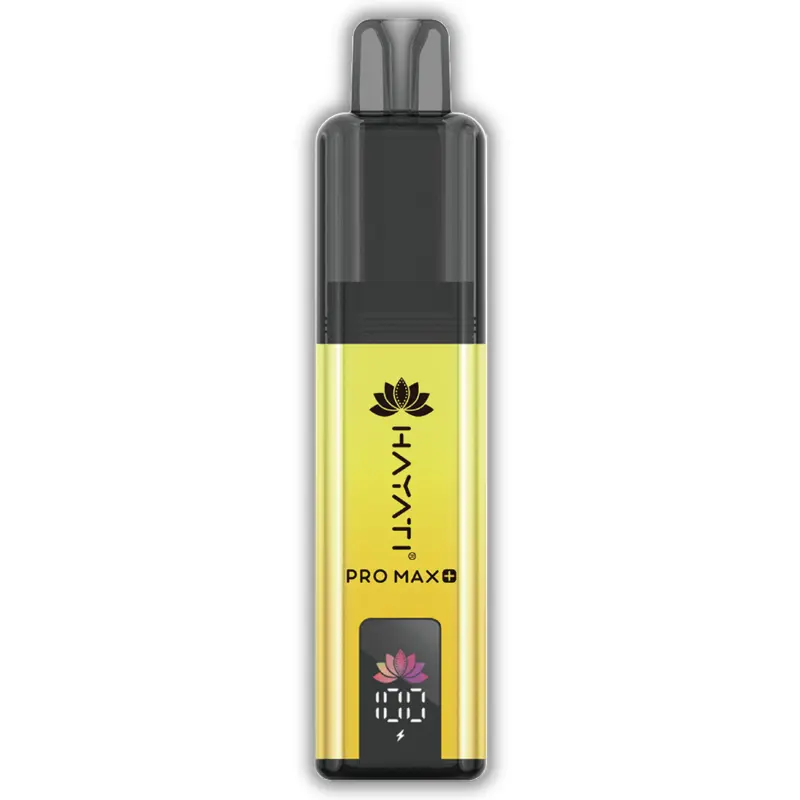
Hayati · Pro Max Plus
Lemon Pineapple Hayati Pro Max Plus 6000 Pod Kit
£7.99
✔ In stock — ready to ship
Genuine Hayati
Free over £20
Same-day dispatch
Secure checkout
Lemon Pineapple on the Pro Max Plus 6000 is sold here as the complete set for £7.99: one rechargeable body carrying an 850mAh cell, and one pod that left the factory already holding 12ml of liquid at 20mg nicotine salt. There is nothing to fill, nothing to assemble and no coil to fit. Hayati attach a rating of up to 6,000 puffs to the pod, which is a laboratory output from a rig taking uniform draws at fixed intervals, and it belongs in the same mental compartment as a fuel-economy figure rather than in the compartment marked promise.
Two fruits are named and nothing else is. No coolant word, no drink framing, no soft or creamy element, no third fruit hiding in the description. On most listings that would be the end of the specification and the beginning of a straightforward flavour write-up.
It is not straightforward here, and the reason is unusual enough to be worth the opening paragraphs. The bare Lemon Pineapple pod was written up before this kit was, and that page spent its length on a question nobody else in the range had asked: whether the order of fruits in a Hayati name carries any information at all. It counted, and the counting produced a result that lands directly on this product. That page owns the finding. This one owns what the finding implies about the liquid, which is a different job and a larger one.
Short version of what follows. The published record cannot agree on which of these two fruits leads, and after working through what the two fruits actually do in a heated aerosol, the most likely explanation is not that somebody was careless. It is that the question has no stable answer, because lemon and pineapple are both front-loaded and both acidic, so they arrive in the same part of the draw and fuse into a single bright sour impression rather than stacking into a first note and a second one. That has consequences for what you should expect, for how much the ratio can possibly matter, and for what happens to the pod as the coil tires. Those consequences are the subject of this page.
The finding this page inherits, and does not re-argue
The pod listing's page ran three tests against the catalogue and reached something sharper than it set out to find. The numbers are its work, they are reproduced here in a sentence or two because the argument below depends on them, and anybody who wants the full derivation should read that page rather than have it repeated in worse form.
Across every single-flavour listing whose title names two or more fruits and whose description mentions at least two of them, 137 in total, the fruit printed first leads the description in 120 cases. That is 87.6%, which looks like a convention until you notice what it measures: agreement between a title and a paragraph written by the same hand in the same sitting, not agreement between a name and a liquid.
The second number is the one that bites. Thirty-three multi-fruit names appear on two or more listings with usable flavour text, and nine of those thirty-three contradict themselves about which fruit is in front. Twenty-seven per cent of the time, the same recipe under the same name is described two or three different ways depending on which listing you happen to be reading.
And the third is the local one. Lemon Pineapple and Pineapple Lemon Burst each exist as a bare pod and as a kit, four listings in total. Both pod listings say the lemon leads. Both kit listings say the pineapple leads. The split is clean, it is two against two, and it does not follow the name. It follows the format.
Our own source text for this kit sits exactly where that pattern predicts. Hayati's flavour paragraph for this listing opens on the pineapple, gives it the golden sweetness and the ripe tingle, and then puts the lemon over the top of it as the thing that sharpens. The paragraph for the pod version of the same 12ml puts the citrus in front instead. Same liquid, same sealed pod, two accounts, and the only thing that changed between them is whether a device was in the box.
A device in a box cannot reach inside a sealed pod and reorder the aroma compounds. So the variable that predicts Hayati's stated lead fruit has no physical connection to the liquid, and the variable a buyer is invited to read, the name, predicts nothing. That is the inherited finding, it is cited here rather than re-derived, and it hands this page a question that is genuinely open: if the record cannot say which fruit leads, what is this liquid actually like?
Working the copy any further will not answer that, because the copy is the thing that failed. What is left is the chemistry, and the chemistry turns out to be unusually informative, because it does not merely describe the liquid. It explains why four separate attempts to describe it landed in two different places.
Two fruits arriving at the same moment
A draw has positions in it, and most blends fill different ones
Think of an inhale as a short timeline rather than a single event. There is an arrival, the first quarter to half second, which is almost entirely aroma carried into the nose by the vapour. There is a middle, a second or so long, where heavier and less volatile material catches up and where anything resembling body or texture registers. There is the exhale, where retronasal aroma peaks because the air is now travelling the other way past the olfactory receptors. And there is a finish, a few seconds after the vapour has gone, made up mostly of whatever is left sitting on the tongue rather than in the air.
A well-built two-fruit blend usually spreads itself across those positions. One component is chosen to be quick and aromatic and own the arrival. Another is chosen to be slow and fleshy and own the middle and the finish. The listener, so to speak, hears two notes in sequence, and that sequence is exactly what a description means when it says one fruit leads and another supports. The word leads is a statement about time before it is a statement about volume.
Now apply that to lemon and pineapple, and the trouble is visible before any tasting happens. They are both quick. They are both aromatic. Neither of them is the slow one.
What pineapple contributes, and when
Pineapple's aromatic signature rests on esters, which are small, light molecules that evaporate readily and reach the nose almost immediately. They read as sweet, distinctly fruity, and at high concentration slightly solventy, in the way an over-ripe pineapple left in a warm room smells faintly of something other than fruit. That solvent edge is not a defect in a flavouring. It is part of what the real fruit smells like, and a pineapple flavouring that removes it stops reading as pineapple and starts reading as generic tropical sweetness.
Underneath the esters sits an acid load that is genuinely substantial. Pineapple is one of the properly sour fruits rather than a sweet one carrying a decorative tartness, and that matters here for a reason that becomes central later: the acid and the aroma are different kinds of molecule with different fates. The esters are volatile and travel as smell. The acid is comparatively heavy, does not travel as smell, and registers as taste on the tongue.
Two separate things are therefore happening every time pineapple appears in a pod, and they are only loosely coupled. The ester lift arrives fast and early. The sourness arrives with the liquid itself, lands on the tongue and stays there a while. In a blend where pineapple is the only acid source, those two components read as one fruit because nothing else is competing for either channel.
What lemon contributes, and when
Lemon in a vaporised liquid is overwhelmingly citral sitting over limonene. Citral is the compound that reads as lemon rather than as generic citrus; limonene is the lighter, more general peel note that surrounds it. Both are volatile, both reach the nose very fast, and neither has any weight to it at all. A lemon aroma is a spike, not a plateau, and it is over almost as soon as it registers.
Lemon's acid behaves the same way pineapple's does. It is not part of the aroma, it does not evaporate with the citral, and it presents as sourness on the tongue rather than as smell in the nose. So lemon, too, arrives as two separate deliveries: a very fast aromatic spike, and a sour taste that outlasts it.
The practical point is that lemon has no second act. There is no fleshy component behind the citral, no sugar-heavy mid-palate, nothing that continues once the spike has decayed. Used alone that reads as thin, which is why an unaccompanied lemon liquid is rare and a lemon paired with something is common. The something is normally chosen to occupy the positions lemon cannot.
Why these two do not layer
Set the two timelines side by side and they are almost the same timeline. Citral arrives in the first fraction of a second. Pineapple esters arrive in the first fraction of a second. Both are aromatic, both are bright, both are pitched high rather than low, and both have finished delivering by the time the middle of the draw arrives. The middle of the draw has nothing scheduled in it.
What happens next is the part that matters, and it depends on the difference between the two senses involved. Sourness is a taste, detected on the tongue, and two acid sources broadly add together: put lemon acid and pineapple acid in the same liquid and you get more total sourness than either alone. Aroma does not add in the same way. Two volatile notes arriving in the same instant, in the same register, through the same channel, do not sum into a louder version of both. They mask each other. The nose is being asked to resolve two overlapping bright fruit signals in under half a second, and it resolves them poorly, which is a normal property of olfaction rather than a failing of this particular liquid.
The result is a composite. Not lemon then pineapple, and not pineapple then lemon, but a single bright sour arrival that most people, asked to name it cold, would call citrus-tropical and leave at that. The fruits are both present. They are simply not separately legible in the position where both of them land.
Then the arrival decays, the middle of the draw passes with relatively little in it, the exhale brings a second and slightly clearer read of the aroma as the air reverses, and the finish is left to the acids, which are still on the tongue after the smell has gone. The finish is therefore sourer than the draw and much less fruity, because the component that carries fruit identity has left and the component that carries sourness has not.
This is the best available explanation of the contradiction
Return to the four listings and the two-against-two split. If a liquid genuinely presents a clear lead fruit, four writers describing it would tend to converge, whatever their habits. If a liquid presents a fused arrival in which neither fruit is cleanly separable, then a writer's account of which fruit leads is being produced by something other than the liquid: by the title in front of them, by the batch of copy they are working through, by whichever fruit they were thinking about first.
That is offered as a probable reading and not as a certainty, because nobody has published a chromatogram of this pod and no retail page is going to. But it is a better fit for the evidence than carelessness is. Carelessness produces scatter. This produced a clean pattern in the wrong variable, which is what you would expect when the underlying property being reported is genuinely ambiguous and the reporter falls back on the nearest available cue.
The practical form of it is blunt. Asking which fruit leads in this pod is close to asking which of two people shouting at once spoke first. There is presumably an answer at the level of the recipe. There is no reliable answer at the level of the draw, and the draw is what you are buying.
What that means for the ratio, and therefore for the price
One further consequence follows, and it decides the comparison further down this page. If the two fruits fuse at the arrival, then moderate changes in the ratio between them are close to imperceptible. A blend of sixty per cent lemon character and forty per cent pineapple, against one built the other way round, differs mainly in the balance of two signals that are already masking each other. Total acid load barely moves, because both fruits supply acid. Total brightness barely moves, because both fruits supply brightness. The middle of the draw stays empty either way, because neither fruit fills it.
Ratio is thus the least perceptible variable available in a blend of this construction, which is precisely the opposite of the situation in a blend pairing a sharp fruit with a soft one, where shifting the ratio changes the whole shape of the draw. Anyone hoping to detect a formulation difference between two listings that name these two fruits in different orders is hoping to detect the one variable this construction hides best.
Sweetness, and why it is harder to read here than usual
Expect this to sit slightly above the middle of the Pro Max Plus range for sweetness and to taste as though it sits below it. Those are not contradictory statements. Sourness and sweetness suppress one another perceptually, so a liquid carrying a lot of both presents as less of each, and this pod carries acid from two sources at once. First impressions will therefore understate the sugar.
Two checks make the real level obvious. Take it immediately after something genuinely dry, a mint or an unsweetened profile, and the sweetness becomes plain. Or take it at the end of a pod's life, when the aromatics have thinned and less of the perceptual competition is going on, at which point plenty of people report a citrus pod tasting sweeter than they remember. The recipe did not change. The masking did.
It will not, in any event, reach the sweetness of the confectionery-framed listings. Hubba Bubba and the candy-adjacent pods on this shelf are built on a sugar impression that no two acidic fruits can produce, and if sweetness is the axis you buy on, this is not the listing.
There is no cooling in it
Nothing in the name and nothing in the supplied facts indicates a coolant, and Hayati name cooling explicitly when it is present. The bare-pod page for Blue Frozen counted the cooling vocabulary across the whole catalogue and established that the terms are not graded, with Ice appearing in ninety titles, Frozen in three, Cooler in two, and Chill and Freeze in none. The relevant point here is simpler than the grading question: this title carries none of them, so treat it as an uncooled liquid.
One confusion is specific to acidic blends and worth heading off, because it costs people money. Sharpness is not coldness. A high-acid liquid produces a tightening along the sides of the tongue and a prickle towards the back of the mouth, and that sensation gets described as fresh, crisp or even icy in casual conversation. It is not menthol and there is no drop in perceived temperature on the exhale. If cold is what you actually want alongside fruit, buy a listing that says so.
Three things it is not
Not a lemonade. Four listings on this shelf run citrus through a sweetened soft-drink construction, and that construction supplies exactly the rounded middle this pod lacks. The difference in mouthfeel between a lemonade profile and this one is considerably larger than the difference between any two fruits involved.
Not a sour-sweet confection. Genuine sour candy profiles use a dedicated souring agent over a heavy sweet base to produce a deliberate pucker that arrives late and hits hard. Fruit acid does something different: it builds gradually through the draw and persists into the finish, without the spike that a souring agent gives you. This is the fruit kind.
Not a tropical blend in the sense most people mean. Tropical usually implies two or three soft fruits layered for weight, which is a completely different shape from one tropical fruit with a citrus arriving on top of it at the same instant. If you want the layered version, that is a separate purchase and it is named below.
What to expect, stated without hedging
A fast, bright, distinctly sour arrival that reads as citrus and tropical fruit simultaneously rather than as one followed by the other. A middle of the draw that is lighter than the arrival led you to expect. An exhale where the aroma becomes marginally more legible and where, if you are paying attention, the pineapple is usually the easier of the two to name. A finish of a few seconds that is mostly sourness with a modest sweet residue behind it and very little fruit identity left.
Whether that is a good pod depends entirely on whether you are buying acid or buying fruit definition. It delivers acid generously and reliably. It delivers two separately identifiable fruits poorly, and no amount of attention on your part will fix that, because the limitation is in the timing rather than in the quality of the flavourings.
What a tiring coil takes first, and why it takes it from both ends
Every prefilled pod drifts across its life. This one drifts in a way that is worth knowing in advance, because it follows directly from everything above and because the usual advice about spent pods does not quite apply.
Volatility is a queue, and a loaded coil serves the front of it worst
As a coil accumulates residue, its ability to deliver delicate volatile material degrades before its ability to produce vapour does. The device keeps making clouds. The clouds keep carrying the heavier and less fragile components. What they stop carrying properly is the material at the very top of the volatility range, which is exactly where citral, limonene and the pineapple esters all live.
Both of this pod's aromatic components are therefore in the first group to suffer, and there is nothing behind them in the queue. A blend with a soft fruit or a dessert base underneath loses its top and still has something substantial left working. This one loses its top and finds that the only thing behind it is a taste rather than a smell.
The two do not fade at identical rates, though, and the difference is the interesting part. Citral is the more fragile of the two: it is heat-labile and it oxidises, and when it degrades it does not simply become quieter. It changes character, drifting towards a duller, slightly stale, faintly soapy impression that does not read as fresh lemon at all. Pineapple esters mostly thin rather than transform, becoming a quieter version of themselves with the solvent edge sometimes more exposed as the sweeter facets drop away.
So a pod at three-quarters is not a faded version of a pod at a quarter. It is a pod whose lemon has partly turned into something else while its pineapple has merely got smaller.
Sourness does not leave when the aroma does
Here is where a liquid built on two acids behaves differently from its neighbours. Acidity is a taste, delivered by relatively heavy non-volatile material that reaches your tongue as part of the aerosol rather than as smell. It is much less dependent on the coil delivering fragile molecules intact, so it survives a level of coil fatigue that has already flattened the aroma completely.
The end state of this pod is therefore sourness without fruit. Not burnt, not obviously spent, just sharp and blank. That is a specific and slightly unusual failure mode, and it matters because the signals most people use to retire a pod are the wrong signals here. Waiting for a burnt taste will keep you running a pod long past the point where the flavour you paid for stopped arriving. Waiting for the vapour to thin will do the same.
The correct retirement signal on this liquid is the loss of fruit identity while the sharpness continues. If you take a draw and the honest answer to what am I tasting is sour, with no fruit name attached, the pod has finished doing its job even though it will keep producing vapour for some time yet.
The one useful side effect, which is a small gift
There is a genuine compensation buried in this. The reason the two fruits are hard to tell apart on a fresh pod is that they arrive simultaneously and mask one another. Coil fatigue breaks that simultaneity, because it does not affect both components equally. Citral degrades faster and differently; the esters thin more gracefully.
Late in a pod's life, therefore, the fusion comes apart, and for a window of perhaps a millilitre or two you can often hear the two components separately for the first time. That is the best chance you will get to answer the question the pod page raised, which is which fruit was actually the larger presence. It is a decomposition rather than the blend as intended, so it tells you about the recipe rather than about the experience, but it is real information and it costs nothing.
Worth noting that this cuts slightly across the advice on the pod page, which recommends judging lemon dominance early in a pod's life. Both are right, for different questions. Early tells you what the liquid does when it is working, which is what you are actually buying. Late tells you what is in it, which is what the naming argument was about. If you care about the second question, take a note at the beginning and another at around the three-quarter mark, and expect them to disagree.
Twelve millilitres makes the drift long
One last consequence, and it is the reason the volume figure matters more on this flavour than on most. Twelve millilitres is a long run for a single sealed coil. On a heavy, sweet, forgiving blend that length is an advantage and the drift is easy to ignore, because the base carries on working. On a pod whose entire aromatic content sits at the fragile end, the same length means you spend a meaningful fraction of the pod in the degraded state described above.
Nothing can be done about that, since there is no coil to change, but it should inform how you buy. If you like this profile, running it continuously to the last drop is a worse plan here than it would be on a dark fruit, and alternating it with something else extends the useful part of its life by simply taking longer to get through it.
The kit itself, kept short
What arrives for £7.99 is two items: a rechargeable device holding an 850mAh cell, and one pod already containing 12ml of liquid at 20mg. The pod is prefilled and sealed, with its coil and wick built in, and there is no provision for topping it up or servicing it. Charging accessories are not itemised in the facts supplied for this listing, so check the packaging when it arrives rather than taking any page's word for what is alongside the device. Everything else about how this platform behaves, and the eighty-seven other flavours it is sold with, is covered on the Pro Max Plus prefilled kit shelf and on the broader Hayati pod kits shelf, which is a better place to read it than an eighty-eighth repetition here. Match the range name printed on your device to the range name in this title before ordering a replacement, since Hayati run several pod systems that are not interchangeable.
The one specification that genuinely interacts with this particular liquid is the 12ml volume, for the reason set out above: a long single-coil run is the worst case for a blend whose entire flavour identity sits at the fragile end of the volatility range. On a dessert or a dark fruit the same number is simply good news. Here it is good news with a caveat attached, and the caveat is that the last third will not taste like the first third.
The 850mAh figure is a property of the body rather than of the flavour, and it tells you nothing useful about how this pod tastes. Its only bearing on the liquid is indirect: a body that reaches the end of a charge does not stop at a cliff edge, and vapour produced as a cell tires renders fragile aromatics less well than vapour produced on a full charge. On this profile that shows up as the fruit going quiet rather than the clouds getting smaller, which is the same symptom coil fatigue produces. Charge it before you conclude the pod is finished.
The listing set out in rows
The table below leads with the two figures that actually bear on the liquid, puts the identification details in the middle, and groups everything Hayati do not publish at the bottom, so the gaps read as a set rather than as scattered omissions.
| Liquid in the pod | 12ml, prefilled and sealed |
| Nicotine | 20mg, salt preparation |
| Fruits named | Lemon and pineapple, no third component |
| Cooling | None indicated in the name or the facts |
| Supplied as | Device plus one filled pod |
| Cell in the body | 850mAh, rechargeable |
| Price here | £7.99 |
| Maker | Hayati |
| Full listing name | Lemon Pineapple Hayati Pro Max Plus 6000 Pod Kit |
| Manufacturer capacity figure | Up to 6,000 puffs, produced under laboratory conditions |
| Shelves it appears on | Lemon Vapes, Pineapple Vapes, three Hayati pod shelves, New Products |
| Carrier ratio | Not published |
| Coil resistance | Not published |
| Balance of lemon to pineapple | Not published, and not readable from the name |
Three of those rows deserve a note, and the most informative row is one of the empty ones.
Start with the strength, because 20mg on an acidic liquid is not the same experience as 20mg on a rounded one. Twenty milligrams is the UK maximum for a consumer nicotine product, so it is not a decision Hayati made about this flavour specifically, and it appears on essentially every prefilled pod in the range. What differs is how it reads. Acid produces its own prickle towards the back of the mouth, this recipe supplies acid from two fruits at once, and the two sensations arrive in the same place. The number on the box is identical to the number on a soft berry pod; the draw is noticeably more pointed. Nicotine is an addictive substance, and how much of it suits anyone is their own judgement rather than something a product page should be nudging.
The capacity figure next. Six thousand is a machine's output, generated by equipment drawing at a set length and a set interval, and no human draws that way. It is fair for ranking one pod against another and poor as a forecast of days. On this liquid it is worth even less than usual as a planning number, because a front-loaded profile tends to be taken in shorter pulls than a heavy one, and pull length is the single largest source of variation in how far 12ml goes.
The carrier ratio is the absence that matters most, and it matters specifically here. How a liquid splits between vegetable glycerine and propylene glycol governs how well fragile top-end aromatics survive the trip from coil to nose, and this pod is nothing but fragile top-end aromatics. A thicker carrier buries them; a thinner one carries them better. Hayati publish no ratio, there is no way to deduce it from the listing, and since the liquid, wick and coil in a sealed pod are matched to each other at the factory, it is not a number you could act on anyway. It is simply the reason that brightness is not predictable from the specification and has to be discovered.
How it sits against the neighbours
Against Pineapple Lemon Burst, which is the comparison everybody arrives with
Hayati sell the same two fruits in the opposite order at the same price on the same shelf, and the two listings sit within a scroll of each other. The honest answer to how they differ has three parts.
First, on the liquid: probably not detectably. No ratio is published for either, so nothing can confirm they are identical, but the argument above says that even a real difference in ratio is the hardest kind of difference to perceive in this specific construction. Two front-loaded acids mask each other regardless of their proportions, the total acid load barely moves when you shift the balance, and the middle of the draw stays unoccupied in both. If there is a formulation difference, it is being expressed through the one channel this blend is worst at expressing.
Second, on the claim that the Burst is the sweeter of the two. That reading exists in our own shelf copy and it may well be right, but it rests on no published figure, and the perceptual masking described above means small differences in sweetness on an acid-heavy blend are among the least reliable things anyone reports. Treat it as a reasonable guess rather than a specification, and do not pay for it.
Third, on the names, where there is a real and non-trivial difference. The Pineapple Lemon Burst pods page worked through the grammar of the Burst family and found it consistent: the first fruit is the base, Lemon Burst is a single unit naming the sharp thing that cuts across it, and the name promises a shape rather than a ranking. Base plus interruption. That is a structural claim, and the chemistry above says it is a claim this pairing cannot deliver, because a pineapple that arrives in the same half-second as the lemon is not functioning as a base for it. Lemon Pineapple, a plain two-word name with no modifier, promises no structure at all and therefore cannot overpromise.
The verdict, then. Buy one of the two, not both. If you want the more accurate label, the bare name is the more accurate label, because the structural promise in the other one describes a blend that this fruit combination does not produce. That is a preference about honesty in labelling rather than about flavour, and it is worth exactly nothing in money, which is fitting, since the two cost the same.
Pineapple with something underneath it
This is the most useful swap on the page, because it directly fixes the empty middle. Mango Peach Pineapple keeps the pineapple and puts two soft fruits below it, so the mango occupies the middle of the draw, the peach rounds the finish, and the pineapple's role changes from co-arrival to lift. The draw stops being a spike followed by a gap and becomes something continuous. Take it if you like pineapple and have found sharp blends tiring by the afternoon.
Blue Razz Pineapple gets to a similar place by a different route, pairing the same fruit with a confected blue raspberry that supplies sweetness rather than flesh. It is the one to pick if what you enjoy about pineapple is the ester lift and not the acidity, since the blue note carries sugar impression without adding a second acid source.
Pineapple with cold in place of the citrus
Pineapple Ice is the single-variable experiment, and it is instructive precisely because both products are solving the same problem. A lone pineapple risks reading as heavy and syrupy. This listing addresses that with a second acid; that one addresses it with a coolant. The outcomes are not interchangeable. A coolant lengthens the finish and gives the exhale something to do, while acid shortens the finish and concentrates everything at the front. Whichever of the two you prefer tells you something worth knowing about your own palate.
If you want more acid rather than less
Lemon Lime is the obvious step further in the same direction, and it is drier than this by a clear margin. Two citrus fruits with no tropical sweetness at all is about as austere as this shelf gets, and it has the same simultaneity problem in an even purer form, since lemon and lime overlap more completely than lemon and pineapple do. Take it if you found this nearly right and still too sweet in the finish. Do not take it expecting to taste two distinct citruses.
Lemon as a drink rather than as an acid source
Several listings here use lemon as a base rather than as a sharpener, which is what a great many people actually want when they ask for a lemon vape. Pink Lemonade is the plainest of them. Berry Lemonade runs a general berry accord over the same construction, Blackcurrant Lemonade uses a darker and tarter fruit over it, and Blue Razz Lemonade does it with the confected blue note. All four supply the sweetened, rounded middle this pod does not have, and all four are easier to spend twelve millilitres on. If the appeal of this listing was brightness rather than sharpness, that is the direction to go.
Cherry Peach Lemon is the most interesting use of lemon on the shelf for anyone who liked the idea of citrus as a distinct element. The peach occupies the middle of the draw, which means the lemon has something to be distinct from and finally reads as its own component rather than as part of a composite. That is the blend to buy if your complaint about this one is that you cannot find the lemon.
If two acids turns out to be too much
The dark fruits are the natural retreat, because they carry body without being confected. Blackcurrant Juice keeps a real tartness but sits lower in the mouth and lasts longer through the draw. Grape Berry is rounder again and much sweeter. Blackberry Raspberry gives you two fruits that genuinely do occupy different positions in the draw, which is a useful thing to taste straight after this one, since the contrast makes the fusion effect obvious. Blueberry Raspberry Cherry stacks three of them for weight. Blackberry Ice adds cold to a dark fruit, producing brightness with no acid involved at all, which suits anyone who liked the freshness here but not the scrape.
What to run alongside it
A fused, front-loaded, acid-led pod needs a rotation partner more than a rounded one does, and the choice is less arbitrary than it looks. What you want beside it is something that does not compete at the same end of the palate. Fresh Mint works because its job is essentially to reset the mouth, and a citrus pod taken after it reads noticeably brighter than one taken after another fruit. Double Menthol does the same thing harder. Cola Ice leaves fruit behind entirely for a spiced soft-drink profile with a long finish, which is about as far from a short sour spike as this shelf travels. Double Apple is the gentlest option, sweet and slightly perfumed, and it does not fight for the same second of the draw.
What does not work is a second acidic blend. Two of them in rotation blur into one another, both taste less than they should, and you lose the ability to tell either apart, which is the same fusion problem operating across pods instead of within one.
Two footnotes for browsing
If you would rather judge the range yourself than take any page's word for it, the pineapple shelf holds twenty listings across every platform stocked here and the lemon shelf runs to fifty-four, which makes those two the easiest places to see how often Hayati reuse a fruit pairing under a different name. The full Hayati catalogue is where the 492-listing figure quoted earlier comes from.
Two other listings are worth a mention as contrasts rather than as alternatives. Black Mamba names no fruit at all, which puts a buyer in a worse position than this listing does: an unreliable order of two known fruits still beats no ingredient information whatsoever. And Blue Razz Pineapple with Strawberry Ice on the Mini Ultra is a cheaper way to meet a pineapple on different hardware, though it is a dual-flavour pod on a smaller platform and answers a different question from this one.
Running a sharp pod well
General pod handling is documented on the shelf pages. What follows is the part that behaves differently because of what is in this pod rather than because of the format, and all of it follows from the volatility argument above rather than being generic advice with a citrus word dropped in.
The first minute is not evidence. A pod that has arrived cold and been used immediately has a wick that has not fully taken up liquid, and a partly dry wick runs hotter than a saturated one. The most heat-sensitive thing in this pod is the citral, so an impatient first draw does not merely taste harsh; it produces a lemon note that is genuinely not what the liquid contains, dull and slightly off rather than bright. Stand the kit upright for a couple of minutes, keep the first few pulls short, and form no opinion at all until the fourth or fifth.
Space the draws rather than shortening them. Advice to take shorter pulls is common and does not quite fit here. The problem on a front-loaded blend is not pull length, it is pull frequency, because the wick needs time to resaturate and a dry-ish wick hurts the fragile top end first. Leave a proper gap between draws and the arrival stays vivid. Take four in quick succession and the fourth is noticeably duller than the first, which people routinely misread as the pod failing.
Heat in storage costs you the lemon before it costs you anything else. Warmth and light both accelerate the degradation of citrus aromatics, and citral is among the more reactive things in any fruit liquid. A spare pod that spends a fortnight in a car is measurably worse than one that spends it in a drawer, and the loss shows up as the lemon going flat and stale rather than as any obvious damage. A cool dark drawer is all that is required, and it matters more on this flavour than it would on a dark berry.
Judge retirement on fruit identity, not on burning. Repeating this because it is the single most useful handling note for this liquid: the acids outlast the aromatics, so this pod ends its useful life sour and blank rather than burnt. The test is to take a draw and try to name the fruit. If the only honest answer is sharp, the pod is done, whatever the window shows and however much vapour it still makes.
Put it in fresh, not after something sweet. Taken straight after a dessert or a heavy confectionery pod, an acid-led blend gets buried under residue on the tongue and reads as tasting of almost nothing. It is not a fair test and it is a common way to write off a pod unfairly. Take it first in a session, or after a mint, and it presents properly.
A part-used pod needs the seal watched, not the liquid. If you swap this out to run something else for a week, stand it upright where it cannot roll, and keep the mouthpiece away from pocket lint. Coming back to it is fine, but the first two or three draws will be muted while the wick takes liquid up again, and on this profile that muting looks exactly like coil fatigue. Give it a minute before deciding anything.
Do not chase a fading pod by pulling harder. Drawing longer and stronger on a coil that is already struggling moves more liquid across it, cooks residue onto the mesh faster, and brings forward the flat sour end state. It cannot recover a top note that the coil has stopped delivering.
At the end of its life. The pod cannot be refilled and the coil cannot be changed, so a spent pod is replaced rather than repaired. Keep spares and the device itself out of reach of children and pets. The body contains a cell and electronics, so when you eventually retire it, take it to a retailer take-back point or a household electrical recycling facility rather than putting it in general waste.
Questions worth asking before you buy
Which fruit actually leads, lemon or pineapple?
Neither, in any dependable sense. Both are front-loaded and both are acidic, so they arrive in the same fraction of a second and mask one another rather than forming a sequence. Expect one composite bright sour impression, with the pineapple usually a little easier to name on the exhale than on the inhale.
Then why do Hayati's own descriptions disagree about it?
The bare-pod page counted this and found the stated lead fruit tracks whether a listing is a kit or a pod rather than what the name says. The likeliest reason, offered as a probable reading, is that the liquid does not present a clear lead, so writers fall back on the nearest cue available to them. A description written from a title is not evidence about a liquid.
Is it genuinely different from Pineapple Lemon Burst?
Probably not in any way you could detect. No ratio is published for either, and the ratio between two overlapping acidic fruits is the least perceptible variable in this kind of blend. The real difference is in the names: the Burst grammar promises a base with a sharp element cutting across it, which is a shape this pairing does not produce.
How sweet is it?
Slightly above the middle of the shelf, and it tastes as though it is below. Sourness suppresses the perception of sweetness, this pod carries acid from two fruits at once, and first impressions consistently understate the sugar. Take it after something dry and the sweetness becomes obvious.
Is there any ice or menthol?
No. The name carries no cooling word and nothing in the supplied facts mentions a coolant, so this is an uncooled liquid. The sharpness that people sometimes describe as fresh or icy is acid, which produces a prickle rather than a drop in perceived temperature.
Why does it taste sour and blank near the end of the pod?
Because the sourness and the fruit arrive through different channels. Aroma is fragile volatile material that a residue-loaded coil delivers badly; acidity is heavier, registers as taste on the tongue, and survives much longer. So the fruit identity goes first and the sharpness carries on, which is the signal to replace the pod.
Can I get the flavour back by charging it or cleaning it?
Charging is worth trying, since a tired cell renders fragile aromatics less well and the symptom looks similar. Cleaning is not, because the coil is sealed inside the pod with no access to it. If a full charge does not restore the fruit, the pod has reached the end of its life.
What is in the box?
Two items are itemised in the facts for this listing: the rechargeable device with an 850mAh cell, and one prefilled pod holding 12ml at 20mg, together for £7.99. Charging accessories are not specified, so check the packaging rather than assuming.
Can the pod be refilled once it empties?
No. It arrives sealed with its own coil and wick and there is no fill port or serviceable part. Replacement pods for this platform are sold separately at £5.49, which is the route to carrying on with the same device.
Is this a sensible all-day flavour?
It depends entirely on how you respond to acid. Two acidic fruits with nothing soft between them accumulate on the palate faster than a rounded blend does, and a lot of people find this kind of profile works better in sessions than continuously. A rotation partner at the other end of the palate is the sensible precaution if you are unsure.
Is a lower strength available in this flavour?
Not under this name. Twenty milligrams is the UK maximum and it is the only figure recorded for this listing. Hayati do stock lower-strength Pro Max Plus prefilled products where the flavour is set as a family default rather than printed in the title, so check those listings individually.
What single thing should I check before deciding between two lookalike listings?
Whether the difference is a treatment or just a rearrangement. A cooling word, a sour designation or a lemonade base changes the construction of the liquid and is applied consistently. A reordering of the same two fruits, on the evidence counted by the bare-pod page, changes the label and nothing else.
The verdict in short
A complete Pro Max Plus 6000 kit at £7.99: an 850mAh rechargeable body and one sealed pod holding 12ml at 20mg nicotine salt, carrying a manufacturer rating of up to 6,000 puffs obtained under laboratory conditions. No coolant, no third fruit, no drink base.
The flavour question that the bare-pod page opened, and deliberately left open, has an answer that is more interesting than either of the ones the published copy offers. Lemon and pineapple are both front-loaded and both acidic, so they occupy the same position in the draw instead of dividing it between them. What you get is a single fused bright sour arrival rather than a lead fruit and a supporting one, a middle of the draw with comparatively little in it, and a finish made mostly of acid after the aroma has left. That is also the best explanation available for why four separate descriptions of this liquid could not agree on which fruit comes first: there is no stable answer to give.
Buy it if what you want from a fruit pod is acid, brightness and a short clean finish, and if a heavy sweet blend has been feeling like too much. Avoid it if you want to taste two distinct fruits, if you want a draw with weight in the middle, or if you intend to run one pod continuously from morning to night, because the construction stacks up on the palate quickly and the last third of a twelve millilitre run is markedly less interesting than the first. Against Pineapple Lemon Burst, expect no detectable difference in the liquid and prefer this name for being the one that does not promise a structure the fruit cannot deliver.
Strictly for adults aged 18 and over. Nicotine is an addictive substance.
You might also like