
Home / Hayati Pro Max Plus Prefilled Pod Kit / Pineapple Lemon Burst Hayati Pro Max Plus 6000 Pod Kit
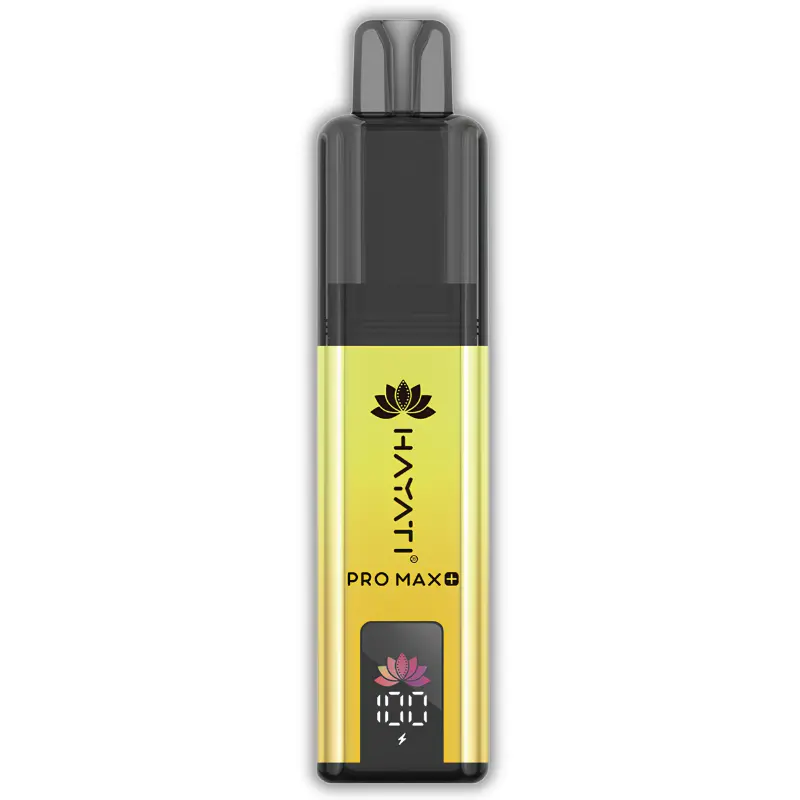
Hayati · Pro Max Plus
Pineapple Lemon Burst Hayati Pro Max Plus 6000 Pod Kit
£7.99
✔ In stock — ready to ship
Genuine Hayati
Free over £20
Same-day dispatch
Secure checkout
Pineapple Lemon Burst is the tropical-plus-citrus listing in Hayati's Pro Max Plus 6000 line, and at £7.99 it arrives as a complete kit: one rechargeable device holding an 850mAh cell, and one pod that has already been filled with 12ml of liquid at 20mg. Nothing needs mixing, nothing needs measuring, and the pod comes out of the wrapper ready to be pushed into the body. Hayati rate the pod at up to 6,000 puffs, a figure produced on laboratory equipment rather than by anybody's actual use, which is worth keeping in the right mental box before it gets treated as a promise.
That is the easy half of the description and it is identical to the other eighty-seven listings on the Pro Max Plus kit shelf. The half that is only true of this one is the recipe, and it is unusual for reasons the name does not give away. Pineapple and lemon sound like an ordinary tropical pairing. They are not. They are two acidic fruits stacked with nothing soft underneath to catch them, and almost nothing else on this shelf is built that way.
Look along the rest of the range and the pattern is clear. Blends here overwhelmingly set one sharp element against one soft one: a berry against a lemonade base, a mango against a blackcurrant, a raspberry against a cream-adjacent strawberry. The soft half is structural, giving vapour weight in the middle of the mouth so the sharp half has somewhere to land. This listing removes it and puts a second acid there instead.
Whether that is a good idea depends on what you want from a fruit pod. If sweet blends have been feeling heavy and you want something that arrives fast, says one thing and gets out of the way, the construction is right and very little else on this shelf does it. If you want a liquid you can sit with for twelve millilitres without your palate being scraped, this is a harder recommendation, and the page says so at some length rather than pretending otherwise.
A blend with no floor under it
Most fruit recipes have three layers whether or not the label mentions them. A top: the volatile aromatic part that hits in the first quarter second and gives the blend its identity. A body: the fleshy, low-volatility sweetness that fills the middle of the mouth and makes vapour feel thick. And a finish, meaning whatever is still detectable two or three seconds after the exhale.
Pineapple has a large top and a moderate body. Lemon has a large top and essentially no body. Put the two together with nothing else and the recipe is almost entirely top, its body supplied by the pineapple alone and its finish dependent on whatever sweetener is in the base. That single structural fact explains why the liquid tastes fast, why it tastes thin to some people, and why it changes more over the life of a pod than its neighbours do.
There is a decent argument for building a liquid this way. A floor of soft fruit is also a source of cloying. Remove it and you remove the residue that coats the tongue and makes a sweet pod tiring by the middle of the afternoon. Plenty of people who describe themselves as fruit vapers actually mean they like acid, and every soft-fruit blend they try is a compromise with something they did not ask for. For that person this pod is not thin. It is undiluted.
The honest counterweight is that acid without a body does not stack well over hours. Sugar fatigues the palate slowly. Acid does it quickly and abrasively, and it reaches the back of the throat before it reaches the tongue, so two acid sources get there sooner than one acid held up by fruit flesh. That does not make the recipe wrong. It does mean treating this as a pod with a natural session length, and it means a rotation partner matters more here than on a rounder flavour.
The flavour, taken apart
The pineapple, which is the loudest fruit anyone puts in a pod
Pineapple is chemically the most assertive fruit in common use, and that governs how the whole blend behaves. Its aroma is dominated by esters, short volatile molecules that read as sweet, fruity and very slightly solventy. The solvent edge is not a flaw in the flavouring; it is what real pineapple does, and it is why a pineapple note can smell almost fermented at the top of the scale, the way an over-ripe one does in a warm kitchen.
Underneath the esters sits a real, substantial acidity. Pineapple is one of the genuinely sour fruits rather than a sweet one with a hint of tartness, and that sourness carries into vapour more readily than most fruit acids because so much aroma rides alongside it. The result is a fruit that occupies more of the palate than its share of the recipe would suggest.
In this pod the pineapple presents in the tinned register rather than the fresh one. Fresh pineapple has a green, almost vegetal edge and a fibrous quality nobody has reproduced convincingly in a vape. What you get here is the rounder, syrup-adjacent reading: sweet at the front, tangy immediately after, with the ester lift very much present. That is not a criticism, since the tinned reading is the one that survives being vaporised.
What the lemon contributes, which is more of the same
Lemon in a liquid can be built two ways. Peel-forward lemon leads with limonene and reads as oily, aromatic and faintly bitter, like zest coming off a grater. Juice-forward lemon leads with acid and citral and reads as sour and thin, like squash made a little too strong. They behave very differently in a blend.
This one is juice-forward with a modest amount of peel behind it, and the consequence is that the lemon reinforces the pineapple rather than contrasting with it. A peel-led lemon would have supplied an aromatic dimension the pineapple lacks, and the two would have sat side by side. A juice-led lemon supplies acid and brightness, both of which the pineapple already had.
That is the most useful thing on this page for anybody choosing between flavours. The lemon is an intensifier, not a partner. If you hoped the citrus would cut through the fruit and give the blend two distinct halves, it does not. It sharpens the pineapple and pushes it further forward.
The word "Burst", and what it actually commits to
"Burst" is not an ingredient. It is an abstract noun, so it tells you nothing about what is in the pod, unlike a listing that names a second fruit or a treatment such as Ice. What it describes is a shape, and the shape is accurate enough to be useful.
That shape is front-loaded. The payload arrives in the first fraction of the inhale, peaks almost immediately, then decays rather than sustaining. A jammy berry or a dessert profile does the opposite, climbing through the draw and holding into the exhale. This one has already made its point by the time you exhale, leaving a receding sourness and a faint sweet residue.
Whether that reads as exciting or as insubstantial genuinely splits people. Read "Burst" as a claim about timing and it is honest. Read it as a claim about intensity sustained across the whole draw and it will disappoint.
One draw, front to back
Start the pull and the first thing to register is not fruit but brightness, a sharpness arriving before the palate has sorted out what it is made of. Pineapple resolves out of that within about half a second, ester-led and sweet at the front edge. The lemon is not separately identifiable yet; it is folded into the sharpness.
Through the middle of the inhale the acid builds, and this is where the missing body shows. On a blend with a soft fruit in it, the middle of the draw is where that fruit fills out. Here the middle is thinner and more acidic than the opening, and the vapour feels lighter than its volume suggests. Some read that as crisp, others as hollow, and both are describing the same event.
The exhale is where the lemon finally becomes legible on its own, as a thin sour edge along the sides of the tongue once the pineapple aroma has left the nose. Behind it sits a short sweet residue, sweeter than the middle of the draw, presumably the base sweetener outlasting the fruit. Two or three seconds later there is very little left, which makes the finish unusually short for a fruit pod at this sweetness level.
Where it sits on sweetness
Against the rest of the shelf this lands a little above the middle, sweeter than an unsweetened citrus and drier than a confected candy profile. The acid disguises the sugar effectively, which is why first impressions overstate how dry it is. Come back to it after something genuinely austere and the sweetness is obvious.
Acid and sugar also suppress each other perceptually, so a liquid carrying plenty of both tastes less of each than the recipe contains. That is why a pineapple blend reads as less sweet than a strawberry blend with the same sweetener in it, and why this one appears to grow sweeter as a pod ages: the sugar that was being masked stops being masked.
For anybody cross-shopping, our shelf page describes this as the marginally sweeter of the two pineapple-and-lemon listings Hayati sell. Marginally is the operative word, and that comparison is dealt with properly further down.
Cooling
None is indicated. The listing carries no Ice, no Frozen and no Cooler in the name, and nothing in the supplied facts mentions a coolant, so this page treats it as an uncooled liquid. If you want the sensation of cold alongside the fruit rather than acid alone, that is a different purchase and there are several on the shelf that do it deliberately.
One confusion is worth heading off, since it comes up specifically on acidic blends: sharpness is not coldness. A high-acid liquid produces a prickle at the back of the throat and a tightening along the sides of the tongue, but there is no menthol effect and no drop in perceived temperature on the exhale. Take a review calling a citrus pod refreshing to mean cooled and you will find this one warmer than expected.
The thing this liquid can go wrong as
Two acids stacked together have one specific failure mode and it is worth naming. The intended result is vividness: everything bright, nothing muddy, the fruit arriving with real definition. The failure is sharpness without substance, which registers as thin rather than vivid. The same liquid does both, depending on the coil, the draw and how far through the pod you are.
Both qualities come from the same absence. What makes the blend vivid is that no soft fruit is muffling the top. What makes it thin is that no soft fruit is filling the middle. You cannot have the first without risking the second, because it follows from the ingredient list rather than from how well that list has been executed. In practice the pod is at its best early, on a fresh coil and on short to medium draws, and at its most exposed late, on a loaded coil and on long ones.
What it is not
It is not a lemonade. No carbonation effect, no soft-drink roundness, no sweet bakery base under the citrus. A liquid such as Blackcurrant Lemonade runs its fruit through a sweetened fizzy-drink construction, and the gap in mouthfeel between the two approaches is wider than the gap between the fruits.
It is not a sour candy either. Confectionery profiles layer a dedicated souring agent over a sweet base to produce a deliberate pucker, which is a different sensation from fruit acidity. Blue Sour Raspberry is the shelf's version of that, sharper in a more artificial and more controllable way.
Nor is it tropical in the mixed-fruit sense. No mango, no passion fruit, no guava, nothing coconut-adjacent, nothing creamy. If the word tropical had you expecting a fruit punch, Guava Kiwi Passion Fruit is the closer match.
The first millilitre against the last
Every prefilled pod shifts over its life. This one shifts in a direction worth knowing in advance, because it is not the direction most pods move in.
The usual story is a collapse into generic sweetness, because a residue-loaded coil renders fine aromatic detail worst and most blends keep a sweet base working once the detail has gone.
This liquid has no such base, so it degrades toward its skeleton instead. The pineapple's ester lift lives at the very top of the volatility range and thins out first. Acid perception drops too, though less steeply, since sourness is partly a taste rather than purely an aroma and depends less completely on the coil delivering delicate molecules intact. The effect is a shift in ratio rather than a straight fade. Around the two-thirds mark the blend stops reading as tropical fruit with a citrus edge and starts reading as sour with a vague fruitiness behind it.
This pod therefore has further to fall than most of its neighbours. A blend with a soft floor loses its top and still has its floor; this one loses its top and has nothing to land on. Anyone used to running a sweet dessert pod to the very last millilitre should adjust accordingly, because the last two or three millilitres here are distinctly less interesting than the first two or three.
Pod seating, the contacts, and a fault that tastes exactly like a spent pod
The general behaviour of this device is documented once on the Hayati pod kits shelf rather than eighty-eight times across individual listings, so this section covers one mechanical detail instead: the joint between the pod and the body, which is the only part of this kit an owner remakes by hand on a regular basis.
A prefilled pod is not only a container, it carries part of the electrical circuit. The coil lives inside it, and current reaches that coil through contacts on the underside of the pod meeting contacts in the well of the device. Every time a pod goes in, that joint is remade by hand with no way to inspect it. It is the one thing in the kit that can be wrong without being broken.
The failure is almost never total. A pod genuinely making no contact does nothing at all and you know immediately. The awkward case is a partial connection: the pod is nearly home, or a film of liquid sits across one contact, and current still flows through a slightly higher resistance than intended. The device fires, produces vapour, and the vapour is underpowered. Nothing announces itself as a fault.
On this particular liquid, that is unusually easy to misread, and the reason goes back to the structure described above. Underpowered vapour renders the top of a profile badly and the base of a profile acceptably, because the delicate volatile compounds need proper heat and the heavy sweet ones do not. A blend that is almost entirely top therefore responds to a weak connection by losing most of its character while still producing a perfectly respectable cloud. What you taste is flat fruit and residual sourness, which is precisely what a spent pod tastes like. On a heavy dessert pod you would notice the vapour volume dropping before you noticed the flavour. Here the flavour goes first and the obvious conclusion is that the liquid has given up.
The check takes a couple of seconds and is worth making before you write off a pod with liquid still in it. Pull the pod out, look at both sets of contacts, and wipe away any visible film with a dry tissue rather than anything damp. Liquid across a contact does not block conduction, it degrades it, which is exactly why the symptom is weakness rather than silence. Then push the pod back until it stops moving, not until it feels seated. There is a meaningful difference between those two points, and a pod resting a fraction proud will still look completely normal from the outside.
Where the film comes from is worth knowing. Pods weep a little when warm, and more when carried mouthpiece-down, because gravity then works against the seals. A kit that spends the day upright keeps its contacts drier than one that spends it inverted in a coat pocket.
One more thing applies if you own more than one of these bodies. Contacts are sprung metal and they compress slightly every time a pod is fitted and removed. A device that has taken twenty pods does not seat as firmly as one that has taken two, and the oldest body in a drawer will be the one most likely to produce this fault. If a brand-new pod tastes wrong, try it in a different body before you conclude the pod is faulty, because the variable you have not controlled is the one you have owned longest.
What not to do is force it or pack anything behind it. Hayati publish no retention force, no contact type and no tolerance figure for this joint, so there is nothing to work to and no sanctioned adjustment. A pod that will not sit down is telling you something about that pod or that body, and an improvised shim turns a marginal connection into an unreliable one. If you find yourself holding the pod in place while you draw, the diagnosis is finished and it is not the liquid.
What the listing records
| Listing name | Pineapple Lemon Burst Hayati Pro Max Plus 6000 Pod Kit |
| Retail price | £7.99 |
| Stock reference | HPM-6K-KIT-PINEAPPLE-LEMON-BURST |
| Fruit pairing | Pineapple with lemon, no third fruit named |
| Added cooling | Not indicated anywhere in the listing |
| What arrives | Rechargeable device together with one filled pod |
| Liquid in the pod | 12ml |
| Strength | 20mg |
| Battery | 850mAh, rechargeable |
| Hayati's own rating | Up to 6,000 puffs, obtained under laboratory conditions |
| Maker | Hayati |
| Listed under | Pineapple Vapes, Lemon Vapes, Hayati Pro Max Plus Prefilled Pod Kit, Hayati Pod Kits, Hayati Prefilled Pod Kits, New Products |
Two of those rows do useful work, one absence matters more than either, and the remainder exist so you can identify the listing again later.
Take the price against the volume first, since nobody reads that pair together. Twelve millilitres for £7.99 including hardware is about sixty-six pence per millilitre on the first purchase, and the figure is misleading in your favour because the device is a one-off and the pod is not. The Pineapple Lemon Burst replacement pod at £5.49 brings the same twelve millilitres down to roughly forty-six pence each. Buy the kit once and not again, unless you want a second body to run another flavour in parallel, which on an acidic liquid is a more reasonable want than it sounds.
The strength next. Twenty milligrams is the UK legal maximum and the only figure recorded here, and it behaves differently on this liquid than on a rounded one, because the sensation at the back of the throat has two sources rather than one. Acid produces its own prickle and this recipe carries plenty from both fruits, so the same 20mg reads as considerably more pointed here than on a low-acid pod with identical nicotine content. Nicotine is an addictive substance and the strength that suits anyone is their own judgement; the number alone simply does not predict how the draw will feel. A 10mg Pro Max Plus kit is stocked at the same price in other flavours.
The absence is the carrier ratio. Hayati do not state how this pod splits between vegetable glycerine and propylene glycol, and on an acid-led recipe that matters: bright volatile aroma travels better in the thinner of the two components and gets buried by the thicker one, so the ratio governs how legible the ester lift is. It is also a number you could do nothing with, since the liquid, wick and mesh in a sealed pod are already matched to each other. The upshot is that brightness is not predictable from the listing.
The rating describes capacity and nothing else. Up to 6,000 puffs is a laboratory estimate from a rig drawing at fixed intervals, fair for ranking capacity and close to useless as a forecast of days: draw length alone moves the real figure by a factor of two either way, and a front-loaded flavour tends to be taken in shorter pulls than a dessert would be. Note the date the pod goes in and the date the fruit stops being identifiable, then use your own number.
How it sits against its neighbours
The coin toss: Lemon Pineapple
This has to be dealt with first because it is the question most people arrive with. Hayati list Lemon Pineapple on the same shelf at the same price with the same two fruits in the other order, and our own shelf page says outright that choosing between the two is close to a coin toss, with the Burst marginally the sweeter.
That assessment is fair and this page will not manufacture a distinction that is not there. Word order in a two-fruit name tends to reflect which fruit leads, so the other listing sits slightly further toward the citrus end and this one slightly further toward the fruit end, but the gap is smaller than the variation between two batches of the same flavour sometimes is. Prefer pineapple and take this one; prefer lemon and take the other. Without a strong preference, buy whichever is in front of you, because you will not identify which you have without the label.
The one real inconvenience is reordering, since the fruit names alone will not reliably get you back to the one you had. Record the full listing name.
The same liquid without the hardware
With a Pro Max Plus body already in the drawer, the kit is the wrong purchase. The bare Pineapple Lemon Burst pod carries the identical twelve millilitres at £5.49 and fits what you own. Buying kits repeatedly leaves you with interchangeable bodies of different ages, which is exactly the situation that produces a seating fault you then blame on a pod.
Pineapple with something soft underneath it
This is the most useful comparison on the page, since it answers the structural point at the top directly. Mango Peach Pineapple takes the same aggressive fruit and puts two soft ones under it: the mango supplies body, the peach a rounded sweetness, and the pineapple's job changes from leading a blend to lifting one. If you like pineapple but find straight pineapple blends tiring, that is the listing to try, and its middle is considerably fuller than this one's.
Blue Razz Pineapple reaches a similar place by a different route, pairing the fruit with a confected blue raspberry that supplies sweetness rather than flesh. Pick it if what you want from pineapple is the ester lift without the acidity.
Pineapple with cold instead of citrus
Pineapple Ice is the instructive alternative, because it solves the same problem differently. Both are trying to keep a pineapple from cloying: this one adds acid, that one adds cold. The results are not interchangeable, since a coolant thins the perceived body and lengthens the finish while acid thins it and shortens it. Either will fix heaviness, and the choice comes down to whether you want the fruit to linger.
Lemon treated as a drink rather than a fruit
Several listings use lemon as a base rather than an acid source, which is what most people mean when they ask for a lemon vape. Pink Lemonade is the plainest of them, sweetened and soft-edged with a berry tint; Berry Lemonade runs an unspecified berry accord over the same construction, and Blue Razz Lemonade does it with the confected blue note. All three are rounder than this pod and much easier to spend twelve millilitres on.
Cherry Peach Lemon is the most layered use of lemon here, keeping it as a genuine third fruit with its own position in the draw rather than folding it into a base. If citrus as a distinct component is what drew you to this listing, that one delivers it more clearly, because the peach gives the lemon something to be distinct from.
If two acids is exactly what you wanted
Lemon Lime is the only other listing on this shelf built on the same principle, and it is the drier of the two by a clear margin. Two citrus fruits with no tropical sweetness at all is about as austere as this range gets. Take it if you found this one nearly right but still too sweet in the finish.
Cola Lime approaches acidity from the soft-drink direction, with the cola supplying a spiced, slightly bitter base under the lime rather than a fruit one. It is a different kind of sharpness and a much longer finish.
If it turns out to be too much
The darker fruits are the natural retreat, since they carry body without being confected. Blackcurrant Mango keeps a tart top note over a genuinely fleshy mango, and Dragon Berries sits lower and rounder again. Blackberry Ice adds cold to a dark fruit, producing brightness without acid, which suits anyone who liked the freshness here and not the scrape.
Rotation partners, which matter more on this one
A pod with a natural session length needs something to alternate with, and the choice is less arbitrary than it looks: what you want beside an acidic fruit is something that does not compete at the same end of the palate. Double Menthol works because it resets the mouth rather than adding another flavour to it, and a citrus pod reads noticeably brighter taken afterwards. Blue Razz Mojito is the middle option, carrying a lime and a mint of its own so the transition either way is less abrupt.
A cheaper way to find out whether you want this much acid
Twelve millilitres is a real commitment to a divisive profile, and there is a smaller way in. Lemon Cola Ice on the Rubik platform is £5.99 and puts a forward lemon in front of you on different hardware. It is cooled and it is not this recipe, so it settles the larger question rather than the narrow one: whether you enjoy lemon in the lead at all.
Browsing the rest properly
If you want to see the neighbours side by side rather than through this page, the pineapple shelf gathers twenty listings across every platform we stock, and the lemon shelf runs to fifty-four. The wider prefilled kit shelf covers every Hayati device sold with liquid already in it, and the full Hayati range is there for anyone whose next purchase is not a pod kit at all.
Living with twelve millilitres of a sharp liquid
Ordinary pod handling applies here as it does everywhere and is set out on the shelf pages. The points below are the ones that behave differently because of what is in this pod rather than because of the format.
Let it settle, then start gently. Stand the kit upright for two or three minutes after unwrapping and keep the first several pulls short. The reason to bother specifically here is that a scorched wick does not announce itself the way it does on a sweeter liquid. On a dessert profile, a cooked wick produces an obvious burnt-sugar note. On an acid-led fruit, it produces a dry, papery flatness sitting behind the sharpness, which is very easy to interpret as the blend simply being thin. Given that thinness is this recipe's known risk, you are unusually likely to blame the liquid for something you did in the first thirty seconds.
Track the ester lift, not the sourness. The retirement signal here is the tropical top going, not the sharpness going. Sourness persists long after the pineapple has stopped being identifiable, and a pod in that state is functional rather than pleasant. Once only the acid remains, the pod is finished regardless of what the window shows.
Shorter pulls suit it. This is not general advice, it follows from the front-loaded shape. Most of what this liquid has to offer arrives in the first part of the inhale, so a long draw adds vapour volume and acid without adding any more fruit. The back half of a long pull on this pod is measurably less interesting than the front half. On a blend that builds through the draw the opposite is true, which is why the habit does not transfer.
Do not chase a fading pod by drawing harder. The instinct when flavour drops is to pull longer and stronger, which moves more liquid across a coil already struggling and cooks residue onto the mesh faster. If the fruit has gone, fit a new pod.
Carry it upright if you can. This has already come up in the context of contacts and it is the single cheapest habit associated with this kit. A pod carried mouthpiece-down is working against its seals all day, and the liquid that escapes ends up in the airflow path and across the contacts rather than in your mouth.
Keep spares cool and out of direct sun. Warmth thins the liquid and thinned liquid finds its way past seals more readily. A drawer is right. A car windscreen in July is the worst place available, and a windowsill is not much better. Store any spare pod somewhere it cannot be reached by anyone this product is not sold to.
Give it a fresh palate. Taken straight after something sweet and long-tailed, an acid-led blend gets buried and you conclude it tastes of nothing when it is really competing with residue. Taken first, or after a mint, it presents properly, and that asymmetry is sharper here than on a rounder flavour because there is no body to push through with.
Questions buyers actually ask
Is there any cooling in this one?
No. The name carries no Ice, Frozen or Cooler designation and nothing in the supplied facts mentions a coolant, so this is treated here as an uncooled liquid. The sharpness people sometimes mistake for cold is acid from the two fruits, which produces a prickle rather than a drop in perceived temperature.
Is it actually sour, or just tart?
Genuinely acidic rather than merely tangy, since both fruits contribute real acid. It is not a sour-candy profile though, which uses a dedicated souring agent over a sweet base for a deliberate pucker. Fruit acidity builds more gradually and sits further back in the throat.
How does it differ from Lemon Pineapple?
Barely. The two carry the same fruits in reversed order, and our shelf listing describes picking between them as close to a coin toss, with this one marginally sweeter. Expect this to lean very slightly toward the pineapple and the other very slightly toward the citrus, and do not expect to identify which is which blind.
I already own a Pro Max Plus device. Should I buy the kit?
No, buy the pod on its own. The replacement pod holds the identical twelve millilitres at £5.49 and fits the body you have. The kit only makes sense if you need another device, for instance because you want to run a second flavour alongside this one without swapping pods.
What does the 6,000 figure actually mean?
It is a capacity estimate produced by Hayati under laboratory conditions, on equipment drawing at fixed intervals, and it is a reasonable way to compare one product against another. It is not a prediction of days, since draw length and frequency vary enormously between people.
Can I top the pod up when it empties?
No. It arrives filled and sealed as a complete unit with its own coil and wick, and there is no provision for adding liquid. When the fruit stops presenting properly you replace the whole pod, which is why the replacement listing exists separately from the kit.
Is 20mg the only strength for this flavour?
Twenty milligrams is the only figure recorded for this listing. A 10mg version of the Pro Max Plus 6000 kit is stocked, though not necessarily in this flavour, so check the specific listing rather than assuming a lower option exists for Pineapple Lemon Burst.
Will the pod fit any other Hayati device?
It is designed for the Pro Max Plus body supplied with it, and Hayati's own text confirms that a Pro Max Plus replacement pod in any flavour fits the same device. Nothing in the facts for this product states compatibility with any other platform, so treat the Rubik, Mini Ultra and Pro Ultra Plus ranges as separate systems.
It has gone flat after a week. Is that normal?
Some loss of definition over a pod is normal, but check the connection before you accept it. Remove the pod, wipe both sets of contacts dry, push it firmly back in and try again. A partially seated pod produces weak, unrepresentative vapour that on this flavour is almost indistinguishable from a worn coil, because the part of the profile that suffers first is the same in both cases.
Which flavour should I run alongside it?
Something that does not compete at the same end of the palate. A menthol resets the mouth rather than adding another flavour to it, so a citrus pod taken afterwards reads noticeably brighter. A soft dark fruit works too. What does not work is a second acidic blend, since the two will blur into one another and both will taste less than they should.
Is this a good choice for all-day use?
It depends on how you respond to acid. Two acidic fruits with no soft fruit between them stack up on the palate faster than a rounded blend does, and a lot of people find this kind of profile is better in sessions than continuously. If you already know you can vape citrus all day without it wearing on you, it will be fine. If you do not know, a rotation partner is the sensible precaution.
What comes in the box?
The facts supplied list two items: the rechargeable device and one prefilled pod containing 12ml at 20mg, sold together for £7.99. Charging accessories are not itemised in the specification and this page will not guess at them, so check the packaging when it arrives rather than relying on what another listing claims.
The short version
Pineapple Lemon Burst is a complete Pro Max Plus 6000 kit at £7.99: a rechargeable 850mAh device and a pod holding 12ml at 20mg, rated by the manufacturer at up to 6,000 puffs as a laboratory figure. The recipe is two acidic fruits with nothing soft between them, unusual on a shelf where almost every blend sets one sharp element against one rounded one.
That construction is the whole argument, for and against. It gives a fast, bright, front-loaded fruit with a short finish and none of the coating heaviness sweeter pods leave behind. It also gives a thinner middle, a profile that stacks up on the palate faster than most, and a pod that falls further than its neighbours as the coil ages, because no sweet base is left working once the tropical lift has gone.
Buy it if you like acid and have been finding fruit blends too heavy. Look at the softer pineapples or the lemonade-based listings if you want something you can run continuously without thinking about it. And if you are choosing between this and Lemon Pineapple, do not spend long on it, because the difference between them is smaller than the difference between your first pod and your last.
Strictly for adults aged 18 and over. Nicotine is an addictive substance.
You might also like


