
Home / Hayati Pro Max Plus Pods / Lemon Lime Hayati Pro Max Plus Pods
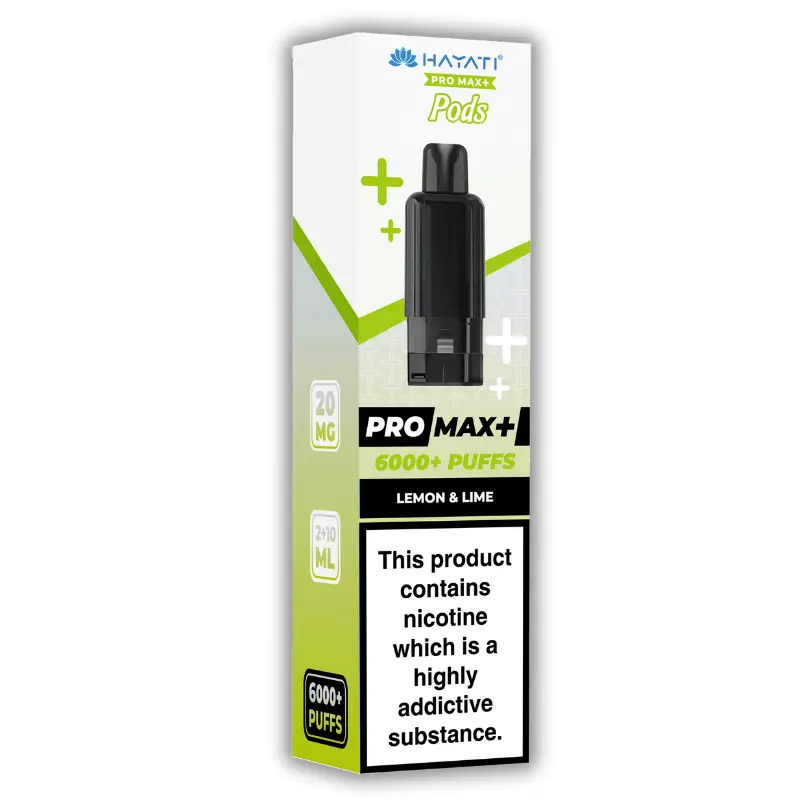
Hayati · Pro Max Plus
Lemon Lime Hayati Pro Max Plus Pods
£5.49
✔ In stock — ready to ship
Genuine Hayati
Free over £20
Same-day dispatch
Secure checkout
Lemon Lime Hayati Pro Max Plus Pods are a bare refill at £5.49: one prefilled 12ml pod at 20mg, no device, for a Pro Max Plus body you already own. The liquid is two citrus fruits and very little else. Lemon opens the draw with the acidity, lime lands at the close with a greener, more aromatic edge, and there is a small amount of sugar underneath holding the two together rather than sitting on top of them. Hayati rate the pod at up to 6,000 puffs, which is a laboratory figure rather than a promise about your week.
That is the product, and it is not what this page is about. Almost everything written on this site about Lemon Lime concerns the first encounter with it: what it tastes like, whether the lime survives a tiring element, what it costs per millilitre and when to throw it away. All of that is settled and most of it is settled well. What nobody has written is the thing a refill buyer is actually in the middle of, which is the second pod, and the third, and the slowly forming suspicion that they are not the same as the first.
There is already a page on this site titled after exactly that complaint. It sits on the Lemon Lime / Lemon Blueberry Hayati Pro Ultra Plus 25K Pods listing, it is about this same citrus, and it explains the pod-to-pod difference entirely through hardware: two liquids ageing on one element, a running order that never varies, carry-over that only travels one way. Every one of those explanations requires a divided pod with a collar on it. This pod has one reservoir, one liquid and nothing to turn.
So this page runs the same question as a subtraction. Take the hardware explanations away, leave the liquid alone, and find out what is left to account for the difference between your first Lemon Lime pod and your third. The answer turns out to be short, countable in one place, and pointed in a direction most buyers do not look.
The page this one is a control for, and how clean a control it actually is
Start with what the divided pod is doing, because the subtraction only means something if the thing being subtracted is real.
On a two-flavour Pro Ultra Plus pod, the collar selects which of two reserves feeds one shared element. The page cited above works out three consequences and they are all mechanical. The two halves blur into each other early in a pod's life because a new owner switches constantly, then stop blurring once a routine settles, so the halves appear to separate. The element is running the pod's whole total, so whichever half you have filed as second inherits tired mesh every time. And the last days of every pod land on the same half, so the memory you carry into the reorder is always taken from the worst part of the cycle.
Now check this shelf against that. Of the 89 listings on Hayati Pro Max Plus Pods, not one title carries an oblique and not one description mentions a rotating mouthpiece, a pair of reserves, or a selection of any kind. There is no divided pod anywhere on the platform. Every pod on the shelf is one liquid in one space, and when the pod is discarded the element inside it goes with it, so the next pod starts from wherever a new pod starts.
Two of the three mechanisms therefore cannot apply here at all. Nothing can carry over from a second liquid because there is no second liquid. No half can be permanently assigned to the tired end of the element because there are no halves. Those two are gone cleanly and there is no argument to have about them.
The third one survives, and it is worth being exact about how, because the handed-over version of this argument said all the hardware explanations disappear and that is not quite true. Recency does not need a collar. Every sealed pod ends its life on an element that has had the whole fill across it, so the flavour you carry into the reorder is always taken from the pod's last stretch rather than its middle. What changes without the collar is the shape. On the divided pod the effect loads permanently onto one named flavour and compounds across cycles, which is why that page describes a verdict drifting steadily downward. Here it loads onto the whole pod and then resets when you fit the next one, so what you get is a sawtooth rather than a slide: a repeated low point, followed each time by a return to the top. Same effect, different geometry, and the difference matters because a sawtooth does not accumulate.
The second correction concerns whether this SKU is the right control at all. It was handed to me as the control case and it is not the cleanest one available. Lemon Lime Hayati Pro Ultra Plus Pods is the true match: identical platform, identical 22ml volume, identical £7.99 ticket, one flavour, no collar. Set that against the divided pod and the only variable is the division. Set this pod against it and you have also changed platform, volume and price, which is three variables more than a control is supposed to carry. There are ten other undivided Lemon Lime listings besides this one, so the control condition is over-supplied rather than scarce.
What this SKU is, narrowed to something defensible, is the control a Pro Max Plus owner can actually run. Of the 21 listings on Lemon Lime Vapes, exactly one sits on the 89-pod Pro Max Plus shelf, and this is it. If you own the body, this is the only undivided lemon-and-lime refill that fits it, so the experiment is available to you and the tidier version is not. That is a smaller claim than the one I was given and it is the one that holds.
Eleven listings that cannot describe this liquid without naming a different one
Hayati sell this recipe eleven times, across four hardware ranges and three formats, with fresh copy written for each. The Lemon Lime Rubik Prefilled Pod Kit page has already lined all eleven up and pulled two things out of them, a bitterness word attached only ever to the lime and an explicit absence of sugar in nine of the eleven, and it goes on from there to the arithmetic of retiring a pod early, the cost per millilitre you actually draw rather than the one you paid for, and the signal that tells you the lime has stopped arriving. All three of those are its property and I am citing them rather than rebuilding any of them.
The eleven support a different reading as well, on an axis nobody has run, and it is the one this page needs.
All eleven define the liquid by reference to something sweeter than itself. Not one of them gets through its flavour paragraph without invoking a class of liquid this is not. The Mini Ultra kit copy reaches for heavily sweet flavours wearing on you over a day. The bottled nic salt reaches for sweet fruit blends being too heavy and for sweetness building up across a session. The 70/30 bottle reaches for candy and dessert liquids. The Pro Ultra Plus refill reaches for vapers who find most fruit too sugary. Eleven writers, or one writer eleven times, and every single one of them arrived at the same structural move.
Eight of the eleven go further and put it in a sequence. Between sweeter flavours, a reset between sweeter flavours, a palate refresher after candy, a welcome contrast if much of your rotation is candy-style, in rotation alongside richer fruit. These are not descriptions of a taste. They are instructions about position: what you have just had, or what you are about to have next.
Before any of that can mean anything, it has to survive the obvious objection, which is that this might simply be how Hayati write about everything. It is not, and the margin is wide. Across all 492 listings in the catalogue, 32 use a construction of that kind at all, which is 6.5 per cent. Eight of those 32 are this one recipe. A quarter of every rotation-and-contrast sentence Hayati have written about any product in the range is spent on Lemon Lime.
That could still be an artefact of Lemon Lime having more listings than most flavours, so the rate settles it rather than the count. Take the 23 flavour names with five or more listings and work out what proportion of each one's listings are framed that way. Lemon Lime comes in at 73 per cent, eight of eleven. The next highest is Fresh Mint at 22 per cent, two of nine. Then Juicy Peach and Strawberry Kiwi at 20 per cent. Nine of the 23, including Blueberry Raspberry, Blue Razz Cherry, Red Apple Ice and Triple Mango, are never framed that way in any of their listings at all. This liquid is more than three times more likely to be described by its position than the next flavour in the range, and infinitely more likely than nine of them.
Two honest limits on what that establishes. The first is the caution this site keeps having to relearn: a listing set is evidence about copywriting, not about chemistry. Eleven agreements tell you eleven writers reached for the same frame, and the most they can support is that the frame was the obvious one to reach for. The second is that the direction of the inference is not proved. It may be that the liquid genuinely behaves this way and the copy is reporting it, or it may be that a two-fruit citrus with no sugar base leaves a writer nothing to describe except what it is not. Both readings produce the same eleven paragraphs.
But the two readings converge on the same consequence for a buyer, which is why the ambiguity does not matter much. Either way, the product being sold here has been positioned as a relationship rather than an object, in every listing, without exception. And a relationship gives a different reading every time the other end of it moves.
What a relative flavour does to your second and third pod
Here is the whole argument in one line. If a liquid is described eleven times out of eleven by what it follows, then your reading of it is a difference measurement, and a difference measurement changes when the thing you are subtracting changes, even though nothing has happened to the pod.
Work it through as a sequence, because the sequence is the point.
Pod one. Almost nobody arrives at this liquid cold. You bought it because something else had gone heavy on you, and the eleven listings say so plainly enough that this is close to the intended purchase. So the baseline against which you first tasted it was a sugary one, quite possibly a pod you had been running for a fortnight and had stopped enjoying. Against that baseline the citrus lands hard. It is sharp, it is dry, it stops when it is finished, and the relief of it is a genuine part of the experience. That reading is accurate, and it is also a reading of the gap rather than of the liquid.
Pod two. You liked it, so you bought another one, and here the baseline starts to move. Some of pod two runs against a sweet predecessor and some of it does not. The pod is now competing partly against itself, because the thing you vaped before it was frequently this. The sharpness is still there and it is less startling, which people read as the new pod being slightly weaker.
Pod three. If it has become the default, the baseline is now more or less flat. Nothing is being subtracted. The citrus is doing exactly what it did on pod one, at the same intensity, and it reads thinner because there is no longer a contrast for it to be measured against. This is the point at which a lot of buyers conclude that Hayati have changed something, and it is also the point at which the arithmetic says they almost certainly have not.
It is worth separating this from the explanation it gets mistaken for. Palate fatigue is a change in how sensitive you are, it builds with exposure, and it is the standard account of why a liquid goes quiet. What I am describing is not that. Your sensitivity has not moved. What has moved is the reference point, and the two produce different signatures: fatigue gets worse the more you vape something and takes a break to reverse, whereas a contrast effect can flip inside a single afternoon. The test that separates them is cheap and it is the only genuinely useful thing on this page. Run this pod immediately after a heavily sweet one, twice, on two different days. If it comes back loud, it was never fatigue.
The direction of the effect is asymmetric and that is worth knowing too. A sugary predecessor moves the reference up, so this reads sharper and drier than it is. A mint or menthol predecessor moves it the other way, so the same pod reads noticeably sweeter, and people who have just come off Double Menthol Hayati Pro Max Plus Pods sometimes report a sweetness in Lemon Lime that they did not find in it before. The liquid has not gained sugar. The comparison has lost its coldness.
How much exposure does a Pro Max Plus owner have to the upward direction? Almost total. Of the 89 pods on the shelf, 88 use a sweetness word in their own description. Four of those 88 qualify it in some way, saying the blend is not too sweet or that the sugar is restrained, and this pod is one of the four. One listing, Black Mamba, uses no sweetness word at all, though it is named for a mood rather than a fruit so the silence means little. That leaves something like 84 of 89 reading as unambiguously sweet. Whatever you pick off this shelf to run alongside this pod, the odds are overwhelming that it moves your reference in the same direction, which is why the effect is so consistent and so easy to mistake for a property of the citrus.
And this is where the finding cuts against the instinct it is competing with. The natural reaction to a third pod reading flatter is to suspect the pod: a bad batch, older stock, a supplier change, something quietly altered. That suspicion is aimed at the one component of the whole arrangement that gets replaced outright every time. The liquid is new, the element is new, the housing is new. Meanwhile the two things that actually changed between pod one and pod three, your rotation and your expectations, are the two nobody replaces and nobody suspects.
The three residues, which is one more than I was handed
The version of this argument I was given said that with the hardware explanations removed there is nowhere left for a difference to sit except in the reader and in what they vaped between the pods. Two residues. Counting says three, and the third one is the one a page like this is most tempted to leave out.
One: the rotation, which is the large one and the countable one
Everything above. It is the biggest of the three, it is the only one supported by a number, and it is also the only one you can do something about without spending money, since the fix is a habit rather than a purchase.
Two: the reader, kept modest because that is all the evidence supports
The first pod of anything is attended to. You bought it deliberately, you had a reason, and you spent the first hour working out whether the reason was sound. The third is a restock, arriving in a routine, drawn on without being examined. Attention is a real input into what a flavour seems to be doing and there is no way to quantify it from a retail page, so the honest statement is that it exists, that it points in the direction of later pods seeming duller, and that its size is unknown. Anybody who tells you how much of the effect it accounts for is making the number up.
I am deliberately not extending this into a claim about your sensitivity adapting to the acid over weeks. That is a different mechanism, it belongs to a different kind of liquid, and there is nothing on the record about this one that would support it.
Three: the parts that do not reset, which nobody can rule out from here
Two things in the arrangement are not replaced when the pod is. One is the body, which is older on pod three than it was on pod one and whose behaviour over time is covered elsewhere on this site rather than here. The other is batch variation, and on this the correct answer is that it is unknown. Hayati publish no formulation, no batch coding and no tolerance for any prefilled pod they sell, so a retail page cannot tell you whether two pods bought three months apart are identical, and one that says they definitely are is guessing in the flattering direction.
What can be said is a proportion rather than a certainty. Given that the rotation effect is large, consistent in direction and supported by a count, and given that batch variation is unmeasured, the reasonable order of suspicion when your third pod reads flat is rotation first, attention second, batch last. That is the opposite of the order most people use, and the reordering is the practical content of this page.
What a third pod settles that a first one cannot
There is a reason to be glad of all this rather than merely informed, which is that a third pod answers a question a first pod is structurally unable to answer.
Go back to the eleven listings and count a second axis on them. Eleven out of eleven offer the liquid as a contrast to something sweeter. Only three of the eleven also offer it as a standing choice: the Rubik kit copy calls it a steady option for anyone who prefers tang to sugar, the 50/50 shortfill calls it a daytime liquid you can return to repeatedly, and this listing offers it as an everyday pick for anyone who simply prefers tang to sweetness. So Hayati are unanimous that it works as a corrective and split eight to three on whether it works as a default.
That split is precisely the question your pods are answering for you, and the answer is not available on pod one. On pod one the liquid is always in corrective mode, because a corrective is why you bought it. Only when the contrast has been removed, which happens naturally somewhere around pod two or three if it has become your main liquid, do you find out what the citrus is like with nothing underneath it to push against.
Two outcomes, both useful, neither a failure.
If the flat reading on pod three bothers you, this liquid is a corrective for you and not a default, which is the majority verdict in Hayati's own copy. Run it that way deliberately. Keep something sweet as the main and this as the reset, and it will read on pod ten exactly as it read on pod one, because you will have kept the contrast intact instead of eroding it. In that pattern a 12ml pod lasts a long time and the per-millilitre argument matters much less than it does for a daily liquid.
If the flat reading is fine, and what you notice on pod three is a dry, uncomplicated citrus you are happy to draw on all day without thinking about it, then you are one of the three in eleven and you have a daily liquid. That is a genuinely better outcome to have discovered by pod three than by pod eight, because it changes what you should be buying: a daily liquid wants the cheapest sound refill in your format, and a weekly reset does not care about the price nearly as much.
The protocol for getting a clean answer takes one pod and no money. Fix the predecessor. For the whole of the next pod, take your reading at the same slot each day, after the same previous liquid, with the same draw length. One variable, the pod, moving. Everything else held. It is not a laboratory and it does not need to be, because you are not trying to measure the liquid. You are trying to stop measuring your rotation by accident.
The pod itself, which is the short part
What arrives is one prefilled pod and nothing else. No body, no cable, no spare. Twelve millilitres of 20mg liquid, sealed, with the element inside the unit rather than in the device, which is why fitting a new pod resets the element as well as the liquid. Match the range name printed on your device against the range name in this title before ordering, because Hayati build several pod formats that are not interchangeable. If you do not have a body, the Lemon Lime Hayati Pro Max Plus Pod Kit at £7.99 is the same liquid with a device in the box, and the £2.50 between them is the same £2.50 everywhere on this platform, since all 89 pods on the shelf are priced at £5.49 and all 88 kits at £7.99.
The specification that bears on this particular argument is the sealed 12ml volume. You cannot see the level, so you cannot express where you are in a pod as a fraction by looking at it. That matters here because every claim on this page about pod one versus pod three is really a claim about points on a repeating arc, and if you cannot locate yourself on the arc you will compare the wrong points. Time is the available proxy. Note how many days a pod lasts you once, and after that you can say roughly where you are without opening anything.
Hayati rate the pod at up to 6,000 puffs. That is a laboratory estimate produced under fixed conditions and it is not a forecast of your fortnight, but it does one useful job on this page: it is the same rating the kit carries, so a pod bought on its own and a pod that came in a box are the same article and your third pod is comparable with your first. The rest of the platform, the other 88 pods and the bodies they sit on, is on the shelf.
The figures, ordered by how much they bear on a repeat purchase
| What it decides | Figure |
|---|---|
| Cost of one more of these, assuming the body is already yours | £5.49 |
| Rate you are paying if you empty the pod | 45.8p per millilitre |
| Liquid in the unit | 12ml, sealed, level not visible |
| Nicotine | 20mg per millilitre, the UK ceiling for a consumer pod, as a salt |
| Manufacturer's rating | Up to 6,000 puffs, laboratory estimate |
| Flavour components named | Two, lemon and lime, with a small sugar base |
| Cooling named | None |
| What comes in the pack | The pod alone |
| Not published by Hayati | Element resistance, wick material, formulation, batch coding |
Two rows do real work for somebody on their third pod and the rest are context. The 45.8p is the number to hold against alternatives, and it is the honest rate only if you run the pod to the bottom. The Rubik kit page has already worked out what happens to that figure under a policy of retiring early, and its conclusion transfers here without modification, so I will not restate the arithmetic.
The 20mg row is worth a sentence because it is easy to misread as a strength choice. It is not one on this SKU. Every prefilled pod on the shelf is 20mg, that is the maximum a consumer nicotine product may carry in the UK, and the only Pro Max Plus listings that give you anything else are Hayati Pro Max Plus Prefilled Pods 10mg and Hayati Pro Max Plus Prefilled Pods 5mg, which are filed by strength rather than by flavour. Neither carries a lemon-and-lime option, so the strength and the flavour are not independently selectable here.
The last row is the one that should be read as a limit rather than a complaint. Nothing about the element inside this pod is published, which is why nothing on this page tells you what resistance it runs at or how it is built.
Where the £5.49 goes if this is not the right SKU
Three different questions send people away from this listing and they have different answers.
If you want this liquid on cheaper or smaller hardware
Lemon Lime Hayati Rubik Pods is the same 12ml at £3.99, on a different body, and it is the cheapest sealed pod Hayati sell per millilitre. Lemon Lime Hayati Mini Ultra Pods holds 4ml at £3.49, which is a much worse rate and buys you something specific in exchange: a pod too small for its element to get old, so every millilitre in it is drawn on fresh mesh. If your reason for reading this page is that your third pod tastes different, the 4ml format removes one variable from the question entirely, at a price. Lemon Lime Hayati Pro Ultra Plus Pods goes the other way at 22ml for £7.99, which is the best rate of the three refills and the longest run on one element.
If you want this citrus as one half of something
Four divided pods pair it with a second flavour behind a collar, and all four are on the Pro Ultra Plus platform rather than this one. Lemon Lime / Lemon Blueberry Hayati Pro Ultra Plus 25K Pods puts it against a lemon-led berry, which shares its opening note and differs at the floor, and that pairing also exists complete as the Lemon Lime / Lemon Blueberry Hayati Pro Ultra Plus 25000 Prefilled Pod Kit if you need the body too. Lemon & Lime/Summer Dream Hayati Pro Ultra Plus 25K Pods pairs it with a half that has no fruit on its label at all, and the page on the Summer Dream kit works through what that asymmetry is worth. Blue Razz GB/Lemon & Lime Hayati Pro Ultra Plus 25K Pods sets it against a confectionery blue raspberry, which is the sharpest contrast of the four. Orange Lemon & Lime Hayati Pro Ultra Plus 25K Pods is a different thing again, three citrus fruits rather than two behind a collar.
Worth noting if you go looking for any of these: the URLs are inconsistent with the titles across this range, and the bottled version of this liquid is a good example. It is titled Lemon Lime Hayati Pro Max Nic Salt, singular, and its address ends in the plural. A buyer reading the address bar and a buyer reading the page heading will come away with two different product names, which is worth knowing before you decide you have found the wrong listing.
If the austerity is the problem
This liquid has very little sugar under it, which is the whole of its appeal to some people and the whole of the problem for others. Three pods on this shelf give you citrus with a proper sweet base instead. Pink Lemonade Hayati Pro Max Plus Pods is the most direct swap, a lemon with the sugar turned up. Blackcurrant Lemonade Hayati Pro Max Plus Pods puts a dark berry under the citrus, and Blue Razz Lemonade Hayati Pro Max Plus Pods does the same job with a confectionery berry instead. If it is a softer fruit you want rather than more sugar, Lemon Pineapple Hayati Pro Max Plus Pods and Pineapple Lemon Burst Hayati Pro Max Plus Pods both keep the lemon and replace the lime's green edge with tropical weight, and Cherry Peach Lemon Hayati Pro Max Plus Pods pushes the citrus into third place behind two stone fruits. Cola Lime Hayati Pro Max Plus Pods is the only other pod on the shelf built on lime, and it uses the lime the way a drink does, as a squeeze over something else.
If you are looking for the other end of the rotation
Given the argument above, the more useful recommendation is often not a replacement for this pod but a partner for it, because the pod only reads the way you liked it if something sweet is going in front of it. On this shelf the obvious candidates are Blue Razz Cherry Hayati Pro Max Plus Pods and Blue Razz Pineapple Hayati Pro Max Plus Pods at the confectionery end, Blueberry Raspberry Hayati Pro Max Plus Pods and Blackberry Raspberry Hayati Pro Max Plus Pods for a darker, jammier main, Blueberry Pomegranate Hayati Pro Max Plus Pods if you want a berry with some tartness of its own, and Caribb Crush Hayati Pro Max Plus Pods for a tropical blend. Any of those, run as the main, keeps this pod doing the job all eleven listings describe. The wider pool of Hayati prefilled pods and refills runs to 201 listings, and every lemon in the range, 54 of them, is filed on Lemon Vapes.
Running a second and third pod so that they tell you something
Most of what follows is ordinary handling, anchored where it matters to the fact that this is a two-component citrus with no sugar and no cooling to hide behind.
Give a new pod its wicking time before you judge it. A few minutes upright after fitting, and a couple of gentle draws before a full one. This matters more here than on a sweet blend because the first impression of a citrus is carried by light aromatic material, and a dry first pull on this liquid reads as harsh rather than merely thin, which is exactly the reading that convinces somebody a new pod is worse than the last one. It is not. It has been in your hand for forty seconds.
Do not take your reference reading in the first hour after something sugary. This is the entire practical content of the page and it is worth stating as an instruction. If you want to know what a new pod is like, taste it in a slot where the previous thing was neutral, not in the slot where it will flatter itself most.
Lengthen the pull before you condemn the finish. The lime on this recipe arrives at the close, so a short clipped draw ends before the second half of the flavour has happened. The Rubik kit page sets out at length how to read a genuine loss of lime and what it means for when to retire a pod, and that diagnosis is worth having before you decide anything.
Store it flat, cool and away from light. Heat and daylight work on the light citrus material first, which on a two-part recipe means the part that distinguishes it rather than the part that carries the acidity. A pod that has spent a summer week in a car is not a fair sample of anything. Keep spares somewhere dark, and store them out of reach of children and pets.
A part-used pod keeps better than most. If you run this as a corrective rather than a default you will have a pod in progress for weeks, which raises the question of whether it degrades while it waits. Nothing on the record from Hayati addresses shelf behaviour in a partly used pod, so treat the sensible precautions as precautions rather than facts: upright, cool, away from sun. The absence of a coolant helps here, since there is no volatile cooling agent to fade and leave the fruit behind.
When it is finished, it does not go in the bin at home. A spent unit still holds the element and whatever liquid the wick did not give up, so it belongs in a shop's vape or battery collection rather than with household rubbish. Most places that sell these will take one back.
Questions that come up on a repeat purchase
Is the liquid in this pod the same as the liquid in the kit?
Hayati describe both as Lemon Lime, both hold 12ml at 20mg, and both carry the same 6,000-puff laboratory rating, so there is nothing on the record to distinguish them. The kit page and this page differ only in whether a body is included and in the £2.50 between them.
My third pod tastes weaker than my first. Has something changed?
Probably not in the pod, which is the one part of the arrangement replaced entirely each time. The likelier explanations, in order, are that your rotation has changed so the citrus has less to contrast against, that you are paying it less attention than you did when it was new, and only then that the pod itself is different. Batch variation cannot be ruled out because Hayati publish nothing about it, but it is the last thing to suspect rather than the first.
How do I test that without wasting a pod?
Run this pod immediately after a heavily sweet one, on two separate days, and see whether it comes back to the brightness you remember. If it does, the liquid is intact and what moved was the comparison. If it stays flat under a strong contrast, the reading is about the pod or the element and is worth acting on.
Is there any ice or menthol in this?
No. Neither Hayati's copy for this pod nor any of the other ten listings of the liquid names a cooling agent, and none of the titles carries an ice or mint word. What people sometimes read as coolness is the acidity and the lime's green edge.
Can I use this pod as a daily flavour rather than a reset?
Three of the eleven listings Hayati write for this liquid offer it as a standing everyday choice and all eleven offer it as a contrast, so the copy itself leans towards it being a corrective. Whether you are in the three or the eight is not something a page can tell you, and your third pod will.
Why is this the only lemon-and-lime pod on the Pro Max Plus shelf?
Hayati do not say. What can be counted is that 21 listings in the catalogue name both fruits, that they are spread across the Pro Ultra Plus, Mini Ultra and Rubik ranges and the bottles, and that exactly one of the 21 sits on the 89-pod Pro Max Plus shelf. If you own that body, your choice within this profile is this pod or nothing.
Does the pod come with a spare, or in a multipack?
The listing describes a single pod for £5.49 and gives no pack option. If you want two, they are two purchases.
What strength is it, and can I get it lower?
20mg per millilitre, as a nicotine salt, which is the highest strength permitted for a consumer product in the UK. Lower strengths exist on the platform only as the 5mg and 10mg listings, which are filed by strength rather than flavour, and neither offers this profile.
Is the 6,000-puff figure something I can plan around?
Treat it as a laboratory estimate produced under fixed test conditions rather than a prediction. It is more useful as a comparison between listings on the same platform than as a count of your own draws, since draw length and power both move the real figure.
Will a spare pod keep if I only use this occasionally?
Hayati publish no shelf life for a prefilled pod, so nobody can give you a date. Stored sealed, cool and out of sunlight, a spare is a reasonable thing to keep, and the lack of a cooling agent in this recipe removes one of the components that fades soonest in liquids that have one.
Does the element in a new pod need anything doing to it?
Only time. Fit it, leave it upright for a few minutes so the wick saturates, and start with light draws. Hayati publish no resistance or wick specification for this pod, so there is nothing to set on the device beyond whatever your body already does.
The position, plainly
Lemon Lime Hayati Pro Max Plus Pods is a £5.49 refill of a two-fruit citrus with a small sugar base, 12ml at 20mg, no device, rated by the manufacturer at up to 6,000 puffs as a laboratory figure. On flavour alone the earlier pages on this liquid have said what there is to say and said it well.
What this page adds is about the second and third purchase rather than the first. The divided Pro Ultra Plus pod explains its own pod-to-pod drift through a collar, two liquids and one shared element. Remove all of that, which this pod does, and the difference between your first and your third does not disappear. It relocates. Eleven listings out of eleven define this liquid by what it follows, eight of them put it explicitly in a sequence, and no other flavour in the range is framed that way at anything close to the same rate. A liquid described that consistently as a relationship gives you a reading of the relationship, and between pod one and pod three the other end of it has moved.
That leaves rotation as the first suspect, your own attention as the second, and the pod as the last, which inverts the order most people reach for. It also means the honest recommendation depends on something only you can find out: whether you are one of the three listings in eleven for whom this is a default, or one of the eight for whom it is a corrective and works best kept that way.
Strictly for adults aged 18 and over. Nicotine is an addictive substance.
You might also like


