
Home / Hayati Quokka / Hayati Quokka Elite Pod Vape Kit
Hayati · Quokka
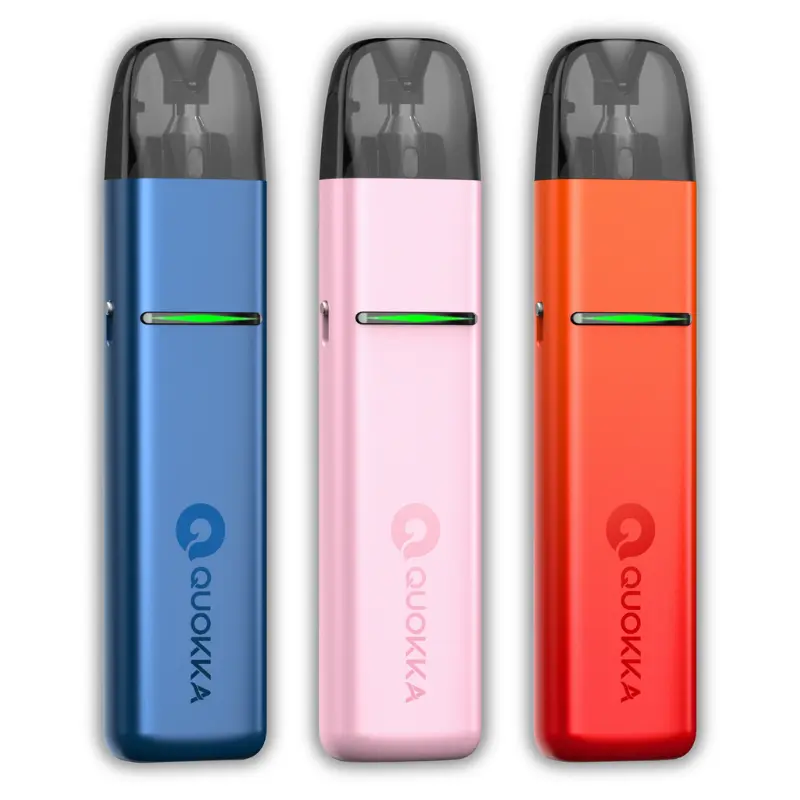
Hayati Quokka Elite Pod Vape Kit
£14.99
✔ In stock — ready to ship
Genuine Hayati
Free over £20
Same-day dispatch
Secure checkout
The Hayati Quokka Elite Pod Vape Kit costs £14.99, and the single most useful fact about it is that it is the middle of three. Hayati's own description opens by saying so, which is unusual. Most product copy leads with what a thing is. This listing leads with where it sits, between the Lite below it and the Pro above it, and only then gets around to the device.
Take those positions from the catalogue rather than from the copy. The Quokka line is four listings in a catalogue of 492: three refillable bodies and one pack of replacement pods. The bodies are the Hayati Quokka Lite Pod Vape Kit at £8.99, this one at £14.99, and the Hayati Quokka Pro Pod Vape Kit at £20.99. The two gaps are six pounds and six pounds, to the penny. £14.99 is the exact arithmetic midpoint of £8.99 and £20.99. That is either a coincidence or the fingerprint of a ladder built by adding a fixed step, rather than three prices arrived at separately by costing three different objects. Nothing Hayati publish settles which, and this page is not going to pretend otherwise.
What is settled, because Hayati print it themselves, is that the three bodies share a published specification. All three list a 2ml pod. All three list a battery figure of 1100mAh. The Elite listing says its battery figure is the one given for the Lite and the Pro; the Pro listing says its own battery and capacity match the other two. So the manufacturer is not concealing the sameness. They state it, in their own copy, on two of the three pages.
Which leaves a buyer choosing between three devices on a published specification that does not distinguish them, across a twelve pound spread, with a name and a photograph to go on. That situation is worth understanding properly, because there is a well-documented pattern in how people resolve it, and the pattern reliably lands on the middle. This page is about that pattern, what actually differs between the three as published, and how to choose on something better than position. It is also, in the interests of being straight with you, a page selling the middle option while telling you not to take the middle option by default. Everything factual on it is countable from this catalogue, so you do not have to take my word for any of it.
The three tiers, exactly as the catalogue prints them
Before any argument about behaviour, the raw positions. Here is the whole Quokka range, priced, with what each listing publishes about itself.
| Listing | Price | Pod | Battery figure | Liquid included |
| Quokka Lite | £8.99 | 2ml | 1100mAh | None |
| Quokka Elite (this page) | £14.99 | 2ml | 1100mAh | None |
| Quokka Pro | £20.99 | 2ml | 1100mAh | None |
| Quokka Pods | £6.99 | Not stated on that listing | Not applicable | None |
Two columns of that table are constant and one is not. The price column is the entire published difference between the three devices.
Now place those prices against the rest of the catalogue, because the position of the Quokka range as a whole is easy to miss. There are thirteen distinct prices across 492 listings, and almost all of them are crowded. One hundred and forty-one listings cost £7.99. Ninety cost £5.49. Sixty-four cost £2.49. Fifty-two cost £11.99. Those are format prices: a price attached to a type of product, shared by every flavour of it.
Four listings in the whole catalogue hold a price that nothing else holds, and three of those four are the Quokka bodies. £8.99, £14.99 and £20.99 each belong to exactly one product. The fourth is a single bottle priced thirty pence above its sixty-four shelf-mates. Everything else on this site is one of a crowd at its price point; the Quokka bodies stand alone at theirs.
They also stand at the top. Of 492 listings, 490 cost £11.99 or less. The Elite at £14.99 is the second most expensive product on the site, behind only the Pro. It costs three pounds more than the dearest prefilled kit Hayati sell and nearly twice the catalogue's commonest price. That is not a criticism of the price. It is context that gets lost when you look at the Quokka shelf on its own, where £14.99 reads as the sensible middle of a range, rather than as the second highest number in the whole catalogue.
The Hayati Quokka shelf holds those four listings and nothing else. Step up one level to Hayati Pod Kits and there are 174 devices, of which 171 arrive with liquid sealed inside and three do not. The three are these. So the Quokka range is simultaneously the most expensive corner of the catalogue and the only corner where you supply the liquid yourself, and those two facts are connected: a body you keep and refill is priced as hardware, while a prefilled kit is priced mostly as liquid with a body attached.
Why the middle is the most chosen and least examined position in a range
Here is the phenomenon, stated plainly, because it is the thing this page exists to explain.
Offer somebody two versions of a product, a cheaper one and a dearer one, and record how the choices split. Now add a third version, more expensive than both, and offer the same three to a comparable group. The middle option, which is the item that used to be the expensive one, takes a larger share than it did before. Nothing about that item has changed. Its price has not moved, its specification has not moved, and nobody's needs have moved. All that changed is that it stopped being an end of the range and became the middle of one.
This has a name in the research literature, where it is called the compromise effect, and a companion name for the underlying tendency, extremeness aversion. It has been demonstrated in choice experiments since the late 1980s and replicated across an unglamorous variety of goods: cameras, microwaves, batteries, beer, computers. The effect size varies with the study and the category, and honest summaries say so. What does not vary much is the direction. Put an option in the middle and its share goes up.
Two explanations are usually offered for it, and they are not in competition. They both apply, in different proportions, to different buyers.
The first is about how losses register. Compare any two options and each one is worse than the other on something: cheaper but less of whatever the price buys, or more of it but dearer. If a shortfall on an attribute registers more heavily than an equivalent advantage, then an option that is worst on nothing has an advantage over one that is worst on something, even if it is also best on nothing. The middle is the only position in a three-step range that is not worst at anything. It is not the cheapest, so nobody can say you were cheap. It is not the dearest, so nobody can say you overpaid. It has no exposed flank.
The second is about justification. People do not only choose, they choose in a way they can explain, to a partner, to themselves at three in the morning, to whoever asks why they spent that much on a vape. Of the three available explanations, two are uncomfortable. "I bought the cheapest" invites the thought that you compromised, and if the thing then disappoints, the explanation and the disappointment fit together neatly. "I bought the dearest" invites the thought that you were had, and if the thing turns out no better than the cheap one, that explanation fits too. "I bought the middle one" is the only account that cannot be turned against you afterwards. It is the choice with the best alibi.
Notice what neither explanation involves. Neither of them requires the middle option to be good, or appropriate, or better value. They are both mechanisms by which the structure of the range, rather than the merits of the product, determines what gets bought. The middle wins on position. That is the whole finding, and it is why the middle is at once the most chosen thing in any range and the least examined: it gets picked by people who did not want to run the comparison, precisely because it is the option that lets you skip the comparison.
It is not the decoy effect, and the difference matters
Anyone who has read about pricing tricks will be reaching for the other famous one, so it is worth separating them, because they get conflated constantly and only one of them is going on here.
The decoy effect, more precisely asymmetric dominance, needs a bad option. You add a third choice that is clearly worse than one of the existing two on every dimension that matters, so that the option it is worse than now looks obviously correct by comparison. The decoy exists to be rejected. It is a wasted line on the price list, and it works by being pointless.
The compromise effect needs no such thing. All three options can be entirely reasonable, sensibly priced and genuinely on sale to genuine buyers. None of them dominates any other. The pull towards the centre comes from the arrangement itself, from the simple fact of there being a top and a bottom, and it would operate on three well-made devices priced fairly by people with no interest in behavioural research whatsoever.
That distinction matters for how you should read this page, and it is the reason the next section exists. A decoy is a manipulation. A three-step range is not. It is one of the ordinary ways to sell hardware, it predates anybody studying why it works, and it is doing something useful for a lot of the people who encounter it.
Being fair to the middle tier
A range needs a default. Most people do not want to research a vape body. They want a sensible object at a sensible price, they want the decision to take ninety seconds, and they are entirely right to want that, because the difference between the plausible outcomes here is six pounds and some unpublished ergonomics. Spending an hour comparing three devices to save six pounds is, for most people, a bad trade of their own time.
A default serves those people. It is a real service, not a con. The middle of three is a legible default, it is recognisable at a glance, and offering one is not a trick played on anybody. If you are the buyer who wants an answer rather than an investigation, the middle tier is a defensible answer and you should take it without guilt and without reading the rest of this page.
What is worth resisting is the version where the middle gets chosen as the defensible answer by somebody who actually wanted the right one. Those are different objectives and they land in the same place by accident. The defensible answer is the one you cannot be criticised for. The right answer is the one that fits how you will use the thing and how long you will keep it. Sometimes they coincide. When they do not, the pull towards the centre is quietly overriding your actual requirements with a reflex about how the choice will look.
The only reliable defence is to notice that the reflex is running. Once you can see it, you can decide whether it applies to you, and quite often it will not.
The condition that makes the pull strongest
There is a qualification on the research that is more useful here than the headline finding, because it is the part that tells you when to worry.
The compromise effect is not uniform. It weakens when buyers hold strong prior preferences, when they have used the category enough to know exactly what they want, and when the attributes on offer are rich, numerous and directly comparable. Give somebody five specifications that differ across three products and they will start trading them off against each other, and the tradeoffs will start driving the choice instead of the position.
It is strongest in the opposite case: thin information, few attributes, no way to compare the options on their merits. That is not mysterious. If nothing distinguishes three products except their order, then their order is the only thing left to choose on, and position is not a bias in that situation so much as the only available signal.
Which brings the general finding into contact with this specific listing, because the Quokka range is an unusually clean instance of the strong condition. The published attributes are two, pod volume and battery figure, and both are constant across all three tiers by Hayati's own statement. There is nothing to trade off. A buyer comparing the Lite, the Elite and the Pro on published data is comparing three identical specifications at three different prices, and the only variable in the comparison is the position in the range.
That is about as much clear air as the effect ever gets.
What the three actually publish, and what nobody publishes
Set out flatly, because it is short.
Published, and identical across all three bodies: the pod holds 2ml, the battery figure is 1100mAh, the device is refillable and arrives with no liquid in it, and a freshly filled pod wants a pause before the first draw. That is it. Four items, none of which separates the three.
Published, and different: the price, and the name.
Not published anywhere in the Quokka data, for any of the three: coil resistance, how the battery takes a charge, box contents beyond the device and its pod, dimensions, weight, materials, finish, whether airflow can be adjusted, whether there is any control or display, how long a pod lasts before it needs replacing, and whether the separately listed Quokka Pods fit one body or all three. Hayati attach an instruction to that pods listing asking buyers to establish that a pod matches the model they own, and the sensible way to read that instruction is literally rather than as legal wallpaper.
Anyone who wants that second list examined in more depth, alongside the case for refilling at all, should read the Quokka Lite page, which works through the blanks and the break-even arithmetic against the prefilled ranges. The Quokka Pods listing on the same shelf carries the other half of it, the running cost of the consumable itself and why a refillable's cost per millilitre is a range rather than a number. Neither argument is rebuilt here. This page is about the choice between three bodies, which those pages deliberately did not settle, and the Pro page takes up the separate question of whether a specification sheet can carry a top price at all.
The names do not even rank properly
One small thing, easily missed, and genuinely useful at the point of purchase.
Lite, Elite, Pro. None of those words describes a property of a vape. They are ranking vocabulary, borrowed from the general business of selling three of something, and they carry no information about pod volume, battery, materials or anything else you could check.
Worse, they do not rank cleanly among themselves. Lite is unambiguously the bottom, and English is happy with that. But Elite and Pro are both status words and there is no settled order between them. In most ordinary use, elite outranks professional: an elite athlete is above a professional one. A buyer ordering these three by name alone would put the Elite on top and the Pro in the middle, and they would have the ladder upside down, because the prices say the opposite.
So the name does not tell you the tier. Only the price does. If you are trying to work out which of the three is which, sort by price and ignore the words, because the words were chosen to sound like a hierarchy rather than to be one.
Elsewhere in this catalogue, price tracks something you can read
The Quokka arrangement looks less ordinary once you compare it with how the rest of the range is priced, because everywhere else a price step comes with a specification step attached.
Mini Ultra kits are £3.99 and carry a 4ml pod. Rubik kits are £5.99 with 12ml. Pro Max Plus kits are £7.99, also 12ml. Pro Ultra Plus kits are £11.99 with 22ml. Those ladders are not perfectly tidy, and the two 12ml formats at different prices show that capacity is not the only thing being charged for. But in each case you can see a published number changing as the price changes, and you can form a view about whether the change is worth the money. Whether you conclude yes or no, you are reasoning from evidence.
Between the three Quokka bodies there is no published number that changes. Six pounds buys a step in the range, and the range is the only thing the step is a step in. That does not mean nothing changes. It almost certainly does: bodies at different prices in the same family usually differ in size, materials, finish, the feel of the mouthpiece, how the pod seats, how solid the object is in a pocket. Those are real differences and they matter a great deal to how a device is to live with. They are simply not specifications, they are not written down anywhere, and no amount of reading will get you at them.
What the six pound step buys, and what it would have to be worth
The useful question is not what the Elite costs. It is what the step costs, because the step is the only part of the decision that is actually in play once you have decided to refill at all.
Denominate six pounds in things this catalogue prices, which is more informative than leaving it as an abstract sum. Hayati's own bottled nicotine salts are 10ml at £2.49, so the Lite-to-Elite step is about two and a half bottles, roughly 24ml of liquid, which at 2ml a fill is about twelve fills of the pod. The full Lite-to-Pro step of twelve pounds is closer to 48ml, or two dozen fills. The step is not nothing. It is also not a large sum by the standards of hardware that might last years.
Then denominate it in time, which is where it actually resolves, because six pounds is a one-off and the device is not.
- If the body lasts two years, the step is about 6p a week.
- If it lasts one year, about 12p a week.
- If it lasts six months, about 23p a week.
- If you stop refilling after three months and go back to prefilled pods, about 46p a week, and you have also spent twelve fills' worth of liquid money on a body you abandoned.
Those four lines are the whole economics of the tier decision, and notice what they depend on. Not the device. You. The cost of moving up a tier is almost entirely a function of how long you keep the thing, which is a fact about your own habits that you know and nobody else does.
That has an uncomfortable implication for the default. The buyer most likely to take the middle without examining it is the buyer who knows least about the category, and the buyer who knows least about the category is the one least certain they will still be refilling in a year. So the pull towards the centre is strongest on exactly the person for whom the centre is hardest to justify on the numbers. Someone confident they will be filling a pod every other day two years from now can pay the step without thinking about it, and should not feel bad about doing so. Someone finding out whether they get on with handling liquid at all has the strongest case for the £8.99 entry, and that case gets stronger the less sure they are.
The fair version of the other side, which deserves stating properly rather than as a concession. If the unpublished differences are real, and there is no reason to assume they are not, then six pounds spread across a couple of years of daily handling is a trivial sum to pay for a device that sits better in the hand, seats its pod more positively or survives being dropped. Hardware you touch twenty times a day is worth paying for. The problem is not that the step might be worth it. The problem is that the decision turns on a fact nobody has written down, and the right response to a decision turning on an unwritten fact is to go and get the fact, by handling the three or asking someone who has. Splitting the difference is not an answer to an information gap. It is a way of not noticing there is one.
Specifications, and the blanks that are doing the work
Everything below comes from Hayati's published data for this listing. Where a row is empty, it is empty on the listing, and the emptiness is printed rather than smoothed over.
| Price | £14.99 |
| Position in range | Middle of three Quokka bodies (£8.99 / £14.99 / £20.99) |
| Brand | Hayati |
| Format | Refillable pod kit, filled by the owner with bottled liquid |
| Pod capacity | 2ml |
| Battery figure published | 1100mAh, stated as matching the Lite and the Pro |
| Flavour | None supplied. Decided at a second purchase |
| Nicotine strength | None supplied. Decided by the bottle |
| Puff rating | None published on any Quokka listing |
| Coil resistance | Not published |
| Charging arrangement | Not published |
| Box contents | Not itemised |
| Dimensions, weight, materials | Not published |
| Replacement pods | Listed separately at £6.99; establish that they suit your model first |
| Handling note from Hayati | Pause after filling before the first draw |
| Shelves | Hayati Quokka, Hayati Pod Kits, New Products |
Six of those sixteen rows say some version of nothing. That ratio is the page's argument compressed into a table, and it is worth comparing against a prefilled entry, where a capacity, a strength, a puff figure, a battery number and several paragraphs of flavour arrive before the listing runs out of things to state. The Elite gives you two numbers and a format.
The two numbers deserve individual notes, since they are the only quantities in play.
2ml. No device listed here holds less than this, and the figure fixes the rhythm of ownership more than anything else on the list. A 10ml bottle is five fills. Everything else about living with the device follows from that cadence: how often it wants attention, how much liquid you have to carry, how quickly you can change your mind about a flavour. It is identical on all three tiers, so it is not a reason to pick one over another, but it is the specification that decides whether the format suits you at all.
1100mAh. This is the largest battery figure published anywhere in the catalogue, and only the three Quokka bodies carry it. It looks like the headline number and it is probably the least consequential thing here, because the constraint on a device with a 2ml reservoir is almost never the charge. You will be opening the thing to refill it long before the battery becomes the reason you stopped. A large capacity on a small reservoir mostly means the battery is not the part that interrupts you.
The blank coil row matters more than either. With no resistance figure there is nothing to say about how tightly the device draws, and on a refillable that has a consequence the sealed shelves do not have, because it governs which liquids will wick at all. Lacking the number, a thin 50/50 is the conservative pick, and Hayati's own 10ml bottles are exactly that. The charging row stays blank deliberately. Pages on this site have previously filled that row by guessing, the guesses were taken out, and nothing is going back in.
How it compares, and where £14.99 goes elsewhere
Three comparisons matter: against its two siblings, against the prefilled shelves at the same money, and against the version of yourself who buys two cheap bodies instead of one middling one.
Against the Lite and the Pro
On published data there is nothing to compare, and it would be dishonest to manufacture a comparison out of price alone. What can be said is what each page is for. The Quokka Lite at £8.99 is the cheapest way to establish whether you get on with refilling, and its page carries the arithmetic on whether refilling beats buying prefilled pods in the first place, which is the prior question to this one. The Quokka Pro at £20.99 is the top of the ladder and its page takes on the question this one raises from the other end, namely whether an identical specification can support a price twelve pounds above the entry.
The honest summary of the three-way comparison is that it cannot be made on paper, that the paper is the same for all three, and that a buyer who wants to decide on evidence needs to handle them or ask somebody who has. Anyone telling you confidently that the Elite is the sweet spot of the range is telling you about the shape of the range, not about the device.
Against prefilled at the same money
Fourteen pounds ninety-nine is more than any prefilled kit on this site costs, and that is the comparison a lot of people are implicitly making without spelling it out. Spelled out, £14.99 buys a Quokka Elite and no liquid whatsoever. The same money buys a Blackcurrant Lemonade Hayati Pro Ultra Plus 25000 Prefilled Pod Kit at £11.99, which is 22ml of dark berry and sharp citrus in a device, with three pounds left over. Or it buys a Blue Razz Pineapple / Strawberry Ice Hayati Pro Ultra Plus 25000 Prefilled Pod Kit, a single 22ml pod split into two reserves with a collar that picks which one feeds the coil, so you get tangy blue raspberry over pineapple on one side and a cooled strawberry on the other. Or a Blackcurrant Cotton K / Blue Raspberry Hayati Pro Ultra Plus 25000 Prefilled Pod Kit, where one side is candy floss softening a tart berry and the other is bright and undiluted.
Drop to £7.99 and the choice widens enormously, because that is the catalogue's commonest price and the shelf behind it is the deepest. Blackcurrant Lemonade Hayati Pro Max Plus 6000 Pod Kit tastes like squash topped up with fizzy lemonade. Blackberry Ice Hayati Pro Max Plus 6000 Pod Kit puts a winey, faintly tart dark berry under a cold exhale. Blackcurrant Mango Hayati Pro Max Plus 6000 Pod Kit sets a musky, sharp berry against soft golden fruit. Cherry Peach Lemon Hayati Pro Max Plus 6000 Pod Kit runs dark cherry and mellow peach under a zesty lift. Berry Lemonade Hayati Pro Max Plus 6000 Pod Kit is cloudy lemonade with mixed berries stirred through. Blue Razz Mojito Hayati Pro Max Plus 6000 Pod Kit crosses blue raspberry with mint and lime. Buy any one of those and £7.00 of your £14.99 is still in your pocket, with liquid in the device.
Stated that baldly, prefilled looks like better value, and for the first few weeks it is. The refillable argument is a long-run argument and the Quokka Lite page runs it properly. The point here is narrower: at £14.99 the Elite is competing not only with two other Quokka bodies but with the most expensive tier of prefilled kit plus change, and a buyer who only ever compares the three Quokkas with each other will never notice that.
Against two cheap bodies
This is the comparison the tier structure hides most effectively, and it is arithmetic rather than opinion. Two Quokka Lites cost £17.98. One Quokka Elite costs £14.99. The difference is £2.99.
For three pounds more than the middle tier you could own two complete devices, each with its own pod, which solves a problem that no single refillable body solves: running two liquids at once without either tasting of the other. That is a real advantage of owning two bodies rather than one better one, and it is worth weighing against an unpublished improvement in build. A second body is also a spare, which on hardware with no published lifespan is not a small thing.
It is not free of drawbacks. Two bodies means two things to charge and two things to lose, and if the Elite genuinely is a nicer object then two of the cheaper thing is not the same as one of the better thing. But the comparison should at least be made, and the three-tier layout does not invite you to make it, because the layout invites you to compare the Elite with the Lite and the Pro and stop there.
Where the flavour argument goes if you walk away
Plenty of readers will conclude that the refillable format is not for them, and they should be pointed somewhere useful rather than left at a dead end. If your objection is the handling, the answer is a sealed pod, and the range runs from small and cheap to large and long-lasting.
At £3.99 the Mini Ultra kits are the smallest commitment on the site, 4ml in a device: Cherry Berry for ripe cherry filled out with softer berries, Blueberry Raspberry for mellow blueberry against a tarter raspberry with no cooling in it, Blue Razz GB Hayati Mini Ultra Pod Kit for blue raspberry pushed towards the sweets counter, and two dual-sided listings for anyone who wants variety without a refill: Blackcurrant Lemonade / Straw’ Lemonade Hayati Mini Ultra Pod Kit builds both sides on lemonade, and Blueberry Cotton K / Raspberry Cotton K Hayati Mini Ultra Pod Kit puts candy floss over two related berries.
At £5.99 the Rubik kits carry 12ml, which is the cheapest prefilled liquid in the catalogue once the body is paid for: Blue Sour Raspberry Hayati Rubik Prefilled Pod Kit for sugary blue fruit with a sour edge that stops it building up, and Banana Ice Hayati Rubik Prefilled Pod Kit for mellow banana lightened by a chilled finish. The same banana exists two pounds dearer as Banana Ice Hayati Pro Max Plus Pod Kit with the same 12ml, which puts a figure on how much of a sealed-pod ticket is hardware and how much is what is inside it.
And on the £7.99 shelf, beyond the ones already named, the berry writing is where the range is strongest: Blackberry Raspberry Hayati Pro Max Plus Pod Kit for a late-summer bramble mix, Blueberry Raspberry Hayati Pro Max Plus Pod Kit for the same pairing without ice, the three-fruit Blueberry Raspberry Cherry where none of them dominates, Cherry Berry for dark cherry with brighter fruit around it, Blackcurrant Juice Hayati Pro Max Plus 6000 Pod Kit for blackcurrant treated as a drink rather than a raw berry, and Blue Frozen Hayati Pro Max Plus 6000 Pod Kit for blue fruit served very cold indeed.
Two on that shelf are named for an impression rather than an ingredient, Black Mamba Hayati Pro Max Plus 6000 Pod Kit and Blue Fusion Hayati Pro Max Plus 6000 Pod Kit, and their own pages are candid that the name settles less than it appears to. There is a tidy parallel with this page in that: an opaque name and an identical specification are the same problem in different clothes, which is a buyer being asked to choose on something other than information. The whole range sits on New Products, and the complete Hayati catalogue is the place to check a flavour against a bottle before deciding which side of the refillable question you are on.
Choosing on something other than position
Four questions, in the order they actually decide the outcome. None of them is about the Elite specifically, which is the point: the tier decision is downstream of questions about you.
One: are you buying a body or finding out whether you want one? These are different purchases wearing the same label. Finding out is a short-horizon commitment and short horizons make the six pound step expensive per week, as the arithmetic above shows. Buying a body you expect to still be using in two years makes the same step almost invisible. Answer this first, because it swings the tier decision more than anything else on this list.
Two: can you get your hands on one before deciding? If the difference between the three is build, size and feel, and nothing published suggests it is anything else, then thirty seconds holding all three settles the question more reliably than any amount of reading. If you have a shop within reach, that is the answer and this page is a poor substitute for it. If you are buying blind, then you are choosing on price and position alone, and you should at least know that is what you are doing.
Three: do you need one device or two? The two-body comparison above is genuine and the structure of the range obscures it. If you already know you want to run a fruit and a menthol without one bleeding into the other, two of the cheapest bodies at £17.98 is a serious option against one middle body at £14.99, and it solves a problem the middle body does not.
Four: does the unpublished axis actually matter to you? Some people genuinely care how a device feels in the hand, how it sounds when the pod clicks home, whether it is metal or plastic, whether it looks like anything. Others could not care less and want the thing that works. If you are in the second group, the unpublished differences between the three tiers are unpublished differences in something you do not value, and the cheapest one is the rational buy. If you are in the first group, the unpublished differences are the entire decision and you must not make it from a specification table, because the table has nothing in it for you.
Who should take which
Plainly, and including the cases where this listing is the wrong one.
- Take the Elite at £14.99 if you have handled all three and preferred this one, which is the only fully evidenced reason available. Take it also if you want a default and genuinely do not want to spend time on this, and six pounds is inside the range where you do not care. That is a legitimate reason, it is the reason most middle tiers get bought, and it stops being a problem the moment you have said it out loud instead of drifting into it.
- Take the Lite at £8.99 if you are establishing whether refilling suits you, if you are unsure you will still be doing it in six months, if you want a spare or a second body for a second liquid, or if you simply do not care how hardware feels as long as it works. On the published specification you are giving up nothing measurable.
- Take the Pro at £20.99 if you have handled it and prefer it, or if its own page convinces you on the question of what a top tier can be worth when the specification will not carry it. Do not take it because it is the top one, which is the mirror image of the mistake this page is about.
- Take two Lites at £17.98 if running two liquids in parallel is the thing you actually want, and accept two devices to charge as the price of it.
- Take none of them if the handling is the objection. Five fills per 10ml bottle is the deal on any of the three, and a sealed 12ml or 22ml pod removes it completely. The prefilled shelves above are not a consolation prize, they are the majority of this catalogue for a reason.
Living with a 2ml pod you fill yourself
Practical notes, all of them consequences of the two published numbers rather than general advice, because general advice is available everywhere and is worth what you pay for it.
The rhythm. Five fills to a 10ml bottle sets the tempo of ownership. This is the same on all three tiers, so it is not a reason to choose between them, but it is the thing most likely to make somebody regret the format regardless of which one they bought. The device is only as useful as your proximity to a bottle, and 2ml does not travel far.
The pause. Hayati's one handling instruction is to leave a newly filled pod for a few minutes before drawing on it. On a reservoir this size that instruction recurs five times per bottle rather than once per device, and the temptation to skip it grows with repetition. A useful habit is to fill at the end of a session rather than the start, so the pause happens while you are doing something else and never feels like waiting.
Filling. Aim down the inside wall. The column up the middle carries air, not liquid, and anything poured into it comes straight back out of the mouthpiece. Stop a little short of full, so warming has somewhere to expand into.
What to put in it. No resistance figure is published, so a thin 50/50 liquid is the conservative choice, and Hayati's own 10ml salts are exactly that. Hayati's copy on their large 70/30 bottles points that ratio at low-resistance coils and tanks drawn straight to the lung, and warns that a small pod may not keep up with something thicker. On the manufacturer's own account, that line is out. One difference of fact worth knowing before you order rather than after: every bottle in Hayati's salt line is listed at 10mg, while every prefilled pod format on this site is listed at 20mg. That is a description of the catalogue and not a suggestion about what belongs in your pod.
Pods. Pods deplete; the body does not. No lifespan is published for one, in fills, in millilitres or in weeks, so the moment at which the £6.99 pack becomes necessary is not something anybody can quote you, and you will establish it by counting your own. Before you need one, establish that the replacement pods suit this particular body. Hayati ask you to check, they publish no compatibility table or pod code, and a shared range name on a pack is not a guarantee that a part seats. Get that settled once, from somewhere better than a retail page, and it never has to be thought about again.
Charging. Not published on any Quokka listing, and not going to be guessed at here.
Storage. Bottles upright, capped, and nowhere warm. Heat thins liquid, and thin liquid overwhelms a small reservoir faster than cold liquid will. Keep the device and the bottles out of reach of children and pets. A filled pod left somewhere hot is the commonest cause of a leak on any small-reservoir device, and this one has less to lose than most but the same seals doing the work.
End of life. The body has a battery and electronics in it, so when it eventually stops it goes to a retailer take-back point or a council electrical collection rather than into the bin. A spent pod contains a coil and a residue of liquid and goes the same way. Empty 10ml bottles are ordinary plastic. This applies identically to all three tiers, which is worth noting because the longer you keep whichever one you buy, the better the step you paid for looks, and the disposal question is the far end of the same calculation.
Questions worth asking before ordering this one
What separates the Lite, the Elite and the Pro?
On published data, nothing whatsoever. Each of the three states 2ml and 1100mAh, and on two of the three listings Hayati's copy says outright that the figures are shared. Six pounds separates each step and no published specification accounts for it. It will come down to size, materials, finish or how the pod seats, none of which Hayati describe anywhere.
Is the middle one the sensible choice?
It is the defensible choice, which is a different thing. The middle of three reliably takes a larger share than the same item would take as an end of two, because it is worst at nothing and easiest to justify afterwards. If you have handled all three and preferred this one, buy it. If you have not, you are choosing on position rather than on the device, and it is worth knowing that before rather than after.
Is there liquid in the box?
None. The pod turns up empty and the device is inert until a bottle has been bought separately. Of the 174 pod kits listed here, exactly three are filled by their owner, and the remaining 171 arrive sealed and ready to draw on.
Why does it cost more than every prefilled kit?
Because you are buying hardware rather than hardware plus a measured volume of liquid. A prefilled kit's price is largely the liquid inside it, which is why £7.99 buys a body and 12ml while £14.99 buys a body and nothing. Whether that trade pays off over time is the question the Quokka Lite page works through in detail.
Is the Elite better made than the Lite?
Unknown, and nobody selling it to you should claim otherwise. Hayati publish no materials, dimensions, weight or finish for any of the three, and the only published figures are identical across the range. It may well be a better object. There is simply no evidence on the listing either way, and inferring build quality from a price is not evidence.
Should I buy two Quokka Lites instead?
Worth considering seriously, since two of them come to £17.98 against £14.99 for this one. Two bodies let you run two liquids with no carryover between them and give you a spare, which matters on hardware with no published lifespan. Against that, it is two things to charge and two to keep track of, and if the Elite really is a nicer object then two cheaper ones do not replace it.
What nicotine strength is it?
None. It is one of only four listings on this site with an empty strength field, because strength is a property of the bottle rather than the device. For reference, every 10ml salt in Hayati's own line is listed at 10mg, and that is not the 20mg that appears on every sealed format here.
How many fills does a bottle give?
Five, since the pod holds 2ml and Hayati's bottles are 10ml. That cadence is the same on all three Quokka bodies, so it does not help you choose between them, but it is the thing most likely to decide whether the refillable format suits you at all.
Why is there no puff rating?
Puff figures are laboratory estimates tied to a sealed volume, and this listing has no sealed volume to estimate against. Not one of the four Quokka entries carries a rating, which is a consequence of the format rather than a gap in the data.
Will the replacement pods fit it?
Hayati list Quokka Pods at £6.99 for the range and ask buyers to confirm the pods match their own model before ordering. No compatibility table, pod code or statement that one pod serves all three bodies appears anywhere in their data, so this is worth establishing before you need it rather than after. Do not take the answer from a retail page, including this one.
How is it charged?
Hayati name no charging method on any Quokka listing, so this page cannot tell you. Several pages on this site once stated a connector type for devices whose specification never mentioned one and those claims have been removed. If it matters to you, check the packaging or ask before ordering.
Is the 1100mAh battery a reason to choose the Quokka range?
It is the largest battery figure published in this catalogue and it is also the least useful of the two numbers on the listing. On a device holding 2ml, the thing that interrupts you is the refill, not the charge, so a generous cell mostly means the battery is not the bottleneck. It is identical on all three tiers in any case, so it cannot help you choose one.
Does the name tell me anything about the specification?
No. Lite, Elite and Pro are ranking words rather than descriptive ones, and they do not even rank consistently, since elite normally outranks professional in ordinary English while the prices here put the Pro on top. Sort the range by price and disregard the words.
The short version
The Hayati Quokka Elite Pod Vape Kit is a £14.99 refillable pod device with a 2ml pod and a battery Hayati list at 1100mAh, and it is the middle of three bodies priced at £8.99, £14.99 and £20.99, with an identical published specification across all three and six pounds between each step. Hayati themselves state that the figures match. So the only published difference between the Elite and its siblings is where it sits and what it costs.
That matters because of a pattern in how people choose that has been demonstrated repeatedly in choice experiments: when three tiers are offered, the middle takes a disproportionate share, not because it is right for the buyer but because it is worst at nothing and easiest to defend. The pattern is strongest exactly where the attributes are thin and the options are hard to tell apart, which describes this range precisely. A three-step range is not a trick, and a default is a real service to somebody who does not want to research a purchase. But a default chosen by reflex is not the same as a product chosen on its merits, and only one of those is what most buyers think they are doing.
So: if you want an answer rather than an investigation, and six pounds is not a sum you will think about again, take the middle and get on with your day. If you can handle all three before deciding, do that instead, because the differences that exist are the kind you can feel and cannot read. If you are still working out whether filling a pod five times a bottle suits you, the £8.99 entry is the cheaper way to find out and gives up nothing measurable. And if two liquids at once is the real requirement, two of the cheapest bodies cost three pounds more than one of these and actually solve it. What nobody can honestly tell you, from this listing or any other, is that the middle one is the right one, because no published fact settles it.
Strictly for adults aged 18 and over. Nicotine is an addictive substance.
You might also like


