
Home / Hayati Rubik Prefilled Pod Kit / Red Apple Ice Hayati Rubik Prefilled Pod Kit
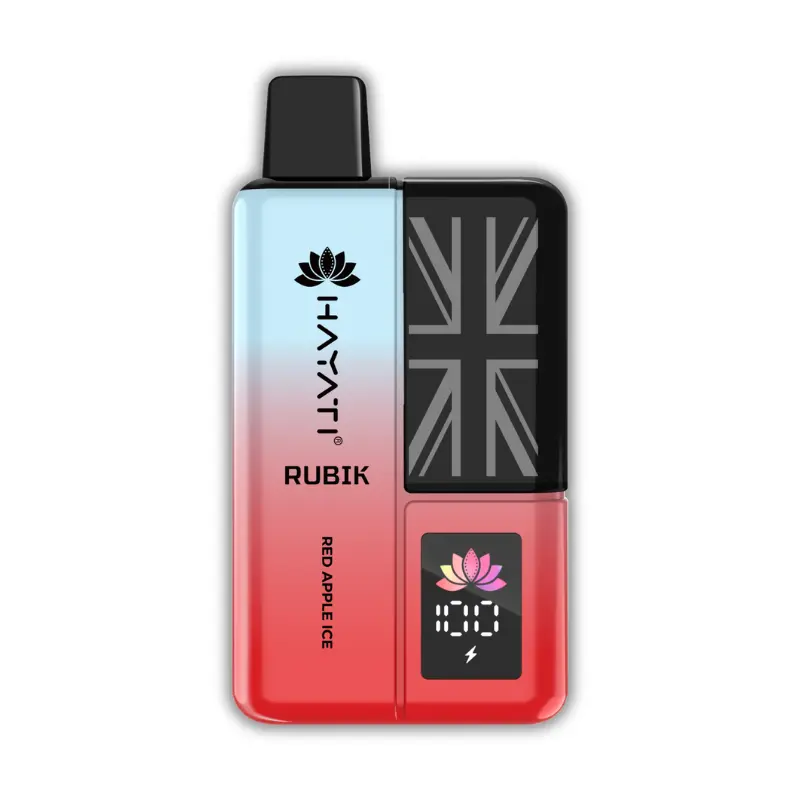
Hayati · Rubik
Red Apple Ice Hayati Rubik Prefilled Pod Kit
£5.99
✔ In stock — ready to ship
Genuine Hayati
Free over £20
Same-day dispatch
Secure checkout
Red Apple Ice on the Hayati Rubik is a complete purchase at £5.99: the Rubik body with an 850mAh cell inside it, and a pod that left the factory already holding 12ml of liquid at 20mg nicotine salt. The figure Hayati attach to a filled pod is up to 7,000 puffs, produced on bench equipment drawing at a fixed interval, which makes it a way of ranking one pod against another and not a forecast of how long yours will run. Every other kit on the Hayati Rubik Prefilled Pod Kit shelf carries those same four figures. None of them is a reason to pick this one over the nineteen beside it.
The reason to pick this one, or to leave it, is the first word of the name. Red looks like it is narrowing the fruit down for you. It has the grammar of a qualifier: a word placed in front of an ingredient to tell you which version of that ingredient you are buying, in the same slot that White occupies in White Peach and Sour occupies in Sour Apple. And with apples, of all fruits, a qualifier ought to be worth a great deal, because apples differ from each other more than almost anything else in a fruit aisle. Two apples in the same bowl can be further apart in the mouth than a raspberry is from a strawberry.
So a word that genuinely narrowed an apple would be one of the most useful words on any flavour label Hayati print. This one does not narrow it. Red is a skin colour, and red-skinned eating apples run the whole range of the only property that decides what an apple tastes like, which is acid. That point has already been established elsewhere on this site and is cited rather than rebuilt below. What has not been established is what the word is doing instead, and that question has a real answer with consequences for the liquid, because the missing acid is the reason this pod is iced and the reason it could not have been sold any other way.
This page works through three readings of the word, says which one survives, and then spends the rest of its length on the liquid: what a sweet red apple accord is actually built from, why a coolant is load-bearing on it rather than decorative, and what twelve millilitres in a sealed pod does to a flavour of this shape. The price argument for the platform belongs to the Hayati Rubik shelf, which has already done the arithmetic properly, so it is pointed at rather than repeated.
The word Red, and the three things it could be doing
Start with what is not in dispute. Hayati sell 492 listings. Seven of them are Red Apple Ice, making this the largest single apple recipe in the range and the only apple sold as a bottle, as a Rubik pod and as a Pro Max Plus pod simultaneously. The Apple Vapes shelf counts the rest: three Double Apple listings, four Sour Apple, three Apple Mint Grape, seventeen genuine apples in total across six recipes. That is the field the word is operating in.
Reading one: Red as a varietal marker. This one is already settled, and it fails
The White Peach Raspberry pages on this site did the census, and the finding is theirs rather than mine. Strip the hardware suffix from all 492 titles and 173 distinct flavour names remain. Exactly two of them specify a variety of the fruit they name, and one of the two is Red Apple. Not one name in the catalogue gives a cultivar outright: no Granny Smith, no Bramley, no Alphonso on any of the mangoes, no named strawberry among the eighty listings that use one.
Those pages then examined Red Apple specifically and disqualified it, on grounds worth restating exactly because the reasoning is the hinge of everything below. Red versus green is a genuine distinction that everybody recognises. What it does not do is pick out a group that shares a measurable property. Red-skinned dessert apples run from the flat, low-acid sweetness of a Red Delicious to the sharp, aromatic bite of a Braeburn, and those two sit further apart than a red apple and a green one. The colour narrows the field by skin and tells you almost nothing about acid.
That verdict stands and is not re-argued here. What follows takes it as the starting condition rather than the conclusion. If the word is not varietal, the interesting question is not whether it fails as one. It is what it succeeds at instead, because Hayati have printed it seven times and a word reprinted seven times is not an accident.
Why acid is the axis, and why the silence about it matters more on apple than on anything else
Before the other two readings, it is worth being precise about what a buyer of an apple liquid is actually trying to find out, because this is the part the word is silent on.
Apples vary on several axes. Sugar content varies, though less than people assume. Aromatic intensity varies a great deal. Flesh density and water content vary, which is why some eat as juicy and some eat as dry. But the axis that reorganises everything else is acidity, and the reason is that acid does not simply add sourness. It changes how every other component registers. Raise the acid and the sugar reads lower even when the sugar has not moved. Raise the acid and the aromatic compounds sitting above it read sharper and more separated, because there is a bright line for them to sit on. Drop the acid and the same aromatics read rounder, softer and more perfumed, and the sugar comes forward with nothing pushing back.
That is why two apples can taste like two fruits. It is also why apple is the fruit where a qualifier could do the most work, and why a qualifier that misses the acid axis is a particularly expensive miss. Nobody buying a mango liquid needs to be told whether it is the acid one, because mangoes do not divide that way at retail. Apples do, visibly, in every supermarket in the country, and the division is the one thing the buyer already knows how to think about.
Now look at what Hayati have on the shelf. The range contains three apple names, and each one is built on a different axis. Red Apple Ice names an appearance. Sour Apple names a taste. Double Apple names a construction, which the Double Apple pages have already worked out at length as two varieties of one fruit laid over each other rather than an intensity claim, and which is their finding rather than anything re-derived here. Three apples, three incompatible naming systems, and exactly one of the three qualifiers sits on the axis that decides an apple. It is not the one on this pod.
That is the shape of the problem. The word in the slot where the useful information belongs is the word that carries none of it.
Reading two: Red as an index entry, marking this out from the other one
There is a reading that rescues an uninformative colour word entirely, and this site has already found it working elsewhere. The Red Sour Raspberry pages tested whether Red on a raspberry could be varietal, established that it could not, because the catalogue contains no golden, yellow or black raspberry for the marker to point at, and then found a different job the word was doing. It was contrastive. It was not describing the fruit, it was marking out which of Hayati's two sour raspberries you were looking at, by negation: this is the one that is not the blue one. Their conclusion was that a descriptive adjective tells you about the object while a contrastive one tells you about the set the object came from, and that the two look identical on a listing.
That is a genuinely good result and the obvious hypothesis to bring here. If Red on a raspberry is an index entry pointing at Blue, then Red on an apple is plausibly an index entry pointing at the range's other, sharper apple. Sour Apple is green in everything but the title, and Hayati's own copy for it calls it sharp and green. So the reading writes itself: Red means the sweet one, Sour means the green one, and the pair works.
It writes itself and it does not survive the counting. Four pieces of evidence cut against it, and they cut in the same direction.
The first is that the two words are not on the same axis, and a contrastive pair has to be. Red Razz and Blue Razz work as an index because both are colours; a buyer reading one knows immediately that the other exists and what slot it occupies. Red Apple and Sour Apple do not pair like that. One is an appearance and one is a flavour property, and a buyer who has only ever seen Red Apple Ice has been given no reason to expect a Sour Apple anywhere. The marker points at nothing the reader can locate.
The second is distribution, and it is the decisive one. The raspberry pages found that Red Razz GB has never once been printed without Blue Razz GB beside it in the same title. Red Apple Ice and Sour Apple run the other way entirely: they have never once shared a device range. Red Apple Ice lives on the Pro Max bottles, on Pro Max Plus and on the Rubik. Sour Apple lives on Pro Ultra Plus and Mini Ultra. The six shelves they do share are all of the sort that collect by filing rather than by hardware, which is the flavour shelf, the new arrivals shelf, and four format shelves. On no range shelf anywhere in the catalogue does a buyer see both apples at once.
The third narrows it further, to the shelf you are standing on. Twenty kits sit on the Rubik kit shelf. Exactly one of them is an apple, and it is this one. Pineapple Ice is on the same shelf and is not an apple, a distinction the Apple Vapes page had to check rather than assume and found the filing gets right. So at the point where the purchase is actually made, Red is distinguishing this pod from no other apple at all. There is no second apple in the room.
The fourth is about weight. Sour Apple appears on four listings, and three of those are dual-flavour Pro Ultra Plus or Mini Ultra products where the apple shares a pod with Juicy Peach. Across 492 listings there is exactly one place you can buy Sour Apple on its own. Red Apple Ice has seven listings across five formats. An index entry that marks a seven-listing recipe against a one-listing recipe the buyer will probably never encounter is not doing much indexing.
So the reading that won on raspberry loses on apple, and it loses on the same kind of evidence that won it there. That is worth saying plainly, because the tidy move would have been to carry the finding across and announce a pattern. The catalogue does not support one. Red behaves differently on the two fruits.
Reading three: Red as a trade accord name, which is the one that holds
The third possibility is that the word is not pointing at anything inside Hayati's catalogue, and is not describing the fruit either. It is naming a recipe, in a vocabulary that belongs to the flavour trade rather than to fruit growing.
Flavour houses sell apple in two standard shapes, and they have done for decades. One is built around acid with sharp green top notes over it, low on sweetener, and it is sold under names containing the word green or the word sour. The other is built around the perfumed ester side with the sweetener raised to support it, low on acid, and it is sold under names containing the word red. Those are not descriptions of two apples. They are two concentrate categories, and a mixer ordering one of them knows exactly what will arrive in the drum. The word red on a flavour label is a purchase order, not a botanical observation.
Under that reading the word is genuinely informative, and it is informative about something other than the fruit. It tells you which of two standard builds the mixer was working from. It does not tell you which apple, it does not tell you the acid level within the red build, and it is not narrowing a population of fruit at all. It is naming a product that a flavour house sells.
The evidence for this reading is sitting in Hayati's own copy, and it is the strongest single piece of evidence on this page. All seven Red Apple Ice listings gloss the word. Every one of them, without exception, explains in the body text that this is the sweeter one and not the green or sour one. The Rubik kit says the fruit is the sweeter, mellower side compared with sharp green varieties, and that it is refreshing without being sour. The Rubik refill says it avoids the sourness of green apple flavours. The Pro Max Plus kit says red apples are sweeter and mellower than green ones. The Pro Max Plus refill says juicy with a gentle crunch rather than a sour snap. The bottles say the same thing in their own words, three times over.
Seven listings, seven glosses, all making the identical move. That is the tell. A word that narrowed the fruit on its own would not need explaining seven times in a row. The fact that Hayati write out the contrast every single time they print the word is an admission, made in the copy rather than in the title, that the word alone does not carry it. And notice what the gloss contrasts against: green apple flavours in general, out in the wider market, not any product Hayati sell. The reference class is the trade, not the catalogue.
So here is the verdict, stated once and then used for the rest of the page. Red is not varietal, because a skin colour spans cultivars with completely different acid, which the White Peach Raspberry pages settled. Red is not an internal index entry either, because unlike the raspberry case there is no second apple sharing a shelf with it and the two apple qualifiers are not even on the same axis. Red is a trade accord name, inherited from the flavour houses, and it is accurate about the build while being silent about the fruit. It tells you a mixer ordered the sweet ester concentrate rather than the sour green one. The guarantee you actually get, that there is no acid in here, comes from the gloss underneath the name, not from the name.
That matters practically as well as pedantically. It means the name is reliable in one direction and useless in the other. If you want the sweet build, the word delivers it and has delivered it on seven listings. If you want to know how sweet, how perfumed, or how close to the sharper end of the red category this particular mix sits, the word is not going to help and neither is any other word in the title.
What a sweet red apple accord is actually made of
With the naming settled, the liquid. The bottled nic salt page for this flavour has already taken the underlying contrast between the two apple builds and the chemistry that separates them, so that ground is cited rather than walked again. What follows comes at the liquid from a different direction: as three components that have to be supplied, each with its own way of failing, and each audible on your own pod within a day.
The identity component, and why it is the fragile one
Something in the mix has to make this read as apple rather than as generic sweet red fruit, and that something is the perfumed ester layer sitting above the sugar. It is a narrow, slightly floral, faintly candied lift, and it is the only part of the recipe doing identification work. Remove it and you are left with a sweet cold liquid that could be almost anything on the red end of the shelf.
It is also the most volatile part of the mix and the first thing a tiring coil stops reproducing, which gives you a diagnostic rather than a guess. Draw on a new pod and hold the vapour in the mouth for a second before exhaling. The lift is what appears in that held second, sitting above the body of the fruit. When it stops appearing, the pod has moved past its useful stretch, regardless of what the liquid window shows and regardless of whether anything tastes burnt.
Two things worth knowing about this layer. It is quieter here than the sugar is, so on a first pod a lot of people never consciously register it and only notice when it goes. And it is the part that heat damages in storage, which is why a spare pod kept in a warm place will read flatter than one kept in a drawer, even though nothing has been used.
The sweetness component, which has nothing pushing back on it
The red build needs a high sweetener load, and it needs it structurally rather than as a preference. Strip the sugar out of an ester-led apple and the perfumed layer reads thin and slightly soapy, because there is nothing underneath it holding it in the fruit register. The mixer does not have a choice about this. It is what the concentrate category requires.
The consequence is that this liquid sits above the middle of its shelf for sweetness and has no internal brake. A green build brakes itself: the acid arrives early, cuts the sugar and clears the palate on the way out. There is no acid in here to do that job. Every sweet fruit pod on the Rubik shelf faces some version of this, and the ones that solve it do so by importing sharpness from elsewhere, which is what Blueberry Cherry Cranberry does with cranberry tannin and Lemon Lime does with citrus. This pod does not import sharpness. It imports temperature instead, which is a different solution with different behaviour, and the next section is about why.
Stated plainly: if sweet liquids tire you out by the middle of a session, that will happen here and the cooling will only partly postpone it. This is not a criticism of the mix. It is what the red accord is, and the honest version of this page says so rather than calling the sweetness balanced.
The texture component, which is the interesting one
Here is a contradiction sitting in plain sight in Hayati's own copy for this listing, and working out how it resolves explains the whole product.
The Rubik kit description calls the apple crunchy. The Rubik refill calls it the crunchy freshness of a just-cut fruit. The Pro Max Plus refill says gentle crunch. And the same descriptions, in the same paragraph, say refreshing without being sour, and juicy rather than sour, and that it avoids the sourness of green apple flavours. So the copy is promising a crisp, crunchy apple while explicitly denying the property that makes an apple crisp.
Because crunch is not a taste. It is a mechanical event that happens between your teeth and a piece of fruit, and vapour cannot produce it. When a flavour writer reaches for the word, they are pointing at a perceptual result: the tight, bright, slightly astringent sensation that makes the mouth read an apple as firm rather than as mealy. In real fruit that sensation is carried almost entirely by acid, with a little help from the tannins in the skin. A low-acid apple is exactly the one people describe as mealy, and Red Delicious has the reputation it has for precisely this reason.
So the red build has a problem built into it. It is the apple people reach for when they want sweetness, and it is missing the component that makes an apple feel like an apple rather than like sweet juice. A mixer working from the red concentrate has the fruit identity and the sugar and no crispness at all.
The coolant is the answer. Cold produces a large part of the same perceptual result that acid produces: it tightens the palate, it makes the sweetness read lower without removing any of it, and it supplies a definite edge for the fruit to sit against. That is not a general claim about cooling agents flattering fruit. It is specific to this one, because on an apple the sensation the cold delivers is already part of what the word apple means. A chilled apple is crisper than a warm one, and everybody has that reference.
Which is why the copy can promise crunch and deny sourness in the same breath without lying. The crunch is real. It is being produced by the coolant, not by the fruit. And it is worth noticing that crunch is a rare word in this catalogue: five of 492 descriptions use it, and four of the five are apples. The word is doing specific work here rather than being house filler, which is the check that has to be run before treating a word as meaningful.
How that adds up across a draw, without a timeline
The three components do not arrive in a queue, which is why describing them as a sequence tends to mislead. They arrive layered, and what changes over a draw is which of them is loudest.
The sugar is loudest at the front and it is broad rather than detailed. The apple identity sits above it and becomes most legible a beat later, particularly if you hold the vapour. The cold builds through the pull rather than appearing at a point, and on this listing Hayati place its peak at the exhale. What you are left with at the end is cold and sweet rather than cold and fruity, because the perfumed layer is the shortest-lived of the three.
The finish is short, which is unusual for something this sweet and is one of the more useful properties here. A sugared fruit liquid with no cold in it tends to leave a coating that dulls the next draw and eventually dulls everything. The cooling keeps clearing that, which is the mechanical reason a sweet pod of this size stays drinkable rather than becoming cloying by the halfway mark.
What it is not, listed flatly so nobody has to infer it
- Not sour, not tart, and not sharp at any point in the draw. There is no acid component in the red accord and nothing in the listing suggests one has been added.
- Not green. No cut-stem note, no vegetal edge, no skin astringency.
- Not a blend. One fruit and one coolant, with nothing else declared anywhere in the listing.
- Not a shisha or aniseed profile. That belongs to the other apple family and the Double Apple Hayati Pro Max Plus 6000 Pod Kit pages have the argument about whether the anise is present in Hayati's version.
- Not a bakery flavour. No cinnamon, no pastry, no caramel shell, no toffee.
- Not a freeze liquid. The cold is integrated and moderate, and anyone arriving from heavy menthol pods will read it as mild.
The coolant is not a garnish on this one
Apple and cold is one of the oldest pairings in the liquid trade, old enough that most product copy treats it as a default and stops thinking about it. It is worth thinking about, because on this particular accord the coolant is not an optional finish. It is doing structural work, and the catalogue can prove it.
The count that settles it
Fourteen listings in this range name an apple. Seven of them are Red Apple Ice, and all seven carry the word Ice. Not one of the seven has ever been sold uncooled. Meanwhile the other two apple recipes, three Double Apple listings and four Sour Apple listings, carry no cooling word at all between them. Seven out of seven on one side, zero out of seven on the other, and the split falls exactly along the line of which apple has acid in it.
That is not a coincidence about house style. It is the same argument the texture section made, visible in the product list rather than in the mouth. Sour Apple does not need a coolant because it has its own edge. Double Apple does not need one because, by the account the Double Apple pages give, the construction has a sharper component built into it. The red accord has neither, and every time Hayati have shipped it they have shipped it cold.
The buyer's consequence is concrete and slightly annoying. You cannot audition the fruit on its own. There is no uncooled red apple anywhere in these 492 listings, in any format, at any strength. If you buy this pod and decide you like the fruit but want it warm, the range has nothing to sell you. The coolant is not a variable you control on this flavour; it is part of what the flavour is here.
Where the cold sits, and a disagreement worth reporting
Lining up all seven descriptions of this liquid against each other turns up one genuine disagreement, and the honest thing is to report it rather than to pick a side.
Six of the seven put the cooling at the back of the draw. The Rubik kit says the ice adds a cold snap on the exhale. The Rubik refill puts it on the finish. Both Pro Max Plus listings put it on the exhale. Both 120ml bottles have it carrying through to the exhale. The seventh, the 10ml salt bottle, is the odd one out: it says the ice arrives quickly, early enough that the fruit feels as though it has come straight from a fridge.
Six to one is a clear majority and it is not proof of anything about the recipes, because a copy disagreement between listings of one flavour is evidence about how the copy was written, not about two different mixes. It is also fair to note that the outlier is a 50/50 bottled liquid at a different strength, so a difference in the actual pour is not impossible. What can be said without inventing anything is this: on the listing you are buying, Hayati place the cold at the exhale, and the site's own page for the bottled version built its structure on the early reading because that is what its own listing says. Both pages are reporting their own listing accurately. If you already own the bottle and the pod reads differently to you, that is the likeliest reason, and it is a small difference either way.
How strong the cooling is, and what the word Ice does and does not promise
Moderate, and integrated rather than layered on top. It registers clearly, it does not numb, and it never takes the front of the palate away from the fruit. Anyone whose daily pod is a dedicated freeze product will find it light. Anyone coming off warm fruit with no coolant will find it properly cold. Both readings are about the reader rather than about the pod.
On the word itself, the Blue Frozen pods page ran the census across the whole catalogue and established that Hayati's cooling vocabulary is not graded: Ice, Frozen and Cooler do not mark three intensities, Ice appears on around ninety titles while the other two appear a handful of times between them, and no listing ever combines an ice word with a mint word. That finding is theirs and is cited rather than recounted. What it means for this pod is that Ice is a category marker rather than a dial setting, and the only way to place the intensity is against products you have already tried.
The thing that goes wrong when the cold fades
Because the coolant is carrying the texture rather than just the temperature, losing it costs more here than it would on a fruit with its own acid. On a tart liquid a fading coolant leaves a tart liquid. On this one it leaves the sweetness standing on its own with nothing supplying an edge, and the fruit stops reading as crisp and starts reading as syrup.
Two situations produce that. The first is a coil late in its life, where the cold drops out after the perfumed lift has already gone. The second is temperature, and it is more common than people expect: a pod that has been warm in a pocket all afternoon reads flatter and sweeter than the same pod did in the morning, because cooling agents register less intensely in a warm pod. Nothing is wrong with the liquid in either case, but on this flavour the symptom is not simply less chill. It is a fruit that has gone from crisp to mealy, which people misread as the pod being finished when it has only been warm.
Twelve millilitres of one sweet fruit, sealed
The pod holds 12ml. That is a generous fill for a prefilled format and it is the specification with the largest effect on what owning this is like, more than the cell, more than the published puff figure and considerably more than the shape of the body.
The reason is commitment. Twelve millilitres of one profile, in a sealed unit with no way in and no second reserve to turn to, is a long time with a single sweet fruit. There is no collar on this device to switch to another side mid-session, which is a thing some of the larger dual-flavour pods elsewhere in the range offer and this format does not. Once it is seated, the flavour question is closed until the pod is done.
That cuts both ways and the direction depends on what you already know. If red apple is a profile you have lived with, 12ml at £5.99 with a body in the box is straightforwardly good value and the Hayati Rubik shelf sets out the per-millilitre arithmetic for the kit-then-refill pattern, which is where the range actually pays off. If you are not sure whether an unbraked sweet fruit will still be welcome at the two-thirds mark, 12ml is a larger bet than the price makes it look, and the bet is on your own palate holding steady rather than on the liquid being good.
What happens to the taste across a full pod
A 12ml pod runs long enough that the coil ages noticeably inside one fill, which is not true of smaller formats where you change the pod before the coil has done much. The order in which things go is consistent on a sweetened fruit and has a specific shape here.
The perfumed lift goes first, usually while everything else still seems fine, and taking it away removes the part that says apple rather than sweet. The cold goes second, and on this liquid that removes the crispness as well, for the reason the texture section set out. The sugar goes last and never becomes actively unpleasant, which is the trap: a pod can be well past its best and still taste acceptable, so it is entirely possible to spend two days on a flat version without noticing the moment it changed.
The practical version of that is a two-part check rather than waiting for a burnt note. Is the lift still there when you hold the vapour. Does the fruit still read crisp rather than syrupy. If both answers are no and the pod is warm, warm it is the likely cause; if both answers are no and the pod is cool, the coil has had enough.
Part-used pods, and why they are awkward on this format
A sealed 12ml pod that you have stopped enjoying is a difficult object. It cannot be emptied, it cannot be topped up with something sharper, and stored half-used it will drift, because the aromatic side of the recipe is the part that degrades and it is already the quietest part. A pod set aside for a fortnight comes back sweeter and less apple-like than the one you put down.
The cleanest way round that on this range is a second body rather than a second pod, so that two profiles can run in parallel and neither has to be abandoned midway. At £5.99 for a complete kit that is not an extravagant position, and it is the argument the shelf page makes at greater length. The alternative, finishing something you have tired of out of thrift, is how people end up deciding they dislike a flavour they actually liked for the first eight millilitres.
The Rubik body, briefly
What is in the box is the Rubik body with an 850mAh cell and one pod already seated in it, filled and ready. There is no separate liquid to add, nothing to prime and nothing to assemble.
The one specification that matters for this particular liquid is the pairing of 12ml with an 850mAh cell, because those two numbers are out of step with each other on purpose. The liquid will outlast several charges rather than the other way round, so the rhythm of owning this is a device that runs down repeatedly while a single pod is still half full. Leave a cable somewhere you naturally sit rather than treating charging as an event. Nothing else about the hardware changes what the flavour does.
Everything else about the device, including what a non-standard body shape does in a pocket and how the two tiers on this range price against each other, belongs to the Hayati Rubik shelf page, which covers it properly and is not summarised here. The Vim Ice kit on the same shelf has the detailed comparison against the equivalent Pro Max Plus listings if the question you want answered is why two ranges with identical fill, strength and cell size carry different prices. Between ranges nothing interchanges, so check the range name printed on your device before ordering a refill.
Specifications, and what each figure changes
Only what Hayati publish for this listing. Anything missing from the table is missing because it is missing from the listing, and filling gaps from a product photograph would be invention.
| Price | £5.99 |
| What arrives | Rubik body plus one prefilled pod, seated |
| Liquid volume | 12ml, prefilled and sealed |
| Nicotine | 20mg nicotine salt |
| Cell | 850mAh, rechargeable |
| Manufacturer puff figure | Up to 7,000, a laboratory measurement |
| Flavour | Red Apple Ice |
| Brand | Hayati |
| Coil resistance | Not published |
| Airflow | Not published |
| Strength options | None; 20mg is the only figure on this range |
| Filed under | Hayati Rubik Prefilled Pod Kit, Hayati Rubik, Apple Vapes, Ice Vapes, Hayati Pod Kits, Hayati Prefilled Pod Kits, New Products |
Two rows repay more than a glance. The 20mg figure is the ceiling permitted for nicotine in this format in the United Kingdom and it is the only concentration this entire range is sold at, so there is no lighter version of this pod to move to and no heavier one to move from. Nicotine is an addictive substance, and that is a statement of what is in the pod rather than a recommendation about it. Anyone who wants a different milligram figure is looking at a different product category, not a different option on this page.
The two unpublished rows matter more on a sweetened liquid than they would on a plain mint. Resistance and airflow between them decide how hot the coil runs and therefore how quickly a sugared recipe deposits residue on it. Without those figures nobody can tell you in advance how many of the twelve millilitres will be drunk through a coil at its best. What can be said is that a sweetened fruit will get there sooner than an unsweetened one would, and that the check described above is more reliable than any number would have been.
The 850mAh figure is the same cell fitted across this whole range, so it is not a point of difference between this kit and the nineteen beside it. The 12ml is not a point of difference either. On this shelf the flavour really is the only variable, which makes the naming question at the top of this page less academic than it might look: the name is very nearly the entire basis on which anyone chooses between twenty identical devices.
Choosing between this and the nineteen beside it
Twenty kits share this shelf at one price with one set of figures, so the whole decision is flavour. Grouping them by what they do rather than by what fruit is in them makes the choice quicker.
The refill, which is where the money goes
The direct companion to this listing is Red Apple Ice Hayati Rubik Pods at £3.99, the same 12ml of the same liquid with no body attached. It is the listing that matters over time, and it is inert on its own: without a Rubik already in your possession it is a purchase you cannot use. Buy the kit first and the refill afterwards, in that order, and check before committing to a flavour long term that the refill exists, because the kit list runs to twenty and the refill list to nineteen. Fizzy Cherry is the one kit with no matching standalone pod on the shelf.
The other cold fruit on this shelf
Fourteen of the thirty-nine Rubik entries finish cold, so this pod has plenty of company and the differences are all in what the cold is sitting on. Watermelon Ice is the closest neighbour in intent, another low-acid sweet fruit relying on the coolant for its edge, and the two are genuinely hard to separate on structure. The fruit is the whole difference: watermelon is waterier and less perfumed, apple is denser and carries the aromatic lift. If you like one there is no strong reason to expect you would dislike the other.
Pineapple Ice goes the other way and is the useful contrast for anyone who found this pod too rounded. Pineapple brings real acid of its own, so the coolant there is decorating a fruit that already had an edge rather than supplying one. Strawberry Raspberry Ice sits between the two: the raspberry contributes a small lift that apple cannot, which makes it finish a touch sharper at a similar sweetness. Banana Ice is the most polarising of the cold group for a reason that follows directly from the texture argument above, since banana has no crisp state to refer to and the cold therefore reads as a separate event rather than as the temperature of the fruit.
Lemon Cola Ice leaves fruit behind for a drink profile while keeping the cold structure, which makes it the sensible second kit for anyone who knows they want cooling and does not want two sweet fruits in rotation. Vim Ice is the other cold entry worth naming, and its page is also where the price comparison between this range and the equivalent Pro Max Plus listings has been worked out in detail.
If the sweetness is the problem
Apple's difficulty here is that it brings no brake, so anyone who finds this tiring should be looking at the entries that have one rather than at colder versions of the same shape. Blue Sour Raspberry declares a sour treatment in the title, which on this range is a real signal rather than a flourish. Fizzy Cherry uses a carbonation effect to produce a prickle that works on the palate the way acid does. Blueberry Cherry Cranberry uses cranberry's drying character, which produces a finish nothing in the apple family can reach, and Lemon Lime solves it with straightforward citrus.
That last group is also the right place to look if what you actually wanted was a green apple. There is no green apple on this shelf, there is no green apple anywhere in Hayati's titles, and the nearest thing the range sells is a sour apple on two other hardware platforms entirely. A sharp citrus or a declared sour berry on the Rubik will get you closer to the sensation than any apple listed here.
The warm sweet fruits, for rotation rather than replacement
Running two cold sweet pods in parallel gets dull quickly, so a second body is better spent on something structurally unlike this one. Juicy Peach is sweet and soft with no cooling at all, which makes it the clearest demonstration of what the coolant is contributing here: same rough sweetness, no chill, and a very different texture. Triple Mango is the heaviest fruit on the shelf and its page has the argument about what a multiplier in a flavour name can and cannot promise. Strawberry Kiwi pairs the range's commonest fruit with its rarest and gets its sharpness from the kiwi rather than from cold.
The blue side of the shelf is where most second purchases come from, and it is a different register rather than a different fruit. Blueberry Raspberry is the plainest of them, Blue Razz Cherry and Blue Razz GB both sit in confectionery territory. None of them competes with apple directly, which is the point of naming them. Fresh Mint is the outright palate-resetter and the most effective partner if the problem you are solving is sugar fatigue rather than boredom.
The same flavour and the same idea on other hardware
Red Apple Ice exists on five formats. Two are bottles at 120ml and one is a 10ml salt, and all three are for people who fill their own hardware rather than buy sealed pods. The prefilled route splits between this range and Pro Max Plus, where the same flavour sells as a kit and a pod at higher prices for the same 12ml fill.
If the platform rather than the flavour is the open question, Pineapple Ice Hayati Pro Max Plus Pod Kit and Blackberry Ice Hayati Pro Max Plus 6000 Pod Kit show where that range lands at £7.99. Strawberry Raspberry Ice Hayati Mini Ultra Pod Kit at £3.99 is the smaller-capacity end, useful for anyone who would rather commit to less liquid per flavour. At the other extreme, Hayati Pro Ultra Plus Shisha 30000 Prefilled Pod Kit is the largest thing the brand makes and one of the few places an apple note appears outside the three recipes counted above. The Ice Vapes shelf collects everything that finishes cold across all the ranges, and the full Hayati catalogue is there for anyone who would rather browse than filter.
Living with this pod
Nothing here is difficult, but a sweetened iced liquid in a large sealed pod rewards a few specific habits, and the generic advice is less useful than the flavour-specific version.
Judge the pod on the lift and the crispness, not on a burnt note. Both markers described above go long before anything tastes scorched, and on 12ml that leaves plenty of liquid to drink after the pod has stopped being worth drinking. Checking takes one held draw.
Rule out temperature before you rule out the coil. A warm pod on this flavour does not simply taste less cold, it tastes mealy, because the cold is carrying the texture. Give it twenty minutes somewhere cool and try again before deciding anything.
Keep spares out of the warm. The perfumed layer is the fragile part of this recipe and heat is what degrades it. A sealed pod kept in a drawer holds up; one kept on a sunny sill or in a car through summer will read duller than a fresh one before it has been used at all.
Draw slowly and keep the pull restricted. Twenty milligrams of salt in a sealed pod belongs at the narrow end of the draw spectrum. A long, unhurried pull lets the cooling build across the length of it, which is where the crispness comes from; a short hard pull gets you mostly sugar.
Pair it with acid rather than with more cold. The obvious second flavour is another iced fruit and it is the wrong choice, because the fatigue that sets in on this profile is sugar fatigue and a second sweet cold pod does nothing about it. Something tart or something mint resets the palate properly.
Leave a charging cable where you sit. Twelve millilitres against an 850mAh cell means the device empties repeatedly while the pod is still half full, so charging is a routine rather than an occasional interruption.
Do not set a part-used pod aside for long. It cannot be topped up or emptied, and stored half-finished it drifts sweeter as the aromatic side fades. Either finish it or plan on a second body so that nothing has to sit idle.
Keep it somewhere children and pets cannot get to it, along with anything else in the house containing nicotine.
Dispose of it as electricals. A finished Rubik still contains a cell, a coil and a little liquid, so it belongs in a retailer collection bin or the electrical waste point at a household recycling centre rather than in a kitchen bin.
Questions this listing raises
Does the word Red tell me which apple I am getting?
No, and that is the main finding of this page. Red is a skin colour that spans cultivars with completely different acid levels, a point the White Peach Raspberry pages established when they counted varietal words across all 173 flavour names in the catalogue. What the word does reliably signal is which of the flavour trade's two standard apple concentrates the mixer worked from, the sweet ester-led one rather than the sour green one. It is accurate about the recipe and silent about the fruit.
Is Red there to distinguish this from Hayati's Sour Apple?
Probably not, and the catalogue argues against it. The Red Sour Raspberry pages found exactly that contrastive job being done by Red on a raspberry, where the word marks the pod out from the blue one. It does not transfer here: the two apple qualifiers are not on the same axis, one naming an appearance and the other a taste, and the two products have never shared a device range. On this shelf there is only one apple, so the word is distinguishing it from nothing at all.
How sweet is it, honestly?
Above the middle of the shelf and with no internal brake, because the red accord needs a high sweetener load to keep its perfumed layer in the fruit register. The cooling offsets some of that by tightening the palate and clearing the finish, and it is a partial mitigation rather than a solution. Anyone who has abandoned sugared pods halfway down before will find the same thing happens here.
How cold does it get?
Moderate, integrated into the fruit rather than sitting above it, and placed at the exhale by Hayati's own description of this listing. It does not numb and it never displaces the apple. A reader whose daily pod is a dedicated freeze product will find it mild, and a reader coming off warm fruit will find it substantial, which makes the question partly about your own recent history.
Why is there no uncooled version of this flavour?
Because the coolant is doing structural work rather than decorating. The red accord has no acid, and acid is what makes an apple read as crisp rather than mealy, so the cold is supplying the missing edge. The count bears it out: all seven Red Apple Ice listings carry Ice, and the range's other two apple recipes, which have their own sharpness, carry no cooling word between them.
Can it really be crunchy and not sour at the same time?
Yes, and the resolution is that the crunch is being produced by the coolant. Crunch is not a taste at all, it is the perception of firmness, and in real fruit that perception is carried mostly by acid. Cold produces a large part of the same effect, which is why the copy can promise crispness and deny sourness in the same paragraph without contradicting itself.
What is in the box?
The Rubik body with its 850mAh cell, and one pod already seated and filled with 12ml at 20mg nicotine salt. There is nothing to assemble, nothing to prime and no separate bottle. The only thing you will need later is a refill pod, which is sold separately at £3.99.
How long will a pod last?
Hayati publish a figure of up to 7,000 puffs for a filled pod, arrived at on laboratory equipment taking identical draws on a timer. It is a way of comparing one pod with another rather than a description of anybody's week, since draw length, frequency and how often you reach for the device all move it substantially. The honest answer is that nobody can tell you in advance.
Is there another nicotine strength?
No. Twenty milligrams of salt is the only concentration this range is sold at, across all thirty-nine entries, with no second option behind it. Nicotine is an addictive substance. Anyone who needs a particular milligram figure will not find a choice of them on this shelf whatever the body looks like.
Can I refill the pod when it is empty?
No, it is a closed unit sealed before it left the factory, and opening one is outside what the format supports. The intended route is a replacement pod at £3.99 seated into the body you already own. Anyone who wants to put their own liquid into a device is looking at refillable hardware rather than at this range.
How does it compare with Double Apple?
They are less alike than the shared fruit suggests. This is one apple from the sweet concentrate category with cooling supplying the edge. Double Apple is a construction rather than a single fruit, built on two apple characters laid over each other, and the Double Apple pages work through what that phrase promises and what Hayati do and do not commit to. This one is the more predictable purchase. That one is the more interesting unknown.
My pod tastes flat. Is it finished?
Check the temperature first. A pod carried warm all day reads sweeter, duller and noticeably less crisp on this flavour, and twenty minutes somewhere cool usually restores it. If it is cool and still flat, run the two-part check: no perfumed lift when you hold the vapour, and a syrupy rather than crisp fruit, means the coil has moved past its useful stretch even though there may be liquid left.
Where this lands
Red Apple Ice on the Rubik is £5.99 for a body, an 850mAh cell and 12ml of sealed liquid at 20mg, with a manufacturer figure of up to 7,000 laboratory puffs against a full pod. On a shelf where twenty kits share every one of those numbers, the name is very nearly the whole basis for choosing, which is why it was worth taking apart.
The conclusion is that Red looks like it narrows the fruit and does not. It is not a variety, because red skin covers apples that behave nothing like each other, and it is not an internal index entry either, because the range's other apple is named on a different axis and never appears on the same shelf. It is a recipe name borrowed from the flavour trade, reliable about the build and silent about the acid, and Hayati's own copy admits as much by spelling out the contrast underneath the word on all seven listings that carry it.
What follows from that is the useful part. The sweet build has no acid, acid is what makes an apple read as crisp, and so the coolant here is not a finish but a substitute for the missing edge. That is why the fruit can be described as crunchy and not sour at once, why every red apple Hayati sell is iced and neither of the other two is, and why a warm pod on this flavour goes mealy rather than merely lukewarm. Buy it if you want a recognisable single fruit on the sweet side with a cold structure holding it together. Leave it if you want sharpness, because there is none in here and no setting on the device will produce any.
Strictly for adults aged 18 and over. Nicotine is an addictive substance.
You might also like


