
Home / Hayati Rubik Prefilled Pod Kit / Summer Dream Hayati Rubik Prefilled Pod Kit
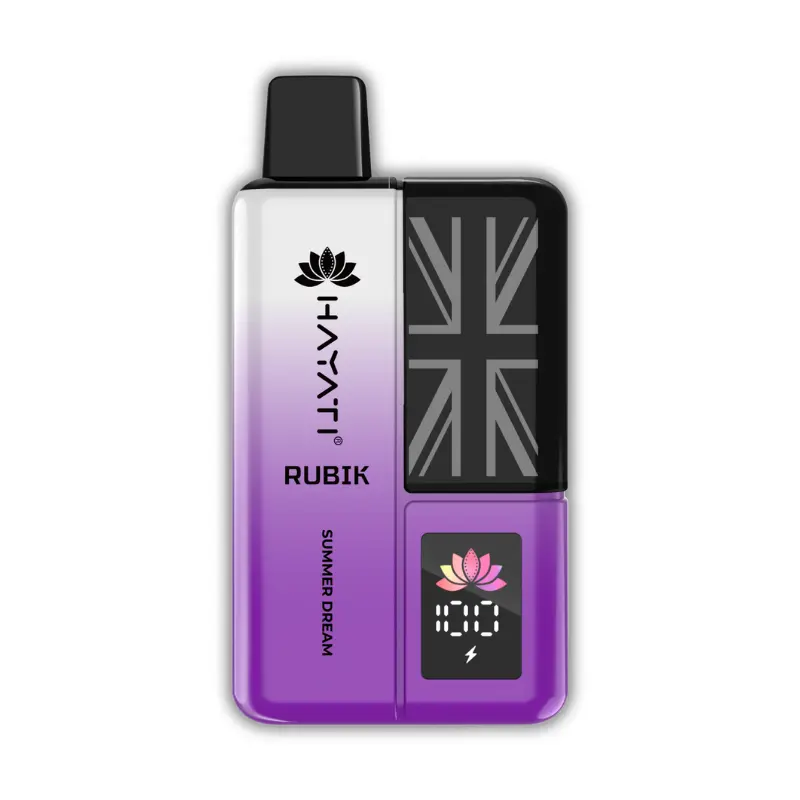
Hayati · Rubik
Summer Dream Hayati Rubik Prefilled Pod Kit
£5.99
✔ In stock — ready to ship
Genuine Hayati
Free over £20
Same-day dispatch
Secure checkout
The Summer Dream Hayati Rubik Prefilled Pod Kit is £5.99 for a complete setup: the Rubik body, an 850mAh cell, and a prefilled pod holding 12ml of liquid at 20mg nicotine salt. Hayati rate the pod at up to 7,000 puffs, which is a laboratory figure arrived at on test equipment rather than a description of anybody's week. That is the whole specification, and none of it is unusual. What makes this listing worth an argument is the two words at the front of the title, and specifically the fact that those two words have been printed on eleven separate products.
Summer Dream names no ingredient. It is a coined phrase, the same kind of phrase as Midnight Dream, Sunset Aura, Galaxy Aura and Peach Aura, and like all of them it leaves the buyer with no way to predict the liquid from the label. That problem has been worked over properly elsewhere in this catalogue and this page is not going to repeat it. The Summer Dream Hayati Pro Max Plus Pod Kit sells the identical liquid on different hardware and the shelf around it is full of names that do say what they contain.
The interesting thing sits one level up. Four of those coined names exist on two listings each. Summer Dream exists on eleven, spread across every product line Hayati operate, and one of the eleven is this kit. A manufacturer does not fill seven separate production formats with a liquid out of sentiment. Something about this particular invented name earned it a place on the tooling schedule seven times over while the ones it most resembles stayed on one device each, and that difference is measurable, independent of anything Hayati write in their copy, and answerable at least partway.
So this page does three things. It counts the distribution properly and says what the count is and is not evidence of. It asks why this coined name travelled and four near-identical ones did not, and gives a ranked answer with the inferences marked. Then it lines up all eleven descriptions of the same liquid against each other, which turns out to yield one genuine piece of fruit information that exists nowhere else in 492 listings, and finishes with what £5.99 on this platform actually buys against the alternatives.
Counting it first, because the handed-down version was wrong in two places
The claim I set out to test was that Summer Dream appears on roughly eleven listings across six hardware families. The listing figure holds. The family figure does not, and the correction matters because it makes the spread wider rather than narrower.
Searching the catalogue for the phrase returns thirteen titles. Two of those are dual-flavour Pro Ultra Plus products in which Summer Dream is the unnamed half sharing a 22ml pod with Lemon Lime, so it is sensible to count them separately. Eleven listings carry Summer Dream on its own. They break down like this:
- Rubik: this kit at £5.99 and the matching Summer Dream Hayati Rubik Pods at £3.99.
- Pro Max Plus: a kit at £7.99 and a replacement pod at £5.49.
- Pro Ultra Plus: a 25000 kit at £11.99 and a 22ml replacement pod at £7.99.
- Mini Ultra: a 4ml kit at £3.99 and a 4ml replacement pod at £3.49.
- A 10ml nicotine salt bottle at 10mg, £2.49.
- A 120ml 50/50 shortfill at 0mg, £6.99.
- A 120ml 70/30 bottle at 0mg, £6.99.
That is seven product lines, not six. Four of them are devices with a pod you do not fill yourself, and three of them are bottles for hardware you already own. The Summer Dream Vapes shelf collects all thirteen titles in one place, which is the quickest way to see the shape of it, and the two dual pods sit there alongside the eleven.
The second correction is bigger. The angle I was given implied Summer Dream stood alone at the top of the range. It does not. Counting every distinct flavour name in the catalogue gives 192 of them, and mapping each one onto the seven product lines gives an average reach of 1.78 lines per flavour. One hundred and twenty-four flavours, roughly two in three, exist on a single line and nowhere else. Against that baseline a flavour on seven lines is plainly exceptional, and exactly eight flavours manage it: Juicy Peach, Strawberry Raspberry Ice, Lemon Lime, Blueberry Raspberry, Blue Sour Raspberry, Blue Razz Cherry, Mr Blue and Summer Dream.
Eight, not one. The honest version of the claim is narrower and, I think, more interesting than the version I was handed. Summer Dream is one of eight flavours Hayati have put on every line they operate. Six of those eight tell you in the title what is in them. Two do not, and they are Summer Dream and Mr Blue. So the real finding is not that one coined name travelled further than its peers. It is that only two coined names reached the top tier at all, out of roughly seventeen genuinely invented flavour names in the catalogue, and that the other fifteen are clustered at the bottom of the distribution with Midnight Dream and the three Auras.
For scale on that lower cluster: Midnight Dream has two listings on one line. Sunset Aura, Galaxy Aura and Peach Aura have two listings each, all four of them Pro Max Plus only, six listings between the three of them. Rainbow has three across three lines. Black Mamba, Mad Blue and H'Bubba have three each. T-Misu, Pipeline Punch, Hubba Bubba, Caribb Crush, Mr Pink and Fruit Bomb have one or two apiece. Summer Dream has eleven. The gap between it and the median coined name is not a matter of degree.
The Rubik flavour list is the strongest version of this argument
Distribution counts are easy to wave at and hard to interpret, so here is the version of the evidence that needs no interpretation at all. The Rubik is a small line. It carries twenty flavours out of the 192 in the catalogue, which means someone sat down and chose twenty. That choice is a document, and this listing is on it.
Line the twenty up against the reach figures and the selection rule becomes obvious. All eight of the flavours that reach seven lines are on the Rubik. Every one. The average reach of a Rubik flavour is 5.40 lines against a catalogue average of 1.78, and fifteen of the twenty reach five lines or more. Only two are genuinely narrow: Vim Ice Hayati Rubik Prefilled Pod Kit, which exists on two lines, and Lemon Cola Ice Hayati Rubik Prefilled Pod Kit, which exists only here and nowhere else in the catalogue.
A twenty-slot shelf that happens to contain all eight of the widest-distributed flavours is not a random draw. The probability of that happening by chance with 192 candidates is negligible, and the sensible reading is that the Rubik flavour list is a shortlist of proven performers with one or two new entries attached. Whatever the selection criterion was, Summer Dream cleared it, and it cleared it in company that otherwise reads like a list of the range's most literal, most obviously commercial fruit blends: Blue Razz Cherry, Blueberry Raspberry, Juicy Peach, Blue Sour Raspberry, Lemon Lime.
What I am inferring, and where the inference could fail. I am inferring that the selection was made on commercial performance, because that is what a manufacturer normally optimises when it decides which twenty of 192 recipes to tool for a new format. Hayati publish nothing that says so. Three alternative explanations survive and none of them can be ruled out from the catalogue. The twenty could have been chosen for supply reasons, because those particular concentrates were already being made in volume for the other lines. They could have been chosen for formulation reasons, if some blends behave better in whatever pod the Rubik uses. Or the list could be inherited wholesale from another line rather than chosen at all. The first of those would still be downstream of sales volume, so it does not really weaken the reading. The third is the one that would, and I cannot test it.
One practical oddity while we are on the shelf. There are twenty Rubik kits and nineteen Rubik pods. The missing refill is Fizzy Cherry: Fizzy Cherry Hayati Rubik Prefilled Pod Kit exists, and at the time of writing no matching bare pod does. That is worth knowing before you commit to a Rubik flavour you intend to rebuy, and it does not apply here, because the Summer Dream refill is listed.
What seven lines proves, and the four things it does not
Wide distribution is the strongest commercial signal available in this catalogue, and it is strong for a specific and limited reason: it is expensive. Putting one liquid into seven formats means seven sets of packaging, seven listings, seven inventory lines and seven separate decisions to commit stock. A manufacturer repeats that only for a recipe that keeps selling. That signal is entirely independent of the marketing copy, which is what makes it useful here, because on a coined name the marketing copy tells you nothing.
Now the limits, because the gap between "sells well" and "is good" is wide and this is exactly the product where the two come apart.
It is not evidence of quality. A range like this one is built for breadth, and in a breadth-first range the flavour that gets tooled repeatedly is usually the one with the lowest rejection rate rather than the one with the highest enthusiasm. A sweet, mild, unobjectionable fruit medley offends almost nobody. A sharp citrus, a strong menthol or a divisive candy note will be loved harder and refused more often. If Summer Dream is what all eleven descriptions say it is, it is close to the archetype of a flavour that wins on low refusal rather than on being anybody's favourite.
It is not evidence that you will like it. This follows from the above but is worth saying separately, because distribution feels like a recommendation and is not one. The eight seven-line flavours cover citrus, blue raspberry, peach, mixed berry and whatever this is. They have nothing in common except reach.
It is not evidence about the liquid at all. Nothing in a distribution count touches the recipe. It tells you how many times a name was put on a box. If anything it raises a question about the recipe rather than settling one, because a liquid formulated for a 70/30 sub-ohm bottle and a liquid formulated for a 12ml 20mg pod are not obviously the same liquid, and Hayati publish nothing about whether the Summer Dream in this pod matches the Summer Dream in the 120ml bottle beyond the shared name.
And the count has a feedback loop in it. A flavour that gets listed on more lines gets seen by more buyers and therefore sells more, which justifies listing it on more lines. Some of the distance between Summer Dream and Midnight Dream is almost certainly that loop rather than an underlying difference in how much people like the liquids. I have no way to separate the two, and anybody who tells you they can from public catalogue data is guessing.
The defensible summary: eleven listings tells you Hayati keep choosing to make this, which is real information about the catalogue and about the commercial history of the recipe. It tells you nothing about how it tastes, and the reason it tells you nothing is not a technicality. It is that the properties which make a flavour easy to stock everywhere are not the properties that make it good.
Why this coined name and not the other four
The grammar of these names has already been settled and I am not going to re-derive it. The Black Mamba shelf neighbours aside, the argument lives on the Midnight Dream kit page, which established that a two-word coined name has one slot doing work and one slot doing none. Dream is the empty slot. Peach Aura proves the point for the other family, because nobody attaches a literal fruit to the front of a series word unless the series word carries no flavour information of its own. Whatever meaning these names have is in the first word.
That reframes the question usefully. It is not "why did Dream travel and Aura not", because both series words are empty. It is "why did Summer travel while Midnight, Sunset, Galaxy and Peach did not". Four candidate answers, ranked by how much the evidence supports them.
One: Summer forecloses less than the others
This is the explanation I find most persuasive and it is testable in a small way. Rank the five first words by how much they rule out. Peach rules out everything that is not peach, which is nearly the whole catalogue. Midnight commits to darkness, which in flavour terms means the dark berry and blackcurrant end and excludes citrus, tropical and anything pale. Sunset commits to a colour temperature, so oranges, reds and the warmer fruits. Galaxy commits to nothing literal but carries a strong connotation of something mixed, cosmic and probably candy-adjacent. Summer commits to a season, and a season in flavour terms means bright and fruity and not much else. It excludes the least.
A name that excludes little can be printed on seven different formats without any of them looking mis-sold, and it can also be reused if the recipe drifts between production runs. That is a genuine commercial advantage rather than a neat observation, and it predicts exactly what the data shows. It also survives its one available test: Mr Blue, the only other coined name in the top tier, is likewise a name that commits to almost nothing. A colour, and as the Midnight Dream analysis notes, a colour in this trade is close to a flavour family. Two names that forecloses least are the two that travelled furthest.
The test is a sample of two, so treat this as a reasonable inference and nothing stronger. It also has an obvious weakness: Galaxy forecloses very little either, and Galaxy went nowhere.
Two: Summer is a merchandising word as well as a flavour word
Seasonal words do work in retail that flavour words do not. A summer-named product has a natural promotional window, can be pushed in a specific quarter, and reads sensibly on a display in a way that Midnight does not. If a flavour gets extra distribution because it gives a wholesaler something to build a shelf around, that is nothing to do with the liquid. This is plausible and I have no evidence for it whatsoever from the catalogue. Listing it because it would change how you read the count if true.
Three: it is simply older
The flavours with the widest reach might just be the ones introduced first, having had time to accumulate formats while Midnight Dream and the Auras are recent additions that have only reached one line so far. This would explain the data completely and would mean the distribution gap says nothing about relative success. It is the explanation most likely to be right and the one I can least test, because the catalogue carries no introduction dates and everything in it sits on the New Products shelf regardless of age. Treat the age hypothesis as unresolved rather than dismissed. If it is correct, the honest reading of eleven listings drops from "this recipe keeps earning its place" to "this recipe has been around a while".
Four: the liquid is genuinely better
Possible, unfalsifiable from here, and the one everybody wants to be true because it is the only one that would make the count into a recommendation. Nothing in the catalogue speaks to it either way, and the first explanation above actively cuts against it, since a flavour selected for being hard to dislike is not the same as a flavour selected for being good.
Where that leaves the question: the best-supported answer is that Summer Dream travelled because it is the least committal name of the five, which made it both easy to sell everywhere and easy to keep selling. The age explanation is a live and untestable rival. Neither of them, and this is the point, tells you anything about what is in the pod.
Eleven descriptions of one liquid, lined up against each other
A flavour sold eleven times has been described eleven times, by copywriters working at different moments to different templates, and those eleven descriptions can be compared. The technique was established in this catalogue by the Blackcurrant Lemonade kit page, which found seven listings of one flavour disagreeing with each other in a patterned way and used the pattern to work out which axis actually mattered. Applied here it produces more than I expected, because the eleven Summer Dream descriptions turn out to be unusually consistent in some places and revealingly split in others.
What all eleven assert
That the name is a mood and not a recipe: 11 of 11. Every single listing says out loud that no fruits are named. The wording varies (a feeling rather than a fruit, a mood rather than a menu, a mood rather than a fruit bowl) but the content does not. This is worth sitting with. Hayati's own copy, on every one of eleven listings for a flavour they have tooled across seven formats, declines to describe the liquid and says so explicitly. That is not an oversight repeated eleven times. It is a policy.
That no fruit is ever named: 11 of 11. Not one description resolves the blend. The closest any of them comes is the Pro Max Plus kit, which mentions strawberry and mango as examples of the clearly named flavours Summer Dream is an alternative to, which is the opposite of naming an ingredient.
That there is no cooling: 11 of 11 by omission. No listing mentions ice, menthol, mint, frozen or a cool finish. That silence is worth more than silence usually is, because the Blue Frozen pods page counted the cooling vocabulary across this catalogue and established that Hayati signal cooling in the title when it is present. On this evidence Summer Dream is an uncooled fruit blend, and that is one of the few practical things about it I would state with confidence.
That the register is warm-weather: 11 of 11. Summery, sunny, holiday, warm-weather, lazy afternoons. Nine of the eleven use the word sunny specifically.
Where they split, and the split is by format rather than by recipe
A sweetness word appears in 8 of 11. The three that omit it are the 10ml nicotine salt bottle, the 120ml 50/50 shortfill and the 120ml 70/30. In other words, every prefilled pod listing calls it sweet and no bottle does. That is exactly the shape of finding the Blackcurrant Lemonade page flagged: a property that splits cleanly along a format boundary is evidence about who wrote the copy, not evidence about two recipes. The bottle listings are written to a different template, one preoccupied with VG/PG ratios and what device the liquid suits, and the sweetness word simply did not make it in. I would not read a difference in the liquid into it.
A pacing word appears in 8 of 11. Easy-going, relaxed, laid-back, mellow, unhurried. Again absent from two of the three bottles.
Five listings define it by what it is not. Not sharp, not heavy, not dessert-like, not a single-note flavour, a gentle change from the sour and citrus pods. That negative definition is the most substantive thing the copy does, and it is consistent: nothing anywhere in eleven descriptions attaches a sour, tart, tangy or acidic word to Summer Dream. When the dual pod pairs it with Lemon Lime, the copy explicitly casts Summer Dream as the softer counterpart and gives the citrus half all the sharpness. If you want the citrus with the same partner, the Lemon Lime / Summer Dream Hayati Pro Ultra Plus 25000 Prefilled Pod Kit is where that pairing lives.
Two listings give up and tell you to work it out yourself, describing it as a flavour to discover by taste rather than by ingredient list. A copywriter conceding the gap is a small thing, but eleven attempts and two open concessions tell you the information was not available at the writing end either.
The one fruit anywhere in the record, and how much it weighs
Descriptions are not the only data. Every listing carries shelf tags, and those are assigned by whoever merchandises the catalogue rather than by whoever writes the copy, which makes them a partly independent source. Ten of the eleven Summer Dream listings carry no flavour shelf at all. One does.
The 120ml 70/30 bottle is filed under Strawberry Vapes. That is the only place in 492 listings where Hayati's own data attaches a specific fruit to Summer Dream, and it deserves careful handling rather than either dismissal or excitement.
The Midnight Dream kit page established the right method for weighing a tag, which is to ask how rare it is before treating it as informative, on the grounds that a shelf holding nearly one listing in two is a bucket and a shelf holding one in nine is a decision. Strawberry Vapes holds 82 products out of 492, about one in six. Middling rarity, so the method alone does not settle it. The discipline of the shelf is what makes this one interesting.
- Every listing in the catalogue with Strawberry in the title is on the shelf. All sixty of them, with no misses. The tag is applied consistently.
- Nineteen more members use the contraction Straw' in the title, which accounts for most of the apparent exceptions.
- That leaves exactly three members whose titles name no strawberry in any form, and between them they are only two flavours. Two are the Mixed Berries pod and kit, a berry medley where the tag is self-explanatory. The third is the Summer Dream 70/30.
Now the control, because a catalogue this size is full of loose tagging and I wanted to know whether this was just noise. Counting every case where a listing carries a specific fruit shelf that neither its title nor its description supports gives 43 instances. About thirty of them are the blueberry shelf applied to anything with Blue in the name: Blue Razz, Blue Frozen, Blue Fusion, Mr Blue. That is a colour rule rather than knowledge, and it explains most of the noise. Strip those out and the remainder is a handful of cases where somebody attached a fruit that nothing in the public listing mentions, and Summer Dream is one of them.
The case against reading much into it. Flavour tagging is inconsistent between listings of the same flavour in 20 of the 123 multi-listing flavours in this catalogue, which is about one in six, so a tag appearing on one listing and not its siblings is common enough to discount rather than to read as a signal. Ten Summer Dream listings carry no fruit shelf. The one that does is not even the closest sibling to the odd one out: the 50/50 shortfill is the same size bottle from the same bottled line and it carries no fruit tag. One tag out of eleven is thin evidence by any standard.
The case for taking it seriously. The tag had to be typed by somebody. It is not produced by a colour rule, since nothing in the name is red or pink, and it is not produced by the copy, since the copy names no fruit. The only obvious way for a merchandiser to file Summer Dream under strawberry is to know something about the liquid that the listing does not say.
Where I land. Strawberry is more likely to be in this blend than any other single fruit, and that is the strongest statement the record supports. It goes in the possible column, not the probable one, and it is nowhere near enough to write a tasting note from. A medley can contain strawberry and taste nothing like strawberry, and the tag says nothing at all about proportion or about what else is in there.
One related data point, offered for completeness rather than as evidence. The catalogue feed carries a structured flavour-profile field, filled in for only 15 listings out of 492. Black Mamba is the sole coined name among those 15, and its profile resolves it to mixed berries with a cool finish. So Hayati do hold this information in a form that can be published, and have published it once for a name of exactly this type. They simply did not enter it for Summer Dream, on any of eleven opportunities.
Claims about this liquid, with the confidence attached to each
Reasonably confident. It is fruit-led rather than dessert, drink or confectionery. It is a blend rather than a single fruit. It carries no deliberate cooling, on the strength of eleven silences and a catalogue-wide naming convention. It is sweet rather than sour, and no listing anywhere attaches a tart word to it.
Probable. Its sweetness sits in the upper half of this shelf without reaching the top, since the copy repeatedly pairs the sweetness word with light rather than with rich or intense. It has no bakery or cream element. It is a medley in which no single component is meant to dominate, which four listings state and none contradicts.
Possible, on one piece of evidence. Strawberry is in it.
Unknown, and this is the axis that actually decides the purchase. Which fruits, in what proportions, and whether the result reads as berry, tropical, orchard or a deliberate blur. Whether there is any citrus lift. Whether the recipe in this 12ml Rubik pod is the same recipe as the one in the 120ml bottle. Nothing published resolves any of that, and no amount of reasoning from the word Summer is going to.
If the fruit identity is the axis you care about, buy a pod that names its contents. The Rubik shelf has seventeen of them and Strawberry Kiwi Hayati Rubik Prefilled Pod Kit or Blueberry Cherry Cranberry Hayati Rubik Prefilled Pod Kit will both close the question before you pay.
Reading the blend yourself, using an advantage the Auras do not have
No tasting note is possible here and manufacturing one would be dishonest. What is possible is a method, and this flavour supports a better method than its coined-name peers do, for the same reason the page exists: it is sold eleven times.
Start with the pod in front of you. The first three or four draws on a fresh coil are the most informative you will get and also the most easily wasted, so take them before you have formed an expectation and before the coil has come up to temperature. A warm coil pushes sweetness forward and flattens the separation between components, which on a medley is precisely the information you are trying to extract.
Then score rather than name. Naming a blend is hard and scoring it is easy, and scoring is what actually helps you decide whether to rebuy. Two axes do most of the work:
- Sweetness, on a scale anchored at both ends by things you can buy on this shelf. Fresh Mint Hayati Rubik Prefilled Pod Kit sits at or near zero. Blue Razz GB Hayati Rubik Prefilled Pod Kit sits at the confectionery end. Place Summer Dream between them on the first day and again on the fifth, and note whether it moved.
- Resolution. Does the blend separate into components you could list, or does it stay a single undifferentiated fruit impression? This is the question the eleven descriptions dodge and the one that determines whether you will get bored of it. A medley that never resolves is restful for a week and tedious for a month.
A third axis worth a note if you are paying attention: whether anything green, sour or citric appears at the back of the exhale. The copy insists there is nothing sharp in here. Testing that claim is cheap and it is the one assertion the eleven listings make consistently enough to be worth checking.
The advantage. Midnight Dream exists twice, both times at 12ml on one platform, so a buyer has no cheap route in and no way to cross-check a reading. Summer Dream has eleven listings across four price tiers. The 10ml bottle at £2.49 is the cheapest instance of this name in the catalogue by a wide margin, and it is available before you commit £5.99 to a kit or £3.99 to a refill. Two honest caveats: the bottle is 10mg rather than 20mg and a 50/50 liquid in your own device rather than a prefilled pod, so it is a check on the flavour name rather than a controlled replicate of this pod, and any difference you find could be the base, the strength, your coil or the recipe. It is still more than the Aura buyer gets.
Timing matters more on a blend than on a single fruit. As a coil accumulates residue from a sweetened liquid, the lighter and more volatile notes drop out before the heavy ones. On a named single fruit that reads as a gradual dulling. On a medley it reads as the blend collapsing towards whichever component is heaviest, which means a pod you characterise in week two is describing a different liquid from the one you bought. Do the reading in the first two days or accept that you are describing a tired pod.
The Rubik itself, which is the short part
The box contains the Rubik device and the prefilled pod system, ready to use. The cell is 850mAh and rechargeable, the pod holds 12ml at 20mg nicotine salt, and Hayati's rating is up to 7,000 puffs. Treat that figure as a laboratory estimate produced under standardised conditions; real consumption depends on draw length and how often you reach for it, and nobody's number matches the test bench.
The specification that matters for this particular liquid is the 12ml, and it matters for a reason specific to an unnamed blend. The pod is not user-refillable and the coil is not replaceable, so all 12ml passes through one coil from new to spent. On a flavour you already know, that is a supply fact. Here it is a measurement problem, because your assessment of an unfamiliar blend and the coil's gradual change are happening on the same piece of hardware at the same time, and you have no way to separate them without a second pod. That is the strongest practical argument for buying the refill alongside the kit rather than after it.
On fitment, the usual caution applies and once is enough: check the range name printed on your device before ordering any replacement pod, because the ranges do not interchange and a retail page is not a hardware specification. Everything else about the Rubik line lives on the Rubik kits shelf and the wider Hayati Rubik range, which covers both the kits and the bare pods. Hayati describe the Rubik as one of their compact, lower-priced ranges, and the pricing is flat: every Rubik kit is £5.99 and every Rubik pod is £3.99, with no flavour costing more than another.
The figures, and the fields that were left blank
| Price | £5.99 |
| Listings of this flavour in the catalogue | 11 on its own, 13 including the two dual pods |
| Product lines it appears on | 7 of 7 |
| Nicotine | 20mg nicotine salt |
| Liquid in the pod | 12ml, prefilled |
| Cell | 850mAh, rechargeable |
| Manufacturer puff rating | Up to 7,000, a laboratory estimate |
| Supplied as | Device plus prefilled pod system, complete |
| Refill listing | Summer Dream Hayati Rubik Pods, £3.99 |
| Flavour components published | None |
| Cooling published | None stated on any of the eleven listings |
| Flavour shelf tags | None on this listing |
| VG/PG in the pod | Not published |
| Coil resistance | Not published |
Two of those rows are unusual and both belong to the argument rather than to the hardware. The distribution rows are not specifications in any normal sense and no other retailer would print them, but on a product whose flavour cannot be described they are the only quantitative facts available that are not shared with nineteen other listings on the same shelf. They are also, to be clear about it, facts about the catalogue and not about the liquid.
The blank rows are worth reading as deliberately as the filled ones. Hayati publish nothing about coil resistance or the liquid ratio in the Rubik pod, which is normal for prefilled hardware and means nobody can tell you how this pod will behave against the one in your drawer. The 20mg figure is the UK legal maximum for a nicotine-containing e-liquid, so it is a ceiling rather than a choice Hayati made for this flavour, and it is the same on every prefilled Hayati pod in the range. The listing itself does not specify the nicotine preparation; 20mg in a prefilled pod is a salt in practice and the rest of this catalogue states it plainly, so this page does too.
What £5.99 buys against everything else with this name on it
The claim I was asked to check was that this is the cheapest platform Hayati sell liquid on, so a buyer wanting the widest-stocked coined flavour can have it here for less than anywhere else. Two thirds of that is wrong and the remaining third is genuinely useful, so here is the arithmetic.
Cheapest ticket: not this. The 10ml bottle is £2.49, the Mini Ultra pod is £3.49, and the Mini Ultra kit and the Rubik refill are both £3.99. This kit at £5.99 is fifth on that list.
Cheapest liquid per millilitre: also not this. The 120ml bottles work out around 5.8p per ml and the 10ml salt bottle around 24.9p, both far below anything prefilled. They are bottles, though, so they need hardware you already own, and the two 120ml ones are supplied at 0mg.
Cheapest prefilled liquid per millilitre: this, on both counts, and not narrowly. As a complete kit the Rubik works out at 49.9p per ml against 54.5p for the Pro Ultra Plus, 66.6p for the Pro Max Plus and 99.8p for the Mini Ultra. As a refill the Rubik pod is 33.3p per ml against 36.3p, 45.8p and 87.3p for the same three lines in the same order. So the Rubik is the cheapest of the four prefilled platforms whichever way you buy it, and the Mini Ultra, which looks cheapest because the ticket is small, is comfortably the most expensive liquid in the range.
That is the accurate version, and it still supports the practical point: if you want to find out what Summer Dream is and you want a device in the box, £5.99 here is the least you can spend per millilitre to do it, and the £2.49 bottle is the least you can spend in absolute terms if you already own something to put it in.
The same liquid, other hardware
The Summer Dream Hayati Pro Max Plus Pod Kit at £7.99 is the closest comparison: the same 12ml, the same 20mg, the same stated 850mAh cell, £2 more, and a manufacturer rating of 6,000 rather than 7,000. Hayati do not publish why two pods of identical volume carry different puff ratings and I am not going to guess at it, but on the published figures the Rubik is the better-value kit of the two by both measures. The Pro Max Plus line is much larger, so if you want the same liquid on hardware with 179 listings behind it rather than 39, that is the reason to pay the difference.
At the top of the range the Lemon Lime / Summer Dream Hayati Pro Ultra Plus 25000 Prefilled Pod Kit at £11.99 puts this blend into one half of a 22ml dual pod with a rotating collar, alongside a citrus that is described in detail. That is a different proposition: you get a known flavour and an unknown one sharing a coil, switchable mid-session, and the two halves cannot be bought apart. It is a poor way to buy Summer Dream on its own and a decent way to hedge.
Other coined names, if the name is what interests you
Mr Blue Hayati Rubik Prefilled Pod Kit is the other seven-line coined name and the only true peer this listing has. Vim Ice is the third invented name on the Rubik shelf and the only one that declares cooling in the title. At the other end of the distribution, Black Mamba Hayati Pro Max Plus 6000 Pod Kit is the coined name whose profile Hayati actually filled in, which makes it the one invented flavour in the range you can buy with the contents known.
Rubik flavours that answer the question the title leaves open
If what you want is a warm fruit blend with the fruit declared, Red Apple Ice Hayati Rubik Prefilled Pod Kit and Pineapple Ice Hayati Rubik Prefilled Pod Kit both name their fruit and their cooling, which is two more pieces of information than this listing offers, at the same £5.99. For berry blends with everything on the label, Blue Razz Cherry Hayati Rubik Prefilled Pod Kit and Blueberry Raspberry Hayati Rubik Prefilled Pod Kit are the obvious pair, and Banana Ice Hayati Rubik Prefilled Pod Kit is the single-note option if a medley is the thing putting you off. Blue Sour Raspberry Hayati Rubik Prefilled Pod Kit is the one to pick if the consistent absence of any sour note here reads as a drawback rather than a feature.
Elsewhere in the range
On the Pro Max Plus side, Blue Razz Cherry Hayati Pro Max Plus Pod Kit and Blueberry Pomegranate Hayati Pro Max Plus Pod Kit cover the declared-berry ground at £7.99, Blackcurrant Juice Hayati Pro Max Plus 6000 Pod Kit is the dark-fruit option and Blue Frozen Hayati Pro Max Plus 6000 Pod Kit is where to go if you want the cooling this pod does not have. Blueberry B'Gum Hayati Pro Max Plus 6000 Pod Kit is the confectionery-leaning end of the same shelf. If the dual-pod format appeals but the unnamed half does not, Blue Razz Cherry / Blue Razz GB Hayati Pro Ultra Plus 25000 Prefilled Pod Kit and Blackcurrant Cotton K / Blue Raspberry Hayati Pro Ultra Plus 25000 Prefilled Pod Kit both declare both sides. For the smallest prefilled commitment in the range on a different device family, Blue Razz GB Hayati Mini Ultra Pod Kit is £3.99, though as the arithmetic above shows you pay for that in cost per millilitre. The full spread is on the Hayati Pod Kits and Hayati Prefilled Pod Kits shelves, or across the whole Hayati range.
Living with a pod whose contents you are still working out
Most of the handling advice for a prefilled pod is generic and I will keep the generic parts brief, because the parts that matter here are specific to an unlabelled medley.
Let it settle before the first draw. A pod that has been in transit benefits from a few minutes upright with the mouthpiece clear, and the first two or three pulls are worth taking gently rather than hard. On this product that advice has a second purpose: the first clean draws are your best read of an unknown blend, and a dry or scorched first draw wastes the one moment when the coil is telling you the truth.
Write the reading down. This sounds fussy and is the single most useful thing you can do with an unnamed flavour. Two lines on your phone on day one, sweetness score and whether it resolved into components, is enough. In three weeks when you are deciding whether to rebuy, you will not remember, and the pod you are holding by then will have changed underneath you.
Expect the blend to narrow, not just to fade. Sweetened fruit liquids leave residue on a coil, and the effect on a medley is different from the effect on a single fruit. The lighter components go first, so the pod slowly becomes a simpler and heavier version of itself. If the flavour seems to be turning into one fruit around the two-thirds mark, that is likely to be the coil rather than a discovery about the recipe.
Storage, for a flavour judged on subtlety. Keep it out of direct sun and away from heat, upright where possible, and somewhere children and pets cannot reach. Warmth accelerates the ageing of the liquid, and on a blend whose lighter notes are the thing you are trying to identify, a pod that has sat on a windowsill for a fortnight will give you a misleading reading before it gives you a spoiled one.
A part-used pod. If you set this one aside to try something else, cap or bag the mouthpiece to keep dust out and remember that the coil stays wet the whole time. A pod picked up after three weeks tastes duller than the one you put down, so do not treat that first returning draw as your considered verdict on the flavour.
When it is spent. A pod that tastes flat, thin or harsh on the exhale and does not recover after a rest is finished, regardless of how much liquid you think is left. Pushing on past that point teaches you nothing and makes the last of your 12ml unpleasant.
Disposal. The pod contains a coil and residual liquid, and the device contains a rechargeable cell, so neither belongs in household waste. Electricals of this kind go to a retailer take-back point or a local recycling facility under the WEEE rules. The Rubik body outlives several pods, which is the one part of this purchase that is genuinely reusable, so it is worth keeping it in working order rather than replacing the kit every time.
Questions about a flavour the catalogue keeps making and will not describe
What does Summer Dream actually taste of?
Nobody selling it will tell you, and eleven separate listings all decline in the same words. What the record supports is a sweet, uncooled, warm-weather fruit blend in which no single component is meant to dominate, and one shelf tag on one of the eleven listings suggests strawberry may be in it. The specific fruits are not published anywhere, and this page is not going to invent them.
Is there any ice, menthol or mint in this pod?
None is stated on any of the eleven Summer Dream listings, and Hayati put a cooling word in the title when a liquid has one, a convention established by counting the range's cooling vocabulary across the whole catalogue. On that basis it is reasonable to expect an uncooled blend. If you want cooling on the same shelf at the same price, Pineapple Ice and Red Apple Ice both declare it in the title.
Why does it matter that this flavour is on eleven listings?
It is the strongest commercial signal the catalogue contains, because seven production formats is expensive and a manufacturer only repeats that for a recipe that keeps selling. It is evidence about the catalogue rather than about the liquid. It does not tell you the blend is good, only that Hayati keep choosing to make it, and the properties that make a flavour easy to stock everywhere are not the same as the properties that make it enjoyable.
Is Summer Dream the most widely stocked flavour Hayati sell?
It is joint top rather than outright top. Eight flavours appear on all seven product lines: Summer Dream, Mr Blue, Juicy Peach, Lemon Lime, Blue Razz Cherry, Blueberry Raspberry, Blue Sour Raspberry and Strawberry Raspberry Ice. Against a catalogue average of 1.78 lines per flavour, all eight are unusual. What is distinctive about Summer Dream is that it and Mr Blue are the only two of the eight whose names give no clue to the contents.
How is this different from Midnight Dream or the Aura flavours?
Structurally they are the same kind of name, with a coined series word doing no work and a first word carrying whatever meaning there is. The difference is reach. Midnight Dream exists on two listings, the three Aura flavours on six between them, all on one platform, while Summer Dream is on eleven across seven lines. The practical consequence is that Summer Dream can be sampled cheaply from a £2.49 bottle and the others cannot be sampled at all below the price of a full pod.
Is the liquid in this pod the same as in the bottles of the same name?
Not established. The name is shared and the listings describe the flavour in very similar terms, but the bottles are 50/50 and 70/30 at different nicotine strengths, and Hayati publish nothing about whether the underlying concentrate is identical or reformulated per format. Treat a bottle as a useful check on the flavour name rather than as a controlled sample of what is in this pod.
Is £5.99 good value on this platform?
For prefilled liquid, yes, and by a clear margin. The Rubik kit works out at 49.9p per millilitre against 54.5p, 66.6p and 99.8p for the Pro Ultra Plus, Pro Max Plus and Mini Ultra kits, and the £3.99 refill at 33.3p per millilitre is the cheapest prefilled liquid in the range. It is not the lowest ticket price, and the bottled liquids are far cheaper per millilitre but need hardware you already own.
Should I buy the refill at the same time as the kit?
There is a specific reason to on this flavour rather than a general one. All 12ml runs through one coil that you cannot change, so your impression of an unfamiliar blend and the coil's gradual wear are happening on the same pod. A second pod gives you a fresh reference point to check the first reading against. If you already know you like it, a single pod bought as needed is the cheaper habit.
Does the strawberry shelf tag mean this is a strawberry flavour?
No. It means one of eleven listings, the 120ml 70/30 bottle, is filed under a shelf that otherwise contains only products with strawberry in the title or its abbreviation. Somebody typed it, and there is no colour rule or copy phrase that would produce it automatically, which makes it mildly interesting. But flavour tagging differs between listings of the same flavour in about two cases in five across this catalogue, so a single tag is not a fact. It is the only fruit datum that exists for this name, and that is all it is.
How many puffs will I actually get from the pod?
Hayati rate it at up to 7,000, which is a laboratory estimate produced under controlled test conditions rather than a figure derived from ordinary use. Actual consumption varies with draw length, draw frequency and how long you leave between sessions, and most people land some way below a published rating. Read it as a comparative number between products rather than a quantity you are purchasing.
Can I refill the pod when it runs out?
No. The Rubik pod is supplied prefilled and is not designed to be opened or topped up, and the coil inside it is not replaceable either, so the pod is a single unit from first draw to last. When it is finished you fit a new Summer Dream Rubik pod, or a different Rubik flavour, and the device body carries on.
What if I try it and cannot work out what it is?
That is a reasonable outcome and not a failure on your part. A deliberately unresolved medley is designed not to read as any one fruit, and several of Hayati's own descriptions effectively say so by telling you to approach it as a flavour to discover rather than a recipe. The useful question is not what it is but whether you want another one, and sweetness and whether it stays interesting after a week will answer that better than identification will.
The position, in plain terms
Summer Dream is a coined name that tells you nothing, attached to a liquid Hayati have chosen to manufacture in eleven listings across all seven of their product lines, which puts it in a group of eight flavours at the top of the range and makes it one of only two invented names to get there. That count is real, it is independent of the marketing copy, and it is the single most informative thing available about this product. It is also, strictly, information about the catalogue rather than about the liquid: it tells you the recipe keeps earning its place on the production schedule, not that you will enjoy it, and a flavour selected for being hard to dislike is a different thing from a flavour selected for being good.
Eleven descriptions of the same blend agree that the name is a mood rather than a recipe, name no fruit, mention no cooling and define the flavour largely by what it is not. One shelf tag, on one bottle, points at strawberry, and it is the only fruit anywhere in 492 listings attached to this name. That is enough to say with confidence that this is a sweet, uncooled, warm-weather fruit medley, and nowhere near enough to say which fruits.
What the Rubik adds is price. At £5.99 with the device included and £3.99 for the refill, it is the cheapest prefilled route to this liquid per millilitre of the four device lines Hayati operate, which makes it a sensible place to settle an open question if the question interests you. If it does not, seventeen of the twenty flavours on this shelf say what is in them, and one of those will serve you better.
Strictly for adults aged 18 and over. Nicotine is an addictive substance.
You might also like


