
Home / Hayati Pro Max Plus Pods / Pipeline Punch Hayati Pro Max Plus Pods
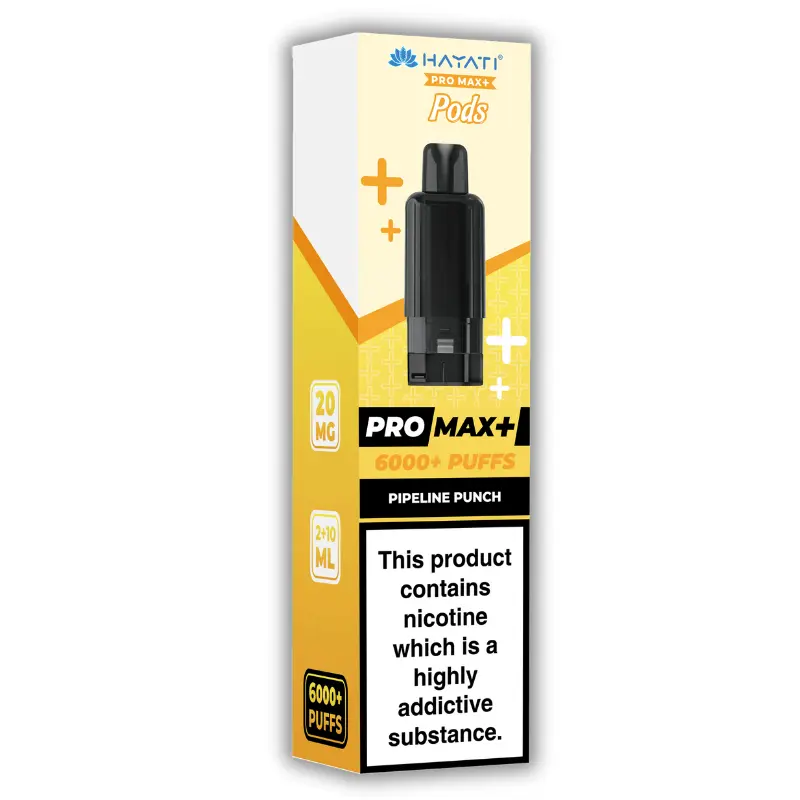
Hayati · Pro Max Plus
Pipeline Punch Hayati Pro Max Plus Pods
£5.49
✔ In stock — ready to ship
Genuine Hayati
Free over £20
Same-day dispatch
Secure checkout
One prefilled pod, £5.49, twelve millilitres of 20mg nicotine salt sealed at the factory and posted with no hardware around it. If you already own a Hayati Pro Max Plus, that is the whole of the transaction and you could stop reading here. The rest of this page exists because Pipeline Punch is a strange liquid to keep rebuying, and the strangeness has nothing to do with how it tastes. It is about how the pod tells you it is finished.
Here is the argument in one paragraph, so you can decide whether the rest is worth your time. On nearly every pod on this shelf, the moment to retire it announces itself as a subtraction. The fruit printed on the front stops arriving, you know which fruit you were listening for, and the absence registers. Pipeline Punch has no fruit printed on the front. Neither of its two listings names one, the catalogue's own filing system could not put it on a fruit shelf, and its description states outright that nothing in the blend takes the lead. A liquid with no named note has no named note to lose, so the usual signal is not available to you at all. What happens instead runs the other way. The lightest aromatic material in any blend is the first thing a tiring pod stops lifting, so the mix collapses towards whatever is heaviest and most stable in it, and one component starts to stand clear of the others. The tell that this pod is spent is that you can suddenly name a fruit in it. On a named liquid, that would be the sound of everything working.
That inversion is the spine of this page, and it is a cadence argument rather than a flavour one: when to open the next pod, what to listen for, and how not to be fooled. There is a flavour section too, and an unusually careful one, because no page anywhere on this site has yet described this liquid and the job therefore falls here. What you will not find is a long account of the device. Eighty-nine pods share this hardware and everything worth saying about it has been said on other pages. You will get the two specifications that bear on cadence and a link to the shelf for the rest.
Two listings, one liquid, and what they agree on
Hayati sell most of their flavours several times over, across formats and platforms, and they commission fresh copy for each listing. Lining those descriptions up against one another is the most reliable evidence this catalogue offers about a sealed liquid nobody outside the factory has analysed, because agreement across independently written descriptions is worth far more than one confident sentence. On a well-travelled flavour that gives you seven or eight documents to compare.
Pipeline Punch gives you two. Across all 492 listings, the word punch appears in exactly two titles, and they are this pod at £5.49 and the Pipeline Punch Hayati Pro Max Plus Pod Kit at £7.99, which is the same liquid with a device in the box. So the technique yields a pair rather than a set, and a pair can only ever tell you whether two writers were briefed the same way.
Before treating two listings as scarcity, it is worth checking what normal looks like on this shelf, because a claim of rarity that nobody counts is how pages end up misleading people. Taking each of the 89 products on the Hayati Pro Max Plus Pods shelf and counting how many listings in the full 492 carry the same flavour, two is not unusual. It is the single most common answer. Thirty-six of the 89 have exactly two listings, 22 have three, and only four have one, and those four are not flavours at all but the strength variants filed under the range name rather than under a recipe. At the other end, seven flavours appear eleven times each. So a two-listing flavour is the modal case here, not an outlier, and anyone telling you Pipeline Punch is thinly stocked has counted nothing.
What the pair does agree on is easy to set out, because they agree on almost everything. Both say the blend contains several fruits. Both say it is sweet and tangy. Both attach a slight tartness to it and say that tartness keeps the draw lively. Both call it smooth, both call it bright, and both reach for the word energy. Most importantly for this page, both state explicitly that nothing in the mix leads: the pod listing says there is no single fruit stealing the spotlight, and the kit listing says no single fruit takes the lead. Neither of them names a fruit. Not one, in either document, in any sentence.
Agreement is worth less when it is built from house vocabulary
An honest reading has to weigh those agreements rather than just count them, and most of them turn out to be very cheap. Bright appears in 213 of the 492 listings. Blend appears in 232. Juicy is in 162, tangy in 145, rounded in 101, lively in 72. A word that describes nearly half the catalogue cannot discriminate between two pods on it, and its presence on this one tells you close to nothing about what is inside. Tartness, at 38 listings, and bold, at 37, are only a little more informative. The pair agree, then, but they mostly agree in the catalogue's default register.
Two words survive that test. Crowd-pleasing appears on exactly one listing out of 492 and it is this pod. That is the sort of frequency worth stopping at, in the same way that a word used once in a catalogue of this size is either a deliberate choice or an accident of drafting, and there is no way from outside to tell which. The second is energy, and it needs narrowing rather than repeating. Five listings contain the string, but two of those are Vimbull Ice bottles using the compound energy drink, which is a flavour reference and a completely different word doing a completely different job. Set those aside and energy as a description of a liquid's character appears three times in 492: both Pipeline Punch listings, and a Fizzy Cherry listing where it sits directly beside a reference to carbonation. Three instances is a thin basis for a theory and I am not going to build one on it. It is worth knowing, as a hint and not as evidence, that when this catalogue reaches for energy it has twice been reaching towards fizz.
The one place the pair pull apart
Two listings that agree on eight properties and differ on one make the difference interesting, and here it concerns how assertive the blend is meant to be. The pod copy opens by calling it a bold, fruity blend and closes by calling it an all-rounder. The kit copy never uses bold, describes the mix as smooth and rounded, calls it generous, and finishes by saying it does not demand much thought. Bold and undemanding are not contradictory, but they are pulling in opposite directions, and if you were choosing on the strength of the copy alone you would form two different expectations depending on which page you landed on.
The right conclusion is not that there are two recipes. There is one liquid and two commissioned descriptions of it, and this catalogue has caught the same pattern before, where a split between listings fell exactly along a platform line and turned out to be evidence about which writer had the brief rather than about what was in the pod. Treat this the same way. The pair agree on the shape and diverge on the adjective for its volume, which is the part of a description most exposed to a copywriter's taste.
The filing system agrees with the copy, which is the part worth noticing
Descriptions are written by people who may never have tasted the product. The category structure is a different kind of evidence, because somebody had to decide where the listing goes, and a filing decision is harder to fudge than an adjective.
Pipeline Punch carries one tag: its own name. On a shelf of 89, only two listings have a single tag, and the other is Fruit Twist. The normal count is three or four, with 27 listings on three tags and 28 on four, and seven listings carrying six. Tags on this catalogue are mostly fruit names, so a listing with one tag is a listing whose fruits nobody could identify.
The same thing shows up in the shelves. Four of the 89 sit on no flavour category whatsoever: this pod, Fruit Twist, Smooth Tobacco, and the plain 20mg listing filed under the range name. The last two have obvious explanations, since there is no tobacco shelf to put one on and the strength listings are filed by strength. That leaves two pods that are unambiguously fruit and have no fruit shelf to go on, and Pipeline Punch is one of them.
Compare that with the near neighbours that also decline to name their ingredients. Caribb Crush names no fruit either, but its copy specifies tropical and it is filed on the exotic shelf, so the family is fixed even if the members are not. Mad Blue puts blue in the title, which in this catalogue points hard at the blue raspberry and blueberry family, and it is tagged accordingly. Black Mamba gives you a direction rather than a family, dark and intense, and is still filed on two flavour shelves. Every mood-named pod on this shelf hands you something: a colour, a temperature, a time of day, a direction of travel.
Pipeline Punch hands you a style of drink and a denial. Of the three listings on the 89 that state outright that no single element leads, one names both its fruits and one names its family. This is the only one that names neither. That is not a marketing failure and it is not a gap to be papered over. It is the defining property of the product, and the whole cadence argument below follows from it.
What the blend is, and where the listing stops
No page on this site has described this liquid, so the flavour work is done here rather than cited. I am going to be careful about the boundary between what the two listings assert, what a punch construction conventionally contains, and what I am inferring, because a page that states an inference in the same voice it uses for the price has told you something false.
The shape both listings describe
Strip the adjectives back to structural claims and the pair tell you five things. The liquid contains more than two fruits. None of them is dominant. The overall register is sweet. There is an acid component, described as slight rather than sharp, and it sits in a position where it affects the whole draw rather than punctuating it. And the texture is smooth, which in this catalogue is usually doing the work of saying that no element has a hard edge on it.
Those five combine into something quite specific, whatever the fruits turn out to be. A blend of three or more fruits with no leader is not a layered flavour. Layering requires a foreground and a background, and something to move between them, which is exactly what Blackcurrant Mango is built on, where the dark berry arrives first and the tropical fruit displaces it. Take the hierarchy away and you do not get a subtler version of that. You get a single compound impression that arrives whole.
The practical consequence is that a draw on this pod should have very little internal movement. On Cherry Sour Raspberry the sourness lands first and gives way to fruit, so the draw has an arc you can describe. On Mango Peach Pineapple the pineapple supplies the sparkle at the top and the other two fill in a honeyed body beneath it, which is a foreground and a background even though all three are named. If the two Pipeline Punch listings are accurate, this pod does neither. It should open at more or less the intensity it closes at, with the tartness present throughout as a thin line under the sweetness rather than as an event at either end.
That is a flavour architecture with real consequences for how you use it, and they are not all favourable. A draw with no internal movement is undemanding, which is the quality the kit listing puts its finger on. It is also the kind of flavour a palate stops registering quickly, because attention is drawn by change and there is not much change here. Expect it to recede into the background of a long session faster than a pod with a landmark in it.
What a punch conventionally contains, and why I am not going to state it
Punch, as a drink, has a conventional build, and the temptation is to read that build straight into the pod. The temptation should be resisted, and it is worth being explicit about why.
The conventional punch is a citrus base, one or two red fruits, and something tropical, sweetened and served long. If Hayati had formulated to that template you would expect orange or pineapple carrying the acid, strawberry or raspberry or cherry supplying the body, and mango or passion fruit doing the aromatic work at the top. That is a plausible reading. It is also entirely reconstructed from the word on the label, and this catalogue has a documented history of writers reasoning from a product name to a physical property and then stating the result in the same tone they use for the volume. The sensible discipline is to name the inference as an inference and stop.
So: if the blend follows the conventional build, the components above are the likely candidates. Hayati confirm none of them. They do not name a single fruit in either listing, they have declined to file the pod under any fruit shelf, and they have tagged it with nothing but its own name. There are three separate places in their own data where a fruit could have been recorded and it is absent from all three. The honest position is that the identity of the fruits is unknown from the listing, that the shape of the blend is reasonably well established, and that the two facts are worth keeping in different columns.
The less flattering reading deserves an airing too. A range this size runs out of distinct fruit combinations, and a blend that could not be given a descriptive name because it does not resolve into one is a blend that gets a style name instead. Both readings, the deliberate and the residual, produce the same product and the same buying decision. Neither of them is knowable from outside.
A method for characterising it on your own first pod
Since nobody can tell you what is in it, here is how to find out for yourself, and the method matters more than usual because the answer also gives you the baseline the cadence argument needs.
Do it in the first two days, before the pod has aged at all, and do it on a palate that has not had anything else on it for an hour. Take three or four draws and then, rather than asking what it tastes like, ask a narrower question: if you had to guess two fruits, which two, and how confident are you. Write the answer down. The writing down is not fussiness. The entire argument of the last third of this page depends on you having a record of what the blend was like when it could not be resolved, because the change you are watching for is a change in resolvability, and memory is very bad at that.
Then run three specific checks. First, sweep the draw for a citrus edge, which is the easiest single component to detect in a blend because its acid is structurally unlike anything a red fruit contributes. Second, check whether the tartness sits at the front, the middle or the close, because that position is stable in a fresh pod and it moves as the pod ages. Third, exhale through the nose once and note whether anything aromatic and high, in the mango or passion fruit register, arrives that did not arrive in the mouth. Those three readings take five minutes and they give you a baseline in a form you can compare against later, which is worth considerably more than an adjective.
What it is not
Four things this pod is not, all of them checkable from the listings rather than guessed.
It is not cooled. Neither listing mentions ice, frozen, menthol, mint or any other cooling term, and 32 of the 89 pods on the shelf do mention one, so the silence is a genuine signal rather than an omission. The census of Hayati's cooling vocabulary was done properly on the Blue Frozen pods page, which established that the terms are not graded into a scale and that no listing ever mixes an ice-family word with a mint-family word. That finding is theirs and I am citing rather than recounting it. What matters here is only the negative: nothing cold has been declared, so plan for a warm fruit flavour. If cold is what you are after, Double Menthol is the far end of that axis and Blackberry Ice is a fruit-led version of it.
It is not sour. The acid is described as slight and as a tartness, which in this catalogue's register is a different quantity from the mouth-watering sourness that Cherry Sour Raspberry opens with. Anyone buying this expecting a sour pod will find the acid far too polite.
It is not a confectionery flavour. Nothing in either listing points at candy, sherbet, bubblegum or cola. The sweetness is described as fruit sweetness with a tart line under it, which puts it a good way from the deliberately sugared register of Blue Razz GB.
And it is not a single fruit with supporting cast. That is the distinction that separates it from most of the shelf and it is worth stating plainly, because Blackcurrant Juice and Double Apple both read, in their own copy, as one fruit examined closely, and this reads as several fruits deliberately prevented from separating.
Replacement cadence: the signal runs backwards on this pod
Everything above is groundwork for this. You own the device, you have settled on the flavour, and the only live question on a repeat purchase is when to open the next one. That question has a standard answer across this catalogue and the standard answer does not work here.
How retirement normally announces itself
A prefilled pod does not fail. It declines, and the decline has a physical shape that is the same on every pod in the range. Aromatic compounds differ in weight and volatility. The light ones, which are typically the ones carrying a fruit's identity rather than its sweetness, are held least securely and lifted least readily by an element that has accumulated residue. They go first. The heavy material, the sugars and the base notes, goes last. So a pod does not fade evenly. It loses its top and keeps its bottom, and what you are left with is disproportionately the dull part.
That mechanism was established on the citrus pages of this site, and most thoroughly on the Lemon Lime Hayati Rubik Prefilled Pod Kit page, which set out why lime, sitting at the close of a draw and carried by the lightest material in the recipe, is the first thing a tiring pod stops delivering. That page also works out the arithmetic of acting on the signal, what the discarded liquid costs and how the sums differ across platforms, and none of that is repeated here. The physical premise is the only thing I need from it and it is theirs, not mine.
On a named liquid the consequence is a clean diagnostic. The fruit on the label is usually the light component, because the light component is the one that gives the liquid its identity and therefore its name. When it stops arriving, the pod has announced itself. Blackberry Raspberry without its raspberry brightness is a heavier, flatter blackberry and you notice. Berry Lemonade without its citrus lift is a berry pod with nothing lifting it. Fizzy Cherry without its sparkle is a cherry pod, and the name has told you exactly which property to audit. In each case the name is the test, and the test is a subtraction: is the thing on the label still there.
Why that test is unavailable here
Run the same test on Pipeline Punch and it returns nothing. There is no name to audit. You cannot ask whether the punch has stopped arriving, because punch is not a component, it is the word for an arrangement of components you have never been told the identity of. You cannot ask whether the tartness has gone, because tartness is a quantity and quantities are exactly what a palate cannot hold in memory across three weeks. Ask yourself now to recall precisely how tart something was a fortnight ago and you will find there is nothing there to recall.
This is the mirror image of an argument that already exists on this site, and it is worth being precise about the relationship because mirrors are easy to mistake for repetitions. The best-argued page in this corpus on a liquid with no landmark in it, the Juicy Peach Hayati Rubik Prefilled Pod Kit, makes the case that a smooth gradient cannot report its own decline: a flavour that is one continuous build with no landmark in it can lose any proportion of itself without ever reaching a point where it stops being a plausible version of what you bought, so every stage of the decline still tastes like a peach and the liquid gets worse without ever telling you. That argument is theirs and it is correct.
The position here is the same problem approached from the opposite side, and it resolves differently. Juicy Peach is a single fruit with no landmark, so its decline hides inside the fruit. Pipeline Punch has no single fruit and no landmark either, but it has something Juicy Peach does not: multiple components with different weights, held in a balance that is itself the product. On a single-fruit gradient, the decline removes intensity and leaves the identity intact. On a multi-fruit blend with no leader, the decline removes the lightest components and the identity changes, because the identity was the balance. The decline does not hide in the flavour. It manufactures a landmark that was not there before.
The inverted tell
Which gives you a diagnostic that works, and it is the reverse of the one you use everywhere else on this shelf.
A fresh Pipeline Punch pod should be unresolvable. You should not be able to pick out a fruit and name it with confidence, because the whole construction is designed to prevent that and both listings say so. As the pod wears, the light top material thins out first, the components that were holding each other in balance stop doing so, and whatever is heaviest and most stable in the blend is left standing on its own. At that point you will be able to name it. Most likely it will be a red fruit or a generic sweetness, because those are the heaviest things a punch construction contains, but the identity does not matter. The event matters.
So the retirement test on this pod is one question, and it is a yes or no rather than a magnitude: can I name a fruit in this. If you can, it is finished. Not fading, not past its best, finished, because the property you bought was the absence of a nameable fruit and that property has now gone. What is in your hand is no longer a version of the product. It is a different and considerably worse product that the catalogue does not sell.
Two things make that a better diagnostic than the one most pods offer. It is categorical rather than continuous, so it does not require you to remember an intensity, and a yes or no survives a tired palate and a bad day in a way that a comparison of magnitudes does not. And it is an appearance rather than a disappearance, which is easier to detect, because attention is built to notice things arriving and is poor at noticing things that have quietly stopped. On this one narrow point the buyer of an unnamed blend is better served than the buyer of a named one.
The misreading to guard against
There is a trap in it, and it is the reason this section is worth its length. A fruit emerging from a blend feels like an improvement. It reads as the pod finally opening up, as the flavour resolving, as the thing you have been half-tasting for a fortnight coming into focus. Everything about the experience is pleasant. On any other pod in the range that impression would be trustworthy, because on any other pod a component becoming more legible means the liquid is delivering.
Here it means the opposite, and it means it precisely because the impression is pleasant. The blend has not resolved. It has lost the material that was preventing resolution. You are not hearing a fruit arrive, you are hearing everything else leave, and the reason it sounds like arrival is that a subtraction from a balanced mix presents itself as an addition to whatever survives. If you find yourself thinking that this pod has finally started to make sense, that is the signal, and the correct response is to open the next one.
Three false positives, and how to rule each one out
A diagnostic this sensitive will fire when nothing is wrong, so it needs controls. Three things can make a fruit appear in a blend that has not aged at all.
A worked palate is the first and the most common. Anything sour, sweet or cold taken in the preceding half hour will suppress part of the blend and let another part through, and the result is indistinguishable from the real signal. Run the test on a neutral palate, first thing or well after eating, and never straight after a cooled pod.
Draw length is the second, and it is the only variable on this hardware you control directly. A long, slow draw pulls more of the heavy material through and a short one favours the top notes, so changing your draw changes the balance of a blend far more than it changes the intensity of a single fruit. If a fruit has appeared, take three draws at your normal length and three deliberately shorter. If the shorter ones put the mix back together, your draw has drifted and the pod is fine.
Temperature is the third. A pod that has been in a cold room or a car overnight will read differently for the first few draws, with the aromatic top suppressed until the liquid warms, and that is exactly the profile of a worn pod. Give it ten minutes indoors before you trust a reading taken on a cold morning.
Run all three controls and if the fruit is still there, it is real. Two consecutive days of a confirmed positive is a sound rule, and it costs you almost nothing to wait the extra day.
A cadence you can actually run
Turning all of that into practice takes four steps and none of them involves counting anything.
Write down your first-week impression, in the terms set out earlier: which two fruits you would guess, and how confident you are. A note on your phone is enough. This is the only step people skip and it is the one that makes the rest work, because the test compares against the baseline rather than against yesterday.
Check weekly rather than daily. A daily check gives you a reading dominated by your own state, since the day-to-day variation in a palate is larger than the day-to-day change in a pod. A weekly check on a neutral palate compares two points far enough apart for the real change to exceed the noise.
Buy in pairs rather than singly. This is not an economic argument, and the economics of stocking refills are worked out elsewhere on this site, on the Grape GB pod page and on the Blue Razz GB Rubik pod page, so none of that is rehearsed here. It is a diagnostic one. The moment you are unsure whether the fruit you are hearing is real, the fastest way to settle it is to open a fresh pod and take three draws, and you can only do that if a fresh pod is in the house. A second pod is your reference standard, and on a flavour with no named note it is the only reference standard available.
And accept that the pod will go before it is empty. A liquid whose defining property is a balance loses that property while there is still liquid in it, and that is a structural feature of unnamed blends rather than a fault in this one. If the thought of retiring a pod with liquid left in it bothers you, a single-fruit pod is the better purchase, because a single fruit is still itself at the bottom of the reservoir. Blackcurrant Juice is the clearest example of that on this shelf.
The pod itself, briefly
Eighty-nine pods share this hardware and nine pages have already worked through its behaviour in detail, so this section stays short and points you at the shelf for the rest.
What arrives is one sealed pod and nothing else. No device, no cable, no spare anything. The pod comes filled with twelve millilitres at 20mg and is intended to be used and replaced rather than opened, so treat the liquid in it as the whole of what you have bought. Check that your device is a Pro Max Plus before ordering, because cross-range fitment is not something to settle from a retail listing.
The one specification that bears on the argument above is the twelve millilitres, and it bears on it more than it would on most pods. Twelve millilitres is a lot of liquid to put behind one element, which is why the puff figure attached to it is what it is, and it means the element spends a long working life in contact with a sweetened blend. On a named liquid that long life is mostly a convenience. On a blend whose identity is a balance between several components, it means the window in which the pod is actually the product you bought is a fraction of the window in which it still contains liquid. The capacity that makes this format convenient is the same capacity that makes the cadence question worth thinking about at all.
Everything else about the device, including how it behaves as the cell ages, how condensate moves through the airflow path, how a pod seats, and what to do with the hardware at the end of its life, is covered across the Hayati Pro Max Plus Pods shelf and the wider Hayati Pods range. There is no point in a tenth account of it here.
Specification, and what each line means for cadence
The table below includes two rows most product pages leave out, the tag count and the flavour shelf, because on this particular pod they are not filing trivia. They are the evidence that the blend resolves into no identifiable fruit, and that is the fact the whole page turns on.
| What you receive | One prefilled pod. No device, no accessories. |
| Liquid volume | 12ml, sealed at the factory |
| Nicotine strength | 20mg/ml |
| Nicotine form | Nicotine salt. This is the standard preparation for a prefilled pod at this strength, though the listing itself does not specify it. |
| Price | £5.49 |
| Manufacturer puff figure | Rated by the manufacturer at up to 6,000 puffs per pod. A laboratory estimate. |
| Flavour shelf | None. Hayati file this pod under no fruit or flavour category. |
| Catalogue tags | One, and it is the product's own name. |
| Cooling declared | None in either listing |
| Device required | Hayati Pro Max Plus |
| Designed to be refilled | No. The pod is supplied filled and replaced as a unit. |
| Other listing of this liquid | Pipeline Punch Hayati Pro Max Plus Pod Kit, £7.99, the same pod with a device |
Three of those lines deserve a sentence each. The 20mg is the ceiling permitted for nicotine-containing e-liquid sold in the United Kingdom, so it is not a position on a scale that continues upwards, and if it is more than you want the same liquid is not offered lower. What is offered lower is a different flavour: the 10mg pod and the zero nicotine pod are both Banana Ice, filed under the range name rather than under a flavour, which is why they turn up in searches that look as though they should return a strength choice for whatever you were reading about. They are not a Pipeline Punch variant and there is no Pipeline Punch variant.
The puff figure is a bench measurement taken on test apparatus running a fixed draw pattern, and its only honest use is comparing one pod size against another. It is not a forecast of your fortnight, and on this pod in particular it is doubly beside the point, because the argument above says you should be retiring it on a flavour signal rather than on exhaustion. Whatever the figure is, the number that matters to you is smaller.
The nicotine form row is worth reading carefully. Hayati do not print the preparation on this listing, and the corpus states it anyway because a 20mg freebase liquid in a sealed low-power pod would be close to unusable and salt is what this format uses. The row says both things so that you are not left inferring one from the other.
Where it sits against its neighbours
All 89 pods on this shelf cost £5.49, so the decision between them is entirely about what is in them and never about money. That makes the comparison genuinely useful rather than a formality, and it also means the only cost of getting it wrong is the pod.
The two pods it is closest to
Fruit Twist is the nearest thing on the shelf and it is not linked here only because it sits outside this page's list, so look for it on the shelf by name. It is the other single-tag listing, it is another several-fruit blend with no fruit named, and the two descriptions are close to interchangeable in their first half. The difference is in the second half and it is exactly the difference this page cares about. Fruit Twist's copy says a sharper note twists through the mix. That is a declared landmark, a component deliberately allowed to stand out, and it changes the pod's whole character as a purchase: it has a named property to lose, so the standard retirement test works on it and the inverted one does not. Pipeline Punch is the one with nothing designated to stand out.
Caribb Crush is the second, and it is a family-restricted version of the same idea. Several fruits, none of them named, none of them headlining, but the copy commits to tropical and the listing is filed as exotic, so you know roughly which cupboard the components came from even though you do not know which ones. If you want an unnamed blend but would rather not be entirely in the dark, that is the one. If the open-endedness is the appeal, this pod goes further.
Blends that keep their hierarchy
Mango Peach Pineapple is the control case and the best single comparison on the shelf. Three fruits, all named, with a declared structure in which the pineapple supplies the top and the other two build a body underneath. Everything Pipeline Punch withholds, that pod publishes. It is also the pod to buy if the cadence argument here strikes you as more trouble than it is worth, because a named three-fruit blend gives you three separate properties to audit and any one of them going missing tells you the same thing.
Grape Berry is the halfway house: a named base with an unnamed supporting mix layered over it. The grape is your landmark and the berries are the part you cannot resolve, which means the standard test works on the base while the top behaves the way this pod's whole blend behaves. Anyone curious about the argument on this page without wanting to commit to it entirely could sensibly start there.
Blue Razz Fruit Twist inverts the proportions again, putting the named component in the lead and the mixed fruit behind it as a softener. Its own copy says the blue raspberry lands at the start of the draw and the twist of mixed fruit rounds it out, which is a foreground and a background stated plainly. Blue Fusion does something similar within a single fruit family.
Landmarks that are not fruit
Three pods on the shelf give you something to audit that is not a fruit at all, and they are useful comparisons because they show how many forms a landmark can take. Fizzy Cherry uses an effervescent tingle, which is a physical sensation rather than a flavour and is therefore very hard to mistake for anything else. Berry Lemonade and Blue Razz Lemonade both use a citrus lift over a sweet base, which is an acid rather than a fruit note and is the single most reliable thing to monitor on a fading pod. If the argument on this page has persuaded you that you want a legible signal above all else, those three are where the signal is loudest.
Single fruits, examined closely
Blackcurrant Juice and Double Apple are at the far pole from this pod. Both are one fruit looked at in detail, the first as a sweetened juice-style profile and the second as two apples of different ripeness layered together. Their virtue on a long pod is that they degrade into quieter versions of themselves rather than into something else, so there is no point at which they stop being the product. That is precisely the property the Juicy Peach page identifies as a problem for anyone trying to notice a decline, and precisely the property that makes them undemanding to own. Both readings are correct and which one applies depends on whether you would rather be told or left alone.
Cooled pods, for contrast
Thirty-two of the 89 declare some form of cooling and this is not one of them, which matters more than it sounds because a coolant does something to the cadence question. Cooling is a trigeminal sensation rather than a flavour and it persists long after the aromatic material has thinned, so a cooled pod keeps feeling like something after it has stopped tasting like much. Banana Ice and Blackberry Ice both pair a fruit with a chill, and Double Menthol is cooling with essentially nothing else in it. The chill masks the decline, which is comfortable and unhelpful in equal measure. An uncooled blend has nowhere to hide, and that is one of the few respects in which this pod makes the buyer's job easier.
The rest of the range
If none of the above fits, the full Hayati Prefilled Pods and Refills listing runs to 201 products across every platform Hayati make, and the complete catalogue at all Hayati products comes to 492. Recent additions are gathered under New Products.
Handling, storage and knowing when to stop
Practical notes, anchored to this pod rather than to pods in general, because generic advice about priming and chain-vaping is available on every page on this site and is worth nothing extra here.
Give a new pod two or three minutes seated in the device before the first draw. On a blend with no leader this matters slightly more than usual, because an element that is not yet fully wetted delivers an unrepresentative balance, and an unrepresentative balance is exactly what you are trying to record as your baseline. A reading taken in the first minute will be wrong in the direction that makes the pod look worn.
Take the first several draws gently and at your normal length. Consistency of draw is not a general courtesy on this pod, it is a measurement requirement: since your diagnostic is a change in the balance of components, and draw length changes that balance, an inconsistent draw destroys the instrument you are relying on. Pick a draw and keep it.
Sweetened liquids leave residue behind on an element over time, and that residue is the mechanism behind everything described in the cadence section above. Nothing you can do will prevent it on a sealed pod, since there is nothing to clean and nothing to replace. What you can do is avoid accelerating it, which mostly means not running long unbroken chains of draws, because heat is what turns residue into a hard deposit.
Store spares upright, away from sunlight and away from heat, and somewhere children and pets cannot get at them. Heat is the relevant enemy for this particular liquid rather than light, because the light aromatic material that makes this blend unresolvable is the first thing a warm cupboard drives off, and a pod that has spent a summer in a car boot can arrive already halfway through the process this page describes. A cool drawer is enough.
A part-used pod keeps reasonably well for a few weeks if you have swapped away from it, but with one caveat specific to this flavour. What you take out of the drawer will not be what you put in it, because the balance shifts in storage in the same direction it shifts in use. Re-run the naming test before you trust it, and treat a stored pod as further through its life than the liquid level suggests.
When you are finished with it, a spent pod is not household waste. It contains an electrical element and a residue of liquid, so it belongs at a shop take-back point or a council collection that accepts small electricals. Most vape retailers, this one included, are obliged to take them.
Questions buyers actually ask
Is there a device in this listing?
No. This is the pod on its own at £5.49, intended for someone who already owns a Hayati Pro Max Plus. If you need the device as well, the Pipeline Punch Hayati Pro Max Plus Pod Kit at £7.99 is the same pod supplied with one.
Which fruits are actually in it?
Hayati do not say, in either of the two listings, and they have not filed the pod under any fruit category or tagged it with anything but its own name. A conventional punch build would suggest citrus, red fruit and something tropical, but that is reconstructed from the word on the label rather than confirmed by anything, and this page is not going to state it as fact. The shape of the blend is well established. The membership is not.
Does it have any cooling in it?
Neither listing mentions ice, frozen, menthol or mint, and 32 of the 89 pods on this shelf do mention one of those, so the silence is meaningful rather than an oversight. Plan for a warm fruit flavour with no chill.
How do I know when the pod is finished?
On this one the test is inverted. A fresh pod should be unresolvable, with no fruit you can confidently name. When one fruit starts to stand clear of the others, the light material that was holding the blend together has gone and the pod is done. Check it on a neutral palate, at your usual draw length, on two consecutive days before acting.
It seems to be tasting clearer than it did. Is that good?
No, and it is the specific trap this pod sets. A component becoming legible in a blend that was designed to prevent legibility means the rest of the blend has thinned, not that the flavour has come into focus. The impression is pleasant and the reading is the opposite of what it feels like.
Can I refill the pod when the liquid runs out?
It is not built for it. The pod arrives filled and is meant to be replaced as a unit, and since the element inside it is the part that degrades, topping it up would leave you with fresh liquid on a tired element, which is the wrong half of the problem solved.
How is it different from Fruit Twist?
They are the two single-tag listings on the shelf and their descriptions overlap heavily, but Fruit Twist declares a sharper note running through the mix and this one declares that nothing stands out at all. That one difference decides how you own them: Fruit Twist has a property you can audit as it fades, and this pod does not.
Is the kit worth the extra £2.50?
Only if you need a device. The difference between the two listings is the hardware and nothing else, since the pod inside the kit is the same twelve millilitres of the same liquid. Anyone who already has a Pro Max Plus in a drawer is buying a second body for £2.50, which is a reasonable thing to want and a poor default.
What does the 6,000 figure mean in practice?
It is a manufacturer's laboratory estimate, produced on bench equipment drawing to a fixed schedule, and its useful function is ranking pod capacities against each other. It is not a prediction of how long yours will last. On this pod it matters even less than usual, because the argument above says you should retire it on a flavour signal that arrives well before the liquid does.
Is there a lower-strength version of this flavour?
No. Pipeline Punch exists at 20mg only. The 10mg and zero nicotine pods on this shelf are Banana Ice filed under the range name, which is why they surface in searches that look as though they ought to return a strength option for whatever you were reading.
How should I store a spare?
Upright, cool, dark, and out of the way. Heat is the specific risk for this liquid, because the light aromatic material that keeps the blend unresolvable is the first thing warmth drives off, so a spare that has been somewhere hot may arrive already partway through the decline described above.
Why does this pod have no flavour category?
Because nothing in it could be assigned to one. Four of the 89 pods on this shelf have no flavour shelf: this one, Fruit Twist, Smooth Tobacco, and the plain strength listing. The last two have structural explanations, which leaves two fruit pods that the catalogue's own filing system could not place, and that absence is the most reliable evidence available that the blend genuinely does not resolve into a nameable fruit.
The short version
A twelve millilitre replacement pod at £5.49 for a device you already own, filled with 20mg nicotine salt, carrying a sweet several-fruit blend with a thin line of tartness through it and no cooling. Hayati name none of the fruits, in either of the two listings that exist for this liquid, and they have filed it under no flavour shelf and tagged it with nothing but its own name. That is unusual on a shelf of 89, where only one other pod is in the same position, and it is the most useful thing anyone can tell you about the product.
It matters because it changes how you own it. The ordinary way to know a pod is spent is to notice that the fruit on the label has stopped arriving, and there is no fruit on this label. The signal runs backwards instead: as the lightest material thins, the blend collapses towards whatever is heaviest in it, and a single fruit becomes nameable. That is the end of the product, not the arrival of it, and the feeling that the pod has finally come into focus is the thing to act on rather than enjoy. Buy in pairs so you have a fresh one to check against, note down what the blend was like in its first week, and retire it on the naming test rather than on the liquid level. If none of that appeals, a named blend will tell you what you need to know without any of the bookkeeping, and there are eighty-eight of them on the same shelf at the same price.
Strictly for adults aged 18 and over. Nicotine is an addictive substance.
You might also like


