
Home / Hayati Pro Max Plus Prefilled Pod Kit / Rocky Candy Orange Hayati Pro Max Plus 6000 Pod Kit
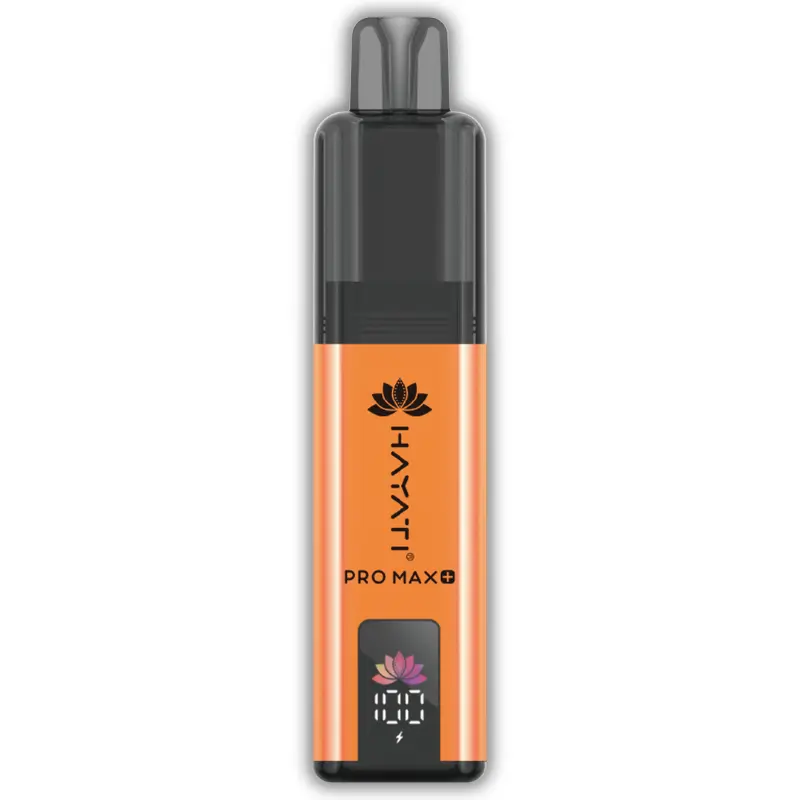
Hayati · Pro Max Plus
Rocky Candy Orange Hayati Pro Max Plus 6000 Pod Kit
£7.99
✔ In stock — ready to ship
Genuine Hayati
Free over £20
Same-day dispatch
Secure checkout
Rocky Candy Orange in kit form is £7.99 for a rechargeable Pro Max Plus body and a prefilled pod holding 12ml of liquid at 20mg nicotine salt, with an 850mAh cell inside the body and a manufacturer puff ceiling of 6,000 quoted on the listing. Those are the facts, they take one sentence, and they are identical to the facts on the eighty-seven other listings on the Hayati Pro Max Plus Prefilled Pod Kit shelf. What is not identical, and what this page is about at length, is the liquid: a single-fruit orange built in a confectionery register, which is a more unusual thing to find on a shelf of this size than the price tag suggests.
The bare pod version of this flavour already exists as a separate listing, and it did a specific job. Rocky Candy Orange Hayati Pro Max Plus Pods at £5.49 took apart the name rather than the liquid, and its finding was that "Rocky" announces hardness, which is the single sensory property an aerosol has no route whatsoever to deliver, so read as a promise about mouthfeel the label cannot come true. Its second finding is the one that matters here: read instead as a pointer to a register, the word is unusually informative, because a boiled sweet is cooked to hard crack and therefore has to be flavoured with robust, heat-stable materials, which makes confectionery orange the most vapour-compatible orange there is. That argument is settled and it will not be re-run below. This page starts where it stopped.
Because what that page deliberately did not do was tell you what the liquid tastes like. It marked several axes as probable, one as unknown, and it put the intensity question, which is the axis most likely to decide whether you buy a second one, squarely in the unknown column and left it there. So the flavour work is this page's job: what a confectionery orange accord is actually assembled from, why that assembly reads simpler and more even than the fruit it is named after, what order the parts of it reach you across a single draw, what happens to all of it over twelve millilitres as the coil starts to coat, and which buyer this is genuinely right for. There is one complication that shapes all of it, and it is worth flagging at the top. Orange appears in seven of Hayati's 492 titles. Four of those are the Orange Lemon Lime family. The other three are this flavour on three different platforms. Nowhere else in the range does orange stand on its own, which means that unlike a buyer choosing between four blue raspberries, you have nothing on the shelf to triangulate against.
What a confectionery orange is actually made of
Flavour is manufactured, and the kind of manufacturing determines the result more than the target fruit does. A flavour house asked for "orange" by a soft drink producer and a flavour house asked for "orange" by a sugar confectioner are solving two different engineering problems, and they hand back two materially different compositions. Understanding the confectioner's constraints tells you almost everything about how this pod will behave, so it is worth setting them out properly.
The confectioner is working with molten sugar. A hard sweet is a syrup of sucrose and glucose boiled past the hard crack stage, which sits well above the boiling point of water, then cooled quickly enough that it sets as a transparent amorphous solid rather than forming crystals. Flavour goes in near the end of that process, as late as the plant allows, but even so it meets a medium that is extremely hot, extremely viscous and chemically aggressive. Anything volatile and delicate is simply lost at that moment. The material that survives into the finished sweet is whatever was robust enough to sit in molten sugar and come out the other side.
The second constraint is shelf life. A wrapped sweet sits in a jar, a tin or a warehouse for months, and the sugar glass around the flavour is hygroscopic, meaning it draws moisture in from the air. Any component prone to oxidising will have oxidised long before the sweet is eaten. Citrus is the worst-affected family here, because the light terpene fraction that gives fresh peel its lift degrades readily in the presence of air, warmth and light. A confectioner who builds an orange out of that fraction alone produces a product that smells of cardboard by spring.
The third constraint is the medium it has to be heard through. Sucrose at that concentration contributes enormous perceived body. It coats the tongue, it is intensely sweet, and it masks. A subtle accord under all that sugar is not subtle, it is inaudible. So the flavour load has to punch through, which in practice means fewer components carried at higher impact rather than many components in careful balance.
Put those three together and the composition writes itself. Hayati publish no ingredient list for this pod and nothing below should be read as a statement about their particular recipe, but the general shape of a confectionery citrus accord is well understood and it looks like this. There is a terpene backbone, dominated by limonene, which reads as broad generic citrus and is cheap and loud, kept deliberately modest because it is the least durable part. There is a small load of aliphatic aldehydes, the octanal and decanal family, which are the actual identity markers that make a citrus read as orange rather than as lemon, and which are potent at vanishingly low concentrations. There is usually a sesquiterpene contribution, valencene being the familiar one, which sits deeper in the profile, is considerably more heat-stable than the top notes, and pulls the whole thing towards sweet orange rather than towards grapefruit or bergamot. There is an ester or two doing the work of making the aroma itself read as sweet before any sugar has touched the tongue. And, critically, there is a sugar-note material of the ethyl maltol and vanillin family, which is not a citrus component at all. It is the thing that makes an accord smell cooked, caramelised and confected.
That last item is the entire dividing line. A fresh orange accord and a candy orange accord can share most of their citrus materials and still land in completely different places, because one of them has a cooked-sugar note underneath and the other does not. That note is what your nose recognises as "sweet shop" before you have consciously identified the fruit, and it is almost certainly present in a liquid whose name has the word candy in it. It is also, usefully, one of the most heat-stable things in a flavourist's kit, which is part of why the register transfers to vapour so readily.
Why it reads simpler than the fruit
A real orange is chemically enormous. Analyses of orange essence routinely identify several hundred volatile compounds, and only a handful of them are present above their individual detection thresholds. The rest sit underneath, contributing not identifiable notes but something more like grain or roughness: a sense that what you are smelling is a physical object with a history rather than a construction. That undetectable majority is exactly what a compounded accord cannot reproduce and does not attempt.
Working from a dozen materials instead of hundreds has two consequences, and they pull in opposite directions. Each surviving component is unmasked, so it is more clearly perceptible, which the brain reads as clarity and intensity. But nothing is sitting behind anything else, so there is no depth of field. The result is a flavour with a sharp foreground and no background, which is precisely the impression a boiled orange sweet gives: instantly recognisable, very legible, and obviously not a fruit. Anyone who has eaten both knows the difference before they could explain it, and the explanation is component count.
This is also why confectionery flavours age well in the mouth of the person eating them, so to speak, and badly in the memory. They are easy to identify and hard to find anything new in. A complex flavour rewards attention on the fiftieth encounter. A simplified one has given you everything it has on the second.
Why it reads more symmetrical than the fruit
Simplification is about how many things are present. Symmetry is about when they arrive, and it is the more interesting of the two properties because it is imposed by manufacturing rather than chosen.
Eating a fresh orange is a sequence, and the sequence is a large part of the experience. Breaking the peel releases an oil spray that hits the nose before anything reaches the mouth. The flesh follows, with the juice arriving in irregular bursts as individual vesicles rupture, so acidity and sweetness pulse rather than hold steady. Chewing releases the membrane, which is where the faint bitterness lives. Swallow, and what stays behind is a slightly astringent, faintly soapy residue from the peel oil. Four distinct phases, in a fixed order, over perhaps thirty seconds.
A hard sweet cannot do any of that, because the flavour is dispersed evenly through a homogeneous glass. There is no skin, no interior and no structure to release things in an order. Dissolution proceeds from the outside inward at a roughly constant rate, so the concentration of flavour arriving at the tongue is roughly constant too. Whatever you tasted in the first thirty seconds is what you will taste in the last thirty. And the manufacturer wants it that way: a sweet that changed character halfway through would read as a fault rather than as complexity, because the object is being consumed slowly enough that the change would be obvious.
So the confectionery register is engineered flat in time, and that is the property that transfers most cleanly into a pod. The liquid in this one is a homogeneous solution being wicked to a coil at a roughly steady rate. There is no mechanism by which it could deliver phases in order even if the accord had been built with phases, and the accord has not been. What you get is the same composition on every draw, which is either the strongest argument for buying it or the strongest argument against, depending entirely on what you want out of a flavour.
The two things it structurally cannot have
Bitterness is the first. Every bitter element in an orange comes from parts a confectioner discards: the pith, the albedo, the membranes, the rind. Naringin and the related flavonoids that give marmalade its backbone are not in a boiled sweet and are not in a candy accord, because the whole point of the category is a flavour that a person can eat continuously for ten minutes without tiring of it, and bitterness is a brake. Their absence is worth naming because it is the fastest way to identify the register blind. If a liquid has any rind character at all, it is not aiming at a sweet.
Real acidity is the second, or at least real acidity at any meaningful level. Confectioners do add acid, usually citric or malic, and in a sour sweet they add a great deal of it. But in a plain boiled orange sweet the acid load is a seasoning rather than a structural element, present to stop the sugar reading as flat. It lifts the top of the flavour slightly and then gets out of the way. That matters in vapour because acidity is one of the few flavour properties that carries reasonably well in condensate, so a liquid built on a low-acid confectionery template will read notably rounder than one built on a lemonade or a juice template even when both are describing citrus.
The supporting evidence for a low acid load here is Hayati's own naming habit rather than anything they publish about the recipe. Twenty-one listings across the catalogue carry the word Sour in the title, reducible to about seven distinct flavour names, so the house labels sourness when sourness is a feature of the product. Its absence from this title is reasonable evidence rather than proof, and the confectionery reference points the same way. Treat it as probable, not certain.
How it should arrive across one draw
Translating a register into a description of an actual mouthful is the part of a product page most likely to shade into fiction, so it is worth being explicit about what kind of claim each part of this is. The composition arguments above are general flavour chemistry, and they are solid. What follows is inference from those arguments to the behaviour of an aerosol, and the confidence level drops accordingly. Nobody at this retailer has a gas chromatograph, and a tasting note presented as fact on a page like this one would be worth nothing.
The mechanism that drives the sequence is volatility. Materials in the liquid do not leave the wick at the same rate: the light, low-boiling fraction goes most readily, and the heavier, higher-boiling fraction requires more energy and arrives in proportionally lower quantity. That produces a predictable sorting, and on a citrus accord the sorting is unusually consequential because the spread between the lightest and the heaviest components is wide. A berry accord is more bunched, so it sorts less.
Reasonably confident: the inhale is the vaguer half. What reaches the mouth first is terpene-dominated, and terpenes on their own read as generic bright citrus without specifying which fruit. Alongside that there will be an immediate impression of sweetness, some of which is genuine sweetener depositing in condensate on the tongue and some of which is the aroma materials being read as sweet by association. So the front of the draw should be bright and sugary without being clearly orange yet. People who take one short pull and decide a citrus liquid is "just generically fruity" are usually reporting the inhale accurately and stopping too early.
Reasonably confident: the exhale is where it resolves. Warm air passing up behind the soft palate carries the aldehyde and sesquiterpene fraction to the olfactory epithelium, and those are the identity-bearing materials. This is where an orange becomes an orange rather than a citrus, and on a confectionery accord it is also where the cooked-sugar note becomes audible, because maltol-family materials sit in the same heavier fraction. Expect the peak of the whole experience to be roughly half a second into the exhale.
Probable: the finish is sugar with a fading zest, not zest with a fading sugar. This is the most useful single prediction on the page and it follows directly from the volatility sorting. Light citrus materials clear the mouth quickly. Heavy sweet ones linger. So the aftertaste of this liquid, thirty seconds after the exhale, should be a broad sweetness with an orange memory attached rather than a citrus brightness with sweetness behind it. Anyone who dislikes a residual sugary coating between draws will notice that about this liquid before they notice anything else.
Probable: little or no cooling. The title carries no temperature word, and the Blue Frozen pods page established by counting that Hayati's cooling vocabulary is not graded: Ice appears in ninety titles, Frozen in three, Cooler in two, and Chill and Freeze in none at all, with no listing ever mixing an ice word and a mint word. What that count establishes is that the house does use a marker when a liquid is cooled, so the absence of one here is meaningful. It is a convention rather than a declaration, though, and a small coolant load used to sharpen the citrus rather than to make the liquid cold would not necessarily earn a word in the name.
Worth knowing: draw length moves the balance. Because the sorting is driven by how much energy the wick receives, a longer draw pulls proportionally more of the heavy fraction and a short one skews light. On most liquids that is a marginal effect. On this one, where the heavy fraction is the sugar note and the light fraction is the zest, it is the difference between a sweeter mouthful and a brighter one, and it is under your control without touching the device. If the liquid seems cloying, shorten the pull before concluding the flavour is wrong for you.
The intensity question, which is the one that decides it
The pod page put intensity in the unknown column and it was right to, because nobody publishes a figure and there is no honest way to conjure one. But "unknown" is not the same as "nothing can be said", and three structural facts push in the same direction, so the reasoning is worth laying out even though the conclusion has to stay a probability.
The first is that the confectionery register is built loud by design. Everything in the manufacturing account above selects for high-impact materials, because that is what survives the sugar. An accord engineered to be heard through a boiled sweet has no reason to be quiet in a pod.
The second is that there is no second fruit to share the space with. Most listings on this shelf name two or three components, and a blend distributes the load: no single element has to carry the whole flavour, so no single element needs to be at full volume. A one-fruit liquid has nothing to hide behind, and the natural formulation response is to raise the level.
The third is the sweetener. A liquid marketed on a candy reference is not going to be under-sweetened, because the reference sets an expectation that a restrained sweetness would fail. Sweetener load is also the component most likely to be pushed high, because it is cheap and it reads as quality to a lot of buyers on the first draw.
Taken together, the probable answer is that this sits towards the loud end of its shelf rather than the middle. That is a reasoned expectation, not a measurement, and it comes with a caveat that cuts the other way: loud on draw one and loud on draw eight hundred are different things, because adaptation works fastest on exactly this kind of profile. Which brings us to the pod as a whole rather than the draw.
Twelve millilitres of one loud sweet thing
A 12ml pod is a long commitment to a single liquid, and three separate processes act on it over that run. They operate on different timescales and they compound, which is why the end of a pod rarely tastes like a smaller version of the beginning.
The coil coats. Sweetness in an e-liquid is not sugar, because sugar caramelises and carbonises on a hot wire rather than vaporising usefully. It comes from sweet-smelling aroma materials plus, in most sweet liquids, an intense sweetener. Those sweeteners do not fully volatilise. A fraction stays behind on the coil and the wick, darkens under repeated heating, and forms a layer that reduces how much of anything gets through. Hayati publish no ingredient list, so nothing here is a statement about what is in this particular pod, but sweet-forward liquids as a class behave this way and there is no reason to expect an exception. The practical shape of it is that flavour delivery declines gradually rather than failing suddenly, and that the decline is slow enough to adapt to without noticing.
What the coating takes first is the part you bought it for. A coating layer does not remove flavour evenly. It reduces transmission, and the components with the least headroom above their detection threshold are the ones that drop below it first. On a citrus accord those are the aldehydes, which are present at very low concentrations precisely because they are so potent. The sugar note, carried by heavier materials at much higher load, has a great deal more margin. So the failure mode of this liquid is specific and predictable: the orange identity thins out while the sweetness stays put, and what was a bright confectionery citrus turns into a vague sugary something. It will not taste unpleasant. It will taste anonymous, which is a harder thing to notice and an easier thing to keep using.
The liquid itself ages. This is the process most often left out, and on a citrus it matters more than on anything else. Aliphatic aldehydes oxidise. Exposed to warmth and to the small amount of air a pod is not perfectly sealed against, they convert over weeks towards the corresponding acids, and the sensory result is a loss of freshness and the emergence of a slightly waxy, faintly soapy character. This is the same chemistry that makes a bottle of orange oil smell wrong after a year on a warm shelf. A pod carried in a pocket for three weeks has been held near body temperature that whole time, which accelerates it. So the liquid at millilitre eleven is not the liquid at millilitre one even before the coil is taken into account, and the direction of change is away from bright and towards dull.
And your palate adapts. Sweet is the modality that habituates fastest and most thoroughly, and a simplified single-note profile gives adaptation the easiest possible target, because there is nothing else in the flavour for attention to move to. Complex blends resist this to a degree: you notice the raspberry one day and the blackcurrant the next. A liquid with one fruit and a sugar note has no such rotation built in. Three or four consecutive days of nothing else and most people will report that it has faded, when a large part of what has changed is the reader rather than the liquid.
Stack the three and the arc over a pod looks like this. The opening stretch, on a new coil with fresh liquid and an unadapted palate, is the loudest and brightest it will be, and it is the reading everything else should be judged against. Through the middle the proportions shift: relatively less zest, relatively more sugar, and the overall volume drops slightly. Towards the end the citrus marker is faint, the sweetness dominates, and the liquid reads flat. Some of that is coil, some is oxidation, some is you. Distinguishing them is not really possible in the moment, and it does not matter much, because the remedy is the same in each case: a new pod, or something else entirely for a few days.
One point specific to buying the kit rather than the pod alone. You are starting with an unused coil and an unused cell at the same moment, which is the cleanest possible baseline, and it is worth using deliberately. Whatever the first half-dozen draws give you is the reference reading for this flavour, and because there is no near neighbour in the range to calibrate against, that reading is the only reference you are ever going to have. A second pod bought later will be judged against it, and if that second pod seems weaker, the first question to ask is whether the coil in it is genuinely different or whether you are comparing a fresh pod against a memory formed on a fresh pod.
Who this is right for, and who should leave it alone
The register is narrow enough that the recommendation can be unusually precise, which is rare on a shelf where most listings are variations on sweet dark fruit.
It suits somebody whose rotation has collected too many berries. Forty-two of the eighty-eight listings on the Pro Max Plus kit shelf name a berry, a currant, a cherry or a grape, Blackberry Raspberry and Blue Razz Cherry among them, and those profiles share a great deal of their aroma chemistry, which is why a drawer of them blurs together faster than the individual names suggest. A citrus is the cheapest way to make the rest of a rotation legible again, and this one is further from the berry cluster than a lemonade is, because the lemonades on this shelf, Berry Lemonade included, carry berry names too.
It suits somebody who actively wants a flavour that does not develop. That is a real preference and it is usually treated as a deficiency. Some people want the liquid in their pocket to be exactly the same thing every time they reach for it, with no surprises and nothing to pay attention to. The confectionery register is engineered for precisely that, and it is more honest to call it a feature for that buyer than to pretend it is complexity.
It suits somebody who takes short, frequent draws rather than long ones, for the volatility reason set out above. Short pulls favour the bright end of this accord, and the bright end is the more interesting end.
It suits somebody buying a second flavour to sit alongside a sharp or cold one. As a rotation partner it is unusually well behaved, precisely because nothing else in the range is anywhere near it. Add a fourth berry to a drawer of three and you have muddied the set. Add this and every other pod in the drawer keeps its identity, because there is no overlap at all to negotiate.
Now the other side, which is longer, and which is the part of a product page most often missing.
Anyone who wanted fresh orange should not buy this. Not because it is a poor version of fresh orange but because it is not attempting fresh orange, and the gap between the two is wide enough that it will read as the wrong product rather than as a disappointing one. The same goes for anyone with orange juice in mind. Juice implies pulp, body, a cooked roundness from pasteurisation and a genuine acid spine, and none of those are in a confectionery template.
Anyone who finds sweeteners cloying should not buy this. Some people are notably sensitive to the particular flat, wide, slightly lingering quality of intense sweeteners, and a candy-named liquid is the last place in the range to test that sensitivity. There is no mitigation available: the sweetness is not a garnish here, it is the base the fruit sits on.
Anyone who needs acidity to keep a liquid interesting across a long pod should think carefully. Acid does real structural work over twelve millilitres, because it resists adaptation in a way sweetness does not. A liquid with a declared sour spine, Cherry Sour Raspberry for instance, stays lively when a sweet one has gone quiet. This one, on the naming evidence, has no such spine.
Anyone who wants cooling should look elsewhere on the same naming evidence, to Blue Frozen or one of the other temperature-marked titles. And anyone who is minded to run a single pod exclusively for a week should expect adaptation to arrive early with this profile, earlier than it would with a three-fruit blend.
Last, and this is the constraint that genuinely separates this listing from every other one on the shelf: anyone who wants to make an informed comparison before committing cannot. With a blue raspberry you can read across four or five listings, notice what the range does with the profile, and form an expectation. With this there is nothing to read across. The only other orange in Hayati's catalogue is the three-citrus blend inside Cola Ice / Orange Lemon Lime, which sits on different hardware and tells you nothing about how the house handles orange on its own. That raises the information cost of the decision, and the only honest resolution is to buy one and find out. If the body is already on your desk, the £5.49 pod by itself is the cheaper way to settle it.
The kit, kept brief
There is very little about this hardware that has not already been written out in detail across the rest of the shelf, so this section is short on purpose and the words saved have gone into the liquid above. The listing records two items: a rechargeable Pro Max Plus body with an 850mAh cell, and a prefilled pod system carrying 12ml at 20mg. It does not itemise anything beyond those two, so treat any further contents as unpublished rather than assuming what a box usually holds.
The one specification that earns discussion on this particular page is the volume, and it earns it for a flavour reason rather than a hardware one. Twelve millilitres in a single sealed pod is a long stretch of one liquid, and the analysis above is essentially an argument that a loud, simplified, single-fruit confectionery profile is a more demanding thing to spend that much volume on than a three-fruit blend would be. A three-fruit tropical blend gives your attention somewhere to move between draws. This one does not. Nothing about the device changes that, and nothing about the device mitigates it either, which is why the volume figure belongs in a discussion of the liquid rather than in a discussion of the body.
The coil sits inside the pod and cannot be separated from it, so the pod is the consumable and the body is the durable part. Check the range name printed on your device against the range name in this title before ordering a refill, because Hayati run more than one pod family and a compatibility question is not one a retail page should settle for you. Everything else worth knowing about this platform, the charging behaviour, the airflow path, pod seating, storage orientation and end-of-life handling, has been covered in depth on the other listings that share it, and the full set sits on the Hayati Pro Max Plus Prefilled Pod Kit shelf. If you want the device explained rather than the flavour, the generic Hayati Pro Max Plus 6000 Prefilled Pod Kit listing is the one written around the hardware itself.
The listing, itemised
| Flavour, as Hayati file it | Rocky Candy Orange |
| Register | Confectionery citrus, one fruit, no second component named |
| Temperature word in the title | Absent |
| Sour word in the title | Absent |
| Supplied as | Complete kit: rechargeable body plus prefilled pod |
| Cell in the body | 850mAh, rechargeable |
| Volume in the pod | 12ml, filled before it reaches you |
| Nicotine | 20mg per millilitre, salt preparation |
| Coil | Integral to the pod, changed only by changing the pod |
| Maker's puff figure | 6,000, quoted by Hayati as a ceiling from test apparatus |
| Price | £7.99 |
| Stock reference | rocky-candy-orange-hayati-pro-max-plus-pod-kit |
| Brand | Hayati |
| Filed under | Five shelves, of which only one describes the liquid |
| Not published anywhere on the listing | Carrier ratio, coil resistance, coolant declaration, sweetener, ingredient list |
Three rows there repay a second look. The 20mg figure is the ceiling permitted for nicotine strength in the United Kingdom, which is why it appears on almost every prefilled pod rather than because anybody chose it for this flavour. Nicotine is addictive, and that is the reason the number is worth registering. If a different figure suits how you use a pod, the platform is also sold as the Hayati Pro Max Plus 6000 Prefilled Pod Kit Zero Nicotine, though that listing carries the range's own default flavour rather than this orange, so it is a change of two variables at once.
The puff figure is the second. Six thousand is produced by test equipment operating a fixed puff regime that bears no relation to how anybody actually uses a device, so its only real use is putting two listings side by side. On a heavily sweetened liquid it is also likely to be the looser of the two constraints, because a coil carrying sweetener residue tends to stop being worth drawing on before the reservoir runs dry. That is not a defect in the pod, it is an ordinary consequence of what sweeteners do to hot metal.
The last row is the one most product pages omit. Hayati publish no carrier ratio for this product, no coil resistance, no coolant statement and no ingredient list, and this page has invented none of them. Where the flavour analysis above describes what materials a confectionery accord generally uses, that is a statement about the category, not a claim about the contents of this pod.
What to weigh it against
The comparison section on most pages writes itself, because most listings have four or five obvious neighbours. This one does not, and that absence is the first thing to deal with.
Across all 492 listings Hayati sell, seven titles contain the word orange. Four of those are the Orange Lemon Lime family spread across three platforms, and the remaining three are this flavour as a kit, as a bare pod and as a 10ml bottle. Narrow to the eighty-eight listings on this kit shelf and the count falls to one: this one. Ten of those eighty-eight name a citrus of any kind, and every other one of the ten is lemon or lime, usually inside a lemonade. So there is no near neighbour, no second interpretation of the same fruit, and no way to establish what the house does with orange by reading a sibling.
The nearest thing to an alternative is the Cola Ice / Orange Lemon Lime Hayati Mini Ultra Pod Kit at £3.99, and it is a genuinely different proposition rather than a substitute. Orange there is one of three citrus fruits sharing a profile, so it is a component rather than the subject, the lime brings an acid edge a confectionery orange will not have, the cola side is a different register again, and it is a smaller pod on a different hardware family. The Orange Vapes shelf gathers what there is in one place, and it is worth knowing that it holds nine products of which only seven actually have orange in the name. Blue Fusion and Blue Razz Fruit Twist are filed there without the word appearing in their titles at all, which is a reminder that a category page reflects merchandising decisions rather than a recipe.
So the useful comparisons are not by fruit. They are by structure, and the shelf divides into a handful of structures that this liquid can be placed against precisely.
Against the sweet-with-acid drinks
The lemonades are the largest citrus group on this shelf and they solve a different problem. Berry Lemonade, Blackcurrant Lemonade and Blue Razz Lemonade all carry an acid load and a suggestion of carbonation as part of the profile, which is exactly the structural element this orange lacks. Over a long pod that acid is doing useful work, because it resists adaptation and keeps the liquid reading as lively when a purely sweet profile has gone quiet. If your history is that sweet liquids go flat on you by the third day, a lemonade is the more dependable structure and this one is the one that asks more of your tolerance. If, on the other hand, you find acid tiring on the throat over a long session, the position reverses.
Against the other confectionery and drink references
A small cluster on this shelf names something manufactured instead of something grown, and these are the closest relatives this pod has in spirit even though none of them is a citrus. Ice Pop is the nearest structural match: another confectionery item rather than an ingredient, another simplified high-impact accord, and another name that promises a physical state vapour cannot produce. The difference is that an ice pop's second promise, the cold, can genuinely be delivered by a coolant, while hardness cannot be delivered by anything. Take Ice Pop for sweet and cold, take this for sweet and warm-toned.
Fizzy Cherry is the other confectionery-adjacent listing worth naming, and it makes an instructive contrast because effervescence, unlike hardness, has a partial route into vapour through the trigeminal tingle that acids and certain aroma materials produce. A fizzy sweet reference is therefore half-deliverable where a rock sweet reference is not. Cherry Cola sits in the drink register rather than the sweet register, with a spiced, slightly bitter cola note that gives it a complexity this orange deliberately does not have. And Blackcurrant Juice is the direct structural opposite of what Rocky Candy Orange is doing: juice implies pulp, body and tartness, rock implies glass, volume and no tartness at all. Somebody who reads the word juice as appetising and the word candy as excessive has already made their decision.
Against the correctives
If the sweetness is what worries you, the declared sour listings are the counterweight, and running one alongside this is a more sensible plan than hoping the sweetness will grow on you. Cherry Sour Raspberry and Blue Sour Raspberry both put the word in the title, which on Hayati's naming habits means the acid is a deliberate part of the recipe rather than an accident of the fruit. A palate resets much faster against something sharp than against something neutral, so a sour pod in the rotation extends how long a sweet one stays interesting.
If what you miss is cold rather than acid, the temperature-marked listings do the same job by a different route. Banana Ice, Blackberry Ice, Lychee Ice and Blue Frozen all declare cooling in the name, and the reason those declarations are trustworthy is the one the pod page established: a coolant acts on the nerve that reports temperature, so a cooling word names something the format can actually produce.
Against the crowded middle
Most of this shelf is sweet dark fruit, and that is the background this orange is a break from. Blue Razz Cherry, Blackberry Raspberry, Blue Razz Blackcurrant and Blackcurrant Mango are representative of it, and the honest case for the orange is not that it is better than any of them. It is that it does not overlap with them. Berry accords share a great deal of their chemistry with one another, so a rotation built entirely from them converges, and the fourth one you buy adds less than the second one did. A citrus does not converge with any of them, which is a structural advantage rather than a quality judgement.
Two other listings are worth naming for contrast rather than similarity. Peach Aura and Black Mamba are both named for a mood or an image rather than for an ingredient, and their pages spend their length on the problem of a title that identifies nothing tastable. Rocky Candy Orange has the opposite problem and it is a much smaller one: the name over-promises on texture while being genuinely precise about register. Dragon Berries sits between the two, naming one real fruit and one category. Caribb Crush is the tropical alternative if what appealed about this was the idea of a bright, sunny profile rather than the confectionery treatment specifically.
Kit or pod
The two listings for this flavour differ by £2.50 and that difference is the body. If a Pro Max Plus is already sitting on your desk, the bare pod is the listing you want and the kit is £2.50 of hardware you do not need. If it is not, or if a second body genuinely earns its place in your bag, the kit is the one. There is no flavour difference between them, and this page and the pod page describe the same liquid from two different angles. The rest of the range sits in the full Hayati catalogue if you want to see what else shares the platform.
Living with a sugar-led citrus
The generic handling advice for a prefilled pod is on ninety other pages and repeating it here would be padding. What follows is the part that is specific to this liquid, which is sweet and citrus at the same time, a combination with consequences the average berry pod does not have.
Take a reading on the first day and remember it. This matters more here than anywhere else on the shelf, because there is no sibling listing to calibrate against. With a blue raspberry you can form an expectation from four other listings. With this one, the only reference point that will ever exist is your own first pod on a new coil, so pay attention to it: how sweet, how bright, how much zest at the finish, how long the aftertaste sits. Everything you later conclude about batch variation or about whether a pod has gone off depends on having that baseline.
Shorten the draw if it reads as too sweet, lengthen it if it reads as thin. The volatility sorting described earlier is not a theoretical point, it is a dial you already have. Short pulls skew towards the light citrus fraction, long ones towards the heavy sugar fraction. Most people settle into one draw length and never test the other, and on a liquid with this much distance between its top and its base that is leaving something on the table.
Space the draws out. Back-to-back pulls leave the wick under-supplied and the coil running hotter than intended, and hot running is what turns slow residue build-up into fast residue build-up. On this liquid the first casualty of that is the zest, because the aldehydes have the least margin above threshold, so chain drawing costs you the orange specifically rather than the flavour generally. A few seconds between pulls is the cheapest maintenance available.
Keep spares cool and dark. Citrus is the flavour family most vulnerable to heat and light, for the oxidation reason set out earlier, and a pod left somewhere warm loses its brightness faster than a berry pod in the same place would. A drawer at room temperature is perfectly adequate and a refrigerator achieves nothing useful. What actually ruins a spare is a car in summer or a windowsill, and the damage is not visible, so there is no warning.
Expect a rested pod to open badly. Set one aside half used, come back three weeks later, and the first few pulls will be muted and slightly off-key before it recovers. The liquid sitting immediately against a warm wick has had the longest exposure of anything in the pod, and on a citrus that shows up faster than on anything else. Draw through it slowly three or four times before judging whether the pod is finished, because the stale layer clears and what is behind it is usually fine.
Rotate it rather than living on it. Adaptation is the single largest threat to enjoying this particular profile, and it is entirely avoidable. A sharp or cold pod in the drawer beside it, used for a day or two at a time, keeps the orange reading as loud as it did at the start for considerably longer than continuous use will.
Dispose of the spent pod as electrical waste. It contains a coil, which is an electrical component, along with a residue of liquid, so the general household bin is the wrong destination. Vape retailers commonly operate a take-back arrangement and household waste centres accept small electricals. This is the one decision in this list with nothing to weigh up.
Questions buyers actually ask about this one
Will it taste like a hard orange sweet?
It should taste like the flavour of one: simplified, loud, evenly sweet and free of any rind bitterness. It cannot feel like one, because hardness is read by pressure receptors sensing a solid and there is no solid in an aerosol. The pod sibling works that distinction out in full; the short version is that the flavour half of the reference is deliverable and the physical half never was.
How does it differ from an orange juice flavour?
Juice profiles carry pulp body, a cooked roundness from heat treatment and a real acid spine, and they tend to read thick and slightly dull. A confectionery accord is the opposite: no pulp, no cooked fruit character, very little acid, and a cooked-sugar note underneath that a juice would never have. They are the same fruit solving different problems.
How sweet is it, honestly?
Towards the loud end, on three converging arguments: the register is built high-impact by design, there is no second fruit sharing the load, and a candy-named liquid is unlikely to be under-sweetened. None of that is a published figure and nobody can place it on a numerical scale against the other eighty-seven listings, because no such scale exists.
Is it cooled at all?
Nothing in the name says so, and Hayati do mark cooled liquids with a temperature word. That is a naming convention rather than a specification, so it is good evidence and not proof. A small coolant load used to sharpen the citrus rather than to make the liquid feel cold would not necessarily earn a mention in the title.
Is there any sourness?
Probably just a small lift at the finish rather than an acid spine running through the draw. Hayati put the word Sour in twenty-one titles across the catalogue, reducible to about seven distinct flavour names, so they label it when it is a feature of the recipe. Its absence here is reasonable evidence of a modest acid load.
Why is there nothing similar in the range to compare it with?
Orange appears in seven of Hayati's 492 titles, and four of those are the Orange Lemon Lime family. This flavour accounts for the other three, across three platforms. On this kit shelf it is the only orange of any kind, which means there is genuinely no sibling to read across before buying.
What comes in the kit?
A rechargeable Pro Max Plus body with an 850mAh cell and a prefilled pod holding 12ml at 20mg. The listing itemises those two things and nothing further, so anything else you might expect in the packaging is unpublished rather than confirmed.
Should I take the kit or the bare pod?
The bare pod if you already own a Pro Max Plus body, since £2.50 is the whole difference and it buys hardware you have. The kit if you do not, or if a second body is worth having. The liquid is identical either way.
Will it taste the same at the end of the pod as at the start?
No, and the direction of change is predictable. Residue on the coil reduces transmission, the citrus markers have the least headroom so they fade first, and the sugar note has the most margin so it persists. The endpoint is a vaguer, sweeter version of what you started with rather than an unpleasant one.
Can I change the coil when the flavour dulls?
No. The coil is built into the pod and the two are discarded together, which is why a sweetened liquid is worth buying one pod at a time. On this kind of profile the coil usually reaches the end of its useful life before the reservoir empties.
What does the 6,000 figure mean in practice?
It is a manufacturer ceiling obtained on test apparatus running a fixed puff regime that nobody reproduces in real use. Treat it as a way of lining two listings up against each other, not as a forecast of how long your pod will run.
Why is 20mg the only strength offered?
Twenty milligrams per millilitre is the maximum permitted in the United Kingdom and most prefilled pods are filled at it, so it reflects the legal ceiling rather than a decision about this flavour. Nicotine is addictive, which is the reason the figure is worth knowing.
What should I run alongside it?
Something with declared acid or declared cooling, for the practical reason that a palate resets faster against a contrast than against another sweet fruit. A second sugary liquid in the rotation does not achieve this and will make both of them fade faster.
Where that leaves it
Rocky Candy Orange as a kit is £7.99 for a rechargeable body and 12ml of a single-fruit confectionery citrus at 20mg, and it occupies a position nothing else in Hayati's range occupies: the only listing in 492 where orange stands on its own, and the only citrus on an eighty-eight-listing shelf that is not a lemon or a lime.
The liquid is what the name implies once you read the name correctly. A confectionery orange accord is assembled from a short list of durable, high-impact materials because that is what survives molten sugar, which makes it simpler than the fruit, flatter in time than the fruit, free of the rind bitterness that anchors the fruit, and carried on a cooked-sugar note the fruit does not have at all. Across a draw it should open broad and sweet, resolve into recognisable orange on the exhale, and finish with the sugar outlasting the zest. Across twelve millilitres it should lose the zest first and keep the sugar, helped along by coil residue, by the slow oxidation citrus is prone to, and by a palate that adapts to one loud sweet note faster than it adapts to three quiet ones.
That makes it a good buy for someone who wants a break from a rotation gone entirely to berries, who likes a flavour that does not develop, and who will use it alternately rather than exclusively. It makes it a poor buy for anyone hoping for fresh fruit, anyone who finds sweeteners cloying, anyone who needs acidity or cooling to stay interested, and anyone who wanted to research the decision properly before spending, because the range gives you nothing to research it against. That last point is the honest one to end on: this is a listing you can only really settle by buying one.
Strictly for adults aged 18 and over. Nicotine is an addictive substance.
You might also like


